More Lessons Learned, “Guardians of the Gulf: A History of Coast Guard Combat Operations in Support of Operation Iraqi Freedom, 2002-2004”

1024px-USCGC_Adak

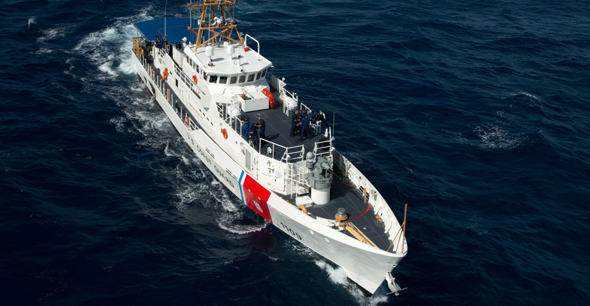
Photo: USCGC Adak, part of Patrol Forces, South West Asia, note extra machinegun mount behind the pilothouse. Click on the photo to enlarge.

Not long ago we talked about the need to preserve lessons learned from atypical (usually military) Coast Guard operations like participation in the Vietnam War or operations in South West Asia. Craig Allen Jr. brought to my attention a LANTAREA historian’s publication, “Guardians of the Gulf: A History of Coast Guard Combat Operations in Support of Operation Iraqi Freedom, 2002-2004” (pdf) by William H. Thiesen, PhD, June 2009

Regarding the deployment of WPBs the study noted, “Even though the Coast Guard served a similar mission in Vietnam, there existed no operational plan to provide guidance for OIF planning and preparations.

If the Coast Guard does not yet have a contingency plan for deployment of patrol vessels there is enough detail to make a fair start on a checklist of things to be done. The experience of the WPBs deployed to the Mediterranean can leave little doubt of the Webber Class’ ability to go almost anywhere, given time to avoid bad weather.

“On May 14, the five cutters (one 378 and four 110s–Chuck) began the return trip; however, this time the smaller cutters followed Dallas across the Atlantic rather than riding on board an MSC vessel. The 5,000-mile voyage set a record as the longest transit ever completed by a 110-foot cutter. The PATFORMED fleet had performed its escort and MIO mission admirably. Moreover, the WPBs in the Mediterranean and the Arabian Gulf had set records for hours of operation with some of them deploying for over thirty days of operation.”

For the future, there might be some advantage in organizing at least a few of the Webber class in deployable divisions (3 units) and squadrons (six units) as discussed earlier, with or without augmentation since there will be several location with three or more WPCs.

C4ISR Upgrades Unfunded, Impacting Operations–DHS IG

FierceHomelandSecurity is reporting that the DHS Inspector General has found reduced funding CG funding for C4ISR upgrades has had an adverse effect on operations.

The Homeland Security Department’s inspector general said these aircraft and ships will continue to rely on obsolete technology that will also cost more to operate and maintain. And the Coast Guard hasn’t addressed how and when it will implement these upgrades in revised plans…For example, some older cutters use surface search radar systems that contain almost two-decade old technology, which should’ve been replaced 10 years ago, the report said. In another example, the Coast Guard was planning to upgrade aircraft that use 1990s video and sensor technology to provide surveillance and other functions…”For example, Coast Guard personnel aboard one legacy cutter reported experiencing problems with a malfunctioning surface search radar system, including the need to reboot the system several times a day and system breakdowns while at sea,” the report said…The IG also said that certain aircraft system’s video and mission processor overloads and must be restarted, which could take 30 minutes, if operators try to update a common operating picture with large amounts of data.

US to Sell 8 “Global Response Cutters” (FRC-A?) to Pakistan. Webber Alternative?

Pakistan’s “TheNews” is reporting, “The State Department has made a determination approving a possible Foreign Military Sale to Pakistan for GRC43M Cutters and associated equipment parts training and logistical support for an estimated cost of 350 million.”

They are to be built by Westport Shipyard, Inc. (Westport, WA), a company best known as America’s largest yacht builder. We have seen an example of this 43 meter (143 foot) class before. They were demonstrated for the Coast Guard in 2011.

This composite construction vessel is closer to the original concept of the FRC than the Webber Class, and it appears that the cost is about three quarters that of the Webber class. Claims are also made of lower maintenance and longer hull life. They are also faster. Now that the initial contract for the Webbers has run its course, perhaps it would be a good time to reevaluate these as an alternative.

Thanks to Lee for bringing this to my attention.

“Cutter X” Revisited

L'AdroitStarbBow
Photo: French Patrol Vessel, L’Adroit, DCNS photo

Almost two years ago I made a proposal for an alternative fleet mix. Since then the cutter recapitalization program has moved along. Funding of the eighth and final National Security Cutter is expected in FY2015. 30 Webber class WPCs have been funded and the contract with Bollinger has run its course. The Administration has asked for funding of two more in FY2015. If the Congress does what they have done in the past the Coast Guard may get funding for as many as six.

Like the original post, the purpose here is to offer another possible cutter fleet mix that might be procured at the same cost as the “Program of Record” (POR) that would include approximately the same number of units but provide more large “cruising cutters”, eg, over 1000 tons (49 vs 33), while hopefully replacing the existing WMEC fleet earlier, avoiding the worst of the disastrous drop in the number of major cutters that appears likely in the 2020s, and providing more cutter days while requiring fewer or at least no more personnel than either the legacy fleet or the POR.

The original post was largely in response to a Department of Homeland Security study modeling the effectiveness of alternative fleet mixes, “Options for the Future USCG Cutter Fleet Performance Trade-Offs with Fixed Acquisition Cost,” by Alarik Fritz • Raymond Gelhaus • Kent Nordstromr (.pdf). My hope was to offer a better alternative that might be evaluated by a follow-on study.

What comes through loud and clear, from that study is that:
◾The Coast Guard need some ships with the capability to do boat and helicopter ops in State Five Seas particularly for operations in the Northeast and Alaska.
◾In the Southeast and West, where the primary missions are Drug Enforcement and Migrant Interdiction, we are a long way from a point of diminishing returns, that is, mission performance is directly linked to the number of cutters, effectiveness increasing in almost direct proportion to the number of cutters available.
◾The cutters’ ability to launch boats and helicopters in State Five conditions are much less important in the West and Southeast where most of the cutters are normally deployed.

Meanwhile the Coast Guard’s responsibilities continue to grow.

The concept of Cutter X was basically to take the equipment and crew of the Webber class and put them in a larger, higher endurance, more seaworthy hull and augment the crew only as necessary to deal with the additional endurance, the availability of two boats and helicopter and/or UAV operations. The original post provided several examples of similar ships, and since then I have posted another example. Basically the result is a relatively simple vessel, only a bit more sophisticated than a 210 but grown about 50% larger with the possibility of a hangar in addition to the flight deck. My presumption would be that these ships would rely more on shore based aircraft rather than an organic air search capability, meaning the tempo of air operations would be lower than for larger cutters. They might operate more frequently with UAVs rather than helicopters. In other words, a ship of about 1,500 tons, about half the size of the OPC, closer in size to a 270 than a 210 (but perhaps longer than the 270, L’Adroit at 1,450 tons full load is over 285 feet long), and about four times bigger than a Webber class WPC. Other characteristics I would expect are a speed of approximately 24 knots, a range of 5,000 miles or more, and an endurance of at least three weeks. Weapons would initially be limited to a single Mk38 mod2 25mm and crew served .50 cal.

L'AdroitHangar
Photo: L’Adroit, looking forward from the flight deck toward the superstructure and the hangar.

Basically my assumption was and is that the tradeoffs between ship typed would work something like this:

1 NSC = 2 OPCs = 4 “X” class = 12 FRCs

This equates to approx. prices of: $700M/NSC, $350/OPC, $175M/Cutter X, and $60M/FRC.

It is no longer possible to trade-off NSCs for X class cutters, so the new alternative mix would look like this:

8 NSCs, 15 OPCs, 26 “X” class, and 42 FRCs

This gives us as many vessels as the program of record (91), more “cruising cutters” capable of sustained distant operation (49 vs 33) including 23 ships (8 NSCs and 15 OPCs) that are capable operating boats and aircraft in sea state 5 for Alaska and the Northeast, and 15 OPCs with ice strengthened hulls for operation in the Arctic and potentially the Antarctic.

Like the previous post I’ll compare this possible fleet mix to the Coast Guard Fleet as it existed in 2000/2001 (which was larger than the existing fleet) and the fleet in the Program of Record (POR), on the basis of cutter days available and crewing requirements using both conventional and augmented crewing.

Crewing:

For the analysis below I have used the following as the personnel allowances for the new classes:
◾NSC 122
◾OPC 90 (still to be firmed up)
◾FRC 24 (includes two extra junior officers assigned to gain experience)

While some of the vessels cited in my previous post as comparable to Cutter X are crewed by as few as 30, which I will use as a lower limit, I believe the Coast Guard would use more, if only as an opportunity to provide more at sea experience. At most, the personnel allowance should not be more than that of the 210s. My figures may be out of date, but at least at one point that was a crew of 62. I’ll use this as the upper limit.

Cutter Days AFHP and Crew Requirements:

The 2000/2001 fleet: Theoretically the 2000/2001 fleet could have provided 8,140 cruising cutter days away from homeport (AFHP) (44 cruising cutters x 185 days) and would have required a total personnel allowance of 5,477 (1.49 cutter days/crew member).

The Program of Record: Without augmentation, the program of record would theoretically provide 6,105 cruising cutter days AFHP (33 cruising cutters x 185 days) and require a total personnel allowance of 4,618(1.32 cutter days/crew member).

With Augmentation (increasing their personnel allowance by a third and running the cruising cutters 230 days/year) the program of record would theoretically provide 7,590 cruising cutter days and require a total personnel allowance of 5,693 (1.33 cutter days/crew member).

Proposed Mix: Without augmentation, the proposed mix would theoretically provide 9,065 cruising cutter days AFHP (49 cruising cutters x 185 days) and require a total personnel allowance of between 4,114 (assuming a crew of only 30 for Cutter X, 2.2 cutter days/crew member) and 4,946 (assuming a crew of 62 for Cutter X, 1.83 cutter days/crew member).

With Augmentation (increasing the personnel allowance of the cruising cutters by a third and running them 230 days/year) the proposed mix would theoretically provide 11270 cruising cutter days AFHP (49 cruising cutters x 230 days) and require a total personnel allowance of between 5,150 (assuming a crew of only 30 for Cutter X, 2.19 cutter days/crew member) and 6,259 (assuming a crew of 62 for Cutter X, 1.80 cutter days/crew member).

What about the loss of FRCs? The proposal would trim 16 FRC from the POR. They are projected to operate up to 2500 hours per day. If we assumed that all 2500 hours were devoted to offshore cruising for the 16 additional units, that would add 1667 days AFHP to the POR for a total of 7,772 days AFHP for the un-augmented fleet (1.68 cutter days/crew member) and 9,257 days AFHP for the augmented POR (1.63 cutter days/crew member)(disregarding the 42 additional FRC that are included in both the POR and my proposed fleet mix).

In summary Cutter Days Available:
◾————————————–————–Un-Augmented———Augmented by 1/3
◾2000/20001 (cruising cutters only)—————–8,140———————N/A
◾POR (cruising cutters only)—————————6,105——————-7,590
◾POR (w/1,667 additional FRC day AFHP)——-7,772——————–9,257
◾Proposed Mix w/Cutter X (cruising cutters only)9,065—————–11,270

It looks like this alternative provides an improvement of at least 16.6% over the program of record, possibly as much as 48.5% depending on how you view the FRCs as a patrol asset. It appears that the un-augmented version gives virtually the same number of ship days away from homeport (within 2% assuming both we count the additional WPCs as cruising cutters and that the augmented ships provide 230 days AFHP. If they provide only 225 days AFHP even this small advantage goes away) as that of the augmented version of the program of record while requiring 13 to 28% fewer crewmembers (several hundred to over 1,000). And without the possibly problematic requirement for augmentation.

Is it doable? What is the timing? How would it effect with other programs?

The eight NSC should be essentially fully funded by the end of FY 2015. Thirty FRC are already funded. Funding twelve more to bring the total to the proposed 42 by the end of FY2017 would only require funding four per year, and might be done in only two years if Congress continues funding six a year, meaning funding for construction of X class cutters could begin in FY2018.

I think the funding could look something like this

————-OPC—X class
FY 2017—–1
FY 2018—–1——–1
FY 2019—–1——–1
FY 2020—–1——–1
FY 2022—–1——–2
FY 2023—–1——–3
FY 2024—–1——–3
FY 2025—–1——–3
FY 2026—–1——–3
FY 2027—–1——–3
FY 2028—–1——–3
FY 2029—–1——–3
FY 2030—–2——–0
FY 2031—–1——–0

The proposed mix funds 33 new generation large cutters by FY 2026, four years before the POM. The cutter X program would be fully funded in FY2029. Through FY2030, when the Program of Record is expected to be completed, it will have funded 48 new generation large cutters compared to the 33 new cutters of the Program of Record. In FY 2031 the proposal will add a 49th cutter. Since the X class cutters are nearer the size of existing cutters, they might also reduce the expense of modifying the shore establishment to support a larger number of OPCs. Additionally eliminating the requirement for augmentation will minimize new construction ashore to support the augmentation crews.

Other Considerations:

The proposed fleet mix has a pyramidal structure that may work well as a training ground for COs, e.g., assuming O-3s command the 42 Webber class (I know currently we have been using O-4s), O-4s command the 26 X class, O-5s command the 15 OPCs, and O-6s command the 8 NSCs.

Politically it is probably better for the Coast Guard to have two concurrent shipbuilding programs (OPC & X class) rather than just one, since that will normally lead to budgetary support from two Congressional delegations.

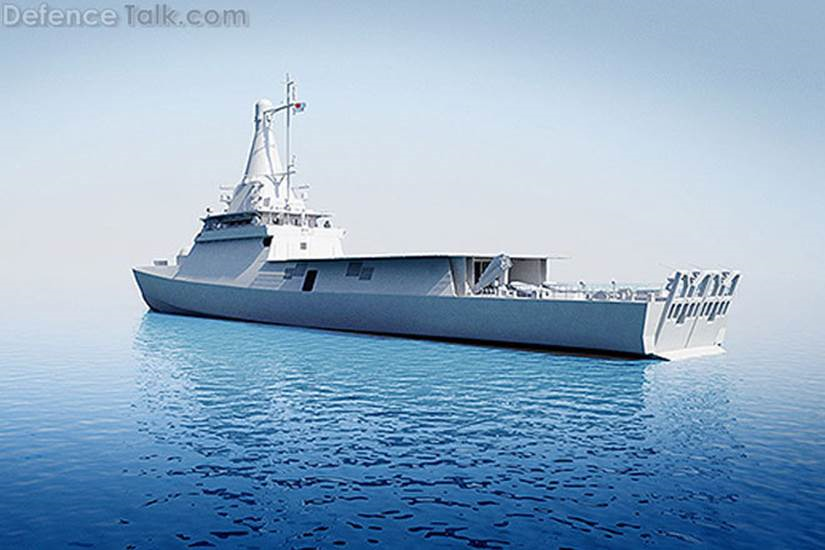
Singapore Builds “Cutter X”

SingaporeLittoralMissionVesselPortBow

Singapore is building a new class of patrol vessels that look very much like my proposal for “Cutter X”, trading some Webber class and some larger ships for an intermediate design, costing about half what an OPC would cost, basically putting the equipment and crew (with some augmentation) of a Webber Class into a larger more seaworthy hull, to allow them to be used for extended operation in environments that do not require the ice strengthened hull and ability to launch and recover helicopters and boats in sea state five provided by the OPC.

Singapore is building eight of the ships under the project name “Littoral Missions Vessel” to replace eleven smaller, 500 ton, Fearless class patrol vessels that are approaching 20 years old. These ships are reportedly 80 meters in length (262.5 feet), displace 1200 tons (probably a light displacement), have a beam of 12 meters (39.4 feet), a range of 5,000 nautical miles at 15 knots, and a speed of 27 knots, all with a crew of only 30, though they do include additional accommodations for 30 more. (more here)

SingaporeLittoralMissionVesselPortQuarter

It appears these ships will use the same engines as the Webber Class. It is not clear how many of these engines they are using. Two would give them almost 12,000 HP which would almost certainly be good for at least 24 knots, but it might require three or four engines to make 27 knots.  (reports now indicate the class has two engines totallin about 12,000 HP)

In some respects these ships are more capable than the proposed cutter, in that they will have a 76mm gun and firecontrol system, in addition to smaller remotely operated weapons. It also appears to have space reserved for a small AAW missile system. On the other hand, while the flight deck can handle an H-60, the ship, unlike the French L’Adroit which was my model for “cutter X”, has no helicopter hangar, although it might be possible to add one using the same solution employed on L’Adroit (putting it under the bridge).

Soon, I expect to do an update of the “Cutter X” proposal, based on where we are now in the cutter recapitalization program.

C4ISR Upgrades

The Coast Guard’s Acquisitions Directorate (CG-9) is reporting that

The Coast Guard awarded a $31 million contract to Lockheed Martin Aug. 21, 2014, to purchase equipment to upgrade the electronic systems known as C4ISR – or Command, Control, Communications, Computers, Intelligence, Surveillance and Reconnaissance – on three National Security Cutters and at the NSC C4ISR training facility.

This is part of a larger Command, Control, Communications, Computers, Intelligence, Surveillance and Reconnaissance Project.

“The C4ISR upgrade focuses on improving “interoperability,” or the ability of Coast Guard operating units to share information and coordinate operations with each other, with shore-based command centers and with other government agencies and allies. Other components will allow cutters (and aircraft?–Chuck) to send and receive tactical information including sensor, navigational and planning data to other U.S. military units as well as tactical sharing with international assets.”

“Features
•For NSCs, networked communications, radio direction finding and other capabilities to integrate with Navy battle groups and the broader U.S. government intelligence community
•For NSCs, HC-144As and HC-130Js, an advanced C4ISR suite that includes a common baseline across assets and transitions to an open architecture system of Coast Guard-controlled components with government software data rights
•The OPC’s C4ISR suite will be derived from the baseline used for NSC and other new platforms
•For in-service cutters, installation of commercial satellite communications and AIS
•For 378-foot and 270-foot cutters, Seawatch C2 system”

All well and good, but does it include Link 16? If so why not say so? If not why not? It seems to be very common and affordable. It is installed on boats smaller than the Webber class and on a wide range of aircraft including helicopters so it is certainly doable.

30mm Better Than 57mm?

The MK46 Mod 1 weapon system fires a round during a live-fire qualification exercise aboard the amphibious transport dock ship USS New Orleans (LPD-18). US NAvy Photo

The MK46 Mod 1 weapon system fires a round during a live-fire qualification exercise aboard the amphibious transport dock ship USS New Orleans (LPD-18). US NAvy Photo

The Navy has apparently made a decision I find incomprehensible. They have decided to alter the DDG-1000 design, replacing the two 57mm Mk110 mounts (the same gun on the Bertholf class and projected for the OPC) with two 30mm Mk 46.

According to the US Naval Institute News,

“The Navy has replaced two 57mm guns planned on the Zumwalt-class guided missile destroyer designed to fight off swarm boat attacks with a smaller pair of 30mm guns, Naval Sea Systems Command (NAVSEA) told USNI News on Monday.”

and later,

“A follow on 2012 assessment using the latest gun and munition effectiveness information, concluded that the MK46 was more effective than the MK110 CIGS. Based on that assessment, approval was received to change from the MK 110 CIGS to the MK 46 Gun System. In addition to the increased capability, the change from MK110 to MK46 resulted in reduction in weight and significant cost avoidance, while still meeting requirements. DDG 1000 is planned to have two medium range MK46, 30mm Close-in Gun Systems that will provide a robust rapid fire capability and increased lethality against hostile surface targets approaching the ship.”

The Mk 46 mount uses the Mk44 30mm chain gun that is derived from the same 25mm chain gun used in the Mk38 mounts. It looks like a small tank turret, but I understand it is not armored. It can be remotely controlled or manned by an on mount operator.

Comparing the two weapons,

Range of the 57mm is four or five times the range of the 30mm.
Projectile weight of the 57mm is about six times that of the 30mm.
Rate of fire is similar, 220 for the 57mm and 200 to 250 for the 30mm.

The only advantage I see for the 30mm is that it has more ready ammunition on the mount (not sure how much but apparently at least twice the number of rounds meaning it should be able to fire twice as long without reloading).

Guided Weapons–Getting Closer?

Lockheed Martin animation of Hellfire employment from an LCS

It looks like the Navy is beginning to field some weapons that are appropriate for the Coast Guard’s mission of preventing maritime terrorist attacks while addressing concerns that using weapons in US ports may cause collateral damage.

We talked about this concern recently.

I have always felt this mission had to devolve onto the smaller vessels, because the larger cutters don’t spend much underway time around US ports and when they are in port they usually cannot be gotten underway quickly. For this reason the WPCs need to be able to perform the mission.

Navy Recognition has news of progress on two of these systems, Dual Mode Hellfire and Dual Mode Brimstone.

The Longbow Hellfire is already present in the US inventory in large numbers and is being adopted for the LCS anti-surface module. The Brimstone is very similar in size, warhead, and range (about 8,000 yards), but has the advantage of a datalink that allows a “man-in-the-loop” which I think is desirable. Unfortunately, so far the USN is only looking at Brimstone as an air-launched weapon.

Test of Brimstone against two 40 foot maneuvering targets, discriminating between the targets and similar sized craft

Test of the Griffin. (Note limited damage)

A third system, SeaGriffin has a smaller footprint and warhead and has had a shorter range (only 43″ long, weighing 33 pounds, with a 13 pound warhead, surface to surface range of 5,500 meters), but it appears that the latest version may have a longer range, than either Hellfire or Brimstone, perhaps up to 18,000 yards (assuming they have, as reported, triple the previous range). The latest version of SeaGriffin does have a man-in-the-loop capability. Griffin is already being deployed on US Navy Cyclone class PCs. There are lots of photos showing the relatively small size of this system here.

I have never expected that extreme range was an important consideration for Coast Guard weapons, but for the anti-terrorism mission (or enforcing a blockade in wartime), we probably need the ability to engage from outside 4,000 yards (beyond the effective range of the 25mm Mk 38), because inside that range, there are a number of systems that might be added to a ship that could have a good probability of quickly disabling our vessels.

I still believe none of these weapons is capable of quickly and reliably stopping a medium sized ship or anything larger. For that I think we still need at least a light weight torpedo, but these weapons would significantly improve the chances against vessels of any size and particularly against small high speed maneuvering targets. Equipped with these, a Webber class cutter could be better able to fulfill this mission than a National Security Cutter with its 57mm guns.