“TEXTRON SYSTEMS AWARDED UNCREWED AIRCRAFT SYSTEM (UAS) CONTRACTOR-OWNED/CONTRACTOR-OPERATED CONTRACT FOR THREE LITTORAL COMBAT SHIPS (LCS) BY U.S. NAVY” –Textron Systems

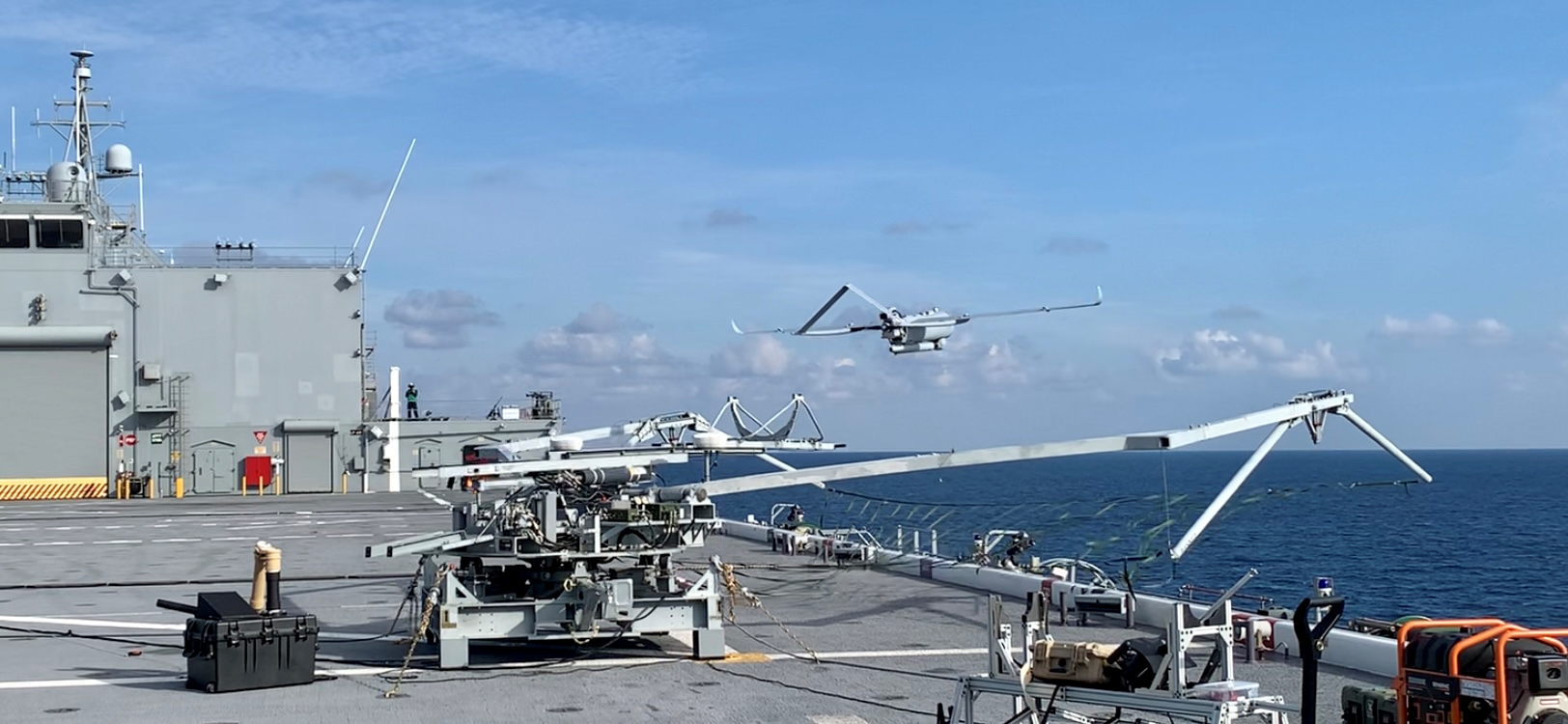
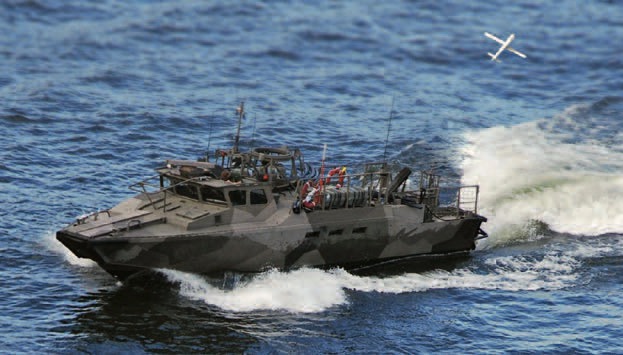
Aerosonde launch from USS Miguel Keith (ESB-5)

Below is a news release from Textron Systems.

It is not clear which version of Aerosonde is to be deployed on the LCSs. There are now hybrid quad versions that can take off and land vertically (see the video) without the supporting catapult and capture gear (top photo), but those with VTOL capability do sacrifice some endurance, speed, and payload as a result of greater weight and increased drag. It is likely the catapult launched version, which we know is on ESB-5, will also be used on the LCSs. Why did the Navy choose the Aerosonde over the Scan Eagle chosen by the Coast Guard? Let’s compare the two catapult launched UAS:

  • Type                                     Aerosonde Fixed Wing            Scan Eagle
  • Max Payload (pounds/kg):              20/9                                    11/5
  • Endurance (hours)                           14+                                     20+
  • Air Speed  (knots)                          45-65                                  60-80
  • Power (HP)                                        4                                        1.5

The Aerosonde’s only immediately apparent advantage is the greater payload. Perhaps the Navy has a sensor, or sensors that may be more capable but heavier that those included in the Coast Guard’s Scan Eagles, but if so, I can’t tell you what they are.

Incidentally, the payload capacity for the vertical takeoff and landing Hybrid Quad version of Aerosonde is 15 pounds, so it could presumably use the same sensor suite used on Coast Guard Scan Eagles.


AEROSONDE® UNCREWED AIRCRAFT SYSTEM (UAS) SUPPORTING SEVENTH U.S. NAVY SHIP WITH EXTENDED RANGE ISR SERVICES

Hunt Valley, Maryland, AUGUST 9, 2023 – Textron Systems Corporation, a Textron Inc. (NYSE:TXT) company, announced today that it has been awarded an initial contract valued at up to $19.5 million by the U.S. Navy’s Naval Air Systems Command (NAVAIR) to provide UAS operational support to two Independence Class LCS and one Freedom Class LCS variants. This award joins the Expeditionary Sea Base (ESB)-4 and ESB-5, as well as two DDG- class ships, bringing the total number of U.S. Navy ships supported by the Aerosonde® UAS system to seven.

Textron Systems will deploy its Aerosonde UAS to provide mission overwatch and extended intelligence, surveillance and reconnaissance (ISR) services with enhanced mission payloads as seen aboard the ESB-5.

“Contractor-owned/contractor-operated contracts like this support the Navy’s continued investments in uncrewed assets for their ships,” said Wayne Prender, Senior Vice President, Air Systems. “We’ve seen the benefits of our Aerosonde UAS for DDG and ESB- class ships already, and we’re honored to be expanding into this new ship class, allowing us to continue supporting maritime domain awareness and missions while delivering operational and logistical capabilities.”

The Aerosonde system continues to set the standard for mission readiness and ease of use, amassing more than 600,000 flight hours serving multiple U.S. customers and allies. It is designed for expeditionary land- and sea-based operations with both fixed-wing and vertical takeoff and landing (VTOL) options. Textron Systems has provided turnkey, UAS operations for customers around the world for more than 10 years.

NAVAIR Public Release 2023-538 Distribution Statement A – “Approved for public release; distribution is unlimited”

“Coast Guard detects 16 unauthorized drones during Seafair Weekend Festival” –CG News

Coast Guard members, in collaboration with the FAA, the Seattle Police Department (SPD), and Mercer Island Police Department (MIPD), employ Counter-Unmanned Aircraft Systems (UAS) capabilities to enforce the FAA-issued Temporary Flight Restrictions on Lake Washington during the 2023 Seafair Weekend Festival in support of the Airshow August 3, 2023. This was the first year Coast Guard Counter-UAS has been employed at Seafair. (U.S. Coast Guard courtesy photo)

Below is a news release from Coast Guard News.

We have seen counter UAS equipment added to the Webber class cutters in Southwest Asia, but this is the first time I have seen public acknowledgement of domestic counter UAS operations by the Coast Guard.

As a drone operator myself, I was happy to see that the effort was primarily educational, but the Coast Guard does need a robust domestic counter UAS capability for contingencies.


Aug. 9, 2023

Coast Guard detects 16 unauthorized drones during Seafair Weekend Festival

SEATTLE — The Coast Guard employed Counter-Unmanned Aircraft Systems (UAS) capabilities in collaboration with the Federal Aviation Administration (FAA), Seattle Police Department (SPD), and Mercer Island Police Department (MIPD) to enforce the FAA-issued temporary flight restrictions on Lake Washington during the 2023 Seafair Weekend Festival in support of the airshow.

This is the first year Coast Guard counter-UAS has been employed at Seafair.

The Coast Guard detected 16 UAS operators violating airspace restrictions during the H1 Unlimited Hydroplane Races and Boeing Air Show. Officers from SPD and MIPD were able to contact eight UAS operators and provide education on airspace restrictions as well as safe UAS operations.

One operator was cited for reckless endangerment by the Seattle Police Department.

“Unauthorized UAS can be extremely dangerous to airshow pilots, as well as spectators,” said Cmdr. Scott McGrew, the Coast Guard incident commander for SeaFair. “Our robust partnership with the FAA, Seattle Police and Mercer Island Police Department is vital to ensure unauthorized UAS operators are intercepted and educated on safe operations and reminded of the FAA Temporary Flight Restrictions in place to support the airshow.”

UAS operators are reminded to check tfr.faa.gov or the b4ufly app to verify the airspace is authorized for UAS flight.

UNITAS 2023

I had expected that at least some Coast Guard units would participate in UNITAS 2023, July 11-21, given the Coast Guard’s prominent role in 4th Fleet, but I find no mention of CG participation.

Also bit disappointed we don’t have a listing of non-US units participating too.

Below is SOUTHCOM’s summary of the event. The incorporation of unmanned systems should have been very interesting.


Overview

UNITAS is an annual exercise conducted in Atlantic and Pacific waters around Central and South America. UNITAS LXIV included maritime and amphibious phases and, for the first time ever, included integrated operations of unmanned systems in the exercise. The exercise was held July 11-21, 2023, in Colombia.

The exercise develops and sustains relationships that increase the capacity of our emerging and enduring partners’ maritime forces to achieve common desired effects.

Training Scenarios

UNITAS’ challenging training addresses key aspects of multinational and combined operations such as technology standardization and common operating procedures. Training included scenarios addressing electronic warfare, anti-air warfare and air defense, anti-surface warfare, live fire, maritime interdiction, littoral operations, and amphibious operations.

UNITAS LXIV consisted of two concurrent phases: at sea and amphibious. The maritime domain included the littorals which incorporates not only the ocean, but also the area inland from the shore that can be supported and defended directly from the sea. The majority of the amphibious training took place along the coast where marines and naval infantry trained in support of greater naval operations. The amphibious phase consisted of riverine operations and culminated in a landing from naval vessels.

Unmanned Systems training: In April the Secretary of the Navy and the Chief of Naval Operations announced that the Navy will scale unmanned systems to the fleet level by operationalizing unmanned systems in the U.S. 4th Fleet area of operations. Specific to UNITAS LXIV, the Navy deployed and exercised several unmanned systems to enhance maritime domain awareness, conduct battle damage assessment in support of the UNITAS LXIV live-fire sink exercise, or SINKEX, and integrate unmanned system operations with partner nation navies. The deployment of multiple unmanned systems is new to UNITAS but will become the standard as NAVSOUTH/4th Fleet takes lessons learned to inform the Navy’s hybrid fleet coming in the next decade. Additionally, the U.S. Marine Corps employed unmanned systems in support of its Force Design 2030 concept and will refine tactics, techniques, and procedures (TTPs) to inform the service on operational employment.

Women, Peace and Security Symposium: UNITAS LXIV featured a forum on the topic of women, peace and security. The forum is part of a global effort to support the contributions of women in the defense and security sectors around the world. The program is a cornerstone to SOUTHCOM’s mission of promoting security partnerships across the Western Hemisphere.

Participating Countries

UNITAS LXIV featured 20 participating countries: Belize, Brazil, Canada, Chile, Colombia, Dominican Republic, Ecuador, France, Germany, Honduras, Jamaica, Mexico, Panama, Paraguay, Peru, Spain, South Korea, United Kingdom, Uruguay, and the United States.

Participating U.S. Forces

  • USS New York (LPD 21)
  • USS Cole (DDG 67)
  • USS Little Rock (LCS 9)
  • USS Pasadena (SSN 752)
  • USNS Burlington (T-EPF 10)
  • Patrol Squadron Five (VP 5)
  • Mobile Diving and Salvage Unit (MDSU) 2
  • Explosive Ordnance Disposal Mobile Unit (EOD) 612
  • Mine Countermeasures Group 3 (MCMGRU 3)
  • Expeditionary Mine Countermeasures EOD Company 61 (EODMU 61)
  • Helicopter Sea Combat Squadron 22 (HSC 22)
  • Helicopter Maritime Strike Squadron 70 Detachment 2 (HSM 70 Det 2)
  • Joint Communications Support Element (JCSE)
  • Fleet Surgical Team (FST) Eight
  • Meteorological Environmental Team (MET)
  • 3rd Battalion, 23rd Marine Regiment (3/23)
  • 4th Amphibious Assault Battalion (4th AABn)
  • 8th Combat Logistic Battalion (CLB 8)
  • 4th Combat Engineer Battalion (4th CEB)
  • Marine Medium Tiltrotor Squadron 774 (VMM 774)
  • Marine Light Helicopter Attack Squadron 775 (HMLA 775)
  • Marine Aerial Refueler Transport Squadron 234 (VMGR-234)
  • Marine Aircraft Control Group – 48 (MACG-48)
  • Marine Fighter Attack Squadron 112 (VMFA-112)
  • Commander, Destroyer Squadron 40 (COMDESRON 40)
  • Commander, Amphibious Squadron Four (COMPHIBRON FOUR)
  • U.S Marine Corps Forces South (MARFORSOUTH)
  • Special Operations Command South (SOCSOUTH)
  • U.S. Naval Forces Southern Command/U.S. 4th Fleet
  • U.S. Southern Command (USSOUTHCOM)

Background

UNITAS I took place in 1960 with forces from Argentina, Brazil, Chile, Colombia, Ecuador, Peru, Uruguay, the United States, and Venezuela. This year marks the 64th iteration of the world’s longest-running annual multinational maritime exercise. Additionally, this year Colombia celebrated the bicentennial of its navy, a historical milestone commemorating 200 years of the country’s maritime forces.

“US Navy ‘operationalizes’ drones in 4th Fleet’s UNITAS event” –Defense News

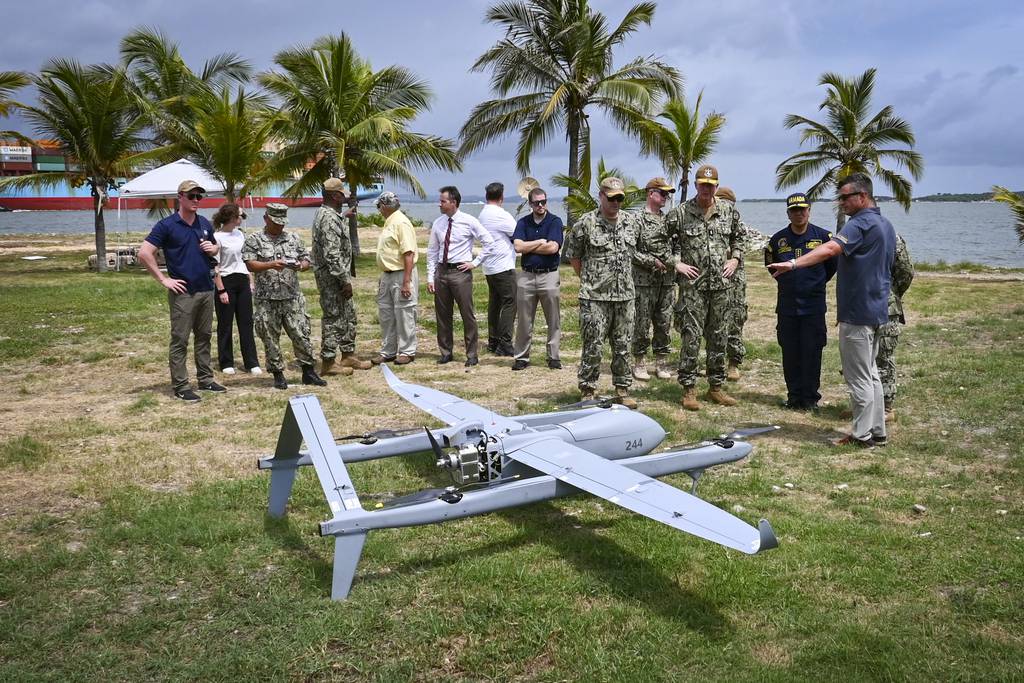
Personnel from the U.S. and Colombian navies attend a demonstration of Aerosonde MK4.7 Hybrid Quad drone during UNITAS on July 16, 2023. (MC1 Hunter Harwell/U.S. Navy)

Defense News reports,

“The U.S. Navy leveraged air and surface drones throughout its two-week UNITAS 2023 naval exercise near Latin America, the first major event since service leadership announced the region would host the sea service’s second unmanned operations hub.”

The Coast Guard certainly has an interest in 4th Fleet’s use of unmanned systems since their area of responsibility (AOR) includes the Eastern Pacific drug transit zones and the Caribbean.

Apparently, not all the systems are in place yet.

“Some of the same systems will return this fall for operations and exercises in the Caribbean and Eastern Pacific Ocean, he added.”

Importantly 4 Fleet is developing a “mesh network that compiles a detailed common operating picture of the region — then AI tools could help flag areas where potentially problematic activities are happening.”

Hopefully we will see video of the SINKEX as recorded by the UAS.

“Our Best Look Yet at the Marines’ New Loitering Munition Toting Drone Boat” –MSN

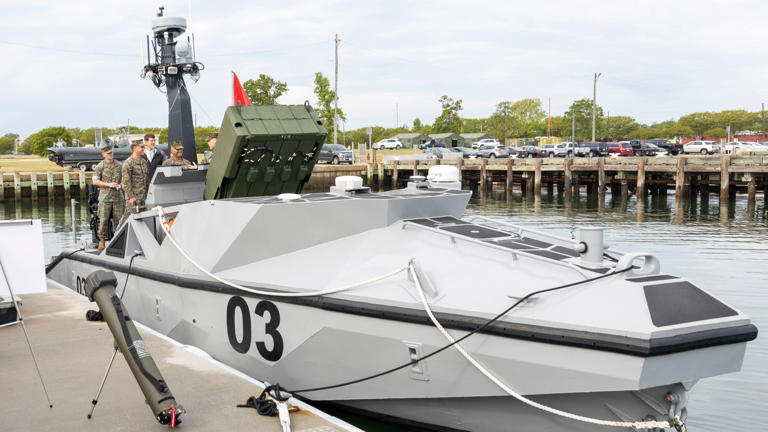
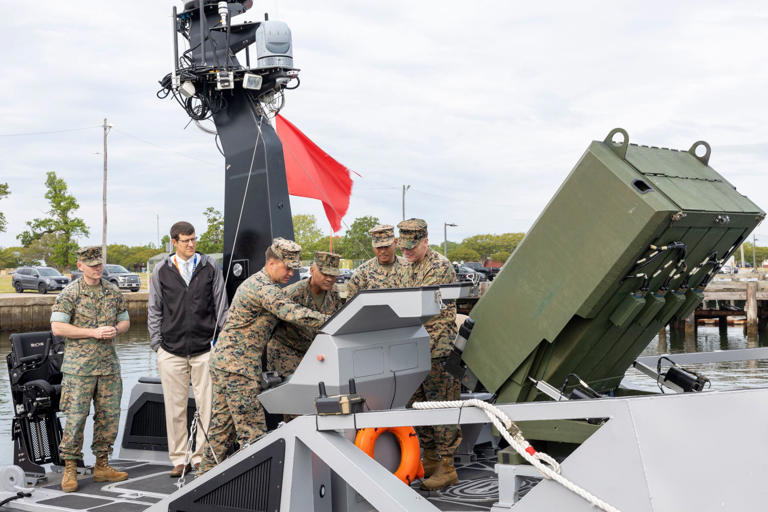
HERO 120 launcher on Long Range Unmanned Surface Vessel (LRUSV)

We talked about the HERO 120 loitering munition before. I noted it might be just what the Coast Guard needs to deal with the potential threat of small, fast, highly maneuverable craft.

While man portable single round launchers are probably all Coast Guard units might need (other than perhaps Bahrain based PATFORSWA Webber class cutters), we now have photos of an eight-cell launcher mounted on a Metal Shark optionally manned 40-foot, Long Range Unmanned Surface Vessel (LRUSV).

The Hero 120 is the largest offering in UVision’s “tactical” line of loitering munitions, weighing around 27 and a half pounds, including a 10-pound warhead. It uses an electric motor to drive a propeller at the rear and has a maximum endurance of around 60 minutes.

U.S. Marine Corps Lt. Gen. Brian W. Cavanaugh, the commanding general of Fleet Marine Force, Atlantic, Marine Forces Command, Marine Forces Northern Command, and Marines with 3d Marine Littoral Regiment, 3rd Marine Division, examine the manual controls to the Long Range Unmanned Surface Vessel, Joint Expeditionary Base Little Creek-Fort Story, Virginia, April 27, 2023. A LRUSV is an optionally manned vessel capable of extended travel and transporting loitering munitions that accurately track and destroy targets on sea or land. Metal Shark is designing, building, testing and implementing the LRUSV system under another transaction authority agreement with Marine Corps Systems Command to primarily serve as an intelligence, surveillance, and reconnaissance platform.
© Provided by The Drive

While it looks increasingly likely this system will become common in the Navy/Marine Corps inventory, it is perhaps important to remember that this eight-round launcher is not necessary to launch these. Loaded single round launchers are small enough to be man portable and would impose no heavy loads on the platform at launch. Certainly, some training would be required, but they could be stored in a group, station, or ship’s armory and be issued when needed.

“Coast Guard signs strategic plan for unmanned systems” –MyCG

MyCG reports the completion of a Coast Guard UxS Strategic Plan,

“,,,the Coast Guard will find ways to use unmanned systems to improve our mission execution. Second, the Coast Guard will prepare to defend against threats from unlawful use of unmanned systems. Finally, the Coast Guard must establish and enforce a regulatory framework for the safe and lawful use of unmanned systems and automation in the Marine Transportation System.”

Using Unmanned air systems (UAS) and surface systems (USV) for increased Maritime Domain awareness is a no brainer.

Unmanned systems will certainly impact crewing requirements for the marine transportation system, with things like remote watch standers, market forces will make that happen.

The most challenging part of this will be “to defend against threats from unlawful use of unmanned systems.” This should include criminals, terrorists, and malevolent state actors.

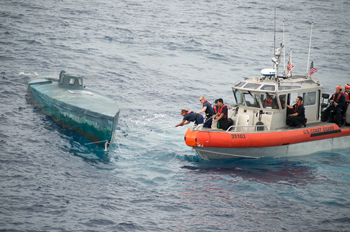
A team aboard Coast Guard Cutter Stratton’s long range interceptor-II cutter boat participates in the interdiction of a self-propelled semi-submersible vessel in the Eastern Pacific Ocean July 18, 2015. U.S. Coast Guard photo by Petty Officer 2nd Class LaNola Stone.

For criminals, shipping drugs without using crewmembers that might provide intelligence on their operations if captured, has to seem like a good idea.

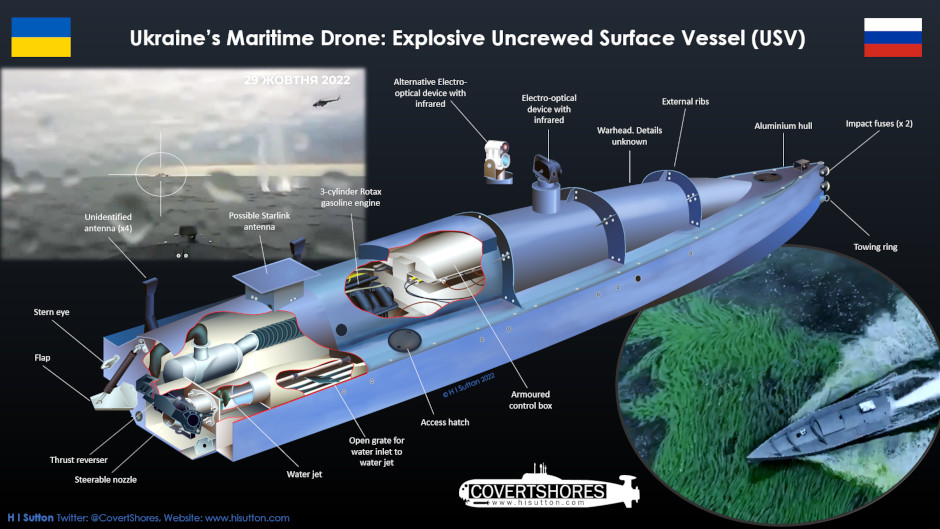
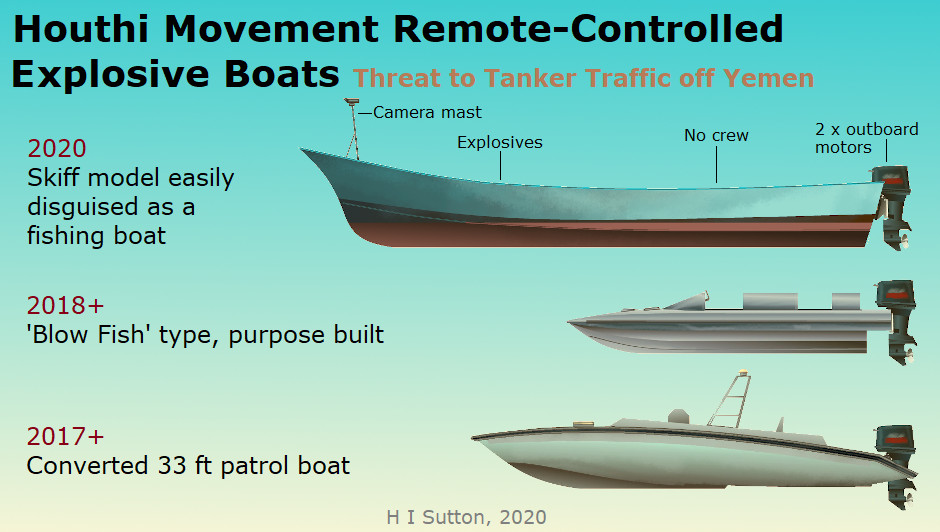
The wars in Yemen and Ukraine have already shown us what terrorists or a nation state might do with unmanned surface vessels.

The US Navy and many others are working on unmanned undersea vehicles (UUVs) as weapons platforms.

Snakehead Large Displacement Unmanned Undersea Vehicle (LDUUV)

Will the Coast Guard include countering UUVs as part of its mission?

Will this prompt a return of the Coast Guard’s ASW mission?

It’s likely unmanned surface vessels will be required to counter unmanned undersea vessels.

“Video: Interview With VADM Cooper On TF 59 Milestones, US 5th Fleet” –Naval News

Naval News provides a video of an interview with 5th Fleet/NAVCENT commander VAdm Charles Bradford (Brad) Cooper II. In addition to the video above, the Naval News post provides a transcript of the interview (always appreciated).

The video provides more than talking heads. There are snippets of video showing the operation of unmanned systems and the people mentioned.

PATFORSWA Webber class cutters show up in the video three times.

Task Force 59 is an exciting development. It appears likely this model will be replicated in other areas including with the 4th Fleet in the Drug Transit Zone. Hopefully the Coast Guard is taking the opportunity to learn as much as possible from these operations. If the Coast Guard does not have a Coast Guard R&D liaison to Task Force 59 we are missing a good bet.

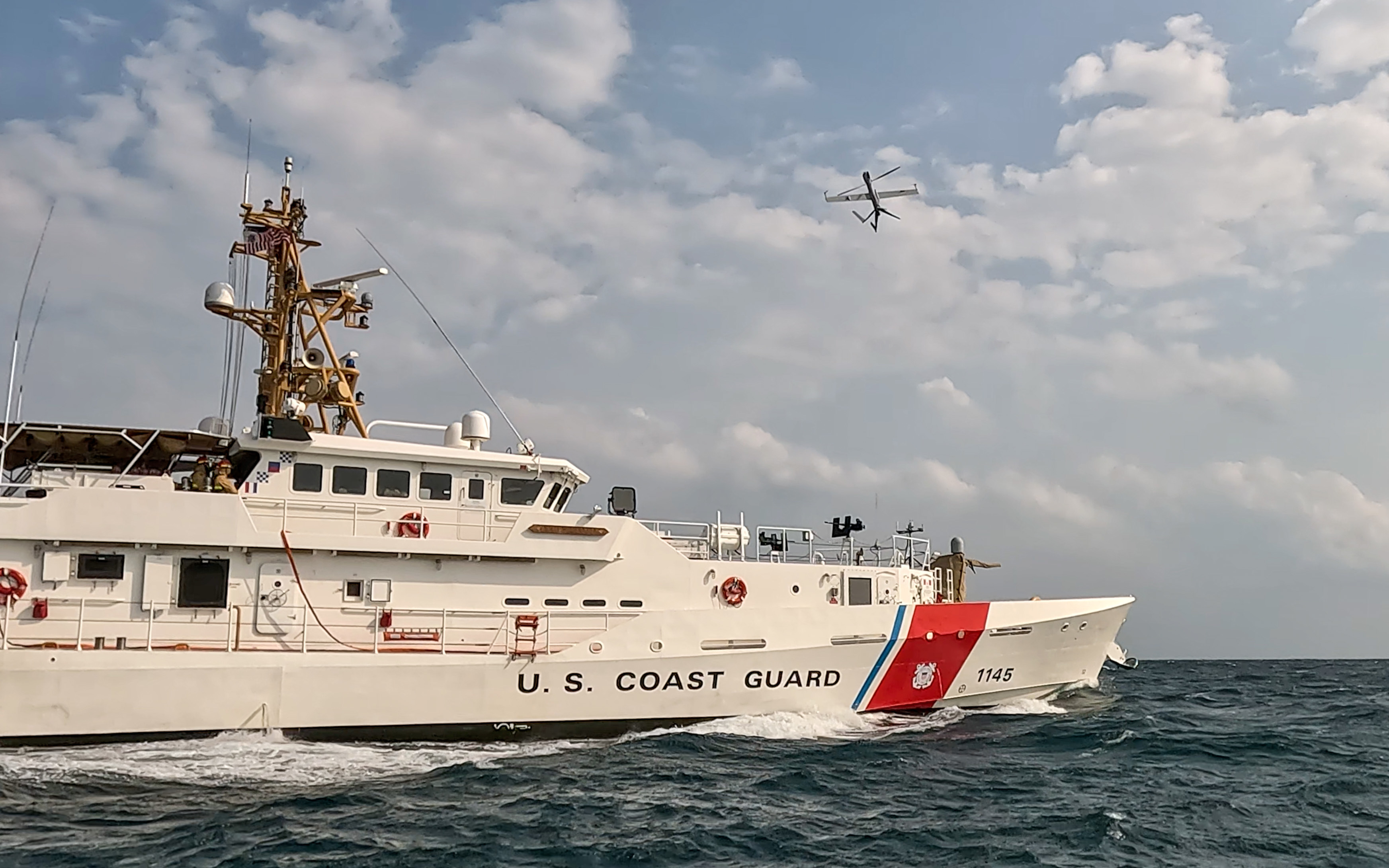
221207-N-NO146-1001 ARABIAN GULF (Dec. 7, 2022) An Aerovel Flexrotor unmanned aerial vehicle (UAV) takes off from U.S. Coast Guard fast response cutter USCGC Emlen Tunnell (WPC 1145) transiting the Arabian Gulf, Dec. 7. U.S. 5th Fleet’s Task Force 59 launched the UAV during Digital Horizon, a three-week event focused on integrating new unmanned and artificial intelligence platforms, including 10 that are in the region for the first time. (U.S. Navy photo)

Related:

“The More ‘Eyes On The Water’, The Better” –Marine News

221207-N-NO146-1001 ARABIAN GULF (Dec. 7, 2022) An Aerovel Flexrotor unmanned aerial vehicle (UAV) takes off from U.S. Coast Guard fast response cutter USCGC Emlen Tunnell (WPC 1145) transiting the Arabian Gulf, Dec. 7. U.S. 5th Fleet’s Task Force 59 launched the UAV during Digital Horizon, a three-week event focused on integrating new unmanned and artificial intelligence platforms, including 10 that are in the region for the first time. (U.S. Navy photo)

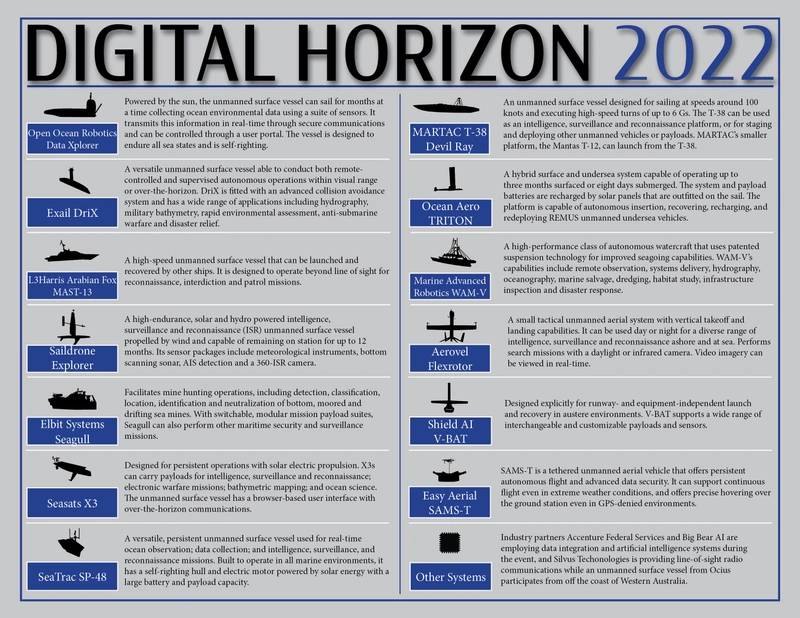
Marine News has an interesting story that discusses both PATFORSWA’s operations using the recently arrived Webber class WPCs and the recent Digital Horizon 2022 exercise. There is also a bit of a tie in between the two in that at least one WPC was operating as part of Task Force 59, the 5th Fleet element charged with operating unmanned systems. We have heard a bit about the exercise before, but the list of participants in the graphic below seems particularly revealing.

Graphic illustration depicting the unmanned systems that participated in exercise Digital Horizon.

“Task Force 59 Launches Aerial Drone from Coast Guard Ship in Middle East” –NAVCENT

221207-N-NO146-1001 ARABIAN GULF (Dec. 7, 2022) An Aerovel Flexrotor unmanned aerial vehicle (UAV) takes off from U.S. Coast Guard fast response cutter USCGC Emlen Tunnell (WPC 1145) transiting the Arabian Gulf, Dec. 7. U.S. 5th Fleet’s Task Force 59 launched the UAV during Digital Horizon, a three-week event focused on integrating new unmanned and artificial intelligence platforms, including 10 that are in the region for the first time. (U.S. Navy photo)

Below is a December 07, 2022, news release by U.S. Naval Forces Central Command / U.S. 5th Fleet Public Affairs.

To me this is really exciting news. The Webber class has been doing some great work at surprising long distances, performing most of the functions of a medium endurance cutter. Their primary weakness as a patrol ship has been the lack of an organic search aircraft. I assume this UAS is operating from the area on the O-1 deck forward of the bridge that had been designated for vertical replenishment.

This from Aerovel, maker of the Flexrotor (follow the link for dimensions and performance),

Boasting a flight endurance of more than 30 hours and a 120-kilometer communications range, this all-weather aircraft has operated in some of the harshest conditions on earth. Flexrotor is excellent for expeditionary missions. Needing only a 20’ by 20’ area for launch and recovery, it takes off and lands vertically and easily transitions into horizontal wing-borne flight. The STUAS flies completely automatically after takeoff, with no pilot intervention needed. Flexrotor quickly assembles for flight and can be boxed and stowed in minutes by a single person.

The Flexrotor is, in most respects, in the same class as the Scan Eagles that are currently being deployed on National Security Cutters. It is not as fast as Scan Eagle but apparently comparable or greater endurance and requires no launch or recovery equipment. These systems may actually constitute an improvement, compared to searches by manned helicopters, because of their much greater endurance and sensors like the VIDAR used on Coast Guard Scan Eagle UAS..


Task Force 59 Launches Aerial Drone from Coast Guard Ship in Middle East

By By U.S. Naval Forces Central Command / U.S. 5th Fleet Public Affairs | December 07, 2022

MANAMA, Bahrain —

A U.S. Navy unmanned task force in the Middle East launched an aerial drone from a U.S. Coast Guard vessel operating the Arabian Gulf, Dec. 7.

U.S. 5th Fleet’s Task Force 59 launched an unmanned aerial vehicle (UAV) from USCGC Emlen Tunnell (WPC 1145), marking a first for the task force with a U.S. Coast Guard vessel since the task force’s establishment in September 2021.

The launch also demonstrated close collaboration between the U.S. Coast Guard and Task Force 59 as U.S. 5th Fleet rapidly integrates unmanned systems and artificial intelligence to enhance monitoring of regional waters.

Task Force 59 is conducting Digital Horizon, a three-week event focused on integrating new unmanned and artificial intelligence platforms, including 10 that are in the region for the first time.

“Each day during Digital Horizon we have pushed to discover new capabilities, fast,” said Capt. Michael Brasseur, commodore of Task Force 59. “I am so proud of the team for their steadfast commitment to not only imagine new possibilities, but to deliver them.”

An Aerovel Flexrotor successfully took off and landed vertically aboard Emlen Tunnell, showcasing close collaboration between Navy, Coast Guard and industry partners to advance technology integration.

“We are so excited to be part of Digital Horizon and play a critical role by helping integrate new technologies into the fleet,” said Lt. Patrick Kelly, Emlen Tunnell’s commanding officer. “I am so proud of the crew for their dedication, commitment and professionalism, which made today’s success possible.”

The Flexrotor can support intelligence, surveillance and reconnaissance (ISR) missions day and night using a daylight or infrared camera to provide a real-time video feed.

In addition to providing ISR capability, UAVs like the Flexrotor enable Task Force 59 to enhance a resilient communications network used by unmanned systems to relay video footage, pictures and other data to command centers ashore and at sea.

U.S. 5th Fleet established Task Force 59 more than 14 months ago. Since its launch, the task force has deployed a suite of new unmanned systems while integrating artificial intelligence at operational hubs in Jordan and Bahrain.

Emlen Tunnell is one of the Coast Guard’s newest Sentinel-class fast response cutters forward-deployed to Bahrain where U.S. 5th Fleet is headquartered. The ship helps ensure maritime security and stability across the Middle East.

Portugal to Build a New Type of Ship–UxS Carrier

The “plataforma naval multifuncional” (multifunctional naval platform). Portuguese Navy image.

It is not often an entirely new category of ship emerges, but this seems to be the case. Perhaps it was inevitable, but it looks like the Portuguese may be the first to make it happen–a specialized, built for purpose, unmanned systems mothership.
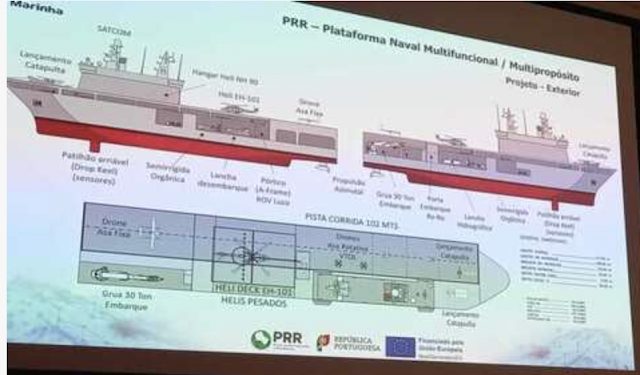
Wish the specs in the lower right above were readable. 

First heard about this ship from Cdr. Salamander. He has some interesting ideas about how such a ship could be used. It is part research ship, part disaster response vessel, and, significantly for the Coast Guard, part Offshore Patrol Vessel. There is more about the ship from Naval News. It is not particularly large, with a crew of about 90 and accommodations for another 100. The cost is reportedly about $100M US, much less than the cost of the Offshore Patrol Cutter. Judging by the size of the helicopter (reportedly an NH-90) on the model, it appears to be 100 to 110 meters (328-360 feet) in length, about the length of the OPC, maybe less. It must be pretty broad if that is an MQ-1C Gray Eagle on the deck. The Span of the Gray Eagle is 56 ft (17 m), but it just does not look like it is in scale. Maybe they have a European sourced UAS in mind. Beam looks to be about 20 to 22 meters based on my presumptions about the length, that is 66 to 72 feet. Those proportions are similar to those of the 6,615 ton Canadian Harry DeWolf class Arctic Offfshore Patrol Ship, 103.6 m (339 ft 11 in) long and a beam of 19 m (62 ft 4 in). By comparison, the beam of both the NSC and OPC is 16m or 54 feet.

The thing that makes this ship totally unique is the runway and ski-jump designed expressly for fixed wing unmanned air systems.

Artist rendering of MQ-9B STOL landing on a big-deck amphibious assault vessel. Photo: Courtesy of General Atomics Aeronautical.

What might make this very useful is the newly developed STOL version of the MQ-9B with shorter span, high lift, folding wings.

Not sure I like this particular design. It is not clear how many UAS and helicopters can be carrier or if there is hangar space. The island is unnecessarily thick and looks too far forward. No indication of speed or endurance. The speed in unlikely to exceed 20 knots, between 16 and 18 knots seems likely, but the concept is novel. Look forward to seeing the ship in final form.

Late Addition: 

After posting this on Facebook, I got some additional information. This is a Google translate from Portuguese. Thanks to Pedro Mateus.

MULTI-PURPOSE PLATFORM SHIP Lisbon, Portugal June 20, 2022 On June 20, 2022, the Portuguese Navy launched a tender limited by simplified prior qualification, via procedure no. of a Multipurpose Vessel/Platform (N-PM), with an execution period of up to 3 years (with delivery until December 2025), for a base price of 94.5 million Euros.

This Multipurpose Ship/Platform (N-PM) will have a total length, between perpendiculars, of 100 meters, a maximum beam (at flight deck level) of 20 meters and a maximum draft of 7.5 meters. It will follow STANAG 4154 (Ed 3) standards and will be able to maintain the operation of lowering and hoisting vessels in sea state 5 on the Douglas Scale. Its garrison will be composed of 1 commander, 7 officers, 8 sergeants and 29 soldiers, in a total of 45 elements. It has accommodation sized up to 28 officers, 30 sergeants and 32 enlisted men, for a total of 90 elements (in addition to the commander). It will be dimensioned for a range of 45 days at a cruising speed of 10 knots.

The N-PM shall comprise a set of aviation facilities including, among others, a flight deck (a ski-jump runway, a spot for helicopter operation, with lighting system, GPI, etc.), hangar for a helicopter (with support for hydraulic maintenance stations, overhead crane, technical lighting, etc.) and a hangar for unmanned aircraft. In terms of organic helicopter, it should support the Lynx MK95A and NH90 aircraft (either in “spot” or in hangar) and EH101 (“spot”). The flight deck must allow the operation of different types of unmanned aircraft, commonly known as “drones” (Ogassa OGS42, Tekever AR3, etc.), as well as all the support required for vertical refueling operations (VERTREP).

Within the scope of semi-rigid vessels, the N-PM will have 3 vessels: a vessel with
SOLAS (“Safety of Life at Sea”) certification for operation as “Fast
Rescue Boat”, with a power of not less than 250 hp; and two non-cooperative approach vessels, with capacity for 8 equipped soldiers, with a maximum speed of 35 knots or higher and a minimum autonomy of 60 nautical miles, for inspection missions , policing, combating drug trafficking, assault and support for a small embarked force.

Following the good practices and installation and operation recommendations of the “Alliance of European Research Fleets” (EUROFLEET), in terms of support systems for scientific research, the N-PM will be designed to be able to operate subsurface Unmanned Vehicles (VENTs) and remotely operated vehicles – “Remotely Operated Vehicle” (ROV). It will have a sensor pavilion (“drop keel”) for the installation of scientific and acoustic sensors; a large volume “Rosette” CTD system (for deep water sampling, with probe capable of operating up to 6,000 m); an MVP system, “Moving Vessel Profiler”, capable of operating up to 700 meters deep with the ship sailing at 8 knots; an “Acoustic Doppler Current Profiler” (ADCP); a “Global Acoustic Positioning System” (GAPS), capable of operating up to 4,000 meters deep. In addition to these organic systems, the N-PM will have the capacity and integration for several other non-organic systems (Piston Corer – Calypso, Vibrocorer, Box Corer, Multi Corer, etc.) as well as all operating and support winches.

Under an integrated architecture of command and control, platform management, and digital information processing and management systems, this N-PM will have a set of navigation systems (IBS, DDU, TACAN, Secure GPS, etc.), with navigation radar surveillance systems, combined warning radar (ARPA capability, “Automatic Radar Plotting Aid” and IMO certification; ECM and Anti-Jamming) and IFF/W-AIS identification systems, as well as underwater surveillance systems (bathythermograph; support for XBT/XSV probe used in the Navy (XBT4, XBT5, XBT7 and MK-8 XBT/XSV) or CTD type probes). In terms of external communications, it will have, among others, satellite communication systems SATCOM and MILSATCOM, GMDSS, submarine telephone, SART, EPIRB and ICCS.

In terms of armament, the N-PM will be equipped, at least, with 4 “softmounts” for a Browning M2 .50 heavy machine gun, with a firing range limiter and respective accessories, and a base, with ballistic protection for the Browning part and respective operator; and with 2 pieces of Hotchkiss salvo. The N-PM will be equipped with magazines and armories capable of storing various portable weapons, ammunition, pyrotechnic material and demolition material and respective detonators.

Technical drawing and 3D model via the Portuguese Navy Ships Directorate
Editing and composition by “Espada & Escudo”