“U.S. Blames Iran for Drone Attack on Tanker Near Oman” –USNI

Shahed 136 drones. Iranian military photo

US Naval Institute’s News Service reports,

U.S. Central Command and Israeli officials are blaming Iran for a Tuesday attack on an oil tanker linked to an Israeli billionaire off the coast of Oman.

Tanker Pacific Zircon was 150 miles off the coast of Oman when what U.S. officials said was an unmanned aerial vehicle hit the ship at about 3:30 p.m. local time, according to the shipping company.

Interestingly this second attack was on a ship linked to Idan Ofer, brother of the Israeli billionaire, Eyal Ofer, linked to the tanker, Mercer Street, attacked in a similar manner in July 2021.

The latest attack did not result in any injuries, unlike the earlier attack that resulted in the death of two crewmembers. Both attacks occured South of Oman in the Northern Indian Ocean.

“USS Jackson Deployment Used Manned/Unmanned Teaming with Fire Scout, Seahawk” –Seapower

SOUTH CHINA SEA (May 19, 2022) An MH-60S Sea Hawk and MQ-8C Fire Scout unmanned aerial vehicle, assigned to Helicopter Sea Combat Squadron (HSC) 23, conduct concurrent flight operations as a manned-unmanned team (MUM-T) while embarked on the Independence-variant littoral combat ship USS Jackson (LCS 6). Jackson, part of Destroyer Squadron (DESRON) 7, is on a rotational deployment, operating in the U.S. 7th Fleet area of operations to enhance interoperability with partners and serve as a ready-response force in support of a free and open Indo-Pacific region. (U.S. Navy photo by Lt. j.g. Alexandra Green)

The Navy League’s on-line magazine, Seapower, reports,

The USS Jackson, based in San Diego, deployed on July 11, 2021, to the Western Pacific for 15 months in support of the Oceania Maritime Security Initiative (OMSI). Both the ship’s Blue and Gold crews each participated in two on-hull patrols during the deployment, which took the LCS to the South China Sea and Oceania. The Jackson, with a Coast Guard law-enforcement detachment embarked, operated with the armed forces of Brunei, France, Germany, Indonesia, Thailand and Japan, and made port calls to several island nations including Palau, Tahiti and Fiji. The ship returned to its homeport on Oct. 15, 2022.

We did employ the manned/unmanned teaming tactic and concept with our aviation detachment from Helicopter Sea Combat Squadron 23 Detachment 6. We executed that approximately one dozen times and we saw over 100 hours of MQ-8C operations while deployed to the 7th Fleet area. While conducting those manned/unmanned teaming operations what we found was that having an unmanned aircraft that had many capable sensor payloads was really a force multiplier that we could use to develop our recognized air and maritime picture beyond the horizon while using the MH-60S to conduct positive identification of things that we detected with the MQ-8C.

Looks like USS Jackson was doing some useful work, but–

This was a 15 month deployment. 461 days by my calculations so, “over 100 hours of MQ-8C operations while deployed to the 7th Fleet area” does not really sound that impressive, not compared with the extended endurance we are told UAS can do (15 hours max for the MQ-8C). Does it mean they only launched 12 time in 15 months?
I think the Coast Guard can get about 100 hours flight out of a single H-65 in a typical 60 day patrol. We used to do two two hour flights a day with some regularity. I have not seen how much search time we are getting out of the Scan Eagles on the National Security Cutters, but it should be a lot more than that.
There was no indication that the Fire Scout was used for anything other than surface search,
While conducting those manned/unmanned teaming operations what we found was that having an unmanned aircraft that had many capable sensor payloads was really a force multiplier that we could use to develop our recognized air and maritime picture beyond the horizon while using the MH-60S to conduct positive identification of things that we detected with the MQ-8C.
Seapower also recently reported, “Navy to Consolidate Fire Scout UAVs on West Coast,” which indicated that of the three detachments currently operating MQ-8s, the LANTFLT detachment will be de-activated, while the one of two PACFLT Fire Scout detachments that still operates the “B” model will upgrade to the “C” model. The report went on to report, “Currently, there are no plans to expand Fire Scout operations to other helicopter sea combat (HSC) squadrons.”
That indicates to me, that the Navy is not all that enthusiastic about Fire Scout. Though they are certainly planning to continue to pursue unmanned systems. Presumably it has been a “learning experience,” but it does not look like Fire Scout, in its present form, will be a growing program.


“Schiebel Teases New Camcopter S-300 UAV At Euronaval” –Naval News

Camcopter S-300 compared to the S-100 (image from company brochure).

Naval News reports Austrian company Schiebel is building a larger version of their widely used Camcopter S-100 to provide greater endurance and payload.

Regarding the technical specifications, according to Schiebel, the UAS is 4.8 meters long, 1.9 meter high and 0.9 meter wide. It can fly at a maximum speed of 120 knots (cruising speed 55 knots). Size apart, the true difference compared to the S-100 system is the payload capacity. Indeed the S-300 is able to carry up to 340 Kg (fuel including) and its maximum take-off weight can reach 660 Kg. This is basically three times more compared the S-100 can carry. With a 50 Kg payload, the S-300 can fly up to 24 hours (4 hours with 250 Kg).

The 660 kg max takeoff weight (TOW) compares to a 3,150 lb (1,430 kg) Max TOW for the MQ-8B Fire Scout and 6,000 lb (2,721 kg) for the larger MQ-8C Fire Scout.

The French Navy’s VSR 700 UAV mentioned in the last paragraph as a competitor for the S-300 was discussed here.


Coast Guard Los Angles Looks at MQ-8C

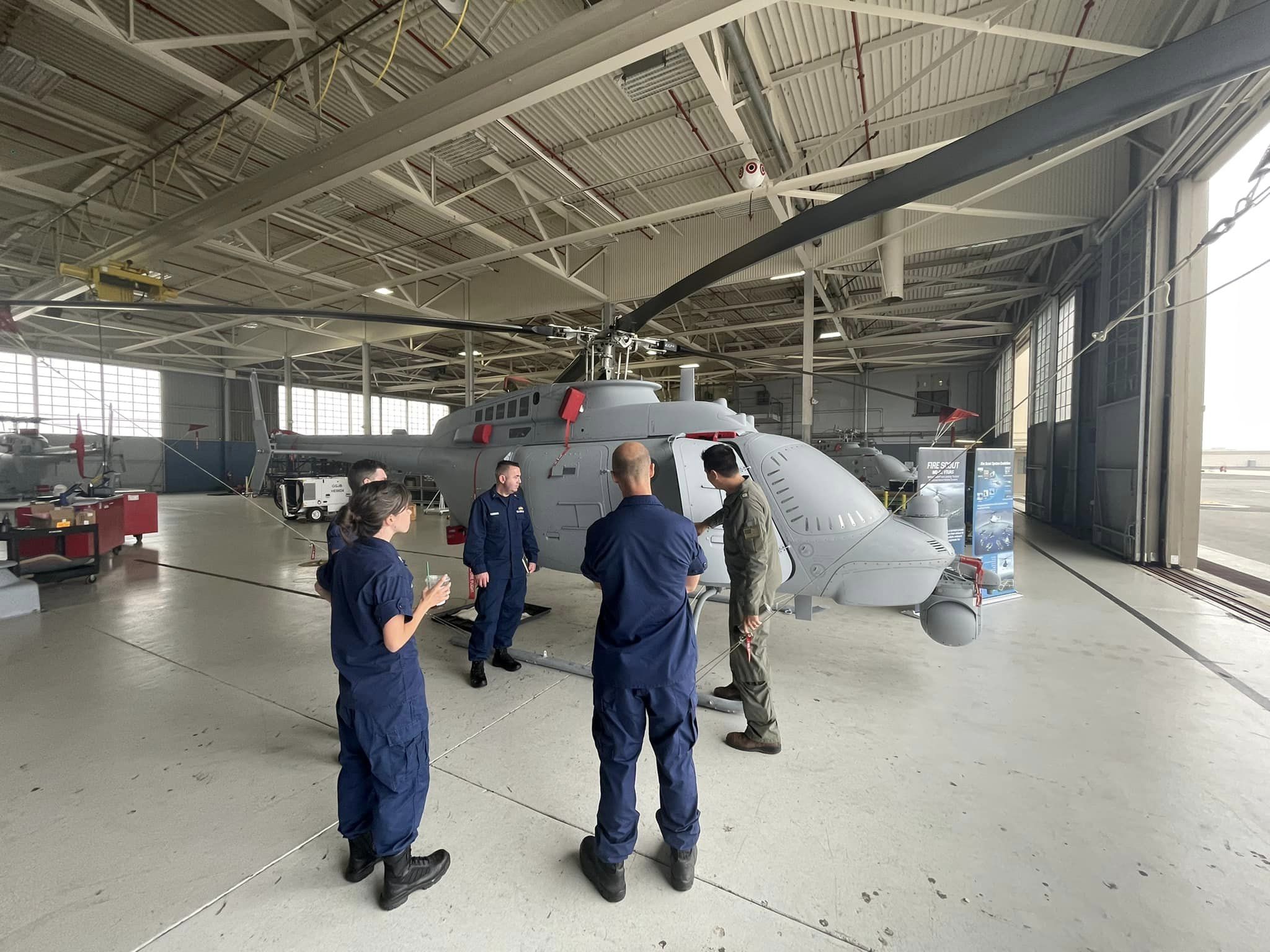
Picked this up off the Coast Guard Aviation Association’s Facebook page. A post by U. S. Coast Guard Los Angeles.

Today, members from Sector Enforcement travelled to Naval Base Ventura County at Point Mugu, Calif. to discuss the possible use of Unmanned Aerial Vehicles to support Coast Guard missions. Pictured is the Navy’s MQ-8C Fire Scout, an unmanned helicopter used for intelligence, surveillance, and reconnaissance.

Is the Coast Guard looking to buy MQ-8C? It is not unlikely, the Navy wants to exercise these assets in an operational environment. Cutters doing drug interdiction are almost perfect for them. This is more likely looking at an opportunity for a Navy Detachment to deploy with a cutter than that the Coast Guard is looking to buy MQ-8C.

The MQ-8C should be able to search a much larger area than the Scan Eagles we are using now. The four National Security Cutters in Alameda have room for one of these in addition to an H-65 and Scan Eagle. There are also two WMEC 210 on the West Coast that might use these, but I would expect to see Scan Eagle on the WMECs before Fire Scout, but it is a possibility.

The First two OPCs are coming to San Pedro, hopefully, beginning next year. They also have ample aviation space, so perhaps they are a possibility as well.

This could be a win-win.

How Much Do Those Drones Cost?

The Coast Guard is equipping its National Security Cutters with Scan Eagle Unmanned Air Systems (UAS), but has yet to buy the systems. The deployed systems are contractor owned and operated. Should the Coast Guard decide to buy these systems we have a rough indication of the going rate. The RQ-21, referred to in the contract reported below, are similar in concept to the Scan Eagle, but a bit larger (135 pounds max takeoff weight vs 58 pounds).

This from the U.S. Department of Defense Daily Digest Bulletin, Contracts for Sept. 14, 2022.

Insitu Inc., Bingen, Washington, is awarded a $191,835,973 firm-fixed-price modification (P00002) to a previously awarded indefinite-delivery/indefinite-quantity contract (N0001922D0038). This modification adds scope to procure 13 RQ-21A Blackjack air vehicles, 25 ScanEagle air vehicles, 48 RQ-21A and ScanEagle payloads and turrets, support equipment, spares and sustainment spares and tools in support of RQ-21A Blackjack and ScanEagle unmanned aircraft platforms for the Navy, Marine Corps, and Foreign Military Sales customers.  Work will be performed in Bingen, Washington (88%); and various locations outside the continental U.S. (12%), and is expected to be completed in June 2026. No funds will be obligated at the time of award; funds will be obligated on individual orders as they are issued.  The Naval Air System Command, Patuxent River, Maryland, is the contracting activity.

It would not be unusual for the Coast Guard to piggy back on a DOD contract to procure these systems.

I can understand the Coast Guard’s decision to contract out rather than buy, because the technology has been moving incredibly fast. At some point in the not too distant future, we should have useful UAS operating from all our patrol vessels down to the Webber Class.

Scan Eagle approaching a ship for its first autonomous recovery, using the Skyhook system. This shows how even very small ships can operate these systems.

“First Three SMDM Fixed-Wing UAS Delivered To The French Navy” –Naval News

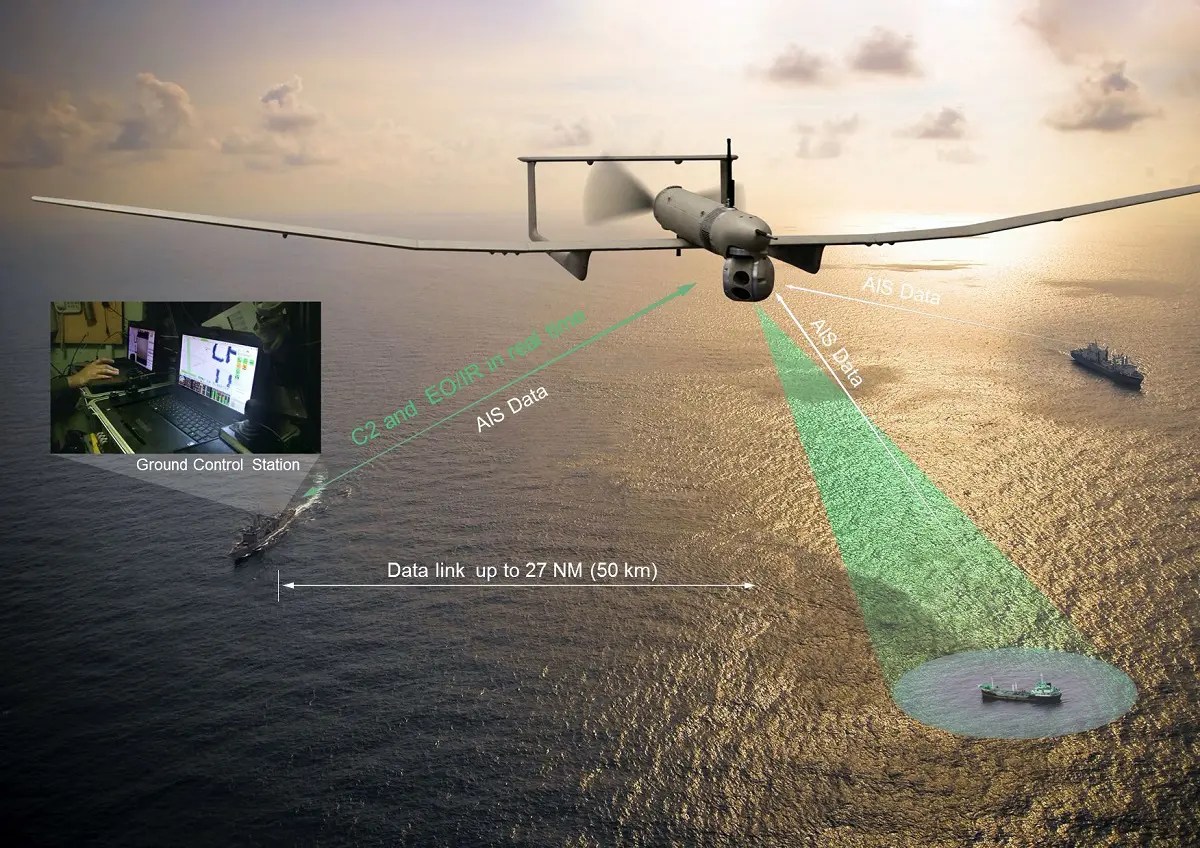
“The Aliaca maritime UAS is a high endurance versatile system allowing up to 3 hours missions over a 50 km (27 Nm) range, perfectly adapted to maritime missions with high gyro stabilized EO/IR payload performances and qualified to operate in severe environmental conditions. Airbus Defence and Space/ Survey COPTER image.”

Naval News reports first deliveries under the French Navy’s “Système de Mini Drones aériens embarqués pour la Marine” (On-board Mini Aerial Drone System for the Navy), or SMDM program intended to provide small, fixed wing, unmanned aircraft to support their Offshore Patrol Vessels. 

The DGA ordered 11 SMDMs at the end of 2020 to the SME Survey Copter, a subsidiary of Airbus Group, for an amount of 19.7 million euros, including procurement of systems and support services. Deliveries will be staggered until 2023…An SMDM is composed of two Aliaca UAVs from Survey Copter. The Aliaca is set to be deployed aboard the future offshore patrol vessels of the French Navy (both the POM and future Patrouilleur Oceanique) and surveillance frigates. Integration on the Mistral-class LHD is also considered.

These electric powered UAVs will fill essentially the same role as the Scan Eagles being used on the Bertholf class National Security Cutters (NSC). They are very nearly the same size. At first glance, at least, Scan Eagle appears more capable in every way.

Electric powered UAS are clean, quiet, and usually extremely reliable. The vessels that will be operating these UAS are all smaller than the 4,600 ton NSCs, the 1,300 ton POMs very much smaller.

It does sound like these will be Navy owned and operated, rather than operated by contractors, like the Coast Guard’s Scan Eagles.

Photos below were found in this French language report: “Marine nationale : une première capacité opérationnelle du SMDM espérée cet été”

Campagne d’essais en 2014 sur un PHM (© : MARINE NATIONALE)
© Mer et Marine https://www.meretmarine.com/fr/marine-nationale-une-premiere-capacite-operationnelle-du-smdm-esperee-cet-ete

“Watch Ukrainian TB2 Striking Two Russian Raptor Assault Boats” –Naval News

Naval News brings us a report of the destruction of two small Russian patrol boats by small guided weapons launched from an unmanned aircraft.

This should not come as a surprise to anyone. The Ukrainians have been attacking Russian vehicles with guided weapons, launched from UAS since the invasion began. Hitting a boat, is, if anything, easier than hitting a particular moving vehicle on a landscape cluttered with other vehicles, buildings, trees, and various heat sources.

But perhaps for those who have not been paying attention this may be a wakeup call. I happy to be able to say it looks like the Coast Guard has recognized this as a threat to our boats in PATFORSWA.

But maybe we need to look beyond the threat of nation states. Like other effective, but relatively cheap weapons, UAVs, and particularly suicide drones, are likely end up in the hands of non-state actors, including criminal and terrorist organizations.

“GA-ASI Selected for Japan Coast Guard RPAS Project” –News Release

MQ-9B SeaGuardian. General Atomic photo.

Below is a news release from General Atomics Aeronautical Systems, Inc. The USCG has yet to select their own shore based unmanned air system. Note, there is as yet no indication Japan Coast Guard is purchasing this system. It appears more likely they are using contractor owned and operated systems as a step toward a more comprehensive JCG owned and operated system. UAS on USCG cutters are still currently contractor owned and operated. 

GA-ASI Selected for Japan Coast Guard RPAS Project

Japan EEZ Surveillance Using SeaGuardian® RPA Scheduled to Begin in October

SAN DIEGO – 06 April 2022  General Atomics Aeronautical Systems, Inc. (GA-ASI), the global leader in Remotely Piloted Aircraft Systems (RPAS), is pleased to be selected to support the Japan Coast Guard’s (JCG) RPAS Project. Operations will feature GA-ASI’s MQ-9B SeaGuardian® and begin in October 2022.

SeaGuardian will be used to conduct wide-area maritime surveillance to support JCG’s missions, which include search and rescue, disaster response, and maritime law enforcement. This project follows a series of successful JCG flight trials in 2020 that used SeaGuardian to validate the same JCG missions in accordance with Japan’s “Policy on Strengthening the Maritime Security Systems,” using unmanned aerial vehicles to perform maritime wide-area surveillance.

“We’re proud to support the JCG’s maritime surveillance mission with our SeaGuardian UAS,” said Linden Blue, CEO of GA-ASI. “The system’s ability to provide affordable, extremely long-endurance airborne surveillance with long-range sensors in the maritime domain is unprecedented.”

SeaGuardian features a multi-mode maritime surface-search radar with an Inverse Synthetic Aperture Radar (ISAR) imaging mode, an Automatic Identification System (AIS) receiver, and High-Definition – Full-Motion Video sensor equipped with optical and infrared cameras. This sensor suite enables real-time detection and identification of surface vessels over thousands of square nautical miles and provides automatic tracking of maritime targets and correlation of AIS transmitters with radar tracks.

SkyGuardian® and SeaGuardian® are revolutionizing the long-endurance RPAS market by providing all-weather capability and full compliance with STANAG-4671 (NATO UAS airworthiness standard). This feature, along with our operationally proven, collision-avoidance radar, enables flexible operations in civil airspace.

About GA-ASI

General Atomics Aeronautical Systems, Inc. (GA-ASI), an affiliate of General Atomics, is a leading designer and manufacturer of proven, reliable, Remotely Piloted Aircraft (RPA) systems, radars, and electro-optic and related mission systems, including the Predator® RPA series and the Lynx® Multi-mode Radar. With more than seven million flight hours, GA-ASI provides long-endurance, mission-capable aircraft with integrated sensor and data link systems required to deliver persistent flight that enables situational awareness and rapid strike. The company also produces a variety of ground control stations and sensor control/image analysis software, offers pilot training and support services, and develops meta-material antennas. For more information, visit www.ga-asi.com

“Sea Air Space 2022” –Naval News Video Coverage

Below I have posted two videos by Naval News, along with the breakdown of topics that accompanied the videos on YouTube. The video of the 30mm Mk38 Mod4 with its included electro-optic fire control system is probably of most immediate interest to the Coast Guard, but the increasing tendency to containerize weapon systems is appears ready to make any cutter (and almost any other ship) a missile carrier.

  • 01:06 – Constellation-class frigate program with Fincantieri Marinette Marine
  • 04:30 – MSI Defence Mark 38 Mod 4 30mm naval gun system
  • 07:53 – Lockheed Martin’s Expeditionary Launching System
  • 09:21 – BAE Systems E-Launcher
  • 09:52 – Kongsberg NSM-HL helicopter launched naval strike missile
  • 00:43 – Kongsberg Hugin Edge UUV
  • 02:27 – General Dynamics Tethered Unmanned Aerial Systems
  • 03:36 – Shield AI’s Hivemind (V-BAT also –Chuck)
  • 05:23 – Saildrone Explorer USV
  • 06:48 – PennState’s 54″ Large Test Vehicle UUV


Three PATFORSWA Island Class Cutters Decommissioned

This from Chris Cavas on Twitter. More photos there.

Three hard-working 110-foot US #Coast Guard cutters were decommissioned 22 March in a ceremony at Manama, #Bahrain. Cutters MAUI WPB1304, MONOMOY WPB1326 & WRANGELL WPB1332 served in the Persian Gulf since 2004, will now be available for foreign transfer.

USCGC Adak was previously decommissioned and sold to Indonesia. Likely these little ships will continue to provide useful service.

They are being replaced in Bahrain by larger and more capable Webber class Fast Response Cutters. It appears the newly arrived cutters are equipped to counter Unmanned Systems.

Thanks to Walter for bringing this to my attention.