Short report and video of an Israeli at sea hostage rescue drill from Defense News. Sounds like they did it they way they should be done with a minimum of scripting.
Hopefully the Coast Guard has or will see the post drill evaluation.

Short report and video of an Israeli at sea hostage rescue drill from Defense News. Sounds like they did it they way they should be done with a minimum of scripting.
Hopefully the Coast Guard has or will see the post drill evaluation.
Looking at this little film, it struck me that the technique that was usable in the heaviest seas was that used by the Canadians (12:45-16:20), claiming a capability to Sea State Six, and they were the only ones that chose to run the ship parallel to the seas during recovery, rather than into the waves. This may be a bit counter intuitive, but it means the ship’s pitching is reduced and consequently there is less vertical displacement of the recovering ship’s stern.
As we saw in an earlier study, “The stern ramp availability is driven by sill depth and pitch motions…” In other words pitching is what limits the ability to recover the boat, and the problem becomes progressively worse as the size of the “host” vessel increases because there is a growing difference between the movement of the ship’s stern and the small boat.
I don’t know what our current doctrine is, but steaming parallel to the seas for recovery might be worth consideration if we are not already doing so.
Thanks to Adroth for bringing this to my attention.
Navy Recognition brings us news of a newly developed propulsion system for operating on the margins where the water meets the land. Where vegetation and debris make operating conventionally powered boats difficult.
Perhaps applications for disaster relief or operating on the North Slope as well.

Wanted to point to the US Naval Institute Coast Guard Essay Contest. Would love to see one of my readers win this. Other than this paragraph, this is a copy of the USNI online announcement where they also have a link for submission.
The Challenge:
Advance new thinking about the U.S. Coast Guard’s critical role in the 21st century. No issue is too big or too narrow as long as it makes the Coast Guard stronger. This does not mean authors cannot be critical and take on conventional wisdom and current practices. In fact, we encourage you to push the “dare factor.”
Prior Publication: We will assume that your essay has not been previously published (online or in print) or being considered for publication elsewhere, unless otherwise notified by you. All previously published essays are ineligible.
Submission Guidelines:
Selection Process: The Proceedings staff members will evaluate every essay and screen the top essays to a special Essay Selection Committee of at least six members who will include two member’s of the Naval Institute’s Editorial Board and four subject experts. All essays will be judged in the blind — i.e., the Proceedings staff members and judges will not know the authors of the essays.
Announcement of the Winners: The winning essays will be announced in the October Proceedings. Some entrants will be awarded a one-year membership in the Naval Institute.
About Naval Institute Essay Contests
Essay contests have been central to the work of the Naval Institute for more than 130 years. They directly fulfill the Institute’s educational mission by encouraging writing on issues of concern to the Sea Services. They provide thought-provoking articles that spur ongoing discussion of these same issues, not only in Naval Institute media, print and digital, but also in other leading defense and national security forums.
Reuters is reporting the Coast Guard is currently investigating the collision between USS Fitzgerald and the container ship ACX Crystal.
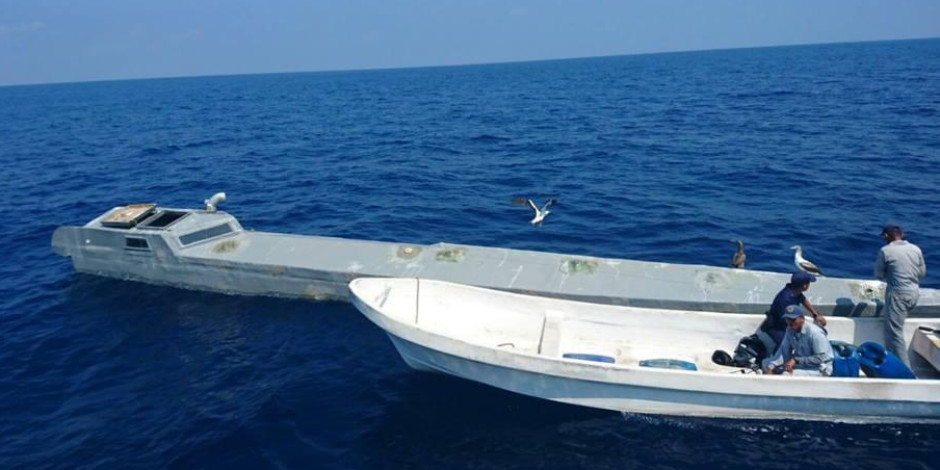
Very Slender Vessel (VSV). Guatemalan Ministry of Defense photo.
Popular Mechanics has a post on the way drug smuggling craft are evolving in an attempt to avoid detection. Specifically they have begun to use very slender hull forms for their self propelled semi-submersibles.
The post also has a link to perhaps the best collection of photos of smuggling craft I have ever seen.
Thanks to Peter O. for bringing this to my attention.
DefenseNews had an interview with the Commandant. You can read it here. I will not repeat the Commandant’s responses here, but I will repeat one of the questions and add my own thoughts.
Admiral, you have said that the Coast Guard’s identity as an armed service is forgotten. Can you tell me what you mean by that?
The Commandant talks here about budget, but I think this starts with self image. We do SAR. We rescue sea turtles. Armed services are first and foremost ARMED. We are by law a military service, but we are currently inadequately armed for even our peacetime counter terrorism, DHS mission. We are less capable of forcibly stopping a ship than we were 90 years ago.
Do our people know what their role will be if there is a major conflict with the Chinese or Russians? You can bet Navy and Marine Personnel have a pretty good idea of their roles.
We have had a quarter century hiatus in a mono-polar world where no one could challenge American seapower. That is changing rapidly and it is time for the Coast Guard to see itself in a new light. Just as the nation has benefited from having two land forces (Army and Marines), it can benefit from having two sea forces. The Coast Guard is a substantial naval force. Certainly we will not replace the Navy’s sophisticated systems, but there is a need for a high low mix and the marginal cost of adding capability to Coast Guard vessels that are going to be built anyway is very small.
We are currently in an unrecognized naval arms race with China. It is time to give the Coast Guard back the ASW and ASuW capabilities it was building before the collapse of the Soviet Union.
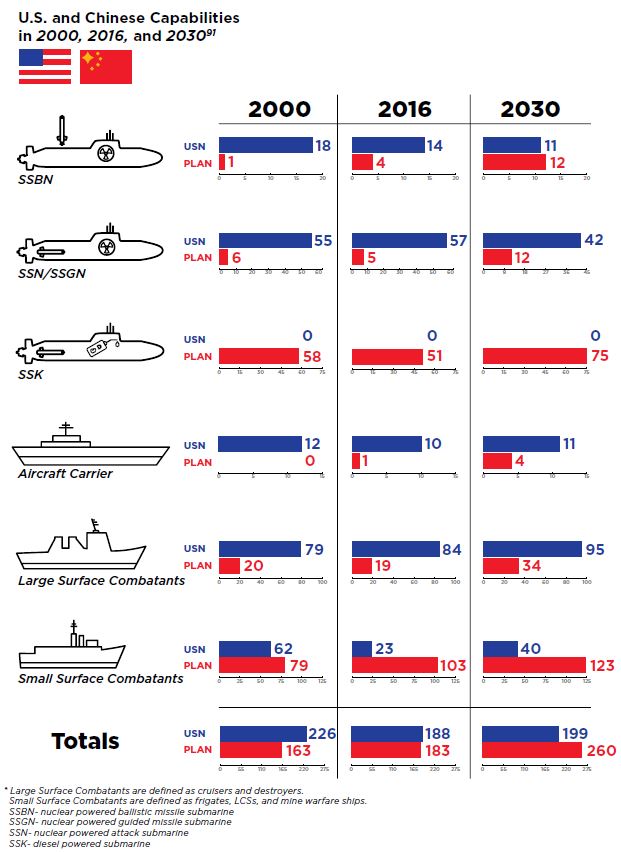
When I reported to the academy in 1965, it had a gun lab, and we were taught ASW (badly) during swab summer. The Coast Guard had 36 ships equipped with sonar, ASW torpedoes and 5″ guns. The ships were old (not as old as now), but we were building a new fleet of 36 Hamilton Class WHECs equipped with a better sonar in addition to torpedoes and a 5″ gun. Being armed did not stop us from doing SAR, fisheries, or aids to navigation.
At that time (1965) in terms of personnel, the US Navy was about 25 times larger than the Coast Guard and had 287 cruisers, destroyers, and frigates. Now it is only eight times as large as the Coast Guard and has only 85 ASW equipped surface ships. We also had a powerful naval ally in Europe in the form of the Royal Navy. Now the Coast Guard is supplying personnel to the Royal Navy and in terms of personnel the Coast Guard is larger than the Royal Navy or the French Navy. Equipping our planned 33 to 35 large cutters as true surface combattants could make a real difference.
Even if we never go to war, preparation can make us better at our peacetime roles. Drug interdiction, migrant interdiction, and even SAR benefit from military grade ISR and C4I. Recognition of naval capabilities in the Coast Guard may justify additional resorces that have dual use for peacetime missions. Its a win-win.
NavyRecognition gives us a great tour of the new Singapore Navy “Littoral Mission Vessel” (corvette) RSS INDEPENDENCE. The boat handling arrangement and the integrated bridge/CIC are very interesting. Do take a look at the original post, there is much more there
We talked about this class earlier as a possible example of what a cutter “X” might be.
Marine inspection has never been my area, but this does not sound good.
“A top U.S. Coast Guard official admitted at a recent congressional oversight hearing that the U.S. Coast Guard “has not been aggressively enforcing the compliance” of vessel response plans filed under federal Salvage and Marine Firefighting (SMFF) regulations. The rules, derived from the Oil Pollution Act of 1990, are meant to prevent a worst-case discharge resulting from fire or explosion aboard a vessel.”
gCaptain provides us both the video above and the full text of the President’s address upon the graduation of the Coast Guard Academy class of 2017.
 Chuck Hill's CG Blog