“Mexican Navy Helicopter Crashes During U.S. Extradition Hunt” –USNI

The US Naval Institute news service reports the loss of a Mexican Navy Helicopter with 15 Mexican Marines aboard. There was only one surviror.

Mexican law enforcement were looking for someone with two warrants out for his arrest in Mexico and an extradition order for the United States, according to the release.

The loss was related to the capture of convicted Mexican drug kingpin Rafael Caro Quintero, wanted by US authorities for allegedly kidnapping and conspiring to murder Drug Enforcement Administration (DEA) Special Agent Enrique Camarena Salazar in 1985.

The Mexican Navy and Marine Corps have proven to be one of the most reliable and incorruptable institutions in Mexico. Hopefully the USCG will extend its sympathies to our partners in Mexico. We know how devastating such a loss can be.

“Russian Overreach Gives New Urgency To Arctic Emergency Drills” –Forbes

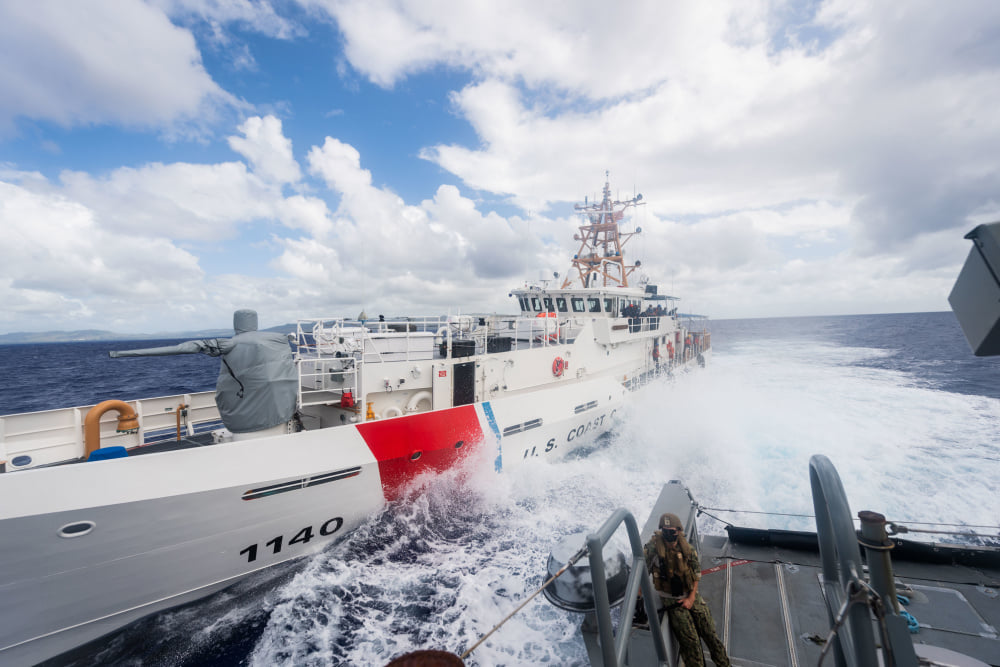
Exercise Argus 2022 participants USCGC Oak and HDMS Ejnar Mikkelsen (P571) meet off Greenland. U.S. COAST GUARD

Forbes gives us a look at Exercise Argus which was sponsored by Denmark and conducted off Greenland. Author Craig Hooper also looks at the challenges facing Greenland as tourism and offshore traffic increase exponentially.

Off Greenland, the Danish Joint Arctic Command just finished hosting Exercise Argus, an annual Danish-led training event. The exercise, designed to enhance search-and-rescue and marine environmental responses in the Arctic, offers the U.S. Coast Guard an opportunity to obtain some experience operating in Polar waters.

For the exercise, a range of U.S. Coast Guard elements, joined by units from France—an Arctic Council observer state—worked with Danish and Greenland-based assets. The international team prepared for a complex maritime accident, a catastrophe that most Arctic observers suspect will be inevitable in the years ahead.

Before the exercise commenced, a 225-foot seagoing buoy tender, the Coast Guard Cutter Oak (WLB 211) arrived in Sisimiut, Greenland, becoming one of only a handful of U.S. ships that have operated north of the Arctic Circle. At sea, the tender was joined by a French patrol boat, FS Fulmar (P740), and the capable Danish Knud Rasmussen-class patrol boat, HDMS Ejnar Mikkelsen (P571), as well as by smaller local law enforcement and pollution-response craft.

For a view of an earlier similar exercise, a comparison of the Knud Rasmussen class OPV with the 270 foot WMECs, and some great photographs take a look here.

“U.S. Navy Offers Cash Reward For Tips On Illegal Maritime Activity And Cargo” –gCaptain

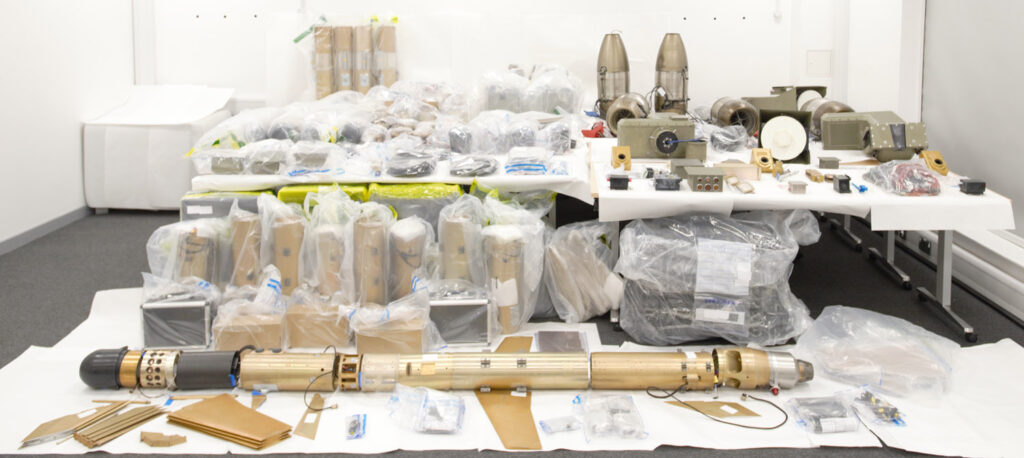
Some of the weaponry and missile parts seized by HMS Montrose in early 2022.

gCaptain reports,

The U.S. Navy will for the first time reward individuals for reporting information that leads to the detection of illegal maritime activity or seizure of illicit cargo in waters across the Middle East.

The first-of-its-kind program, established by the U.S. Naval Forces Central Command (NAVCENT), could potentially reward a maximum $100,000 cash payout or non-monetary items, like boats, vehicles, food or equipment, for tips that support counterterrorism operations or leads U.S. naval forces to successfully seize illicit cargo, such as illegal weapons or narcotics.

This may provide work for the newly arrived Webber class WPCs of PATFORSWA.

In 2021,

U.S. 5th Fleet warships seized nearly 9,000 illicit weapons, three times the amount seized in 2020. Additionally, the U.S.-led Combined Maritime Forces seized illegal drugs worth $500 million in street value, a higher amount than the previous four years combined.

We have a report of Royal Navy seizures in January and February that seems to show there is ample reason to be concerned. (Photo above.)

Below is the original news release. It has been very widely reported.


NAVCENT to Reward Individuals for Tips on Illegal Maritime Activity

By NAVCENT Public Affairs | July 05, 2022

MANAMA, Bahrain —

U.S. Naval Forces Central Command (NAVCENT) announced July 5 that it will begin rewarding individuals for voluntarily providing information that leads to the detection of illegal maritime activity and seizure of illicit cargo in waters across the Middle East.

NAVCENT is establishing a program for the first time to reward individuals who voluntary report information that meets specific criteria under the Department of Defense Rewards Program.

“Launching this program represents another example of our commitment to this region and its security,” said Vice Adm. Brad Cooper, commander of NAVCENT, U.S. 5th Fleet and Combined Maritime Forces. “This also enhances our vigilance and supports counterterrorism efforts, which are essential to safeguarding the free flow of commerce.”

NAVCENT could potentially reward a maximum $100,000 payout for information or nonlethal assistance that supports counterterrorism operations or leads U.S. naval forces to successfully seize illicit cargo such as illegal weapons or narcotics. Rewards can also be non-monetary and include items like boats, vehicles, food or equipment.

U.S. citizens are not eligible for rewards under the program.

Last year, illicit cargo seizures in the Middle East skyrocketed after U.S. and multinational forces increased patrols in the Gulf of Oman and Arabian Sea.

U.S. 5th Fleet warships seized nearly 9,000 illicit weapons, three times the amount seized in 2020. Additionally, the U.S.-led Combined Maritime Forces seized illegal drugs worth $500 million in street value, a higher amount than the previous four years combined.

The U.S. 5th Fleet area of operations encompasses about 2.5 million square miles of water area and includes the Arabian Gulf, Gulf of Oman, Red Sea and parts of the Indian Ocean. The region is comprised of 21 countries and includes three critical choke points at the Strait of Hormuz, the Suez Canal and the Strait of Bab al-Mandeb at the southern tip of Yemen.

Tips can be reported by calling +973 3914-5845. The phone line is staffed by personnel with regional language expertise. Individuals with information can also report online by going to https://dodrewardsprogram.net.

For additional information on how to report a tip or reward eligibility criteria, go to NAVCENT’s website at https://www.cusnc.navy.mil/DoD-RP/.

“Media Advisory: Coast Guard Forces Micronesia/Sector Guam to host Skinner Building ribbon cutting ceremony” –D14

The former USS White Cloud. During the war its sails, most of its masts, and bow sprit were removed.

Below is a News Release regarding the opening a new support facility for Webber class WPCs in Guam. As has become common, a group of three of the class are homeported together, facilitating support functions.

The crew of Guam based USCG Cutter Oliver Henry participated in an integrated exercise alongside Navy Maritime Expeditionary Security Squadron TWO in the Philippine Sea under the direction of U.S. 7th Fleet.

The ship referenced in the news release, USS White Cloud, a Coast Guard manned yatch converted to a patrol gunboat, was unique in WWII, in that it was the first truly racially integrated ship in the US Navy and it was then Carlton Skinner, USCGR’s idea, not as a social experiment, but simply as the best use of available manpower.

News Release

U.S. Coast Guard 14th District Hawaii and the Pacific

Media Advisory: Coast Guard Forces Micronesia/Sector Guam to host Skinner Building ribbon cutting ceremony

SANTA RITA, Guam — Coast Guard Forces Micronesia/Sector Guam invite the media to attend the ribbon cutting ceremony for the newly built Fast Response Cutter (FRC) facility known as the Skinner Building in honor of Guam’s first Governor, Carlton Skinner.

Gov. Skinner also served in the Coast Guard and was the commanding officer of the Coast Guard Cutter Sea Cloud when it integrated into the Navy during World War II for combat services.

The Sentinel-class FRC is the Coast Guard’s next generation of patrol boat and replaced aging Island-class vessels which had been in service since 1985. The FRC boasts advanced command, control, communications, computer, intelligence, surveillance, and reconnaissance systems while providing a larger, more stable, and safer platform from which to conduct operations. The Skinner Building will house personnel and equipment to manage maintenance and maximize FRC operational readiness.

Please contact Lt. j.g. Edward Oingerang via email (Edward.M.Oingerang@uscg.mil) by 4 p.m. on July 6, 2022 as guest passes need to be requested for access to the base.

  • Who: The media
  • What: Skinner Building Ribbon Cutting Ceremony
  • Where: Coast Guard Forces Micronesia/Sector Guam located on Navy Base Guam by Victor Pier
  • When: July 14, 2022
  • Time: 1:00pm

For breaking news follow us on twitter @USCGHawaiiPac

-USCG-

“USCGC Mohawk (WMEC 913) arrives in Lisbon, Portugal”–Navy.mil–and Two More FRCs for PATFORSWA

USCGC John Scheuerman (WPC-1146) and USCGC Clarence Sutphin Jr. (WPC-1147) enroute PATFORSWA

Below is a Navy news release reporting the arrival of USCGC Mohawk in Lisbon. Somewhat surprisingly there is no mention of the two Webber class cutters pictured in an attached photo (above) and no photo of Mohawk.

Looking closely at the photo above, you can see they have the Counter Drone upgrades seen on other FRCs that have been assigned to PATFORSWA.

Obviously this is the last pair of Fast Response Cutters (FRCs) being transferred to Patrol Forces SW Asia (PATFORSWA). They were escorted across the Atlantic by Mohawk. Can’t believe I did not see the gorgeous photo below earlier. Perfect for 4th of July.

The USCGC Mohawk (WMEC 913), USCGC John Scheuerman (WPC 1146), and USCGC Clarence Sutphin Jr. (WPC 1147) sail in formation in the Atlantic Ocean, June 22, 2022. The John Scheuerman and the Clarence Sutphin Jr. are the 46th and 47th Sentinel-class fast response cutters, respectively. They will become the fifth and sixth FRC’s to be homeported in Manama, Bahrain. (U.S. Coast Guard photo by Petty Officer 3rd Class Jessica Fontenette)


USCGC Mohawk (WMEC 913) arrives in Lisbon, Portugal

29 June 2022

From U.S. Naval Forces Europe-Africa Public Affairs

LISBON, Portugal – The Famous-class medium endurance cutter USCGC Mohawk (WMEC 913) arrived in Lisbon, Portugal for a scheduled port visit, June 29, 2022.

This port visit marks the first stop for Mohawk, while employed by U.S. Sixth Fleet in the U.S. Naval Forces Europe and Africa (NAVEUR-NAVAF) area of operations. During the visit, Mohawk leadership will meet government leaders and military maritime counterparts, while the crew enjoys the rich cultural history of Portugal.

“It is a tremendous privilege to be here in Lisbon,” said Cmdr. Andrew Pate, commanding officer aboard USCGC Mohawk (WMEC 913). “Like the United States, Portugal has a rich and deep maritime history and combined maritime operations provide a critical opportunity to improve interoperability with our partners, and prove that we are stronger together.”

Earlier this month, Adm. Linda Fagan, commandant of the U.S. Coast Guard, visited Lisbon and met with Ambassador Randi Charno Levine and Portugal’s Chief of Naval Staff, Adm. Henrique Eduardo Passaláqua de Gouveia e Melo. Fagan is also the first woman, and first mother, to lead any of the U.S. Armed Forces.

Portugal has a long maritime history and their navy boasts 705 years of continuous service.

“Portugal is an important ally of the United States and plays a pivotal role in the security and cohesion of the Alliance,” said Rear Adm. Chase Patrick, director of maritime headquarters, U.S. Naval Forces Europe and Africa. “Mohawk’s visit to Portugal demonstrates our shared goals for regional peace and stability.”

Mohawk is the 13th and last of the Famous-class cutters. It is named for the Algonquin tribe of Iroquoian Indians who lived in the Mohawk Valley of New York. Mohawk is the third cutter to bear the name. Mohawk’s parent command is U.S. Coast Guard Atlantic Area.

The U.S. Coast Guard Atlantic Area command oversees all domestic Service operations east of the Rocky Mountains, including the Arctic, Atlantic, Gulf of Mexico, Caribbean, and out-of-hemisphere operations in Europe, Africa, and Southwest Asia. Atlantic Area is responsible for coordinating and deploying cutters, aircraft, pollution response equipment, and thousands of personnel throughout the globe to ensure resources, equipment, and personnel are available to support the Coast Guard’s statutory missions.

For over 80 years, U.S. Naval Forces Europe-U.S. Naval Forces Africa (NAVEUR-NAVAF) has forged strategic relationships with allies and partners, leveraging a foundation of shared values to preserve security and stability.

Headquartered in Naples, Italy, NAVEUR-NAVAF operates U.S. naval forces in the U.S. European Command (USEUCOM) and U.S. Africa Command (USAFRICOM) areas of responsibility. U.S. Sixth Fleet is permanently assigned to NAVEUR-NAVAF, and employs maritime forces through the full spectrum of joint and naval operations.

Japan’s Shunkou Class Cutters

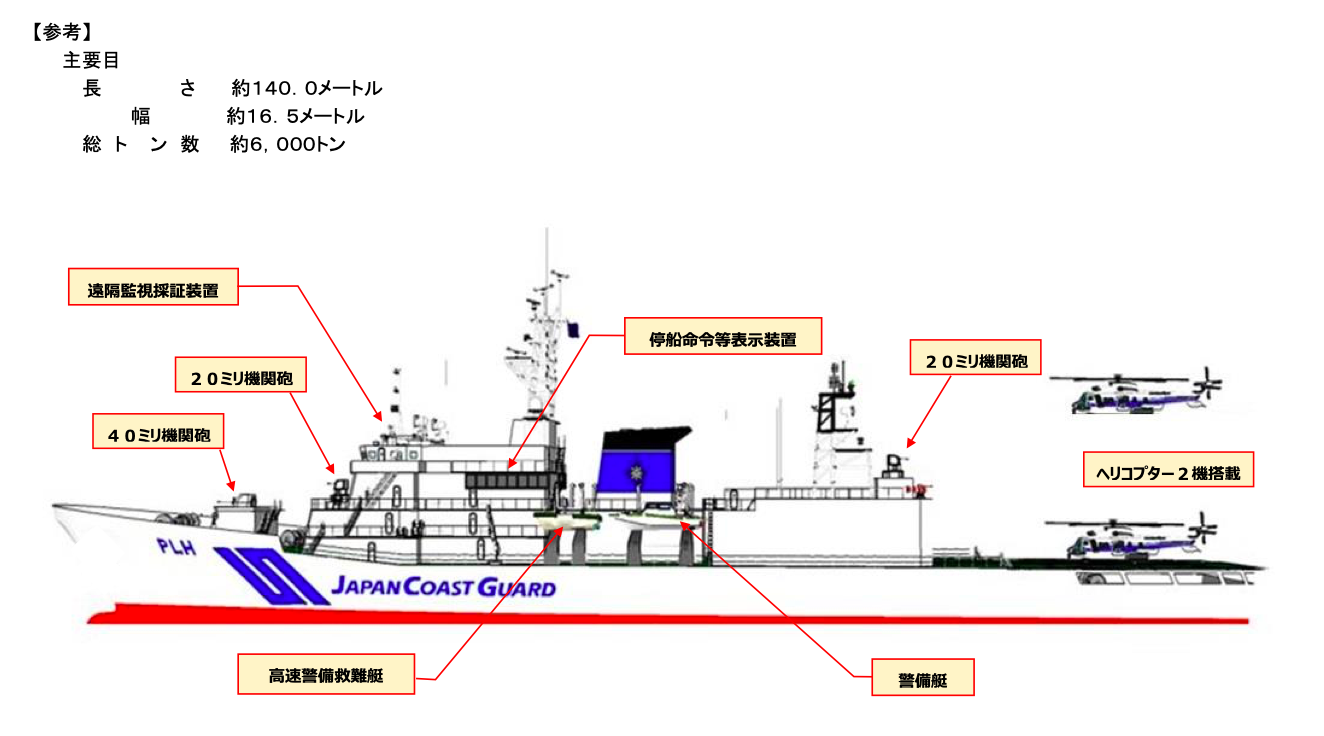
Technical drawing of the Shunkou-class patrol vessel (Credit : JCG)

A couple of posts from Naval News gives us a look at the latest cutters being delivered to the Japan Coast Guard. They typlify an apparent trend to larger, faster cutters with more extensive aviation facilities.

Speed is a respectable 25 knots. The reported displacement of 6,700 tons may be deceptive. Asian navies and coast guards tend to minimize the size of their ships. These ships are about 9,000 tons full load, making them about twice the size of the Bertholf class NSCs and Argus class OPCs.

Dimensions are:

  • Length: 140 meters (459.2 feet–100 feet more than the Offshore Patrol Cutter)
  • Beam: 16.5 meters (54.12 feet–20 inches more than the OPC)

The reported range is a phenominal 20,000 nautical miles.

Their hangar and flight deck can accommodate two helicopters larger than H-60s.

The Japan Coast Guard, unlike the USCG, is not a military service. They have not followed China Coast Guard in becoming more heavily armed. Several China Coast Guard cutters are armed with guns up to 76mm. The 40mm guns that arm these ships are the largest caliber in the Japan Coast Guard. They are backed up by two 20mm Gatling Guns, one forward and one aft. This armament reflects the lessons of their difficulties in stopping a small North Korean spy ship with only 20mm Gatling guns. It is still clearly inadequate for forcibly stopping larger vessels.

I would like to point out a paragraph from the first of the two linked reports, dated 5 Feb., 2020.

In 2012, the JCG had 51 patrol vessels displacing more than 1,000 tons. The service has now 63 large vessels, and the goal is to operate 12 more ships by the end of FY 2023 to deal with new threats.

That the Japanese see a need for 75 large cutters, even though their EEZ is only 39.5% that of the US, and that their cutter fleet is far younger that ours, may say something about the adequacy of the USCG’s large cutter fleet, even when the currently planned fleet of 36 NSCs and OPCs is complete. (Keep in mind that if we proceed as planned, when the last OPCs is completed, the first NSC, Bertholf, will be 30 years old.)

I like the way the Japan Coast Guard designates their cutter types. These are PLH, e.g. Patrol, Large, Helicopter, that is simple, descriptive, truthful, and in accordance with the US Navy type designation system.

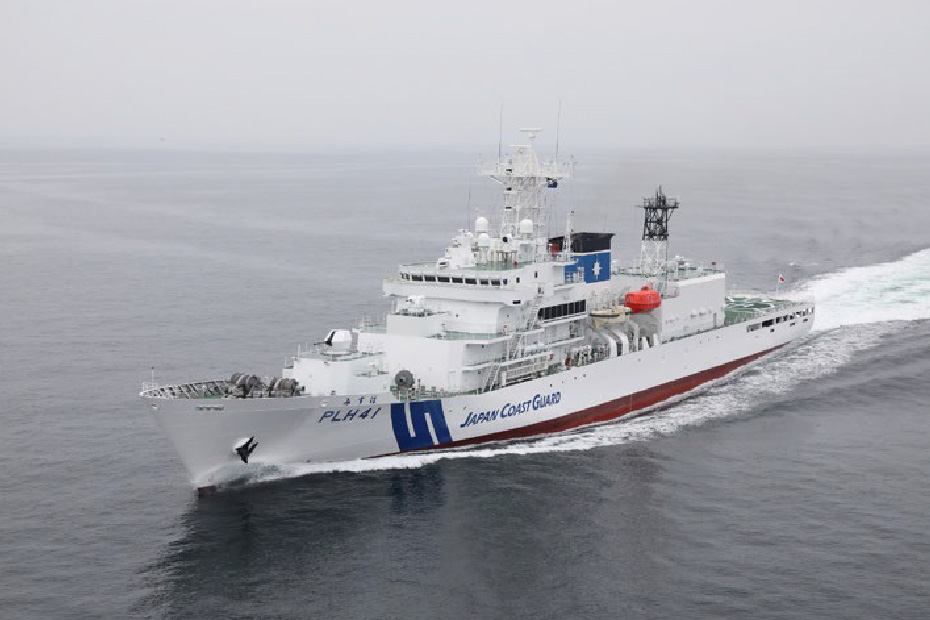
The similar, but 10 meter shorter PLH-41

Japan CG cutter Shunkō PLH-42

U.S. Coast Guard releases 2021 recreational boating statistics–14% Drop in Fatalities

Just passing this along. 

News Release

U.S. Coast Guard Headquarters


U.S. Coast Guard releases 2021 recreational boating statistics

 U.S. Coast Guard records drop in fatalities

The U.S. Coast Guard released statistics on calendar year 2021 recreational boating incidents, revealing that there were 658 boating fatalities nationwide in 2021, a 14 percent decrease from the 767 deaths in 2020.

From 2020 to 2021, the total number of accidents decreased 16 percent (5,265 to 4,439), and the number of non-fatal injured victims decreased 17 percent (3,191 to 2,641).

Alcohol continued to be the leading known contributing factor in fatal boating accidents in 2021, accounting for 86 deaths, or 16 percent of total fatalities.

The data also shows that in 2021:

  • The fatality rate was 5.5 deaths per 100,000 registered recreational vessels.  This rate represents a 15 percent decrease from last year’s fatality rate of 6.5 deaths per 100,000 registered recreational vessels.
  • In 1971, when the Safe Boating Act was first passed, the fatality rate was 20.6 deaths per 100,000 registered recreational vessels.
  • Property damage totaled $67.5 million, which is an all-time high.
  • Operator inattention, operator inexperience, improper lookout, machinery failure and excessive speed ranked as the top five primary contributing factors in accidents.

Capt. Troy Glendye, chief of the Office of Auxiliary and Boating Safety at Coast Guard Headquarters, remarked that most incidents occurred during benign weather conditions: calm waters, no or light wind, and good visibility.

Where the cause of death was known, 81 percent of fatal boating accident victims drowned.  Of those drowning victims with reported life jacket usage, 83 percent were not wearing a life jacket.

“A life jacket is one of the most important safety items on your boat,” said Glendye. “It is critical to wear one when underway as it may be difficult to don in an emergency. The Coast Guard reminds boaters to ensure life jackets are serviceable, properly sized, correctly fastened, and suitable for your activity.”

Where boating instruction was known, 75 percent of deaths occurred on vessels where the operator had not received boating safety instruction.  The Coast Guard encourages all boaters to take a boating safety course that meets the National Boating Education Standards before hitting the water.

The most common vessel types involved in reported accidents were open motorboats, personal watercraft, and cabin motorboats.  Where vessel type was known, the vessel types with the highest percentage of deaths were open motorboats (44 percent), kayaks (15 percent), and pontoons (10 percent).  This is the second time that pontoon vessels ranked in the top three.

The data are from incidents that resulted in at least one of the following criteria:  death, disappearance, injury that required medical treatment beyond first aid, damages to the vessel(s) or other property that equaled or exceeded $2,000, or a loss of vessel.

In addition to wearing a life jacket and taking a boating safety course, the Coast Guard recommends all boaters to attach the engine cut-off switch, get a free vessel safety check, and boat sober.

“We praise the work of our boating safety partners who have resolved to reduce casualties through educational outreach and enforcement,” said Glendye.

To view the 2021 Recreational Boating Statistics report and additional information on boating responsibly, visit http://www.uscgboating.org.  The report is found under the “Statistics” menu selection and the “Accident Statistics” submenu selection.


“US Supplying Ukraine with 23 Metal Shark Military Vessels” –Seapower

Metal Shark “36 Fearless”

The Navy League’s on-line magazine, Seapower, reports that a plan to equip the Ukraine military with boats from Louisiana boat builder Metal Shark has been accelerated. The Program for 23 boats includes six “40 Defiant” force protection patrol boats that are included in the latest aid package. These are to followed by ten 38-foot Defiant pilothouse patrol vessels, four 38-foot Defiant center console patrol vessels, and three 36-foot Fearless high-performance military interceptor vessels.

Part of a 38 Defiant patrol boat fleet deployed in Asia. Metal Shark photo.

Metal Shark 40 Defiant

Metal Shark’s press release is quoted below.
JUNE 28TH, 2022: UNITED STATES SUPPLYING UKRAINE WITH OVER 20 METAL SHARK MILITARY VESSELS

Jeanerette, LA – June 28th, 2022In an effort to help Ukraine to better protect its coastline, waterways, and ports, the United States is providing the country with a range of defense articles, including 23 welded-aluminum military vessels built by Louisiana-based Metal Shark.

Last week it was announced that six US Navy Metal Shark maritime combat vessels would be sent to Ukraine as part of a $450 million security assistance package. Meanwhile, at Metal Shark’s Franklin and Jeanerette, Louisiana production facilities, production is well underway on 17 additional vessels for Ukraine, including ten 38-foot Defiant pilothouse patrol vessels, four 38-foot Defiant center console patrol vessels, and three 36-foot Fearless high-performance military interceptor vessels. Each of these vessels are proven military platforms optimized for the Ukraine mission.

The boats are being built and delivered as part of a long range foreign policy strategy years in the making, but recent events in Ukraine have caused an acceleration of the timelines. As a result, vessels will begin shipping immediately.

“Metal Shark has been working closely with the US Embassy in Kiev since 2019 to develop the strategy now being implemented to support Ukraine’s maritime capabilities, so it is fulfilling to see that the vessels will arrive when they are most needed,” said Henry Irizarry, Metal Shark’s Vice President of International Business Development. “Metal Shark provides next-generation, proven platforms to partner nations, but most importantly, we create long term partnerships with end users to train boat crews and provide seamless technical support to assure 24/7 operational readiness.”

“We have built an efficient production machine capable of delivering high quality, next-generation military vessels, faster, and at higher volume, than anyone else in the business,” said Metal Shark’s CEO Chris Allard. “Metal Shark stands ready and able to support our warfighters with game-changing lethality, delivered via conventional or unmanned platforms, anywhere in the world, whenever needed.”

Metal Shark is a diversified shipbuilder specializing in the design and construction of welded aluminum and steel vessels from 16’ to over 300’ for defense, law enforcement, and commercial operators. Key customers include the United States Navy, Marine Corps, Coast Guard, Air Force, Army, foreign militaries, law enforcement agencies, fire departments, passenger vessel operators, pilot associations, towboat operators, and other clients worldwide. With three fully self-contained shipbuilding facilities in Alabama and Louisiana USA plus a dedicated engineering facility in Croatia, Metal Shark’s 500+ employees produce over 200 vessels per year with a proud and proven track record of high quality, on-time deliveries. www.metalsharkboats.com

NAVCEN website upgrade streamlines access to navigation information

The announcement below showed up on the MyCG website. I’m passing it along because hopefully some of my readers are active mariners and might find it useful. 

June 28, 2022

NAVCEN website upgrade streamlines access to navigation information

The U.S. Coast Guard Navigation Center (NAVCEN) completed a major upgrade to our website, June 5, modernizing the look and feel of the site. The upgrade also streamlines access to products available to assist our afloat members in their day-to-day operations.

NAVCEN products are now optimized for all of your devices including laptops, phones, and tablets. There is also no login or CAC authentication needed to access the contents. This means that whether you are on-duty underway or enjoying liberty out on the water, NAVCEN can help you stay safe and stay informed.

You can find an easily accessible “one-stop-shop” for many of the products a mariner would need on the website. These include marine safety information, such as the weekly local notice to mariners for each Coast Guard district, as well as a real-time database of broadcast notice to mariners for participating sectors. Here you can also find the annual and weekly Light Lists. This is an easy way to make sure you and your unit you are up to date on hazards to navigation in your area before you get underway.

When navigating into a waterway with a vessel traffic service (VTS), you can check our website for information about the VTS you will be entering. Using the interactive map, you can click on a VTS location to find a description of its operating area and links to its user manual and homepage (if available). We also feature a VTS quick reference guide for many of these areas.

If you need a refresher on the Navigation Rules, the NAVCEN website hosts a digital copy of the rules that includes contextual links and imagery. When studying for a new or renewal exam you can use the available digital flashcards tool to quiz yourself and enhance your learning.

The NAVCEN website offers many more features than those listed here, including information about GPS, Automatic Identification System (AIS), waterways safety analyses, and maritime telecommunications. You can also use the contact us links in the site to reach out with questions concerning many of these topics.

We encourage you to visit us at navcen.uscg.gov to get more information and see how we can assist you.