
CGAS Miami H-65 in a CGAS Clear Water C-130
The Drive has a short post noting the Coast Guard’s ability to move its H-65s by C-130.
Some nice photos, kind words, and a video.

CGAS Miami H-65 in a CGAS Clear Water C-130
The Drive has a short post noting the Coast Guard’s ability to move its H-65s by C-130.
Some nice photos, kind words, and a video.
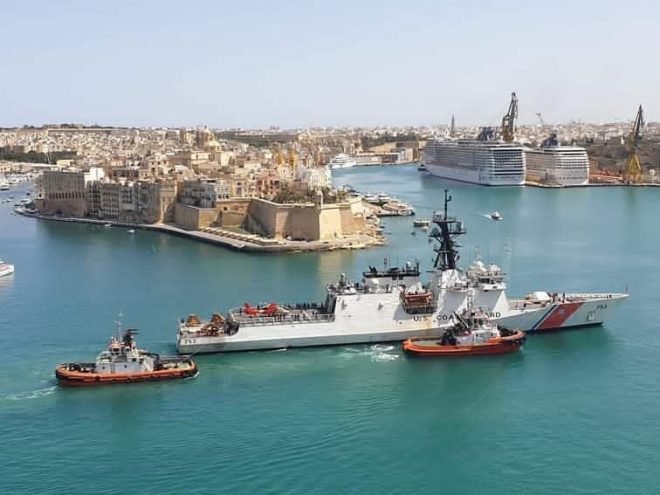
USCGC Hamilton (WMSL-753) conducting port visit in Valletta, Malta on May 17, 2021. Coast Guard Photo
Just passing this along. I have added pictures and a link to a previous post.
R 202101Z DEC 21
FM COMDT COGARD WASHINGTON DC
TO ALCOAST
BT
UNCLAS
ALCOAST 464/21
SSIC 1650
SUBJ: WINNER ANNOUNCEMENT – 2021 HOPLEY YEATON CUTTER EXCELLENCE
AND SUPERIOR CUTTERMAN AWARDS
A. COMDT COGARD WASHINGTON DC 141626Z SEP 21/ALCOAST 336/21
1. The Douglas Munro Chapter of the Surface Navy Association (SNA) is honored to announce and congratulate the recipients of the 2021 Hopley Yeaton Cutter Excellence and Superior Cutterman Awards. The winners were selected from an incredibly competitive pool of nominees.
2. The winners of the Hopley Yeaton Awards for 2021 are:
a. Cutter Excellence Awards
b. Superior Cuttermen Awards
3. Cutter Excellence Award (Large) – CGC HAMILTON (WMSL 753):
a. Following her trans-Atlantic escort of the first Fast Response Cutters bound for service at PATFORSWA, CGC HAMILTON transited the Bosporus into the Black Sea where she conducted freedom of navigation patrols and operated and trained with Turkish and Romanian Naval Forces, the Georgian Coast Guard, and Ukrainian Maritime Forces. While deployed in the U.S. European Command AOR, HAMILTON conducted at-sea exercises and port visit engagements with the navies and coast guard of seven total international allies and partners; bolstering freedom of navigation in international waters of the Black Sea and building maritime domain awareness, cooperation, and interoperability with partner nation navies and coast guards. As Caribbean maritime migration levels increased to the highest levels in more than seven years, HAMILTON assumed command of surface operations in the Windward Pass, directing the employment of three major and four fast response cutters that successfully resulted in a dramatic decline in attempts by migrants to attempt the extremely hazardous voyage at sea.
b. Honorable Mentions for the Large Cutter Award are:
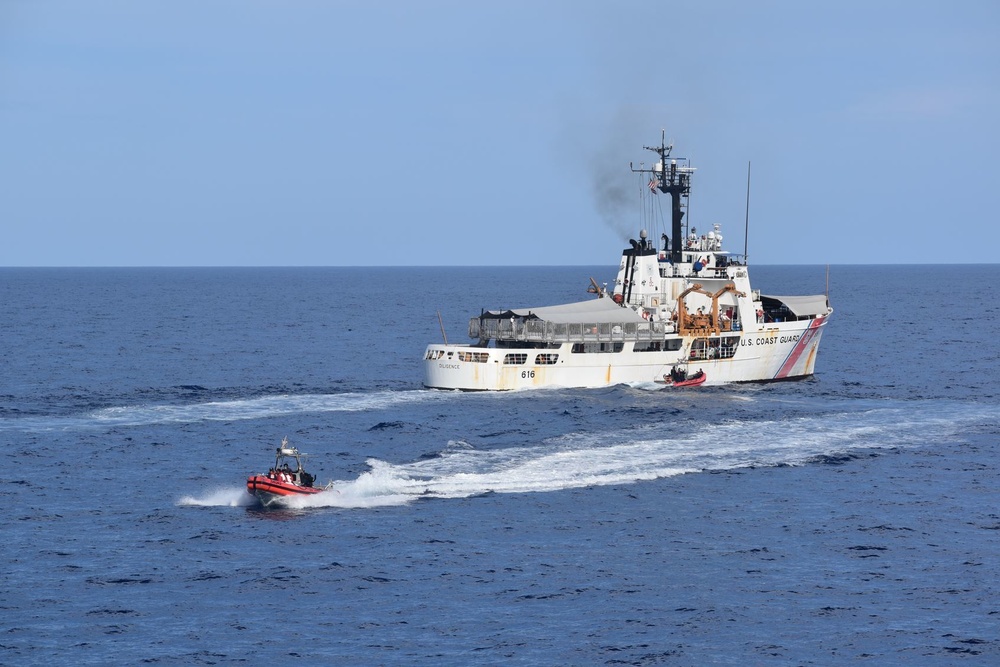
RESOLUTE conducts an at-sea transfer with CGC DILIGENCE. The transfer included a 77 Haitian migrants, their personal belongings, and a Creole interpreter. In total, RESOLUTE cared for 260 Haitian migrants. All migrants are given food, water, and medical attention once onboard a Coast Guard cutter. During a 56-day patrol, RESOLUTE provided overt presence in Northern Haiti to deter illegal and dangerous migration voyages. Photo by ENS Alex Cordes.
4. Hopley Yeaton Cutter Excellence Award (Medium) – CGC RESOLUTE (WMEC 620):
a. In 2021, CGC RESOLUTE safely conducted the largest single-unit, at-sea migration case in more than a decade (183 migrants, including 17 children and infants). RESOLUTE led rigorous dockside and underway trials for the new Cutter Boat-Large acquisition and delivered expert analysis of safety, compatibility, and suitability for a wide range of Coast Guard missions. RESOLUTE’s superb engagement with headquarters program sponsors and naval engineers supported successful acceptance and roll-out across the entire 210′ WMEC fleet. Highlighting a year with multiple SAR cases, RESOLUTE’s lookout detected people in the water, leading to the rescue of 8 migrants who had been treading water for 24 hours following the capsizing of their makeshift vessel.
b. Honorable Mentions for the Medium Cutter Award are:

USCGC Isaac Mayo, Key West, Fla., Jan. 29, 2015. (U.S. Coast Guard photo by Petty Officer 3rd Class Mark Barney
5. Hopley Yeaton Cutter Excellence Award (Small) – CGC ISAAC MAYO (WPC 1112):
a. In 2021, CGC ISAAC MAYO conducted 108 at-sea boardings resulting in the disruption of 3,000 kgs of cocaine valued at $75 million. ISAAC MAYO conducted joint operations with Customs and Border Protection and Homeland Security Investigations during an operation to deter, detect, interdict, and inspect, targets of interest in the northern portion of Sector Key West’s area of responsibility. ISAAC MAYO led the way during Operation CHOKE POINT, an intradepartmental partnership with Customs and Border Patrol and Homeland Security Investigations, to board and inspect vessels operating in the Gulf of Mexico. Additionally, ISAAC MAYO developed a first-ever Tactics, Techniques, and Procedures for operating with a Customs and Border Patrol 45-ft Coastal Intercept Vessel, laying the foundation for sustained multi-agency asset employment far beyond historical operating limitations.
b. Honorable Mentions for the Small Cutter Award are:
6. Hopley Yeaton Superior Cutterman Award (Officer) – LTJG Lauren Kowalski – CGC POLAR STAR (WAGB 10):
a. LTJG Kowalski completed the USCG’s Afloat Icebreaker Training program and demonstrated outstanding professionalism in her role as USCG liaison officer and ice pilot for three months aboard the HMS PROTECTOR. In her capacity as ice pilot, she led the ship to set a new Royal Navy latitude record for surface ships. She managed operations and tracklines for the nation’s only heavy icebreaker, planning and navigating the 10,000 nm voyage for the Arctic Winter West 2021 deployment, through treacherous ice windrows, howling gales, and 10 days of perpetual winter darkness.
b. Honorable Mentions for the Superior Cutterman Award (Officer) are:
7. Hopley Yeaton Superior Cutterman Award (Enlisted) – YN1 Joseph Devito – CGC RELIANCE (WMEC 615):
a. YN1 DeVito went beyond the normal duties of a Yeoman afloat by qualifying as an underway officer of the deck. In addition, YN1 DeVito qualified as boat deck safety, helm and lookout, boatswain mate of the watch, quartermaster of the watch, on scene leader for flight operations, detainee watch stander, boarding team member, force protection officer, .50 cal mount captain, .50 cal gunner, repair party leader, and inport officer of the deck. As the vice chairperson of the cutter’s newly formed Leadership and Diversity Advisory Council, he helped organize multiple events that improved the unit’s investment in the professional and personal development of its junior officers and enlisted members. As a Damage Control Training Team member leading training for Repair III, he trained more than 100 crew members in damage control. His superb expertise as a Yeoman resulted in zero discrepancies across 50 line items during the cutter’s Finance and Administration inspection.
b. Honorable Mentions for the Superior Cutterman Award (Enlisted) are:
8. The winners will be recognized at the 2022 SNA National Symposium.
9. Bravo Zulu and great work to this year’s Hopley Yeaton Award recipients and nominees. This year’s nominees were selected by panels comprised of 61 active duty and retired permanent cuttermen from the rank of E6 to O8, with a collective 604 years of sea time. The sheer volume of praiseworthy nominees and high-quality award write-ups continue to impress. Thank you to all commands that submitted and reviewed nominations.
10. POC: LT Luke Trautwein at John.L.Trautwein@uscg.mil.
11. RDML Todd C. Wiemers, Assistant Commandant for Capability
(CG-7), sends.
12. Internet release is authorized.
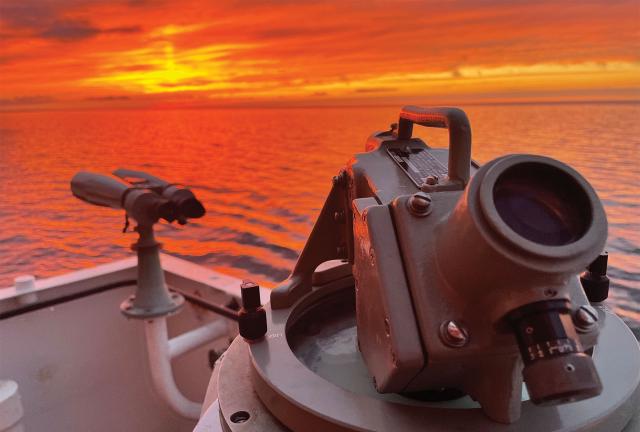
Aleutian Sunset by LCDR Ian Starr, U.S. Coast Guard.
The sun sets around midnight in the Gulf of Alaska during the Coast Guard Cutter Alex Haley’s (WMEC-39) summer 2021 patrol.
The US Naval Institute has announced the results of their annual photo contest. A number of the honorable mentions went to photos with Coast Guard connections.

Vice Adm. Karl L. Schultz, commander, Coast Guard Atlantic Area, speaks at the Coast Guard Cutter Benjamin Dailey commissioning ceremony in Pascagoula, Miss. Coast Guard Photo
Breaking Defense reports the Commandant’s remarks regarding the United Nations Convention on the Law of the Sea (UNCLOS) at a Navy League event.
Also reported were vice chairman of the Joint Chiefs of Staff nominee, Adm. Christopher Grady’s expressions of support for ratification.

U.S. Coast Guard Cutter THETIS (WMEC-910) will be providing escort. US Navy photo ID:J3103SPT95001725 / DNST9800595
The Navy Leagues on-line magazine, Seapower, reports two two FRCs, USCGC Glenn Harris (WPC 1144) and USCGC Emlen Tunnell (WPC 1145), will soon be on their way to Bahrain to join PATFORSWA.
“Coast Guard Commandant Karl Schultz, speaking Dec. 8 at a Navy League Special Topic Breakfast, said the two 154-foot-long FRCs will be escorted across the ocean by the USCGC Thetis (WMEC 910), a Famous-class medium-endurance cutter that was topping off with fuel in Puerto Rico. Schultz said that after the escort mission the Thetis will be operating off Africa.”
I am a bit surprised the escort will be a medium endurance cutter instead of a Bertholf class National Security Cutter.
Also interesting is the report that Island-class patrol boats USCGC Adak (WPB 1333) and USCGC Aquidneck (WPB 1309), were transfered to Indonesia.
Just passing this along. (Thanks to Paul for bringing this to my attention.)

A launch crew is interdicted by Coast Guard law enforcement crews for engaging in illegal fishing in federal waters off the coast of southern Texas April 6, 2020. Coast Guard crews consisting of air support, a small boat crew, and a cutter stopped three lanchas approximately 50 miles north of the Maritime Boundary Line, with a total of thirteen lanchamen were engaged in illegal fishing. Twelve miles of longline gear, illegal fishing equipment, as well as 2,020 lbs of illegally-caught Red Snapper were seized. (U.S. Coast Guard photo)
Below is a news release. Thought it was significant because it provides a summary of an operation that does not get a lot of attention.
The videos that accompanied the release did not transfer over when I cut and pasted the news release. You can see them here.
I would note that while the news release mentions lanchas “…entering the United States Exclusive Economic Zone near the U.S.-Mexico border in the Gulf of Mexico with the intent to smuggle people, drugs, or poach the United State’s natural resources.” There is no information about any people smuggled or drugs seized.
| Coast Guard conducts 78 lancha interdictions in fiscal year 2021 along Texas coast
CORPUS CHRISTI, Texas — Coast Guard law enforcement crews interdicted 78 lanchas, seized 15,484 lbs of catch, and detained 208 fishermen during fiscal year 2021 along the Texas coast. Since the first recorded lancha interdiction in the late 1980s, the Coast Guard has seen a significant uptick in the detection of the vessels, recording close to 300 lancha interdictions in the past three fiscal years combined. A noteworthy case from this year was on Aug. 4, 2021, when Coast Guard Station South Padre Island worked with Coast Guard Sector/Air Station Corpus Christi, Texas Parks and Wildlife and the Coast Guard Cutter Pelican to interdict four lanchas with a total of 320 lbs of red snapper and 1,160 lbs of shark in one day. In cooperation with other law enforcement agencies, the Coast Guard utilizes a layered approach to combat illegal, unreported, and unregulated fishing through aircraft, small boats, and cutters, as well as improved technology on those assets, resulting in the drastic increase in lancha interdictions. “The crew at Station South Padre Island takes their role of protecting our natural resources from poaching along the Maritime Boundary Line very seriously,” said Lt. Cmdr. Daniel Ippolito, commanding officer of Coast Guard Station South Padre Island. “The last few years of record-breaking lancha interdictions speak to the steadfast commitment, professionalism, and teamwork of the Coast Guard crews and our partners at Texas Parks and Wildlife to this mission. We ask that the public continue to stay vigilant and report any instances of illegal fishing to the Coast Guard or Texas Parks and Wildlife.” A lancha is a fishing boat used by Mexican fishermen that is approximately 20-30 feet long with a slender profile. They typically have one outboard motor and are capable of traveling at speeds exceeding 30 mph. Lanchas pose a major threat, usually entering the United States Exclusive Economic Zone near the U.S.-Mexico border in the Gulf of Mexico with the intent to smuggle people, drugs, or poach the United State’s natural resources. If you witness suspicious activity or illegal fishing in state waters (out to 9 miles offshore), please contact the Texas Parks and Wildlife Department’s “Operation Game Thief” at 1-800-792-GAME (4263). For all suspicious activity or illegal fishing occurring in federal waters (out to 200 miles offshore), please contact the U.S. Coast Guard at 361-939-0450. |
Wanted to pass this along.

U.S. Coast Guard sent this bulletin at 10/20/2021 08:44 AM EDT
R 201239Z OCT 21
FM COMDT COGARD WASHINGTON DC
TO ALCOAST
BT
UNCLAS
ALCOAST 388/21
SSIC 1136
SUBJ: VOLUNTEER SOLITICIATION FOR U.S. COAST GUARD ACADEMY
ADMISSIONS PARTNER (AAP) AND ACADEMY MINORITY OUTREACH TEAM
(AMOT) PROGRAM
1. The AAP program is a volunteer network dedicated to supporting
the recruiting and outreach mission of the United States Coast
Guard Academy Admissions office. Since 2006 Academy
Admissions Partners have worked alongside Admissions staff to
educate, recruit and assist the future cadets and officers of the
United States Coast Guard. Our volunteer organization consists of
1,185 members, made up of Active Duty and Reserve members, CGA
Alumni, AMOT, parents of cadets and graduates, USCG Auxiliary, and
friends of the Academy. Volunteer today and give back to America’s
premier maritime Academy by identifying our next generation of
leaders.
2. AMOT is a segment of the AAP program that is comprised of 114
dedicated minority officers and retirees, many of whom graduated
from the Coast Guard Academy. This dedicated group of volunteers
includes African Americans, Asian, and Hispanic officers and
civilians focused on enhancing recruitment efforts and retention
programs for the Academy. Over the last several years, the role
of AMOT has become more influential across every Academy Division
and has expanded beyond recruitment and Admissions outreach support.
Most recently, efforts have crossed into mentoring and retention
efforts at the Academy and in support of the Coast Guard Academy
Scholars (CGAS) program. This renewed direction has held a
significant lasting impact on the overall goal of improving the
cultural competency of the Academy and the Coast Guard. In this
expansion of efforts, in addition to enhancing the recruitment
reach, purposeful and lasting mentoring relationships have been
created with the presence of AMOT volunteers to support retention
of under-represented minority officers at the Academy and in the
fleet after graduation.
3. Normally, AAP and AMOT participants will outreach with local
schools, participate in college fairs, the Academy Introduction
Mission, CGC EAGLE events, USCGA workshops, USCGA Campus Program
events, conduct applicant interviews and present appointments to
accepted students. Realities of COVID-19 have limited personal
interaction, but virtual options exist for Partners and AMOT to
contribute a minimum of two to four hours of volunteer service
each year.
4. Requirements to become an AAP and AMOT member are as
follows: interested Active Duty, Reserve or civilian participants
must pass a basic background investigation or be in good military
standing as an Active Duty and Reserve member. Prospective Partners
must complete the required training and pass an indoctrination test
with an 85 percent or higher. AMOT members will have the option to
take the indoctrination test or attend an annual training session
held by the CGA Admissions office.
5. Interested participants registering for the AAP or AMOT program
are asked to create a profile on the CGA website at:
(Copy and Paste URL Below into Browser)
https://urldefense.proofpoint.com/v2/url?u=http-3A__www.uscga.edu
_partners&d=DwIGAg&c=tnPw9yRHa20_HV5YVoVFtg&r=iweUoGvREbTXYJTAmo
jhygUnTtWgUIWa_NzooIEDasY&m=LjK3atJ-_zT39TfnKDN-ThAQoy3ggnr9wbK9y
NXr6oY&s=fZI3lzvbMtn1vyhW81ZLxels6KdOINellcgq07OG0CM&e=
6. AAP and AMOT registrants will be notified of their Partner status
via email, so prospective Partners and AMOT members should use
an email account that they regularly monitor (personal or .mil
address).
7. For more information about Academy Admissions Partners, visit:
(Copy and Paste URL Below into Browser)
https://urldefense.proofpoint.com/v2/url?u=http-3A__www.uscga.edu_
partners&d=DwIGAg&c=tnPw9yRHa20_HV5YVoVFtg&r=iweUoGvREbTXYJTAmojhy
gUnTtWgUIWa_NzooIEDasY&m=LjK3atJ-_zT39TfnKDN-ThAQoy3ggnr9wbK9yNXr6
oY&s=fZI3lzvbMtn1vyhW81ZLxels6KdOINellcgq07OG0CM&e=
8. Personnel interested in becoming an Admissions Partner should
notify Mr. Alex Eames, Alexander.G.Eames@uscga.edu or
(860) 701-6385.
9. Personnel interested in becoming an AMOT Member should notify
Ms. Katy Robbins, Katy.A.Robbins@uscga.edu.
10. RDML M. W. Raymond, Acting Deputy for Personnel Readiness
(CG-DCMS-DPR), sends.
11. Internet release is authorized.

North Vietnamese 100′ Trawler burns on a South Vietnamese beach after being forced ashore by USCGC POINT LEAGUE, on 20 June 1966. It was carrying an estimated 250 tons of supplies for the Viet Cong. USN 1116663
Mark Tempest’s EagleSpeak has a short post about the Vietnam War Operation Market Time. It included a couple of links I have added to my Heritage page.
Particularly the first provides a good overview of how much combat the Coast Guard was actually in.
Marine Link provides more proof we will be seeing more passenger ships in the Polar Regions. Visions of one of these in serious trouble must being keeping the D17 SAR planners up at night. Basically no SAR assets in the Polar regions.
On the other hand, at some point we may have enough high capacity civilian ships in the area that AMVER rescue becomes a possibility.

