The nearest thing we have had to a Coast Guard SINKEX did not end well. A firehose, it seemed, was more capable of sinking this poorly maintained, unmanned, derelict small vessel than our 25mm gun.
So far there have been two SINKEX exercises in this year’s RIMPAC. The video above is a series of attacks on the former USS Denver (LPD-9).The second video, below, shows attacks on the former USS Rodney M. Davis (FFG 60), a ship about 10% smaller than the Coast Guard’s new cutters (NSC and OPC), that took place on July 12.
The Drive describes the attacks on the former USS Denver. She was a medium sized ship, displacing about 17,000 tons full load, not huge by any means, but larger than most ships used in SINKEX.
During the exercise, the Japanese Ground Self-Defense Force fired Type 12 anti-ship missiles and the U.S. Army launched guided rockets from a High Mobility Artillery Rocket System (HIMARS) at the naval target from land. From the air, U.S. Navy F/A-18F Super Hornets assigned to Fighter Attack Squadron 41 shot a long-range anti-ship missile while U.S. Army AH-64 Apache helicopters shot air-to-ground Hellfire missiles, rockets, and 30mm guns.
From the sea, U.S. Navy guided-missile destroyer USS Chaffee (DDG 90) shot its Mark 45 five-inch gun. To top it all off, the U.S. Marine Corps joined in with F/A-18C/D Hornets assigned to Marine Fighter Attack Squadron 232 and Marine Air-Ground Task Force 7, who then fired an air-launched cruise missile, air-to-ground anti-radiation missiles, and Joint Direct Attack Munition guided bombs. Other weapons were likely used, but these were the ones disclosed by the Navy.
The smaller, 4100 ton, USS Rodney M. Davis (FFG 60), also did not go down easily. In addition to being hit by laser guided bombs and probably other weapons, she was hit by at least four anti-ship cruise missiles, two Harpoon from Canadian frigate Winnipeg, one from a P-8 maritime patrol aircraft, and a French-made Exocet Block 2 from Royal Malaysian Navy Kasturi-class frigate KD Lekir (F-26).
The two SINKEX were somewhat unique, in that they did not require a torpedo to finish sinking the ships, as has occured in almost every previous SINKEX.
It is true that the Coast Guard is more concerned about stopping ships than sinking them, but getting a mobility kill is very difficult. First the propulsion systems take up a relatively small part of the length of the ship and more importantly, most of it is below the waterline. Unless you can hole the engineroom hull below the waterline, forcibly stopping a ship is almost impossible. Killing steering is similarly difficult. If the target is shooting back, it gets much more difficult.
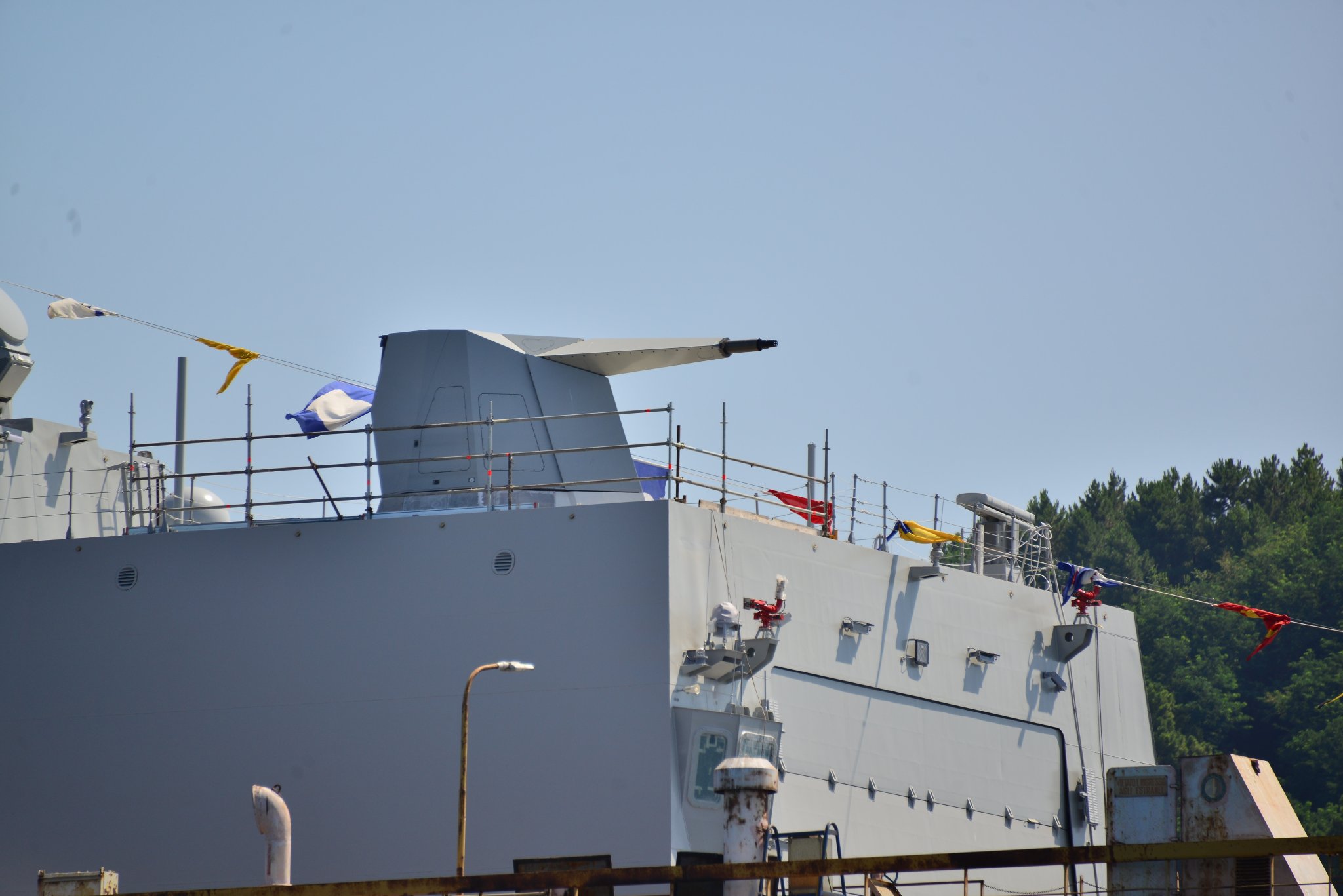
Leonardo 76/62 Sovraponte (Single Deck) naval gun system fitted on the helicopter hangar of the Italian Navy PPA type vessel.
Knowing that a ship will last decades into an uncertain future, when you consider how a ship should be armed.
You want at least two weapons capable of engaging each type of threat for redundancy.
You want the weapons separated so that one hit will not disable all your weapons.
You want to be able to engage more than one target at a time.
You want 360 degree coverage, particularly against air and swarming surface threats.
In addition to self defense, you may want to be able to hit targets on shore. (The Coast Guard did a lot of that in Vietnam.)
It helps both training and logistics if the weapons are versitile enoungh that we can minimize the number of weapon types required. Ideally you want one type of weapon that can do it all.
The 76mm/62 gun may be the most produced medium caliber gun since the 5″/38 of WWII fame, with perhaps more users than any naval gun in history. The Coast Guard still has this gun, the 76mm Mk75, mounted on the Bear class WMECs. Since then, a different, much improved “Super Rapid” (SR) mount has been developed specifically for anti-ship cruise missile (ASCM) defense. In fact, it is designed to deal with the simultaneous arrival of multiple ASCMs.
The Italian Navy considers the SR to be an effective anti-missile weapon and new ships are being built with this weapon in place of the twin “Fast 40” used on earlier ships in that role. OTO-Melara estimates that, combined with the Dardo FCS, the SR can begin engaging attacking missiles at about 6,600 yards (6,000 m), with the first rounds arriving on target at 6,000 yards (5,500 m). With these ranges, a single gun can deal with up to four subsonic sea-skimmer missiles, arriving simultaneously on courses 90 degrees apart, before any reaches 1,100 yards (1,000 m).
The Deck Mounting Advantage
Topside space on many ships is at a premium. Sensors, ECM, comms, and weapons compete for space. A gun normally enjoys pride of place on the bow, but it is more difficult to site weapons on the stern, particularly if they require ammunition handling space under the weapon.
This new mount should retain the capabilities of the SR mount (aside from fewer ready service rounds–76, almost as many as we had on the Mk75, but with the advantage of dual selectable feed) and adds the advantage that it does not require an ammunition handling space below the mount. A clever repackaging of the ubiquitous former Oto-Melara 76 mm gun looks looks like it could be the answer to a number of difficult weapon siting questions This means that it can be mounted in areas where the previous SR mount could not have been mounted, such as on the roof of helicopter hangars or on the fantail where steering gear is directly below (like where the Phalanx was located on the FRAMed 378s).
Frequently, the top of the hangar is to best location, but the space under the roof is already taken up. Weapons like the 25 mm Mk38, the 20 mm Phalanx, or the SeaRAM missle systems can usually find space aft, frequently on top of the hangar, because they don’t require deck penetration, but they do not have the versatility of the 76mm.
That might not matter much on more powerful warships that have a range of different weapons to address different threats, but for ships with a limited number of weapons, it can be critical.
The Alternatives
Looking at the US Navy weapons that are typically mounted on top of the hangar because they don’t require below deck ammunition handling space:
The Mk38 even in the anticipated Mod4 version is a short range (4400 yard max/2200 yard effective) weapon with only minimal anti-air capability and suitable for engaging only small surface targets.
The 20mm Phalanx is capable against ASCMs but it was designed to stop “leakers,” as a last ditch back up to more capable systems. It was never intended as a complete, stand alone ASCM defense systtem. If multiple ASCMs arrive simultaneously, it could probably successfully engage only one, or at most two. It does have limited short range counter drone and counter-swarm capability, but its projectile is a non explosive high velocity .50 caliber, so its effect on any but the smallest surface vessel is likely to be very limited and only then at very short range (1625 yard effective). Quoting from the link in this paragraph,
In recent years, the Vulcan 20 mm gun that is the heart of this weapon has increasingly been seen as not being effective enough against modern missile threats. However, the British Royal Navy did select Phalanx for their new Daring class Type 45 destroyers.
Phalanx is somewhat notorious for having maintenance problems, with the Navy’s Material Readiness Database for fiscal years 1997 through 1999 noting that Phalanx Block 1B (all mods) had an availability rate of between 72 and 81% for this time period.
The RIM-116 Rolling Airframe Missile (RAM and SeaRAM) is probably the best short range counter to anti-ship cruise missile (ASCM) in the USN inventory. I can understand why the Dutch chose it for the Karel Doorman upgrade. It has been modified to incorporate an anti-Helicopter, Aircraft, and Surface (“HAS”) capability. Range is reportedly 10,000 meters, about 11,000 yards, and it has a decent sized warhead, 11.3 kg (24.9 lb). That is far more than the range of the either the Mk38 or the Phalanx.
Each of these is designed for a particular threat. RAM is by far the most versatile but even it cannot match range and capabilities of the 76mm with its numerous ammunition alternatives.
Programable Fuze: Like the 57mm Mk110, the 76mm can use a programable fuze, the 3A-Plus programmable multi-role fuze. It is described as having several modes including a time mode for air burst and a number of proximity modes: gated proximity, anti-missile proximity, conventional air defence proximity and anti-surface proximity. The fuzing includes a digital signal processor which rejects ground/sea clutter and so is claimed to be capable of detecting a missile flying as low as two meters above sea level while being able to recognise a target at a 10-meter stand-off.
Guided munitions are being developed for the 57mm Mk 110 (ALaMO and MAD-FIRES). These technologies could also be applied to the larger 76mm round, but a capability that appears similar to MAD-FIRES has been available with the 76mm for about a decade, with the advantage that it includes a proximity fuze. Additionally, reportedly, extended range rounds that may be guided against both fixed and moving targets are or soon will be available for the 76mm.
DART (Driven Ammunition Reduced Time of Flight):
European Defense Review On-Line reports,
“…the Super Rapido is offered in the Strales (or Davide as identified by Italian Navy) configuration based on the DART (Driven Ammunition with Reduced Time of Flight) guided ammunition and a Ka-band guidance radar antenna required to generate the ammunition guidance beam installed on the gun mount. The sub-caliber DART projectiles demonstrated an effective range up to 8 km (in comparison with a 4.5 km requirement) and a 1,200 m/s initial velocity allowing to cover 5 km in 5 seconds. These performances together with the high maneuverability of the DART round allowed the system to demonstrate its effectiveness against present and future ASCM targets, at a fraction of the cost of a missile engagement but with equivalent performances, Leonardo claims.”
Quoting from Wikipedia:
The DART projectile…is a guided gun projectile with radio controls and a proximity fuze for low level engagement (up to 2 meters over the sea). DART is fired at 1,200 m/s (3,900 ft/s), can reach 5 km range in only 5 seconds, and can perform up to 40G manoeuvre.The DART projectile is made of two parts: the forward is free to rotate and has two small canard wings for flight control. The aft part has the 2.5 kg warhead (with tungsten cubes and the 3A millimetric wave new fuze), six fixed wings and the radio receivers.
The guidance system is Command Line of Sight (CLOS). It uses a TX antenna installed on gun. The radio-command for them is provided on a broadcast data-link (Ka Band).
The first lot of DART 76mm guided ammunition, produced by OTO Melara, was successfully tested at the end of March, 2014. The firing trials were conducted on board one of the Italian Navy’s ships equipped with Strales 76mm SR and Selex NA25 fire control system. The first firing trials of the DART ammunition bought by Colombia in 2012 were successfully conducted in the Caribbean Sea on 29 August from the 76/62 Strales inner-layer defence system fitted to its modernised FS 1500 Padilla-class frigates.
Above is a video of the DART validation tests, first against a low level, but essentially stationary targert to test the fuzing against a target in sea clutter and then against a moving target, in this case a Banshee target drone. I believe the antennae seen attached above the gun barrel were part of the test rig, as these are not normally present on the gun mounts.
Vulcano
I see the possibility that there may be a confrontation between Offshore Patrol Vessels (OPV) in the South China Sea or East China Sea in which a China Coast Guard (CCG) vessel fires warning shots and directs the OPV of another Asian nation (I will call AN) to depart a disputed area. The AN OPV stands it ground and refuses to leave. The CCG OPV having a longer ranged weapon (up to 76mm currently), remains outside the range of the AN OPV and fires a few rounds for effect in an attempt to drive the AN OPV away. Whether the CCG OPV scores any hits or not, the AN OPV now has three choice, none good, stay and perhaps take additional damage, run away, or attempt to close the CCG OPV to get in range for a fight they will probably lose.
In 2021 Russia claimed to have fired warning shots in driving a Royal Navy Destroyer from waters of Crimea. The claim was untrue, but for many audiances, the claim probably went unchallenged.
Range matters, in the scenario above, if the AN OPV had a weapon of equal or greater range than that of the CCG OPV, the CCG OPV would probably never have fired to hit, because it could not have done so with impunitity. Reportedly, 76mm Volcano rounds that will outrange conventional rounds from Chinese and Russia guns, not just 76mm but also 100mm (3.9″) and 130mm (5.1″) and reach any target within the visual and radar horizon (to over 40,000 meters)
The Vulcano family will actually include at least three different types of 11 lbs. (5 kg), extended range, sub-caliber discarding sabot projectiles.
Unguided Balistic Extended Range (BER) (range over 30 km/32,808 yards)
Guided Long Range (GLR) (range over 40 km/43,744 yards)
Guided Long Range with InfraRed Terminal Homing (GLR/IR)(range 40 km/43,744 yards)
a Guided Long Range with Semi-Active Laser (GLR/SAL) is in development
Leonardo advertises Vulcano rounds for the 76mm as if they are already available. But also advises it is still under development. Apparently development is expected to be complete this year.
The more recent development is the VULCANO 76 ammunition system. Basically, it is a scaled down version of the 127–155 mm Vulcano family of extended-range projectiles developed by Oto Melara; guided by Inertial Navigation System and Global Positioning Systems, it is capable of hitting targets twice the distance of normal 76 mm gun ammunition. GPS-IMU guidance and IR or SAL (Semi-Active Laser-Chuck) Terminal sensor. The Vulcano 76 GLR ammunition is expected to complete the development, test and qualification process by late 2022 with the delivery of production rounds to customers from 2023–24 onwards.
The Unguided Balistic Extended Range (BER) Vulcano round may already be operational. It would certainly be the easiest to develop. This high velocity sub-caliber discarding sabot round is usable for anti-air, anti-surface, or for Naval Gun Fire Support. At 5 kg (11 pounds) it is still about twice the weight of a 57mm Mk110 projectile. It has a multifunctional Fuze that provides options for altimetric, proximity, time and air burst, or impact and delayed impact.
Considering the Coast Guard’s implicit requirement to be able to forcibly stop even relatively large merchant ships, the combination of high velocity, semi-armor piercing, and delayed impact fuzing suggest that a BER projectile might have a better chance of penetrating the hull and delaying detonation until the projectile impacts the engine, compared to the other alternatives.
Guided Long Range (GLR):
These projectiles take the form of the unguided Ballistic Extended Range (BER) round and add GPS and inertial guidance to allow precision attack on fixed targets. The control surfaces allow a glide phase that extends the range another 10,000 meters to beyond 40,000 meter or about 22 nautical miles.
Guide Long Range with InfraRed Terminal Homing (GLR/IR):
These projectiles add a infrared terminal homing to the guided long range round so that it can target moving targets on land or water that have an infrared signature. The guidance system defines where the terminal homer will look for a target. It might be possible to defeat this round using IR decoys or obsurants (smoke).
Guided Long Range with Semi-Active Laser Homing (GLR/SAL):
Like the GLR/IR round this uses the form and function of the GLR round but instead of using IR homing, it uses semi-active laser homing, meaning some one or some thing has to illuminate the target with a laser designator. For shore bombardment the laser designator might be in the hands of a soldier on the ground. For targets afloat and ashore the laser designation might be done by an unmanned system.
For a Coast Guard cutter trying to forcibly stop a vessel, the cutter might well use a laser designator to target a particular part of the target vessel.
Conclusion:
If you are going to put only two gun weapon systems on a ship, be it a cutter, corvette, or a large auxiliary, two of these might be a very good choice if they perform as advertised. Range with volcano ammunition is outstanding. The range of ammunition choices make these systems effective against a wide range of threats from swarming small boats, to surface ships, to UAS, to anti-ship cruise missiles. It is essentially one weapon that can do it all, atleast within the visual and radar horizon and in some cases a bit beyond.
Seems a pair of these would be a nice replacement for the two 25mm MK38s that appear to be the planned armament for the the Polar Security Cutter. Would love to see a pair of these replace the 57mm Mk 110 and 25mm Mk38 or Phalanx on our new large cutters. Replacing the Mk38 or Phalanx with SeaRAM seems more probable, but still unlikely, unless things get a lot more tense.
I have suggested numerous times that the Hellfire missile and its replacement the JASM (Joint Air to Surface Missile) could give even small cutters an effective weapon to counter small, fast, highly maneuverable surface threats and might even be effective to a degree against larger vessel threats.
But before it can be mounted on cutters, the missile and an appropriate launcher have to be in the Navy Department inventory, since all Coast Guard heavy weapons come from the Navy Department.
The Navy and Marine Corps have or will have these missiles in their inventory. They are used from helicopters. The Navy is also already using surface launched Longbow Hellfire missiles as part of the Anti-Surface mission module being used on Littoral Combat Ship. There was a recent test of the missile launched by an Independence class LCS against land targets.
PACIFIC OCEAN (May, 12, 2022) – An AGM-114L Longbow Hellfire missile launches from the Surface-To-Surface Missile Module (SSMM) aboard Independence-variant Littoral Combat Ship USS Montgomery (LCS 8). The missile exercise was the first proof of concept launch of the Longbow Hellfire missile against land-based target. (U.S. Navy photo by Lt.j.g. Samuel Hardgrove)
“Lockheed is increasing production of Hellfire missiles, weapons widely associated with drone strikes, from 7,000 per year to about 11,000 per year, CEO Marillyn Hewson said in May.”
From the Coast Guard perspective, the missing element is a launcher suitable for patrol boats and particularly for the numerous Webber class.
Greater range and an AAW/counter UAS capability could prompt mounting the weapon on a wider variety of Navy and Marine platforms including unmanned surface vessels and the Light Amphibious Warship.
Increased range would certainly be welcomed. There are several similar non-US systems that offer greater range than the current approximate 8 km range of surface launched Hellfire and JASM. 16 km is very close to the maximum range of the 57mm Mk110 and the 76mm Mk75 guns and well beyond their effective range.
JAGM is too heavy to replace Stinger as a man portable system, but as a potential replacement for vehicle mounted Stinger missiles, JASM potentially provides much greater range than the Stinger and is a more versatile weapon.
The Marines are fielding MADIS (Marine Air Defense Integrated System) which currently includes a remote weapon station armed with a 30mm cannon, a 7.62 mm machine gun and Stinger short range anti-air missiles. If JASM should replace the Stinger it would give these small vehicles, not only more range against air targets but also an additional anti-surface/anti-armor capability. The combination of greater range and an additional anti-surface capability might be an incentive.
We may see JASM in the service of the Navy or Marine Corps on Unmanned Surface Vessels (USV). We have already seen a launcher on a USV.
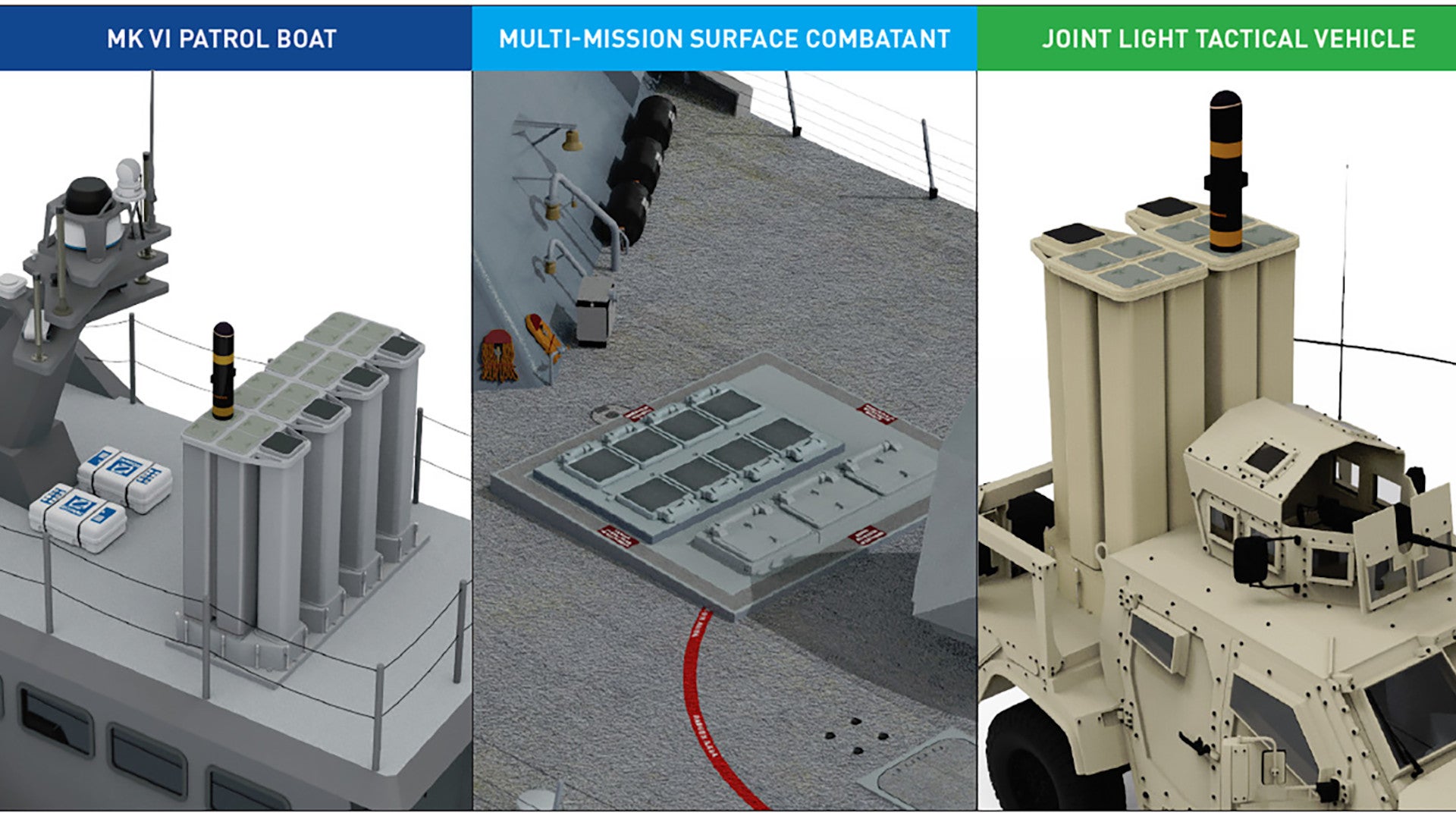
In 2020 Lockheed circulated a proposal for a four round vertical launch system that included an illustration of a 16 missile launch system in a 4×4 configuration mounted on a Navy MkVI patrol boat.
The JAGM Quad Launcher (JQL) leverages technology from Lockheed Martin’s existing Vertical Launch System (VLS) designs, which include the popular Mk 41 VLS found on numerous warships in the U.S. Navy and other navies around the world. It also uses the same Launcher Electronics Assembly (LEA) from the M299 launcher, a four-rail design for helicopters most commonly associated with the AH-64 Apache. All of this combined with an open-architecture Launcher Management Assembly (LMA) designed to help speed up the integration of updated hardware and software as time goes on to improve the JQL’s capabilities and add new functionality.
The system illustrated as applicable to a “Multi-Mission Surface Combatant” appears to be a replacement for the 24 round launch system currently being deployed on LCS but could house 32 missile.
JASM could provide Coast Guard vessels as small as patrol boats, with a much more accurate, more powerful, and longer ranged response to the need to be able to forcibly stop vessels both small and large, while also providing counter UAS, a degree of anti-aircraft protection, and should it ever be required, a naval fire support ashore capability.
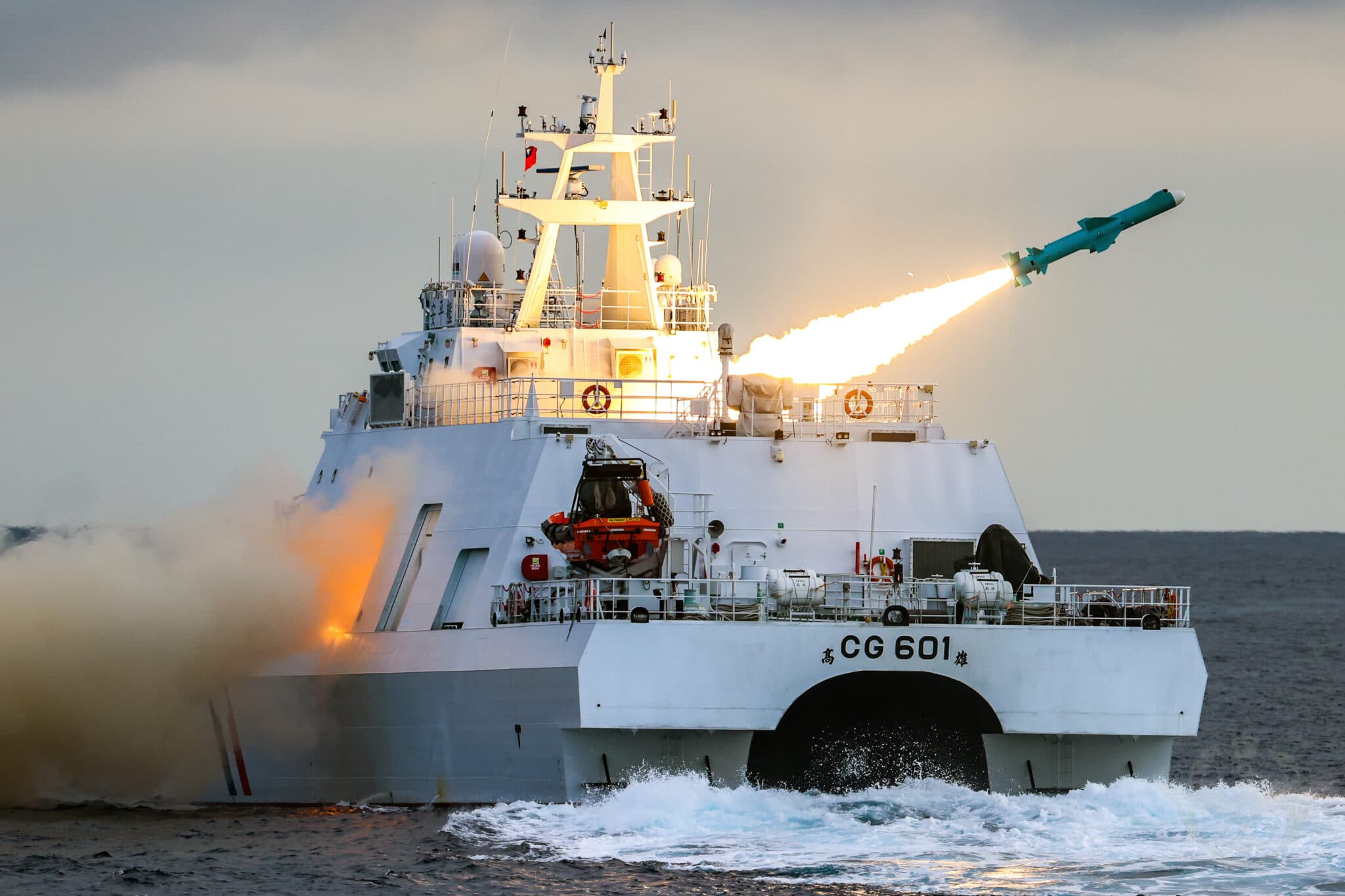
During the test conducted on May 23, officials said that the HF-2 missiles were launched from the cutter off the coast of the Jiupeng Base and successfully hit a target ship that was located 62 miles off the coast of Lanyu, near Orchid Island. According to Taiwan’s Liberty Times Net reporter Zheng Jingyi, “this live ammunition firing specifically verifies the integration of the naval forces and sea cruisers under the ‘peace-to-war conversion.’”
This was a test and the missile launch equipment was removed immediately after the test. The launch and control was conducted by Taiwanese Navy personnel, temporarily assigned for the test.
Since the cutters are a version of a missile equipped Taiwanese Navy corvette, there would seem little reason to believe the test would not have been successful.
Reportedly twelve corvettes and twelve cutters are planned, but the prototype Navy corvette was commissioned in 2014, the second not until 2021, and none since. On the other hand four of the cutters have entered service beginning 2020 with two more under construction.
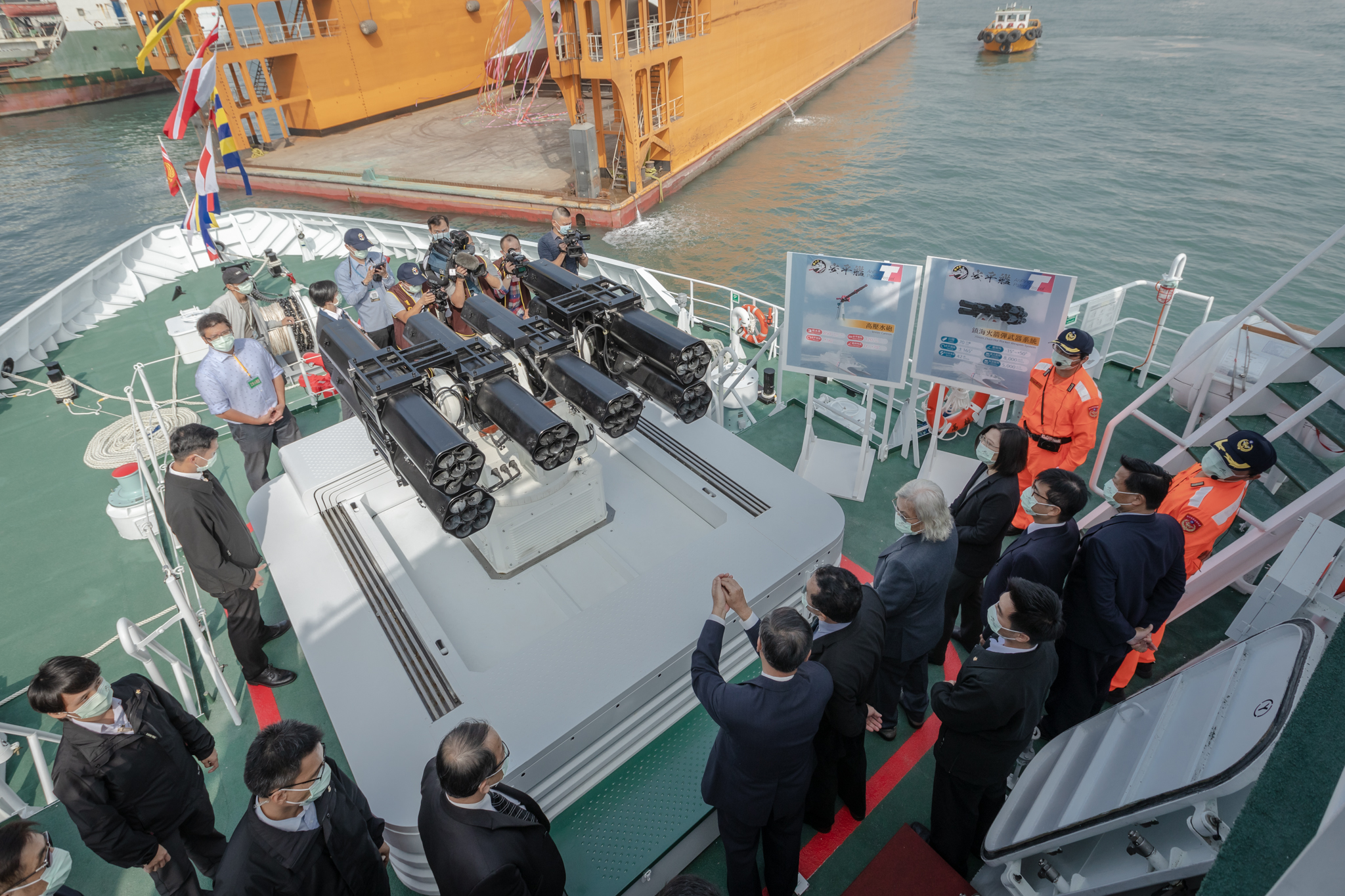
The normal armament of these and other Taiwanese cutters includes an unusual 42 round, remote controlled, “Zhenhai” 70mm/2.75″ rocket launcher. It is unclear if these rockets have a guidance system like APKWS. Photos below from Wikipedia.
Taiwan Anping-class offshore patrol vessel onboard multi-barrel Zhenhai rocket system
Below is a post from the Acquisitions Directorate (CG-9). I had never heard of the “Athena combat weapons system” so “Googled” it. The most common thing that came up was an Army laser weapons program. I don’t really think that is what they talking about, but I could be wrong. The post does call it a “weapons system.” I think it may be the Leonardo ATHENA® (Architecture & Technologies Handling Electronic Naval Applications) Combat Management System (CMS). Leonardo’s web page on the system indicates it is the CMS used on the FREMM frigate which is the parent craft for new USN FFG. Maybe the Navy liked the CMS as much as they liked the ship.
The CMS on the Bertholf class cutters is an Aegis based system. I have not heard anything about its application to the offshore patrol cutter (OPC).
Late Addition: Got this, thanks to Timothy H,
AEGIS Athena Baseline 9G
That is good news, since it means there will be commonality between the systems on the NSCs and the OPCs.
The Coast Guard modified its current contract with Eastern Shipbuilding Group (ESG) May 20 so installation of the Athena combat weapons system and multi-mode radar system will be completed during the production phase of the offshore patrol cutter (OPC). The Athena system, radar and armament of the OPC are provided to the Coast Guard as Navy type-Navy owned government furnished equipment.
Prior to this modification, installation of both systems was to occur after contract delivery while each cutter was in its homeport. The Navy has completed development, integration and testing of the Athena and radar systems, enabling the Coast Guard to shift to production-phase installation. Performing this work prior to delivery reduces the technical risks associated with post-delivery installation and delivers mission-ready OPCs to the fleet as soon as possible.
The first four OPCs are currently in production at ESG’’s shipyard in Panama City, Florida.
The OPC meets the service’s need for cutters capable of deploying independently or as part of a larger task force and is essential to stopping smugglers at sea, rescuing mariners, enforcing fisheries laws, responding to disasters, interdicting undocumented individuals and protecting the nation. The acquisition of 25 OPCs will complement the capabilities of the service’s national security cutters and fast response cutters as an essential element of the Department of Homeland Security’s layered maritime security strategy.
We have discussed possible Coast Guard use of this weapons system several times, here, here, here, here, here, and here.
The weapon is ideal for engaging small, fast, highly maneuverable surface targets, but its warhead is large enough that several hits could seriously damage larger targets. It has also been tested successfully against Unmanned Air Systems. There seems to be some indication APKWS might be mounted alongside the gun on the Mk38 mounts.
The post includes several videos including the one above that shows at least a couple of mounts including a simple ring mount and a remote weapon station. These demonstrate how small the footprint of this weapon can be.
Perhaps more importantly, it reports current and planned production figures for this weapon, that clearly show it to be common, proven, and widely available.
“… the U.S. military has a lot of 70mm rockets and buys thousands more every year. The Army alone plans to buy 60,000 unguided rockets in fiscal 2023 alone. BAE Systems, which builds the APKWS II seeker kit, is tooled to build 25,000 of them per year and is expanding production, according to its website. It has already delivered 37,000 units in six years of production.”
Naval News brings us a report of the destruction of two small Russian patrol boats by small guided weapons launched from an unmanned aircraft.
This should not come as a surprise to anyone. The Ukrainians have been attacking Russian vehicles with guided weapons, launched from UAS since the invasion began. Hitting a boat, is, if anything, easier than hitting a particular moving vehicle on a landscape cluttered with other vehicles, buildings, trees, and various heat sources.
But perhaps for those who have not been paying attention this may be a wakeup call. I happy to be able to say it looks like the Coast Guard has recognized this as a threat to our boats in PATFORSWA.
But maybe we need to look beyond the threat of nation states. Like other effective, but relatively cheap weapons, UAVs, and particularly suicide drones, are likely end up in the hands of non-state actors, including criminal and terrorist organizations.
Below is a press release from Sig Sauer, reporting that they have been awarded a contract for two closely related weapons intended to replace the M4/M4A1 carbine and the M249 Light Machinegun. Both use a new 6.8 mm round. There has been concern that the 5.56 mm round is not effective against some of the better body armor. I have not seen the M249 in Coast Guard service, but the Coast Guard does use the M4/M4A1 and the 7.62 mm M240. The new round is reportedly an improvement on both the 5.56 and 7.62mm rounds, so it would not be unreasonable to expect the new weapons to ultimately also replace the M240 in Coast Guard service. This would offer the logistical advantage of requiring only a single rifle caliber round service wide.
According to a report from National Defense, the weapons will be paired with a ruggedized advanced fire control system that increases accuracy and lethality, the XM157, which “integrates a number of advanced technologies, including a variable magnification optic (1X8), backup etched reticle, laser rangefinder, ballistic calculator, atmospheric sensor suite, compass, Intra-Soldier Wireless, visible and infrared aiming lasers and a digital display overlay.”
It probably will take some time before the Coast Guard sees these new weapons.
NEWINGTON, N.H., (April 20, 2022) – SIG SAUER is honored to be awarded the Next Generation Squad Weapons System (NGSW) Contract by the U.S. Army after a rigorous 27-month testing and evaluation process.
“The U.S. Army is taking a bold step toward command of the 21st century battlefield and SIG SAUER is immensely proud to be the selected provider for this historic revolution in infantry weapons. The fielding of the SIG SAUER Next Generation Squad Weapons System will forever change the dynamic of military engagement for America’s warfighters with American innovation and manufacturing,” began Ron Cohen, President and CEO SIG SAUER, Inc.
The SIG FURY Hybrid Ammunition (6.8 Common Cartridge), SIG-LMG (XM250), SIG MCX-SPEAR Rifle (XM5) and SIG SLX Suppressors meaningfully advance soldier weapons technology to meet the emerging requirements of the U.S. Army.
The SIG 6.8×51 FURY Hybrid Ammunition uses a patented lightweight metallic case designed to handle pressures higher than conventional ammunition, resulting in dramatically increased velocity and on-target energy in lighter weapons.
The SIG-LMG lightweight belt-fed machine gun and SIG MCX-SPEAR Rifle are purpose-built to harness the energy of the SIG FURY 6.8 Common Cartridge Ammunition enabling greater range and increased lethality while reducing the soldier’s load on the battlefield. Both the SIG-LMG and MCX-SPEAR deliver significant weapon and technology advancements to the soldier and provide a solution for battlefield overmatch in comparison to the current M249 and M4/M4A1.
The U.S. Army’s procurement of the NGSW System marks the beginning of an era where combat weapons are coupled with a suppressor as standard issue equipment. The SIG SLX Suppressors are designed to reduce harmful gas backflow, sound signature and flash. SIG SLX Suppressors feature a patented quick-detach design for easy install and removal.
“We commend U.S. Army leadership for having the vision to undertake this historic procurement process to deliver a transformational weapon system to our warfighters. This award is the culmination of a successful collaboration between SIG SAUER and the U.S. Army, and we look forward to the continuing partnership,” concluded Cohen.
Below I have posted two videos by Naval News, along with the breakdown of topics that accompanied the videos on YouTube. The video of the 30mm Mk38 Mod4 with its included electro-optic fire control system is probably of most immediate interest to the Coast Guard, but the increasing tendency to containerize weapon systems is appears ready to make any cutter (and almost any other ship) a missile carrier.
01:06 – Constellation-class frigate program with Fincantieri Marinette Marine
04:30 – MSI Defence Mark 38 Mod 4 30mm naval gun system
07:53 – Lockheed Martin’s Expeditionary Launching System
151014-N-GR120-152 INDIAN OCEAN (Oct. 14, 2015) The guided-missile cruiser USS Normandy (CG 60) prepares to come along side for a fueling-at-sea with the aircraft carrier USS Theodore Roosevelt (CVN 71). Theodore Roosevelt is operating in the U.S. 7th Fleet area of operations as part of a worldwide deployment en route to their new home port in San Diego to complete a three-carrier homeport shift. (U.S. Navy photo by Mass Communication Specialist 3rd Class Anna Van Nuys/Released)
If we ever have another major conventional naval war, as appears increasingly likely, the Navy is going to need a lot more ships, including a lot more missile shooters. Defense News reports the Navy is considering how to add additional capability. The Navy is even considering putting missiles on cargo ships. As Rep. Elaine Luria (D-VA, Cdr. USN, ret.) pointed out, a number of cruisers equipped with MK41 VLS are being retired. The 22 remaining cruisers each have 122 Mk41 vertical launch cells as well as two 5″/62 Mk45 Mod4 guns.
Five of the cruisers have been approved for decommissioning in the 2022 budget. It is likely the remaining 17 will follow in the next few years.
I suggest that some of these VLS sets be stored and earmarked as mobilization assets for possible future installation on the National Security Cutters (NSC) should the need arise. Studies have shown that the NSCs could accept up to 16 Mk41 VLS. These VLS might be recycled to the new Constellation (FFG-62) class too, but since the planned 20 ships will only use 640 VLS, it would only require seven cruisers to donate enough VLS to arm both 20 FFG and 11 National Security Cutters.
It should not be too difficult to integrate the Mk41 VLS on the National Security Cutters since their combat systems use Aegis software.
Potential Mk41 VLS weapons load outs for tactical and strike length launchers.
In addition, it might be wise to earmark the cruisers 5″/62 Mk45/Mod4 guns for possible upgrades for both National Security and Offshore Patrol Cutters as well.
The Navy’s entire Naval Gun Fire Support (NGFS) capability is about 114 Mk45 5″ guns on 22 cruisers with two guns each and about 70 DDGs with only one gun. By the time the cruisers are gone, we may have perhaps 80 DDGs. That means the loss of about 30% of the current capability. Equipping the 36 NSCs and OPCs with 5″/62 Mod4 guns from the retiring cruisers could entirely replace the lost capability and importantly provide it in ships that are not likely to be deployed out of position to provide NGFS because they are needed elsewhere to provide AAW protection.
To ensure we can make these changes quickly when needed, it might be prudent to equip at least one ship of each class as a prototype for future upgrades. Upgrading one ship of each class would probably cost less than one FFG and would provide a template for future upgrades if necessary. The OPC prototype might attempt something like I described here.
Since this is preparation for war, the prototypes and storage of the weapons could come from the Navy’s budget.





 Chuck Hill's CG Blog