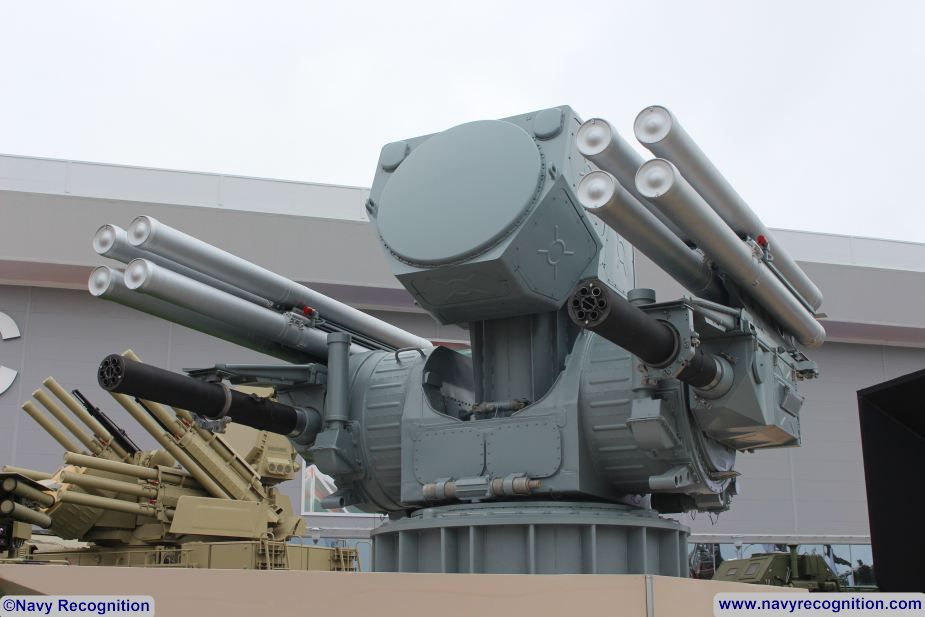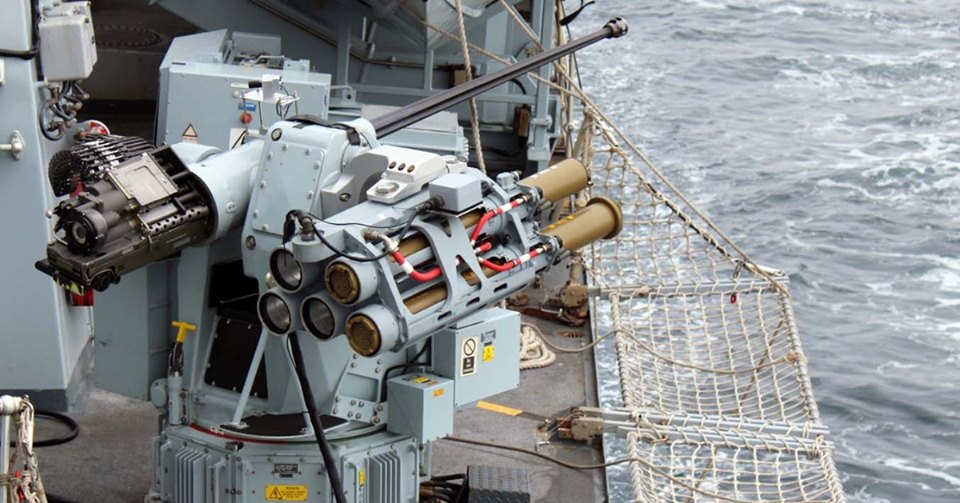
This is certainly not the first time we have seen missile launchers attached to a gun. The Israelis have been doing it for years using the Typhoon gun mount which is the basis for the current 25mm Mk38s as used on the Webber class. .
Spike LR Missile launched from a Typhoon weapon station on an Israel Navy Super Dvora Mk 2. A similar configuration was recently tested by the US Navy, from an unmanned surface vessel (USV-PEM). Photo: RAFAEL
The dimensions of the British missile and American APKWS and Hellfire are provided for comparison.
Martlet LMM: Length: 51 in. (1.3 m), Diameter: 3 in. (76 mm), Weight: 28.6 lb (13 kg), Range: 8,000 meters
APKWS: Length: 73.8 in (1.87 m), Diameter: 2.75 in (70 mm), Weight: 32 lb (15 kg), Range 5,000 meters
The Martlet has the option of proximity fusing and Laser Beam Rider guidance (in addition to semi-active and IR homing), that probably makes it more effective against air targets, particularly smaller ones like drones. It has been used successfully against a target drone. It also has a longer range than APKWS, but is probably more expensive. Its biggest disadvantage from our point of view is that it is not in the USN inventory.
I am not advocating for this particular weapon, but both Israel and the Royal Navy have seen the wisdom of combining missiles with auto cannon.
It minimizes manning requirements in that a single operator can control both missiles and guns.
It minimizes space requirements
It eliminates the need to pass the targeting information from one fire control to another as the target enters gun range.
Unlike separate systems it probably also means you cannot engage two targets simultaneously.
We need a gun for the signaling, the proverbial shot across the bow, but it is not the best way to neutralize a threat. In an installation like this, the missile is more accurate, has longer range, and is less likely to cause collateral damage.
My feeling is that the Coast Guard would be better off with Hellfire than APKWS. We probably will not have to engage a large number of small targets as the Navy might, but our targets might be larger and this might be the largest weapon available to us. Either APKWS or Hellfire would be an improvement over what we have. The nominal effective range of the 25mm Mk38 is 2,700 yards (2,457 m). The APKWS would double this and the Helfire would triple the effective range. Either would allow us to engage from outside the likely effective range of any improvised weapon system that might be used in a terrorist attack, which I estimate would not exceed 4,000 yards.
When the Mk38 Mod3 was announced, there were indications BAE intended to add a capability to launch APKWS from the mount. I am still hoping.
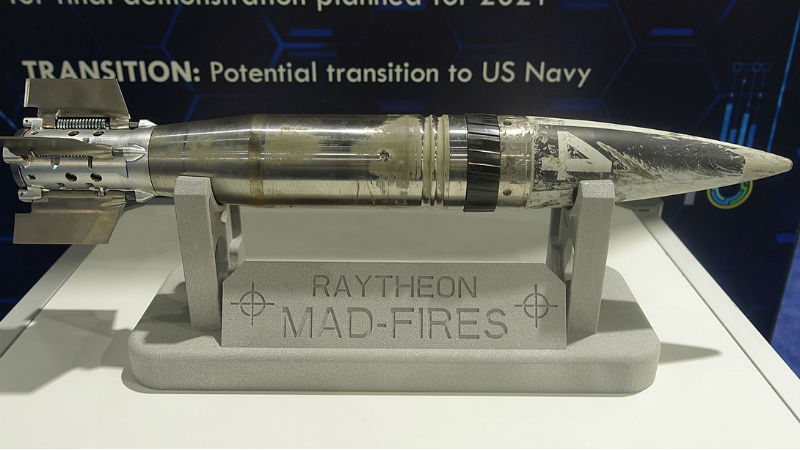
DARPA is working on what is essentially a gun launched guided missile, and reading their description or this report of testing of the rocket motor, you would not know that it is intended for the 57mm Mk110 gun currently mounted on the National Security Cutters (NSC) and planned for the Offshore Patrol Cutter (OPC). Fortunately the video above makes that clear. The portion related to MAD-FIRES is time 6:30 to 7:35. (I have seen some indications they plan to use the same technology on different size rounds, but the 57mm looks like the first beneficiary.)
“Envisioned benefits of MAD-FIRES for future systems include:
“Improved real-time defense against evolving air and surface combat threats, facilitated by:
“Extreme precision
“An ability to defend against greater numbers of simultaneous and diverse attacks
“Decreased per-engagement costs by a factor of 10 or more
“Potential future applicability to air and ground platforms”
Like most of you I did not make it to the Navy League’s 2019 Sea-Air-Space Exposition, so I have found some YouTube reports that can at least provide some of the information passed along at the event. The descriptions below each video are from the YouTube description.
Day 1 video coverage at the Sea Air Space 2019 exposition. In this video we cover:
– Boeing MQ-25 Stingray aerial refueling drone with Rear Admiral Corey
– Future USVs and XLUUV/Orca programs with Captain Pete Small
– Austal USA new range of medium and large size USVs
– Textron Systems CUSV with surface warfare payload
– ST Engineering range of USVs
Day 2 video coverage at the Sea Air Space 2019 exposition. In this video we cover:
– Raytheon SPY-6 radar
– Raytheon / Kongsberg NSM for USMC
– Northrop Grumman PGK for naval 5 Inch and 155mm guns
– Lockheed Martin Freedom-class lethality and survivability upgrade
– Lockheed Martin FFG(X)
– Navantia / BIW FFG(X)
Day 3 video coverage at the Sea Air Space 2019 exposition. Washington-based naval expert Chris Cavas is our guest speaker for this third and final day at Sea Air Space 2019. Cavas covers the follow topics:
– Bell V-247 Vigilant VTOL tilt-rotor UAV in U.S. Navy configuration
– Austal USA USV concepts
– Austal USA FFG(X) Frigate
– Fincantieri FFG(X) Frigate
– GD Bath Iron Works FFG(X) Frigate
– Lockheed Martin Type 26 CSC
– Lockheed Martin hypervelocity missile
– Mic drop
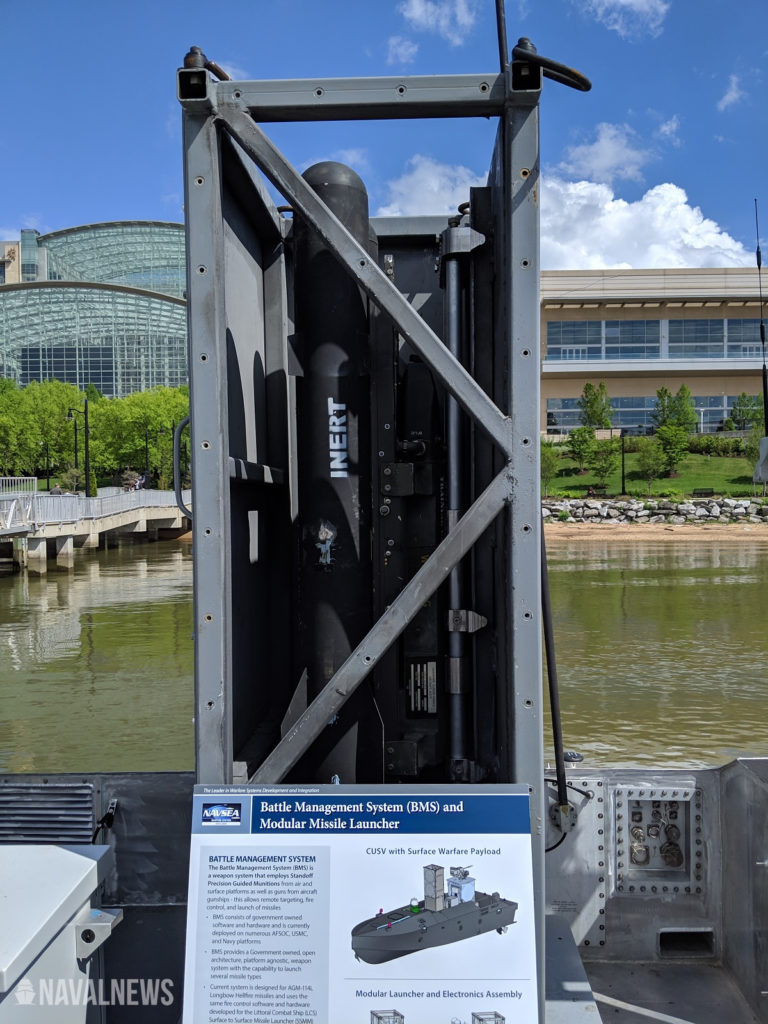
Photos: Above, Modular Missile Launcher, also seen below amidships on the Textron CUSV (Common Unmanned Surface Vehicle). Note relatively small size and innocuous appearance.
Textron Systems’ CUSV with Surface Warfare payload at SAS 2019
Naval News reports that, at this year’s Sea-Air-Space Exposition, Textron showed one of their Common Unmanned Surface Vehicle (CUSV) craft equipped with a remote weapon station and a modular vertical launch system for the Longbow Hellfire.
I find the Hellfire VLS particularly interesting, as it might find application on Coast Guard cutters. The launcher appears to be about 2’x2’x7. The missile itself is 64″ long (1.6 meters), 7″ in diameter (17.8 cm), with a 13″ span (33 cm).
The CUSV is about 39′ (12 meters) in length. The CUSV’s load space is reportedly 20.5′ x 6.5′.
This earlier report indicates a missile shoot from a CUSV is expected in 2019.
There would of course be concerns about how to mount these missiles on a cutter. The effects of the smoke at launch on he crew and the possible effects of the engines ingesting the smoke would have to be considered.
The planned transfer of six Webber class cutters to Bahrain, to replace the six Island class cutters assigned to PATFORSWA, might provide the incentive necessary to plan and test a Hellfire installation on this class.
7.62 mm Chain Gun as Coax as optionally installed on 25 mm Mark 38 Mod 3. Image copyrighted by NAVSEA Dahlgren.
The Navy League’s online magazine Seapower is reporting that ” The Navy is installing a co-axial 7.62 mm machine gun on the mounts of its Mk38 chain gun systems, a Northrop Grumman official said….the addition of the co-axial Mk52 machine gun gives the gunner another “right-sized” option for countering a small target, such as pirates or terrorists on jet skis…Northrop Grumman is installing the Mk52 guns in the Mk38 under an indefinite delivery/indefinite quantity contract.”
This has been proposed for several years now, but this is the first indication it is happening. The proposed weapon, the 7.62mm Mk52, is in fact an electrically powered chain gun like the 25mm Mk242. (The article appears to be incorrect in this regard.)
The article also discusses the possibility of upgrading the Mk38 by replacing the 25mm gun with guns of 30 or 40mm.
I think the Coast Guard could make a good argument for upgrading its Mk38s to 40mm. The change would make very little difference to a DDG, also equipped with a 5″ gun and anti-ship missiles, but the Mk38 is the largest weapon available on about 75 Coast Guard cutters and these cutters could at any moment be required to face a vessel much larger than the Iranian boats the Navy has been fixated on. We already know the 30mm is a quantum leap in capability compared to the 25mm. Effectiveness is closely related to projectile weight. The 30mm projectile weighs about twice that of the 25mm. The 40mm projectile will weight three to four times as much as the 25mm. Since the rate of fire for these guns is similar, the 40mm is likely to be at least three times as effective against more difficult targets and also has a greater effective range.
Addendum:
The Coast Guard plans to install the Mk 38 on 64 Webber class and 25 Offshore Patrol cutters. The older crew served version of the Mk38 is on the remaining 378s, the 210s, and the remaining 110 foot Island class WPBs. I expect we may see the Mk38 on the Polar Security Cutters and the 87 foot Marine Protector class WPB replacement when they are built.
This would of course be less important if the vessels had something like the Long Bow Hellfire, which would be more effective than any of these guns against virtually any size targets.
We are in a naval arms race with the most prolific shipbuilding nation in the world.
The new reality is that China is building up their navy at a rate about twice as fast as the US, not just in numbers but in overall tonnage. That appears to mean, in about 30 years, the Chinese Navy could be twice as large as that of the US. Hopefully there will continue to be mitigating factors, but since any conflict is likely to be in the Western Pacific, the Chinese also have an enormous geographical advantage.
It is time for the Coast Guard to step up their game as an armed force, with real arms and actual missions for a major war that the service has planned, practiced, and equipped for.
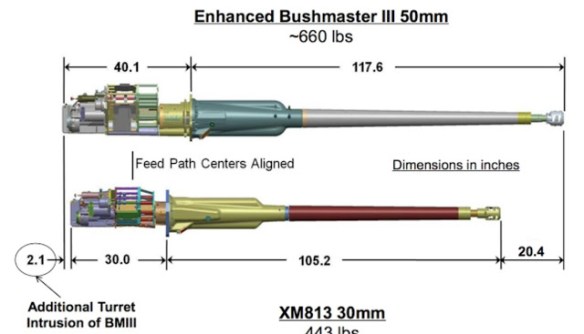
Comparison of 50mm Bushmaster III with the 30mm Bushmaster II. By comparison the 25mm’s length over all is 105.2 in (2.672 m) and its barrel length is 85.6 in (2.175 m)
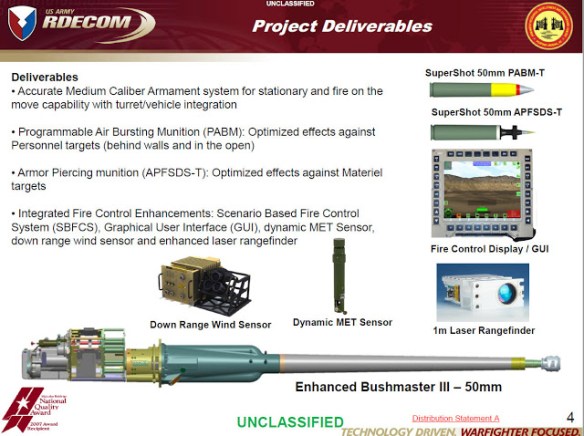
SNAFU has a discussion about what up-gunning Infantry Fighting Vehicles might mean to land warfare and included the graphical information above.
The dimensions provided give us some clues about the characteristics of the gun that were not available before. Length of the barrel in calibers (bore diameter) tells us something about the gun. You usually see it written as caliber/length in calibers, e.g. 5″/38 where 5″ is bore diameter and the barrel is 38 time 5″ in length. Length in calibers suggests other characteristics including muzzle velocity, time of flight, flatness of trajectory, accuracy, and penetration ability relative to other weapons of the same caliber. Greater length in calibers usually translates into higher muzzle velocity which imparts a flatter trajectory to a given range, which usually translates into greater accuracy and better penetration ability relative to other weapons of the same caliber. Larger caliber weapons might, and usually do, exceed these characteristics even using relatively shorter length calibers.
The Coast Guard uses or has used 5″/38s, 3″/50s, 76mm/62s, 57mm/70s, and 25mm/87s. In each case, greater length in calibers translated to higher muzzle velocities.
The barrel length for the 50mm indicated in the diagram above, 117.6″, translates to a length of 60 calibers, so we should expect a muzzle velocity similar to that of the 76mm/62 Mk75 (3,000 – 3,024 fps (914 – 925 mps)), perhaps slightly lower.
There are not a lot of contemporary weapons of similar characteristics. Perhaps the closest was a Soviet 45mm/78 anti-aircraft gun with a maximum ballistic range (firing at an elevation of 45 degrees) of 12,140 yards (11,100 m). Certainly the 50mm’s performance will exceed that of the Soviet 43mm/46 which had a max ballistic range of 10,060 yards (9,200 m).
On a more practical basis this probably means that, while the Army claims an effective range of 4000 meters (probably against another Infantry Fighting Vehicle), even without guided projectiles, it would start scoring hits against larger maritime targets at 7,000 yards, which was the maximum range we used to train 3″/50 crews for, using local control. In any case it would be able to engage from beyond 4000 yards which I believe would be the maximum effective range of any improvised armament available for use on even a terrorist vessel.
Looking at the two rounds mentioned above, Programable Air Burst Munition-tracer (PABM-T) and Armor Piercing Fin Stabilized Discarding Sabot-tracer (APFSDS-T).
The APFSDS-T is probably going to have a better chance of disabling a large marine diesel engine than any weapon we currently have in service.
The PABM-T should be effective against personnel in small fast highly maneuverable vessels and the programable feature means misses will detonate before going any great distance beyond the target, minimizing the possibility of collateral damage. It might also be effective against drones.
Thanks to Lee for pointing me to this information.
The 25mm guns (M242) in the Mk38 mounts that are the main armament on the Coast Guard’s 210 foot, Webber class, and Island class Cutters are part of a family of electrically powered guns marketed by Northrop Grumman, referred to collectively a “Bushmasters.” The 25mm is also used on the Bradley fighting vehicle and the Marine’s LAV 25 wheeled fighting vehicles. A slightly larger version, the Mk44 30mm is used on the San Antonio class LPDs, Littoral Combat Ships, and the DDG-1000 class.
Lately, the Army and Marines have become concerned that these guns are being out-ranged by adversary weapons. (I share this concern with the regard to a possible maritime terrorist attack.) This has lead to development of larger weapons of 40mm and most recently 50mm. The 50mm is claimed to have twice the effective range of the 25mm. These weapons were recently demonstrated at the “Bushmaster Users Conference,” 9-10 April, in Kingsman, AZ with a live fire demonstration at Big Sandy Range (video above). The Coast Guard may use one of these weapons in the future in place of the current 25mm.
Going from 25 to 30, 40 or 50mm may not sound like a big jump, but projectiles are three dimensional and the difference in weight and hitting power is striking.
Below are listed the maximum projectile weight in pounds associated with each caliber. I did not have this information for the 40 and 50mm chain guns, so I have used the weight of modern Bofors 40mm projectiles and an estimate based on a scaled up 30mm round for the 50mm to provide approximate values:
The M3E1 is an updated M3, by using titanium, the weapon system is six pounds lighter, 2.5 inches shorter and has an improved carrying handle, extra shoulder padding and an improved sighting system that can be adjusted for better comfort.
We have at least some indication that the Israelis are equipping their Super Dvora MkIII patrol boats with these, or at least something similar.
The US Marine Corps apparently thinks very highly of this weapon because they plan to equip every squad with one. The US Army is only slightly less enthusiastic. The intend to equip every platoon with one.
Essentially it is a man portable shoulder fired artillery piece. The range is relatively short but there have been numerous improvements with more to come. There is already a new confined space round that minimizes the effect of backblast that has been a disadvantage of recoilless rifles.
A new guided round, expected to be demonstrated in 2020, should increase effective range to 2000 meters.
I also had intended to mention the fact that, if the WPB replacement included provision for stern launch of an 8 meter over-the-horizon boat, as was done with the Webber class FRC, then any mission modules that might developed for the Webber class to take the place of the boat, as discussed in the post, “Webber class Could be the Navy’s Light Duty Pickup Truck,” would probably also be apply to the WPB replacement. These might include anti-ship cruise missiles, Unmanned systems, or small towed array sonar systems.
While the Iran swarming boat attacks are the normal justification for developing the ALaMO round, the emerging threat, unmanned surface vessels (USV) used to make “suicide” attacks may have also been a consideration. As can be seen above, small fast unmanned surface vessels can be hard to kill, and they have proven an effective weapon as can be seen below. One method of attempting to deal with the swarming boat threat has been to have the projectile burst above the boat, showering it with shrapnel. These airbursts could work pretty well against manned boats by killing the exposed boat operators, but the technique is less effective against unmanned craft. It may even be possible to shield critical components of unmanned craft against the effects of shrapnel. This is also a threat the Coast Guard may want to consider since unmanned explosive motor boats are relatively easy to construct.
Video: Houthi attack on Saudi Al Madinah-class frigate using unmanned explosive motor boat.
The new ALaMO projectile may have been developed with this Unmanned Surface Vessel (USV) threat in mind. This suggest to me that the projectile would be designed to home on the heat generated by the craft’s engine. This would work equally well against manned craft. If the ALaMO round is IR homing, then perhaps it would also home on the heat of a larger vessel’s engines as well, making it more useful for countering larger vessels.
If the 57mm Mk110 gun’s projectiles have made it a reliable counter to small, fast, highly maneuverable threats and perhaps some midsized threats, and if it can discriminate between its intended target and other traffic that may be in the area, it may be worthwhile to consider its inclusion in the WPB replacement. I still do not see it capable of countering large or even many medium sized threats. I still think we need to know more about how the round works before we can assume this is correct, but assuming it is correct, can we put this weapon on a vessel this small? I think we can.
This brought to mind how some earlier craft that had had relatively large guns. I will discuss some of the them and point out what I believe were notable features.
Spica Class (Sweden):
Swedish Torpedo Boat T121 “Spica” Photo by Pressbild. “Tidskrift i Sjöväsendet”. 1966. November. Sid 595. Swedish and US public domain
If you look at the Spica class above, it is a bigger than the likely WPB replacement (139 ft loa and 235 tons full load, 40 knots, 12,750 HP). It is 2/3 the size of the FRC, and about 29% more than my assumed maximum (182 tons) for the WPB replacement. It was a steel ship. It was equipped with an earlier version of the same 57mm gun found on the National Security Cutter (NSC) as well as the 9LV combat system which was the basis for the Mk92 Firecontrol system used on the 378 FRAM, and six heavy weight torpedo Tubes. The Torpedoes each weighed approximately 1800 kilos or about two tons, while the gun weighted about seven tons, so the vessel had over 19 tons of weapons. The fire control, ammunition, launchers, and Electronic Warfare equipment would have added to the payload weight. By comparison, if our WPB included the current model 57mm (16,535 lbs/7,500 kg), two Mk54 torpedoes (608 lbs/276 kg each), and eight Longbow Hellfire (108 lbs/49 kg) the total weight of weapons would only be a little over nine tons (18,615 lb/ about 8,461 kg) plus ammunition, launchers, Electronic Warfare equipment, and firecontrol systems. The Over-the-Horizon boat, a primary “weapon,” may add as much as four tons, so the full “weapons load” would be about 13 tons. (I could not find a weight for the Over-the-Horizon boat, but the larger Response Boat, Small weighs a bit over 8 tons.) That is about 68.4% of the weight of systems on the Spica. It is not a complete accounting, but I think it is indicative and I will continue to use this format below.
One thing I liked about this, and the next two designs, is that the bridge and operations rooms are located at or near the center of pitch (which seems to have been done with the FRC as well). This makes it more comfortable for the watch. It also results in a long foc’sle. This allows the gun to be well back from the bow while still being far enough forward of the superstructure to allow a wide arc of fire. That is, it is capable of firing well abaft the beam.
The Norrkoping Class (Sweden):
Swedish Norrköping class fast attack craft (missile and torpedo) HMS Ystad R142, 3 September 2010 Photo by Reedhawk
The Norrkoping class was derived from the Spica class and sometimes referred to as the Spica II class. It gained a little weight, being 143 ft loa and 255 tons (41 knots, 12,750 HP). Initially it was armed like the Spica class, but subsequently the four of the torpedo tubes aft of the superstructure were replaced by four RBS-15 missiles. These weigh in at about 800 kg or 1760 lb. Consequently the weapons load is almost a ton lighter than that of the Spica, but still over 18 tons plus ammunition, launchers, Electronic Warfare equipment, and firecontrol systems. At the same time the missiles were installed, the 9LV system’s radar was replaced by the Sea Giraffe which is the radar installed on the Independence class LCS and planned for the Offshore Patrol Cutter (OPC), US designation AN/SPS 77 V(1). This radar is also used on the Swedish Visby class corvettes completed 2002 to 2015.
Willemoes Class (Denmark):
A danish navy Willemoes-class fast attack craft (missile + torpedoes) HDMS Sehested (P547) as a museum ship at the Holmen naval base. Photo by Flemming Sørensen
The Willemoes class were similar, slightly larger vessels (46 m/150 ft 11 in loa and 260 tons full load, 40 knots, 12,750 HP). Originally they were equipped with four torpedo tubes in addition to the Oto Melara 76mm gun. The after pair of torpedo tubes was replaced by launchers for eight Harpoon Anti-Ship missiles (1,523 lb / 691 kg with booster). Its weight of weapons after installation of the Harpoons was just over 15 tons, plus ammunition, launchers, Electronic Warfare equipment, and firecontrol system (also a 9LV).
The unique feature of this class was that they had small diesel engines for cruising at up to 12 knots.
The Storm Class (Norway:
The Storm Class, (120 ft loa, 138 tons, 30 knots, 7200 HP) is illustrated above, fully armed and launching a Penguin missile, and below in a later configuration after removal of missiles and transfer from the Norwegian Navy to Lithuania. It is considerably smaller than the vessels above, at the lower end of what I expect the WPB replacement to displace, but still capable of mounting considerable weaponry, in this case six Penguin anti-ship missiles, and 76 and 40 mm guns. The missiles weighed 385 kg (849 lb). The 40 mm weighed about 3.5 tons. I was unable to find the weight of this 76mm gun. It would not have weighed as much as the Oto Melara, but it has to be at least 6 tons, so a total weapons weight was at least 12 tons.
Lithuanian Naval Force, Norwegian built, Storm class patrol boat P33 “Skalvis”. Missiles removed. Photo by Ministry of National Defence Republic of Lithuania
Conclusion:
If we chose to do so, it appears we could build something like a slightly scaled down version of the Spica that could mount a 57mm Mk110 forward and still provide an 8 meter Over-the-Horizon boat aft. The firecontrol could be as simple as the electro-optic unit from the Mk38 Mod2 or as capable as the SeaGiraffe which would give us a true all weather capability. In addition, it could probably mount tubes for two light weight torpedoes and eight Longbow Hellfire in vertical launchers. (I would think the Hellfires offset to one side, at the back of the superstructure. Foot print for a 2×4 cluster of missiles would likely be only about 4 x 3 feet.) I know the torpedoes are an unconventional approach, but it seems the surest way to stop a large ship and supposedly the Mk46 Mod5 and later torpedoes have an anti-surface capablity.
Replacing the Marine Protector class WPBs with vessels equipped like this would give the Coast Guard a robust and truly capable Ports, Waterways, and Coastal Security capability.