Some how I missed this when it came out. Lots of topics covered.
Thanks to Luke for bringing this to my attention.

Some how I missed this when it came out. Lots of topics covered.
Thanks to Luke for bringing this to my attention.
CIMSEC has a new post that is worth the read, “Against the Growing Anti-ship Missile Threat, Are We Truly Semper Paratus?” It is the first of two parts.
Pointing toward the increasing ubiquity of anti-ship missiles, it suggests that we install the SeaRAM system in place of the Phalanx on the Bertholf class National Security Cutters (NSC), and that we also install the system on the Offshore Patrol Cutters (OPC) and the new icebreakers.
With the Commandant’s proposal, that the new administration send cutters to the Western Pacific to counter Chinese aggressiveness, better self-defense systems make more sense than ever.
Fitting the system to at least a couple of West Coast NSCs that might be available for WestPAC deployment should be relatively straight forward since the systems have much in common with the Phalanx system it would replace. SeaRAM would have the additional benefit of increasing the ships anti-surface capability as well.

Coast Guard manned destroyer escort USS Menges (DE-320) showing the effects of an acoustic homing torpedo hit on the stern.
It is entirely appropriate for Veteran’s Day weekend reading, but this post was prompted by a recent update of the list of “Top Ten Posts.” I found that the 2011 post “What Does It Take to Sink a Ship?” was not only the top post since I started writing, it is also the top post of 2016. That looked at Navy major surface combatant losses in WWII, but I realized I have never surveyed the Coast Guard’s WWII losses.
This began as another shameless attempt to get the Coast Guard to recognize that they need torpedoes to stop medium to large ships, but it grew into a more comprehensive look at CG losses in WII. I did find that six (or seven, Escanaba?) Coast Guard or CG manned vessels were hit by torpedoes and in every case the ship was either sunk (four or five?) or immobilized (two).
I found a couple of good sources. “The Coast Guard at War” is a series of monographs completed shortly after WWII (between 1045 and 1950) and most of the apparently 25 volumes are available in pdf format here, along with a lot of other WWII references. In particular I used The Coast Guard At War: Lost Cutters (Official History Series, Volume VIII, 1947). It lists the loss of 16 Coast Guard vessels and the loss of 12 Coast Guard manned Navy vessels, but two of these (one Navy and one CG) were actually after the war was over. My other source was “U. S. Coast Guard Ship Losses” by Jim Gill, on the US Coast Guard Light Ship Sailors Association International web site. This source identifies 40 losses beginning with the Tahoma in 1914 up to USCGC Mesquite (WLB-305), grounded in 1989. It included three losses not listed in the official history, all by torpedoes:
Coast Guard Vessels Lost:
The Coast Guard lost 15 vessels during the course of WWII. Of those, three are believed to be the result of enemy action. Of the remaining 12, eight were a result of adverse weather. 214 Coast Guardsmen were killed in these 15 incidents.
The three ships presumed loss to enemy action included the three largest Coast Guard vessels lost during the war:
CG 85006, 67 tons, was destroyed by an explosion, probably gasoline vapors, 27 Mar.’43, four dead.
CG 58012, 30 tons, was destroyed by fire, 2 May ’43, no fatalities.
CG 83421, 44 tons, was sunk in a collision, 30 June ’43, no fatalities.
USCGC Bodega (WYP-342), 588 tons, went aground attempting to assist another vessel, 20 Dec. ’43, no fatalities.
The eight vessels lost to foul weather were:
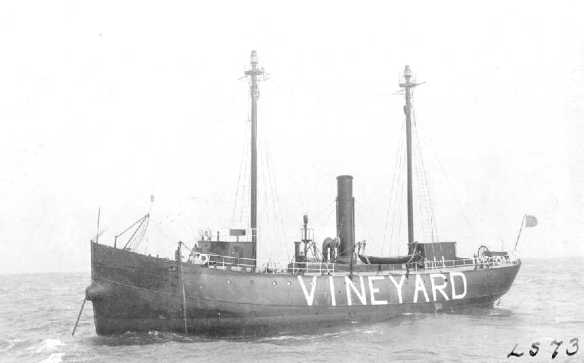
LV 73 on the Vineyard Sound station where she served from 1924 through 1944. On 14 September 1944 she was carried off station during a hurricane and sank with the loss of all hands.
It might be assumed that the non-combat casualties were not war related, but that might not be the case. The urgency of the missions, the diversion of more capable ships to escort duty, the influx of inexperienced personnel placed in responsible positions, and the use of vessels pressed into service for which they may have been ill-suited, were all a result of the war, and it led to crews being placed in more danger than would have been the case in peacetime.
Coast Guard Manned Navy Vessels Lost:
Of the eleven Coast Guard manned US Navy ships lost during WWII, seven were lost to enemy action, the others were:

USS Serpens (AK-97) US Navy photo #NH 89186, from the collections of the US Naval Historical Center, courtesy William H Davis, 1997

USS Sheepscot (AOG-24) underway, August 1944, US Navy photo
Those lost to enemy action were:

Photo: USCGC Muskeget, seen here before conversion to a weather ship. http://www.navsource.org/archives/09/49/49048.htm

“LST discharges supplies. . .”; no date (November, 1943?); Photo No. 3237; photographer unknown. The Coast Guard-manned LST-69 disembarks equipment during the Tarawa invasion.
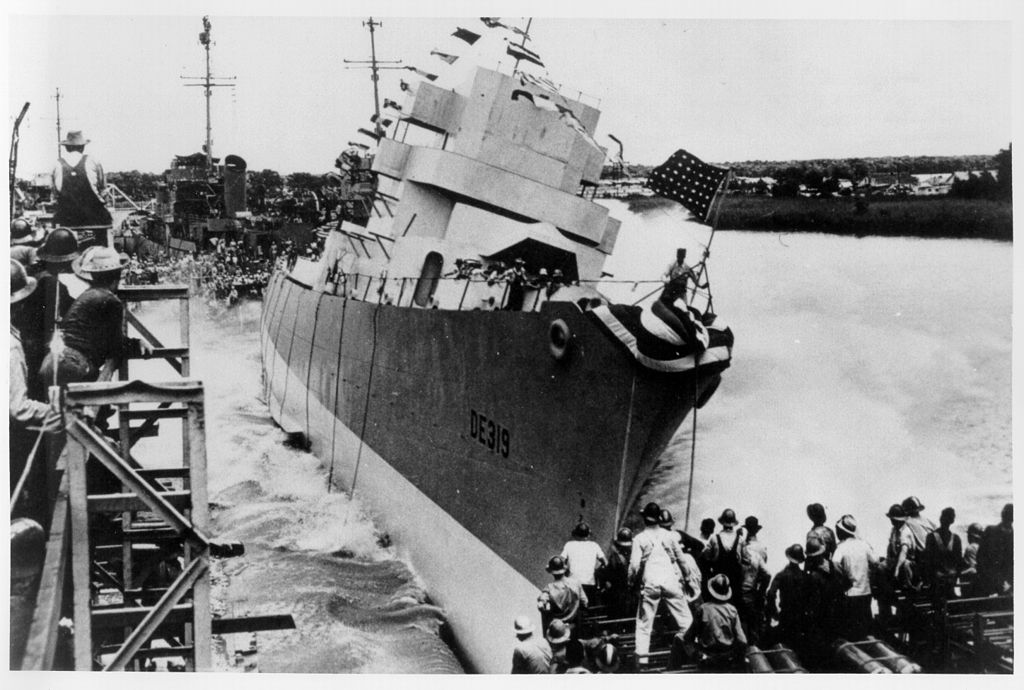
USS Leopold (DE-319) being launched.

Normandy Invasion, June 1944 A convoy of Landing Craft Infantry (Large) sails across the English Channel toward the Normandy Invasion beaches on “D-Day”, 6 June 1944. Each of these landing craft is towing a barrage balloon for protection against low-flying German aircraft. Photograph from the U.S. Coast Guard Collection in the U.S. National Archives. Photo #: 26-G-2333

“SHE FELT THE NAZIS’ WRATH:” A U.S. Coast Guard infantry landing craft still flies its flag, though knocked out of the invasion, ripped and wounded on the beaches of France. Moving in for a landing, the LCI ran afoul of an underwater obstruction, which tore a gaping hole in her bow. Then as its cargo of troops piled ashore, Nazi shells battered her out of further action.”; no date; Photo No. 2395; photographer unknown.
Conclusion:
It may be surprising that it appears the Coast Guard lost two and half to three times as many men in Coast Guard manned Navy vessels, as in Coast Guard vessels.
According to the Coast Guard history web site,
Two hundred and fourteen thousand two hundred and thirty-nine persons served in the Coast Guard during World War II. That number included 12,846 women. The Coast Guard lost a total of 1,917 persons during the war with 574 losing their life in action, “died of wounds” received in action, or perishing as a “Prisoner of War.”
These incidents account over 40% of all lives lost and a majority of lives lost as a result of enemy action.

“We cannot afford to be complacent and should not infer too much from the relative absence of flying IED attacks thus far. Yes, small drones have proliferated rapidly, but the technology is still in its toddler years, and today’s widely available consumer drones are not ideal weapons. It is the next generation of drone technology that has me worried, and it will be here soon.”
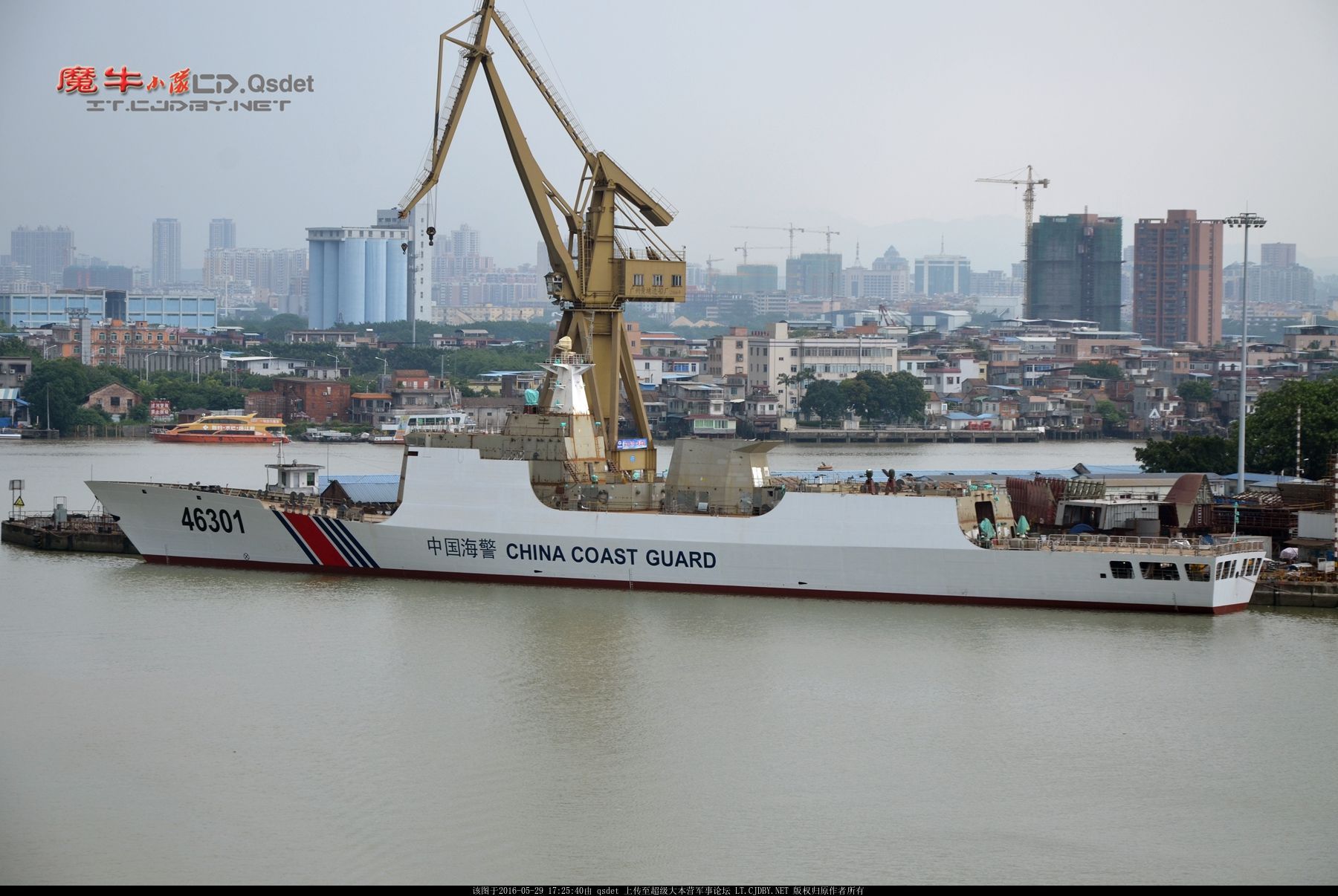
The National Interest reports that the Chinese have openly acknowledged that their newest Coast Guard cutter is being built with provision for upgrading to frigate status should a need arise.
Moreover they were apparently influenced by the example of the USCG during WWII.
In the same issue of this magazine, published by the major Chinese shipbuilding conglomerate China State Shipbuilding Corporation (CSSC), builder of the Type 818, there is not coincidentally a very detailed article about U.S. Coast Guard cutters in combat during the Second World War. That article explains that both USCGC Campbell and also USCGC Spencer were able to sink German U-boats (U-606 and U-175 respectively) during the pivotal Battle of the Atlantic. Most of the article examines the operations of 10 American USCG cutters that were 76.2 meters in length and built between 1928 and 1932. These ships were transferred to the hard pressed Royal Navy (RN) during 1941-42 and achieved an enviable war record in RN service, sinking both U-522 and U-954 – the latter with Germany Navy Commander Karl Donitz’s son aboard. The analysis notes that, according to UK naval records, the American cutters were viewed so favorably as to be rated as “surpassing each kind of comparable British designed frigate.” These ships are labeled as an “ideal anti-submarine escort ship” [理想的反潜护航舰] and the implications for the CCG going forward are obvious.
They actually sold the cutters a bit short. The 327s actually sank at least three and probably four U-boats and the ten 76.2 meter cutters, the 250 foot Lake Class, sank three submarines (two U-boats and an Italian). Six subs sunk by 17 ships may not sound particularly impressive, but in fact by comparison, it was spectacular.
The new Type 818 cutters are based on the Type 054 frigates. Its not too much of a stretch to expect them to be upgunned with the same weapons found on the “parent craft,” but if the time ever comes, there may be better systems available for upgrading the cutters or they might be given different capabilities to support emerging missions. That can be an advantage of having ships with unused upgadability.
The Type 054 are only slightly smaller than the Bertholf class, displacement 4,053 tons full load, length 134.1 m (440 ft), beam 16 m (52 ft), 30,400 HP, 27 knots, compared to the Bertholf’s 4,500 tons, 127.4 m (418 ft), 16.46 m (54 ft), 49,875 HP, and 28 knots. They actually appear to be the same size as the Offshore Patrol Cutters, but their design leans more toward higher speed. Their range is not as great as the OPC at about 8,000 miles compared to the OPCs’ 10,200, but it is a greater range than USN frigates enjoyed.
The Chinese have learned a lesson from USCG experience in World War II. I wonder if it is a lesson we may have forgotten.
Thanks to Luke for bringing this to my attention.
The US Naval Institute’s 2016 Coast Guard Essay Contest winner, “White Hulls Must Prepare for Gray Zone Challenges,” by LCdr.Craig Allen, Jr., USCG is worth the read.
Much of the focus is on the PATFORSWA and LCdr Allen seems to know where of he speaks.
“Lieutenant Commander Allen is a cutterman assigned to the Office of Defense Operations at Coast Guard Headquarters. He previously commanded the Sentinel-class cutter USCGC William Flores (WPC-1103) and the USCGC Baranof (WPB-1318), an Island-class cutter forward deployed to Manama, Bahrain. He also served as the executive officer of the USCGC Tornado (WPC-14), a Cyclone-class patrol craft. Commander Allen is a 2014 graduate of the U.S. Marine Corps Command and Staff College.”
But as he points out. These “Gray Zones” are not limited to SW Asia. We see them in South East Asia, East Africa, West Africa, and even in Central and South America.
While the post concentrates on crew preparation, I think its appropriate to point out an observation by Vice Adm. Joseph Mulloy, deputy chief of naval operations for integration of capabilities and resources, that attacks like those on the USS Mason, where a non-state actor employed cruise missiles are likely to become more common.
Maybe adding a CIWS (preferably the SeaRAM) to the OPC might not be a bad idea.

Four years ago I wrote a post suggesting that the Offshore Patrol Cutter might be designed from the start for a wartime weapons fit, but then fit them out with only those systems required for their peacetime missions, which might have included only its helicopter, UAS, and 25 mm Mk38 Mod2 gun(s).
I started with the assumption that the OPC should be able to mount a weight of weapons at least equal to those mounted on the 255 foot Owasco class cutters as built during World War II (140-150 tons). This figure did not include ammunition other than depth charges, consequently, nearly all the weight was above the main deck. This now appears very conservative in that the Eastern OPC design is about twice the size of the Owasco Class. (For another data point, when built, the USS Fletcher, first of a class of 175 destroyers with a design displacement of 2,700 tons, had 161.8 tons of armaments and 190.8 tons of ammunition.)
In the earlier post, a possible wartime outfit that I believed might be used for designing the ship (and the weights I used) included:
Total 124.4 tons
Since we now have a notional design for the cutter and my own views have changed somewhat, I thought it might be worthwhile to revisit how this class might be armed in wartime. The design may have ruled out some of the systems above, but the surprisingly large size suggest it should be fairly adaptable.
In fact it looks like the OPC could be turned into a credible warship adding only deck mounted systems that require only minimal deck penetration for cabling and the like.
What’s already there?:
Based on earlier information, as built, the design will includes provision for
For a total of 28.55 tons
Anti-Ship Cruise Missile:


RGM-84 Harpoon SSM was fired from a Mk-141 missile launcher aboard USS Shiloh (CG 67). The Shiloh’s beam is only one foot more than that of the Offshore Patrol Cutter. Looking at the photo, you can see that the launchers take up well under half the width of the fantail.

Photo: Click to enlarge
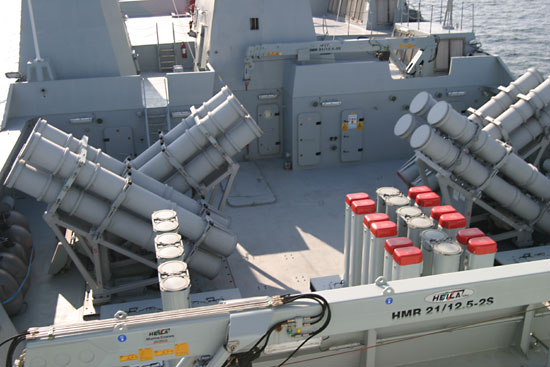
Photo: Click to enlarge. The relatively small foot print of the Mk56 VLS system (pdf) can be seen here on a Danish Absalon-class command and support ship (beam 64 feet, by comparison the Offshore Patrol Cutters’ beam is 54 feet–same as that of the Bertholf class National Security Cutters). Two sets are visible in the foreground, one set of twelve with missile canisters with red tops in place to the right, on the ship’s centerline, and a second set of twelve without canisters to the left. The Absalon class has three twelve missile sets, with the third set off camera to the right.


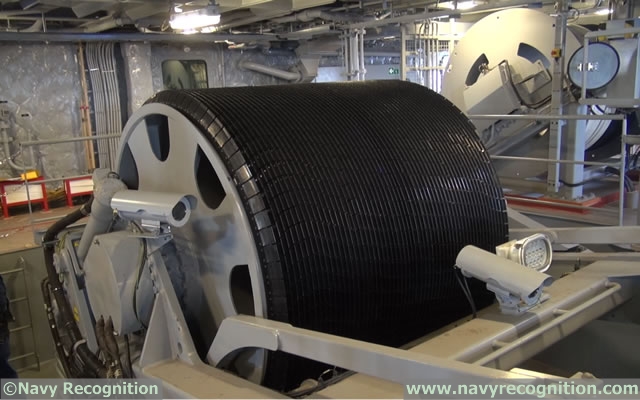
Mk38 mod2/3 and Mk49 ROSAM:
I will assume that the two Mk49 RO
SAM will be retained and the Mk38 mod2 (or mod3) will be relocated and a second Mk38 (1.15 tons) will be added.
Summary:
The resulting additions would be:
This totals 120.3 tons or 91.75 tons more than the planned outfit as built.
We don’t really know if the ship can take this much weight. Assuming it displaces 4,000 tons, which seems likely, this is about a 2.3% increase in displacement and much of the weight is relatively high.
Is it feasible?
There are things that can be done to counterbalance the effects of this additional weight. Some fuel tanks might have to be left permanently full or be converted to ballast tanks. Given the extreme range of the cutter, even half of the design range would be more range than most Navy combatants.
We know the ship is supposed to have some weight moment reservation for additional weapons but we don’t know how much. There is also the requirement that the ship be able to take on, feed and shelter 500 migrants on the foc’sle or flight deck. Those 500 people alone would amount to almost 40 tons of additional top weight.
There are alternatives that could provide a simlar outfit while moving the weight lower. A more extreme change would be to replace both the Mk56 VLS (23 tons) and the 57mm Mk110 (15.4 tons) with Mk41 VLS (33.6 tons) in place of the 57mm. We would loose the gun, but this would provide the additional capability of launching Anti-Submarine Rockets (ASROC) as well. That might be a good trade, but it would require more radical reconstruction.
In short, adding less weight in weapons than carried by the 255 foot Owasco Class cutters of WWII, the Offshore Patrol Cutter could be turned into an effect surface combatant comparable to many frigates. The same sort of alterations could also be appied to the National Security Cutters.
Earlier I explored “What Does It take to Sink a Ship?” as a measure of what it takes to be absolutely sure you can stop one. Then the Japanese Tsunami gave us fishing vessel Ryou-Un Maru, a small vessel USCGC Anacapa attempted to sink with their 25mm gun. Anacapa ultimately resorted to coming along side and using a fire hose to fill the vessel with water, but it took over five hours.
Now the Navy provides us with information about another Sink-Ex. The former USS Rentz (FFG-46), a 4,200 ton, 453 foot long frigate, was the target. In spite of being hit by 22 missiles, she took five hours to sink. The last hit or hits were by Hellfire, and may not have been necessary, but not all the missiles were that small. The caption below appears to indicate at least two Harpoons were used.

Photo: US Navy. Guided-missile destroyer USS Benfold (DDG 65), foreground, and USS John S. McCain (DDG 56) fire Harpoons missiles as part of a sink exercise (SINKEX) during Valiant Shield 2016.
Reports also indicate that at least one JSOW C-1, an over 1000 pound guided gliding munition with both Infra-Red and Link-16 guidance, was used.
The caption on the photo below seems to indicate multiple AGM-65F were used. These are infra-red homing, Air to Surface Missiles, weighing over 600 pounds with a 300 pound warhead.

U.S. Navy sailors with Patrol Squadron 46 load a P-3 Orion aircraft with AGM-65F MAVERICKs, prior to a sinking exercise (SINKEX) Sept. 13, 2016, at Andersen Air Force Base, Guam, during Valiant Shield 2016.
When the video at the head of this post begins, it appears that the ship has already taken at least three major hits. I suspect these were two Harpoons and possibly the JSOW C-1. I suspect the four hits seen in the video were Mavericks launched from the P-8 that made the video.
The video below shows a Hellfire hitting what appears to be an already sinking hulk. It appears to me, the effects are clearly less than those seen in the video at the top of the post.
I would love to have a clearer idea of the sequence and effects of the individual hits, but one thing is clear. It took a lot of ordnance to put even this relatively small ship down. The Coast Guard’s 25 mm and 57 mm guns, with their five ounce and six pound projectiles, will not cut it.
NavyRecognition reports, “The State Department has made a determination approving a possible Foreign Military Sale to Qatar for Mk-V Fast Patrol Boats, equipment, training, and support. The estimated cost is $124.02 million.”
Based on the number of .50 calibers ordered, it appears that this will include four boats.
Looking back, in 2009 DefenseIndustryDaily reported the sale of ten of these craft to the Kuwaiti Navy under the Foreign Military Sales (FMS) Program for $61.6M. Saudi Arabia is also interested in these boats and is reportedly planning to buy 30 at an estimated $1.2B.
These are apparently an extended version of the US Navy Mk5 Speicial Operations Craft. The company web site has more information on both versions.
I don’t recognize the 27 mm reportedly included in the Qatar deal as a weapon in US service, but the Germans (Mauser, now Rheinmetall) do make a 27mm and this is the gun used on the Kuwati boats, and it appears to be gun used on the boats for Qatar.
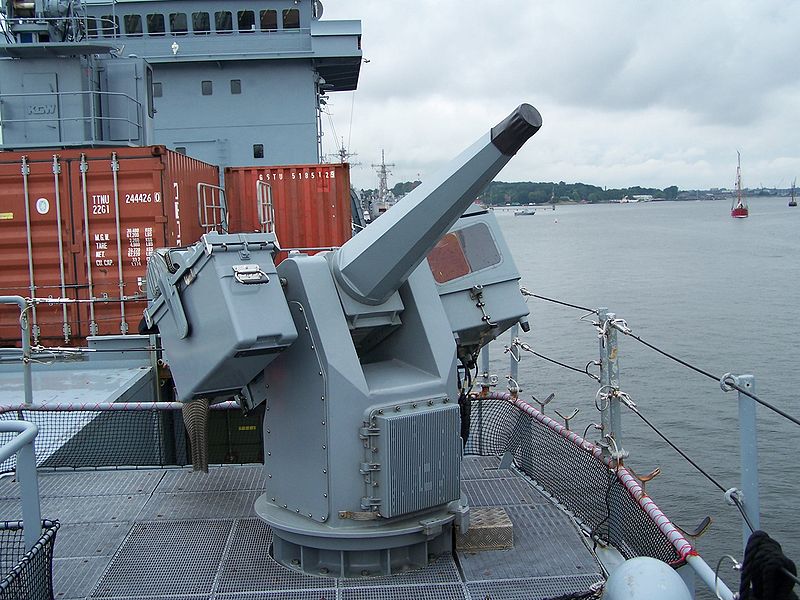
MLG27 onboard Elbe Class Tender Rhein at the en:Kiel Week 2007. Photo by Rebell18190
The size of the boat seen on the stern ramp in the video is not clear.
These 90 foot boats is clearly optimized more for speed than our 87 footers. They also have a shorter range and with water jets, are probably less manuverable at the slow speeds often required for SAR.

The US Naval Institute reports the Chilean Navy is planning to upgrade three of their British Built Frigates, with Evolved Sea Sparrow Missile (ESSM) replacing their existing Sea Wolf weapon systems. Since ESSM was planned as a possible upgrade for the National Security Cutter, I thought the information might be of interest.
The US is providing the equipment under a Foreign Military Sales contract valued at $140.1M that will include three sets of Tactical Length Mk41 VLS (vertical launch systems), 33 Evolved Seasparrow Missiles (ESSMs) Six Evolved Seasparrow Telemetry Missiles, “Ten (10) MK25 Quad Pack Canisters; Five (5) ESSM Shipping Containers; Five (5) MK-73 Continuous Wave Illumination Transmitters, One (1) Inertial Missile Initializer Power Supply (IMIPS); spare and repair parts, support and test equipment, publications and technical documentation, personnel training, U.S. Government and contractor engineering, technical and logistics support services, technical assistance, installation and integration oversight support, logistics, program management, packaging and transportation.”
These figures include only the additional equipment. They do not include the yard work necessary to prepare the ship for installation and the installation of the equipment. Still I think this constitutes most of the cost of the upgrade of the three ships.
I would note that it is not clear how many VLS cells will be installed on each ship, but they are always installed in groups of eight. If we assumed eight cells on each ship, then each ship could theoretically support 32 missiles since they can be “quad packed,” that is four missiles can be placed in each cell. Chile is buying only 33 “war-shot” missiles and ten quad pack canisters. That is barely more than enough to fully arm one ship with eight cells, so it appears there will be some cells either left empty or filled with other types of weapons, which might include ASROC which also fit the tactical length Mk41 VLS.
 Chuck Hill's CG Blog