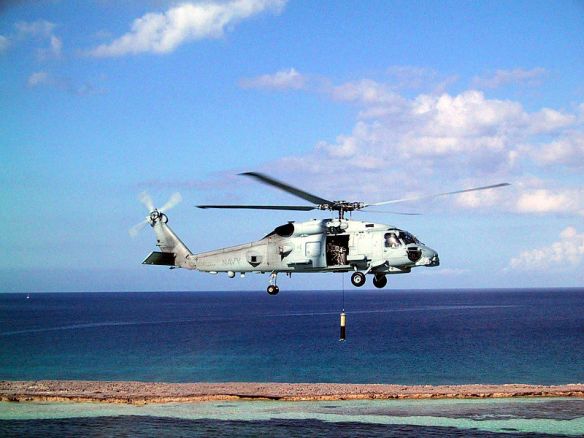
Ports, Waterways, and Coastal Security–Russian Style

NavyRecognition is reporting a Project 21980 Grachonok-class anti-commando boat of the Black Sea Fleet, the Yunarmeyets Kryma, has joined the Russian Navy’s standing naval force in the Mediterranean (Presumably in Syria).

The Yunarmeyets Kryma is a special boat built by the Zelenodolsk Shipyard in 2014. The Vympel Design Bureau in Nizhny Novgorod had developed the class to guard water areas and fight enemy naval commandos in the waters of naval bases and on close approaches to them. The boats in the class carry heavy machineguns, antidiver grenade launchers and man-portable air defense systems. Their radio electronics allow searching for underwater objects – both static and moving – while their diving system allows several divers to dive simultaneously.

It looks like a WPB so I looked up the class. They are 138 tons, 102 ft (31 m) in length, 23 knots, and a crew of eight. The Russians have built twelve and are building ten more.

Described as being anti-saboteur and anti-commando boats these are in intended for “force protection” which is included in the Coast Guard’s Ports, Waterways, and Coastal Security mission (PWCS). It is also one of the missions of the new US Navy MK VI patrol boat. We have detachments at Bangor and Kings Bay to protect Fleet Ballistic Missile subs while in transit that also perform this function.

Despite the similarities in mission, the Russian boat is armed and equipped much differently from their USN and USCG counterparts. It has a couple of sonars. In addition to a 14.5 mm (.60 cal.) machine gun, they have point defense anti-air missiles. Defense against swimmers is apparently much on their mind. They have two anti-swimmer weapon systems, the DP-64 a shoulder fired mini-depth charge thrower and the DP-65, a ten barrel, automated, sonar controlled mini-depth charge thrower.

File:DP-64.png

DP-64 anti-swimmer grenade launcher. Artist: Jason Biggs

“The 55mm DP-65 remotely controlled…grenade launching system is designed for protection of ships against attacks of underwater combat swimmers at external roadstead open anchor stops and bases, for protection against attacks of underwater combat swimmers at water-development works, sea platforms and other important sea and coastal installations.”

The US had a lot of trouble with Viet Cong combat swimmers during the Vietnam war. They even manage to sink a small WWII built aircraft carrier (CVE) being used as an aircraft transport. It is unclear how well prepared we are for this type of attack now.

Laser Added to Mk38 Mod2

Navy Recognition reports that BAE now offers a 60 kW Laser addition to the Mk38 mod2 gun mount currently on the Webber Class Fast Response Cutters and planned for the Offshore Patrol Cutter.

“The addition of a 60kW TLS would provide true selectable and scalable effects ranging from non-lethal to lethal. This would allow for new response options in both conventional and irregular conflicts.”

Note the laser on the USS Ponce is only 30 kW.

Late addition: 

How it might be useful: It could be used in a less than lethal mode. It could probably be used for disabling fire against outboard motors with greater precision than a gun. It could be used to destroy UAS (drones) inside ports without worrying about where misses might land.

H-60s Convertible to Gunships

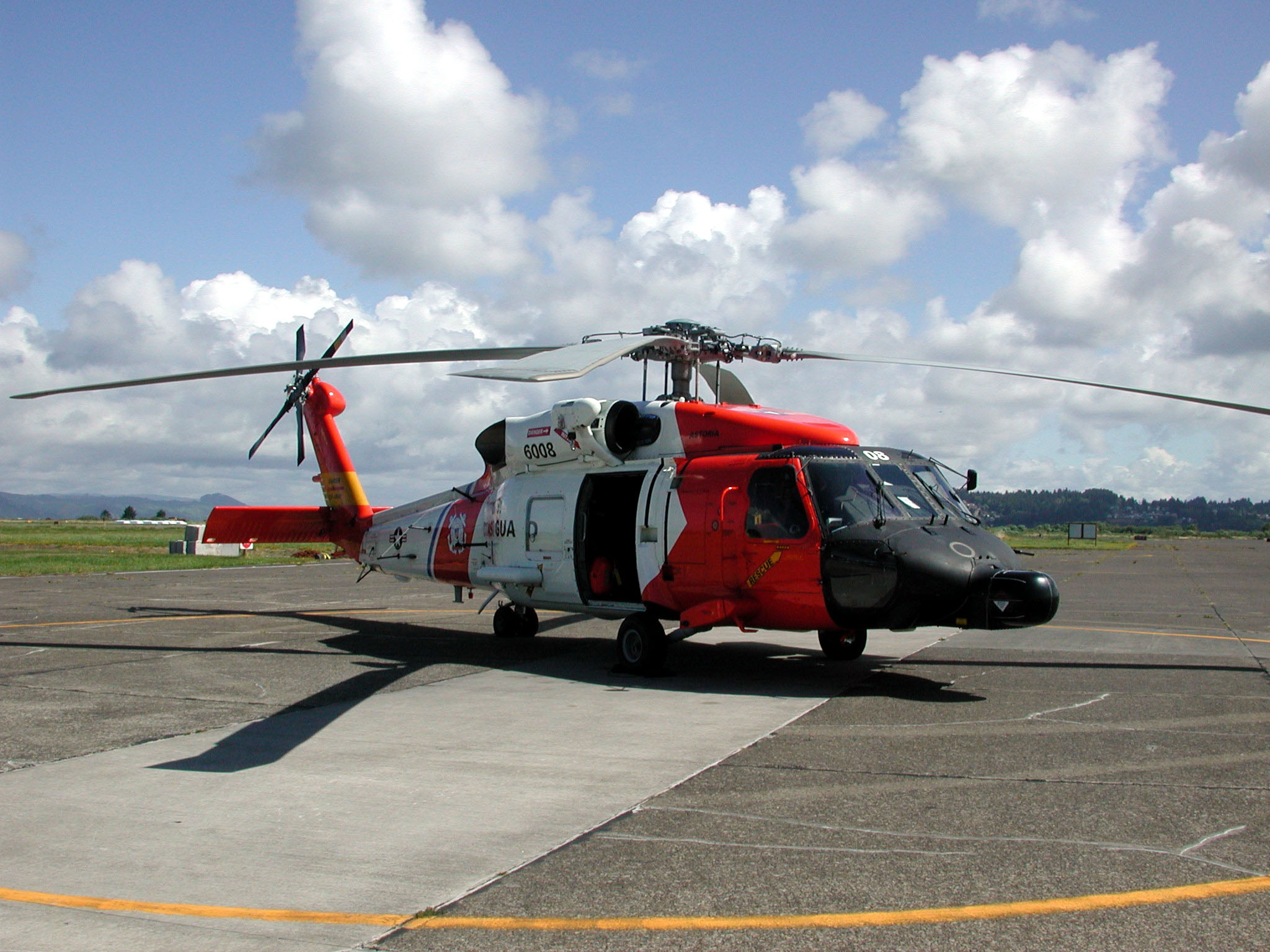
Not that I see us doing this any time soon, but if we ever decide we need to arm our H-60s against smaller targets such as fast inshore attack craft, it looks like it might not be too difficult.

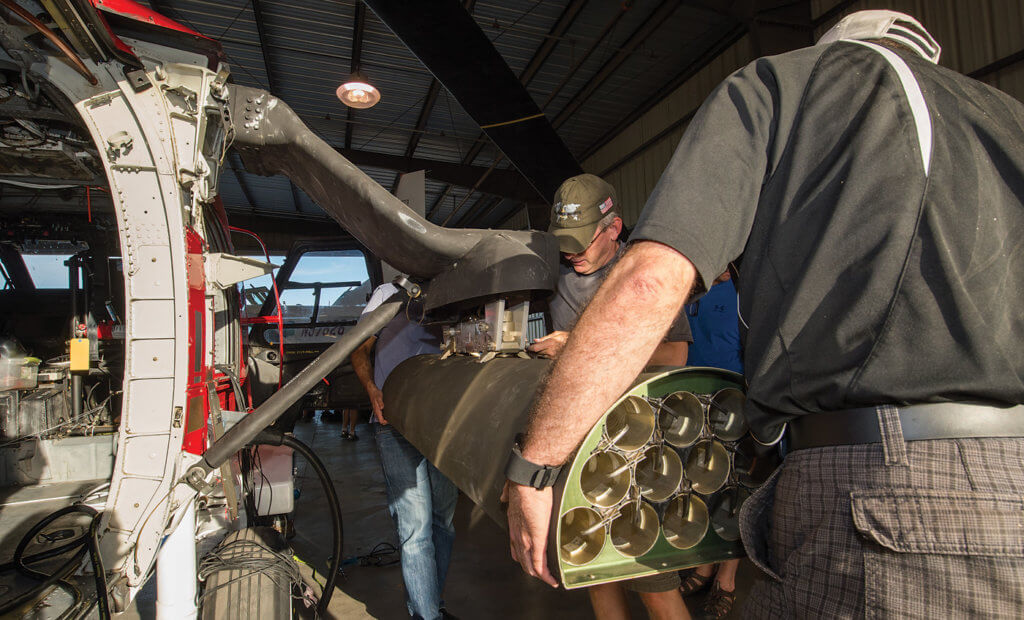
The APKWS guided 70 mm rockets and Hellfire systems that are included in the program,appear appropriate for countering small vessels.

Technicians install the Arnold Defense LWL-12 lightweight 2.75-inch (70mm) rocket launcher.

Photo: Technicians install the Arnold Defense LWL-12 lightweight 2.75-inch (70mm) rocket launcher.

My Unfunded Priority List

An earlier post reported a plea by Representative Duncan Hunter, Chair of the Transportation Subcommittee on Coast Guard and Maritime Transportation, for the Coast Guard to provide an unfunded priority list to include six icebreakers and unmanned Air System.

Thought perhaps I would list my own “unfunded priorities.” These are not in any particular order.

PLATFORM SHORTFALLS

Icebreakers: We have a documented requirement for three heavy and three medium icebreakers, certainly they should be on the list. Additionally they should be designed with the ability to be upgraded to wartime role. Specifically they should have provision for adding defensive systems similar to those on the LPD–a pair of SeaRAM and a pair of gun systems, either Mk46 mounts or Mk38 mod 2/3s. We might want the guns permanently installed on at least on the medium icebreakers for the law enforcement mission. Additionally they should have provision for supporting containerized mission modules like those developed for the LCS and lab/storage space identified that might be converted to magazine space to support armed helicopters.

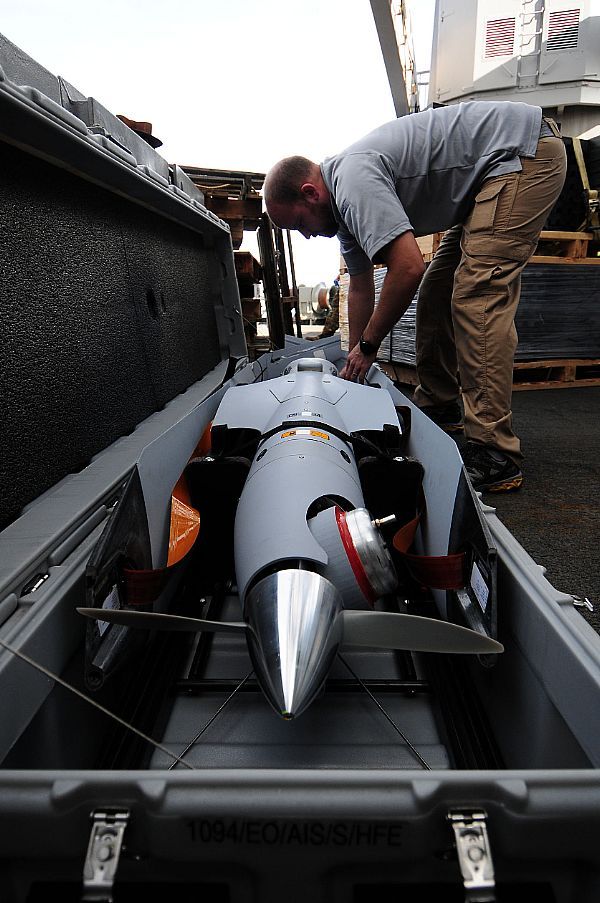
110225-N-RC734-011 PACIFIC OCEAN (Feb. 25, 2011) Guy Mcallister, from Insitu Group, performs maintenance on the Scan Eagle unmanned aerial vehicle (UAV) aboard the amphibious dock landing ship USS Comstock (LSD 45). Scan Eagle is a runway independent, long-endurance, UAV system designed to provide multiple surveillance, reconnaissance data, and battlefield damage assessment missions. Comstock is part of the Boxer Amphibious Ready Group, which is underway in the U.S. 7th Fleet area of responsibility during a western Pacific deployment. (U.S. Navy photo by Mass Communication Specialist 2nd Class Joseph M. Buliavac/Released)

110225-N-RC734-011
PACIFIC OCEAN (Feb. 25, 2011) Guy Mcallister, from Insitu Group, performs maintenance on the Scan Eagle unmanned aerial vehicle (UAV) aboard the amphibious dock landing ship USS Comstock (LSD 45). Scan Eagle is a runway independent, long-endurance, UAV system designed to provide multiple surveillance, reconnaissance data, and battlefield damage assessment missions. Comstock is part of the Boxer Amphibious Ready Group, which is underway in the U.S. 7th Fleet area of responsibility during a western Pacific deployment. (U.S. Navy photo by Mass Communication Specialist 2nd Class Joseph M. Buliavac/Released)

Unmanned Air Systems (UAS): We seem to be making progress on deploying UAS for the Bertholf class NSCs which will logically be extended to the Offshore Patrol Cutters. So far we see very little progress on land based UAS. This may be because use of the Navy’s BAMS system is anticipated. At any rate, we will need a land based UAS or access to the information from one to provide Maritime Domain Awareness. We also need to start looking at putting UAS on the Webber class. They should be capable of handling ScanEagle sized UAS.

File:USCGC Bluebell - 2015 Rose Festival Portland, OR.jpg

Photo: The Coast Guard Cutter Bluebell sits moored along the Willamette River waterfront in Portland, Ore., June 4, 2015. The Bluebell, which celebrated its 70th anniversary this year, is one of many ships participating in the 100th year of the Portland Rose Festival. (U.S. Coast Guard photo by Chief Petty Officer David Mosley.)

Recapitalize the Inland Tender Fleet: This is long overdue. The program was supposed to begin in 2009, but so far, no tangible results. It seems to have been hanging fire for way too long.

Expand the Program of Record to the FMA-1 level: The Fleet Mix Study identified additional assets required to meet the Coast Guard’s statutory obligations identifying four asset levels above those planned in the program of record. Lets move at least to first increment.

Alternative Fleet Mix Asset Quantities

————–POR       FMA-1      FMA-2      FMA-3       FMA-4
NSC                8             9                 9                 9                  9
OPC              25           32               43                50               57
FRC              58           63               75                80               91
HC-130         22            32               35                44               44
HC-144A       36            37               38                40               65
H-60              42            80               86                99             106
H-65             102         140             159              188            223
UAS-LB           4            19                21                21              22
UAS-CB        42            15                19               19               19

At the very least, looks like we need to add some medium range search aircraft (C-27J or HC-144).

Increase Endurance of Webber Class Cutters: The Webber class could be more useful if the endurance were extended beyond five days (currently the same as the 87 cutters, which have only one-third the range). We needed to look into changes that would allow an endurance of ten days to two weeks. They already have the fuel for it.

MISSION EQUIPMENT SHORTFALLS

Seagull_torpedo_trial_1

Ship Stopper (Light Weight Homing Torpedo): Develop a system to forcibly stop even the largest merchant ships by disabling their propulsion, that can be mounted on our patrol boats. A torpedo seems the most likely solution. Without such a system, there is a huge hole in our Ports, Waterways, and Coastal Security mission.

121211-N-HW977-692

Photo: SeaGriffin Launcher

Counter to Small High Speed Craft (Small Guided Weapon): Identify and fit weapons to WPB and larger vessels that are capable of reliably stopping or destroying small fast boats that may be used as fast inshore attack craft and suicide or remote-controlled unmanned explosive motor boats. These weapons must also limit the possibility of collateral damage. Small missiles like SeaGriffin or Hellfire appear likely solutions.

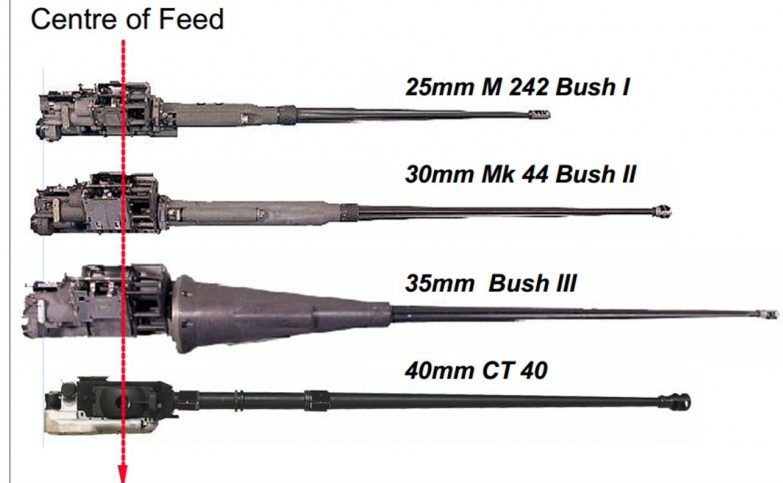
40 mm case telescoped gun (bottom) compared to conventional guns.

40 mm case telescoped gun (bottom) compared to conventional guns.

Improved Gun–Penetration, Range, and Accuracy: The .50 cal. and 25mm guns we have on our WPBs and WPCs have serious limitations in their ability to reach their targets from outside the range of weapons terrorist adversaries might improvise for use against the cutters. They have limited ability to reach the vitals of medium to large merchant vessels, and their accuracy increases the possibility of collateral damage and decreases their probability of success. 30, 35, and 40 mm replacements for the 25 mm in our Mk38 mod2 mounts are readily available.

Laser Designator: Provide each station, WPB, and WPC with a hand-held laser designator to allow them to designate targets for our DOD partners.

CONTINGENCY PLANNING SHORTFALLS

Vessel Wartime Upgrades: Develop plans for a range of options to upgrade Coast Guard assets for an extended conflict against a near peer.


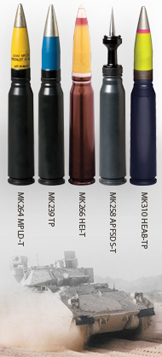
30mm “Swimmer” Round

30x173mm ammunition for Mk44 Bushmaster II

30x173mm ammunition for Mk44 Bushmaster II

Ran across an interesting new type of ammunition, the 30 mm Mk 258 mod 1 APFSDS-T, which appears to be designed specifically to counter Fast Inshore Attack Craft (FIAC). It uses a unique configuration to allow it to maintain high velocity after entering the water. Being an armor-piercing, fin stabilized, discarding sabot, tracer round, I suspect it might help us attack the engine rooms of larger ships. if we upgrade our Mk38 gun mounts to use the 30mm. Might be able to disable propellers and rudders as well.

In a test “…it destroyed a representative FIAC target travelling at 30kts at a range of 4.8km with the first shot.”

It would probably be good against radio controlled boats like the one in the recent attack off Yemen. General Dynamics is advertising that this “swimmer version” is currently available. This might explain why the Navy replaced the 57mm on the DDG-1000 class will 30mm guns. 

There is a bit more in the 2014 NAMMO Bulletin, on page 8 (5/13 on the pdf), under the title “The Navy’s Best Ammunition”;

The nose-shaped configuration was originally patented by the U.S. Navy and NSWC Dahlgren, but was never turned into functional ammunition. Nammo, NSWC Dahlgren and FFI (Norwegian Defense Research Establishment) carried out a comprehensive study that resulted in the final design configuration of the penetrator nose. Today, Nammo’s Mk258 mod 1 ammunition is used on board the LPD-17 and LCS class of U.S. Navy ships. This has significantly increased the fleet’s capability to defeat aerial and surface threats, as well as submerged threats like torpedoes and mines.

At the very least the 110s in Bahrain (or their Webber class replacements–whenever?) probably should have these. I’d like to see them on all the Webber Class WPCs.

Attack on Saudi Frigate was by “Drone Boat”


DefenseNews reports that the 30 January attack on the Saudi frigate, previously reported as a suicide attack, was actually done using unmanned, remote-controlled boat filled with explosives.

The story makes it sound like this is hard to do, but in fact it has become very simple just as has the use of hobby drones.

“Donegin is concerned “first that it is in the hands of someone like the Houthis. That’s not an easy thing to develop. There have been many terrorist groups that have tried to develop that, it’s not something that was just invented by the Houthis. There’s clearly support there coming from others, so that’s problematic.”

What does it require? I presume this boat had no real autonomy, that it was simply radio controlled (RC). Presumably it was supported and controlled by the boat from which the Houthi rebels filmed the attack.


Steering a collision course may be difficult from a half mile to a mile away, but it can be simplified by mounting a camera on the RC boat and broadcasting the picture back to the controlling boat. Then all you need to do is keep the target in your camera’s field of view and close the range to zero.

Theoretically it is relatively easy to disrupt the radio control and television links, but unless you anticipate the need it won’t happen.

We know these remote control boats are not easy to stop because the “swarming boat,” remote control targets we use take an awful lot of punishment and can seem impossible to stop.


If you are a terrorist, you can also make the boats very hard to sink by putting the explosives and critical components low in the boat and covering them with a steel plate. Laid near horizontal the steel plate would deflect small arms and resist fragment. Follow that up with liberal use of expanding foam filler to maintain flotation.

Unfortunately, it is just not that hard.


Worried about the Size of the U.S. Navy? Rearm the Coast Guard–The National Interest

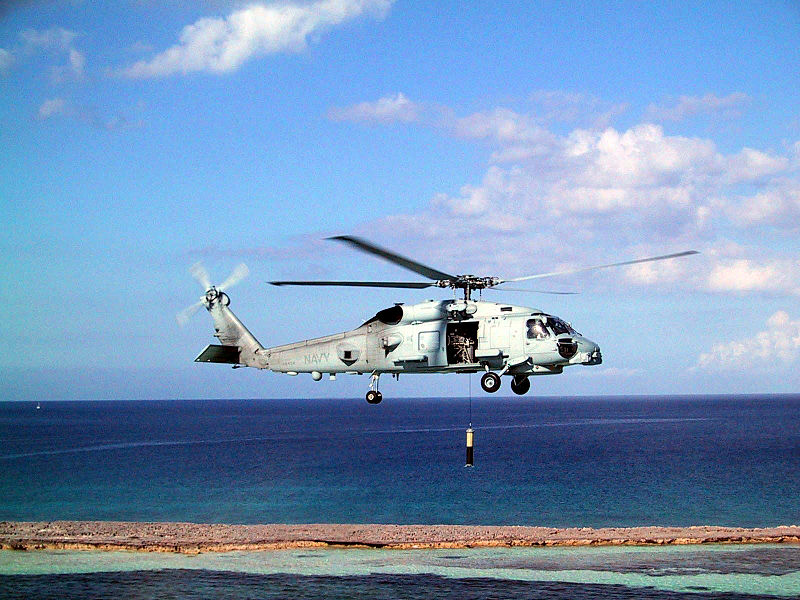
Navy photo. MH-60R “Knighthawk” helicopters conducts an airborne low frequency sonar (ALFS) operation during testing and evaluation

Navy photo. MH-60R “Knighthawk” helicopters conducts an airborne low frequency sonar (ALFS) operation during testing and evaluation

The National Interest has a post subtitled, “A new challenge for Trump: redefine the U.S. Coast Guard’s defense roles” you might find interesting.

The author, a Coast Guard Officer and Cutterman, wants to see our larger cutters better armed. He recommends specifically, provision for support of the Navy’s MH-60R

“The U.S. Coast Guard should explore adding the ability to embark, operate with, maintain and rearm these aircraft from both the National Security Cutter and Offshore Patrol Cutter. Only complete solutions that see cutters equipped with ordnance handling facilities, surge berthing for a full-maintenance detachment and sensor integration through data links should be considered.”

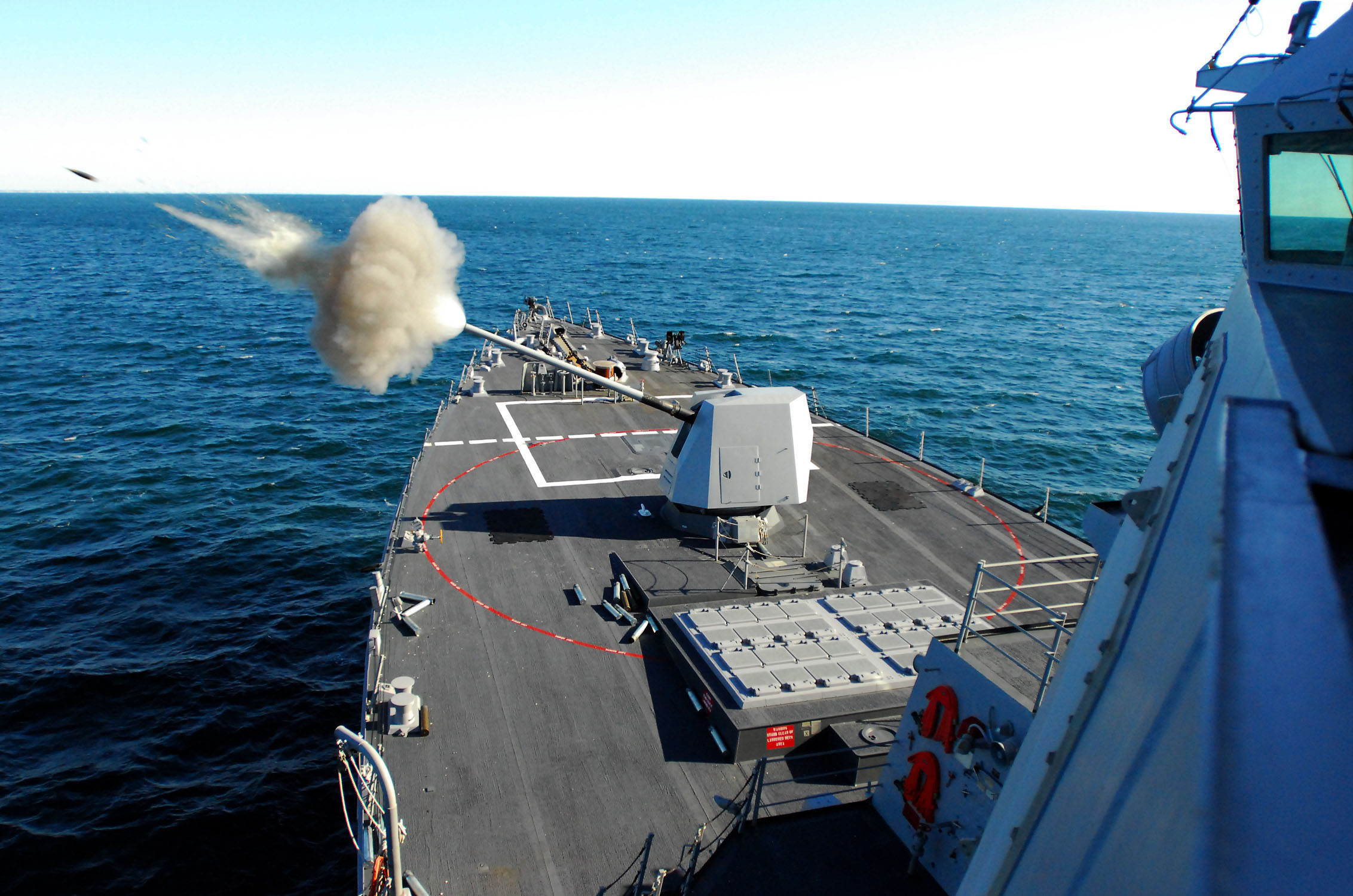
and the 5″ Mk45 for the National Security Cutter.

“The addition of a true major caliber-deck gun offers immediate utility, but the system’s real potential will be unlocked if efforts to develop hypervelocity projectiles bear fruit. If so, the National Security Cutter would emerge as a true utility warship capable of providing fires to forces ashore at substantial range and meaningfully contributing to air defense.”
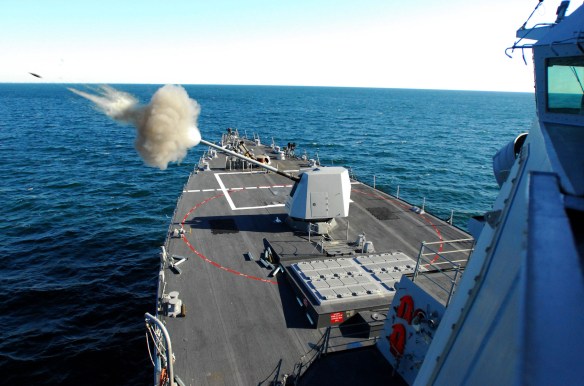
070111-N-4515N-509 Atlantic Ocean (Jan. 9 2007) - Guided missile destroyer USS Forest Sherman (DDG 98) test fires its five-inch gun on the bow of the ship during training. The Sherman is currently conducting training exercises in the Atlantic Ocean. U.S. Navy photo by Mass Communication Specialist Seaman Apprentice Joshua Adam Nuzzo (RELEASED)

Atlantic Ocean (Jan. 9 2007) – USS Forest Sherman (DDG 98) test fires its five-inch Mk 45 mod4 gun during training.U.S. Navy photo 070111-N-4515N-509 by Mass Communication Specialist Seaman Apprentice Joshua Adam Nuzzo

He does, however, see the services culture as an impediment.

“The lesson of the twenty-five years following the Hamilton experience is that a challenge to maintaining the U.S. Coast Guard’s warfighting capability lies in managing the service’s perception of its character…

He also notes that previous concepts of the Coast Guards wartime environment may be unrealistic.

“Attempts to define the U.S. Coast Guard’s defense roles following the Cold War have been challenging. Published in 1998, Coast Guard 2020 proclaimed that the “Coast Guard will be prepared to operate in low-threat conflict environments, and to provide specialized functions at all levels of operation.” The notions of low-threat operations and service-unique specialization are obstacles to interoperability. While U.S. Coast Guard buoy tenders and icebreakers absolutely provide specialized capability, the major cutter fleet’s warfighting role was never—nor should it have ever been—unique to the U.S. Coast Guard. Rather, the major cutter fleet provided an active augmentation force trained and equipped to provide service in any theater of war. This should be the target for the fleet’s future employment as the community of nations returns to its more normal mode of great power competition. As for the limitation of a low-threat environment, U.S. Coast Guard cutters have deployed recently to Southeast Asia, the Black Sea, the Arctic and the Arabian Gulf. Saber rattling among great powers and the HSV-2Swift incident demand that we ask: which of these locations will qualify as a low-threat environment on the first day of a global or major regional war?

Generally I agree with the thrust,

“The immediate challenges are acquiring and integrating combat systems and training crews in their employment. These are not trivial tasks and will necessarily consume time and resources. Better to act with dark clouds forming on the horizon, however, than in the midst of the storm.”

It is a two page post. The first page is mostly history lesson on the Coast Guard’s participation in past conflicts, but if he gives the impression the Coast Guard was historically ready for these roles on day 1, that would be a mistake. The Coast Guard entered WWII terribly unprepared. The cutters had no sonar or radar and no depth charge racks. There is nothing new about our current lack of readiness for war, it is not the exception, it is the norm.

Trouble is, we tend to have a binary approach. Either we are at peace and could care less about war-time roles, or we are all in after an attack. We need a more measured approach that responds to changing circumstance.

We really need to do better at preparing for a transition from peace to war. 

I don’t necessarily think removing the ASW systems from the 378s following the collapse of the Soviet threat was a mistake. It was a rational response to rapidly changing circumstance. Since then, we have had a quarter century without a substantial ASW threat, and the 378s are now on their way out. We probably should have removed the CIWS too, unfortunately it did mean we lost all the Coast Guard’s accumulated expertise in ASW. Hopefully we can rebuild it with the Navy’s help if needed.

But circumstances have changed again.

To me, a major conflict now appears more likely in the next ten to twenty years than at any time since I entered the Academy in 1965. We have a true peer challenger, with a chip on its shoulder and a belief in its inherent right to rule, in China. If that was not enough, Russia is rearming and acting increasingly obnoxious. Iran and North Korea may be annoying, but they are really not in the same league, at least in terms of a naval threat. Dealing with them would not stress our Navy, so would not really require Coast Guard assistance. China is the real threat, and if Russia sides with them, things could get dicey. Even without the Russians, the Chinese are building credible surface combattants at least as fast as the US. They already have a local superiority in the Western Pacific. We have to spread our fleet out, while they can concentrate their forces. To concentrate our forces in the Western Pacific, the US will be fighting at arm’s length with long vulnerable supply lines.

I don’t necessarily think war with China inevitable, but we need to recognize the possibility and plan for it.

Theoretically the process should start with an agreement between the Navy and the Coast Guard about what the Coast Guard, particularly its vessels and aircraft, will do in a general war. I see few indications that is happening. Certainly the OPC Concept of Operations did not include anything beyond a simple contingency operation.

I may be wrong about this, since I am way out of the loop, but if the service had an established general war mission focus to prepare for, it should be generally known. It should be reflected in our procurements. Perhaps the Navy thinks it would be presumptuous of them to assign the Coast Guard missions, and the Coast Guard does not want to push itself into Navy planning, but this is too important for delicate feelings to get in the way. Right now the Coast Guard is probably proportionately larger compared to the Navy than at any time in the last 100 years. When I entered the service, the Navy was 22 times larger than the Coast Guard in terms of personnel. Now it is only eight times larger. A combat ready Coast Guard may be the difference between victory and defeat.

Plans:

The Coast Guard has potentially important roles to fill in any general conflict. If the Navy cannot envision these roles, perhaps the Coast Guard should think for itself. Plans should include our aircraft as well as our vessels, but I will stick to the vessels for now.

What we need is not an overall strategy to defeat China, but a well developed range of options for employment and a good idea of what upgrades would be required.

In a major war, I see a major shortfall in open ocean escorts. Thirty years ago, when the threat was the Soviet Navy and the problem was projecting American power across the shorter distances of the Atlantic, the US had 36 cruisers, 69 destroyers, and 115 frigates (plus 12 WHEC 378s). Now they have 22 cruisers, 63 destroyers, and 8 LCS.

Then we had the advantage, that the Soviet Fleet was split into four parts and their egress to our supply lines was limited by the presence of powerful European Allied navies that restricted their access to our supply lines.

In a Pacific War with China, the distances are much greater, our allies fewer, and, with the exception of Japan and S. Korea, much weaker. Our Navy’s fleet, currently 274 ships, with ambitions of 355, is scattered across three oceans while China’s fleet, likely soon to be 500 ships, is geographically concentrated.

If we needed over a hundred frigates to cross the Atlantic, we probably need at least that many to push across the Pacific. As it is, the Navy cannot meet their current peacetime commitments, and replenishment ships cross the oceans unescorted and unarmed.

The Navy seems to have belatedly recognized this with moves toward a new frigate to be based on one of the LCS designs, but even if they complete all 52 small surface combattants currently planned, less than half will be completed as frigates, and if based on the LCS designs, they will have limited range, survivability, and crew size. The Independence class LCS will likely be permanently employed as mine countermeasures (MCM) vessels (There were 22 of those in 1987). The Freedom class will likely be employed in enforcing a blockade (perhaps with help from Webber class WPCs). Even with some backfitting of LCS  25-32, that leaves at most 28 frigates in the current plan. 35 ASW equipped cutters could make a huge difference.

The Cutters:

Cutters should be designed with wartime roles in mind, even if they will not be initially fully equipped with combat systems.

In the Bertholf class and Offshore Patrol Cutters, we will have most of the elements of modern warships. To not be prepared to add the few systems necessary to make them effective warships, if the nation were engaged in combat, would be criminal. If we do not already have plans to upgrade the Bertholf class National Security Cutters and the Offshore Patrol Cutters to give them significantly improved ASW, AAW, and ASuW capability we should start those plans.

At some point perhaps we should prototype an installation of these capabilities on at least one NSC and one OPC. Then we need to wring them out by deploying with the Navy and getting feedback on their performance, and periodically update plans for mobilizing their war-time potential.

The People: 

Just as we have marine inspection, fisheries, and drug enforcement specialist, the Coast Guard needs a cadre of officers in the Office of Counter Terrorism and Defense Operations Policy (CG-ODO) who have a deep understanding of the needs of modern naval warfare, who will advocate for naval capabilities consistent with both wartime missions and the Ports, Waterways, and Coastal Security (PWCS) mission. Likely this means revival or strengthening of officer exchange programs, Tactical Action Officer training, and War College education.

Perhaps the longest lead time item in mobilizing the Coast Guard for war would be the senior enlisted we would need for rating not currently found in the peacetime Coast Guard. It might be possible for the Navy to identify some reservist to augment the crews of Coast Guard cutters upon mobilization, but even a small cadre within the Coast Guard, founded on prototyping systems on at least a couple of cutters would provide valuable continuity and advice in defining required capabilities.

Bottom Line–When we get in trouble, we cannot make it up as we go along. Sweat now, saves blood later.

Thanks to Lyle for bringing this to my attention.

“SNA 2017 Surface Navy Association Day 3 – Part 2/2”–NavyRecognition

This is one of a series of videos from NavyRecognition discussing sponsors’ presentations at the Surface Navy Symposium. This one includes:

  • Extended Range Harpoon from 00:20 to 02:45
  • SeaRAM launcher from 02:45 to 05:15
  • RAM Block 2 from 05:15 to 5:45
  • Lockheed Martin export Multi Mission Surface Combatant 5:45 to 7:00
  • Curtis-Wright towed sonar (TRAPS) 7:00 to 08:30
  • Atlas North America SeaCat AUV 08:30 to 10:54

The things I found interesting were:

  • The growing use of SeaRAM, which has been being fitted to the trimaran Independence Class LCS, has replaced Phalanx on some destroyers and will replace the Mk49 RAM launcher on the mono-hull Freedom Class beginning with LCS-17. It is also expected to be fitted on the follow on LCS derived Frigate as well. If things start to get tense we may see these on NSCs and OPCs as well.
  • The fact that the extended range RAM Block 2 is now operational. The SeaRAM has the same degree of autonomy as Phalanx but because it is a “fire and forget” missile, will be able to engage multiple incoming anti-ship missiles at extended range.
  • More info on the Curtis-Wright TRAPS containerized active passive towed array which should be able to fit on anything WMEC sized and larger.