This is one of a series of videos from NavyRecognition discussing sponsors’ presentations at the Surface Navy Symposium. This one includes:
Extended Range Harpoon from 00:20 to 02:45
SeaRAM launcher from 02:45 to 05:15
RAM Block 2 from 05:15 to 5:45
Lockheed Martin export Multi Mission Surface Combatant 5:45 to 7:00
Curtis-Wright towed sonar (TRAPS) 7:00 to 08:30
Atlas North America SeaCat AUV 08:30 to 10:54
The things I found interesting were:
The growing use of SeaRAM, which has been being fitted to the trimaran Independence Class LCS, has replaced Phalanx on some destroyers and will replace the Mk49 RAM launcher on the mono-hull Freedom Class beginning with LCS-17. It is also expected to be fitted on the follow on LCS derived Frigate as well. If things start to get tense we may see these on NSCs and OPCs as well.
The fact that the extended range RAM Block 2 is now operational. The SeaRAM has the same degree of autonomy as Phalanx but because it is a “fire and forget” missile, will be able to engage multiple incoming anti-ship missiles at extended range.
More info on the Curtis-Wright TRAPS containerized active passive towed array which should be able to fit on anything WMEC sized and larger.
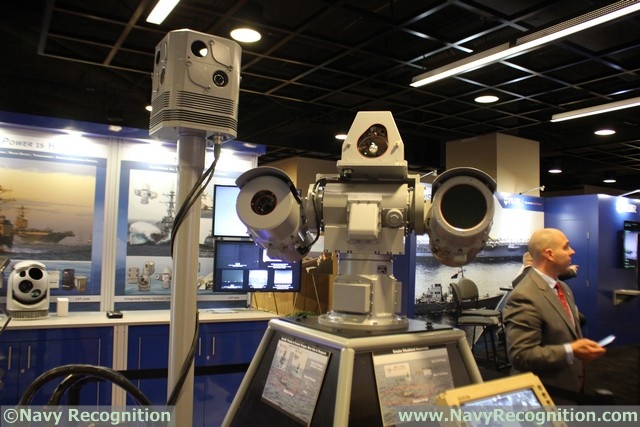
Two reports by NavyRecognition from the Surface Navy Symposium on the L3 Mk20 Mod1 Electro Optic Sensor System (EOSS). The video report above discusses the system from time 00:45 to 2:55, and there is this short written post reporting successful testing. Reportedly this EOSS will weigh half as much as the previous mk20 mod0 system, but have greater resolution and range. According to the report it is currently planned to be installed aboard U.S. Navy Cruisers/Destroyers and U.S. Coast Guard Cutters, presumably the Offshore Patrol Cutters (OPC).
The earlier Mk20 Mod0 is on the National Security Cutter.
The three parts visible are, I believe, a day light TV camera, a thermal imaging camera, and a laser range finder. I wonder if it could also function as a laser target designator?
Other than using it as a firecontrol for ASuW and AAW, this system can be used for:
– Spotting and kill assessment
– Target detection and identification
– Naval gunfire support
– Safety check-sight
– Location and track of man overboard
– Channel position and navigation
Above is a short presentation by a BAE representative brought us by NavyRecognition from the 2017 Surface Navy Association Meeting.
00:00–00:20 is intro.
00:20–01:15 discusses the electromagnetic rail gun.
01:15–02:30 covers the hypervelocity projectile that they expect to fire from the Mk45 5″ naval gun, the 155mm howitzer, and the electromagnetic railgun.
02:30–03:35 is about the Mk45 mod4 5″ and an automated, unmanned magazine designed for an international customer (It is planned for the UK’s Type 26 frigate).
03:35–04:42 is about the Mk110 57mm gun and a special purpose round they are developing, the ORKA (Ordnance for Rapid Kill of Attack Craft).
Below I have included a video with more detail on the ORKA round. Note this is a specialized guided round intended for use against small surface targets and inbound air targets. It should have a much higher probability of hit than the ballistic round, but is unlikely to have the full range (17,000 meters) or high altitude reach (PFHE: 24,930 feet) credited to the Mk110 because the round appears heavier than the ballistic round, control surfaces will add drag, and because of its larger size displaces some of the propellent that would have been in a more conventional round. The video claims an effective range of 10,000 meters (about 11,000 yards). That may also be its maximum range.
Part one recounted an engagement in 1939 between the “pocket battleship” (heavy cruiser) Admiral Graf Spee and three smaller British cruisers. This part will discuss the implications.
So what does a 77 year old Naval battle have to do with the Coast Guard’s ability to stop a terrorist attack using a medium to large ship?
As I said in part one (in a different order), I think it shows:
It is very difficult to sink a ship by gunfire alone.
Ships’ structure provide a degree of protection that makes it difficult to comprehensively target the crew of a ship without sinking the ship.
It is difficult to forcibly stop a ship with gunfire alone.
In comparing guns, at any given range, the longer ranged weapon generally enjoys an advantage in accuracy.
You can run out of ammunition before you accomplish your mission. The depth of your magazine may be important.
What do we have to oppose this type of attack?:
We don’t really have a lot of options.
If we have enough warning, say 24 hours, we can ask for help, but as far as I can tell there is no system of rapid response to surface threats. (When 9/11 occurred, we had no system for rapid response to air threat.) Unless we have absolute proof that the vessel in question is hostile, the Coast Guard would almost certainly have to intercept the vessel to determine hostile intent before it could be attacked. If the threat is a 20 knot ship detected 200 miles from its target we will have only ten hours to deal with the threat, and we are likely to be considerably less.
We have one Maritime Security Response Team (MSRT) on each coast, but to mobilize them, brief, organize, transport, and then get them to where we want them to act may take considerable time. Additionally while they might be effective in retaking a hijacked merchant ship, where there are relatively few hostiles who also have to control the crew, attempting an opposed boarding of a ship crewed by armed terrorist as a first step toward stopping an attack may be suicidal. If we have time to get them into place then perhaps we would also have time to get help from other services.
I think it more likely we will have at best a few hours to deal with the threat and we will have to use forces already in the area. I’ve made suggestions about additional equipment we might use to address this threat (here and here), but this time I will discuss tactics using what we have, or plan to have, and limit equipment suggestions to minimal upgrades and choice of ammunition.
While I doubt we will have cutters armed with 57mm Mk110s or 76mm Mk75s, on scene when required, we will discuss their utility and limitations. The Mk38 seems to be the key system, widely available and potentially capable, if the right ammunition is available. Other systems, .50 caliber and smaller, appear ineffective in stopping medium to large ships, but they may have their uses.
It is very difficult to sink a ship by gunfire alone:
Each of the Graf Spee’s 11.1″ projectile weighed 125 times the weight of a 57mm shell or roughly the weight of all the projectiles in a 57mm Mk110 gun mount’s 120 round automatic feed system.
Graf Spee was hit 20 times, three times by 8″ and 17 times by 6″ for a total of 2,672 pounds of projectiles. That is roughly the equivalent of being hit 500 times by a 57mm. From a distance, other than the burned out scout plane she carried, it would have been difficult to tell that she had been hurt.
Exeter was hit at least seven times excluding damaging near misses. That was 4,627 pounds of projectiles, a weight, I believe, almost equal to the total weight of all the 57mm projectiles allowed on a National Security Cutter (about 5,300 pounds assuming 1,000 rounds). While heavily damaged, Exeter was still capable of making 18 knots and completing the approximately 1,000 nautical mile journey to the Falklands.
Neither of these ships would be considered large by current standards. We can conclude, we are unlikely to sink a medium to large merchant ship with any weapon in the Coast Guard inventory.
Ships’ structure can provide a degree of protection that makes it difficult to comprehensively target the crew of a ship without sinking the ship.
Personnel Casualties were relatively light. Out of the approximately 3,000 men on the four ships, there were only 108 killed and 88 wounded.
As severely damaged as Exeter was, less than one in ten of the crew was killed. Unless terrorists choose to expose themselves, gunfire, from either cutters or airborne use of force equipped helicopters, is unlikely to allow us kill enough terrorists to stop an attempt to use a medium or large ship to make an attack.
Can We Immobilize the Target?:
None of the four ships were immobilized.
Of the approximately 30 hits, only one hit a main machinery space and it appears this was not because armor kept rounds out. It was simply that the amount of machinery space above the water line is a very small percentage of the total exposed area.
The single projectile that entered a machinery space was an armor-piercing 8″ round, and it wrecked the Graf Spee’s fuel oil purifier. That made it virtually impossible for the ship to make it back to Germany without having work done in port over an extended period. That would have allowed Britain to guarantee that Graf Spee would never escape, but it did not stop her from transiting at full speed for about 14 hours.
A modern merchant vessel diesel engine.
The task of stopping a ship by gunfire actually may have become more difficult because of the size and toughness of modern large diesel power plants, and because the large size of modern vessels puts more of the engine below the waterline and provides more space between the ships sides and the propulsion machinery.
The ship featured in the video above is no longer particularly large. The new Panama Canal locks needed to be wider and deeper than the old ones to accommodate the larger ships that have now become common. The locks are now 180 feet (vs 110 feet) wide and 60 feet (vs. 42 feet) deep. Many ships now have sufficient draft such that the 40 foot tall engine in video could be entirely below the water line.
Fuel consumption for the engine in the video above was reported twice, first as 328 tons per day and later as 400 tons per day. If we assume only 300 tons per day, that is 12.5 tons per hour or 417 pounds /minute or about 7 pounds per second.
The explosions going off in this type of engine every second are more powerful than the explosion of a 57mm shell.
There is less than a pound of explosive in a 57mm projectile. 1 pound of TNT has 13.4 megajoules of energy. We may assume a more powerful explosive in the Mk110 projectiles, perhaps 20 megajoules. One gallon (about 7.1 pounds) of diesel (the amount consumed in one second) equals 146.5 megajoules.
The 57mm gun does not have a true armor-piercing round. The current 3P fuse has a semi-armor piercing function which I presume is similar to the previous semi-armor piercing (SAP) round, “The SAP round had a delayed action fuze which allowed the round to penetrate about 2 cm (0.8 inches) of armor and then explode after traveling a further 2 m (6 feet).” If that is the case, first it is uncertain that the round will penetrate, since the plating on large ships can considerably exceed 2 cm, but assuming it did, an explosion two meters inside the hull would still be a long way from a very tough engine.
The 76mm Mk75 is the most powerful gun in the Coast Guard inventory, but we have fewer of them every year, although it looks like we will not see the last of those on the 270s until 2034. It is still a relatively small projectile at about 14 pounds. Like the 57mm there is no true armor-piercing round for this weapon. Like the 57mm its projectile would likely explode shortly after penetrating the hull, rather than on or in the engine. The 57 and 76 mm guns might have more success against the steering gear, but that will also be very robustly built on any large ship, and hitting it will require great accuracy, suggesting a close approach.
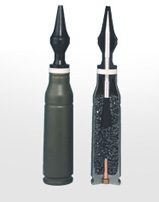
The Mk38 25 mm, with a maximum shell weight of 1.1 pound or less, might be assumed to be even less likely to do damage, but they do have an option for an armor-piercing fin stabilized discarding sabot round (APFSDS) (pdf). It is intended for use against lightly armored vehicles like Armored Personnel Carriers. It may not be commonly available for the Mk38 (the Navy thinks of the Mk38 exclusively as a counter to small craft), but the APFSDS round is in the Navy system for use by Marine LAV-25 Light Armored Vehicle. It fires a 98 gram (3.5 oz) Solid Tungsten Penetrator at a very high velocity, 1390 m/sec (4560 ft/sec).
25MM TUNGSTEN APFSDS-T Armor Piercing Fin Stabilized Discarding Sabot-Trace
The .50 caliber, 7.62 and 5.56 mm weapons are simply too light to make much impression on a medium or large ship. The only other CG gun with a possibility of forcibly stopping one of these vessels is the Phalanx 20mm Close In Weapons System (CIWS). This system uses a discarding sabot round 12.7mm in diameter Solid Tungsten Penetrator with a 3,650 fps (1,113 mps) muzzle velocity. The Phalanx is only found only on WHECs and NSCs, so they will soon be home ported only in Charleston, Alameda, and Honolulu and it is unlikely these ships will be available to respond.
If we do detect a terrorist attack, the only likely Coast Guard counter to it, is likely to be equipped with a Mk38 mount. We are not going to sink a medium or large ship with the Mk38, but we might be able to disable it, if we can accurately penetrate both the ship’s hull and the ship’s engines or disable the steering.
In comparing guns, at any given range, the longer ranged weapon generally enjoys an advantage in accuracy.
I started thinking about the results of the Battle of River Plate after reading this pdf, Offshore Patrol Cutter (OPC) SUW Self-Protection Secondary Battery Study (which compared one and two-gun solutions using .50 cal., 25mm, and 30mm) and writing a post about a possible 40mm alternative for the Mk38 gun mount currently used on the Webber class WPCs and planned for the Offshore Patrol Cutter. It occurred to me that everyone may not understand my strong preference, when considering guns, for the longest ranged weapon available, even if I don’t expect it to be used at extreme ranges.
It is not just the potential of longer range, or the fact that the projectile is probably larger and more effective. It is also the fact that, all other factors being equal, the longer ranged weapon is also almost always more accurate.
Comparing any two weapons, fired at a target at the same range, the longer range weapon will generally fly a flatter trajectory (a more direct path) and have a shorter time of flight, meaning it will be effected less by uncertainties of environment and the actions of the target between firing and impact.
In the battle we see three gun with different ranges and can compare their accuracy. If we look at the British 6″ guns as a base line, how did the weapons compare?
The British 6″ gun had a maximum range of 24,500 yards (22,400 m). They got hits 0.82% of the time.
The British 8″ gun had a maximum range of 30,650 yards (28,030 m), 25% greater range, got hits 1.55% of the time, making them 89% more accurate than the contemporary 6″ guns.
The German 11.1″ had a maximum range of 39,890 yards (36,475 m), with 63% greater range than the 6″ guns, got hits 2.4% of the time, making them almost three times as accurate as the 6″ guns at the ranges the battle was fought (193% more accurate).
While it might be argued that the Graf Spee benefitted from superior fire control, the same cannot be said for the Exeter’s 8″ guns, that for most of the engagement were fired under local control. Additionally it appears that the light cruisers’ director controls were at least as sophisticated as that on Exeter. It appears the greater accuracy is due to the flatter trajectory and shorter time of flight of the longer ranged guns.
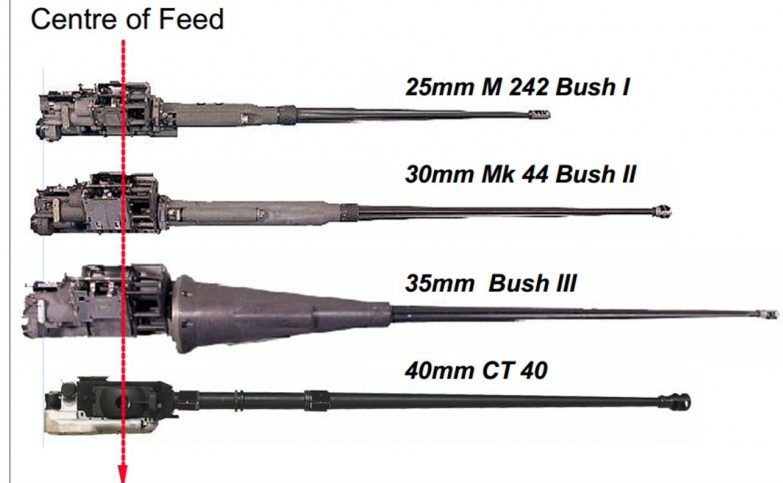
There are at least four different gun calibers that can be mounted on the Mk38 gun mount, 25, 30, 35, and 40mm. If we have the opportunity to upgrade the Mk38s to higher caliber weapons, we should take it, not just for the greater effectiveness of the projectile but also for the likely greater accuracy and effective range.
Case Telescoped 40 mm ammunition
Making the Best of the Mk38:
“No captain can do very wrong if he places his ship alongside that of the enemy.”–Horatio Nelson
When I looked at this problem earlier, I suggested that we should have systems that could disable a ship at ranges greater than 4,000 yards, so that weapons on the terrorist controlled vessel could not target specific systems on the defending cutter. With what we have now, we don’t really have that option. We are going to need to get a lot closer.
Not only is the effective range of the Mk38 less than 4,000 yards, we will need to get closer to increase accuracy to target specific parts of the terrorist vessel, and close the range to maximize the kinetic energy of the rounds.
If we are to have any chance of stopping a medium to large ship making a terrorist attack, we need to do what the British did. We need a team approach. We need to gang up on it.
The only ships we have that might have a chance are those with 25mm and larger weapons. There are relatively few of those. They would be the primary shooters. Hopefully you would have more than one to respond, but in many cases, perhaps most, there would be only one.
We can still use less capable units to take pressure off the primary shooter. These supporting units equipped only with .50 caliber and smaller weapons might be used to target the bridge, but their primary function should be to target any weapons that might endanger the more capable cutter(s).
Targeting the bridge is relatively simple, but if the terrorists plan properly they will not need to navigate from the bridge. They can use an autopilot or steer from after steering.
As we approach we will want to establish hostile intent as early as possible, preferably without putting a boarding party aboard that might become hostages.
We can demand that the vessel stop or change course away from the endangered potential target. The quickest way to do that might be with an Airborne Use of Force helicopter. Other supporting units might also be sent ahead of the primary shooter to attempt to stop or turn the suspect vessel.
After establishing hostile intent, supporting units should, if possible, precede the primary shooter and engage the threat with the idea of suppressing any weapons the vessel might employ against the cutters.
As it approached its target, before attempting to disable it, the primary shooter should probably put a few rounds into the bow of the target, in case it has been loaded with explosives.
Because the supporting units will need to stay out of the line of fire between the primary shooter and terrorists’ vessel, and because projectile will lose the minimum amount of kinetic energy if it strike normal to the target’s side, the primary shooter should move to a position on beam of the threatening vessel, while supporting units should be both forward and aft of the primary shooter’s line of fire, ready to engage any attempt to return fire.
If the supporting units include a unit with only one machine gun on the bow, like a Response Boat, Medium (RB-M) and a unit with machine guns both fore and aft, like an 87 foot WPB, the WPB should be positioned toward the bow of the target, so that it can parallel the target and still have weapons on target while the unit (RB-M) with only gun on the bow, can keep its weapon on target.
An airborne use of force helicopter could also be very useful as a supporting unit, taking out any terrorist who appeared on deck and keeping an eye out for their activities on the disengaged side of the vessel.
At some point the primary shooter is going to have to close alongside, so that it can shoot through the hull near the waterline, down and into the engine room below the waterline. The supporting units should get there first, shoot up the bridge, attempt to draw fire and suppress any return fire.
When the primary shooter comes alongside ready to attempt to disable the terrorist vessel it will need a lot of ammunition so it will need to exercise fire discipline during the approach.
If we are unable to disable the engine(s) or steering, as a last ditch effort, we can attempt to push the vessel into shoal water and run it aground. This would of course make the cutters easy targets for grenades and RPGs.
Conclusion:
The approach outlined above implies a desperate fight, with no guarantee of success. If the terrorists manage to knock out the few (or one) weapon capable of stopping them, we might have no chance of success.
This is not the kind of fight the Coast Guard should want. It puts our people, our mission, and the people we are supposed to protect in danger. Right now there is no assurance that 25mm can even do the job.
We really ought to do better.
The Future:
I would hope the Coast Guard would do some testing to find out if we have the weapons we need to stop the full range of possible maritime terrorist attacks.
That should help us pick the right ammunition. We really need to make sure we have the right types. of ammunition.
If tests show we cannot disable the largest ships, we need to insist that we get weapons that can, and they may not be standard US Navy weapons.
Alternately, we need to establish means to have other services deploy anti-ship weapons on short notice. (Coast Defense is still officially an Army mission.)
We noted earlier that a new Mk38 mod3 mount is on the way. It will have much more ammunition on the mount. While the mount appears designed for a 30mm gun, it appears we will be getting them equipped with 25mm guns. More ammunition is good, but a larger weapon would be better.
Guns may not be the answer, but any upgrade we can get in the caliber of the gun on the mount will permit it to be more effective against progressively larger ships and at longer range.
In the not too distant future we will need to start replacing the 87 foot Marine Protector class WPBs. The oldest are already 18 years old. As soon as the last Webber class is funded, we need to start funding 87 footer preplacements. Hopefully we will see fit to arm these vessels for this mission.
Photo: Heavy cruiser HMS Exeter seen after the battle, looking aft from the bow. Both forward twin 8″ gun turrets and the firecontrol system were disabled and the bridge destroyed by “splinters.”
Introduction:
Note, this has been edited from the original, based on feedback particularly with regard to the ammunition remaining on Graf Spee after the engagement. I don’t believe the thrust of the post has been changed.
This is the first of two parts. Part one will tell a story. Part two will talk about the implications of lessons learned, applied to how the Coast Guard might deal with the threat of terrorists using a medium to large merchant ship to make an attack.
These are themes that will be discussed in part 2 before looking at specific tactics to make the best use of what we have. Hopefully you will see these illustrated in the following story.
In comparing guns, at any given range, the longer ranged weapon generally enjoys an advantage in accuracy.
It is very difficult to sink a ship by gunfire alone.
Ships’ structure provide a degree of protection that makes it difficult to comprehensively target the crew of a ship without sinking the ship.
It is difficult to forcibly stop a ship with gunfire alone.
You can run out of ammunition before you accomplish your mission. The depth of your magazine may be important.
But first the story.
To the Germans, it is the story of a lone warrior, that by guile and deception, manages to evade the world’s largest navy for three months. Graf Spee is captained by an honorable and humane gentleman of the old school, Captain Hans Langsdorff, who after seeking a fight with the British and apparently besting them, does the unthinkable, retreating to a neutral port and sinking his own ship, but sparing the lives of his crew.
From the British perspective, it is a story of three little guys, lead by Captain (later Admiral) Henry Harwood, that work together, and despite severe damage, manage to corner a bully. Then by cleaver manipulation, the bully is convinced he has no chance of winning a second round and he self destructs rather than face the Royal Navy again.
Graf Spee Cruise, 1939
The story I will tell is one of how many hits, how many rounds expended, how many rounds remained, and unlikely, almost invisible, but critical damage.
The British had made the Deutschland Class, of which the Graf Spee was the third and last, something of a boogeyman, bestowing on them the description “pocket battleships.” In fact they lacked the protection implicit in the battleship description. The Germans called them simply “Panzerschiff,” (armored ships) and in 1940 reclassified the surviving ships as heavy cruisers. Graf Spee was little better protected than the ships she would fight. She was in fact a large heavy cruiser, but there were others that were larger and better protected, including the German Hipper class (the first commissioned in 1939) and the American Baltimore and later cruiser classes (the first commissioned in 1943). The Japanese and Italians, who were also cheating on their treaty commitments, had several cruiser almost as large.
(Note: the distinction between heavy cruisers and light cruisers was one of gun caliber, not displacement. Light cruisers’ heaviest guns were 6.1″ (155 mm) or smaller. Heavy cruisers carried guns larger than 6.1″; usually 8″ (205mm) guns which were the largest cruiser guns allowed signatories of the Washington Naval Treaty.)
On the other hand, the guns of the Deutschland class were exceptional. These ships were a very real tactical problem for the British, since no single cruiser could deal with them individually. The British considered they needed 70 cruisers to meet their needs and they never approached that number. If they had to double up, there would be many needs left unfilled.
Admiral Graf Spee in the English Channel in April 1939. U.S. Naval Historical Center Photograph # NH 89566.
The Ships:
Admiral Graf Spee, 16,200 tons (full load), 610 ft (186 meters) loa, six 11″, eight 5.9″, six 4.1″, eight torpedo tubes, 26 knots (reduced to 24 by a fouled bottom), crew 1,134.
HMS Exeter, (one of the smallest of the treaty heavy cruisers) 10,490 long tons (full load), 575 ft (175 meters) loa, six 8″ guns, four 4″, six torpedo tubes, 32 knots, crew 630.
HMS Ajax and HMNZS Achilles, 9,740 tons (full load), 555 ft (169 meters) loa, eight 6″ guns, four 4″, eight torpedo tubes, 32 knots, crew 570.
Note the total displacement of the three Commonwealth cruisers totaled 29,970 tons, almost twice the displacement of Graf Spee.
HMNZS Achilles. Photo, State Library of Victoria – Allan C. Green collection of glass negatives.
The Guns:
Commonwealth:
British 8″/50 MkVIII (203mm), 256 lbs.(116.1 kg) projectile, 3-4 rounds/minute, range: 30,650 yards (28,030 m). Time of flight to 20,000 yards (18,290 m), 38.4 seconds, elevation for 20,000 yard range: 16.5 degrees
British 6″/50 BLMkXXIII (152mm), 112 lbs.(50.8 kg) projectile, 6-8 rounds/minute, range: 24,500 yards (22,400 m). Time of flight to 20,000 yards, 47.2 seconds, elevation 24.1 degreees.
British 4″/45 (102 mm), 31 lbs (14 kg), 10-15 rounds/minute, range: 16,300 yards (14,950 m)
German:
German 11.1″/52 (283mm), 661.4 lbs (300 kg) projectile, 2.5 rounds/minute, range: 39,890 yards (36,475 m) at 40 degrees elevation. Would have been more if 45 degrees elevation had been possible, elevation for 20,000 yard range: approximately 11 degrees.
German 5.9″/55 (149mm), 100 lbs. (45 kg) projectile, 6-8 rounds/minute, range: 25,153 yards (23,000 m) at 40 degrees elevation, would have been slightly greater if 45 degree elevation had been possible.
German 4.1″/65 (105mm), 35 lbs (15.8 kg) projectile, 15 – 18 rounds/minute, range: 19,357 yards (17,700 m).at 45 degree elevation.
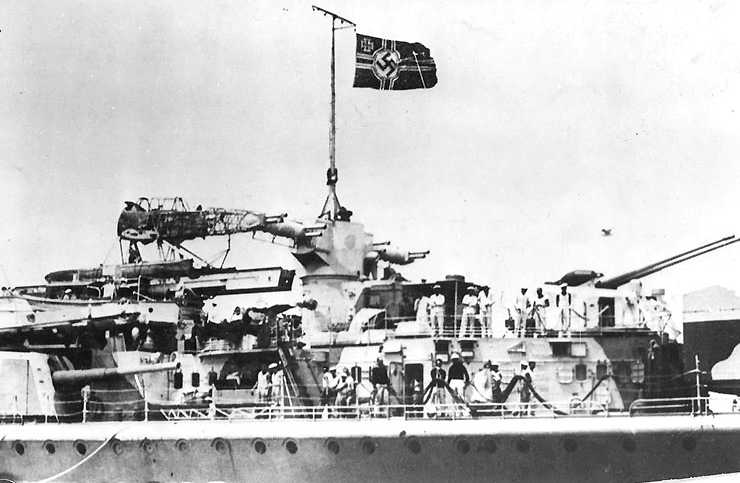
Photo: After superstructure of Admiral Graf Spee showing 15 cm/55 and 10.5 cm/65 guns. Note the burned-out Arado Ar 196A-1 floatplane on the catapult and the after main-director rangefinder. Photograph taken at Montevideo, Uruguay in mid-December 1939, following the Battle of the River Plate. U.S. Naval Historical Center Photograph # NH 80976.
How Deep Is Your Magazine?:
The number of rounds carried by each ship would become important as the engagement progressed and as options were weighed. Total weight of rounds available was also an important variable determining how much damage could be inflicted:
From official British report into the cruise of the Graf Spee and Battle of the River Plate. Published by HMSO (His Majesty’s Stationery Office).
Battle Before Breakfast:
It is 13 December 1939. In the Southern Hemisphere, this is one of the longest days of the year. As the sun comes up, Graf Spee sights masts on the horizon. Believing the ships to be a cruiser and two destroyers escorting a convoy she had hoped to attack, she turns toward them and accelerates.
6:10: Graf Spee’s increased speed results in more smoke and she in turn is seen by Commodore Harwood’s cruisers. In accordance with their previously planned response, the cruisers divide up, so that Graf Spee will have two separate groups to engage about 90 degrees apart. Heavy cruiser Exeter goes NW and the two light cruisers go NE. Additionally this should allow the two groups to spot fall of shot and provide range correction for each other.
06:18 Graf Spee opens fire at a little less than 20,000 yards. Exeter at 06:20, Achilles at 06:21 and Ajax at 06:23.
From the first, Graf Spee’s fire, targeting Exeter, is accurate. First salvo over, second salvo short, third salvo straddled. A near miss, bursting short, kills the crew on the starboard torpedo tubes and damages Exeter’s two spotter planes, which are jettisoned. It is textbook gunnery, the rocking ladder. Only one salvo of three is expected to yield any hits. Even then, dispersion of the rounds means, even if the fire control solution is perfect, it is unlikely more than one round out of a salvo would hit. Straddles that include no hits are common. So under ideal condition, if everything worked perfectly, the best one could expect would be that, one round of 18 would hit.
But the adversary is also doing everything he can to throw off the gunnery solution. Assuming the gun line is perpendicular to the base course, at 30 knots, a 30 degree course change for only thirty seconds will change the range 250 yards. At long range, this can be done between the time the guns fire and the shells impact. Both sides used smoke and evasive maneuvers to complicate the fire control problem.
At 06:26, Graf Spee scores a direct hit on the “B” turret (second turret on the bow). Splinters wipe out the entire bridge crew with the exception of the Captain and two others. The Captain is wounded but continues to command the ship. For the rest of the action, the ship is controlled by messenger to after steering.
06:37 Ajax launches her spotter plane to observe and provide correction of the cruisers’ gunnery.
06:38 Exeter is hit twice. One hitting the “A” (most forward) turret and putting it out of action, the other strikes the hull starting a fire.
“At this point, Exeter was severely damaged, having only “Y” turret still in action under ‘local’ control, with Jennings (Gunnery Officer–Chuck) on the roof shouting instructions to those inside. She also had a 7° list, was being flooded and being steered with the use of her small boat’s compass. However, Exeter dealt the decisive blow; one of her 8 in (200 mm) shells had penetrated two decks before exploding in Graf Spee′s funnel area, destroying her raw fuel processing system and leaving her with just 16 hours fuel, insufficient to allow her to return home.
“At this point, nearly one hour after the battle started, Graf Spee was doomed; she could not make fuel system repairs of this complexity under fire. Two-thirds of her anti-aircraft guns (two out of three mounts–Chuck) were knocked out, as well as one of her secondary turrets (one of eight guns–Chuck).“
06:40 A near miss on Achilles–splinters kill four, wound several others, and temporarily disable the main fire control director.
07:25 An 11″ shell puts one of Ajax’s after turrets out of action and jams the other. She now has use of only half of her 6″ battery.
07:30 Flooding shorts out power to Exeter’s only remaining turret.
About this time, it appears Graf Spee begins to break off the engagement and heads for the River Plate.
07:40 Now listing heavily, with all major guns disabled and her speed reduced due to flooding in the bow, Exeter breaks off action and begins a long retirement to the Falklands where she will make temporary repairs before returning to Britain for a 13 month refit.
About the same time the Exeter turns to disengage and begin her transit to the Falkland, Commodore Harwood, having closed to close to 8,000 yards, hears reports he is running short of ammunition. He probably also realizes he is in a very dangerous position where his adversary’s shooting is much more accurate. He changes tactics, opens the range and plans to make a night attack when an effective torpedo attack is more likely.
Ajax and Achilles drop back and follow Graf Spee as it becomes obvious she is heading for the mouth of the River Plate. Some shots are exchanged, but these appear to be only Graf Spee warning the cruisers to maintain their distance.
Late in the evening Graf Spee anchors in Montevideo harbor.
The following day she releases her 62 merchant navy prisoners, transfers wounded to hospitals ashore, and buries her dead.
How accurate were they?:
The British light cruisers fired 2064 x 6″ projectiles and scored 17 hits or one hit for every 121 rounds fired or 0.82%. Of their original 3200 rounds 1136, 35.5%, remained.
Exeter fired 193 x 8″ rounds (possibly a few more) and scored three hits or one hit for every 64 rounds fired, 1.55%. This is all the more remarkable because 177 of these are fired by the after twin turret, most of which were fired under local control, and Exeter never closed the range to the degree the light cruisers did. It appears one of Exeter’s three hits was made while the gun was in local control.
Graf Spee fired 414 x 11.1″ rounds. Graf Spee’s 11.1″ hit Exeter at least seven times plus a particularly damaging near miss, along with several others that caused minor damage. These guns also made two hits on Ajax and a damaging near miss on Achilles. If we assume ten hits, that is one hit for every 41 rounds fired or 2.4%. Graf Spee had only 306 rounds, 42.5%, remaining. If she continued shooting with the same degree of accuracy, these could be expected to score at best eight more hits.
My primary source indicates that Graf Spee’s relatively powerful secondary armament fired 377 x 5.9″ and 80 4.1″ projectiles, but made not hits. They should have performed similarly to the British 6″. “It was not known until later that splinter damage to the director directing the 15 cm fire caused bearing track inaccuracy for the 15 cm fire…a small shell splinter entered the starboard director (of assume the forward conning tower FC station). But as luck would have it, the optic was left intact and the director function but little impaired, so the damage remained unknown until late in the evening. The casualty was not noticed by the operator during the battle at all. However, the director did not provide the proper fine bearing angle alignment to the battery, resulting in very poor on target performance.”
A Second Round?:
Diplomatic rankling begins almost as soon as Graf Spee anchors, with the Germans asking for two weeks in port to make the ship seaworthy enough to deal with the North Atlantic winter. The British first try to have Graf Spee’s stay limited to 24 hours, and then, realizing it will be several days before their heavy units arrive, they attempt to keep her in port without saying so.
The Uraguian authorities are unmoved and give the Graf Spee 72 hours.
Meanwhile the Royal Navy has ordered a battlecruiser, an aircraft carrier, and eight cruisers to converge on the River Plate to make sure Graf Spee does not escape.
22:00, 14 December, Heavy cruiser HMS Cumberland arrives, having steamed at full speed for 36 hours from the Falkland Islands. 28% Larger than Exeter (13,450 tons full load and 630 ft loa), with 33% more 8″ guns, she brings with her full magazines, 800 rounds of 8″.
17 December, Graf Spee sets sail, but a large portion of her crew has already left the ship. She stops, anchors, the rest of the crew leave the ship, transferring to waiting tugs. A series of explosions erupt and Graf Spee settles in shallow water, her guns and superstructure still out of the water.
Why did they do it?:
The British provided disinformation that the battlecruiser Renown and aircraft carrier Ark Royal were waiting outside and the Graf Spee crew members convinced themselves they saw the masts of these ships offshore.
Even an accurate view of the odds looked unfavorable for a successful sortie. After the arrival of HMS Cumberland, Graf Spee faced a force at least as powerful as the one engaged on the 13th. Additionally, the three cruisers waiting off shore did not have to sink Graf Spee to be successful. All they really had to do was shadow her until the heavy units could join them and Graf Spee’s fate would be sealed. With less than three quarters the ammunition she had used in the first engagement and her forward fire control director already disabled, Graf Spee’s chances of inflicting significant damage, escaping her tormentors in the South Atlantic, getting through the British blockade of Germany, and making it home appeared slim.
Then there is the matter of the fuel oil purifier. Without it, they could not expect to make it back to Germany, even if the Royal Navy were not in their way.
EXETER during the “Battle of the River Plate”, came under shell fire from the German Pocket Battleship, ADMIRAL GRAF SPEE.
Hit No. l, struck the shelter deck just abaft “B” Turret and passed out through the superstructure side without exploding.
Hit No. 2, struck the front plate of “B’ Turret between the two guns and detonated on impact. “B” Turret was seriously damaged and put out of actions. Splinters caused damage and casualties on the bridge.
Hit No. 3,, struck on or very near, the fluke of the starboard sheet anchor and detonated on impact. The side plating was split and torn and much damage in the paint shop was caused by splinters.
Hit No. 4, struck the forecastle deck on the middle line just aft of the cable holders and exploded on impact. A hole 10 ft. by 10 ft. was blown in the forecastle deck and splinters penetrated the upper deck.
Hit No. 5, struck the jacket of the right gun of “A” Turret, and exploded on impact. “A” Turret was put out of action although it was found later that the turret could be trained and the left gun used. The forecastle deck was torn and the upper deck damaged by splinters.
Hit No. 6, passed through the whee!house, charthouse, out through the armament office and exploded just forward of the starboard 4 inch H.A. (High Angle-Chuck) Gun. Damage from splinters was widespread, ammunition in R.U. (Ready Use-Chuck) lockers was ignited, the lower bridge and 25% of the 4 inch armament was put out of action.
Hit No. 7, passed through the ship’s side just under the upper deck abreast “B” turret, travelled aft through the mess spaces on the lower deck and exploded abreast the E.R.A .’s (Engine Room Artificers-Chuck) mess. Damage from splinters was widespread, the fire main was fractured, communications seriously damaged and the lower deck holed. The 4 inch H.A. magazine and handing room were flooded by water escaping from the fractured fire main. Fire broke out in the mess spaces just aft of “B” turret supports.
Splinter Damage. EXETER suffered a great deal of superficial damage from splinters due to shells that burst short. Splinters on the ship’s side near the waterline caused a good deal of flooding. Most aerials were carried away and searchlights, signal projectors;, rigging etc. were badly damaged. One R.U. Ammunition locker was also ignited by splinters.
Fighting Efficiency = Seriously impaired. “A”, “B” and °Y° Turrets and 25% of the 4 inch H.A. armament was out of action. Slight loss of speed due to flooding and consequent heel and trim of the ship.
AJAX during the “Battle of the River Plate” came under shell fire from the German pocket battleship ADMIRAL GRAF SPEE. The direct hit struck the after superstructure port side passed thro’ “X” barbette and exploded in the Admiral’s cabin, starboard side causing slight structural damage. The shell did not detonate but burst with a mild explosion. Splinter damage caused, “Y” turret to jam.
(Ajax was again hit by a 283 mm (11.1 in) shell that destroyed her mast and caused more casualties, but damage was apparently not worth reporting–Chuck)
Fighting Efficiency = Impaired, “X” and “Y” turret were out of action due to the shell hit. “B” turret had one gun out of action due to failure of the hoist.
ACHILLES during the “Battle of the River Plate” came under shell fire from the German pocket battleship ADMIRAL GRAF SPEE. Splinters from shells bursting short pierced the ship’s side above the waterline, bridge screen etc, and also caused other slight damage. Minor damage was sustained in the director control tower but after casualties had been replaced it was able to continue in action.
Fighting Efficiency – Not impaired. Gun fire was not efficient until casualties in the D. C.T. (Fire Control Director–Chuck) were replaced. W/T (radio-Chuck) was out of action temporarily.
REMARKS The “Battle of the River Plate” revealed the following items.
Increased protection to vital communications required.
Additional portable telephones required,
Improvement to look-out positions necessary,
Need for increased protection for exposed personnel.
Remote control of the smoke apparatus required.
Square ports to be abolished.
Automatic emergency secondary lighting to be introduced.
Modifications required to telephone hand sets to prevent “jumping off”.
Additional portable pumps to be supplied.
Fire mains to be modified to provide for easier isolation and repair.
Print Sources:
Bennett, Geoffrey, Battle of the River Plate, Ian Allen, Ltd., 1972
Campbell, John, Naval Weapons of World War Two, Conway Maritime Press Ltd, 1985
Chesneau, Roger, Conway’s All the World’s Fighting ships, 1922-1946, Conway Maritime Press Ltd, 1980
A first hand account of the battle from a Damage Control officer about HMS Exeter. https://www.navyhistory.org.au/hms-exeter-at-the-battle-of-river-plate/
Pointing toward the increasing ubiquity of anti-ship missiles, it suggests that we install the SeaRAM system in place of the Phalanx on the Bertholf class National Security Cutters (NSC), and that we also install the system on the Offshore Patrol Cutters (OPC) and the new icebreakers.
With the Commandant’s proposal, that the new administration send cutters to the Western Pacific to counter Chinese aggressiveness, better self-defense systems make more sense than ever.
Fitting the system to at least a couple of West Coast NSCs that might be available for WestPAC deployment should be relatively straight forward since the systems have much in common with the Phalanx system it would replace. SeaRAM would have the additional benefit of increasing the ships anti-surface capability as well.
Coast Guard manned destroyer escort USS Menges (DE-320) showing the effects of an acoustic homing torpedo hit on the stern.
It is entirely appropriate for Veteran’s Day weekend reading, but this post was prompted by a recent update of the list of “Top Ten Posts.” I found that the 2011 post “What Does It Take to Sink a Ship?”was not only the top post since I started writing, it is also the top post of 2016. That looked at Navy major surface combatant losses in WWII, but I realized I have never surveyed the Coast Guard’s WWII losses.
This began as another shameless attempt to get the Coast Guard to recognize that they need torpedoes to stop medium to large ships, but it grew into a more comprehensive look at CG losses in WII. I did find that six (or seven, Escanaba?) Coast Guard or CG manned vessels were hit by torpedoes and in every case the ship was either sunk (four or five?) or immobilized (two).
I found a couple of good sources. “The Coast Guard at War” is a series of monographs completed shortly after WWII (between 1045 and 1950) and most of the apparently 25 volumes are available in pdf format here, along with a lot of other WWII references. In particular I used The Coast Guard At War: Lost Cutters(Official History Series, Volume VIII, 1947). It lists the loss of 16 Coast Guard vessels and the loss of 12 Coast Guard manned Navy vessels, but two of these (one Navy and one CG) were actually after the war was over. My other source was “U. S. Coast Guard Ship Losses” by Jim Gill, on the US Coast Guard Light Ship Sailors Association International web site. This source identifies 40 losses beginning with the Tahoma in 1914 up to USCGC Mesquite (WLB-305), grounded in 1989. It included three losses not listed in the official history, all by torpedoes:
(FS-255), a small Army freighter, 560 tons, torpedoed and sunk by a Japanese submarine while anchored, 11 May 1945, with the loss of four men.
USS Menges (DE-320), 1,590 tons, torpedoed while on convoy duty, 4 May, 1944, the ship survived severe damage to her stern, but there were 31 dead.
USS Etamin (AK-93), 7,176 tons, which was hit by a hit by an air launched torpedo and damaged badly enough that it was decommissioned and was used subsequently as an unpowered floating warehouse. One dead.
Coast Guard Vessels Lost:
The Coast Guard lost 15 vessels during the course of WWII. Of those, three are believed to be the result of enemy action. Of the remaining 12, eight were a result of adverse weather. 214 Coast Guardsmen were killed in these 15 incidents.
The three ships presumed loss to enemy action included the three largest Coast Guard vessels lost during the war:
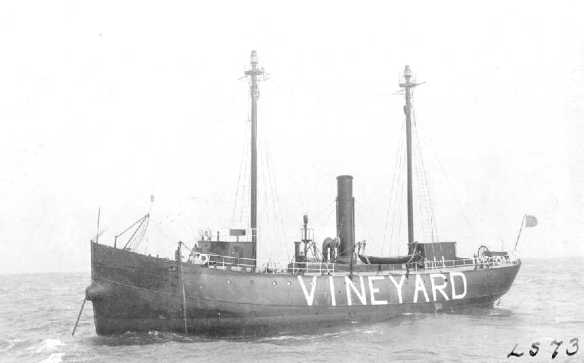
LV 73 on the Vineyard Sound station where she served from 1924 through 1944. On 14 September 1944 she was carried off station during a hurricane and sank with the loss of all hands.
It might be assumed that the non-combat casualties were not war related, but that might not be the case. The urgency of the missions, the diversion of more capable ships to escort duty, the influx of inexperienced personnel placed in responsible positions, and the use of vessels pressed into service for which they may have been ill-suited, were all a result of the war, and it led to crews being placed in more danger than would have been the case in peacetime.
Coast Guard Manned Navy Vessels Lost:
Of the eleven Coast Guard manned US Navy ships lost during WWII, seven were lost to enemy action, the others were:
LST 203, 2,366 tons, was stranded after an intentional beaching, 1 Oct. ’43, no fatalities.
USS Serpens (AK-97), 14,250 tons, destroyed as a result of an apparent internal explosion of its cargo, 29 Jan. ’45, 196 CG fatalities. (Largest single loss of CG personnel)
USS Sheepscot (AOG-24), 2,270 tons, driven ashore by adverse weather, 6 June ’45, no fatalities.
USS Serpens (AK-97) US Navy photo #NH 89186, from the collections of the US Naval Historical Center, courtesy William H Davis, 1997
USS Sheepscot (AOG-24) underway, August 1944, US Navy photo
Those lost to enemy action were:
USS Muskeget, 1,827 tons, was torpedoed, 9 Sep. ’42, 121 dead, 116 CG.
“LST discharges supplies. . .”; no date (November, 1943?); Photo No. 3237; photographer unknown. The Coast Guard-manned LST-69 disembarks equipment during the Tarawa invasion.
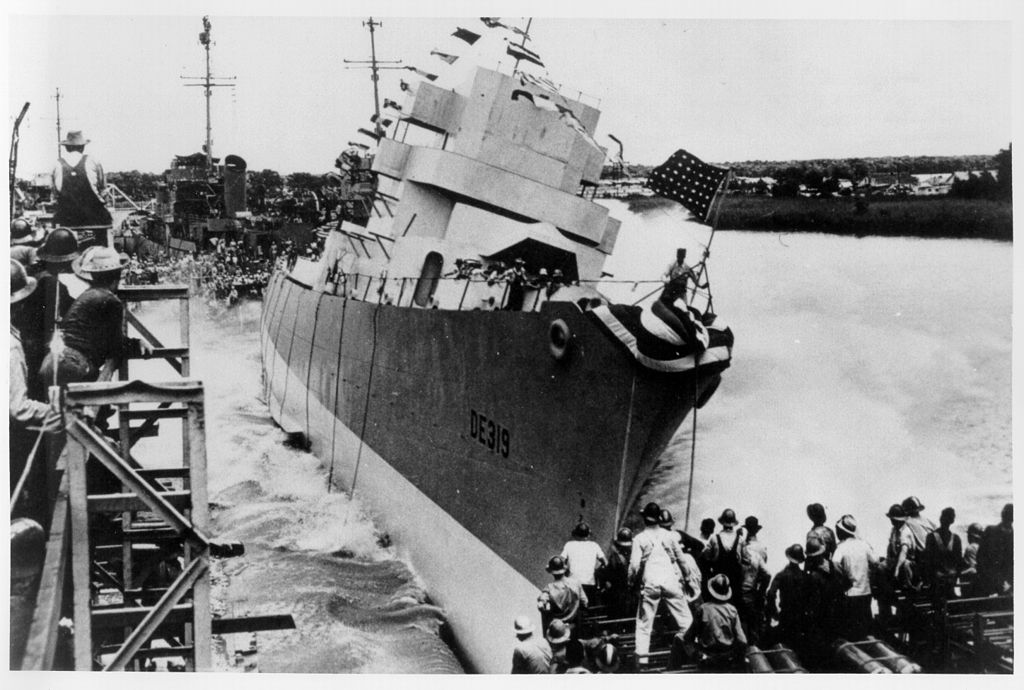
USS Leopold (DE-319) being launched.
Normandy Invasion, June 1944 A convoy of Landing Craft Infantry (Large) sails across the English Channel toward the Normandy Invasion beaches on “D-Day”, 6 June 1944. Each of these landing craft is towing a barrage balloon for protection against low-flying German aircraft. Photograph from the U.S. Coast Guard Collection in the U.S. National Archives. Photo #: 26-G-2333
“SHE FELT THE NAZIS’ WRATH:” A U.S. Coast Guard infantry landing craft still flies its flag, though knocked out of the invasion, ripped and wounded on the beaches of France. Moving in for a landing, the LCI ran afoul of an underwater obstruction, which tore a gaping hole in her bow. Then as its cargo of troops piled ashore, Nazi shells battered her out of further action.”; no date; Photo No. 2395; photographer unknown.
Conclusion:
It may be surprising that it appears the Coast Guard lost two and half to three times as many men in Coast Guard manned Navy vessels, as in Coast Guard vessels.
Two hundred and fourteen thousand two hundred and thirty-nine persons served in the Coast Guard during World War II. That number included 12,846 women. The Coast Guard lost a total of 1,917 persons during the war with 574 losing their life in action, “died of wounds” received in action, or perishing as a “Prisoner of War.”
These incidents account over 40% of all lives lost and a majority of lives lost as a result of enemy action.
Since ISIS’s successful weaponization of a commercially available “drone,” as a flying improvised explosive device (IED), there has been a lot of discussion about the possibility of using hobby drones, or the technology associated with them, as a sort of poor man’s guided missile.
War on the Rocks’ “The Democratization of Air Power: the Insurgent and the Drone,” by T. X. Hammes, Oct. 18, 2016, does a great job of outlining the potential dangers. In particular I can see that his suggestion that they could be used to employ a small explosively formed projectile to attack the wing tanks of parked aircraft could be very effective.
As a beginning drone pilot (I have both an FAA licence for drones and FCC radio amateur radio license to allow use of transmissions of more than 25 milliwatts) I thought perhaps I could put some of this into context, but I found another post, also from “War on the Rocks,” that probably does a better job than I could. “Why the IED Threat Has Barely Started” by Mark Jacobsen.
Still I would like to make some small points:
Capabilities:
When they think of drones, many, perhaps most people, will think of multi-rotors, those strange new aircraft that fly on, usually four, electric motors, but they can have amost any number three or more. They can pack an amazing degree of electronic sophistication into very small and relatively cheap packages. These can include auto pilots with GPS navigation with waypoints. The Phantom 4 is an example of the state of the art. The FAA now considers all radio controlled aircraft as “drones.”
Photo: DJI Phantom 4, by Doobybutch
Multi-rotors are all electric powered. Their range is limited and usually they are controlled by 2.4 GHz radios of limited output. Their visual systems that allow real time control are usually 5.8 GHz. These are short range, line of sight and can be blocked by trees and terrain. In fact all the frequencies that are used to control and provide video for hobby UAVs (910MHz, 1.2-1.3GHz (1200-1300MHz), 2.4 GHz, and 5.8 GHZ in the US) are line of sight systems.
The are not the only potential platforms. Autopilot and navigation systems can also be applied to fixed wing aircraft or surface vessels as well as multi-rotors, and if internal combustion engines are used, they can have very long ranges. At least one fixed wing drone has crossed the Atlantic. On the other hand internal combustion systems are generally noisy and sacrifice the advantage of quiet approach enjoyed by electric systems.
Implications:
Range against moving targets like ships is limited. Fixed targets with a known geographic position can, at least theoretically, be attacked at much longer ranges.
(gCaptain has a series of ship chase videos, including the one above, that illustrate what can be done in terms of piloting a drone out to intercept a ship. The videos are all about ten to twelve minutes long. That is a typical quadcopter endurance. The Phantom 4 now claims an endurance of 28 minutes. This is a round trip and an attack would only require one way. Still the range may be less than the two way range shown because of limits on the reach of the control systems)
Reliably extending real time control beyond a couple of milles may require special transmitting antenna.
Payloads for hobby systems are very small. Most are designed for, at most, a camera like a “Go-Pro” (about 6 oz. while a typical hangrenade is about 14 oz.). Carrying greater weight will generally require a trade-off in reduced range.
Countermeasures:
The DOD is taking the small UAS threat seriously, as evidenced here and here.
For attacking moving targets, the operator requires a controlling signal from the control transmitter and, if the target is beyond the operators ability to observe both the target and the relatively small drone, a video signal from the drone. Neither of these signals is encrypted, though the typical 2.4 GHz control signal is usually frequency agile. Disrupting either signal for an extended period may result in loss of control. Early command guided missiles during were defeated relatively easily using electronic countermeasures. The presence of these signals may serve to alert the possibility of an attack.
Attacking fixed targets at a known position requires only GPS, but this signal can be rendered inaccurate with GPS blocking or spoofing.
A directed electro-magnetic pulse may be able to fry internal circuits that are built with no apparent reason for hardening.
What does it mean to us?:
The threat to parked aircraft is real, but our own aircraft are unlikely to be a target, except perhaps for those working in SOUTHCOM.
The Navy might reasonably worry about one of these taking off from a dhow or near shore in the Straits of Hormuz or Bab-el-Mendab, as a carrier passes through and having a drone attack a plane on deck in hopes of causing a major conflagration. Of course, the drone is more likely just trying to get a video from an unusual angle. We don’t really have to worry about that happening in a US port, because carriers fly off their airwings before returning to homeport.
There is the possibility of a drone attacking the bridge of a ship as it approaches a turn in a narrow channel, and the ship running aground or colliding with a bridge or another ship in the resuting confusion.
The Future:
Battery technology has been advancing very rapidly and likely will continue to do so, giving electric drones greater range.
There is some concern that future development may allow target recognition allowing the drones to pursue a moving target without operator control.
“We cannot afford to be complacent and should not infer too much from the relative absence of flying IED attacks thus far. Yes, small drones have proliferated rapidly, but the technology is still in its toddler years, and today’s widely available consumer drones are not ideal weapons. It is the next generation of drone technology that has me worried, and it will be here soon.”
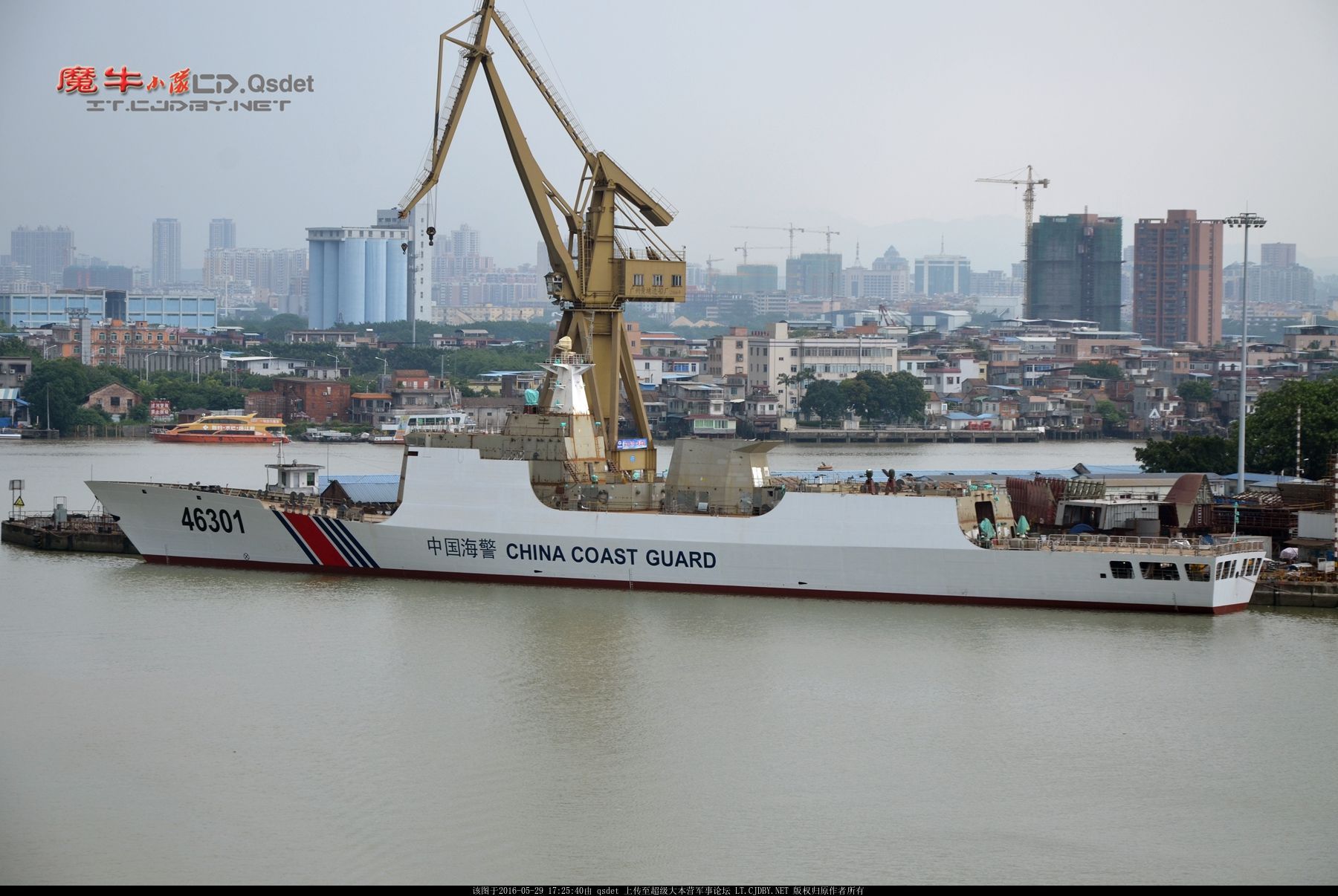
The National Interest reports that the Chinese have openly acknowledged that their newest Coast Guard cutter is being built with provision for upgrading to frigate status should a need arise.
Moreover they were apparently influenced by the example of the USCG during WWII.
In the same issue of this magazine, published by the major Chinese shipbuilding conglomerate China State Shipbuilding Corporation (CSSC), builder of the Type 818, there is not coincidentally a very detailed article about U.S. Coast Guard cutters in combat during the Second World War. That article explains that both USCGC Campbell and also USCGC Spencer were able to sink German U-boats (U-606 and U-175 respectively) during the pivotal Battle of the Atlantic. Most of the article examines the operations of 10 American USCG cutters that were 76.2 meters in length and built between 1928 and 1932. These ships were transferred to the hard pressed Royal Navy (RN) during 1941-42 and achieved an enviable war record in RN service, sinking both U-522 and U-954 – the latter with Germany Navy Commander Karl Donitz’s son aboard. The analysis notes that, according to UK naval records, the American cutters were viewed so favorably as to be rated as “surpassing each kind of comparable British designed frigate.” These ships are labeled as an “ideal anti-submarine escort ship” [理想的反潜护航舰] and the implications for the CCG going forward are obvious.
They actually sold the cutters a bit short. The 327s actually sank at least three and probably four U-boats and the ten 76.2 meter cutters, the 250 foot Lake Class, sank three submarines (two U-boats and an Italian). Six subs sunk by 17 ships may not sound particularly impressive, but in fact by comparison, it was spectacular.
The new Type 818 cutters are based on the Type 054 frigates. Its not too much of a stretch to expect them to be upgunned with the same weapons found on the “parent craft,” but if the time ever comes, there may be better systems available for upgrading the cutters or they might be given different capabilities to support emerging missions. That can be an advantage of having ships with unused upgadability.
The Type 054 are only slightly smaller than the Bertholf class, displacement 4,053 tons full load, length 134.1 m (440 ft), beam 16 m (52 ft), 30,400 HP, 27 knots, compared to the Bertholf’s 4,500 tons, 127.4 m (418 ft), 16.46 m (54 ft), 49,875 HP, and 28 knots. They actually appear to be the same size as the Offshore Patrol Cutters, but their design leans more toward higher speed. Their range is not as great as the OPC at about 8,000 miles compared to the OPCs’ 10,200, but it is a greater range than USN frigates enjoyed.
The Chinese have learned a lesson from USCG experience in World War II. I wonder if it is a lesson we may have forgotten.