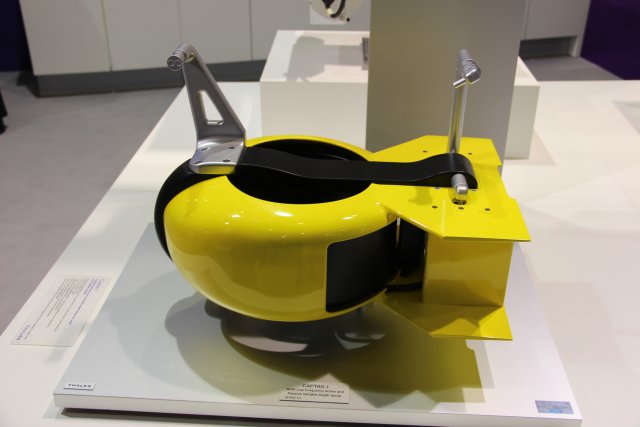
As expected, the EuroNaval 2014 trade show is offering some interesting products. This one might be of interest if the Coast Guard ever decides to get back into the ASW mission. Thales, maker of some of the most highly respected sonars in the world, is offering both hull mounted and towed active/passive sonars for vessels as small as 300 tons. The towed sonar is the CAPTAS 1, joining two previous members of a family of systems that share common technology. The Largest of these, the CAPTAS 4 is being evaluated for the ASW module for the LCS.
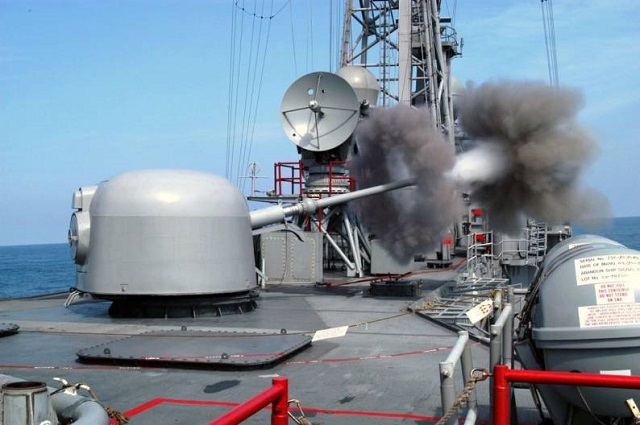
Photo: Mk-75 3”/62 caliber naval gun aboard USS Curts (FFG-38). U.S. Navy photograph
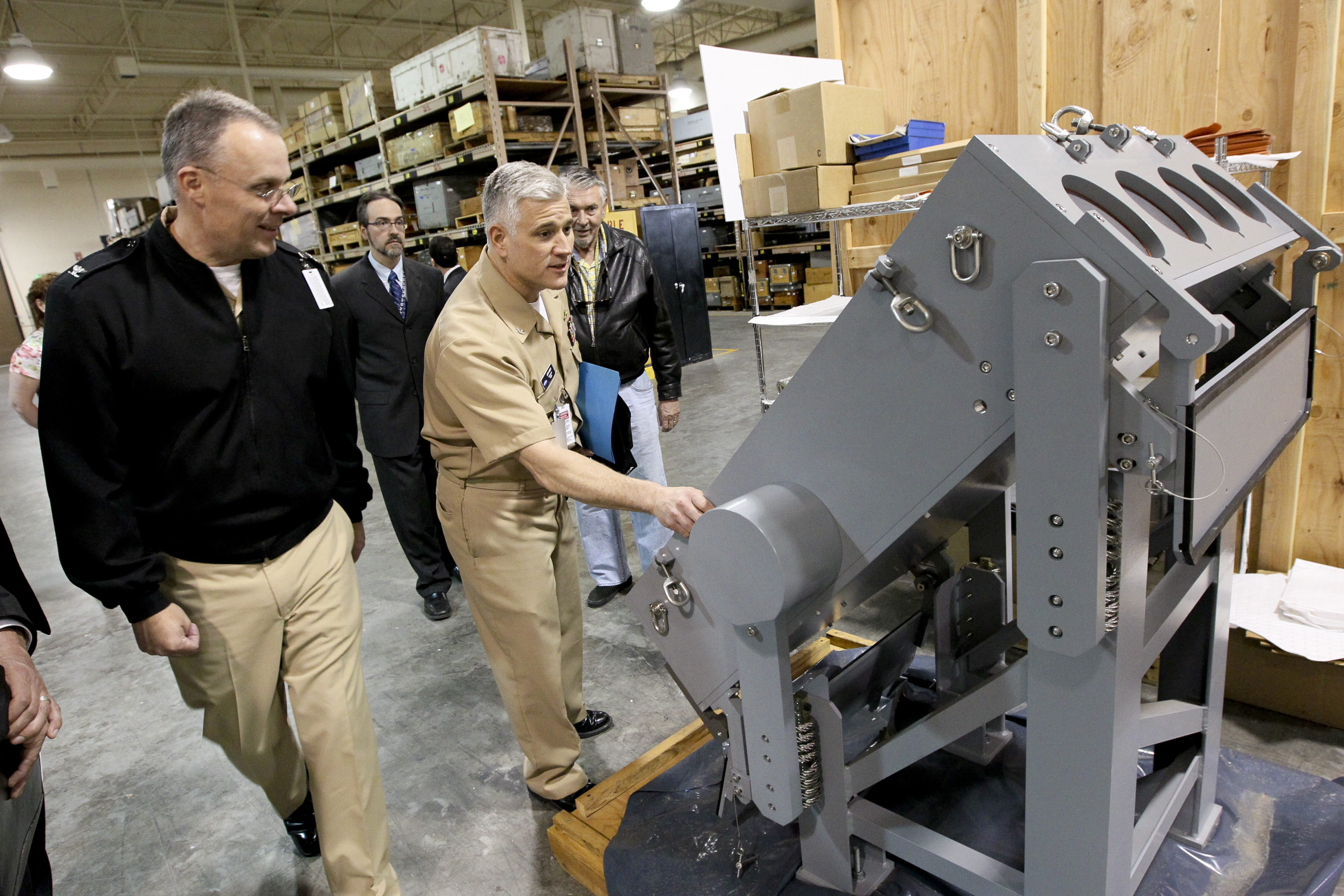
NavyRecognition is reporting that the Navy and Coast Guard are in the process of stripping five FFGs of weapons components that will be used to support Coast Guard Mk75 gun systems on Bear Class WMECs that are expected to be in service into the 2030s. It is not apparent from the post if Mk92 fire control system parts were also scavenged.
It is clear that soon virtually all US expertise in the Mk75 gun will reside in the Coast Guard. We can expect that some of those nations that have received (or will receive) former USCG 378s are likely to ask for help with these system for both training and maintenance.
Video: Hellfire launch from a 52 foot Combat Boat 90.
Previously we have talked about several guided weapons with potential for use by the Coast Guard for stopping small fast craft that might be used for a terrorist attack, while minimizing the chances of collateral damage. These included guided 70mm rockets (there are actually several different similar adaptations of the 70mm Hydra including, BAE’s APKWS, Lockheed’s DAGR, and Raytheon TALON), in addition to larger SeaGriffin, Hellfire, and Brimstone missiles, but we have not talked much about launchers, with minor exceptions.
Our friend at ThinkDefence recently did a post about the Brimstone missile, “Dual Mode Brimstone Greatest Hits,” and speculated on additional ways it might be used. He showed a number of launchers and I realized, perhaps it was time to show some of the alternatives with the purpose of showing that these systems are not that large, and would have relatively little impact on the ships.
Lockheed has a land based pedestal launcher that handles both Hellfire and 70mm rockets. For our purposes it would probably have to be “marineized” but the size looks reasonable.
Raytheon has demonstrated their version of the guided Hydra 70mm rocket using a standard rocket pod of the type commonly used on helicopters mounted on a remotely controlled weapon station.
Photo: Raytheon TALON 70mm guided rocket fired from LAU-68 launcher
Most of these launchers look to be like those used on aircraft. It is not clear that the weapons could be mounted and left for months or years until needed. The weapons might have to be stored elsewhere and mounted only when use is anticipated. On the other hand, the launcher used for the SeaGriffin as recently mounted on Navy Cyclone Class PCs looks to be suitable for long term storage.
We have heard that the Navy tested vertical launching the Hellfire on a 65 foot boat, simulating an LCS, and that they expect to mount vertically launched Hellfires on the LCS. Hopefully this will be a good option for cutters as well, with the capability of holding the missiles at the ready for long periods.
“The technology—called CARACaS (Control Architecture for Robotic Agent Command and Sensing)—is under development by ONR, and can be put into a transportable kit and installed on almost any boat. It allows boats to operate autonomously, without a Sailor physically needing to be at the controls—including operating in sync with other unmanned vessels; choosing their own routes; swarming to interdict enemy vessels; and escorting/protecting naval assets.”
Why should the Coast Guard care? The Coast Guard also protects vital maritime assets including passenger ships, vessels with dangerous cargos, and Navy assets including major ships and ballistic missile submarines so there is that direct application.
The system also appears capable of providing a persistent patrol capability that might be useful in Interdiction Operations. We cannot put a boat crew in a RHIB and send them off to operated as an independent extended sensor for 24 hours, but we could do that with an automated RHIB.
We only have a limited sample of the effects of modern weapon systems, so I think they are worthy of consideration.
gCaptain has a report on the recent test launch of a Naval Strike Missile from LCS-4, USS Coronado, I would like to point out the video that shows the result of a hit by this type missile in an earlier test that is included in gCaptain’s report and posted above, and talk about not the damage that was done, but the damage that was not done.
The result, is shown on the video at time 0:55. The target of this earlier test was a decommissioned Norwegian Oslo class frigate. These are relatively small ships, 317 feet long and 2,100 tons full load, only a little larger than a Bear class cutter and considerably smaller than the average merchant ship.
The Naval Strike Missile has a 125 kG warhead, smaller than that of a Harpoon (just under 500 pounds), but still respectable. The explosion and the resulting smoke are impressive. The damage would almost certainly have caused a mission kill, wiping out critical command and control, sensor, and fire control systems.
On the other hand, it appears the hull is largely intact. In fact, the target did not sink, it was subsequently towed back into port. I have observed that sea-skimming anti-ship cruise missiles always seem to strike about 20 feet or more above the waterline. This may be necessary to ensure they do not strike waves as they make their final approach, but it also seems to limit hull damage. This kind of hit might not have damaged the propulsion or steering gear, particularly on a larger ship.
If the Coast Guard is required to stop a medium to large ship, bent on doing some mischief, I don’t think even a cruise missile like NSM, could assure immobilization of the threat.
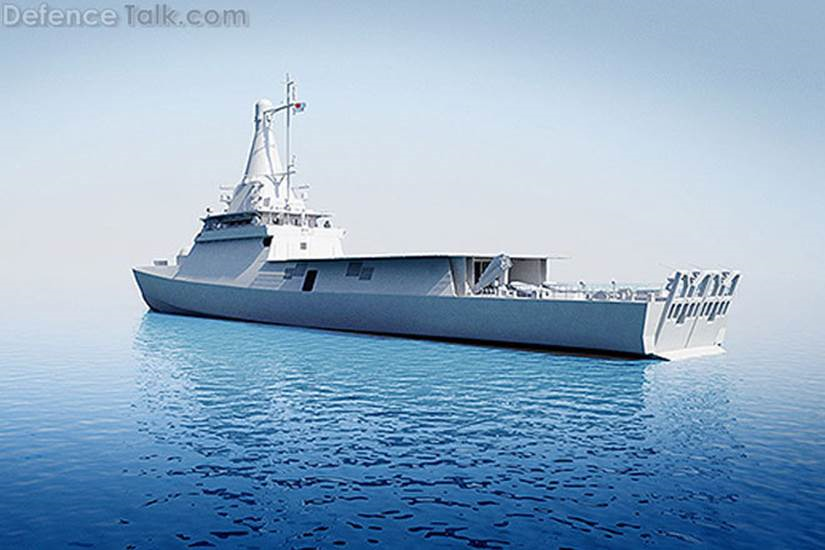
Singapore is building a new class of patrol vessels that look very much like my proposal for “Cutter X”, trading some Webber class and some larger ships for an intermediate design, costing about half what an OPC would cost, basically putting the equipment and crew (with some augmentation) of a Webber Class into a larger more seaworthy hull, to allow them to be used for extended operation in environments that do not require the ice strengthened hull and ability to launch and recover helicopters and boats in sea state five provided by the OPC.
Singapore is building eight of the ships under the project name “Littoral Missions Vessel” to replace eleven smaller, 500 ton, Fearless class patrol vessels that are approaching 20 years old. These ships are reportedly 80 meters in length (262.5 feet), displace 1200 tons (probably a light displacement), have a beam of 12 meters (39.4 feet), a range of 5,000 nautical miles at 15 knots, and a speed of 27 knots, all with a crew of only 30, though they do include additional accommodations for 30 more. (more here)
It appears these ships will use the same engines as the Webber Class. It is not clear how many of these engines they are using. Two would give them almost 12,000 HP which would almost certainly be good for at least 24 knots, but it might require three or four engines to make 27 knots. (reports now indicate the class has two engines totallin about 12,000 HP)
In some respects these ships are more capable than the proposed cutter, in that they will have a 76mm gun and firecontrol system, in addition to smaller remotely operated weapons. It also appears to have space reserved for a small AAW missile system. On the other hand, while the flight deck can handle an H-60, the ship, unlike the French L’Adroit which was my model for “cutter X”, has no helicopter hangar, although it might be possible to add one using the same solution employed on L’Adroit (putting it under the bridge).
Soon, I expect to do an update of the “Cutter X” proposal, based on where we are now in the cutter recapitalization program.
The MK46 Mod 1 weapon system fires a round during a live-fire qualification exercise aboard the amphibious transport dock ship USS New Orleans (LPD-18). US NAvy Photo
The Navy has apparently made a decision I find incomprehensible. They have decided to alter the DDG-1000 design, replacing the two 57mm Mk110 mounts (the same gun on the Bertholf class and projected for the OPC) with two 30mm Mk 46.
“The Navy has replaced two 57mm guns planned on the Zumwalt-class guided missile destroyer designed to fight off swarm boat attacks with a smaller pair of 30mm guns, Naval Sea Systems Command (NAVSEA) told USNI News on Monday.”
and later,
“A follow on 2012 assessment using the latest gun and munition effectiveness information, concluded that the MK46 was more effective than the MK110 CIGS. Based on that assessment, approval was received to change from the MK 110 CIGS to the MK 46 Gun System. In addition to the increased capability, the change from MK110 to MK46 resulted in reduction in weight and significant cost avoidance, while still meeting requirements. DDG 1000 is planned to have two medium range MK46, 30mm Close-in Gun Systems that will provide a robust rapid fire capability and increased lethality against hostile surface targets approaching the ship.”
The Mk 46 mount uses the Mk44 30mm chain gun that is derived from the same 25mm chain gun used in the Mk38 mounts. It looks like a small tank turret, but I understand it is not armored. It can be remotely controlled or manned by an on mount operator.
Comparing the two weapons,
Range of the 57mm is four or five times the range of the 30mm.
Projectile weight of the 57mm is about six times that of the 30mm.
Rate of fire is similar, 220 for the 57mm and 200 to 250 for the 30mm.
The only advantage I see for the 30mm is that it has more ready ammunition on the mount (not sure how much but apparently at least twice the number of rounds meaning it should be able to fire twice as long without reloading).
CIMSEC continues their series on “non-navies” with “Narco-Submarines: Drug Cartels’ Innovative Technology,” by Byron Ramirez. It provides an overview of the state of narco-sub development, employment, and countermeasures. It also announces the imminent publication of an unclassified study, “Narco-Submarines – Specially Fabricated Vessels Used For Drug Smuggling Purposes,” to be released by the Foreign Military Studies Office (FMSO).
Lockheed Martin animation of Hellfire employment from an LCS
It looks like the Navy is beginning to field some weapons that are appropriate for the Coast Guard’s mission of preventing maritime terrorist attacks while addressing concerns that using weapons in US ports may cause collateral damage.
I have always felt this mission had to devolve onto the smaller vessels, because the larger cutters don’t spend much underway time around US ports and when they are in port they usually cannot be gotten underway quickly. For this reason the WPCs need to be able to perform the mission.
The Longbow Hellfire is already present in the US inventory in large numbers and is being adopted for the LCS anti-surface module. The Brimstone is very similar in size, warhead, and range (about 8,000 yards), but has the advantage of a datalink that allows a “man-in-the-loop” which I think is desirable. Unfortunately, so far the USN is only looking at Brimstone as an air-launched weapon.
Test of Brimstone against two 40 foot maneuvering targets, discriminating between the targets and similar sized craft
Test of the Griffin. (Note limited damage)
A third system, SeaGriffin has a smaller footprint and warhead and has had a shorter range (only 43″ long, weighing 33 pounds, with a 13 pound warhead, surface to surface range of 5,500 meters), but it appears that the latest version may have a longer range, than either Hellfire or Brimstone, perhaps up to 18,000 yards (assuming they have, as reported, triple the previous range). The latest version of SeaGriffin does have a man-in-the-loop capability. Griffin is already being deployed on US Navy Cyclone class PCs. There are lots of photos showing the relatively small size of this system here.
I have never expected that extreme range was an important consideration for Coast Guard weapons, but for the anti-terrorism mission (or enforcing a blockade in wartime), we probably need the ability to engage from outside 4,000 yards (beyond the effective range of the 25mm Mk 38), because inside that range, there are a number of systems that might be added to a ship that could have a good probability of quickly disabling our vessels.
I still believe none of these weapons is capable of quickly and reliably stopping a medium sized ship or anything larger. For that I think we still need at least a light weight torpedo, but these weapons would significantly improve the chances against vessels of any size and particularly against small high speed maneuvering targets. Equipped with these, a Webber class cutter could be better able to fulfill this mission than a National Security Cutter with its 57mm guns.
DefenseTech is reporting that the Coast Guard is looking for means of making its general purpose machine guns into precision weapons, so that if they have to use the weapons, the possibility of collateral damage can be minimized.
“The Coast Guard wants to make its deck-mounted machine guns accurate enough for crowded American harbors.
“To do that, Coast Guard gunners need a weapon mount that’s stable enough to turn an M240 machine gun – a weapon designed to kill area targets on the battlefield – into a precision tool capable of putting every round on target.”
Gratifying to see that the Coast Guard is thinking though how situations might develop where they will need to use deadly force in situations where there is a danger of collateral damage. Its easy to understand that using a machinegun on an unstabilized mount on a boat that is bouncing around might endanger the local population as well as the intended target.
But even that may be too large for some of our smaller boats.
There are smaller alternatives. Thanks to RStoner for bringing this option to my attention:
Looks like this might have trouble accurately firing bursts, but apparently it could accurately fire single shots and give boats some of the disabling fire accuracy of the airborne use of force units without the extensive training.
Still I hope the Coast Guard will look beyond simply making a more accurate machine gun. Any gun is likely to have a percentage of its rounds go astray, possibly endangering the innocent.
Perhaps the Coast Guard should continue this train of thought, applying the same concern on a larger scale. After all, we may need to stop much larger vessels inside US internal waters. Shooting 25mm or even 57mm inside Puget Sound or Chesapeake Bay is a poor option, but given the way cutters are currently equipped, it may be the only option available and ultimately they may be ineffective even for small targets.
Looking at true precision weapons, there are a whole range of options:
Griffin can be used for relatively small targets, here and here.
For larger targets Longbow Hellfire is already in the US Navy inventory or perhaps the largely American made BAE Brimstone/Sea Spear which appears to offer even more target selectivity.
Once the target gets larger than about 1000 tons it is going to be very difficult to stop. As noted earlier I think the answer to this problem is a light weight torpedo that can target a ship’s propellers.
Frankly I doubt we will have a major cutter (WMSL/WHEC/WMSM/WMEC) in the area if the Coast Guard ever suddenly finds itself needing to stop a maritime terrorist threat. They do not hang around US ports when they are underway, and when they are in port, they take too long to go from cold iron to underway. If this ever happens the largest Coast Guard vessel likely to respond is a Webber Class WPC. They are large enough to mount weapons capable of stopping even the largest ship. They really need to be properly equipped for the possibility.