“Illegal Drugs Seized by CMF French-led Combined Task Force 150 in Arabian Sea” / “Canada Assumes Command of Combined Maritime Forces’ Combined Task Force 150” –Combined Maritime Forces

ARABIAN SEA – ARABIAN SEA (Jan. 16, 2024) Illegal narcotics seized by the U.S. Coast Guard Sentinel-class fast response cutter USCGC Emlen Tunnell (WPC 1145) sit on the deck of a vessel in the Arabian Sea, Jan. 16. Emlen Tunnell was operating under Combined Task Force 150, one of five task forces under Combined Maritime Forces, the largest multinational naval partnership in the world. CTF 150 focuses on maritime security operations outside the Arabian Gulf.

Below is a Combined Maritime Forces – U.S. 5th Fleet news release.

Below that is a second news release reporting a transfer of command of CTF 150 but also providing information about the organization.


Illegal Drugs Seized by CMF French-led Combined Task Force 150 in Arabian Sea

MANAMA, Bahrain —

A U.S. Coast Guard cutter operating under the French-led Combined Task Force 150 of the Combined Maritime Forces seized about $8.1 million worth of illegal drugs from a vessel in the Arabian Sea, Jan. 16.

The Sentinel-class fast response cutter USCGC Emlen Tunnell (WPC 1145) seized 173 kilograms of methamphetamines following a search. The Coast Guardsmen properly disposed of the drugs and released the vessel.

This is the second interdiction by CTF 150 of the year and marks the 14th time they have seized illegal narcotics at sea since France took command in July 2023. During their tenure, more than 16 tons of illegal narcotics with a street value of over $600 million were seized and disposed of, preventing criminal and terrorist organizations generating income from drug smuggling. The seizure came one day before France turned over command of the task force to the Royal Canadian Navy.

The mission of Combined Task Force 150 is to disrupt the ability of non-state actors to move weapons or drugs, or engage in other illicit activities, in the Gulf of Oman, Arabian Sea and Indian Ocean.

CTF 150 is one of five task forces under Combined Maritime Forces, the world’s largest multinational naval partnership, and focuses on maritime security operations in the Gulf of Oman, Arabian Sea and Indian Ocean.

The 39-nation naval partnership upholds the international rules-based order by promoting security and stability across 3.2 million square miles of water encompassing some of the world’s most important shipping lanes.


Canada Assumes Command of Combined Maritime Forces’ Combined Task Force 150

MANAMA, Bahrain —

The Royal Canadian Navy assumed command of a multinational maritime task force during a change-of-command ceremony Jan. 17.

French Navy Capt. Yannick Bossu turned over command of Combined Task Force 150 to Royal Canadian Navy Capt. Colin Matthews. CTF 150 was established in February 2002, and is one of five operational task forces under Combined Maritime Forces. CTF 150 conducts maritime security operations outside the Arabian Gulf against threats from non-state actors. The core staff of CTF 150 consisted of French, British, New Zealanders, Australians, and Bahrainis.

Since France took command of CTF 150 in July 2023, ships working in support of the task force carried out 14 successful boardings, in which more than 16 tons of illegal narcotics with a street value of over $600 million were seized. These seizures prevent criminal and terrorist organizations generating income from drug-smuggling.

While Commander of CTF 150, Bossu also spread CMF’s message through key partner engagements with countries including Seychelles, Mozambique and India. These engagements help strengthen ties between CMF nations and provides an opportunity to discuss the work of CMF with countries not yet members.

“Today marks the end of the French Navy’s successful 12th command of CTF 150. I would like to express my thanks to all those who have continually supported us during our tenure, including Vice Admiral Cooper, Commodore Anderson, Commodore Dennis and Rear Admiral Al bin Ali,” Bossu said. “Integral to CTF 150’s achievements over the past six months are, of course, the French, British, American, Indian, and Pakistani ships that have been working in support and my team made up of staff from a range of nations. We are pleased to welcome the Royal Canadian Navy to Combined Task Force 150; it has been a pleasure to meet your team. To everyone, keep on enjoying and serving in Combined Maritime Forces.”

Matthews joins CTF 150 following a tour as Director of Naval Information Warfare. Over the years, he has participated in numerous overseas deployments to the Arabian Gulf and Arabian Sea regions in support of counterterrorism operations.

“It is an honor to take command of Combined Task Force 150 and a privilege to lead this team of dedicated personnel from Canada, Bahrain, Australia, and New Zealand for the next six months,” Matthews said. “We are eager to build on the achievements of Capt. Bossu and his team. The success of this operation lies with our ability to work with like-minded nations toward the same goals, ensuring that legitimate commercial shipping can transit the region free from non-state threats and we are ready to face this task.”

Combined Maritime Forces, headquartered in Bahrain with U.S. Naval Forces Central Command and U.S. 5th Fleet, is the largest multinational naval partnership in the world, with 39 nations committed to upholding the international rules-based order at sea. It promotes security, stability and prosperity across approximately 3.2 million square miles of international waters, encompassing some of the world’s most important shipping lanes.

CMF’s other task forces include CTF 151, which leads regional counter-piracy efforts; CTF 152, dedicated to maritime security in the Arabian Gulf; CTF 153, providing maritime security in the Red Sea; and CTF 154, which delivers maritime training.
WMEC 210s in Retrospect

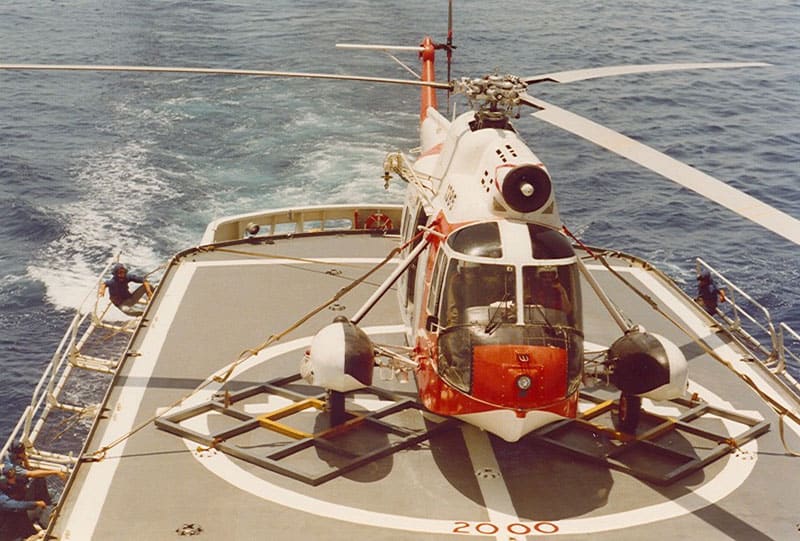
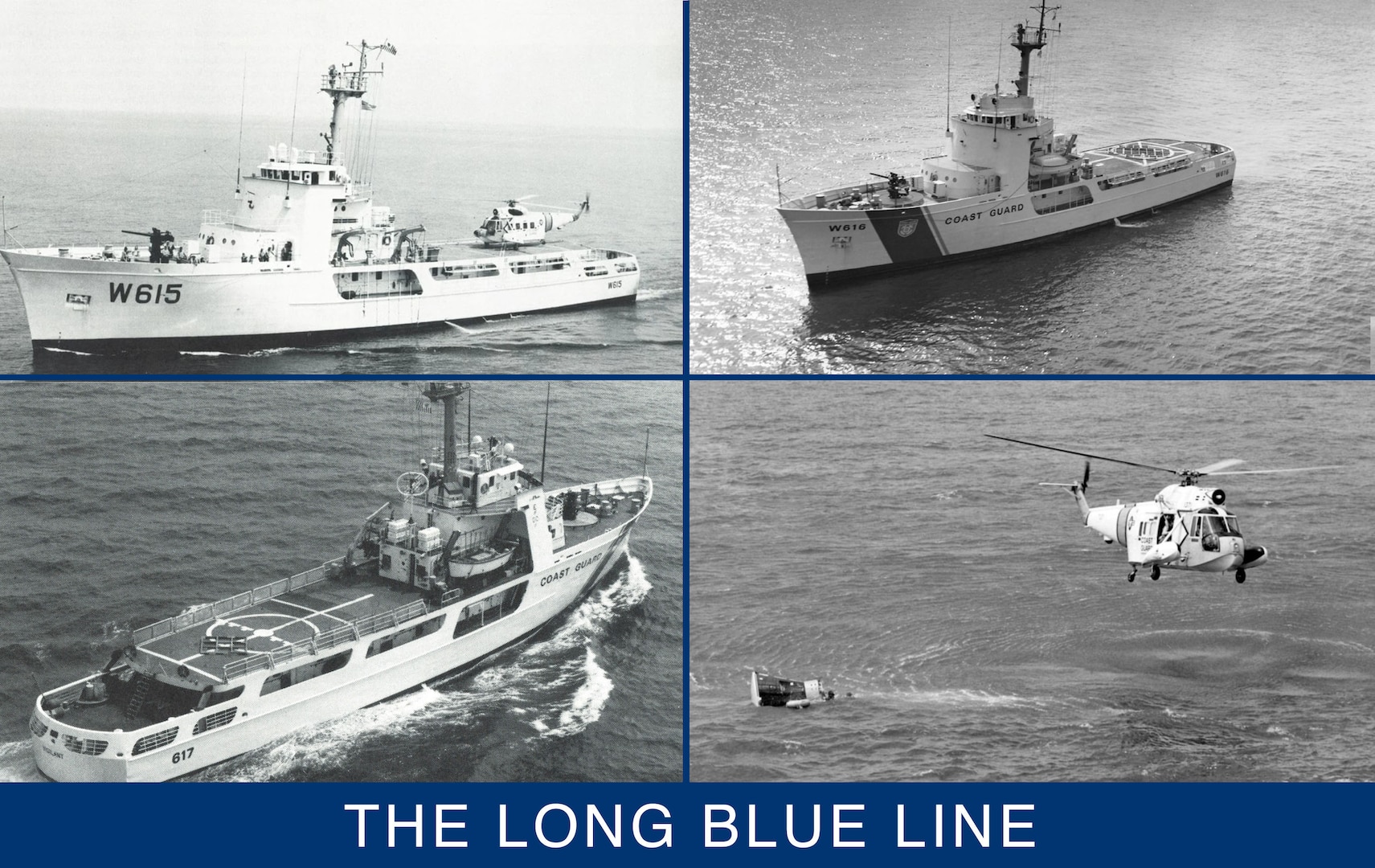
Coast Guard cutter Reliance conducting helicopter operations circa 1964. (U.S. Coast Guard photo).

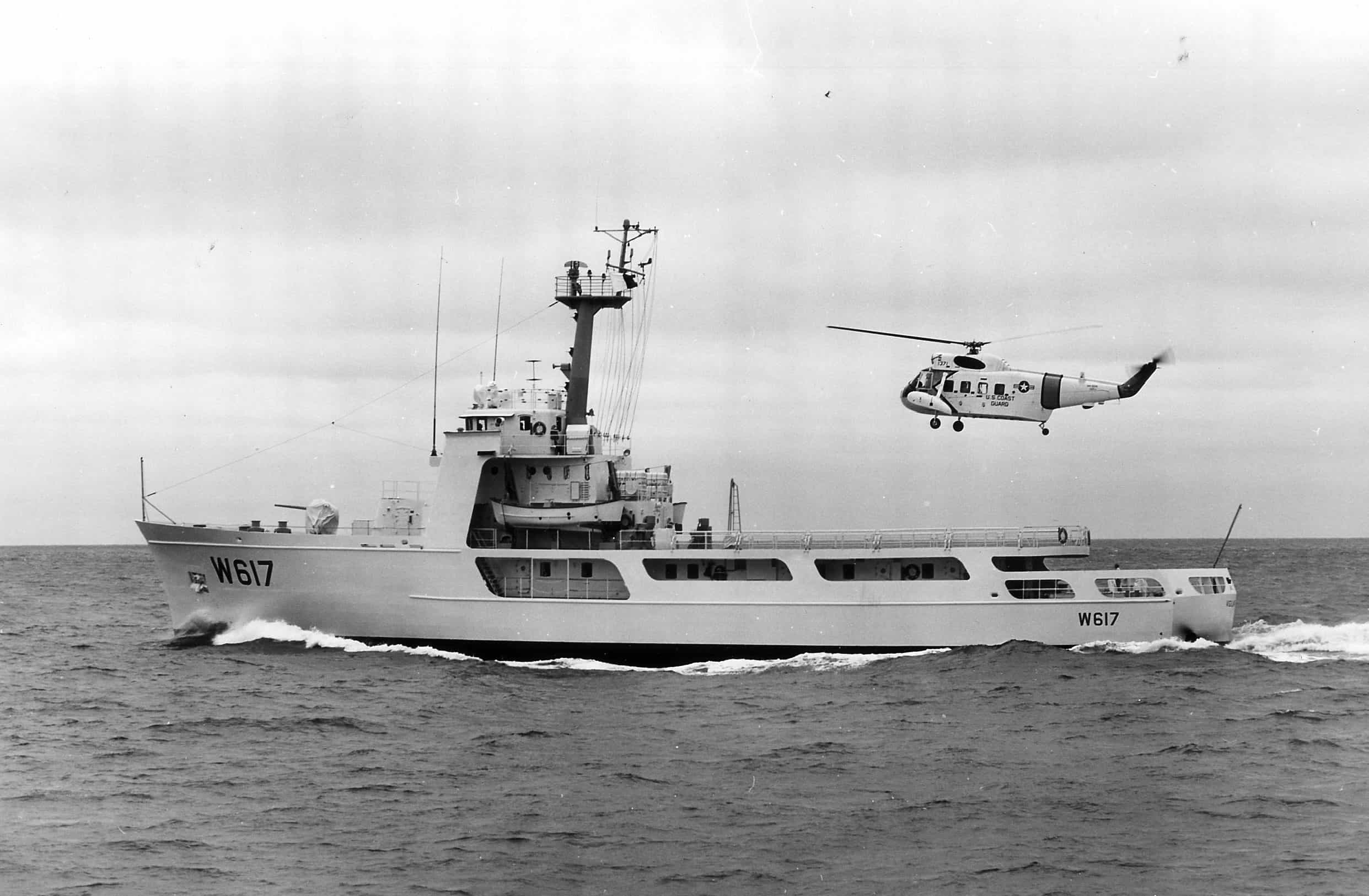
Coast Guard cutter Diligence shown with the prototype “racing stripe” painted on the bow in December 1966. (Coast Guard Historian’s Archive).

The extensive accommodation for helicopter operations is shown by this photo of third-in-class 210 cutter Vigilant. (U.S. Coast Guard photo)

A Coast Guard HH-52A launched from Diligence hovers over the Gemini III space capsule in 1965. (U.S. Navy National Museum of Naval Aviation photo)

“SNA 2024: Adaptable Deck Launcher, MK 70 Missile Launcher, PAC-3 Missile and SPY-6 Radar” –Video

The video above is from Naval News via Youtube.

Just wanted to point out that, should a need arise to equip the NSCs, OPCs, or even icebreakers for combat, there are two options in the video above:

As to alternatives, on the NSCs, we know they were designed to be able to accept twelve MK56 VLS and could probably accept eight Mk41 VLS in their normal deck penetrating configuration. Using quad packed ESSMs this could allow them to carry up to 32 ESSMs or alternately perhaps 16 ESSMs and four vertical launch ASROC. (Since the latest versions of the ESSM are fire and forget weapons that no longer require an “illuminator,” it now requires less supporting electronics and can engage more than one target at a time.) 

I know of no information publicly available that suggests planned upgrades for the OPCs, although I did speculate, “What Might a Wartime OPC Weapons Fit Look Like?

The Mk70 would probably just be a temporary install on the flight deck to meet the requirements of a planned operation, but there is little doubt we could put at least four strike length four tube launchers, on NSCs, OPCs, or icebreakers.

For the OPC, the Adaptable Deck Launcher is a possible more permanent installation and would probably be mounted on the Focs’le. Weight and space requirements might mean a trade-off would be required. Loss of the 57mm in exchange for even four Mk41 tubes might be worthwhile, but we might also consider replacing the gun with eight deck penetrating Mk41 cells. If Strike length cells proved impossible, tactical length cells could still provide weapons with anti-air, anti-surface, and ASW capabilities we do not have with the 57mm.

Potential Mk41 VLS weapons load outs for tactical and strike length launchers.


” Unlawful Boarding Of The Merchant Vessel St. Nikolas In The Gulf Of Oman” –Naval News

Picture from Atlantique 2 MPA showing tanker St. Nikolas escorted by Iranian Navy patrol vessel. EMASOH picture.

Naval News reports,

Yesterday, on the 11th of January, the merchant vessel St. Nikolas was boarded by armed personnel southeast of the Strait of Hormuz, off the coast of Oman. The boarders were reported to be wearing military style black uniforms with black masks. The Company Security Officer (CSO) of the shipping company also reported that the vessel had altered course towards Iranian territorial waters and communications had been lost. Acting on initial external information, EMASoH sent out a French maritime patrol aircraft Atlantique 2 that rapidly located the ship, which was escorted by two Iranian Navy patrol vessels. The Atlantique 2 continued to monitor the ship’s movement until she entered Iranian territorial waters. She is now at anchor near Bandar Abbas.”

Have to say, my first reaction was, who or what is EMASoH? Wikipedia has the answer, European Maritime Awareness in the Strait of Hormuz. EMASoH is a,

 “…French-led maritime monitoring mission with the goal to protect maritime flows through the Strait of Hormuz. It is headquartered at the French naval base in Abu Dhabi and comprises a diplomacy track (EMASoH) and a military track (AGENOR).[1] The mission has 9 participating countries including Belgium, Denmark, France, Greece, Italy, the Netherlands, Norway, and, with political support, Germany and Portugal. These are all European countries, however EMASOH is not initiated by the European Union.”

The situation there is confusing. I have a hard time keeping up with the players. Looks like the Europeans are about to create their own naval defensive coalition to defend shipping in the Red Sea. Wonder if it will be under AGENOR?

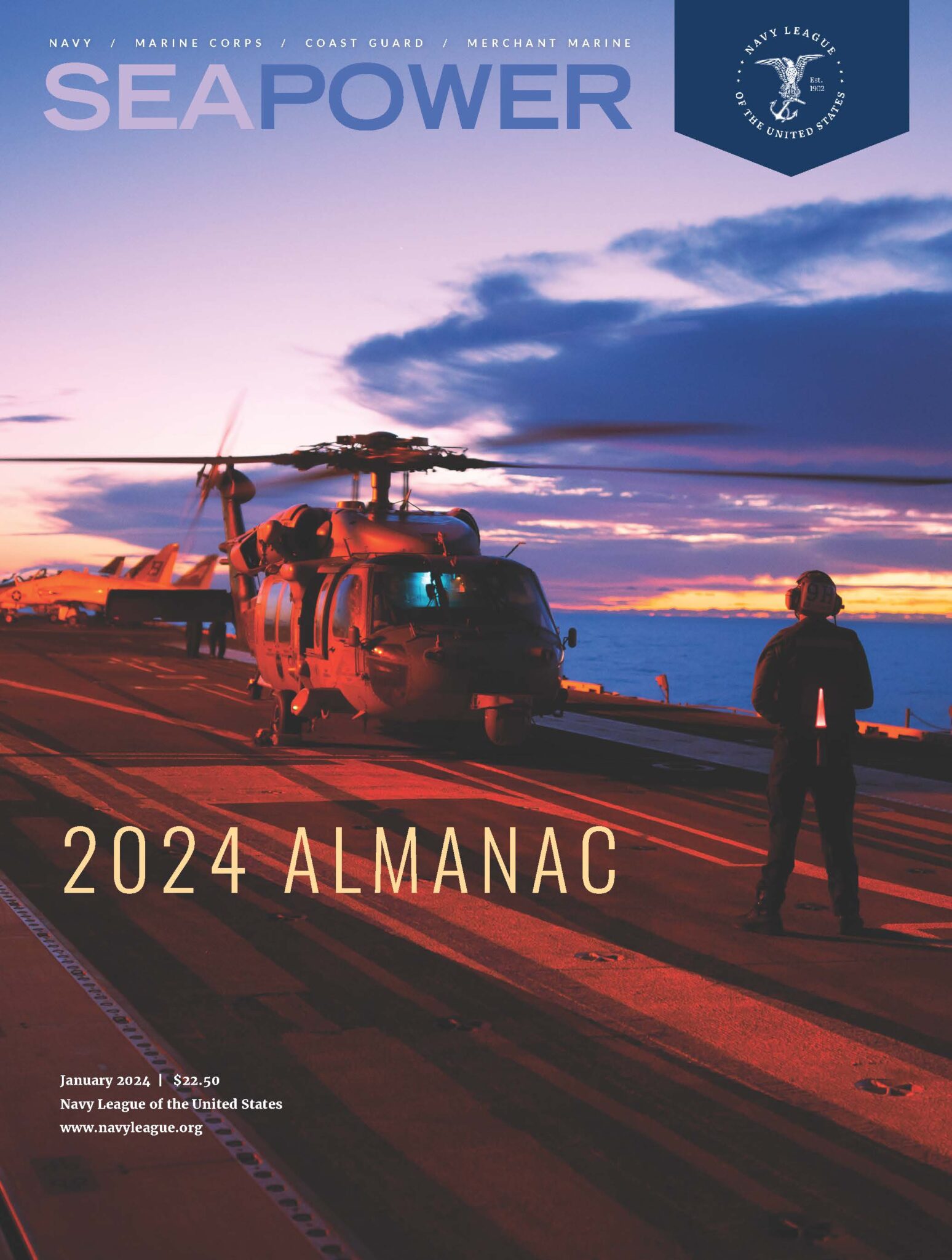
2024 Almanac –SeaPower

Just wanted to put in a good word for the Navy League’s 2024 Almanac. This annual, expanded, special edition of Sea Power alone may be sufficient reason to join the Navy League.

Despite their name, the Navy League is a vital supporter of the Coast Guard and US Merchant Marine and the entire maritime industry.

The almanac includes 189 pages of information about US Navy, Marine Corps, Coast Guard, NOAA, MARAD, and Maritime Sealift Command ships, aircraft, weapons, C4ISR systems, and leadership personnel. It even includes addresses, telephone numbers, and websites.

“Fast Response Cutter Laydown, Report to Congress, November 15, 2023” –USCG

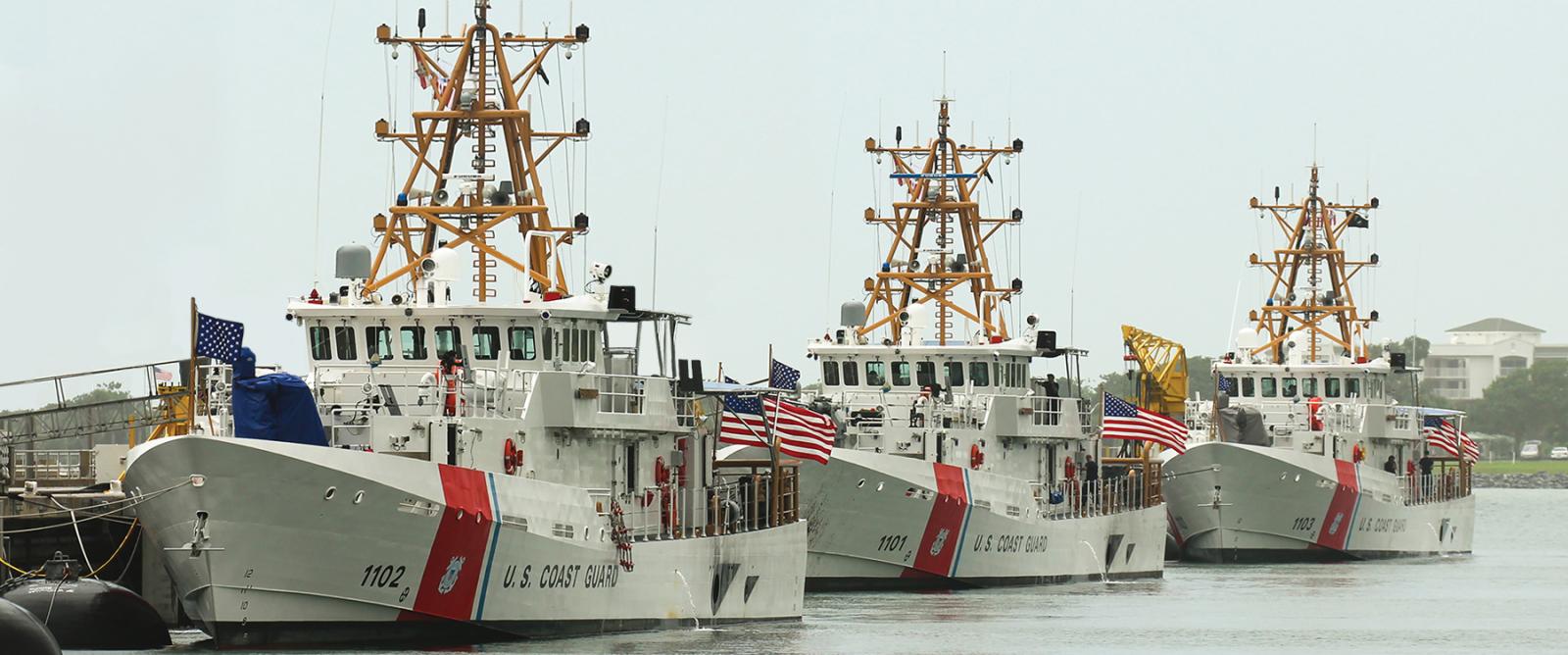
The first three fast response cutters—the USCGC Richard Etheridge (WPC-1102), Bernard C. Webber (WPC-1101), and William Flores (WPC-1103).
U.S. COAST GUARD

Just wanted to alert anyone interested to the existence of this document.

Don’t think there are any real surprises here, but homeports are a bit more complete than the Wikipedia information.

It does further clarify the fate of USCGC Benjamin Dailey (WPC-1123) that suffered a fire while in dry dock. The ship was found beyond economical repair, decommissioned, and is stored awaiting ultimate disposition. That means that the current plan is for 64 operational FRCs with a request outstanding for four more. It may mean at least one of the future FRCs will be based in Pascagoula, as a replacement.

“Anti-Ship Ballistic Missile Hits U.S.-Owned Container Ship In Gulf Of Aden” –The Drive

MV Gibraltar Eagle YouTube screencap

The Drive reports,

” A Marshall Islands-flagged, U.S. owned and operated container ship was struck by a Houthi anti-ship ballistic missile on Monday, U.S. Central Command said.

“There were no injuries or significant damage to the vessel, the M/V Gibraltar Eagle, which is continuing its journey. The vessel is a 200-meter long Ultramax container ship, according to its U.S. owner, Eagle Bulk Shipping.”

The Drive also offers an overview of the Houthi anti-ship capabilities, “The Anti-Ship Missile Arsenal Houthis Are Firing Into The Red Sea.

I believe this is the first time in history, a ship, underway, has been hit by a ballistic missile.

“No Injuries or significant damage”:

At about 200 meters in length, M/V Gibraltar Eagle, is not particularly large. I would say that it is medium sized.

This is one of those rare times like, the Tanker War, when we get to see how modern ships, at least merchant ships survive modern weapons.

So far, I don’t think any of these Houthi attacks has resulted in a mobility kill, much less a sinking.

Modern merchant ships are extremely resilient. A lot of their bulk is made up of non-critical space.

This has implication for the Coast Guard’s own Ports, Waterways, and Coastal Security mission. Explosions below the waterline, torpedoes and mines, remain the most effective way to forcibly stop a medium to large ship.

“Navy SEALs describe how boarding a ship is a team’s ‘sketchiest’ mission” –Task and Purpose

Members of the Coast Guard Cutter Waesche (WMSL-751) law enforcement boarding team inspect a self-propelled semi-submersible (SPSS) in international waters of the Eastern Pacific Ocean, Nov. 20, 2023. The interdiction of the SPSS yielded more than 5,500 pounds of cocaine. In November 2023, Waesche crewmembers seized approximately 18,219 pounds of cocaine, with an estimated street value of over $239 million, during four separate suspected drug smuggling vessel interdictions or events off the coasts of Mexico and Central and South America. (U.S. Coast Guard photo)

Task and Purpose reports,

“Two Navy SEALs went missing during a Visit, Board, Search and Seizure action near Somalia. Former SEALs say those VBSS missions were always among their most dangerous.”

Find it gratifying that Seals recognize the hazards of something the Coast Guard does routinely. Does seem they are more likely to do this in the dark.

K-LOGIR, Korean Low cOst Guided Imaging Rocket and Launcher

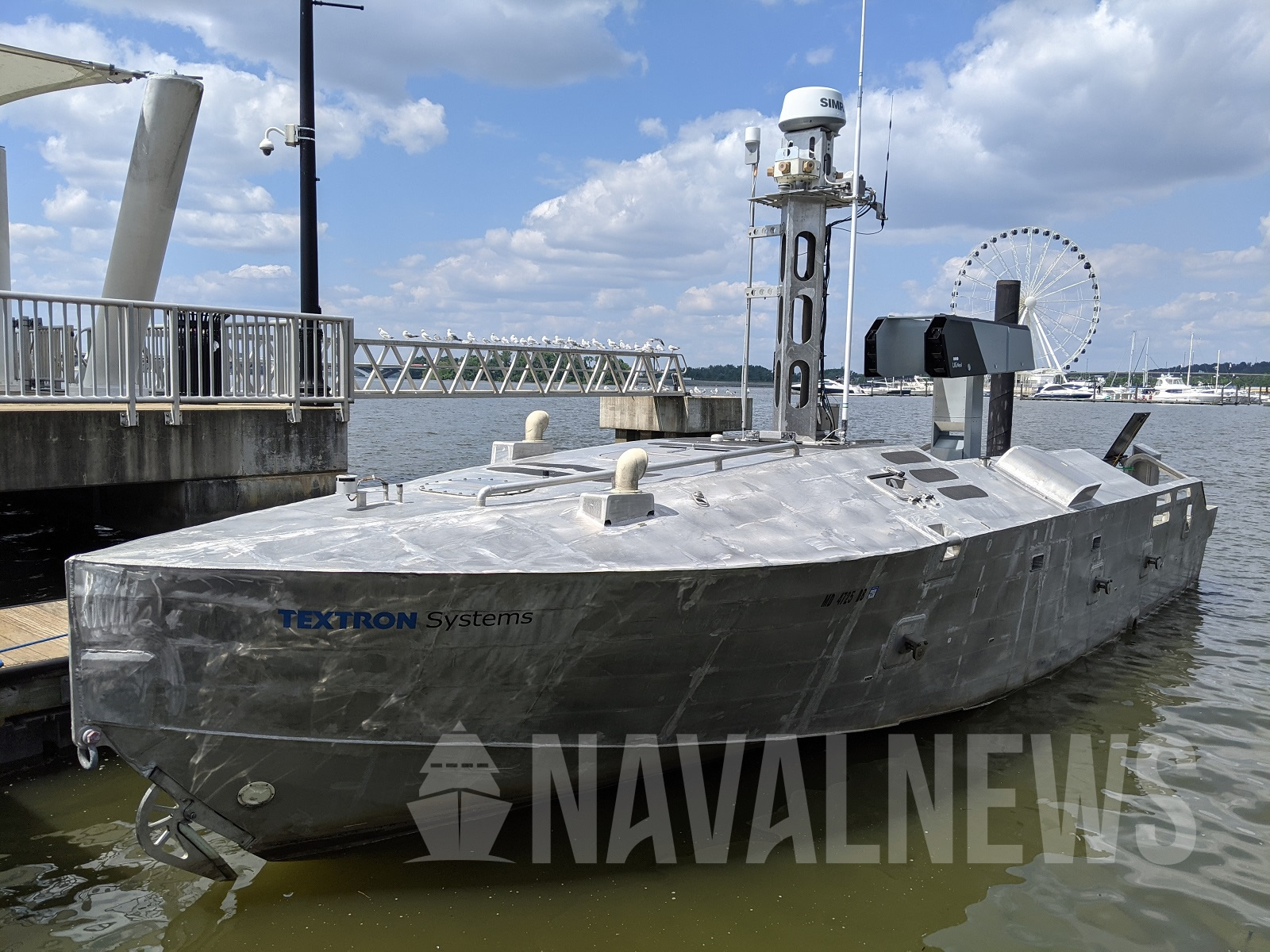
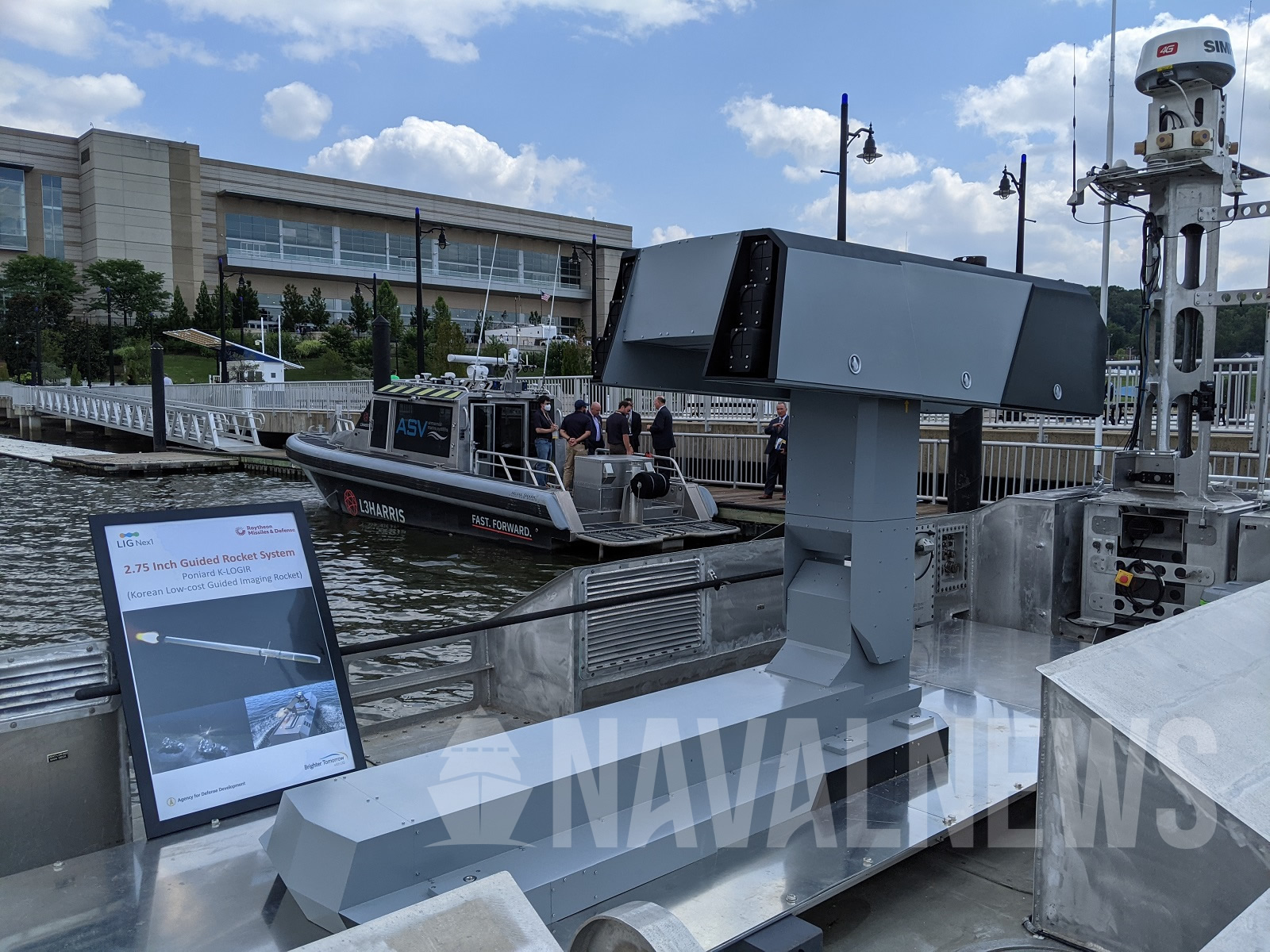
K-LOGIR launcher fitted on a Textron CUSV USV at Sea Air Space 2021. The system was showcased by Raytheon and LIG Nex1.

Naval News recently did a post highlighting a 4th Fleet live fire test combining a Korean developed fire and forget guided rocket system with the Common Uncrewed Surface Vessel (CUSV) cued to a target by a Radiosonde UAS for a fully uncrewed kill chain.

The “Poniard” Korean-Low cOst Guided Imaging Rocket (K-LOGIR) is closely related to the APKWS, both being based on the 70mm Hydra unguided rocket. Unlike the semi-active laser homing APKWS, the K-LOGIR is a fire-and-forget system allowing multiple simultaneous engagements.

Most of the reports I have read on this exercise are unclear if six missiles hit a single target or if six missiles hit six different targets, but this Defense Mirror report, “Textron’s Unmanned Boat Uses South Korean Weapon to Engage Multiple Targets.” makes it clear that multiple targets were engaged in a single salvo.

I don’t fully understand how they designate different targets for the missiles in the salvo, but it may be that they are sending them to different waypoints before they initiate their search.

The ability to engage several targets simultaneously makes this system attractive for countering surface swarm tactics like those that might be encountered by PATFORSWA, but for the Ports, Waterways, and Coastal Security mission, the APKWS’ semi-active laser homing might be a better solution, in that we are unlikely to have to engage numerous targets in a single salvo and we may want to target particular parts of an adversary’s vessel or perhaps engage low-level air targets such as UAS, helicopters, or general aviation aircraft. Presumably, APKS could be fired from the same launcher.

Textron USV fitted with LIG Next1’s Poniard guided rocket. Textron photo.

Take a look at the launcher above and below. Here it is mounted on an unmanned 39-foot boat. In the photo above you can see that it traverses and elevates. It appears to hold up to six rockets. It might be an appropriate way to arm Coast Guard patrol boats and larger cutters with APKWS, but “Vampire” might be even simpler.

K-LOGIR launcher fitted on a Textron CUSV USV at Sea Air Space 2021. The system was showcased by Raytheon and LIG Nex1.

I would really like to see 4th Fleet make more effort to publicize their experimentation efforts. I’m surprised I was not able to find a YouTube video that documented this test and I have seen no mention of it on the 4th Fleet website.

I am also curious to know if the Navy’s 39′ CUSV could be operated from the stern ramp of a National Security Cutter. Interoperability?