Chuck Hill's CG Blog

Chuck Hill's CG Blog

“U.S. Coast Guard Cutter Healy, National Science Foundation embark on Arctic Ocean mission”

News Release from Coast Guard News. There is a second video on the link showing the preparation and launching of an Unmanned Underwater Vehicle (UUV).


Aug. 26, 2023

U.S. Coast Guard Cutter Healy, National Science Foundation embark on Arctic Ocean mission

KODIAK, Alaska – U.S. Coast Guard Cutter Healy (WAGB 20) crew and embarked researchers departed Kodiak, Saturday, for the cutter’s second mission this year in the high latitudes of the Arctic Ocean.

Healy’s next mission takes the cutter west, where the crew and a new team of researchers will support work of the National Science Foundation and International Arctic Research Center by servicing the Nansen and Amundsen Basins Observational System (NABOS).  The month-long mission’s objective is to recover, service, and deploy nine long-term subsurface mooring arrays, stretching from the Eurasian Basin to the East Siberian Sea.

These moorings will give insight into the how water from the Atlantic Ocean is being introduced into the Arctic at the shelf water level, deep basin interior, and the upper ocean; as well as help develop an understanding of water circulation in the region. Another key capability Healy will provide is the ability to execute Conductivity, Temperature, and Depth (CTD) casts, sampling the water column in areas normally inaccessible due to pack ice.

“The Siberian Arctic, one of the regions of the Arctic where changes in sea ice and ocean are currently most noticeable, will be the area of this high-latitude mission onboard the Healy,” said Igor Polyakov, NABOS project lead. “However, this region is also one of the least observed, making this cruise crucial if we want to create a trustworthy observing and forecasting system.”

The NABOS project’s foundational goal since beginning in 2002 is to gain understanding of the circulation and the transformation of Atlantic waters into the Arctic Ocean. Missions from 2021 to 2025 are directed at quantifying the freshwater introductions and their impact on the transportation of heat from Atlantic waters into the region.

With these observations, NABOS looks to inform the scientific community and public on the potential impacts to Arctic sea-ice coverage and marine ecosystems, and the expanding effect on the mid-latitudes. The success of NABOS since its earliest days has always been reliant on international partnerships, researchers of diverse backgrounds, and assets like Healy achieving the results for which the project is known.

During July and August, the Healy’s mission supported and collaborated with the Office of Naval Research (ONR) experts from across a broad spectrum of disciplines, deploying and servicing instruments for ONR’s Arctic Mobile Observing System (AMOS) in the Beaufort Sea.

Under the leadership of U.S. Coast Guard Capt. Michele Schallip, Healy’s commanding officer and mission chief scientist, Dr. Craig Lee, Healy’s crew and research teams completed an array of science stations, including mooring very low frequency acoustic devices to the sea floor, deploying subsurface gliders, and conducting science equipment installations on ice floes.

The naturally hazardous environment of the Arctic required Healy to remain on-scene for lengthy periods to ensure proper function of instrumentation. In one instance, the ship was forced to send a repair part to the ice after a polar bear damaged equipment overnight. Healy’s unique capabilities are essential to the AMOS program, being the only U.S. platform able to provide researchers with access to the most remote reaches of the Arctic Ocean.

In addition to the NABOS and AMOS missions, the U.S. Coast Guard Research and Development Center is running and coordinating numerous scientific research efforts for the U.S. Coast Guard and partner research organizations. These projects will focus on several key areas pertaining to Arctic operations, including search and rescue, communications, crew performance, and atmospheric monitoring and characterization. The expanded knowledge base this research will provide will help the U.S. Coast Guard and partners improve Arctic operations and systems.

Healy is the Coast Guard’s only icebreaker specifically designed for Arctic research, as well as the nation’s sole surface presence routinely operating in the Arctic Ocean. The platform is ideally specialized for projects like NABOS; providing access to the most remote reaches of the Arctic Ocean; areas barricaded by pack ice and insurmountable by most research vessels.

The Healy deploys annually to the Arctic to support multiple science missions and Operation Arctic Shield, the service’s annual operation to execute U.S. Coast Guard missions, enhance maritime domain awareness, strengthen partnerships, and build preparedness, prevention, and response capabilities across the Arctic domain.

Commissioned in 1999, and homeported in Seattle, Healy is the largest ship in the U.S. Coast Guard at 420-feet with a displacement of over 16,000 tons. The crew compliment of 84 supports the ship’s primary mission of scientific support. It is one of two active polar icebreakers in the Coast Guard’s fleet. The Seattle-based Coast Guard Cutter Polar Star (WAGB 10) is a Polar icebreaker commissioned in 1976.

The Coast Guard is recapitalizing its Polar icebreaker fleet to ensure continued access to both Polar regions and support the country’s economic, commercial, maritime, and national security needs.
Force Protection Lesson from the Russo-Ukrainian War

Business Insider has a post reporting the successes of Ukraine’s kamikaze USV program as evaluated by Ukrainian intelligence chief Kyrylo Budanov. It included some information I had not seen in earlier reports.

“Budanov noted one occasion when a sea drone had been destroyed as it approached Russia’s Admiral Essen frigate in Sevastopol Bay…”It seemed unsuccessful. But the blast wave, because it was destroyed about 100 meters from the ship, and the charge was quite powerful, the wreckage completely damaged some of the ship’s electronic equipment, antennas, certain systems, and the hydroacoustic system. And it took 3-and-a-half months to repair,” Budanov said.”

This suggests to me that because kamikaze USVs with large explosive charges can do significant damage at 100 meters, then crew served machine guns on the target vessel are not sufficient protection.

These threats need to be destroyed well before they get within 100 meters (110 yards) of their target.

“Southern Command: Russia disperses ships in fear of Ukrainian strikes” –Kyiv Independent

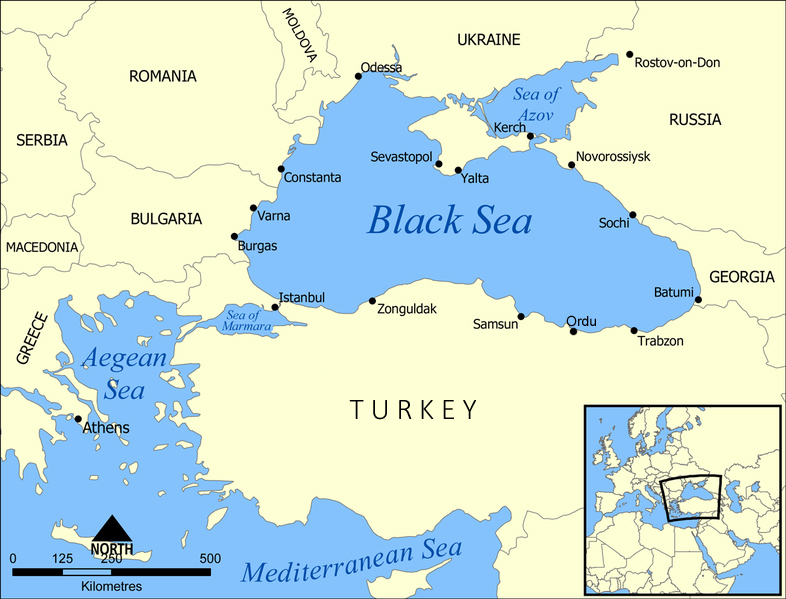
A map showing the location of the Black Sea and some of the large or prominent ports around it. The Sea of Azov and Sea of Marmara are also labelled. Created by User:NormanEinstein, Wikipedia

Kyiv Independent reports,

Russia has dispersed its naval forces in the Black Sea between the southeastern coast of Crimea and Novorossiysk in fear of Ukrainian surface drone strikes, Southern Command spokesperson Natalia Humeniuk said on Aug. 18.

Well, the US Navy is all a twitter about “Distributed Maritime Operations” (DMO) so is this a good idea for the Russian Black Sea Fleet? Like most such questions, it depends.

It depends on how good Ukrainian intelligence is. The supposed advantage for the Russian Fleet would be that their ships are harder to find, but is this case? Not only does Ukraine have access to some Western intelligence sources, but they seem to have good independent intelligence. All their successful USV attacks seem to have been against valid targets though there are many more potential targets that were not directly supporting the Russian military. When Russian ships are in port, the Ukrainians are going to know it.

Convoying has been a feature of Naval Warfare for over a thousand years because it is a defensive tactic that takes the choice of where and when to concentrate out of the hands of the offense. Spreading out the potential targets requires diluting the defense. That leaves the choice of where and when to concentrate effort in the hands of the Ukrainians.

To be successful, the defense has to detect all of the incoming USVs at a distance from their target and have sufficient numbers of countermeasures systems, in the right place, to engage all incoming USVs as they are detected.

The Ukrainian USVs don’t seem to be too hard to defeat once they are detected. Most of the successful countermeasures seem to have used machineguns, but you need one or more within effective range to engage every attacking USV.

The Ukrainians have told the world that no Russian Black Sea port is safe.

On August 4, Ukraine’s maritime authorities issued a “war risk area warning” to all international mariners headed for six Russian Black Sea ports, including Novorossiysk and the smaller oil-exporting terminals of Tuapse and Taman. The warning is scheduled to go into effect on August 23 and continue “until further notice” (Interfax-Ukraine, August 5). And on August 8, Zelenskyy’s economic adviser Oleh Ustenko told US media that “everything the Russians are moving back and forth on the Black Sea are our valid military targets,” including oil tankers or terminals.

When you multiply the number of points you have to defend, you divide your defensive force. USVs are cheap and readily produced. Ukraine will not have trouble finding targets. Ukraine will attempt to overwhelm the defenses by creating situations where even if the defense is taking out say four out of five or six out of seven attacking drones, the Russians still loose, even if it is only one ship at a time.

“CHINA’S MARITIME GRAY ZONE TACTICS AND SEALIGHT WITH RAY POWELL AND GAUTE FRIIS” –CIMSEC Podcast

CRASH AVERTED This photo taken on April 23, 2023 shows BRP Malapascua (right) maneuvering as a Chinese coast guard ship cuts its path at Second Thomas Shoal in the Spratly Islands. AFP PHOTO.

CIMSEC has a podcast discussing China’s “gray zone” tactics.

Perhaps more importantly they provide links to a series of short posts on specific gray zone tactics with examples.

There is also another post, “Gray Zone Tactics Playbook: Going Dark.” by Miao Shou, SeaLight, August 16, 2023.

Those bulbous bows probably make pretty good rams. 

“Naval Special Warfare (NSW) Surface Support Craft (SSC) and U.S. Coast Guard Special Purpose Craft, Law Enforcement II (SPC-LE2) Vessels – Contract Update” –Seapower

The Navy League on-line magazine, Seapower, reports the Navy and Coast Guard are buying Ambar Series boats from SilverShips.

The $8.2 million delivery order is a Firm-Fixed-Price Indefinite Delivery, Indefinite Quantity (IDIQ) single award contract (N00024-21-D-2205) by the Naval Sea Systems Command for the construction and delivery of up to 110 Naval Special Warfare (NSW) Surface Support Craft (SSC) and U.S. Coast Guard Special Purpose Craft, Law Enforcement II (SPC-LE) vessels, in addition to other accessories, parts and training. The contract includes options that, if exercised, would bring the cumulative value of the contract to $51.6 million and production work would continue through 2026-2027.

11 meter SPC-LE

There is more information in this earlier post about the original contract. Coast Guard boats will be Open Center Console (Open) variant with three Mercury 5.7L V10 350 and 400hp Verado outboards.

Silver Ships also has a contract to make remote controlled surface targets for the Navy. The Coast Guard might end up shooting at some of them.

Thanks to Lee for bringing this to my attention. 

Hulai II WPC, China Coast Guard’s FRC

Philippine Coast Guard resupply mission encounters China Coast Guard

Philippine attempts to resupply Second Thomas Shoal, and Chinese effort to block those efforts have become common. Apparently, the Philippines succeeded recently. There was, in fact, a US Navy P-8 maritime patrol aircraft flying low overhead providing overwatch.

US Navy P-8 observing Philippine resupply mission

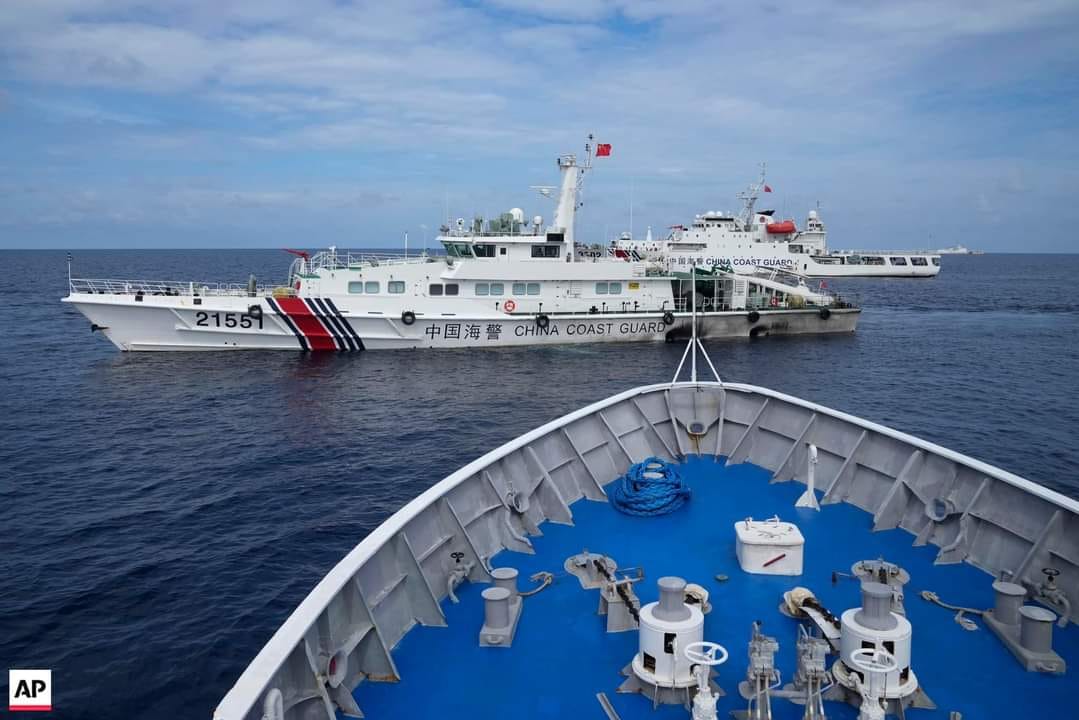
The resulting confrontation provided a lot of photos including ships of a class of China Coast Guard cutters that look a bit like US Coast Guard Webber class cutters.

China Coast Guard cutter attempts to block passage of Philippine supply vessel.

The only thing I have been able to find out about these little ships was from the Office of Naval Intelligence’s (ONI) Chinese People’s Liberation Army Navy, Coast Guard, Ship Identification Guide, which to my eye identifies them as the Hulai II class, which is reportedly 54 meters (177′) in length, with 30 units in the class. The length sounds right. They appear to be a bit longer than the Fast Response Cutters (47m/154′). I haven’t been able to locate any other information on the class.

Previously, China Coast Guard cutters guarding Second Thomas Shoal all seemed to be relatively large. Perhaps the Chinese realized their larger ships could be outmaneuvered and brought in these smaller ships as backup. Still the Philippines has again succeeded in resupplying the small garrison.

“Papua New Guinea leads joint maritime operations with U.S. Coast Guard” –Coast Guard News

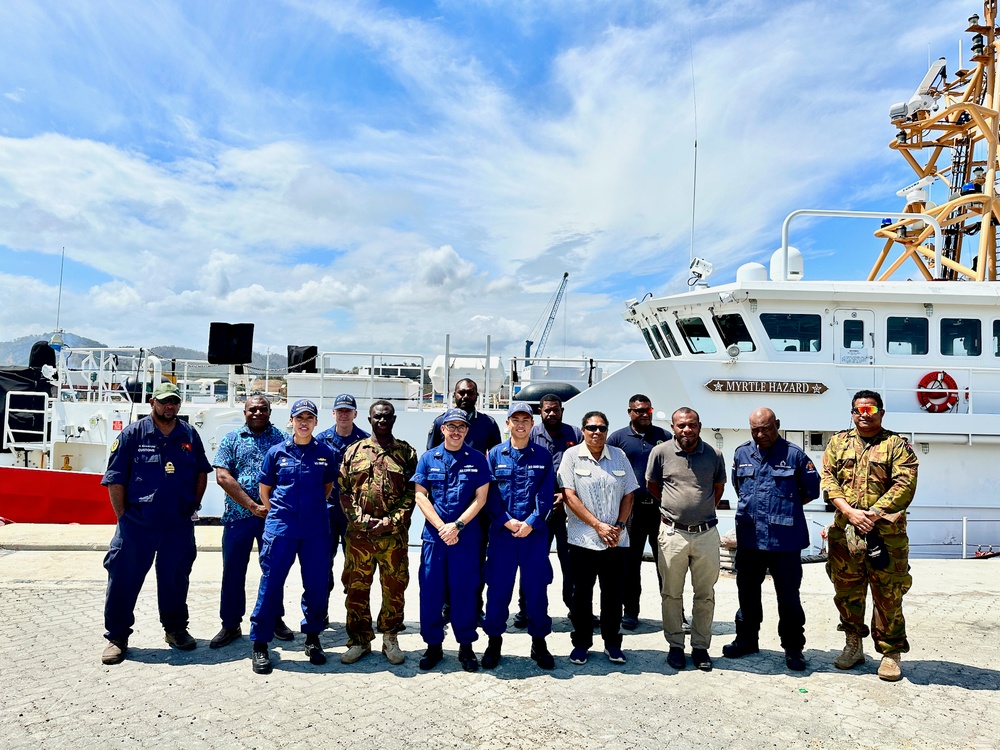
USCGC Myrtle Hazard (WPC 1139) hosts operational planning and subject matter exchange with partners in Port Moresby, Papua New Guinea

The USCGC Myrtle Hazard (WPC 1139) command stand for a photo with partners from the Papua New Guinea Defense Forces, Customs Services, National Fisheries Authority, and Department of Transport’s maritime security division following an operational planning and subject matter exchange with partners in Port Moresby, Papua New Guinea on Aug. 22, 2023. The U.S. Coast Guard is in Papua New Guinea at the invitation of the PNG government to join their lead in maritime operations to combat illegal fishing and safeguard maritime resources following the recent signing and ratification of the bilateral agreement between the United States and Papua New Guinea. (U.S. Coast Guard photo by Chief Warrant Officer Sara Muir) 

Passing along this from Coast Guard News. Like the fact that the Papua New Guinea government is taking the lead on this. We are helping them build capacity not doing the job for them.


Aug. 23, 2023

Papua New Guinea leads joint maritime operations with U.S. Coast Guard

Editor’s Note: For more images, please click here

PORT MORESBY, Papua New Guinea — Papua New Guinea (PNG) has invited the USCGC Myrtle Hazard (WPC 1139) to join their lead in maritime operations to combat illegal fishing and safeguard maritime resources during August 2023.

This collaborative effort marks the first time a joint patrol effort will be executed at sea since the signing and ratification of the recent bilateral defense agreement between PNG and the United States, which allows the U.S. to embark shipriders from PNG agencies aboard the ship to conduct at sea boardings on other vessels operating in the exclusive economic zone (EEZ) under their national agency authority. This is the U.S. Coast Guard vessel deployment first announced during Secretary of Defense Austin’s engagement with Prime Minister James Marape in July.

PNG’s lead in this mission aligns with their sovereign rights to protect the EEZ and emphasizes the country’s commitment to maritime domain awareness, fisheries regulation enforcement, and sovereignty protection. The PNG government requested the U.S. Coast Guard’s participation to utilize the platform and crew of the Guam-based 154-foot Fast Repones Cutter, currently on an expeditionary patrol, to expand coverage of the heavily trafficked maritime EEZ.

“Through our recent operational planning and subject matter exchange, the partnership between the Papua New Guinea Defence Force and the U.S. Coast Guard reached new heights. The spirit of collaboration and shared mission to ensure regional maritime security reflects our nations’ aligned values and commitment. This initiative fosters growth in our bilateral relationship and paves the way for innovative approaches to safeguard our waters and the sustainable use of our ocean resources. Working alongside the U.S. Coast Guard is an honor, and PNGDF eagerly anticipates our cooperative efforts’ continued growth and success,” said Commodore Philip Polewara, the Acting Chief of the PNG Defence Force.

The PNG-led patrol aims to observe activity and conduct boardings to reduce illegal fishing and illicit maritime activities in PNG’s EEZ. It’s part of a long-term effort to counter illegal maritime activity and safeguard the sustainable use of maritime resources.

This collaboration is vital to Operation Blue Pacific and augments ongoing efforts by the Pacific Islands Forum Fisheries Agency and Western and Central Pacific Fisheries Commission. It underscores the recent bilateral agreement, signed in May and ratified in the last few weeks, enabling the Myrtle Hazard crew to work collaboratively within PNG’s legal framework and strengthen relations with agencies with shared objectives.

The USCGC Oliver Henry (WPC 1140) crew was the first U.S. Coast Guard Fast Response Cutter to call on port in Papua New Guinea during their southern expeditionary patrol in the fall of 2022 to build relations, conduct engagements, and resupply.

The USCGC Myrtle Hazard’s crew is building on the work of their colleagues – already engaging with the PNG Defense Force through exchanges in the northern part of the country on this patrol, bolstering cooperation and understanding. This activity included subject matter exchanges with the PNG Defense Force Patrol Vessel Ted Diro crew and a port call in Rabaul, where the team engaged with the local community at the Rabaul Yacht Club. Additionally, the advance team and cutter crew conducted operations planning and subject matter exchanges across agencies in Port Moresby and ship tours for the embassy team and partners.

“We are deeply honored to collaborate with the Papua New Guinea Defense Force, Papua New Guinea Customs Services, Papua New Guinea National Fisheries Authority, and the Department of Transport’s Maritime Security Division at the invitation of the Papua New Guinea Government,” said Lt. Jalle Merritt, commanding officer of the USCGC Myrtle Hazard. “Our shared mission reflects PNG’s leading role in regional security, and we are committed to supporting their goals in this significant undertaking.”

For more information about this patrol and other related activities, please contact Chief Warrant Officer Sara Muir at sara.g.muir@uscg.mil or the respective agencies in Papua New Guinea.

“USNI News Fleet and Marine Tracker: Aug. 21, 2023”

USCGC Munro (WMSL-755) escorts USNS Fisher (T-AKR-301) in the East China Sea on Aug. 12, 2023. US Navy Photo

Looking at the latest US Naval Institute “Fleet and Marine Tracker,” I am a bit surprised to see there are still 3 Navy ships operating under 4th Fleet, presumably doing drug interdiction. This is an uptick.

Again, they report on atypical Coast Guard operations:

  • Legend-class National Security Cutter USCGC Munro (WMSL-755) departed South Korea last week and is in the Korea Strait. (As I mentioned earlier, there is a possibility, cutters may encounter the new North Korean corvettes.)
  • Coast Guard Cutter USCGC Healy (WAGB-20) continues its work in the Beaufort Sea. Healy is on a five-month deployment in partnership with ONR and the National Science Foundation.
  • Coast Guard Cutter USCGC Forward (WMEC-911) is currently supporting Operation Nanook. Operation Nanook is an annual Canadian-led exercise that fosters international cooperation and shared responsibility in the Arctic and the northern Atlantic Regions. The cutter recently made a port call in Nuuk, Greenland.

You can use Control F “USCGC” if you want to quickly find the Coast Guard cutters mentioned in the USNI posts.

PATFORSWA is mentioned again.

The link in the Healy entry, “U.S., Canadian Icebreakers Conduct Operation, Rendezvous en Route to Arctic Ocean” is interesting, plus there is more in the USNI post including an “adorable” polar bear photo.

“‘Strategic’ Cruise Missile Tested From North Korea’s New Corvette” (Corvette with Nuclear Capable Cruise Missile?) –The Drive

The Drive reports.

“North Korea’s state-run media has released new photos of the country’s most modern surface combatant, known in the West as the Amnok class corvette, which is also the largest operated by the Korean People’s Navy. Of particular interest is that the warship is armed with cruise missiles, which can likely be fitted with nuclear warheads, adding yet another platform to North Korea’s diverse and growing strategic arsenal.”

Cutters doing UN sanctions enforcement in the East China Sea might run into one of these.

This coast guard cutter sized vessel, one of four being built, which is reportedly 77 meters (253′) in length, is interesting for its combination of possible nuclear capability with old tech.

Aside from the cruise missiles, which may not have been accurate, this corvette includes four heavy gatling style machine guns (two 30mm and two 14.5mm) which would be very dangerous at short range. For mid-range, the mid 20th century 100mm gun looks rather crude, but it does throw a 34.4 lbs. (15.6 kg) projectile up to 24,323 yards (22,241 m). That is almost seven times heavier and about 6,000 yards further than the 57mm.

The portholes look out of place and may mean the ship is not fully airconditioned.

“U.S. Coast Guard Forces Micronesia Sector/Guam’s Fast Response Cutters bolster Pacific Partnership Strategy and strengthen Pacific Island Country relations” –USCG Forces Micronesia/Sector Guam

The Sentinel-class fast response cutter USCGC Oliver Henry (WPC 1140) crew arriving in Port Moresby for a port visit on Aug. 23, 2022, following a patrol in parts of the Coral Sea, the Solomon Islands and PNG Exclusive Economic Zones. The U.S. Coast Guard was conducting a routine deployment in Oceania as part of Operation Blue Pacific, working alongside Allies, building maritime domain awareness, and sharing best practices with partner nation navies and coast guards. (U.S. Coast Guard photo by USCGC Oliver Henry)

Below is a news release from U.S. Coast Guard Forces Micronesia/Sector Guam. Webber class cutters there are developing a new norm for Coast Guard assistance to Pacific Island nations. It is not clear if this is now the norm, or if this was an unusual period, but from June 21 to August 3, there was only one day (June 17) that they did not have an FRC underway for at least part of the day. This is what I believe should be the norm and probably the reason FRCs are so frequently based in groups of three or six. Typically three ships would be, one underway, one in maintenance, and one in workup/standby (I don’t know if they are employing standby). 

On the other hand, none of these patrols was more than 16 days long and the shortest only five, which suggest why, given the long transit distances, we need some cutters with greater endurance in the Western Pacific (I would say three to have one underway at all times and be able to surge two when needed).

Thanks to Paul for bringing this to my attention.

Aug. 18, 2023

U.S. Coast Guard Forces Micronesia Sector/Guam’s Fast Response Cutters bolster Pacific Partnership Strategy and strengthen Pacific Island Country relations

SANTA RITA, Guam — In a robust display of maritime commitment, U.S. Coast Guard Forces Micronesia/Sector Guam’s Fast Response Cutters conducted four patrols over 44 days, enhancing safety and prosperity in the Pacific Islands region while combatting illicit maritime activity, including illegal, unregulated, and unreported fishing and the illegal and unsafe transport of passengers.

The crews of USCGC Frederick Hatch (WPC 1143), USCGC Myrtle Hazard (WPC 1139), and USCGC Oliver Henry (WPC 1140):

– Conducted seven boardings and five observation reports.
– Completed over 20 training evolutions.
– Qualified 18 new shipboard members.
– Supported the investigation into the transport of 11 people aboard an overloaded vessel transiting to Guam from the Commonwealth of the Northern Mariana Islands on an illegal charter following their rescue by DoD partners.
– Supported operations such as Operation Blue Pacific, Operation Rematau, Operation Nasse, and Operation Koa Moana.

“Our Fast Response Cutter crews exhibit both efficacy and presence as a consistent and trusted partner in the region. Our Pacific Island Country partners’ warmth and regard for the Coast Guard is a testament to the strong connections we have nurtured over the years. It is our commitment to the people of the Pacific Island Countries to protect Oceania and its resources for them from undue strategic competition that would undermine those relationships and destabilize the region,” said Cmdr. Greg Sickels, deputy sector commander of U.S. Coast Guard Forces Micronesia/Sector Guam.

Operational Achievements and Highlights

– USCGC Frederick Hatch (June 21 – July 2 and July 18 – Aug. 3): Enhanced international relations, streamlined boarding processes, qualified new personnel, and improved communication with FSM Maritime Police.

– USCGC Myrtle Hazard (July 3 – 16): Strengthened connection with CNMI, ensured maritime law enforcement presence in less patrolled areas, and enhanced collaboration with customs and public safety departments.

– USCGC Oliver Henry (July 18 – 23): Increased U.S. presence, enforced fishing regulations, and fostered crew readiness with weapons proficiency and collaboration.

These accomplishments underscore the U.S. Coast Guard’s pivotal role in promoting maritime governance, ensuring good relations, and fostering strategic competition in the Pacific Islands region. The U.S. Coast Guard remains a consistent and reliable partner, working collaboratively with Pacific Island Countries to achieve shared objectives and bolster regional security.

Operation Rematau, an integral part of Operation Blue Pacific, is spearheaded by the U.S. Coast Guard Forces Micronesia/Sector Guam. This initiative fosters security, safety, sovereignty, and economic prosperity throughout Oceania. Rematau translates to “people of the deep sea” and embodies the Coast Guard’s unwavering commitment to safeguarding the people of this region.

The U.S. Coast Guard actively exercises 12 bilateral maritime law enforcement agreements with Pacific Island Countries, reinforcing maritime law enforcement operations and domain awareness in the region. In October 2022, the Service, on behalf of the U.S., signed the first enhanced bilateral agreement with the Federated States of Micronesia. This landmark agreement builds on the existing shiprider arrangement, allowing the U.S. Coast Guard to conduct boardings in the FSM’s exclusive economic zone with prior approval working with the FSM National Police, but without an FSM officer physically present. This expansion significantly amplifies the FSM’s capacity to protect its sovereignty and resources across an area spanning 1 million square miles and more than 600 islands. Boardings have already been conducted under this enhanced shiprider agreement, attracting interest in similar arrangements from other nations in the area.

In May 2023, the U.S. signed a new bilateral agreement with Papua New Guinea, richly endowed with natural resources like gold, copper, oil, and natural gas. While its formal sector focuses on exports of these commodities, most of its people rely on subsistence agriculture. As of 2020, agriculture, forestry, and fishing reportedly account for nearly 19 percent of PNG’s GDP. The agreement aligns with the PNG government’s efforts to safeguard their islands and 1.2 million square miles of EEZ, which are vital to their economic well-being. Recently ratified by their parliament, this partnership, at the request of the Papua New Guinea government, further extends the reach and impact of maritime law enforcement efforts. In line with this initiative, a U.S. Coast Guard cutter from Guam will be collaborating with Papua New Guinea to enact their new agreement shortly, continuing to foster security and collaboration across the Pacific.

U.S. Coast Guard Forces Micronesia/Sector Guam comprises more than 300 members based in Guam and the Commonwealth of the Northern Mariana Islands spread across shoreside and afloat units committed to maritime safety, security, and stewardship in Oceania.

For more information on the U.S. Coast Guard Forces Micronesia Sector/Guam’s operations and achievements, please visit the official DVIDS account at https://www.dvidshub.net/unit/USCG-FMSG.