Chuck Hill's CG Blog

Chuck Hill's CG Blog

“Coast Guard begins production phase of medium endurance cutter service life extension program” –CG-9

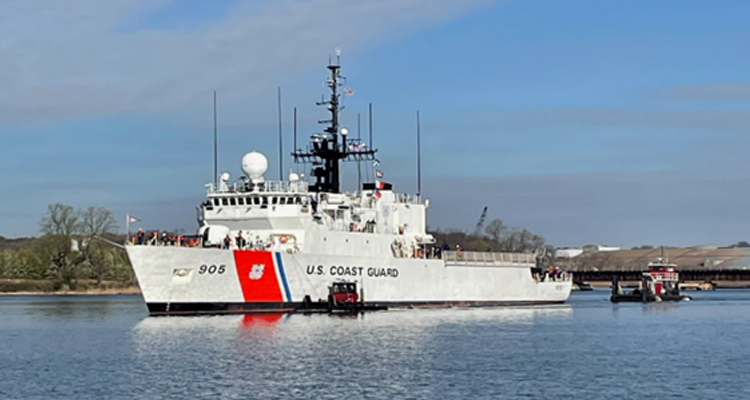
Coast Guard Cutter Spencer approaches the pier at Coast Guard Yard in Baltimore. Service life extension program work on the medium endurance cutter will last 15 months. U.S. Coast Guard photo.

Below is a release from the Acquisitions Directorate, CG-9.

I would note that all six ships getting this service life extension are “B class” 270s, built by Robert Derecktor Shipyard, Middletown, RI, numbers 905, 907, 908, 909, 911, and 912. Unlike the first four “A class,” these have a stronger flight deck, capable of supporting H-60s.

This release clarifies a lot about the SLEP program, but there are still some unknowns.

Reportedly the 76mm Mk75 gun and presumably the associated Mk92 firecontrol system will be removed. A Mk38 gun mount would presumably replace the 76mm, but it is not clear if any additional radar would be added to replace the air search and approach control functions that were provided by the Mk92. “Harriet Lane served as the gun weapons system prototype,” but I have not seen any post conversion photos of Harriet Lane that might show us the new sensor/weapon combination. Harriet Lane is expected to change homeports from Norfolk to Honolulu early in FY2024. Harriet Lane is an “A class” 270.

I also wonder if the SLQ-32 electronic warfare systems will be retained? Will the gun be the same 25 mm we have on the Webber class, or will at least some get the 30mm Mk38 mod4?


Coast Guard begins production phase of medium endurance cutter service life extension program

July 14, 2023

The service life extension program (SLEP) for the 270-foot Famous-class medium endurance cutters (MECs) moved to the production phase July 1 with the start of industrial work on Coast Guard Cutter Spencer.

Four main areas are being addressed during this SLEP, encompassing electrical, weapons system, engine and structural areas. Coast Guard Cutters Seneca and Harriet Lane served as prototypes for the electrical and structural work; Harriet Lane served as the gun weapons system prototype. Work on Seneca ran from July 2021 to March 2022; Harriet Lane work began March 2022 and is scheduled to be completed in August 2023.

Spencer will be the first hull to receive all major work items, including new main diesel engines. The work is scheduled to last 15 months.

SLEP work on the 270-foot MECs is planned through spring 2028 on five additional hulls: Legare, Campbell, Forward, Escanaba and Tahoma. The work involves targeted system replacement to address system reliability, supportability and obsolescence. SLEP work is completed at Coast Guard Yard concurrently with regular maintenance activities to achieve overall schedule and cost savings. The work will facilitate continued MEC operations during the service’s transition to the future offshore patrol cutter class.

In-Service Vessel Sustainment is the Coast Guard’s strategic class-by-class evaluation of its vessels to determine what major maintenance and upgrades are necessary for them to reach or extend their service lives.

For more information: In-Service Vessel Sustainment Program page

“Congress Blasts U.S. Coast Guard in an Unprecedented Hearing” –Forbes

Forbes reports on a Senate hearing that focused on the Coast Guard Academy’s handing of reports of rape, sexual assaults, harassment, and abuse.

On July 13, members of the U.S. Senate Committee on Commerce, Science and Transportation took turns raging at the Coast Guard’s “heartbreaking, maddening, frustrating and intolerable” record of handling sexual assaults at the Coast Guard Academy. Furious legislators slapped the embattled Service with an Inspector General investigation and demanded greater accountability from a Coast Guard that is struggling to reconcile a demanding, zero-defect culture with an imperfect reality.

But the hearing and the post looked beyond these immediate concerns and talks about Coast Guard “zero defects” culture in general, and OPC procurement in particular.

Some prior posts that may be related:

Obviously not a new problem. Transparency is hard when one oh-shit wipes out seven at-a-boys, but we need to be honest with ourselves and welcome honesty. We also need to treat every felony as what it is, a serious crime.

Thanks to John W. for bringing this to my attention. 

“Probing Palau’s Waters: Chinese Ships Are Increasingly Active in the Pacific” –Real Clear Defense

The Republic of Palau on a map of the Pacific. Credit: Encyclopaedia Britannica/Universal Images Group via Getty Images

Real Clear Defense reports on Chinese incursions into Palau’s Exclusive Economic Zone.

None of the actions sighted appear to be illegal or that much different from what the US does in the South China Sea, but they are movements we want to watch. A more detailed understanding of what they are doing might reveal illegality such as tapping into undersea cables.

Seems like the Chinese are telling us we need to station some cutters in Palau, and maybe some land based UAS.

The nearest cutters are based in Guam. It is 700 nautical miles from Guam to Palau, further than the distance between Atlanta and New York City, 50 hours at 14 knots, so Guam really isn’t in the neighborhood.

The nearest Coast Guard fixed wing search aircraft are based in Hawai’i at Barbers Point, 4500 nautical miles away. Even the new C-130J would require two fuel stops just to get to Palau.

“JUST IN: Marine Corps Ramps Up Production of Remote Weapon Stations” –National Defense/ Maybe Something the Coast Guard Could Use

National Defense reports,

The Marine Corps is preparing for the transition to full-rate production of the Marine Air Defense Integrated System Remote Weapon Station, according to a July 10 press release from manufacturer Kongsberg.

The Marine Air Defense Integrated System Remote Weapon Station, otherwise known as MADIS RWS, is a critical system in the Marine Corps Ground-Based Air Defense portfolio, which provides protection from drones with increased lethality against evolving threats.

Since this is a Marine system, built to be exposed to salt air and sea spray, there is no reason it could not also be a naval mount.

Currently no Coast Guard ships seem to have an effective hard kill system to use against Unmanned Air Systems.

The Marines seem to think they have an effective system.

It looks like a version of the MADIS system could be a very useful addition to some Coast Guard Cutters. The Navy might even want a few, including perhaps for the protection of Military Sealift Command Ships.

The war in Ukraine is showing us how useful and potentially dangerous even small Unmanned Surface and Air systems can be. The threat is not limited to Ukraine or Southwest Asia.

The MADIS system and its Remote Weapon Station is light enough to be used on virtually anything the Coast Guard calls a cutter. In addition to defense against UAS, this system could provide basic air defense against other potential threats and defense against swarming small craft.

The Webber Class:

We have already seen the sensors used in the MADIS system on the Webber class WPCs in PATFORSWA, but even those cutters don’t have an effective, installed hard kill system.

The addition of the MADIS remote weapon station to PATFORSWA FRCs would not only allow the cutters to engage UAS but would also provide them with protection against various air threats.

While perhaps less urgent, mounting the system on all Webber class would allow them to offer this protection to other potential targets.

Offshore Patrol Cutter port quarter

The Offshore Patrol Cutter (OPC): 

There are two troubling issues with the OPC with regard to their armament.

  • Aside from the .50 calibers, on most bearings, there is only one weapon that can bear on a target. The lack of redundancy is a serious weakness.
  • Protection against even the most basic air threats, including UAS, is weak at best.

I have always been a bit concerned that the arc of fire for the single 25mm Mk38 Mod3 gun is severely limited. It’s mounted on top of the hangar, but what appear to be satcom antennas on either side may limit the firing arc to less than 180 degrees.

Replacing the Mk38 mount, the two .50 caliber in remote weapon stations, and the crew served .50 caliber guns with three properly sited MADIS style remote weapon stations (RWS), would ensure redundant coverage of 360 degrees, provide a more robust air defense (including against cruise missiles), and reduce the number of different weapon systems that need to be maintained.

The National Security Cutters (NSC):

The NSCs are nominally better armed than the OPCs because they have a 20mm Phalanx rather than a 25 Mk38. They would certainly be better off if a pair of the MADIS RWS replaced the .50 caliber crew served weapons. The additional visual sensors might also be useful. It might even be preferable to replace the Phalanx with a third RWS.

Polar Security Cutter and Others: 

The remote weapon system does not necessarily require the air search radar system. This system is light and compact enough to arm virtually any cutter from patrol boats to icebreakers including buoy tenders that do occasionally do law enforcement and would benefit from the electro-optics that are part of the Remote Weapon Station.

Other Considerations: 

Other Remote Weapon Station combinations might be preferable. I would like to see a more powerful gun than the M230 combined with Hellfire or APKWS in addition to Stinger, but this is in the Navy’s system now and provides a unique combination of capabilities. Training and maintenance course should become available.

The gun in the remote weapon system, the XM914E1 30mm that fires the 30x113mm does have a lower muzzle velocity (805 m/s (2,641 ft/s)) than the 25mm M242 (1,100 m/s (3,600 ft/s)) but the 30mm has a higher rate and airburst ammunition not currently available for US 25mm guns. The 25mm might be a better anti-surface weapon but not by much and the air burst ammunition and particularly the Stinger make me strongly favor the MADIS system.

From Back Left: 40mm grenade casing, 30x173mm (A-10/M44), 30x113mm (M230), 25x137mm (M242/Mk38 gun mount), 20x103mm (Phalanx), 50 BMG
300Blackout (typical rifle round), 9mmx19 (typical pistol round)

The air search radars used with the MADIS system would provide redundancy for air search and helicopter approach control. It could also be used to support UAS operations. Reportedly the radar has a range of up to 30km and an instrumented range of 50km at altitudes from 30ft to 30,000 feet.

Stinger may be an old system, but it has a proven capability. It is likely to be replaced with a new and even better system in the near future.

“Ordering the Selected Reserve and Certain Members of the Individual Ready Reserve of the Armed Forces to Active Duty” –the President

This image is available from the United States Library of Congress’s Prints and Photographs division
under the digital ID highsm.04919

Just saw this. It is not a large recall, but it is unusual, and I have not yet seen an explanation. One should be forthcoming and if so, I will add the explanation in the comments. (See the link for proper format.)

I doubt it would have mentioned the Coast Guard, as it did, if there was not an intention to call up at least some Coast Guard Reservists.

By the authority vested in me as President by the Constitution and the laws of the United States of America, including sections 121 and 12304 of title 10, United States Code, I hereby determine that it is necessary to augment the active Armed Forces of the United States for the effective conduct of Operation Atlantic Resolve in and around the United States European Command’s area of responsibility.  In furtherance of this operation, under the stated authority, I hereby authorize the Secretary of Defense, and the Secretary of Homeland Security with respect to the Coast Guard when it is not operating as a service in the Navy, under their respective jurisdictions, to order to active duty any units, and any individual members not assigned to a unit organized to serve as a unit of the Selected Reserve, or any member in the Individual Ready Reserve mobilization category and designated as essential under regulations prescribed by the Secretary concerned, not to exceed 3,000 total members at any one time, of whom not more than 450 may be members of the Individual Ready Reserve, as they deem necessary, and to terminate the service of those units and members ordered to active duty.

This order is not intended to, and does not, create any right or benefit, substantive or procedural, enforceable at law or in equity by any party against the United States, its departments, agencies, or entities, its officers, employees, or agents, or any other person.

JOSEPH R. BIDEN JR.

THE WHITE HOUSE,
July 13, 2023.

“UNITAS LXIV to begin in Colombia” –USNAVSOUTH/4TH FLEET PUBLIC AFFAIRS

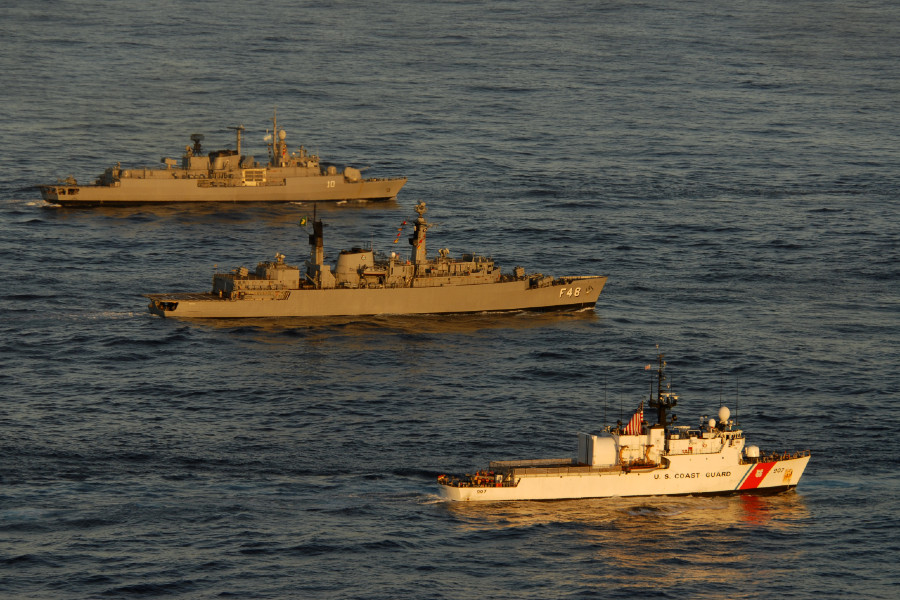
The US Coast Guard cutter USCGC Escanaba (WMEC 907), Brazlian Navy ship BNS Bosisio (F 48) and Argentinian navy ship ARA Almirante Brown (D-10) move into formation for a photo exercise during the Atlantic phase of UNITAS 52 on May 4, 2011. The formation included a total of ten ships from the US, Brazil, Mexico and Argentina. (Photo: US Navy/Mass Communication Specialist 1st Class Steve Smith)

Below is a news release announcing the start of exercise UNITAS LXIV (64 if you are not up on your Roman numerals). There is no mention of Coast Guard participation, but maybe they “simply forgot us.” Think we can bet there are some Coasties involved.

Britain’s Royal Navy also sent one of their highly regarded destroyers, HMS Dauntless.

With 26 surface vessels and three submarines participating, I think this is larger than most of the recent UNITAS exercises. In 2022 it was 19 ships, one submarine, 21 aircraft, accounting for approximately 5,500 total military personnel.

This year will see an attempt at large scale integration of unmanned systems into the exercise by 4th Fleet.


July 11, 2023

UNITAS LXIV to begin in Colombia

By USNAVSOUTH/4TH FLEET PUBLIC AFFAIRS

– U.S. Navy and Marine forces are set to arrive in Cartagena in support of UNITAS LXIV, the world’s longest-running multinational maritime exercise in the world, scheduled to start July 11, 2023.

The Colombian navy will host this year’s UNITAS, which will feature 26 warships/vessels, three submarines, 25 aircraft (fixed wing/helicopter), and approximately 7,000 people from 20 partner nations. Forces will conduct training operations off the coast of Cartagena, Colombia, and ashore in Covenas and Barranquilla, Colombia, through July 21. This year marks the 64th iteration of the exercise. Additionally, this year Colombia will celebrate the bicentennial of its navy, a historical milestone commemorating 200 years of the country’s maritime forces.

“UNITAS is so much more than a two week exercise. All participating nations have given much time, energy and effort into the months of planning leading up to what will be one of the most complex UNITAS to date,” said Rear Admiral Jim Aiken, commander U.S. Naval Forces Southern Command/U.S. 4th Fleet. “Utilizing air, surface, sub-surface, and unmanned assets, and land units, UNITAS will provide the multinational force a challenging environment in which to conduct training across the full spectrum of maritime operations. UNITAS strengthens maritime partnerships, enhances proficiency and improves interoperability of the participating forces, which is why so many partner nations are taking part this year.”

As part of the U.S. Navy’s future hybrid fleet, the Chief of Naval Operations has tasked U.S. 4th Fleet to scale unmanned platforms to the fleet level. An addition to this year’s UNITAS will include the integrated operations of unmanned air, surface, and subsurface systems into the exercise. UNITAS’ challenging training address key aspects of multinational and combined operations such as technology standardization and common operating procedures.

“This is our first opportunity to integrate unmanned systems into our operations at sea,” said Rear Adm. Aiken. “UNITAS has often served as a test bed for technology, so it is appropriate that we begin our unmanned integration campaign to operationalize the hybrid fleet here in UNITAS.”

In addition to the United States, UNITAS LXIV will bring together 19 nations from all over the world to train forces in joint maritime operations that enhance tactical proficiency and increase interoperability. Participating nations include Belize, Brazil, Canada, Chile, Colombia, Dominican Republic, Ecuador, France, Germany, Honduras, Jamaica, Mexico, Panama, Peru, Paraguay, Spain, South Korea, United Kingdom, United States, and Uruguay.

Following the UNITAS LXIV Opening Ceremony on July 12, the in port phase of the exercise will feature subject matter expert exchanges, professional symposia, ship rider exchanges, and operations meetings. During this time, Marines and Sailors will conduct expeditionary training events in Covenas to include riverine operations and diving and salvage operations.

During the UNITAS LXIV Underway Phase, forces will participate in events testing all warfare operations, to include live-fire exercises such as a SINKEX and an amphibious ship-to-shore landing and force retraction.

“Marines and Sailors from across the United States will travel to Colombia to not only train alongside our partner nations’ militaries, but to hone the skills required to operate as part of a larger maritime force focused on sea control and sea denial,” said Lt. Gen. David G. Bellon, commander, U.S. Marine Corps Forces, South, and U.S. Marine Corps Forces, Reserve. “We will be exercising command and control from a forward position as Marines set up and employ Expeditionary Advanced Base Operations to enhance naval capabilities as part of UNITAS.”

U.S. forces participating in UNITAS LXIV include USS New York (LPD 21), USS Cole (DDG 67), USS Little Rock (LCS 9), USS Pasadena (SSN 752), and USNS Burlington (T-EPF 10). Other U.S. participants include Patrol Squadron Five (VP 5), Mobile Diving and Salvage Unit (MDSU) 2, Explosive Ordnance Disposal Mobile Unit (EOD) 612, Mine Countermeasures Group 3, (MCMGRU 3), Expeditionary Mine Countermeasures EOD Company 61 (EODMU 61), East-coast based Naval Special Warfare units, Helicopter Sea Combat Squadron 22 (HSC 22), Helicopter Maritime Strike Squadron 70 Detachment 2 (HSM 70 Det 2), Joint Communications Support Element (JCSE), Fleet Surgical Team (FST) Eight, and the Meteorological Environmental Team (MET). U.S. Marine forces include 3rd Battalion, 23rd Marine Regiment (3/23), 4th Amphibious Assault Battalion (4th AABn), 8th Combat Logistic Battalion (CLB 8), 4th Combat Engineer Battalion (4th CEB), Marine Medium Tiltrotor Squadron 774 (VMM 774), Marine Light Helicopter Attack Squadron 775 (HMLA 775), Marine Aerial Refueler Transport Squadron 234 (VMGR-234), Marine Aircraft Control Group – 48 (MACG-48), and Marine Fighter Attack Squadron 112 (VMFA-112). Finally, Commander, Destroyer Squadron 40, (COMDESRON 40), Commander, Amphibious Squadron Four (COMPHIBRON FOUR), U.S Marine Corps Forces South (MARFORSOUTH), Special Operations Command South (SOCSOUTH), USNAVSOUTH/FOURTHFLT, and U.S. Southern Command (USSOUTHCOM) are participating in UNITAS LXIV.

UNITAS, which is Latin for unity, united, or oneness, was conceived in 1959 during a previous era of strategic competition when representatives at the first Inter-American Naval Conference in Panama agreed to conduct an annual maritime exercise with one another. Prior to UNITAS I in 1960, U.S. Chief of Naval Operations Adm. Arleigh Burke reviewed preparations for the multinational exercise. He commended planners for their progress, especially in building compatible communication systems among navies, and predicted that UNITAS would build strong relationships among Sailors of the Western Hemisphere.

U.S. Naval Forces Southern Command/U.S. 4th Fleet supports U.S. Southern Command’s joint and combined military operations by employing maritime forces in cooperative maritime security operations to maintain access, enhance interoperability, and build enduring partnerships in order to enhance regional security and promote peace, stability and prosperity in the Caribbean, Central and South American region.

U.S. Marine Corps Forces, South is the Marine Corps component to U.S. Southern Command, is responsible for planning exercises, operations, and overall Marine Corps support for the SOUTHCOM assigned area of responsibility.

“Coast Guard icebreaker departs for months-long Arctic deployment” –Coast Guard News

Passing this along from Coast Guard News.

July 12, 2023

Coast Guard icebreaker departs for months-long Arctic deployment

SEATTLE — The Coast Guard Cutter Healy (WAGB 20) departed Seattle, Tuesday, for a months-long Arctic deployment.

The crew aboard Healy, a 420-foot icebreaker, will provide U.S. surface presence in the Arctic, conduct high latitude science and research missions, engage in exercises and professional exchanges with foreign partners, and conduct other operations as directed throughout the deployment.

Healy’s deployment supports the Coast Guard’s Arctic Strategy while providing critical training opportunities for Polar sailors and future operations in the Arctic.

“We’re excited to begin our Arctic deployment to the high latitudes,” said Capt. Michele Schallip, Healy’s commanding officer. “Our deployment will support scientific exploration to increase understanding of the changing Arctic environment and associated impacts. We’ll also have opportunities to deepen the Coast Guard’s cooperation with our allies, and partner nations through engagements and joint exercises to promote regional stability, security and strengthen our collaborative partnerships.”

Schallip assumed command of the Healy in June, having previously served as the cutter’s executive officer.

The Healy deploys annually to the Arctic to support multiple science missions and Operation Arctic Shield, the service’s annual operation to execute U.S. Coast Guard missions, enhance maritime domain awareness, strengthen partnerships, and build preparedness, prevention, and response capabilities across the Arctic domain.

Commissioned in 2000, Healy is one of two active polar icebreakers in the Coast Guard’s fleet. The Seattle-based Coast Guard Cutter Polar Star (WAGB 10) is a Polar icebreaker commissioned in 1976.

The Coast Guard is recapitalizing its Polar icebreaker fleet to ensure continued access to both Polar regions and support the country’s economic, commercial, maritime, and national security needs.

“Japan amplifies maritime security amid rising regional tensions” –Indo-Pacific Defense Forum

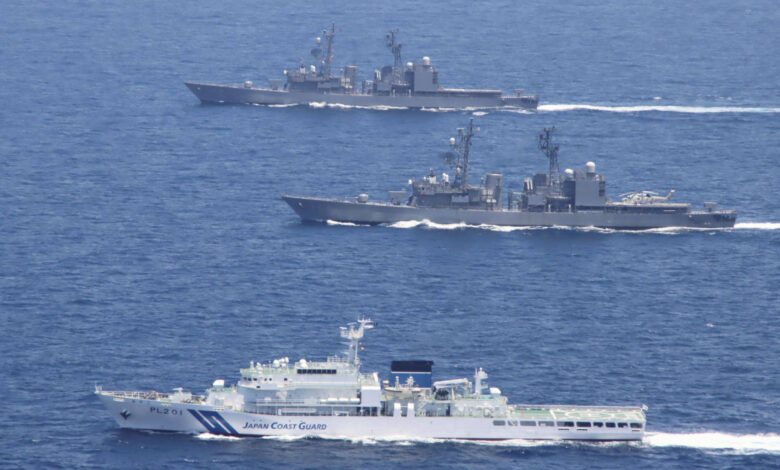
The Japan Coast Guard and Japan Maritime Self-Defense Force conduct a joint drill. IMAGE CREDIT: JAPAN COAST GUARD

Indo-Pacific Defense Forum reports Japan is attempting to increase coordination between their Maritime Defense Force (navy) and Coast Guard.

“Japan’s economic security is wedded to stable sea lines of communication (SLOC) that stretch through the East China Sea to waters around Taiwan, from the South China Seas to the Malacca straits into the Indian Ocean,” Stephen Nagy, professor at the Department of Politics and International Studies at the International Christian University in Tokyo, told FORUM. “The recently announced five-year ocean policy plan aims to bring stability to these SLOCs through more operational synergy between the [J]MSDF and Japan’s Coast Guard.”

There is little doubt this is in response to Chinese misbehavior. Still, until recently there has been little coordination between the two services.

The Japan Coast Guard has a long association with the US Coast Guard. From Wikipedia,

 “…in March 1946, USCG Captain Frank M. Meals was invited to consider the situation. Captain Meals suggested the establishment of a comprehensive coast guard organization based on the USCG. In response to this, the Maritime Safety Agency (MSA) was established as an external station of the Ministry of Transportation in 1948. Its English name was changed to Japan Coast Guard in April 2000.”

The Japan Coast Guard has never had the close association with the Maritime Defense Force that the US Coast Guard enjoys with the US Navy. It appears that is changing.

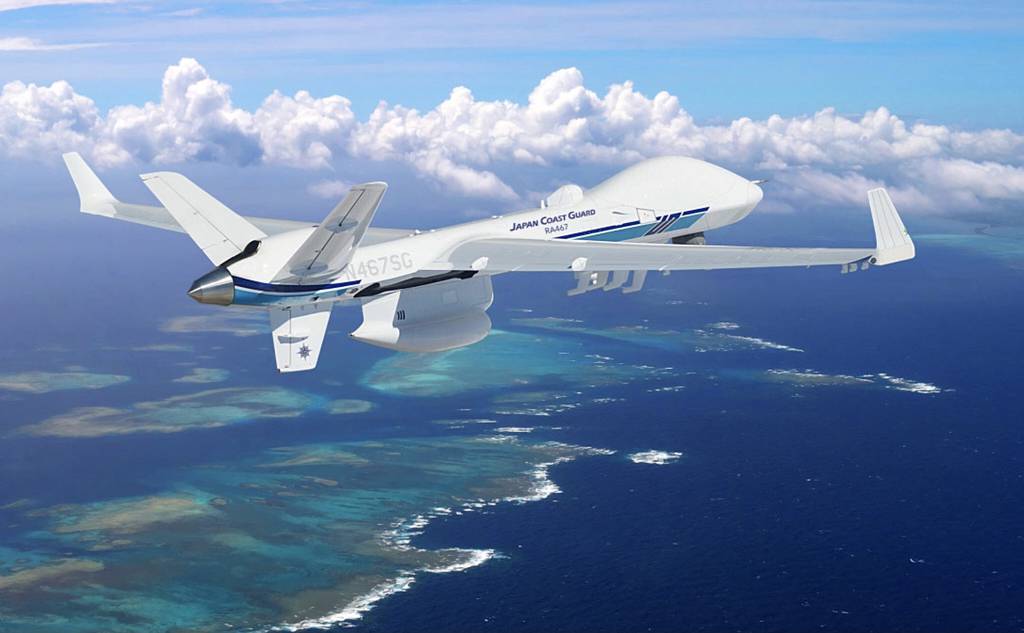
An artist’s rendering shows the Japan Coast Guard’s SeaGuardian drone. (General Atomics Aeronautical Systems)

As noted, the Japan Coast Guard has fielded MQ-9B long endurance, medium altitude, unmanned aircraft, a capability the Japan Maritime Self Defense Force does not yet have.

Seems the Japanese now view the Japan Coast Guard as a trip wire. That if the Chinese make an aggressive move, the Japan Coast Guard is likely to be the first to detect–and feel it.

“Speed, Blind Spots Cited as Contributing Factors in Deadly Accident Involving Coast Guard Cutter” –Military.com

The U.S. Coast Guard Cutter Winslow Griesser, homeported in San Juan, Puerto Rico, transits toward the pier in Bridgetown, Barbados, June 7, 2017. (U.S. Coast Guard photo by Petty Officer 1st Class Melissa Leake)

Military.com reports the results of an investigation into a Aug. 8, 2022 collision between USCGC Winslow Griesser and a 22-foot center console recreational boat that resulted in a fatality.

I was surprised by this,

As the Winslow Griesser left San Juan, it revved up to 29 knots — a normal practice at Coast Guard Sector San Juan to save time, limit crew fatigue and relieve other cutters on duty — even as the operational plan called for 16 knots, according to the Coast Guard.

Transiting at 29 knots does seem a bit excessive, if only because of fuel costs.

Going 29 instead of 25 gets you there 16% faster but burns about 70% more fuel, fuel that could keep you on patrol longer.

Going 29 instead of 21 knots gets you there 38 percent faster but burns almost three times the fuel.

Going 29 knots instead of 16 gets you there 81% faster but uses more than four times the fuel.

“French, Canadian, U.S. Forces collaborate with local responders in successful rescue operation off Rota, CNMI”

French Air Force A400

Below is a U.S. Coast Guard Forces Micronesia/Sector Guam news release, I don’t normally pass along reports on SAR cases, but this one was extremely unusual. 

This probably does show another reason we need some Coast Guard fixed wing aircraft out there. 

July 11, 2023

French, Canadian, U.S. Forces collaborate with local responders in successful rescue operation off Rota, CNMI

SANTA RITA, Guam — French, Canadian, and U.S. Forces, with local responders, successfully conducted a search and rescue operation to save the operator and passengers of a distressed vessel off the coast of Rota, Commonwealth of the Northern Mariana Islands, on July 10.

Thanks to the coordinated efforts of local partnerships and the utilization of aircraft resources, all 11 people from the center console fishing vessel are safely in Rota.

At 5:05 p.m. on July 10, Watchstanders at U.S. Coast Guard Forces Micronesia/Sector Guam’s Joint Rescue Sub-Center Guam received a distress call on VHF channel 16 from the operator of the 21-foot vessel Full 20 Horizon, stating the vessel was disabled and adrift in 6-foot seas and 12 mph winds with 11 people aboard, approximately 30 nautical miles northwest of Rota. Due to the lack of GPS onboard and the inability to use a cell phone to acquire a GPS position, the situation became even more critical.

In response, the watchstanders promptly issued an Urgent Marine Information Broadcast, alerting mariners in the area to be aware of the distressed vessel. They also established a 15-minute communications schedule with the vessel operator and instructed the passengers to wear their flotation devices for safety.

Watchstanders initiated coordinated efforts with the CNMI Department of Public Safety in Rota, who launched their 27-foot vessel to aid in the rescue operation. Additionally, partnerships with the U.S. Air Force 36th Wing and U.S. Navy Helicopter Sea Combat Squadron 25 at Andersen Air Force Base proved invaluable in securing the assistance of multiple aircraft crews for the response.

Capt. Nick Simmons, commander of U.S. Coast Guard Forces Micronesia/Sector Guam, emphasized the importance of aircraft in search and rescue operations at sea, stating, “Aircraft crews play a crucial role in our efforts to save lives in challenging maritime situations. Using aerial assets, combined with our local partnerships, ensures a swift and effective response to distress calls, ultimately increasing the chances of a successful rescue.”

A French Air and Space Force A400 Atlas military transport aircraft and crew were the first aircrew to respond, launching from Andersen Air Force Base and locating the vessel at about 8 p.m. after running a search pattern. They worked to vector in the Department of Public Safety crew.

Unfortunately, the initial rescue attempt by the Department of Public Safety’s crew was hindered by severe sea conditions as winds increased to 18 mph and seas built to 8 feet, forcing them to abort the mission. However, the French Air and Space Force A400 crew remained on the scene and maintained visual contact with the disabled vessel. Recognizing the severity of the situation, the crew of USCGC Myrtle Hazard (WPC 1139), on a port call in Saipan, was recalled, and watchstanders reengaged with HSC-25 to address the evolving circumstances.

Watchstanders also requested additional overhead support from the U.S. Air Force 36th Wing, who offered a Royal Canadian Air Force HC-130 airplane and crew to replace the French crew due to fuel constraints. At 11:15 p.m., the Canadian crew then on scene informed watchstanders that the lights on the distressed vessel went out, but they maintained visual contact with its position.

The U.S. Navy MH-60 Nighthawk helicopter and crew launched to aid the rescue efforts further. After a swift transit, the Nighthawk crew arrived at approximately 1 a.m. and immediately commenced hoisting the operator and passengers. The aircrew transported those rescued to the Rota airport, where local emergency responders and law enforcement met them. The passengers did not report any injuries, and the aircrew did not observe any.

The Nighthawk and Canadian aircrews returned to Andersen Air Force Base at 2:40 a.m., successfully concluding their part in the rescue operation. Meanwhile, the Myrtle Hazard crew continued their search for the vessel relocating it around 10 a.m. Weather conditions improved, and they will take the vessel in tow to deliver it to Rota.

Nine of the 11 people rescued are reportedly citizens the People’s Republic of China. Local law enforcement in Rota is currently addressing these matters. The U.S. Coast Guard remains committed to working closely with local authorities to ensure the safety of those at sea and the security of our maritime borders.

Notably, the French and Canadian aircraft crews participating in Exercise Mobility Guardian 2023 are contributing their expertise to this successful rescue operation. Exercise Mobility Guardian, Air Mobility Command’s largest full-spectrum readiness exercise, involves seven participating countries and supports over 15,000 U.S. forces, Allied, and partner participants in the Indo-Pacific region.

For more information or media inquiries about the multilateral rescue operation, please contact CWO Sara Muir at 671-688-6096 or sara.g.muir@uscg.mil. For information about the vessel or the disposition of the those rescued, please contact the CNMI Department of Public Safety at (670) 664-9035 or pio@dps.gov.mp.

-USCG-

About U.S. Coast Guard Forces Micronesia/Sector Guam:
U.S. Coast Guard Forces Micronesia/Sector Guam is responsible for ensuring U.S. waters’ safety, security, and stewardship and enforcing maritime laws in the Pacific region. With a steadfast commitment to protecting lives at sea, preserving the marine environment, and promoting maritime safety, the Coast Guard collaborates closely with local, federal, and international partners to serve the community and safeguard our nation’s interests.