“Coast Guard and Navy commands formalize support for Research and Development Center autonomous vessels” –CG-9

Passing along this from the Acquisitons Directorate (CG-9):


Coast Guard and Navy commands formalize support for Research and Development Center autonomous vessels

Signing of a memorandum

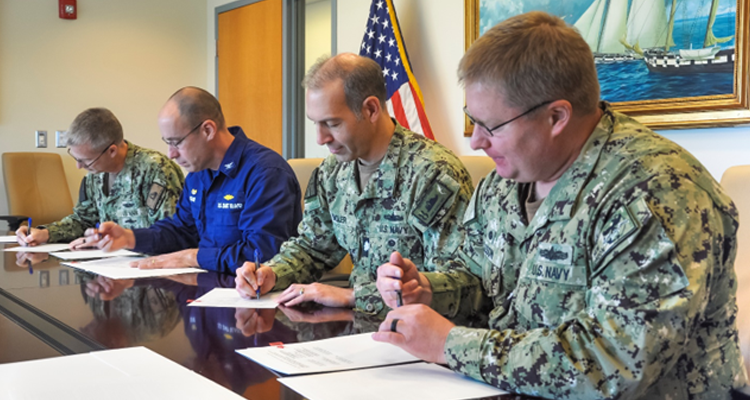
Capt. Daniel Keane, commanding officer, Coast Guard Research and Development Center (RDC); hosted (from left) Capt. Kenneth M. Curtin Jr., commanding officer, Naval Submarine Base New London; Cmdr. David Sigler, officer in charge, Maritime Expeditionary Security Squadron Eight Detachment Groton; and Cmdr. Drew Nilsson, commanding officer, Naval Reserve Center New London, Jan. 18, 2023, at RDC to formalize support for the RDC’s experimental autonomous vessels through signing of a memorandum of understanding. U.S Navy photo by Mass Communication Specialist 2nd Class Maxwell Higgins.


The Coast Guard Research and Development Center (RDC) signed a memorandum of understanding (MOU) with several U.S. Navy commands based in Southeastern Connecticut Jan. 18 to formalize support for experimental autonomous vessels operated by the RDC.

The MOU solidifies the cooperation among the commands to provide for the temporary storage and maintenance of RDC’s three optionally manned/unmanned surface vehicles (USVs) at the Naval Submarine Base. The USVs are the leading edge of the RDC’s autonomy research and encompass experimentation in areas from vessel control systems to new sensors, navigation systems and state-of-the-art communications capabilities. They are employed in joint Department of Homeland Security/Department of Defense research and in partnerships with the private sector.

Capt. Daniel Keane, RDC commanding officer, hosted Capt. Kenneth M. Curtin Jr., commanding officer, Naval Submarine Base New London (SUBASE); Cmdr. Drew Nilsson, commanding officer, Navy Reserve Center New London; and Cmdr. David Sigler, officer in charge, Maritime Expeditionary Security Squadron (MSRON) Eight Detachment Groton, in the signing of the MOU. Navy Region Mid-Atlantic and Navy Reserve Expeditionary Maintenance Detachment New London are also parties to the MOU.

Keane called the MOU a “force multiplier.”

“This is a great opportunity for our commands to work together to share knowledge, resources and talent to further understanding of autonomous vessel operations, support and logistics,” Keane said.

The MOU also fills a vital need.

“The RDC does not have the organic capabilities to fully manage the maintenance and repair aspect of this boat program,” said Lt. Dean Gilbert, the RDC’s lead for vessel maintenance with the Navy. “Partnering with the Navy fills critical gaps in the program, helps in the training of reserve sailor technicians and ensures work is being done in facilities compliant with all Coast Guard, Navy and state requirements.”

For the sailors from SUBASE Port Operations, the MSRON and the Reserve Expeditionary Maintenance Detachment, the support opportunity has multiple benefits.

“This cooperative effort not only provides our Navy sailors with valuable training opportunities to sharpen their skills and maintain mission readiness across several platforms, but also to work with fellow sea service professionals in the Coast Guard,” Nilsson said.

“Additionally, it exposes them to experimental, cutting-edge systems and technologies that may be the standard in the future,” Sigler said.

Local Navy and Coast Guard leaders recognized such beneficial outcomes from the start.

“The signing of an MOU with these Navy commands, all in collaboration and focused on autonomy, is an operationalization of the tri-services strategy,” said Dr. Joe DiRenzo, the RDC’s director of research partnerships, referring to the joint Navy, Marine Corps and Coast Guard focus on modernization, mission efficacy and leveraging each service’s complementary capabilities towards the nation’s strategic priorities.

The MOU exemplifies a forging of the Coast Guard commandant’s tenet to “Sharpen our Competitive Edge” with the chief of naval operations’ initiative to “Get Real, Get Better,” highlighted Curtin.

“The Coast Guard and the Navy in Southeastern Connecticut have a long history of cooperation and support,” Curtin said. “This joint collaboration reflects the execution of senior service strategies at the deck-plate level. Our local Navy and Coast Guard are demonstrating our commitment to constant improvement, maximizing resources, and training, learning and adapting as a collective team to meet current and future challenges. It’s a win for us all.”

With the MOU signed, RDC autonomous vessel storage at SUBASE is anticipated by the end of January, with maintenance efforts to begin soon after.

For more information: Research, Development, Test & Evaluation and Innovation Program page and Research and Development Center page

“Expanding partnerships: U.S. Coast Guard Cutter Stone arrives in Port of Suape, Brazil” –LANTAREA

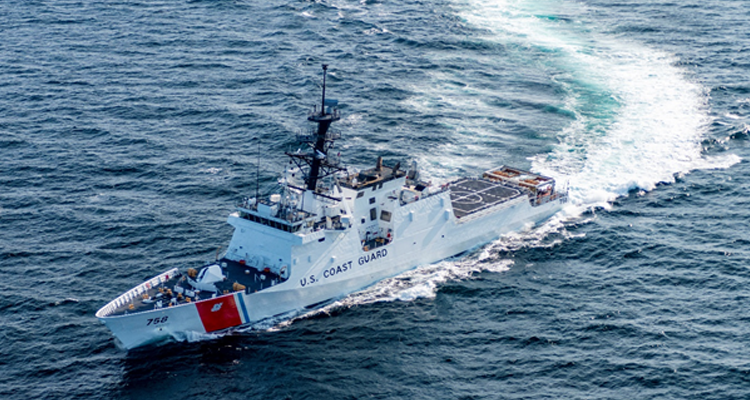
Coast Guard’s ninth national security cutter (NSC), USCGC Stone, October 2020. Photo by Lance Davis of Huntington Ingalls Industries.

Below is an Atlantic Area News Release. Looks like USCGC Stone is taking the counter IUU road show to the South Atlantic Coast of South America a second time. The first time she did this was before she had even been commissioned and after a long quarantine for COVID. The press release reporting the conclusion of their Previous South American voyage is here.

More info about their previous South American adventure:

Suape is part of the Recife metropolitan area. Recife is located on the most Eastern part of South America where it projects toward Africa. During WWII Brazil was an allied nation, declaring war on the Axis 22 August 1942. US Navy ships and aircraft based in Recife and nearby Natal patrolled this narrowest part of the Atlantic to intercept Axis blockade runners.

News Release

U.S. Coast Guard Atlantic Area

Expanding partnerships: U.S. Coast Guard Cutter Stone arrives in Port of Suape, Brazil

USCGC Stone arrves in Suape, Brazil  USCGC Stone partners with Brazliian Navy

Editors’ Note: To view more or download high-resolution photos, click on the images above.

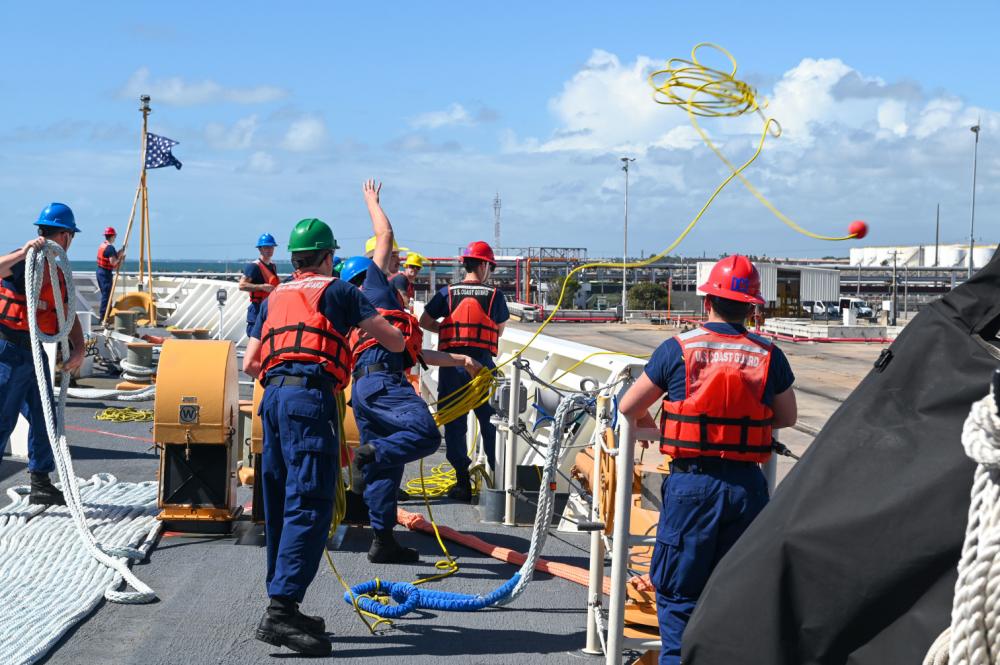
SUAPE, Brazil – The USCGC Stone (WMSL 758) arrived in the Port of Suape, Pernambuco, Brazil for a scheduled port visit Monday.

This port visit marks the first stop for Stone on its scheduled multi-mission deployment in the South Atlantic to counter illicit maritime activities and strengthen relationships for maritime sovereignty throughout the region. This visit also highlights the partnership between U.S. and Brazil to counter illegal, unreported and unregulated fishing.

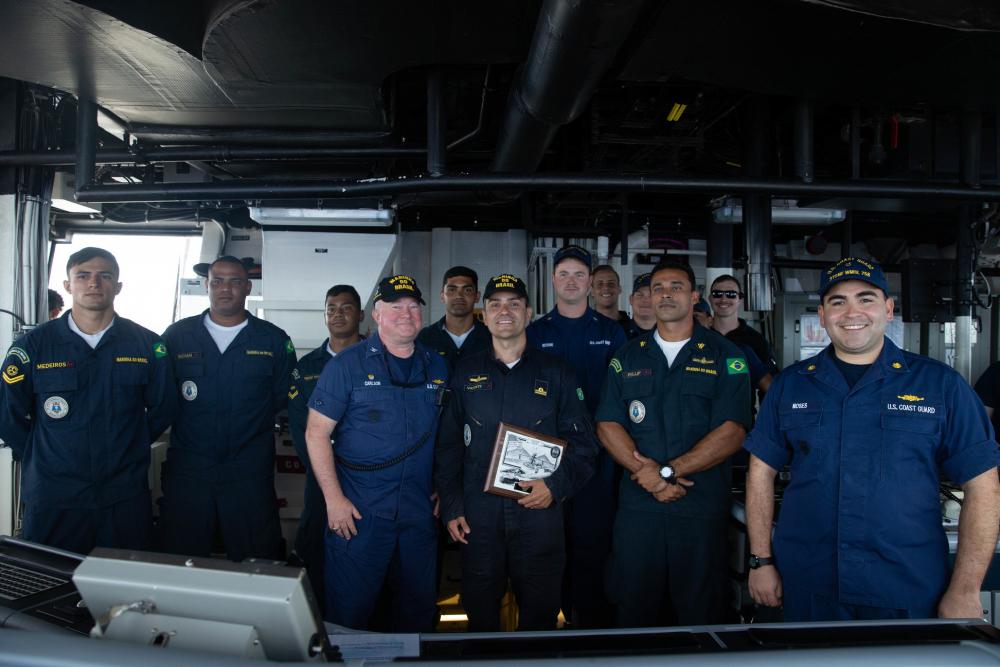
“All nations benefit from free and open access to the maritime domain,” said U.S. Coast Guard Capt. Clinton Carlson, Stone’s commanding officer. “It’s a real privilege to work with Brazil’s maritime forces as we increase our interoperability and work together to uphold the rules-based international order at sea.”

Stone last deployed to the South Atlantic from December of 2020 to February of 2021. During the deployment, Stone operationalized the U.S. Coast Guard’s Illegal, Unreported, and Unregulated Fishing Strategic Outlook, published in September of 2020.

“Our current deployment seeks to deepen our interagency and international partnerships,” said Carlson. “We have embarked personnel augments from the U.S. Navy and Marine Corps as well as representatives from the Brazilian Navy to enhance our capabilities. In leveraging our connections at home and abroad, we provide a flexible, mobile and integrated team capable of enforcing international laws, ensuring regional security and safeguarding free and open access to the sea for all law-abiding nations.”

The United States and Brazil enjoy active, cooperative relations encompassing a broad span of internationally shared political and economic concerns. Ten bilateral agreements signed in March 2011 and five more signed in April 2012 codified the nations’ shared commitment to maritime security and environmental stewardship in the Atlantic Ocean. Both countries participate in the International Commission for the Conservation of Atlantic Tunas, which studies and manages highly migratory fish species and can facilitate the enforcement of conservation and management measures regarding fish covered by the commission.

Stone is the ninth Legend-class national security cutter in the Coast Guard fleet and currently homeports in Charleston, South Carolina. The national security cutters can execute the most challenging national security missions, including support to U.S. combatant commanders.

Stone is under the command of U.S. Coast Guard Atlantic Area. Based in Portsmouth, Virginia, U.S. Coast Guard Atlantic Area oversees all Coast Guard operations east of the Rocky Mountains to the Arabian Gulf. In addition to surge operations, they also allocate ships to work with partner commands and deploy to the Caribbean and Eastern Pacific to combat transnational organized crime and illicit maritime activity.

For information on how to join the U.S. Coast Guard, visit GoCoastGuard.com to learn about active duty and reserve, officer and enlisted opportunities. Information on how to apply to the U.S. Coast Guard Academy can be found here.

“FLOODING THE ZONE: CHINA COAST GUARD PATROLS IN 2022” –CSIS

The Asia Maritime Transparency Initiative of Center for Strategic and International Studies provides a report showing the extent of China Coast Guard patrols of five features of the South China Sea, Second Thomas Shoal, Luconia Shoals, Scarborough Shoal, Vanguard Bank, and Thitu Island, in 2022 and comparing that to 2020. (There was no explanation for why no information regarding 2021 was included.)

The report also indicated that China Coast Guard is using automatic identification system (AIS) in a deceptive manner.

Thanks to Paul for bringing this to my attention.

“US Coast Guard and Space Force Partner on R&D” –Marine Link

The Coast Guard Research, Development, Test, and Evaluation Program, in partnership with the Department of Homeland Security Science and Technology Directorate, launched two 6U CubeSats from Vandenberg Air Force Base, California, as part of the Polar Scout project. Photo courtesy of SpaceX.

Marine Link reports,

“A memorandum of understanding (MOU) inked by the U.S. Space Force Science, Technology, and Research Directorate and U.S. Coast Guard Research and Development Center on January 19 will expand Space Force access to USCG Research and Development Center facilities, infrastructure and personnel.”

“Photos: U.S. Coast Guard Icebreaker Reaches Antarctica’s McMurdo Station” / “Russian Antarctic Vessel Docks In South Africa As Green Groups Protest”–gCaptain

The heavy ice breaker USCGC Polar Star (WAGB 10) moves the ice pier at McMurdo Station, Antarctica so the U.S. Army 7th Transportation Brigade (Expeditionary) can build a modular causeway system for offloading cargo from resupply ships. U.S. Navy Photo

gCaptain reports the arrival of USCGC Polar Star at McMurdo Station, Antarctica.

Meanwhile, gCaptain also reports,

“A Russian research vessel which has been prospecting for oil and natural gas in the Antarctic docked in South Africa on Saturday following protests by green campaigners who say its operations in the region violate a treaty banning mineral exploration.”

I have to see this as more evidence that mineral exploitation of Antarctica is inevitable and that it will bring with it at least some forms of conflict between claimants.

A member of Extinction Rebellion holds up a placard as the Akademik Alexander Karpinsky, a Russian polar explorer ship, arrives in Cape Town harbour, South Africa, January 28, 2023. REUTERS/Shelley Christians

“Operation Vigilant Sentry: Stopping illegal migration at sea” –CG HQ

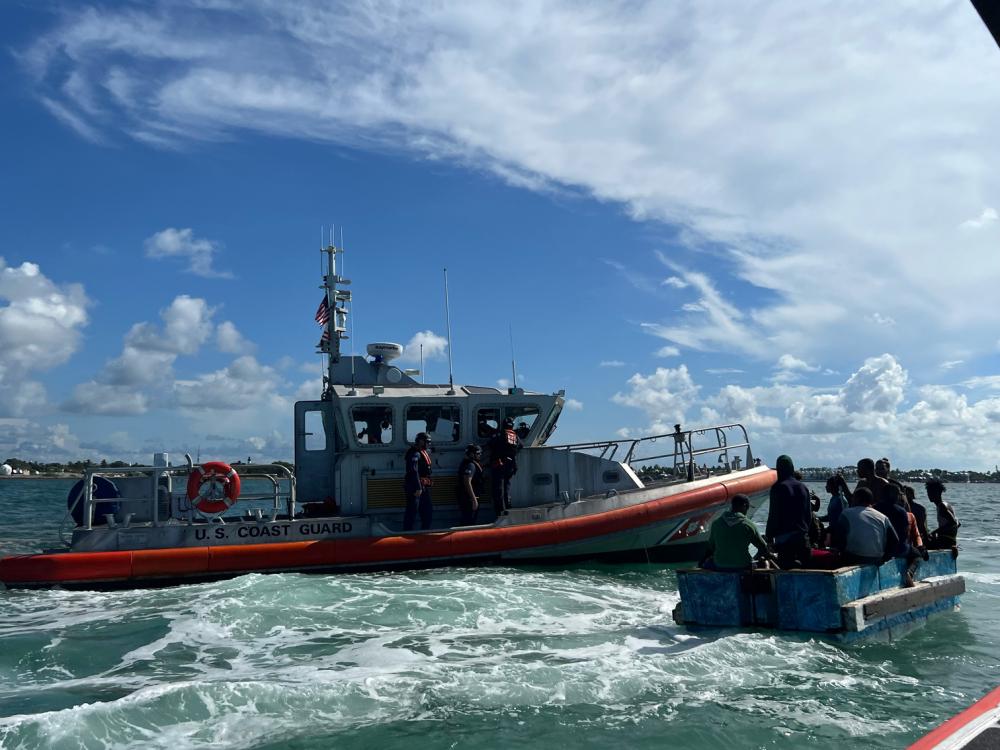
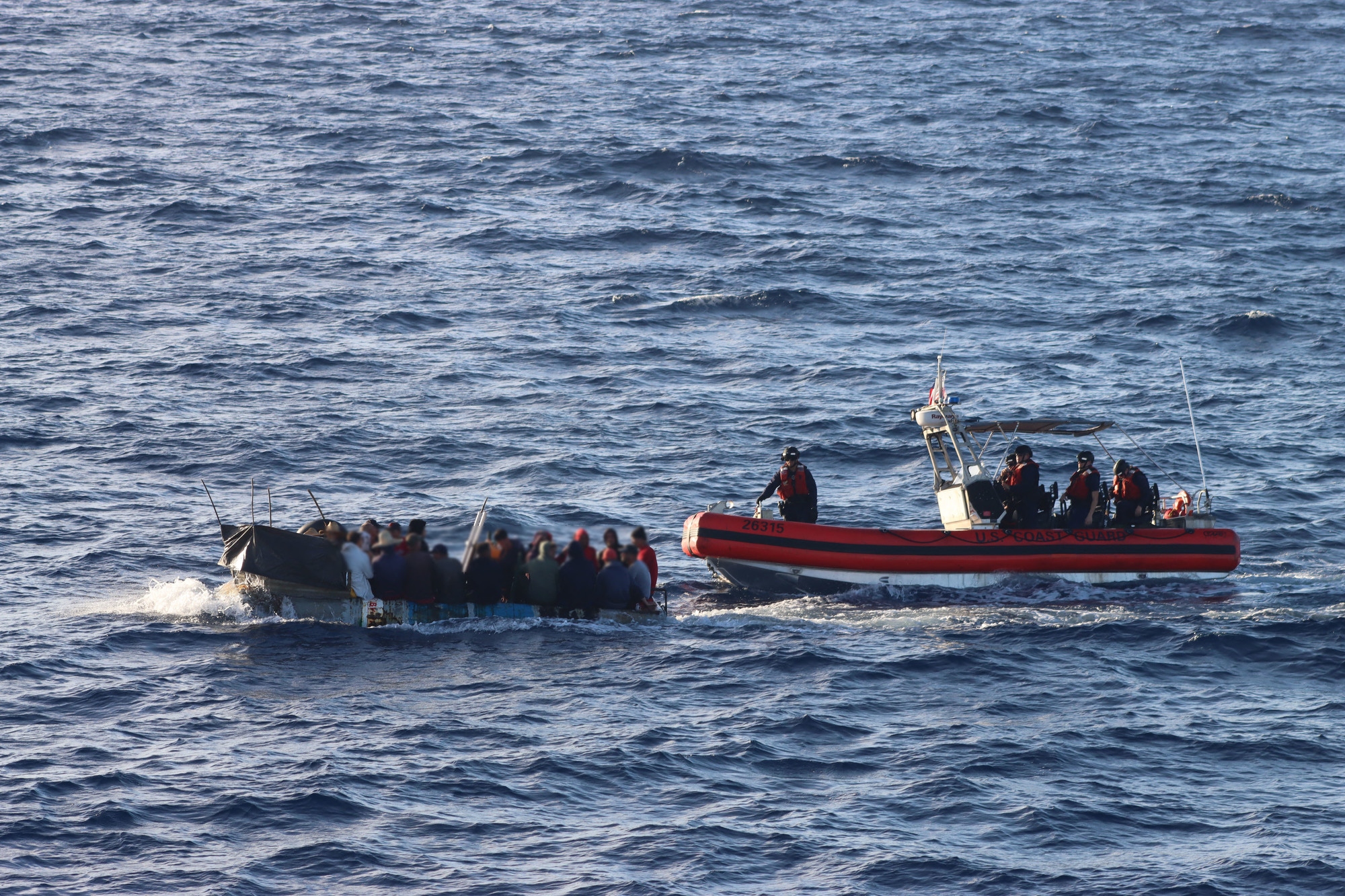
A Coast Guard Cutter Campbell law enforcement crew stopped a grossly overloaded, unsafe vessel near Turks and Caicos, May 9, 2022. (U.S. Coast Guard photo by Petty Officer 3rd Class Erik Villa-Rodriguez)

Below is a news release from Coast Guard Headquarters discussing the history and current situation of the Homeland Security Task Force – Southeast and of Operation Vigilant Sentry, a D7 lead Department wide Alien Migrant Interdiction Operation.

I have also included the text of the DHS Secretary’s remarks that were referenced in the release.

This release got wide distribution. I got it from HQ, LANTAREA, and PACAREA.


Jan. 27, 2023

Operation Vigilant Sentry: Stopping illegal migration at sea

By Petty Officer 1st Class Nicole J. Groll

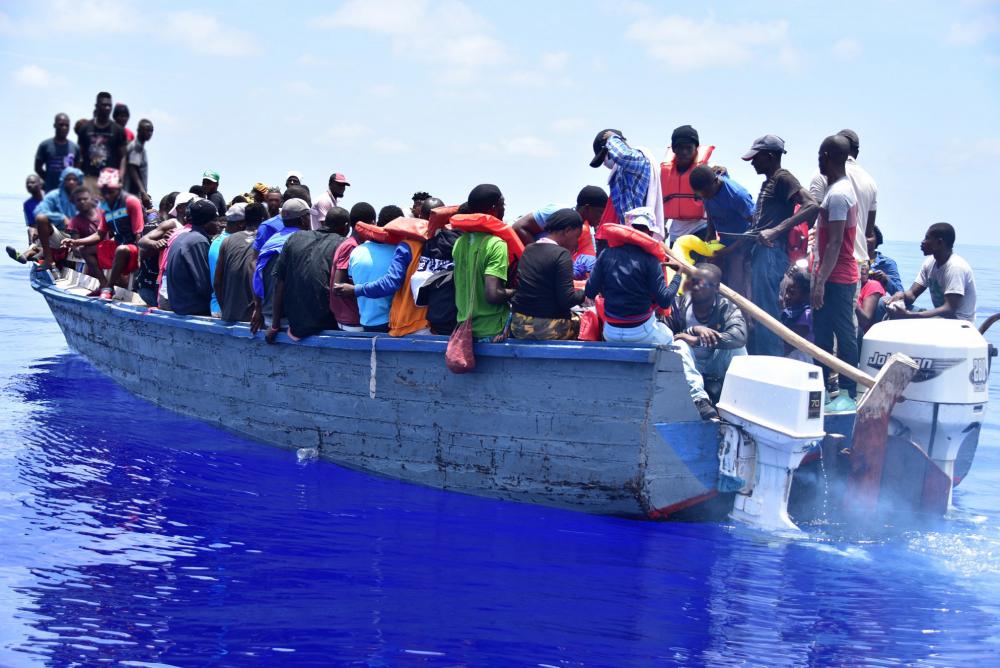
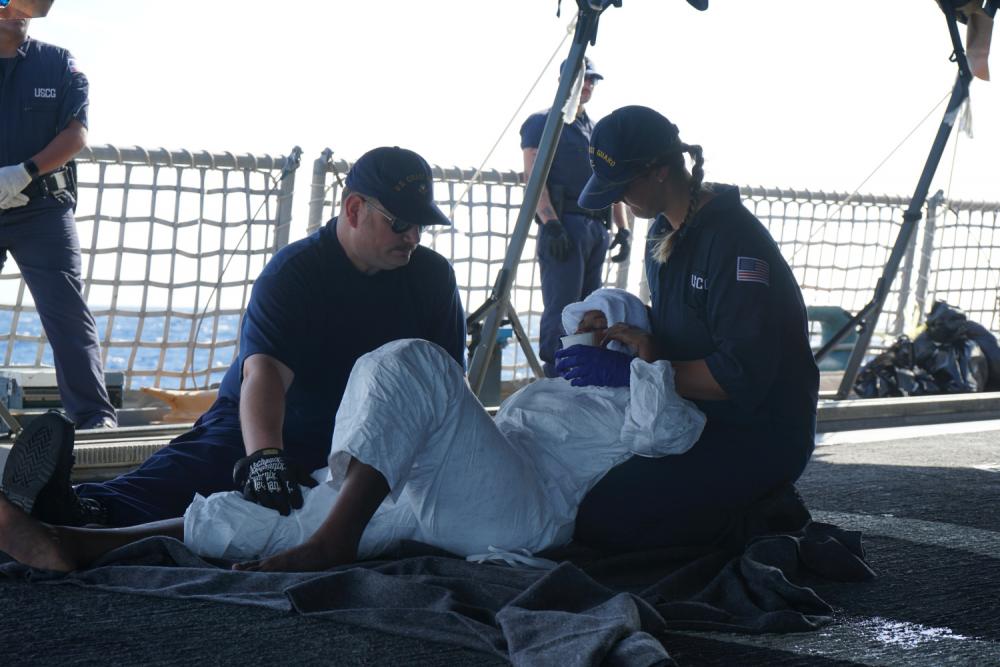
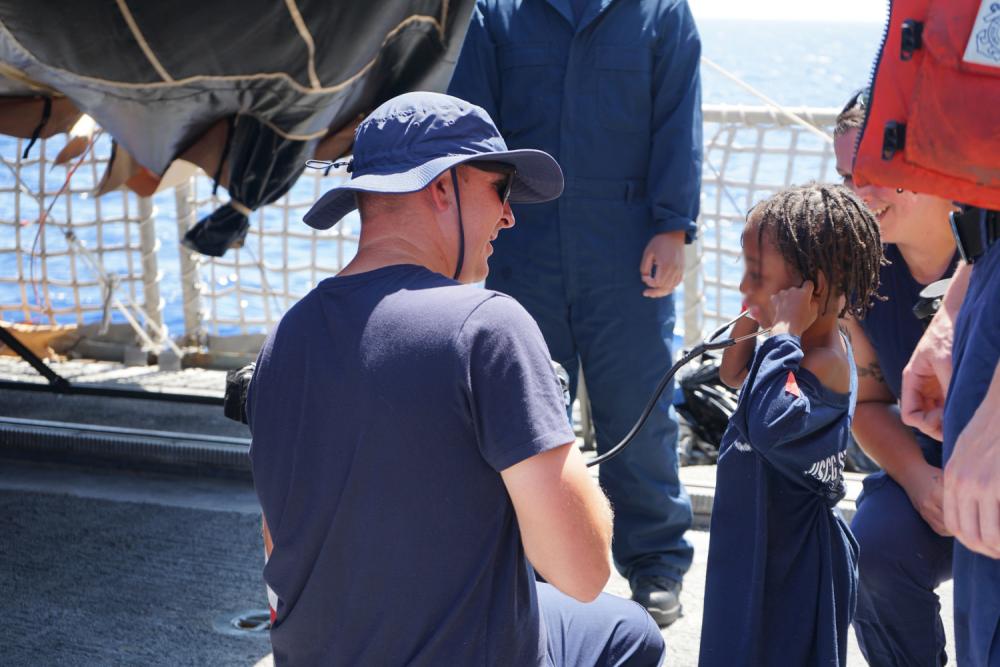
A Coast Guard Cutter Campbell law enforcement crew stopped a grossly overloaded, unsafe vessel near Turks and Caicos, May 9, 2022. Coast Guard Cutter Campbell is homeported in Kittery, Maine. (U.S. Coast Guard photo by Petty Officer 3rd Class Erik Villa-Rodriguez) Two Coast Guard Cutter Campbell crew members assist a person suffering dehydration symptoms in the Windward Passage, April 30, 2022. Coast Guard Cutter Campbell is homeported in Kittery, Maine. (U.S. Coast Guard photo by Campbell's crew) A Coast Guard Cutter Campbell medical crew member lets a child listen to his heart using a stethoscope in the Windward Passage, May 9, 2022. The people were repatriated to Haiti on May 11, 2022. (U.S. Coast Guard photo by Petty Officer 3rd Class Erik Villa-Rodriguez) 

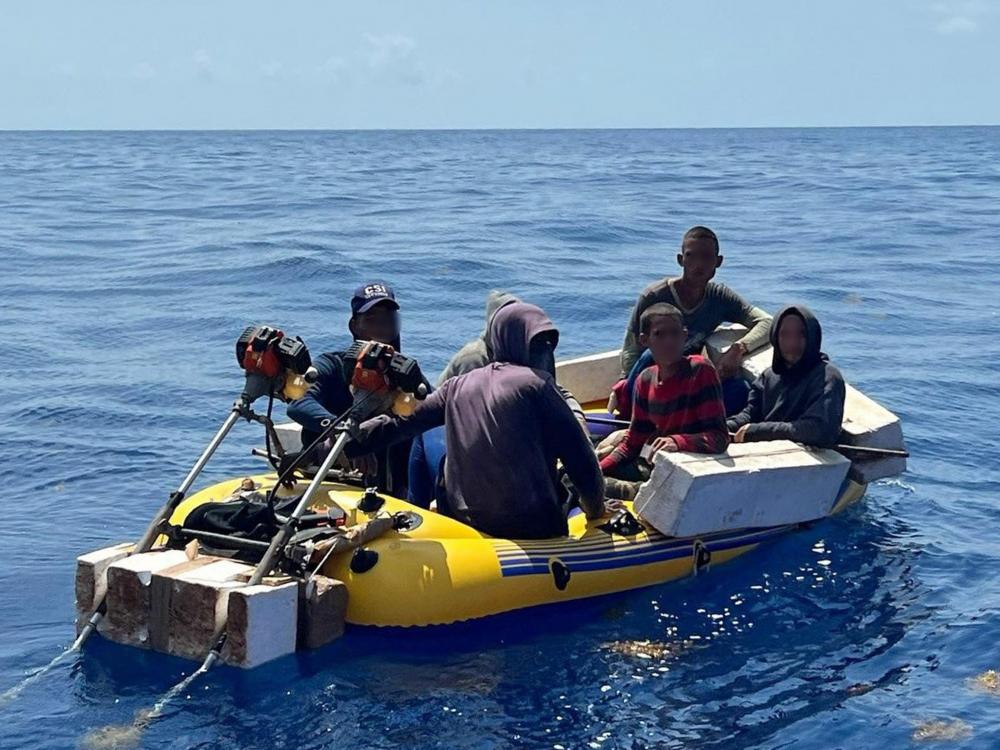
A Coast Guard Air Station Clearwater C-130 aircrew alerted Sector Key West of a wooden vessel 25 miles south of Sugarloaf Key, Florida, Jan. 23, 2023. The people were repatriated on Jan. 25, 2023. (U.S. Coast Guard photo) A good Samaritan notified Coast Guard Sector Key West watchstanders of a rustic vessel about 13 miles south of Marquesas Key, Florida, June 12, 2022. The people were repatriated to Cuba on June 17, 2022. (U.S. Coast Guard photo) A Coast Guard Station Key West law enforcement crew alerted Sector Key West watchstanders of this migrant vessel about 3 miles south of Key West, Florida, July 6, 2022. The people were repatriated to Cuba on July 8, 2022. (U.S. Coast Guard photo by Station Key West) 

Editor’s note: Click on images to download high-resolution version.

Homeland Security Task Force – Southeast was established in 2003 by the Department of Homeland Security. This interagency task force is comprised of resources and assets from the U.S. Coast Guard, the departments of Homeland Security, State, Defense, Health and Human Services, as well as those from state and local agencies. These agencies provide the organizational framework to monitor migration trends to detect and respond to a maritime mass migration.

Operation Vigilant Sentry was first approved in 2004. It is the arm of the task force that deploys joint air and surface assets and personnel to address illegal maritime migration in the Caribbean corridor of the United States. The primary objective: to protect the safety of life at sea, and to deter and dissuade a maritime mass migration with our federal, state and local partners.

The director of Homeland Security Task Force – Southeast is the commander for the Seventh Coast Guard District. Migrant interdiction is one of the 11 statutory missions assigned to the Coast Guard by Congress, giving the military service the authority to take the lead role in the ongoing and historic migrant surge.

OVS is also not country specific, but it is a framework for any Caribbean country. The most common nationalities trying to illegally migrate to Florida by sea are Cuban and Haitian. Despite the unique challenges faced by each country, the rationale for illegal migration can occur for any number of various reasons.

“The risk migrants are willing to take are unfathomable to most Americans: escaping poverty, violence, human trafficking, and persecution are a few realities,” said Cmdr. Ray Caro, chief of intelligence for Operation Vigilant Sentry. “Although change is gradual across nations in the Western Hemisphere, the frequency at which these challenges present themselves is certainly increasing. Politics, migration policies and natural disasters amplify those realities and trigger migration. As a result, maritime migration has been a lifesaving priority for the Coast Guard for more than 40 years.”

The weather, the possibility of drowning, the general unpredictability of the maritime domain all stand as barriers not just to the goals of illegal migrants, but also as threats to their very lives.

“These individuals are ignoring real risks,” said Chief Warrant Officer Matthew James, Coast Guard Station Islamorada’s commanding officer. “Just about every vessel we encounter in these voyages were constructed haphazardly with improvised materials and were taking on water. The few vessels that appeared to be well built were dangerously overloaded and capsizing was imminent when we arrived on scene. It’s very dangerous to try and cross the Florida Straits this way.”

In 2022, the Coast Guard saw one of the deadliest years for illegal migration in recent history with approximately 65 people dying trying to make it to the U.S. In 2020, the Coast Guard recorded 17 deaths and five in 2021. Despite the increased numbers and risk, the service remains dedicated to the preservation of life, imploring those who would see illegal maritime migration as an option.

“The Coast Guard and our partners are working to stop senseless migration-related deaths at sea by rescuing people in rustic, unsafe vessels,” said Capt. Benjamin Golightly, incident commander, Operation Vigilant Sentry. “Help us by not paying smugglers and instead, encourage safe, legal migration.”

Historically, Florida is no stranger to illegal migration. According to the Department of Homeland Security and U.S. Citizen and Immigration Services, the Cuban Adjustment Act of 1966 was established to allow Cuban natives and citizens living in the U.S. at least two years to apply to become lawful permanent residents by getting a Green Card. This applied to the Cuban arrivals who were paroled into the U.S. fleeing communism. In 1995, the so-called Wet Foot/Dry Foot policy was adopted. This meant if illegal migrants were stopped at sea, they were returned to their country of origin or departure. If they were stopped on land, they would eventually be paroled and able to apply for the Cuban Adjustment Act. In 2017, former President Obama repealed the Wet Foot/Dry Foot policy.

After the repeal, illegal migration by sea declined for several years, but Coast Guard crews are seeing an increase once again.

Haitians started coming to the U.S. at the end of 1972 fleeing communism, according to the University of Texas’ history department. In 1998, the Haitian Refugee Immigration Fairness Act was enacted by Congress for eligible Haitian nationals in the U.S. to become legal permanent residents.

“As Haiti’s overall situation continues to erode, our crews have witnessed an alarming uptick in maritime migration; we see spikes in this dangerous activity following natural disasters or socio-economical events,” said Capt. Robert Kinsey, operations chief for Operation Vigilant Sentry. “These vessels are shockingly overloaded; when you see it firsthand, it’s almost unbelievable. Smugglers are coercing desperate people to endure unthinkable conditions for long periods of time. Many of our crews arrive just in time to rescue them from peril.”

The typical 40 to 50-foot Haitian sail freighter intercepted by Coast Guard assets have anywhere from 150 to 300 people aboard these overcrowded, unsafe vessels. A typical safe sailboat can safely hold about 30.

Back in July 2021, Department of Homeland Secretary Alejandro N. Mayorkas told Cubans and Haitians in a press conference not to come to the U.S. by sea, noting the clear threats posed by the maritime domain.

“The time is never right to attempt migration by sea,” said Alejandro N. Mayorkas, DHS Secretary. “To those who risk their lives doing so, this risk is not worth taking. Allow me to be clear: if you take to the Sea, you will not come to the United States.”

Cubans and Haitians who take to the sea and try to land in the U.S. may be ineligible for the parole process and will be placed in removal proceedings, he said.

People interdicted at sea will be repatriated to their country of origin or departure.

Illegal migration at sea is not only dangerous for the people attempting it, but it causes their family members unnecessary distress due to not knowing if their loved ones are alive or not.

“Family members call our command center all the time,” said Lt. Paul Benyovszky, a Sector Key West enforcement officer. “It can be a struggle to maintain our emotional balance when family members are crying and begging for information we don’t have.”

This isn’t an easy mission, and illegal migration isn’t going to go away, he said.

Since the new fiscal year started in October, crews interdicted 5,321 Cubans and 1,766 Haitians at sea. The service increased manpower and assets to the area to stop illegal migration at sea and rescue those in distress before the sea claims their lives. The Coast Guard continues to be the lead federal agency charged with this mission, and the crews and partner agencies are doing their very best to ensure people go home alive at the end of the day.


“USCGC Mohawk returns home following 46-day Caribbean Sea patrol” –LANT AREA-

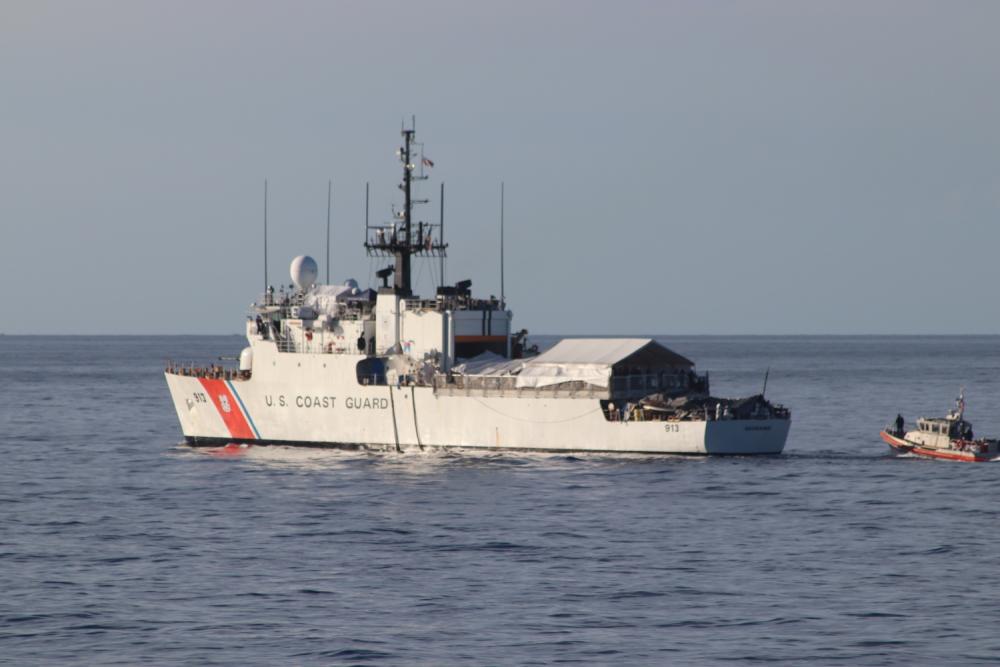
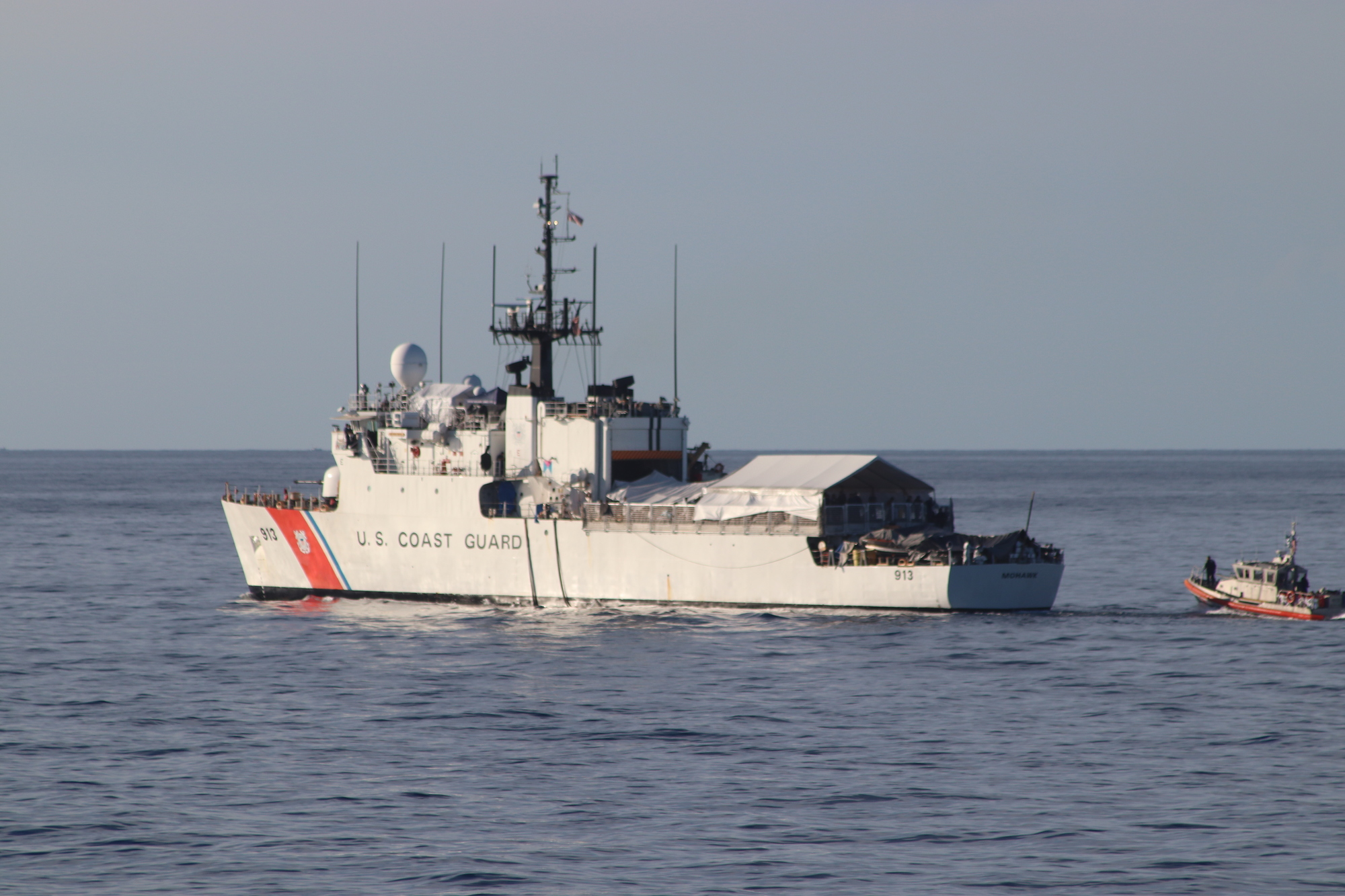
USCGC Mohawk’s (WMEC 913) crew patrols the South Florida Straits during Operation Vigilant Sentry, Jan. 5, 2023. Mohawk’s crew patrolled the Florida Straits and Caribbean Sea in support of Homeland Security Task Force—Southeast and Operation Vigilant Sentry in the Coast Guard Seventh District’s area of operations for a 46-day patrol. (U.S. Coast Guard photo by USCGC Legare (WMEC 912)

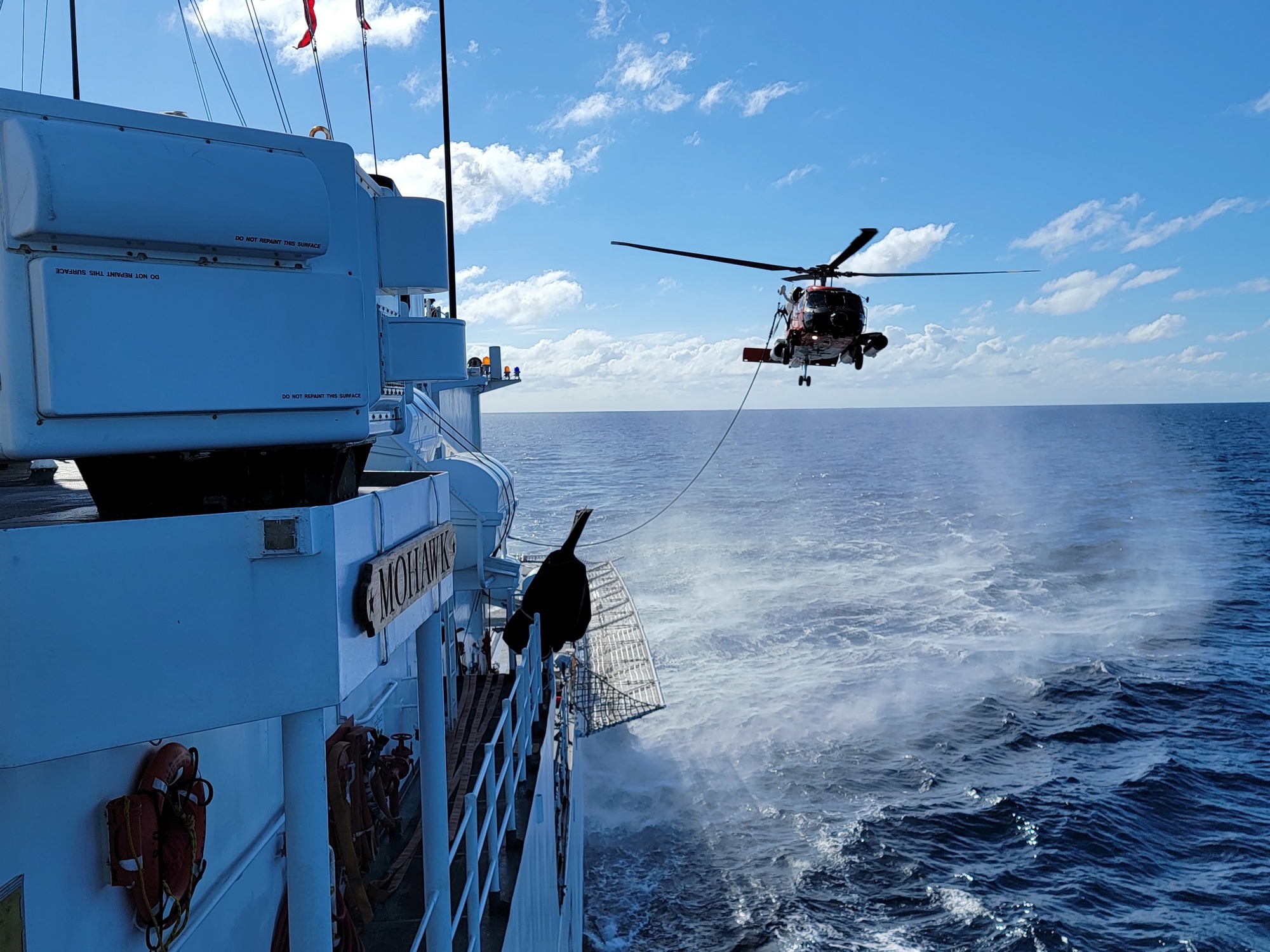
I don’t normally publish a news release like this, it is relatively routine, but I particularly wanted to highlight the photo above and provisions made to shelter migrants which have precluded helicopter operation. We have noted that the migrant traffic has increased substantially. The photo was taken by USCGC Legare, meaning that there were probably at least two 270 foot WMECs, that I would expect to be doing drug interdiction or fisheries, were engaged in Alien Migrant interdiction, in addition to the FRCs and 210 foot WMECs that are more commonly assigned to this mission. Note the large number of migrants interdicted and repatriated. I presume it means Mohawk had at least 273 migrants aboard at one time, out numbering the crew almost three to one.

News Release

U.S. Coast Guard Atlantic Area

Download Image Link Here Download Image Link  Download Image Link Here

Editor’s note: Click on images to download

KEY WEST, Fla.—The crew of the USCGC Mohawk (WMEC 913) returned to their home port in Key West, Monday, after a 46-day deployment in the Florida Straits and Caribbean Sea.

Mohawk patrolled the Florida Straits and Caribbean Sea in support of Homeland Security Task Force—Southeast and Operation Vigilant Sentry in the Coast Guard Seventh District’s area of operations. While underway, Mohawk’s crew conducted counter drug and maritime safety and security missions while working with other Coast Guard cutters and air assets to detect, deter and intercept unsafe and illegal migrant ventures bound for the United States.

During the patrol, Mohawk’s crew cared for 670 migrants interdicted at sea and rescued personnel from seven different unseaworthy vessels. Notably, Mohawk’s crew assisted with the repatriation of 110 Haitian migrants to Cap-Haitien, Haiti, and 273 Cuban migrants to Matanzas, Cuba.

Mohawk’s patrol efforts highlight the Coast Guard’s critical mission of maintaining safety at sea and preventing the potential for loss of life by deterring migrants from taking to the sea in dangerously overcrowded vessels while attempting to enter the United States through non-legal channels.

“It’s never easy being deployed over the holidays, away from family members,” said Cmdr. Andrew Pate, Mohawk’s commanding officer. “I am incredibly proud of the women and men aboard who continue to position Mohawk for success – their role in this historic effort, alongside our state and local partners as well as other Coast Guard units, is nothing short of heroic.”

Mohawk is a 270-foot, Famous-class medium endurance cutter with a crew of 100. The cutter’s primary missions are counter drug operations, migrant interdiction, enforcement of federal fishery laws and search and rescue in support of U.S. Coast Guard operations throughout the Western Hemisphere.

For information on how to join the U.S. Coast Guard, visit GoCoastGuard.com to learn about active duty and reserve, officer and enlisted opportunities. Information on how to apply to the U.S. Coast Guard Academy can be found here.

For more, follow us on FacebookInstagram and Twitter.

“Coast Guard delivers 14th Minotaur-missionized HC-144 to fleet” –CG-9

New Minotaur operator workstations are being installed on all HC-144Bs. Minotaur provides dramatically improved data fusion and integrates installed sensors and radar. U.S. Coast Guard photo by Aviation Engineering Warrant Officer 3 Randy Jopp.

Below is a story from the Acquisitions Directorate (CG-9). 14 of 18 HC-144s have been missionized with Minotaur. The statement, “The aircraft will be based at Air Station Cape Cod, Massachusetts, the first of three to be stationed there” refers only to the “B” model with Minotaur. Three HC-144As were already there and are being replaced by the upgraded aircraft.


The Coast Guard completed work on its 14th HC-144B Ocean Sentry medium range surveillance aircraft outfitted with both the Ocean Sentry Refresh (OSR) modifications and the Minotaur mission system Jan. 17. Modifications to CGNR 2318 were completed at the Aviation Logistics Center in Elizabeth City, North Carolina. The aircraft will be based at Air Station Cape Cod, Massachusetts, the first of three to be stationed there.

The OSR project upgrades the aircraft with a new flight management system, which manages communication control, navigation and equipment monitoring. After the OSR upgrade is completed, each aircraft is redesignated as an HC-144B.

Minotaur integrates installed sensors and radar and provides dramatically improved data fusion as well as information processing and sharing capabilities.

Completion of missionization and upgrade of a 15th HC-144 is scheduled for later this year. Air Station Miami completed transition to the upgraded aircraft in 2022 and Air Station Corpus Christi, Texas, transitioned in 2019. The service plans to upgrade each of the service’s 18 HC-144s by the end of 2024, with transition of Air Station Cape Cod and Aviation Training Center Mobile, Alabama.

For more information: Medium Range Surveillance Program page and Minotaur Program page