“GA-ASI Flies MQ-9 in the Canadian Arctic” –Seapower

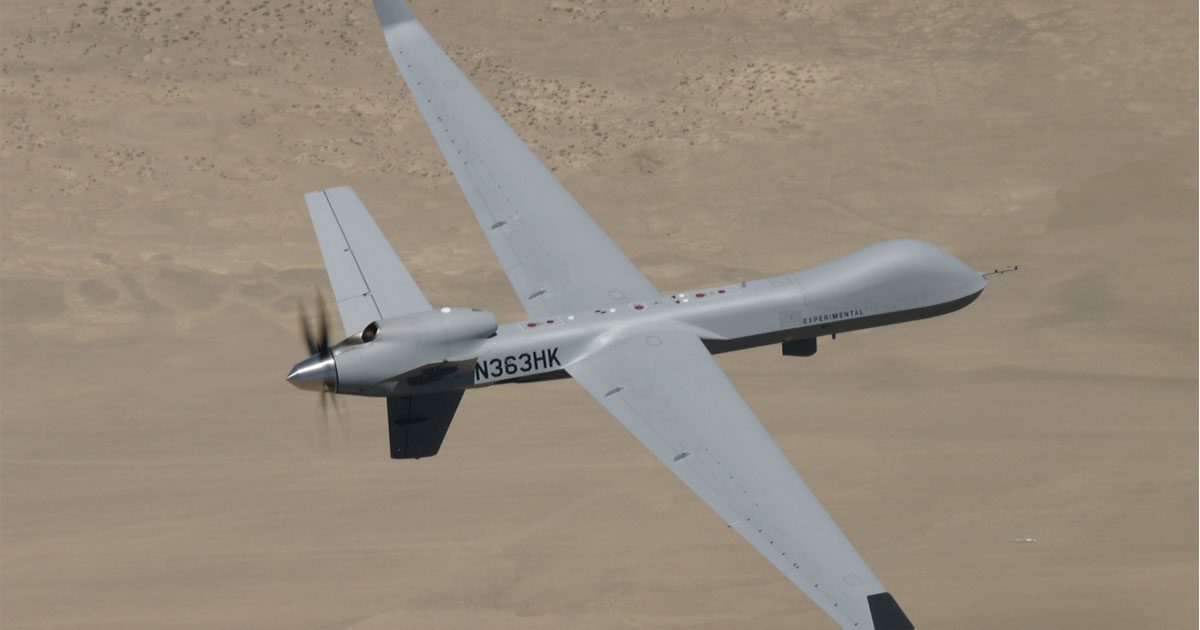
General Atomics Aeronautical Systems’ MQ-9A “Big Wing” UAS flew in the hostile climate of the Canadian Arctic. GA-ASI

The Navy League’s Seapower website reports,

 In a flight that originated from its Flight Test and Training Center (FTTC) near Grand Forks, North Dakota, General Atomics Aeronautical Systems, Inc. (GA-ASI) flew a company-owned MQ-9A “Big Wing” configured unmanned aircraft system north through Canadian airspace past the 78th parallel, the company said in a Sept. 10 release.

A traditional limitation of long-endurance UAS has been their inability to operate at extreme northern (and southern) latitudes, as many legacy SATCOM datalinks can become less reliable above the Arctic (or below the Antarctic) Circle – approximately 66 degrees north. At those latitudes, the low-look angle to geostationary Ku-band satellites begins to compromise the link. GA-ASI has demonstrated a new capability for effective ISR operations by performing a loiter at 78.31° North, using Inmarsat’s L-band Airborne ISR Service (LAISR).

The 78th parallel lies more than 1200 nautical miles North of Kodiak. Getting any kind of air recon that far north, other than perhaps icebreaker based helicopters, has always been difficult.

Even our icebreakers have difficulty communicating. Satellite coverage at these high latitudes is spotty at best.

The ability to operate UAS in this environment could substantially improve our Polar Domain Awareness and serve as a communications relay for multiunit operations in the Arctic or Antarctic.

The high altitude capability of these aircraft also provides a far larger view than would be possible from a helicopters. The horizon distance from 45,000 feet is about 250 nautical miles.

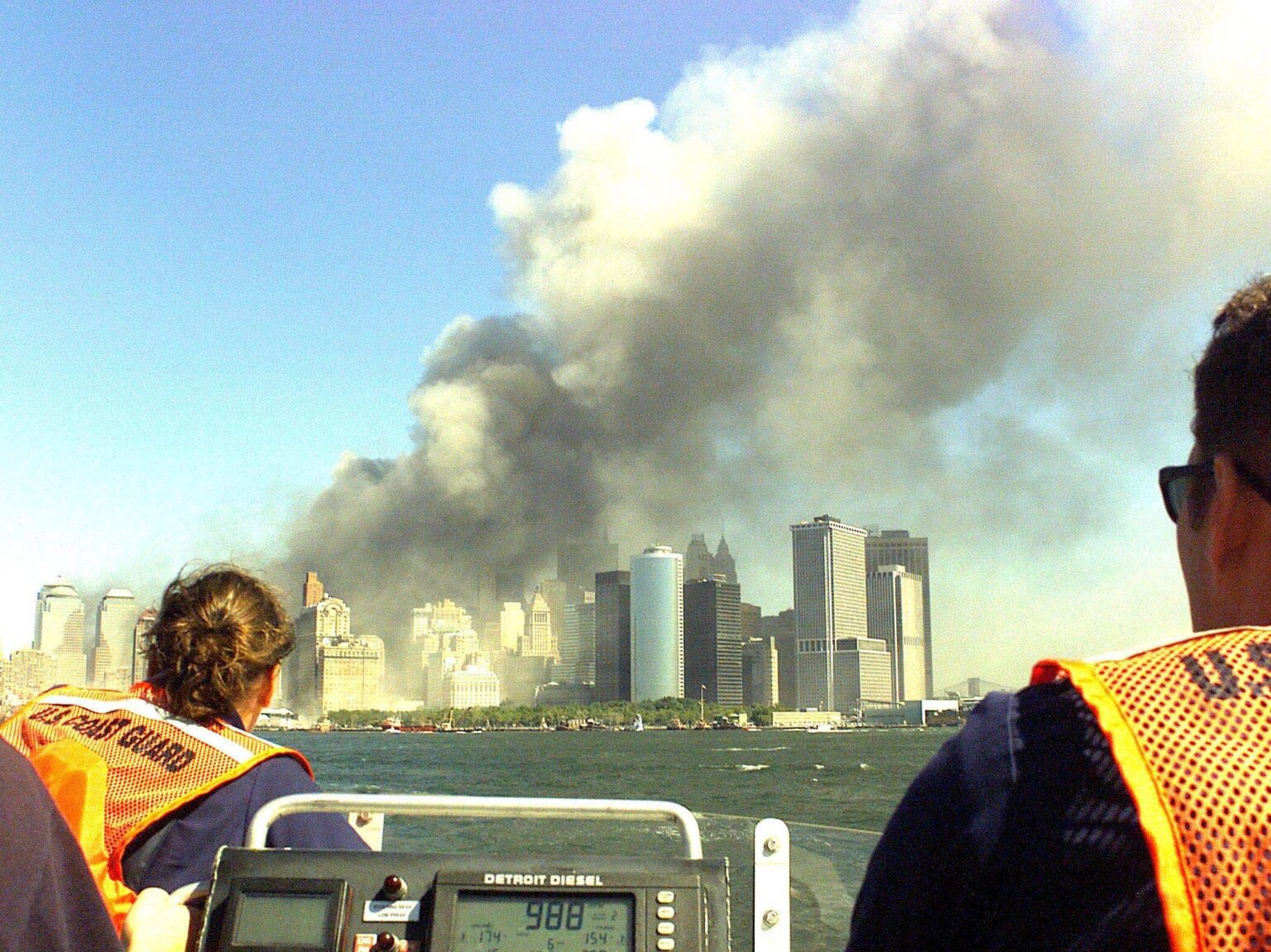
9/11 Twenty Years Ago

Below is the Commandant’s message marking the 20th Anniversary of this attack, that so changed the Nation and the Coast Guard.

Frankly, I do not see that the Coast Guard is really prepared to counter a well planned terrorist attack conducted from the sea. A tiny fraction of the money spent in Afghanistan and Iraq could close this gap. We need to be better armed and more capable of stopping an attack, regardless of the size of the attacking vessel, using forces regularly assigned in each port.

Let the Coast Guard response be, “Never again, Not on our watch.”

united states coast guard

R 101030Z SEP 21
FM COMDT COGARD WASHINGTON DC
TO ALCOAST
BT
UNCLAS
ALCOAST 324/21
SSIC 5700
SUBJ: 20TH ANNIVERSARY OF 9/11
1. On the morning of 11 September 2001, nineteen terrorists took
control of four cross-country commercial aircraft, weaponizing the
planes and steering them into the World Trade Center Twin Towers
in New York and the Pentagon in Washington, D.C. On the fourth
plane, believed to be headed toward the U.S. Capitol or the White
House, a brave band of passengers and crew attempted to regain
control and downed the plane near Shanksville, Pennsylvania in the
struggle.
2. Living up to our motto of Semper Paratus, Coast Guard personnel
sprang into action to save lives and provided security for that
day’s survivors.
3. Almost immediately following the attacks, all bridges and
tunnels in Manhattan were closed leaving hundreds of thousands of
people stranded, with no way to return safely home. Coast Guard
personnel directed the safe evacuation of more than 500,000 people
from the island with the assistance of hundreds of local ferries,
as well as commercial and private craft. This, the largest maritime
evacuation in recorded history, was conducted in less than 8 hours.
4. In and around Ground Zero, after the collapse of the World Trade
Center Towers, the Coast Guard’s Atlantic Strike Team worked in
close cooperation with the Environmental Protection Agency to
monitor air quality for first responders in the rescue and recovery
operation.
5. At the Pentagon, the Navy Command Center sustained a direct hit
from the crash of Flight #77, resulting in the loss of 42
personnel. From a secondary office at Coast Guard Headquarters,
Coast Guard RADM Jeffrey Hathaway, the Director of the Navy Command
Center, fortuitously away from the Pentagon that morning,
established personal security detachments to protect Senior Navy
Leadership in the aftermath of the attack, and supported the
planning and policies of the coming war on terrorism.
6. By October 2001, U.S. Military forces had deployed to
Afghanistan to execute Operation Enduring Freedom (OEF). Coast
Guard personnel served in support of OEF through units such as the
Redeployment Assistance and Inspection Detachment (RAID Team),
inspecting shipments of hazardous materials and facilitating
container movements in support of the Global War on Terror.
7. In support of Operation Noble Eagle, thousands of Coast Guard
Active Duty, Reservists, and Auxiliarists mobilized to assist the
direct defense of the continental U.S., protecting military outload
operations, ensuring the safety of maritime commerce and port
facility operations, search and rescue, and other vital operations.
8. The attacks of September 11th made it clear that our national
security starts well beyond our borders. In response, President
George W. Bush signed the Maritime Transportation Security Act
(MTSA) of 2002 to protect the Nation’s ports and waterways from
terrorist attacks. The U.S. Coast Guard proceeded on the greatest
organizational transformation since World War II and expanded our
capabilities and mission sets. This included the establishment of
Maritime Security Response Teams (MSRT) and Maritime Safety and
Security Teams (MSST). By March 1, 2003, the Department of Homeland
Security was established with the U.S. Coast Guard serving as the
lead federal agency for maritime homeland security. Our efforts
throughout the U.S. Marine Transportation System (MTS) and across
the globe continue to actively counter and deter terrorism threats
in the maritime domain.
9. As an organization, we have made tectonic changes these past
twenty years and continually strive to refine and improve our
operations and mission support delivery, but we must never become
complacent. As technology rapidly advances and threatscapes become
increasingly complex, we too must advance and adapt. We, the U.S.
Coast Guard, are the eyes and ears for safety, security, and
environmental stewardship on our federal waters, and purveyors of
our national maritime interests across the globe. Keep your eyes
and ears wide open; prepare and adapt always; be ready and never
forget the lessons we learned on September 11th.
10. Thank you for your service, and Semper Paratus!
11. ADM K. L. Schultz, Commandant (CCG), sends.
12. Internet release is authorized.

“NAVCENT Establishes Task Force for Unmanned System Operations” –Seapower

MetalCraft Marine 7 meter “The Watcher” Autonomous Surface Vessel (ASV)

Seapower reports that the Navy has set up a task force within NAVCENT (the naval component of CENTCOM) to use and mature unmanned systems.

TF59 “is designed to integrate unmanned systems and AI. Task Force 59 is the first U.S. Navy task force of its kind … taking efforts from across the Navy, concentrating them here in a forward operating environment — a forward fleet — to gradually move toward development and integration.”

The Coast Guard’s PATFORSWA is part of NAVCENT. I can’t help but believe that they will be seen as the most convenient units to use to test some of these systems. The task force commander, Capt. Michael Brasseur, is a former Cyclone class Coastal Patrol CO, so he has certainly worked with the Coast Guard in the past.

The launch ramp in the stern of the Webber class might be useful for launching unmanned surface and subsurface vessels.

The Coast Guard might get some personnel experienced in working with unmanned systems as a result.

“The Coast Guard and American Maritime: A Vital Post-9/11 Partnership” –Seapower

NEW YORK, New York (Sept. 11)–A Coast Guard rescue team from Sandy Hook, NJ, races to the scene of the World Trade Center terrorist attack. USCG photo by PA2 Tom Sperduto

Seapower brings us a short post from Former Commandant James Loy and president and CEO of The American Waterways Operators, Jennifer Carpenter.

It is a reminder of the response to 9/11, a different justification for the Jones Act, and a warning about the potential of cyber attack.

“U.S., Canadian crews conduct joint training exercise during CGC Healy’s Northwest Passage transit” –PACAREA

Coast Guard Commandant Adm. Karl Schultz speaks to Brendon Mendenhall, from the Ship-Based Technical Support in the Arctic (STARC) program, working aboard Coast Guard Cutter Healy (WAGB 20), during a visit aboard Healy while near Resolute, Nunavut, Canada on Sept. 6, 2021. Healy and its crew are circumnavigating North America to strengthen allied partnerships, in addition to conducting Coast Guard missions and supporting oceanographic research to increase understanding of the changing Arctic environment and associated impacts. U.S. Coast Guard photo by Petty Officer First Class Michael Underwood.

News about USCGC Healy’s activities that will include transit of the North West Passage and circumnavigation of North America. The Commandant pays a call and ops with Canadian Coast Guard.

united states coast guard

News Release

U.S. Coast Guard Pacific Area
Sept. 6, 2021
Contact: Coast Guard Pacific Area Public Affairs

U.S., Canadian crews conduct joint training exercise during CGC Healy’s Northwest Passage transit

Photo of U.S. and Canadian Coast Guard members Photo of Coast Guard commandant speaking with Arctic support member
Photo of helicopter landing on cutter Photo of Coast Guard vessel

Editors’ Note: Click on images to download high resolution versions.

ALAMEDA — The Coast Guard Cutter Healy’s (WAGB 20) crew conducted a search-and-rescue exercise and professional exchange with members of the Canadian Coast Guard and Canadian Rangers near Resolute Bay in Nunavut, Canada, Sept. 6, 2021, during Healy’s Northwest Passage transit.

The search-and-rescue exercise enhanced interoperability and effectiveness of response capabilities amongst the services.

U.S. Coast Guard Commandant Adm. Karl Schultz, Canadian Coast Guard Commissioner Mario Pelletier and Canadian Coast Guard Assistant Commissioner for the Arctic Region Neil O’Rourke were aboard Healy to meet with the crew and observe the joint training exercise.

“Training alongside our Canadian partners while underway in the Arctic during a historic circumnavigation of North America is a great example of enhancing our interoperability and mission capabilities,” said Schultz. “Healy is supporting oceanographic research with the science community during this deployment to the critically important Arctic region.”

The U.S. Coast Guard is the nation’s leader in Arctic surface operations and coordinates with international partners to maintain the region as safe, prosperous and cooperative by strengthening international and intergovernmental partnerships in the region through joint exercises and professional exchanges.

“Seeing the members of the Canadian Coast Guard work hand in hand with their counterparts from the Healy has been inspiring,” said Pelletier. “The vastness of the Arctic makes this a very difficult environment for emergency response making every opportunity for training valuable. These exercises ensure our two countries’ Coast Guards stand ready and able to assist should we be needed.”

Coast Guard icebreaker crews aboard Healy and the Coast Guard Cutter Polar Star (WAGB 10) deploy to conduct statutory Coast Guard missions in the Polar Regions such as search-and-rescue and the protection of marine resources. Additionally, the crews support oceanographic research in the Arctic and Antarctic.

The Healy crew is collaborating with the international science community and institutions from the U.S., Canada, Norway and Denmark to perform oceanographic projects throughout the Northwest Passage and within Baffin Bay to inform environmental change research.

The Healy, a 420-foot-long medium icebreaker, departed its Seattle homeport July 10 for a months-long Arctic deployment and circumnavigation of North America. Since departing, the crew has been executing Coast Guard missions, supporting oceanographic research and conducting training to develop the Coast Guard’s future Polar security cutter sailors.

Additional photos from Healy’s deployment are available here. Subscribe here to receive notifications when new photos are added.


“Navy Arming Surface Ships with Drone Repellent System” –USNI

USCGC Charles Moulthrope (WPC-1141) prior to departure for PATFORSWA

The US Naval Institute News Service has a short post about a system that will reportedly detect and if required jam the radio frequency signals that control small Unmanned Air Systems like the commercially available hobby drones and similar control systems that might be used on larger UAS.

We noted the presence of this or a similar system on the Webber class cutters being transferred to PATFORSWA in February.

While there are autopilots that allow drones to travel considerable distances to reach fixed geographic points, operating drones that lack autonomous targeting, against moving targets, typically require two radio frequencies, one the video link from the drone back to the operator and one to control the drone, from the operator back to the drone. Jamming either of the frequencies would probably disable the drone. Generally these frequencies are UHF or VHF, limited to line of sight.

Gunner’s Mate Kyle Mendenhall shows the Drone Restricted Access Using Known Electromagnetic Warfare (DRAKE) system aboard USS Kansas City (LCS-22) on Aug. 16, 2021. USNI News Photo

If you expand the photo of USCGC Charles Moulthrope above, you can see a similar system, with its two vertical antenna of different sizes, on the mast port side, slightly below and behind the port blue flashing light, and above and inboard of the small round fixed air search radar antenna.

“USCGC Escanaba (WMEC 907) returns home to Portsmouth after historic 50-day patrol” –LANT AREA

Courtesy Photo | USCGC Escanaba (WMEC 907) and USCGC Richard Snyder (WPC 1127) practice maneuvering with the Royal Canadian Navy’s HMCS Goose Bay (MM 707) in the Davis Strait on Aug. 13, 2021. In Operation Nanook, the U.S. Coast Guard seeks to work collaboratively with other international partners to enhance collective abilities to respond to safety and security issues in the High North through the air and maritime presence activities, maritime domain defense, and security exercises. (Photo courtesy Royal Canadian Navy)

Below is an Atlantic Area press release. We discussed Operation Nanook earlier, and it looks like Escanaba is arriving just in time for the triple change of home port ceremony reported earlier today.

united states coast guard

News Release

U.S. Coast Guard Atlantic Area

USCGC Escanaba (WMEC 907) returns home to Portsmouth after historic 50-day patrol

Escanaba crewmembers greet families  Escanaba arrives to Portsmouth Escanaba crew handle lines

Editors’ Note: To view more or download high-resolution photos and b-roll video, click on the photos above.
To see more on Op Nanook please visit Op Nanook 21 on DVIDS by clicking here.

PORTSMOUTH, Va. — The crew of USCGC Escanaba (WMEC 907) returned home to Portsmouth on Tuesday following a historic 50-day patrol in support of Operation Nanook in the Arctic region and the Labrador Sea.

Operation Nanook supports the Coast Guard Arctic strategy to develop international relations with like-minded Arctic states, enhance maritime domain awareness, and expand service capabilities within the region.

Escanaba deployed with the 154-foot Sentinel-class fast response cutter Richard Snyder and an embarked members of the Maritime Security Response Team East. The operation expanded the logistical boundaries of the FRC fleet and further refined the modular capabilities of deployable special forces to enhance a cutter’s organic law enforcement capabilities.

Operation Nanook was made up of two phases, Tuugaalik and Tatigiit. The Tuugaalik phase brought the crews of Escanaba, Richard Snyder, and the Royal Canadian navy together to exercise best practices and demonstrate responsive capabilities to potential terrorist or adversarial threats. The training exercises included were a live-fire surface gunnery exercise, close-quarters formation steaming, towing, small boat approaches, and communication drills. In the following phase, Tatigiit, the Escanaba, and Richard Snyder teams participated in a mass casualty and pollution event along the shores of Baffin Island. Both cutters crews seamlessly supported the Royal Canadian navy in rescue and assistance procedures and creating search and rescue patterns.

In addition to conducting law enforcement operations, Escanaba’s crew participated in Frontier Sentinel, a training event with the U.S. and Royal Canadian navies. The exercise simulated a multi-national response to a maritime threat and strengthened interoperability between all three services.

USCGC Escanaba is a 270-foot Famous-class medium endurance cutter, previously known as “The Pride of Boston, now re-homeported to Portsmouth.

Royal Navy Deploys Two OPVs for Five Years to No Base in Particular

We have deployed cutters to the Western Pacific for months at a time, and PATFORSWA kept its 110s operating out of Bahrain for years, but the Royal Navy seems to be doing something different and I believe remarkable.

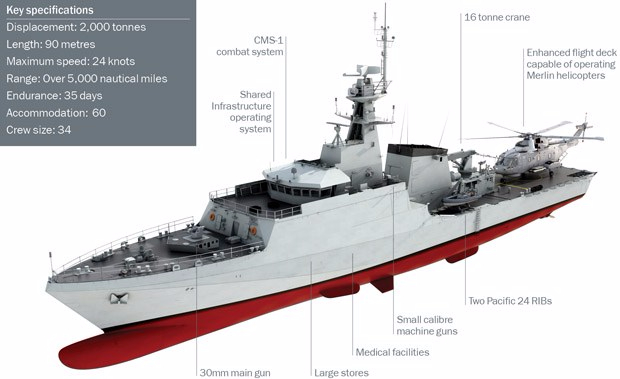
Naval News reports they are sending a pair of River Batch II class ships, HMS Tamar and HMS Spey, well beyond the Suez. It sounds all very 18th Century Star Trek, “Our Five Year Mission, Proceed into the Indian and Pacific Oceans and act in the Queen’s Interests.” (No, not a real quote.)

If these ships were in the US Coast Guard we would see them as MECs. They are slightly larger and faster than the 270s, but are not as well equipped in some respects. They are armed only with a 30mm gun and no helicopter hangar. I don’t believe they have any ESM/ECM. Their crew is also considerably smaller, smaller in fact than that of a 210. (I have seen various numbers for the crew size, 34 in the infographic above, 58 in Wikipedia, 46 as reported below, but all well below the 75 common on a 210 or the 100 typical of a 270.)

“Each ship is crewed by 46 sailors, with half the crew trading places with shipmates from the UK every few weeks.”

The Royal Navy actually has considerable experience keeping OPVs deployed for long periods with austere support.

We might even see one of these helping with drug interdiction in the Eastern Pacific, more likely they will be countering piracy and drug or arms trafficing in the Indian Ocean or capacity building in East Africa or SE Asia. Maybe we could make a multi-national Freedom of Navigation transit of the Taiwan Strait.


“U.S. Coast Guard, Marine Rescue Service Russian Federation meet in Anchorage” –D17

Just passing this along.

united states coast guard


Photo Release

U.S. Coast Guard 17th District Alaska

U.S. Coast Guard, Marine Rescue Service Russian Federation meet in Anchorage

Members of the U.S. Coast Guard host members of the Marine Rescue Service Russian Federation for the 43rd Joint Planning Group meeting and exercise, Aug. 31-Sept. 2, in Anchorage, Alaska. U.S. Coast Guard representatives worked with their Russian counterparts during the event, held under the 2020 Joint Contingency Plan between the U.S. and Russia, for pollution preparedness and response cooperation in the Bering and Chukchi Seas. (U.S. Coast Guard photo by Petty Officer 1st Class Nate Littlejohn)

Editors’ Note: Click on images to download high resolution version.

ANCHORAGE, Alaska — Members of the U.S. Coast Guard and the Marine Rescue Service Russian Federation held their 43rd joint planning group meeting and exercise Aug. 31-Sept. 2 in Anchorage under the 2020 Joint Contingency Plan of the United States of America and the Russian Federation in Combating Pollution on the Bering Sea and Chukchi Seas.

U.S. Coast Guard representatives from Headquarters, Pacific Area, the 17th District and Sector Anchorage worked with their Russian Marine Rescue Service counterparts to review the Joint Contingency Plan and update a 2021-2023 joint work plan for improving preparedness and cooperation between the U.S. Coast Guard and Marine Rescue Service Russian Federation in spill response in the Bering and Chukchi Seas.

The purpose of this joint work plan is to:

  • Implement the Joint Contingency Plan (JCP) of the United States and the Russian Federation on combating pollution in the Bering and Chukchi Seas in Emergency Situations.
  • Develop sustainable infrastructures for marine environmental protection and response to oil and hazardous substance incidents.
  • Develop greater cooperation and understanding between the United States and the Russian Federation; specifically, between the responsible government agencies and private sector entities that take part in response to oil and hazardous substance incidents.
  • Develop methods and techniques for preparedness and response to oil and hazardous substance incidents.
  • Encourage compatibility of response systems in terms of command-and-control techniques, equipment, training, exercises and related preparedness and response issues.
  • Maintain a two-year work plan cycle to permit efficient planning for budget and personnel scheduling. Identify and address risks associated with the shipment of hydrocarbons across or near the shared maritime boundaries.
  • Maintain an up-to-date training and exercise schedule.
  • Identify topics and initiatives for discussion during joint planning group meetings and teleconferences.

The group toured the Alaska Wildlife Response/International Bird Rescue Center and observed an equipment demonstration at Alaska Chadux Network to learn more about response systems and capabilities.

“Meeting our Russian counterparts face-to-face and exchanging information strengthens our shared commitment to environmental protection,” said Rear Adm. Nathan A. Moore, commander 17th District. “The U.S.-Russia maritime boundary is adjacent to heavily-traveled routes for ships carrying hydrocarbons. I rest a bit easier at night knowing that we have developed working relationships with our neighbors and are preparing ahead of time for a pollution incident that we hope does not occur.”

Rear Adm. Nathan A. Moore, commander, Seventeenth Coast Guard District, welcomes Mr. Petr Gerasun, deputy director, Russian Federation Marine Rescue Service, to the 43rd Joint Planning Group meeting at Captain Cook Hotel in Anchorage, Alaska, August 31, 2021. Members of the U.S. Coast Guard and Russian Federation delegation participated in the 43rd Joint Planning Group meeting for pollution preparedness and response cooperation in the Bering Sea and Chukchi Seas. (U.S. Coast Guard photo by Petty Officer 1st Class Nate Littlejohn)

Barbara Callahan, senior director of response services with International Bird Rescue, gives a tour and discusses the wildlife response and rehabilitation process to the 43rd Joint Planning Group at the Alaska Wildlife Response Center in Anchorage, Alaska, Sept. 1, 2021. Members of the U.S. Coast Guard and Russian Federation participated in the 43rd Joint Planning Group meeting for pollution preparedness and response cooperation in spill response in the Bering Sea and Chukchi Seas. (U.S. Coast Guard photo by Petty Officer 2nd Class Melissa E. McKenzie)