“SHOWING UP IS HALF THE BATTLE: U.S. MARITIME FORCES IN THE INDIAN OCEAN” –War on the Rocks

War on the Rocks has a good treatise on the growing importance of the Island nations of the Indian Ocean and why the US should take more interest. The author contends that while forming a new First Fleet Command, something the Navy is contemplating, would be a good start, there is much more that needs to be done, and the Coast Guard has an important part to play. The author mentions the Coast Guard fifteen times in the article. I have reproduced the portion of the article specific to the Coast Guard below, but read the entire article for context.

When USCGC Hamilton escorts the first two Webber class WPCs to Bahrain, hopefully Hamilton will have some time to do some capacity building in the Indian Ocean. Perhaps PATFORSWA will also be involved in a continuing effort.

A Coast Guard Initiative

Finally, Washington should look to its Coast Guard in maximizing its interactions with small island nations. While the Coast Guard plays a significant role in training Pacific island nations’ maritime forces, they are rarely seen in the Indian Ocean. As with the Pacific, the islands of the Indian Ocean, too, face similar non-traditional security issues as their primary challenges. Interactions between, and trainings conducted with, the Coast Guard and Indian Ocean island nations might carry more value at the operational and tactical level. Recognizing resource constraints and its limited capacity to deploy in the region, Coast Guard initiatives can come in the form of training and capacity building efforts. Many island nations such as Maldives, Mauritius, and Comoros have a coast guard tasked with both law enforcement and defense of their sovereign territories. Given the nature of their primary threats — such as illegal fishing, drug smuggling, and human trafficking — training with the U. S. Coast Guard will be a significant step forward for many of the island nations of the Indian Ocean. Such engagements could also help offset an overreliance on military trainings in Beijing, including interpretation of customary law and the U.N. Convention for the Law of the Sea. Chinese interpretation of customary and international laws at Sea are notably different than those of the U.S. and its allies.  However, these interactions should be extended to islands and littorals across the region, instead of limiting them to Sri Lanka and Maldives only.

The U.S. Coast Guard could potentially utilize some of its lessons and experiences from the Pacific in interacting with, and training, the islands of the Indian Ocean on a range of issues from law enforcement to surveillance to disaster response. Washington could perhaps borrow from its interactions as a member of the Pacific Quad, prioritizing engagements with island nations and their security concerns as a model for the Indian Ocean too. If the Coast Guard is to take on this additional mission, it will require additional resources, which may require a willingness to cut some Department of Defense resources previously devoted to ground wars in the Middle East and redirect them to the Coast Guard.

An Indian Ocean deployment leveraging all its maritime forces allows Washington to address two immediate concerns in the region. First, it would provide a singular node, or a specific agency, tasked with engaging with the region as a whole to bridge the gap resulting from the divided combatant commands. Second, a burden-sharing model with close partners and allies leveraging the Coast Guard and the Marine Corps aids the already extended U.S. Navy and its role in the Indian Ocean. This could help conceptualize a framework that allows Washington to deploy and engage its maritime forces in the region in a meaningful and, more importantly, an achievable way.

“ROYAL NAVY REVIVES DAYS OF SAIL WITH TRAINING ON TALL SHIP” –UK Royal Navy

Photo: Training Ship Tenacious under sail.

The Royal Navy reports,

For the first time in decades Royal Navy sailors are learning the art of seafaring on a traditional tall ship.

The use of the Jubilee Sailing Trust’s Tenacious is helping to plug the gap left by the closure of the Navy’s command and leadership school in the Brecon Beacons due to the pandemic.

“In a difficult period for Royal Navy training due to the pandemic, the use of the Jubilee Sailing Trust has allowed us to continue to provide top quality core leadership and team training in a maritime context,” said Commander Adrian Coulthard from the Navy’s training organisation.

Information on the ship here. Remarkably she is a wooden ship completed in 2000.

(Contrary to the claim in the Wikipedia article, she is not the largest wooden ship afloat, unless both USS Constitution and USS Constellation happen to be in dry dock at the same time.)

Exercise Tenacious Wave
Royal Navy sailors are setting sail on a traditional tall ship as part of Exercise TENACIOUS WAVE. Working in partnership with the Jubilee Sailing Trust, junior sailors are put to sea on Sailing Vessel Tenacious to continue their naval training.
This opportunity provides early exposure to maritime life, teaching about routines on board a ship and developing skills through a series of leadership exercises.

“Coast Guard Commissions newest National Security Cutter” –News Release

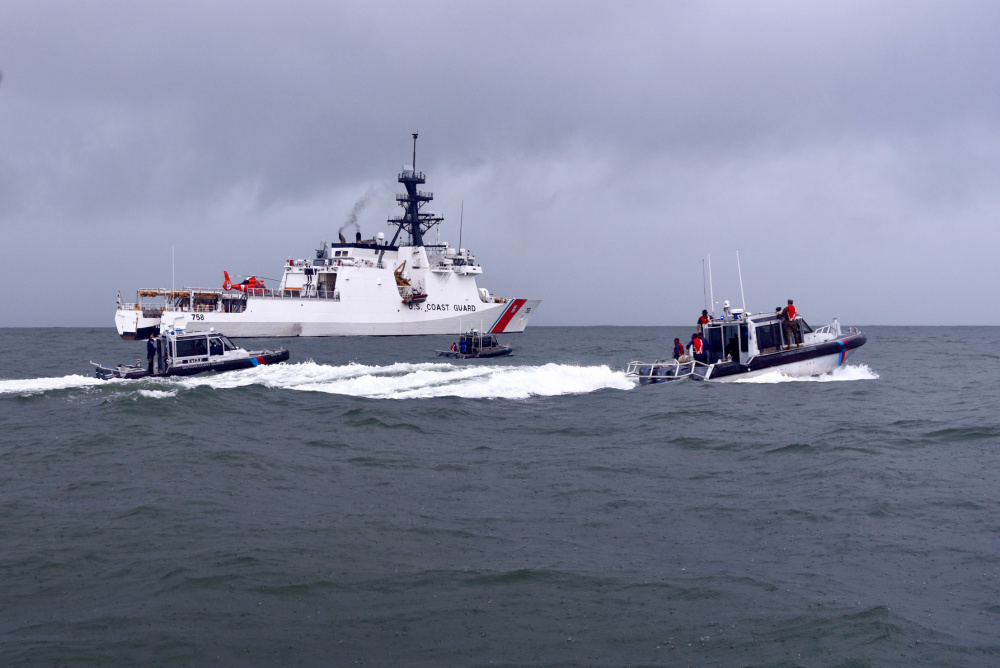
Guyana coast guard small boats patrol alongside the USCGC Stone (WMSL 758) off Guyana’s coast on Jan. 9, 2021. The U.S. and Guyana governments enacted a bilateral agreement on Sep. 18, 2020, to cooperatively combat illegal marine activity in Guyana’s waters. (U.S. Coast Guard photo by Petty Officer 3rd Class John Hightower)

Below is a LANTAREA news release marking the commissioning of USCGC Stone, the ninth National Security Cutter. The Cutter did not even wait to be commissioned to be useful. She has already had a remarkable patrol into the waters of the South Atlantic (here, here, and here).

united states coast guard

News Release

U.S. Coast Guard Atlantic Area
Contact: Coast Guard Atlantic Area Public Affairs
Office: (757) 398-6521
After Hours: (757) 641-0763
Atlantic Area online newsroom

 Coast Guard Commissions newest National Security Cutter

Coast Guard Cutter Stone Commissioning Ceremony

Fellow Aviators pay tribute to the USCGC Stone (WMSL- 758) during the commissioning ceremony at Coast Guard Base Charleston, S.C., Mar. 19, 2021. The cutter’s namesake is the late Cmdr. Elmer “Archie” Fowler Stone, who in 1917 became the Coast Guard’s first aviator and, two years later, was one of two pilots to successfully make a transatlantic flight in a Navy seaplane landing in Portugal. (U.S. Coast Guard photo by Petty Officer 3rd Class Vincent Moreno)

Coast Guard Cutter Stone Commissioning Ceremony

The crew of USCGC Stone (WMSL- 758) prepare to bring the ship to life during a commissioning ceremony at Coast Guard Base Charleston, S.C., Mar. 19, 2021. The cutter’s namesake is the late Cmdr. Elmer “Archie” Fowler Stone, who in 1917 became the Coast Guard’s first aviator and, two years later, was one of two pilots to successfully make a transatlantic flight in a Navy seaplane landing in Portugal. (U.S. Coast Guard photo by Petty Officer 3rd Class Vincent Moreno)

NORTH CHARLESTON, S.C., — The USCGC Stone (WMSL 758) became the Coast Guard’s newest national security cutter during a commissioning ceremony Friday at Coast Guard Base Charleston.

Adm. Karl Schultz, the commandant U.S. Coast Guard, presided over the ceremony.

Ms. Laura Cavallo, the grandniece of the ship’s namesake and ship’s sponsor, was also in attendance.

The cutter’s namesake comes from Cmdr. Elmer “Archie” Fowler Stone, who in 1917 became the Coast Guard’s first aviator and, two years later, was the pilot of the NC-4, a Navy airplane, which in 1919 was the first aircraft to accomplish a trans-Atlantic flight, landing in Portugal.

The Stone is the ninth legend-class national security cutter in the Coast Guard’s fleet. The Legend-class, national security cutters can execute the most challenging national security missions, including support to U.S. combatant commanders.

They are 418 feet in length, 54 feet in beam, and 4,600 long tons in displacement. They have a top speed of more than 28 knots, a range of 12,000 nautical miles, an endurance of up to 90 days, and can hold a crew of up to 150. These new cutters are replacing the high endurance Hamilton-class cutters in service since the 1960s.

The Stone launched on Oct. 4, 2019, for sea trials. Following sea trials, the crew conducted their maiden voyage Operation Southern Cross, a patrol to the South Atlantic supporting counter illegal, unreported, and unregulated fishing.

Taking the newly-accepted cutter on its shakedown cruise, Stone’s crew covered over 21,000 miles (18,250 nautical miles) over 68 days. A mutual interest in combating IUUF activities offered an opportunity to collaborate for Stone’s crew. They interacted with partners in Guyana, Brazil, Uruguay, and Portugal, strengthening relationships and laying the foundation for increased partnerships to counter illicit maritime activity.

Ship commissioning is the act or ceremony of placing a ship in active service.

\

“Top US Commander Warns ‘Front Line’ With China Now South of Border” –Voice of America

Voice of America reports remarks by SOUTHCOM Commander, Admiral Craig Faller, regarding the growth of Chinese influence in the Western Hemisphere, including criminal activity and Illegal, Unreported, and Unregulated fishing.

This isn’t new. Through contributing author, Sanjay Badri-Maharaj (here and here),I have been following what has been happening in Trinidad and Tobago. I am sure similar interaction is happening elsewhere in the Western Hemisphere. Here is some background:

China’s Growing Influence in the Caribbean | Manohar Parrikar Institute for Defence Studies and Analyses (idsa.in)

China, Trinidad and Tobago pledge to consolidate friendship – CGTN

PM and Chinese President Xi Jinping engage in bilateral talks | Loop News (looptt.com)

“New Coast Guard Team to Flesh Out Unmanned Systems Requirements” –National Defense


MQ-9B Seaguardian during the maritime capabilities demonstration flight over Southern California waters in September 2020. GA-ASI picture.

National Defense reports that during a round table following the Commandant’s State of the Coast Guard address, he stated that the Coast Guard would be standing up an unmanned systems requirements office in headquarters. Unmanned surface and sub-surface systems will be considered in addition to air systems.

“We learned that the future of our unmanned systems strategy will most likely rely on more diverse systems and effective integration of machine learning to unlock actionable data for Coast Guard operators,” he said. “These are valuable lessons as we stand up an unmanned systems element within our Coast Guard requirements shop to consider how unmanned technology can augment our future fleet…It’s really a UxS office,” he said of the new group that will be set up to look at requirements.

Thanks to Lee for bringing this to my attention. 

“Japan-U.S. alliance ‘cornerstone of peace and prosperity’ in Indo-Pacific” –Indo-Pacific Defense Forum

Ships from the U.S. Coast Guard and Japan Coast Guard conducted exercises near the Ogasawara Islands of Japan, Feb. 21, 2021. The U.S. Coast Guard Cutter Kimball and Japan Coast Guard Ship Akitsushima, two of the respective services’ newest and most capable vessels, operated alongside helicopters and unmanned aerial vehicles to practice interdicting foreign vessels operating illegally inside Japanese waters. (U.S. Coast Guard photo courtesy of the Coast Guard Cutter Kimball/Released)

Some recognition for what the Kimball has been doing in the Western Pacific from the Indo-Pacific Command web site Indo-Pacific Defense Forum, including a really nice photo.

“Coast Guard Reducing Some Marine Protector Patrol Boats for Budget Reasons, Commandant Says” –Seapower

The Navy League’s on line magazine, Seapower, reports on the Commandant’s response to a question as to why 87 foot Marine Protector class patrol boats are being decommissioned without direct replacement. Bottom line, we need to save some money and between the new FRCs and the Response Boat, Medium, we have the need pretty well covered.

It is absolutely budgetarily influenced and informed within the topline, he said. “I’m the last guy as a cutterman who wants to remove a cutter from service, but I think we’ll have plenty of capacity. That fast response cutter — its seakeeping, its legs — is considerably more [capable] than the patrol boats it’s replacing.”

Referring to the March 10 decommissioning of the Marine Protector-class USCGC Dorado at Crescent City, California, Schultz pointed out that with the mission demands and capabilities in that area resident in the Coast Guard’s heavy-weather-capable 45-foot response boats and the nearby aviation capability, ‘taking out some of those 87’s was a relatively rational, hard choice we had to make.”

2021 State of the U.S. Coast Guard Address March 11, 2021

Above we have the Youtube version of the Commandant’s address.

If you want to read, rather than watch the presentation, you can get the full text here. (You will miss the videos, which are well done, but even at over 17 pages, it will take much less time than the hour required to watch the whole presentation.)

The first half of the presentation seemed aimed internally, primarily addressing Active and Reserve issues. During the presentation the Commandant put a lot of emphasis on improving infrastructure. The presentation got more interesting to me-more “news”-in the second half. (times are approximate, tried to get within 30 seconds)

There will be a new air station, in April will break ground on a new Air Station Ventura County.(31:00)

Confirmed the Coast Guard will probably link to “future vertical lift” program. Meanwhile:

  • We are getting blade fold/tail fold on Coast Guard H-60 helicopters that will deploy on National Security Cutters, Polar Security, and Offshore Patrol Cutters. That will allow more range, endurance, and payload.
  • CGAS Borinquen and New Orleans will transition from H-65 to H-60s.
  • CGAS Barbers Point will transition from H model to J model C-130s with greater range.
  • Helicopters that provide intercepts over DC are getting Link 16. (32:50)

Expects award of Waterways Commerce Cutter contract spring of 2022 (35:30)

Working to address Marine Transportation Cyber (38:30)

Dealing with COVID-19 (41:00)

Discussion of drug interdiction and why we do it. (43:00)

Remarks on UAS (45:00)

Coast Guard role in the Arctic (47:50). In conjunction with Canada, planning a North West Passage transit for Healy. (49)

Coast Guard attaches will be assigned to Denmark, Australia, and Singapore. (49:30)

Indo-Pacific (50:00) Oblique reference to the “Quad,” an informal association of US, Australia, India, and Japan that seems to be forming in response to Chinese aggressiveness.

IUU fishing (50:30)

Bear went to Africa on short notice to counter IUU. (51:30)

Maritime Domain Awareness/Unmanned systems (52:00)

Hamilton is going to support EUCOM escorting first to FRCs bound for PATFORSWA (53:30)

Requirement for a Coast Guard Museum (56:00)

All in all, it was pretty inspiring. It will make you proud.


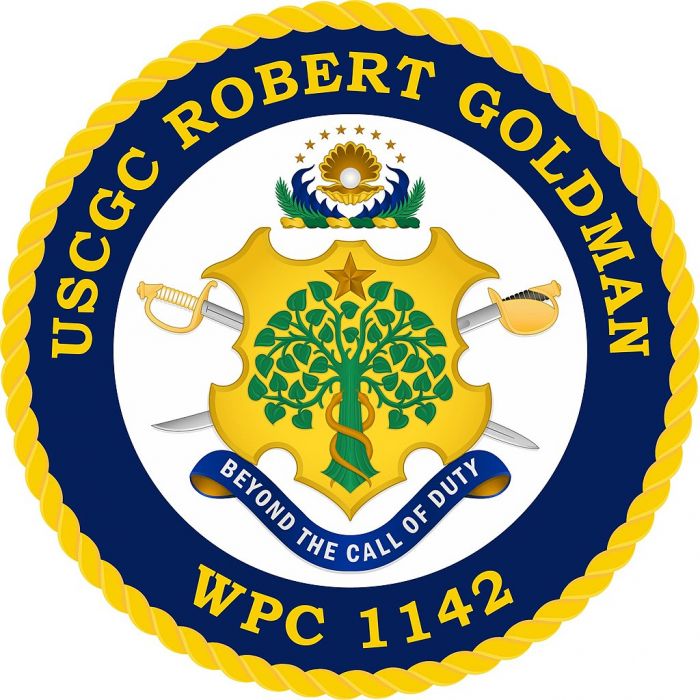
USCGC Robert Goldman (WPC 1142), Bound for Bahrain, To be Commissioned 12 March, 2021

Phoro: Sister ship, the Charles Moulthrope (WPC 1141), delivered on Oct. 22, 2020, and commissioned on Jan. 21

Below is an Atlantic Area news release. USCGC Robert Goldman (WPC 1142) is the 42nd Webber class WPC and is expected to be one of the first two of six to join PATFORSWASIA, replacing six 110 foot WPBs currently homeported in Bahrain.

united states coast guard

News Release

U.S. Coast Guard Atlantic Area
Contact: Coast Guard Atlantic Area Public Affairs
Contact: (757) 452-8336
Atlantic Area online newsroom

U.S. Coast Guard to commission 42nd Fast Response Cutter

USCGC Robert Goldman Seal

Key West, Fla. — The U.S. Coast Guard will commission the USCGC Robert Goldman (WPC 1142), Patrol Forces Southwest Asia’s second Sentinel-class cutter, into service at Coast Guard Sector Key West, Friday at 10 a.m. EST.

Due to COVID mitigation, in-person attendance is limited. Anyone interested in viewing the ceremony livestream may do so at http://bit.ly/WPC1412Com, clicking on the image at the top, or by clicking here

Vice Adm. Scott Buschman, deputy commandant for operations, U.S. Coast Guard, will preside over the 42nd Sentinel-class cutter ceremony. Mrs. Eleanor Goldman is the ship’s sponsor.  

The Robert Goldman is the second of six FRCs planned for service in Manama, Bahrain. The cutter is named after Pharmacist’s Mate 2nd Class Robert Goldman, remembered for heroic and selfless actions as a member of the joint forces serving in the Pacific theater during World War II. 

The Coast Guard took delivery of Robert Goldman on Dec. 21, 2020, in Key West. They will transit to Bahrain later this year with their sister ship, the Charles Moulthrope (WPC 1141), delivered on Oct. 22, 2020, and commissioned on Jan. 21, in Portsmouth, Virginia.

The New Pick for SOUTHCOM

Lt. Gen. Laura J. Richardson, 20 June 2019, US Army photo

Defense News reports that President has nominated three officers to assume the duties of Commander Combatant Command at TRANSCOM, PACOM, and SOUTHCOM.

The SOUTHCOM Commander is particularly important to the Coast Guard because  the Coast Guard’s drug interdiction efforts in the Caribbean and Eastern Pacific fall under SOUTHCOM’s jurisdiction. Frequently SOUTHCOM has been a vocal advocate for the Coast Guard.

The SOUTHCOM nominee is Lt General Laura J. Richardson, currently the head of U.S. Army North. She is an aviator and has an interesting bio. More photos here.