“Coast Guard Reducing Some Marine Protector Patrol Boats for Budget Reasons, Commandant Says” –Seapower

The Navy League’s on line magazine, Seapower, reports on the Commandant’s response to a question as to why 87 foot Marine Protector class patrol boats are being decommissioned without direct replacement. Bottom line, we need to save some money and between the new FRCs and the Response Boat, Medium, we have the need pretty well covered.

It is absolutely budgetarily influenced and informed within the topline, he said. “I’m the last guy as a cutterman who wants to remove a cutter from service, but I think we’ll have plenty of capacity. That fast response cutter — its seakeeping, its legs — is considerably more [capable] than the patrol boats it’s replacing.”

Referring to the March 10 decommissioning of the Marine Protector-class USCGC Dorado at Crescent City, California, Schultz pointed out that with the mission demands and capabilities in that area resident in the Coast Guard’s heavy-weather-capable 45-foot response boats and the nearby aviation capability, ‘taking out some of those 87’s was a relatively rational, hard choice we had to make.”

2021 State of the U.S. Coast Guard Address March 11, 2021

Above we have the Youtube version of the Commandant’s address.

If you want to read, rather than watch the presentation, you can get the full text here. (You will miss the videos, which are well done, but even at over 17 pages, it will take much less time than the hour required to watch the whole presentation.)

The first half of the presentation seemed aimed internally, primarily addressing Active and Reserve issues. During the presentation the Commandant put a lot of emphasis on improving infrastructure. The presentation got more interesting to me-more “news”-in the second half. (times are approximate, tried to get within 30 seconds)

There will be a new air station, in April will break ground on a new Air Station Ventura County.(31:00)

Confirmed the Coast Guard will probably link to “future vertical lift” program. Meanwhile:

  • We are getting blade fold/tail fold on Coast Guard H-60 helicopters that will deploy on National Security Cutters, Polar Security, and Offshore Patrol Cutters. That will allow more range, endurance, and payload.
  • CGAS Borinquen and New Orleans will transition from H-65 to H-60s.
  • CGAS Barbers Point will transition from H model to J model C-130s with greater range.
  • Helicopters that provide intercepts over DC are getting Link 16. (32:50)

Expects award of Waterways Commerce Cutter contract spring of 2022 (35:30)

Working to address Marine Transportation Cyber (38:30)

Dealing with COVID-19 (41:00)

Discussion of drug interdiction and why we do it. (43:00)

Remarks on UAS (45:00)

Coast Guard role in the Arctic (47:50). In conjunction with Canada, planning a North West Passage transit for Healy. (49)

Coast Guard attaches will be assigned to Denmark, Australia, and Singapore. (49:30)

Indo-Pacific (50:00) Oblique reference to the “Quad,” an informal association of US, Australia, India, and Japan that seems to be forming in response to Chinese aggressiveness.

IUU fishing (50:30)

Bear went to Africa on short notice to counter IUU. (51:30)

Maritime Domain Awareness/Unmanned systems (52:00)

Hamilton is going to support EUCOM escorting first to FRCs bound for PATFORSWA (53:30)

Requirement for a Coast Guard Museum (56:00)

All in all, it was pretty inspiring. It will make you proud.


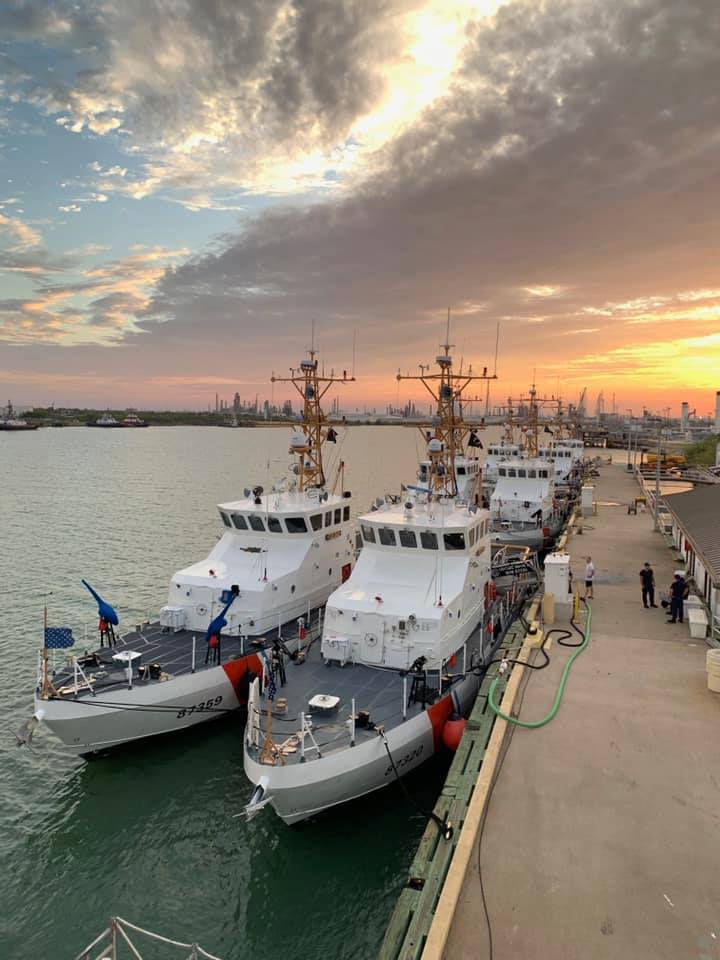
USCGC Robert Goldman (WPC 1142), Bound for Bahrain, To be Commissioned 12 March, 2021

Phoro: Sister ship, the Charles Moulthrope (WPC 1141), delivered on Oct. 22, 2020, and commissioned on Jan. 21

Below is an Atlantic Area news release. USCGC Robert Goldman (WPC 1142) is the 42nd Webber class WPC and is expected to be one of the first two of six to join PATFORSWASIA, replacing six 110 foot WPBs currently homeported in Bahrain.

united states coast guard

News Release

U.S. Coast Guard Atlantic Area
Contact: Coast Guard Atlantic Area Public Affairs
Contact: (757) 452-8336
Atlantic Area online newsroom

U.S. Coast Guard to commission 42nd Fast Response Cutter

USCGC Robert Goldman Seal

Key West, Fla. — The U.S. Coast Guard will commission the USCGC Robert Goldman (WPC 1142), Patrol Forces Southwest Asia’s second Sentinel-class cutter, into service at Coast Guard Sector Key West, Friday at 10 a.m. EST.

Due to COVID mitigation, in-person attendance is limited. Anyone interested in viewing the ceremony livestream may do so at http://bit.ly/WPC1412Com, clicking on the image at the top, or by clicking here

Vice Adm. Scott Buschman, deputy commandant for operations, U.S. Coast Guard, will preside over the 42nd Sentinel-class cutter ceremony. Mrs. Eleanor Goldman is the ship’s sponsor.  

The Robert Goldman is the second of six FRCs planned for service in Manama, Bahrain. The cutter is named after Pharmacist’s Mate 2nd Class Robert Goldman, remembered for heroic and selfless actions as a member of the joint forces serving in the Pacific theater during World War II. 

The Coast Guard took delivery of Robert Goldman on Dec. 21, 2020, in Key West. They will transit to Bahrain later this year with their sister ship, the Charles Moulthrope (WPC 1141), delivered on Oct. 22, 2020, and commissioned on Jan. 21, in Portsmouth, Virginia.

The New Pick for SOUTHCOM

Lt. Gen. Laura J. Richardson, 20 June 2019, US Army photo

Defense News reports that President has nominated three officers to assume the duties of Commander Combatant Command at TRANSCOM, PACOM, and SOUTHCOM.

The SOUTHCOM Commander is particularly important to the Coast Guard because  the Coast Guard’s drug interdiction efforts in the Caribbean and Eastern Pacific fall under SOUTHCOM’s jurisdiction. Frequently SOUTHCOM has been a vocal advocate for the Coast Guard.

The SOUTHCOM nominee is Lt General Laura J. Richardson, currently the head of U.S. Army North. She is an aviator and has an interesting bio. More photos here.


State of the Coast Guard Address, Thursday, March 11, 13:00 Eastern, 10:00 Pacific

Below is a D11 news release. Includes how to watch.

MEDIA ADVISORY: Top Coast Guard officer to outline state of the Coast Guard during San Diego address

Media Advisory

U.S. Coast Guard 11th District PA Detachment San Diego
Contact: Coast Guard PA Detachment San Diego
Office: (619) 278-7025
After Hours: (619) 252-1304
PA Detachment San Diego online newsroom

Top Coast Guard officer to outline state of the Coast Guard during San Diego address

WHO: Adm. Karl Schultz, commandant of the United States Coast Guard

WHAT: The service chief is scheduled to give his third annual State of the Coast Guard Address

WHEN: Thursday at 10:00 a.m. PST

WHERE: Virtual via live stream and video Q&A afterward

Editor’s Note: Media may RSVP at (619) 252-1304 no later than Wednesday at 5:00 p.m. Due to COVID-19 restrictions, in-person attendance will be extremely limited. However, this event will be live-streamed at https://www.uscg.mil/alwaysready/ and on Facebook at @USCoastGuard. Immediately following the event, Admiral Schultz will be available for Q&A via video conference call. Media who RSVP will be given media call details.

SAN DIEGO — The commandant of the United States Coast Guard is scheduled to deliver his third State of the Coast Guard Address Thursday at Coast Guard Sector San Diego.

Adm. Karl Schultz will outline his vision for the service to protect the homeland, enhance economic prosperity and advance America’s national security interests. Adm. Schultz will accentuate the dedication and sacrifice of Coast Guard members stationed across the country and deployed around the world during this past year of unprecedented challenges.

The address will cover topics such as investments in shore infrastructure, vital cutter and aircraft acquisition programs, continued focus on revolutionizing the service’s use of technology and talent management initiatives.

Adm. Schultz will further highlight Coast Guard operations in our nation’s system of ports and waterways, better known as the Marine Transportation System (MTS). The MTS is a key economic engine for the nation, fueling 26% of America’s gross domestic product (GDP) which equates to $5.4 trillion of annual economic activity and 31 million jobs.

Additionally, Adm. Schultz is expected to feature stories of Coast Guard women and men who excelled in crisis, rescued mariners in distress, interdicted illicit narcotics and responded to a record-setting Atlantic basin hurricane season, all complicated by the challenges presented by the COVID-19 global pandemic. Finally, Adm. Schultz will discuss how the global Coast Guard is a unique instrument of national security.

Detailed Schedule of Events:

  • 10:00 a.m. – 11:00 a.m. PST: State of the Coast Guard Address
  • 11:30 a.m. – noon PST: Adm. Schultz will be available for media inquiries via video conference call.

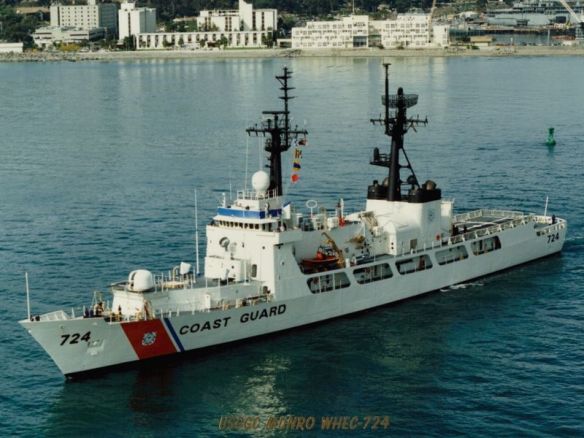
The Hamilton Class 378 foot WHECs, an Appreciation

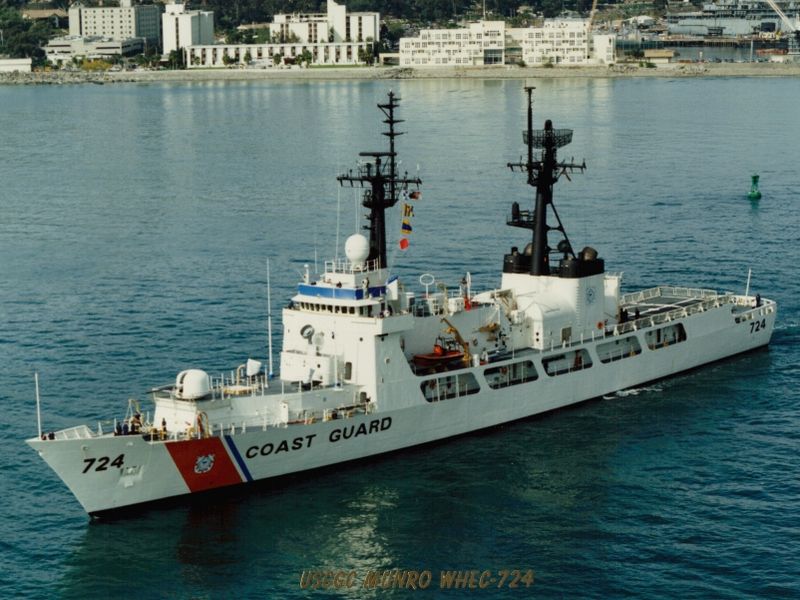
USCGC Douglas Munro (WHEC-724)

The Navy League’s magazine, Seapower, reports that the last of the US Coast Guard’s Hamilton class 378 foot WHECs, Douglas Munro, will be decommissioned at the end of the month.

The designers of these ships certainly made them aesthetically pleasing, and the preliminary design work was done in house by Coast Guard engineers.

The 378s were the crowning achievement of a recapitalization program begun in the late 1950s that resulted in the 82 foot Point class patrol boats, the 210 foot Reliance class WMECs, and ultimately the 378 foot Hamilton class WHECs, all built to preliminary designs developed in house.

Between October 1960 and August 1970 the Coast Guard commissioned 79 Point class WPBs. The Point class followed closely on the heals of the 95 foot WPB, the last of which had been commissioned in July 1959.

Between June 1964 and July 1969 we commissioned 16 Reliance class WMECs. Between February 1967 and March 1972 we commissioned 12 Hamilton class WHECs.

So between Oct. 1960 and March 1972 the Coast Guard commissioned 107 new patrol cutters. In 1967 alone we commissioned 17 Point class WPB. 1968 was the peak year for the larger cutters. In that year the Coast Guard commissioned four 378s and seven 210s. (Makes it clear we should be able to complete more than two Offshore Patrol Cutters per year, doesn’t it?)
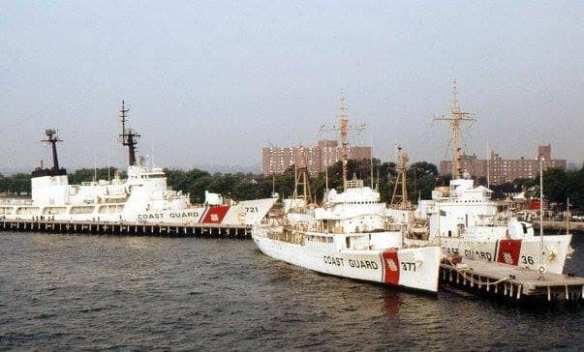
USCGC Gallatin WHEC -721 (378), USCGC Rockaway WHEC-377 (311), and USCGC Spencer WHEC-36 (327)

When the 378s were built, the WHEC designation had just recently been coined. 36 ships were classed as WHECs, six 327 foot 2,656 ton full load Secretary class cutters, 18 Casco class 311 foot 2,529 ton cutters, and 12 Owasco class 255 foot 1,978 ton cutters. The plan was to build 36 of Hamilton class to replace all of them, but the termination of the Ocean Station program resulted in only twelve being built. The 378s were 15 to 54% larger than the ships they replaced at 3,050 tons full load, and they were a much more advanced design.

CODOG Propulsion:

The COmbined Diesel or Gas turbine (CODOG) propulsion was a bold choice in the early 1960s. The Royal Navy had commissioned their first combatants with gas turbines (combined with steam) in 1961  The US Navy would not complete their first gas turbine powered Perry class frigate until 1977. (I think you can see the influence of the Hamilton class in the design of the Perry class frigates.) A pair of Danish Frigates, the Peder Skram class, would also use the same FT-4 turbines, but the first of that class was laid down only four months before Hamilton, so it was more contemporary than predecessor. 49 months after Hamilton was laid down, the Canadian laid down the first of the Iroquois class destroyers that used more powerful versions of the FT-4 in a COGOG arrangement with smaller 7500 HP Allison gas turbines. We would see the FT-4 gas turbine again in the Polar class icebreakers beginning in 1976.

The Coast Guard had done some experimentation with gas turbines. As built, USCGC Point Thatcher (WPB-82314), commissioned in Sept. 1961, was equipped with controllable pitch props and two 1000 HP gas turbines (later replaced by two 800 HP diesels that would became standard in the class). The first five 210 foot cutters of the Reliance class, commissioned June 1964 to February 1966, had two 1,000 HP gas turbines in addition to two 1,500 HP diesels, that they retained until they received major renovations 1985-1990.

The Hamilton Class’s Navy contemporaries were the 3,371 ton full load Garcia and 4,066 ton Knox class frigates (classified as Destroyer Escorts until 1975). Those ships were larger and used high temperature and pressure steam propulsion to produce 35,000 HP (compared to 36,000 for the 378s on their turbines). The frigates used only a single shaft for a speed 27 knots. The Hamiltons’ turbines gave them a two knot speed advantage, while their diesels gave them more than double the range. Two shafts gave them a greater degree of redundancy.

ASW Capability: 

While the contemporary Garcia and Knox class were much better equipped for ASW, the newly commissioned 378s, with their AN/SQS-38 sonar and helicopter deck were not only larger and faster, but also compared favorably as ASW ships to all but the newest Navy Destroyer Escorts (those completed 1963 and later).

CGC DALLAS (WHEC-716)… Vietnam… During seven combat patrols off the coast of Vietnam, Dallas undertook 161 gunfire support missions involving 7,665 rounds of her 5-inch ammunition. This resulted in 58 sampans destroyed and 29 Viet Cong supply routes, bases, camps, or rest areas damaged or destroyed. Her 5-inch (127 mm) guns made her very valuable to the naval missions in the area. Original 35mm Slide shared by Capt W.F. Guy, USCG… Circa May 1970.

Electronic Warfare, Gun and Fire Control: 

The 378s introduced the post WWII Coast Guard to electronic warfare with the WLR-1.

Unlike the earlier WHECs, the 378s were completed with the Mk56 gun firecontrol system which was much more capable than the short to medium range Mk52 used by the older cutters. Their 5″/38s proved useful when deployed to Vietnam. Below is quoted from Wikipedia’s description of USCGC Morgenthau‘s Vietnam deployment.

From records compiled by then-Lieutenant Eugene N. Tulich, Commander, US Coast Guard (Ret), Morgenthaus Vietnam numbers included: Miles cruised – 38,029 nautical miles (70,430 km; 43,763 mi); Percentage time underway – 72.8%; Junks/sampans detected/inspected/boarded – 2383/627/63; Enemy confirmed killed in action (KIA) 14; Structures destroyed/damaged – 32/37; Bunkers destroyed/damaged – 12/3; Waterborne craft destroyed/damaged – 7/3; Naval Gunfire Support Missions (NGFS) – 19; MEDCAPS (Medical Civic Action Program) – 25; Patients treated – 2676.

The FRAM:

During the late 1980s the Reagan administration was pushing for a 600 ship Navy. The FRAM of the Hamilton class was one of the small ways the Coast Guard played a part in the competition that may have driven the Soviet Union into dissolution.

While the 378s would still might not have been first class fighting units, electronic warfare was brought up to date, a newer air search radar, a modern gun, and firecontrol was installed. Harpoon anti-ship cruise missiles were add along with a Close in Weapon System (CIWS), a hangar was added and the ships were equipped to operate with a LAMPs I ASW helicopters.

Ultimately, following the collapse of the threat from the Soviet Union, the ASW equipment and anti-ship cruise missile were removed, but benefits of modernization, remained.

The After Life: 

These ships are now 49 to 54 years old and, thanks to the hard work of their crews over a half century, they are still doing good work, no longer for the US Coast Guard, but for Navies and Coast Guards around the world. Virtually all of their contemporaries have gone to the ship breakers, as have many younger ships.
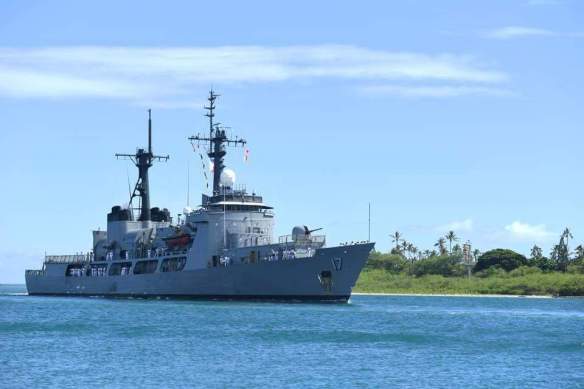
BRP Andrés Bonifacio (FF-17), the former USCGC Boutwell.

  • Hamilton (715), Dallas (716), and Boutwell (719) serve in the Philippine Navy.
  • Mellon (717) serves in the Bahrain Naval Force
  • Chase (718) and Gallatin (721) serve in the Nigerian Navy
  • Sherman (720) serves in the Sri Lanka Navy
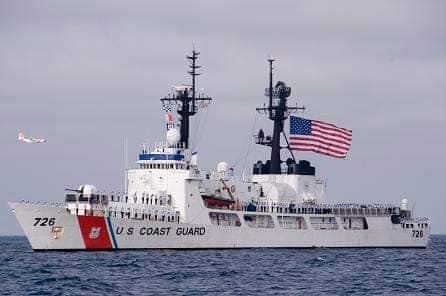
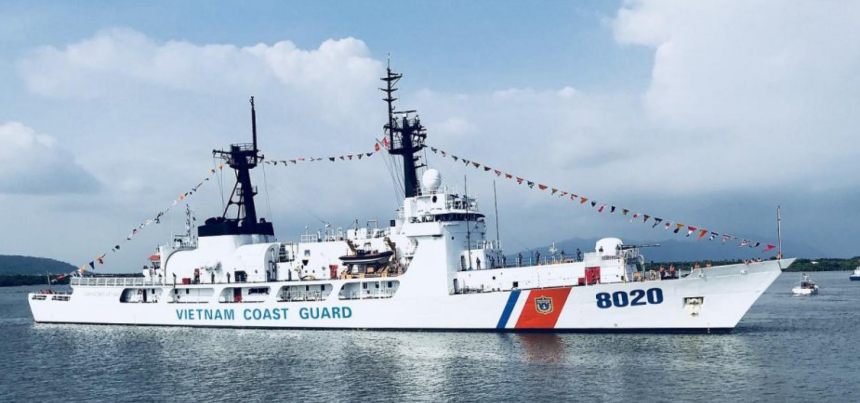
  • Morgenthau (722), Midgett (726), and Munro (724) serve or will serve in the Vietnam Coast Guard
  • Rush (723) and Jarvis (725) are in the Bangladeshi Navy

The Vietnam Coast Guard patrol vessel CSB-8020, formerly the US Coast Guard cutter Morgenthau (Photo: Vietnam Coast Guard)

“Coast Guard RDC evaluates Beyond Visual Line of Sight technology for UAS” –CG-9

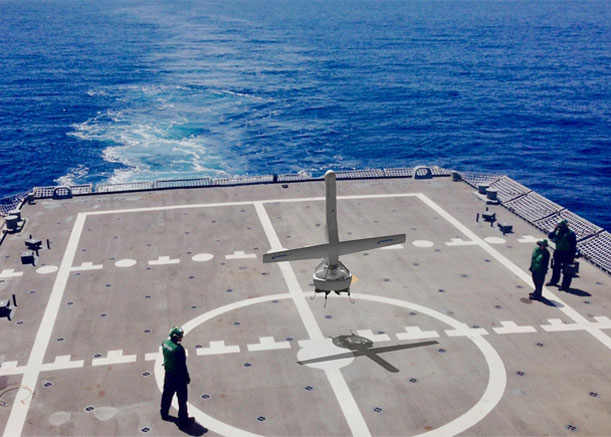
V-Bat from Martin UAV

The Acquisitions Directorate has a post, duplicated below, reporting on evaluation of a “Detect and Avoid” (DAA) system mounted on a small unmanned air system (sUAS). To me, the most significant part of the report is at the end,

“What’s on the horizon? Future evaluations will be focused on two capabilities:

  • “Investigating DAA technologies incorporated onboard a long endurance UAS capable of operating for 6.5 hours. This effort will support future UAS operations with Coast Guard vessels not equipped with a flight deck. (emphasis applied–Chuck)
  • “Evaluating vertical takeoff and landing UAS equipped with DAA technologies for operating onboard cutters with a flight deck.”

Operating UAS from non-flight deck equipped cutters is good news. (WPCs, WPBs, and maybe buoy tenders? Apparently they are operating from a 45 foot Response Boat-Medium.) The specificity of the “6.5 hours” operating capability must mean they are looking at a particular system.

Possibly related:


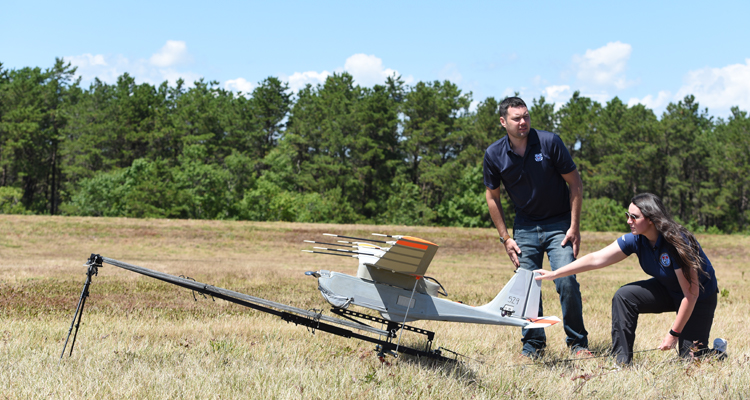
Aviation Branch personnel Evan Gross and Taylor Kall from the Coast Guard Research and Development Center prepare an AeroVironment Puma unmanned aircraft system equipped with the Passive Acoustic Non Cooperative Aircraft Collision Avoidance System for launch at Air Station Cape Cod, Massachusetts. U.S. Coast Guard photo.


The Coast Guard Research and Development Center (RDC) is evaluating Detect and Avoid (DAA) technologies to enable unmanned aircraft systems (UAS) to operate Beyond Visual Line of Sight (BVLOS) without relying on Coast Guard cutter systems for clearing airspace.

Current Federal Aviation Administration (FAA) rules prohibit UAS in national airspace under visual flight rules because UAS cannot detect and avoid other aircraft. DAA technologies may provide one solution to meet national airspace requirements, allowing the Coast Guard to expand its use of UAS to maintain better awareness of activities in the maritime domain.

“The ultimate goal of this project is to provide a pathway for UAS to operate BVLOS for both flight deck-equipped cutters and smaller vessels without a flight deck, providing a tool to increase mission effectiveness for Coast Guard surface operations,” said Steve Dunn, a researcher with the RDC Aviation Branch who is leading this effort.

In addition to supporting operation of UAS to cover greater distances at sea and patrol operational areas from land-based stations, DAA/BVLOS technology could increase Coast Guard efficiency by eliminating the need for a dedicated air direction controller to keep UAS clear of other aircraft.

Acoustic signature system

The RDC evaluated a DAA acoustic signature system called Passive Acoustic Non Cooperative Aircraft Collision Avoidance System (PANCAS) in August 2020 at Air Station Cape Cod, Massachusetts. The objective was to capture audible range data on how far the UAS could detect other aircraft to support future commands for UAS operators to avoid other airborne targets.

The PANCAS technology uses sound rather than radar and computer vision to detect things in its airspace. It has the potential to be used by UAS operators located on cutters or at land-based units, covering the full range of UAS operations.

PANCAS looks for an acoustic signature to identify aircraft in its vicinity and alert the UAS operator, who can then take evasive action to avoid the other aircraft. This equipment is also an example of a passive technology, meaning it is constantly listening for an acoustic signature and has 360 degree listening range. This technology may prove to be an alternative to active transmitters, which may not have 360 field of view and possibly require a lot of power from the UAS’s limited power supply.

The PANCAS evaluation was very successful; however, the technology is not at the stage where it can be submitted to the FAA for approvals. Additional engineering will be done to integrate waterproof microphones into the UAS wing, enabling the system to land in the water.

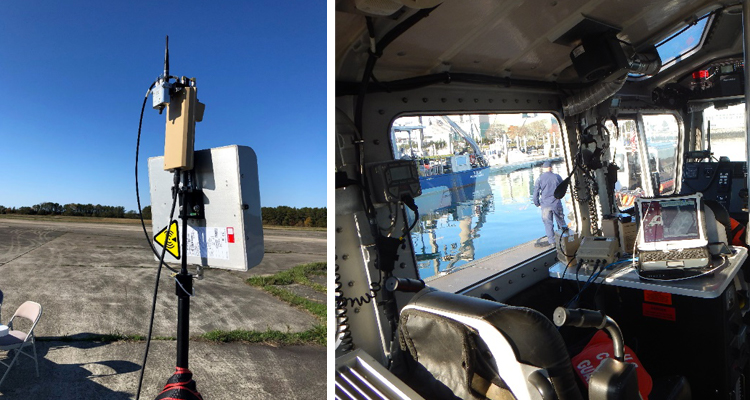
An AeroVironment prototype long-range directional antenna (left) was evaluated for its ability to extend the range of UAS operations using ground control stations at Air Station Cape Cod and onboard a Station Cape Cod Canal response boat (right). U.S. Coast Guard photo.

Long-range directional antenna

The RDC utilized a Cooperative Research and Development Agreement in November 2020 to evaluate a long-range directional antenna developed to extend the operational range of an AeroVironment Puma UAS. With the antenna, the RDC was able to successfully operate the Puma out to a range of 31 nautical miles. For this evaluation, the RDC team established two ground control stations — one land-based unit at Air Station Cape Cod and one onboard a response boat from Coast Guard Station Cape Cod Canal.

The evaluation was successful and proved the antenna’s viability for ground-based operations; data gathered will help support future BVLOS operations using DAA technologies. The demonstration also validated the need for a 360-degree directional antenna for BVLOS operations by the Coast Guard boating community. The RDC team is investigating further partnerships involving directional antennas to provide that capability.

The ability to operate smaller UAS such as a Puma farther away from Coast Guard vessels may unlock the full potential of UAS, providing a force multiplier for non-flight deck equipped cutters. Extending the range and flight time of smaller UAS are key factors for operating BVLOS.

What’s on the horizon?

Future evaluations will be focused on two capabilities:

  • Investigating DAA technologies incorporated onboard a long endurance UAS capable of operating for 6.5 hours. This effort will support future UAS operations with Coast Guard vessels not equipped with a flight deck.
  • Evaluating vertical takeoff and landing UAS equipped with DAA technologies for operating onboard cutters with a flight deck.

The goal of both efforts is to obtain an FAA Certificate of Authorization to use DAA technologies for operating BVLOS. The RDC plans to continue evaluations through early 2023; however, schedules may be impacted by COVID-related travel restrictions.

Puma UAS equipped with PANCAS flying with an Air Station Cape Cod HC-144. U.S. Coast Guard photo.

For more information: Research, Development, Test and Evaluation program page and Research and Development Center page.

“U.S., Canadian, Coast Guards, Royal Canadian Air Force, rescue 31 fishermen from sinking vessel off Nova Scotia” –D1 News Release

Just passing along this news release. Well done. You make us proud.

*VIDEO AVAILABLE* U.S., Canadian, Coast Guards, Royal Canadian Air Force, rescue 31 fishermen from sinking vessel off Nova Scotia

News Release

U.S. Coast Guard 1st District Northeast
Contact: 1st District Public Affairs
Office: (617) 223-8515
After Hours: (617) 717-9609
1st District online newsroom

U.S., Canadian, Coast Guards, Royal Canadian Air Force, rescue 31 fishermen from sinking vessel off Nova Scotia

Editors’ Note: Click on images to download high resolution version.

BOSTON— The U.S., and Canadian Coast Guards, and the Royal Canadian Air Force, rescued 31 fishermen from a disabled, Canadian fishing vessel over 130 miles south of Halifax, Nova Scotia, Tuesday night.

 At 7:05 p.m., Tuesday, the Joint Rescue Coordination Center in Halifax notified watchstanders at the Coast Guard First District Command Center that the 143-foot vessel, Atlantic Destiny, was disabled with a fire on board, and was taking on water. 

 A U.S. Coast Guard Air Station Cape Cod HC-144 Ocean Sentry fixed-wing crew, and two MH-60 Jayhawk helicopter crews launched and arrived on scene.

A Royal Canadian Air Force CH-149 Cormorant helicopter crew from 14 Wing Greenwood, in Nova Scotia, Canada, hoisted six crewmembers from the vessel, and dropped off two search and rescue technicians to assist in dewatering the vessel. A Canadian CC-130 Hercules, also from 14 Wing Greenwood, provided top cover for the operation.

The U.S. Coast Guard Jayhawk crews hoisted another 21 fishermen between the two helicopters. All hoisted crewmembers were taken to Yarmouth, Nova Scotia, where they were transferred for medial assessment.

The remaining four crewmembers, and the two SAR technicians, ceased dewatering efforts and were transferred to the Canadian Coast Guard Ship Cape Roger shortly after 7 a.m. Wednesday morning. The Atlantic Destiny sank to the bottom at 9:36 a.m.

“We have a strong connection with our Canadian partners,” said Capt. Wes Hester, the 1st Coast Guard District chief of response. “We conduct joint training every year with our partners in Greenwood, and our crew’s consistent training, coordinated responses, and international partnership saved 31 lives yesterday. That monumental effort is a testament to the hard work and sacrifice of everyone involved.”

“We were very fortunate to have had the support of the U.S. Coast Guard during this rescue. Their ability to provide such valuable support in the saving of the lives of these fishermen is very much appreciated and demonstrates how important our relationship is in providing search and rescue services to both Canada and the United States.” Maj. Kristin MacDonald, Officer in Charge, Joint Rescue Coordination Centre Halifax.

The weather on scene was 35 mph winds and 26-foot seas.

“U.S. Coast Guard Cutter Stone (WMSL 758) completes Operation Southern Cross” –Press Release

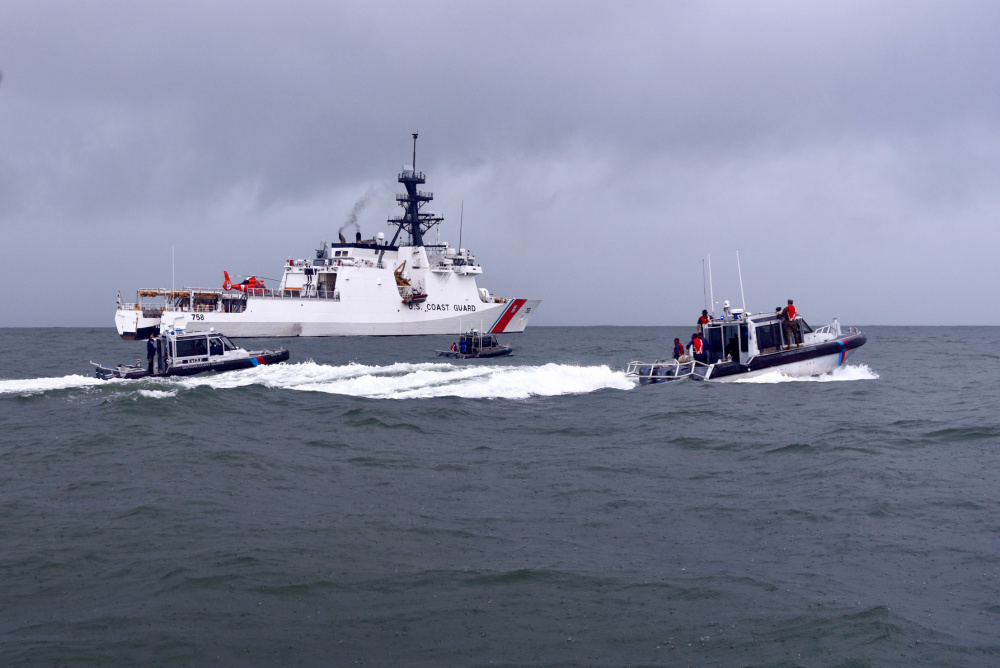
Guyana coast guard small boats patrol alongside the USCGC Stone (WMSL 758) off Guyana’s coast on Jan. 9, 2021. The U.S. and Guyana governments enacted a bilateral agreement on Sep. 18, 2020, to cooperatively combat illegal marine activity in Guyana’s waters. (U.S. Coast Guard photo by Petty Officer 3rd Class John Hightower)

STONE has ended her highly unusual deployment to the South Atlantic. She still has not been commissioned yet. Almost five months away from their families. This crew deserves some time off.

We talked about the Brazilian OPV, hull number P120, seen in one of the photos over ten years ago. “Possible New Ships at a Bargain Price”. The British have built five improved versions of the class and Thailand has built a couple of the class with heavier armament.

united states coast guard

News Release

U.S. Coast Guard Atlantic Area
Contact: Coast Guard Atlantic Area Public Affairs
Contact: LANTPAO@uscg.mil
Atlantic Area online newsroom

U.S. Coast Guard Cutter Stone (WMSL 758) completes Operation Southern Cross

Stone and Guyana defense force Stone and Brazil navy Stone in Montevideo
Stone observes foreign fishing vessel Stone departs Mississippi Stone Guyana coast guard joint exercise

Editors’ Note: to view more or download imagery, please click here or the images above.

PORTSMOUTH, Va. — The USCGC Stone (WMSL 758) crew arrived in their homeport of North Charleston, S.C., Monday, following the conclusion of the Operation Southern Cross, a patrol to the South Atlantic in support of counter illegal, unreported, and unregulated fishing.

Taking the newly-accepted cutter on its shakedown cruise, Stone’s crew covered over 21,000 miles (18,250 nautical miles) over 68 days. A mutual interest in combating IUUF activities offered an opportunity to collaborate for Stone’s crew. They interacted with partners in Guyana, Brazil, Uruguay, and Portugal, strengthening relationships and laying the foundation for increased partnerships to counter illicit maritime activity.

“I could not be more proud of this crew. It was no easy feat to assemble a crew and ready a cutter for sea, but to do so in a COVID-19 environment followed by a two-month patrol is truly quite amazing. While at sea, we completed all patrol objectives and strategic engagements with like-minded partners. Our crew training was balanced with shining a big spotlight on illegal fishing practices in the South Atlantic. We arrived at our homeport on Monday after nearly five months away from families and will now receive some well-deserved rest,” said Capt. Adam Morrison, the Stone’s commanding officer.

Even before leaving the pier, the Stone set milestones. They are the first U.S. Coast Guard cutter with a Portuguese navy member to serve aboard. Lt. Miguel Dias Pinheiro, a Portuguese navy helicopter pilot, joined the Stone’s crew for the entirety of their first patrol.

Pinheiro served as both an observer and a linguist for daily operations. Further, he lent shipboard aviation experience. On this patrol, Stone certified their flight deck for aviation operations and embarked an aviation detachment from Air Station Houston. His participation in the patrol has already led to reciprocal activity with Portugal.

“Working with our partner nations has not only strengthened our working relationships but has allowed the crew of the Stone to conduct training evolutions that we don’t often get to do,” said Lt. Cmdr. Jason McCarthey, the Stone’s operations officer.

While in transit to conduct joint operations off Guyana’s coast, Stone encountered and interdicted a suspected narcotic trafficking vessel south of the Dominican Republic. Having stopped the illicit activity, Stone handed off the case to the USCGC Raymond Evans (WPC 1110), a fast response cutter from Key West, Florida, and continued their patrol south.

Stone’s team practiced communications with the Guyana Defense Force during a fast-paced interdiction scenario. This evolution required focus and attention on both sides of the radio.

In Brazil, the crew practiced communications and steaming in close formation, an essential skill for joint and combined operations. Stone’s team also gave presentations to the Brazil navy members on maritime law enforcement practices and tactics.

“Having the opportunity to work together and exchange ideas helps us all become more proficient in achieving our shared goals,” said McCarthey.

Stone was the first U.S. Coast Guard cutter to call in Uruguay in over a decade. Stone’s crew familiarized their hosts on the Coast Guard’s full range of mission and operations, answering technical questions and sharing best practices. Uruguay expressed further interest in additional professional exchange opportunities and joint operations in the future. 

The Stone crew were given a unique opportunity to forge new bonds and strengthen the foundations of previous alliances in the face of a global crisis and did so through in-person and virtual engagement, conscious of the risks involved.

“We are very keen to not only negotiate international agreements to address IUU fishing, as we did with the Port State Measures Agreement. We’re also very supportive of the work Coast Guard is doing to build relationships and strengthen the operational effectiveness of all of the coastal states to combat IUU fishing,” said David Hogan, acting director of The Office of Marine Conservation, Bureau of Oceans and International Environmental and Scientific Affairs, U.S. Department of State.

Operation Southern Cross promises to expand U.S. relationships with these partner governments. Beyond Operation Southern Cross’s immediacy, the U.S. government intends these collaborations to promote long-term regional stability, security, and economic prosperity.

Stone’s crew now prepares for their commissioning on March 19.

The cutter’s namesake is the late Cmdr. Elmer “Archie” Fowler Stone, who in 1917 became the Coast Guard’s first aviator and, two years later, was one of two pilots to successfully make a transatlantic flight in a Navy seaplane landing in Portugal. 

“COVID-19: MAJOR CUTTER RESILIENCY ABSENCE” –ALCOAST

An interesting and humane response to the difficulties of operating in the world of COVID-19.

united states coast guard

R 041700Z MAR 21
FM COMDT COGARD WASHINGTON DC
TO ALCOAST COMDT NOTICE

UNCLAS
ACN 025/21
SSIC 1000
SUBJ:  COVID-19: MAJOR CUTTER RESILIENCY ABSENCE
A. Coast Guard Pay Manual, COMDTINST M7220.29 (series)
B. Military Assignments and Authorized Absences, COMDTINST M1000.8
(series)
1. Due to the unique and arduous challenges the cutter community
has faced through the ongoing COVID-19 pandemic, this ACN authorizes
the use of administrative absence for members currently assigned
to major cutters to promote wellness and rejuvenation of the
physical, mental, and spiritual health of members of those who
faced significant restrictions on inport movement and impacts
to their cutter port calls. Commanding Officers of major cutters
(level 4 and 5), as defined in REF (A), are authorized to approve
resiliency absence of up to 15 days for permanently assigned
members. COs are encouraged to evaluate individual circumstances
when assessing how many days to authorize for individual members.
Considerations should include, but are not limited to, time
onboard, restriction of movement periods, missed leave, port
call availability and operational tempo.
2. Resiliency absence may be used consecutively or non-consecutively
and may be extended by combining with weekends, holidays, leave,
liberty, or TDY. Similar to other types of administrative absence,
defined in REF (B), resiliency absence will need to be locally
managed by the command of the cutter and it will not be entered
into Direct Access. Any unused days will expire one year after
the release of this message or upon permanent transfer from the
cutter, whichever occurs first. Resiliency absence is not authorized
for use in conjunction with a PCS transfer; it may not be used
as travel or proceed time. Commanding Officers should not withhold
normally authorized administrative absence in lieu of approving
resiliency absence. For example, it should not be used to conduct
house hunting and area familiarization for next assignment.
3. This message will be cancelled 03 MAR 2022.
4. You can find more information and resources related to
resilience at: https://www.uscg.mil/Coronavirus/Resilience/.
Questions regarding resiliency absence or other human resource
management matters may be directed to Office of Military Personnel
Policy (CG-133) at: HQSPolicyandStandards@uscg.mil.
5. Released by RADM J. M. Nunan, Assistant Commandant for Human
Resources (CG-1).
6. Internet release is authorized.