International IUU Fisheries Enforcement Cooperation

Sometimes you need to back away from the details to take a look at the larger picture. Sept. 17, the Commandant released the “Illegal, Unreported, and Unregulated Fishing Strategic Outlook”. There have been a number of reports that indicate the Coast Guard is taking this seriously and in fact started working the plan even before it was published.

The crew of the Coast Guard Cutter Douglas Munro conducts a boarding of a Chinese fishing vessel

On Sept. 3 we had a report of USCGC Bertolf’s joint patrol with the Ecuadorian navy off Galapagos Islands, August 25-29.

Sept. 22 we had a report that USCGC Waesche had had a fire on Sept. 20, while on deployment to the Western Pacific .

Sept. 23, we got this report of cooperative fisheries enforcement with the Royal Bahamian Defence Forces, Coast Guard, RBDF seize more than 12,000 lbs. of illegal catch off Bahamas

Oct.7 we got a report that USCGC Douglas Munro had just completed a two month patrol in the North Pacific, not an ALPAT, Operation North Pacific Guard 2020.

Oct. 8 we got this report indicating that the Coast Guard would continue to do capacity building in Africa. Navy, Coast Guard Keep Up Operations in Africa.

And most recently, Oct. 24, we learned that not only would we be “strategically homeporting significantly enhanced Fast Response Cutters … in the western Pacific,” but that basing cutters in America Samoa is being considered. “US to base Coast Guard ships in western Pacific to tackle China

Taken together, these seem to indicate that the Coast Guard is taking on Illegal, Unregulated, and Unreported (IUU) fishing, particularly Chinese IUU fishing, which is the most egregious, not only in the US EEZ, but also internationally in a cooperative manner.

The line from Jaws comes to mind, I think we are going to need a bigger Coast Guard.

“VESSEL REVIEW | ARKTIKA – NUCLEAR-POWERED 33,000-TONNE BEHEMOTH IS LARGEST ICEBREAKER YET BUILT” –BairdMaritime

Russian Nuclear Powered Icebreaker Arctika

Baird Maritime has a review of the new Russian nuclear powered icebreaker Arctika. Its total shaft horsepower is about 80,000 (not a lot more than Polar Star’s 75,000). It open water speed of 22 knots is high for an icebreaker. The crew does seem to be remarkably small at 54 (31 less than Healy). An earlier more extensive post on these ships with some interesting comments here.

Coast Guard Student Pilot Dies in Training Accident

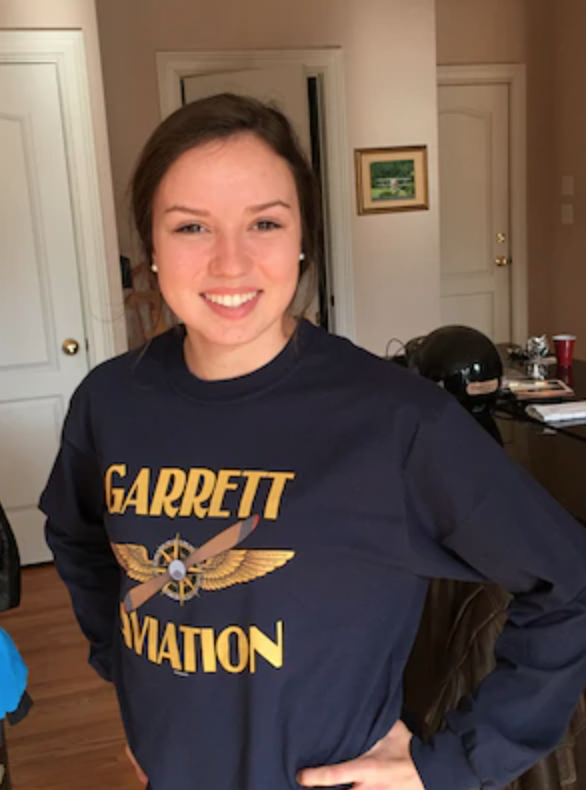
U.S. Coast Guard Ensign Morgan Garrett, 24 years old, from Weddington, N.C., died in an Oct. 23, 2020, crash of a Navy T-6B Texan II trainer aircraft in Foley, Ala. US Navy photo.

US Naval Institute News services has identified the two killed in the crash of a U.S. Navy T-6B Texan II training aircraft. They were U.S. Navy Lt. Rhiannon Ross, a 30-year-old instructor pilot, and U.S. Coast Guard Ensign Morgan Garrett, a 24-year-old student pilot.

Oh! I have slipped the surly bonds of Earth
And danced the skies on laughter-silvered wings;
Sunward I’ve climbed, and joined the tumbling mirth
Of sun-split clouds, — and done a hundred things
You have not dreamed of — wheeled and soared and swung
High in the sunlit silence. Hov’ring there,
I’ve chased the shouting wind along, and flung
My eager craft through footless halls of air . . .

Up, up the long, delirious burning blue
I’ve topped the wind-swept heights with easy grace
Where never lark, or ever eagle flew —
And, while with silent, lifting mind I’ve trod
The high untrespassed sanctity of space,
Put out my hand, and touched the face of God.

“US to base Coast Guard ships in western Pacific to tackle China” –Aljazeera

United States Exclusive Economic Zone – Pacific centered NOAA map

Aljazeera reports that,

The US Coast Guard was “strategically homeporting significantly enhanced Fast Response Cutters … in the western Pacific,” White House National Security Advisor Robert O’Brien said in a statement.

What does that mean? Is this just a reference to the three Webber class WPCs that will be homeported in Guam? Or will we see a replication of PATFORSWA in the Western Pacific? Does “significantly enhanced” mean these FRCs will have improvements to sensors, communications, and/or weapons, or does it just mean they will be better than the two 110 foot WPBs they are replacing?

There is also this interesting tidbit,

O’Brien added that the Coast Guard, which is under the Department of Homeland Security (DHS), was also studying whether to permanently station several of its patrol ships in the area of American Samoa in the South Pacific.

Thanks to Walter for bringing this to my attention. 

“Euronaval: First Details Of The Patrouilleurs Océanique (PO) Platform Unveiled” –Naval News

From Naval News

Naval News provides additional information on the “Patrouilleurs Océanique” (PO) program to build ten offshore patrol vessels for one billion Euros. We discussed this program earlier and it looks very much like a Coast Guard cutter, maybe even a candidate for Cutter X.

The things that might be seen as unique or unexpected:

  • hull mounted sonar
  • 40 mm 
  • Modular capacity in the form of space for a standard container sized system–this might include a towed array
  • Retention room–presumably a holding cell that might be used for alien migrant interdiction

Deliveries are expected 2025-2029.

Small Unmanned Systems Used in Response to Hurricane Sally

Below is a news release from the Eighth district. The thing I found surprising, was that in the video below, it reports that three USCG drone pilots flew 95 flights totaling 16 hours and 34 minutes (about 10.5 minutes per flight). You will see some of the drone video below. Above is a better look at the equipment being used.

united states coast guard


Video Release

U.S. Coast Guard 8th District Heartland
Contact: 8th District Public Affairs
Office: 504-671-2020
After Hours: 618-225-9008
Eighth District online newsroom

Coast Guard ends 37-day response to Hurricane Sally aftermath on Gulf Coast

This video highlights the Coast Guard's role in marine environmental response operations after Hurricane Sally. Hurricane Sally made landfall in Alabama on Sept. 16, 2020. Coast Guard video by Petty Officer 2nd Class Edward Wargo 

Editors’ Note: Click on image to download high-resolution version.

MOBILE, Ala. — The Coast Guard Sector Mobile Incident Command has concluded a 37-day coordinated response effort to Hurricane Sally along the Gulf Coast, Thursday.

Many parts of Alabama and the Florida Panhandle sustained damage during Hurricane Sally when it made landfall September 16th as a Category 2 hurricane. Since then, 1,132 vessels have been assessed for potential pollution threat to the environment. All sources of pollutants have been mitigated and contractors continue to conduct salvage operations in Escambia, Santa Rosa, and Baldwin Counties. 

The Coast Guard federal on-scene coordinator and the state on-scene coordinator from the Florida Department of Environmental Protection coordinated efforts to remove weathered oil, discovered on a half-mile area of Johnson Beach, Florida, in consultation with Federal Trustees:

  • Department of Interior’s U.S. Fish and Wildlife Service
  • National Oceanic & Atmospheric Administration’s National Marine Fisheries Service
  • National Park Service

The impacted area was located on federally designated, critical habitat and marine protected areas as well as being designated as culturally significant to federally recognized tribes.

Coast Guard Sector Mobile Sally Marine Environmental Response (MER) partnered with wildlife response specialists to save the life of a brown pelican. It was found heavily oiled at Day Break Marina in Pensacola, Florida. After a three-week rehabilitation process, it was safely released into the Northwest Florida Wildlife Sanctuary.

“The Coast Guard concluded its response to Hurricane Sally well ahead of our anticipated timeline, ” said Cmdr. Kelly Thorkilson, Coast Guard Hurricane Sally MER incident commander. “Coast Guard members deployed from across the nation, collaborated with our partner agencies, and quickly integrated new technologies which greatly enhanced frontline operations resulting in a more efficient response.” 

There were 148 Coast Guard responders whose combined efforts totaled an estimated 17,630 work hours. Members managed logistics, resources, and operations including; vessel assessments and facilitating the deployment of 11,650 feet of containment boom. Additionally, three drone pilots flew a total of 95 unmanned aerial system flights to pinpoint pollution along the Gulf Coast. 

Any additional pollution incidents should be reported to the National Response Center at 1-800-424-8802.

For more information follow us on Facebook and Twitte


“BOLLINGER SHIPYARDS DELIVERS 41st FAST RESPONSE CUTTER STRENGTHENING DEFENSE CAPABILITIES IN THE ARABIAN GULF” –Bollinger Press Release

USCGC CHARLES MOULTHROPE

Below I have reproduced a Press Release from Bollinger. Normally I would note the delivery of these vessels by a comment on a previous post, “Webber Class WPC Homeports,” but this is the first Webber class to be going to PATFORSWA. I hope we will see some upgrades to their weapons before they get to Bahrain.


BOLLINGER SHIPYARDS DELIVERS 41st FAST RESPONSE CUTTER STRENGTHENING DEFENSE CAPABILITIES IN THE ARABIAN GULF

FRC is first of six cutters destined for overseas operations in Manama, Bahrain

LOCKPORT, La., — (October 22, 2020)Bollinger Shipyards LLC (“Bollinger”) today delivered the USCGC CHARLES MOULTHROPE to the U.S. Coast Guard in Key West, Florida. This is the 164th vessel Bollinger has delivered to the U.S. Coast Guard over a 35-year period and the 41st Fast Response Cutter (“FRC”) delivered under the current program.

The USCGC CHARLES MOULTHROPE is the first of six FRCs to be home-ported in Manama, Bahrain, which will replace the aging 110’ Island Class Patrol Boats, built by Bollinger Shipyards 30 years ago, supporting the Patrol Forces Southwest Asia (PATFORSWA), the U.S. Coast Guard’s largest overseas presence outside the United States.

“Bollinger is proud to continue enhancing and supporting the U.S. Coast Guard’s operational presence around the world by delivering the USCGC CHARLES MOULTHROPE,” said Bollinger President & C.E.O. Ben Bordelon. “It is our top priority to ensure that the brave men and women of the Coast Guard stationed in PATFORSWA have the most state-of-the-art, advanced vessels as they work to build and maintain the necessary regional alliances to ensure maritime security in the region. Building ships for the Coast Guard provides critical assets to bolster our national security and advance America’s interests, both at home and abroad.”

At a PATFORSWA change of command ceremony earlier in the summer, U.S. Coast Guard Atlantic Area Commander Vice Adm. Steven D. Poulin emphasized the importance of the unit, saying, “During these historical times it is important, now more than ever, that we maintain maritime security operations throughout the U.S. Central Command area of responsibility. [PATFORSWA is] pushing forward into the unknown to protect American interests in the region.”

PATFORSWA Commander Capt. Willie L. Carmichael echoed Poulin’s comments, saying PATFORSWA “plays a key role in maritime security, maritime infrastructure protection, theater security cooperation, and counter-smuggling operations.”

PATFORSWA is composed of six cutters, shoreside support personnel, and the Maritime Engagement Team. The unit’s mission is to train, organize, equip, support and deploy combat-ready Coast Guard Forces in support of U.S. Central Command and national security objectives. PATFORSWA works with Naval Forces Central Command in furthering their goals to conduct persistent maritime operations to forward U.S. interests, deter and counter disruptive countries, defeat violent extremism and strengthen partner nations’ maritime capabilities in order to promote a secure maritime environment.

Bordelon continued, “The FRC hot production line continues to produce and provide stability in the industrial base for the U.S. Government and our Bollinger workforce, assuring economic benefit for our region, our vendor partners in the 40-plus states that support the FRC program, and our country.”

The last 20 weeks of the USCGC CHARLES MOULTHROPE build occurred despite the COVID-19 global pandemic and six named storms impacting the Gulf region, all of which affected Louisiana and two of which made landfall in the state as hurricanes, including Hurricane Laura – a Category 4 storm and the strongest to hit the state since the Great Storm of 1856. Bollinger undertook precautions to ensure the health and safety of employees and maintain its delivery schedule. For the COVID-19 pandemic, Bollinger increased and enhanced sanitization practices across the shipyard, and enacted more liberal leave and remote work policies as well as altered shift schedules to promote social distancing.

Each FRC is named for an enlisted Coast Guard hero who distinguished himself or herself in the line of duty. Born in Massachusetts in 1873, Charles Moulthrope was a member of the crew of Revenue Cutter Commodore Perry. Seaman Moulthrope gave his life in the performance of duties in 1896. Moulthrope had previously performed a heroic deed while serving on the Perry.Moulthrope rescued four of his shipmates who had fallen into the sea from the cutter’s launch after they had gone to rescue another crewman, Boatswain Alfred Halfell who had fallen overboard. He grabbed a line and leaped over the side into the freezing water to rescue the four who were rapidly succumbing to hypothermia.Moulthrope worked the line around all four of the sailors and those on board the cutter then pulled the men aboard the Perry.

About the Fast Response Cutter Platform

The FRC is an operational “game changer,” according to senior Coast Guard officials. FRCs are consistently being deployed in support of the full range of missions within the United States Coast Guard and other branches of our armed services.This is due to its exceptional performance, expanded operational reach and capabilities, and ability to transform and adapt to the mission. FRCs have conducted operations as far as the Marshall Islands—a 4,400 nautical mile trip from their homeport. Measuring in at 154-feet, FRCs have a flank speed of 28 knots, state of the art C4ISR suite (Command, Control, Communications, Computers, Intelligence, Surveillance, and Reconnaissance), and stern launch and recovery ramp for a 26-foot, over-the-horizon interceptor cutter boat.

About Bollinger Shipyards LLC

Bollinger Shipyards LLC (www.bollingershipyards.com) is a leading designer and builder of high performance military patrol boats, ocean-going double hull barges, offshore oil field support vessels, tugboats, rigs, lift boats, inland waterways push boats, barges, and other steel and aluminum products from its new construction shipyards as part of the U. S. industrial base. Bollinger has 10 shipyards, all strategically located throughout Louisiana with direct access to the Gulf of Mexico, Mississippi River and the Intracoastal Waterway. Bollinger is the largest vessel repair company in the Gulf of Mexico region.

“Stuck in the middle with you: Resourcing the Coast Guard for global competition” –Brookings

Brookings contends that the Coast Guard, not the Navy, is the proper instrument to counter Chinese maritime “gray zone” operations. But it needs more money, something in the range of $200-500M more per year, a 1.7-4.2% budget increase.

Simply put, for a relatively meager influx of operations and maintenance funds, at least in DoD terms (where the unit cost of a single Fordclass aircraft carrier is more than the Coast Guard’s entire annual budget), the Coast Guard could provide substantially more services in the Pacific. Enhanced funding in the range of $200-$500 million would translate to improved readiness and availability of its National Security Cutter (NSC) fleet and other Coast Guard assets capable of operating deep into the Pacific theater. Importantly, this funding might actually save money for DoD. Using the Coast Guard to conduct joint military exercises and patrols, capacity building, and international training is far cheaper than using a higher-end Navy ship to perform the same missions. (emphasis applied–Chuck)

It goes on to suggest that the PATFORSWA model be replicated in the Western Pacific and suggests,

As a corollary, as the Coast Guard plans for its Offshore Patrol Cutter acquisition, it should consider whether it could optimize a sub-class of these vessels for these types of defense-flavored operations in the Pacific.

There is also a suggestion of overseas basing,

Finally, it may also be time for the Coast Guard to consider independent foreign basing options for the first time in recent memory, perhaps with America’s close ally and “Five Eyes” partner, Australia. A Coast Guard detachment in Australia would not only provide for an additional Pacific-centric staging area, besides existing Coast Guard locations in Hawaii and Guam, but would also assist with Coast Guard strategic icebreaking operations directed towards Antarctica, which is itself becoming more and more relevant in the era of great power competition.

Once we have our fleet of icebreakers, we might want to base one in Australia or New Zealand, but Guam still looks like a good place for our patrol ships, even if we might include OPCs in addition to the three Webber class FRCs currently planned. Patrolling our Western Pacific EEZ and that of friendly Micronesian states, we might want to replenish at Manus Island, Papua New Guinea, where Australia is developing a joint use base. At least for short term deployments, our ships and aircraft might also exploit the newly improved base at Wake Island 1,501 miles (2,416 kilometers) east of Guam, 2,298 miles (3,698 kilometers) west of Honolulu.

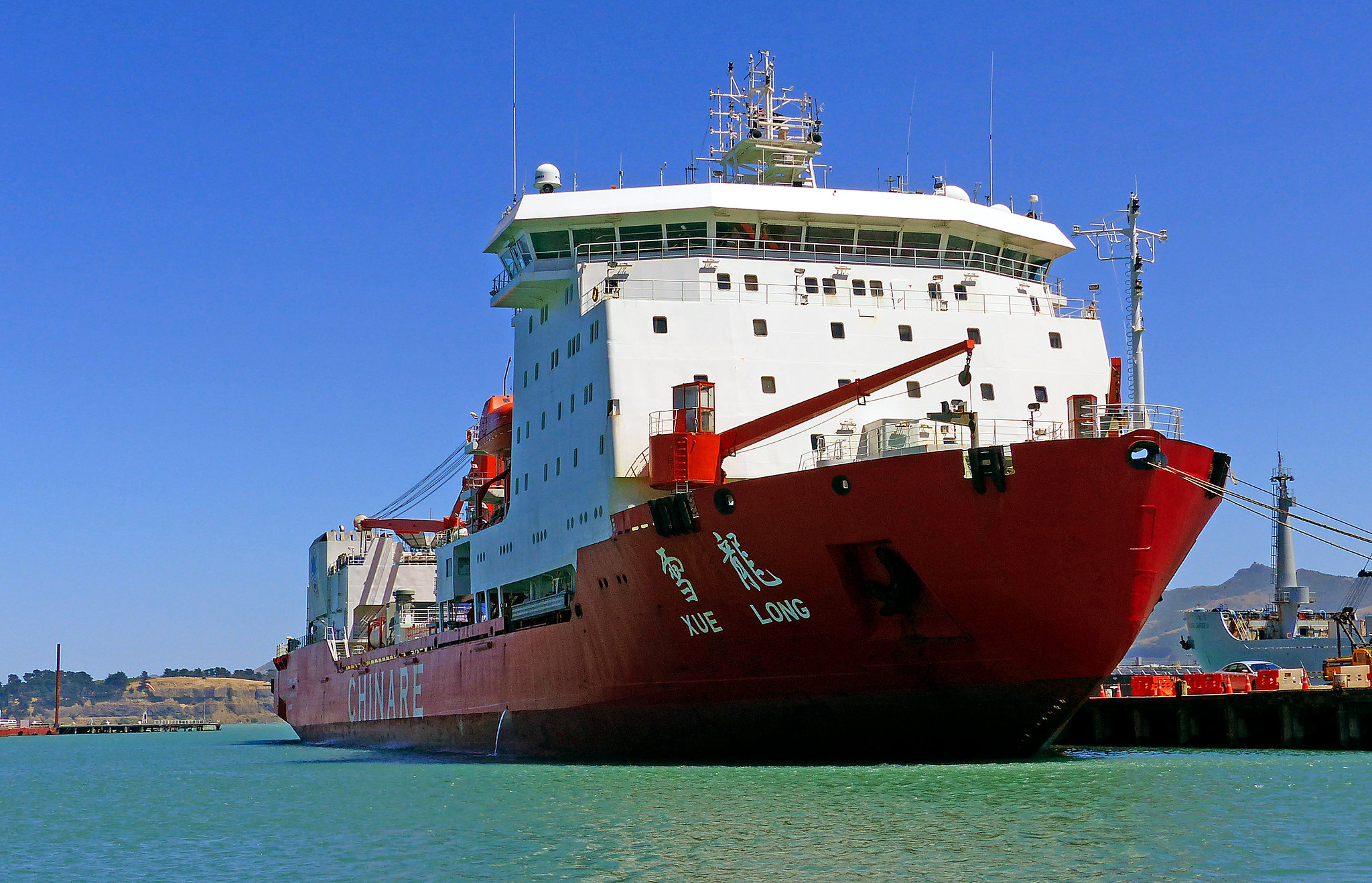
“Breaking the Ice: High Stakes in the High North” –RealClearDefense

Real Clear Defense offers a suggestion of how US policy regarding the Arctic should be shaped.

While some decry an “icebreaker gap”…, the real problem is that U.S. policy in the Arctic lacks direction. The United States needs a better approach – a new cooperative arrangement with Russia to protect the environment, maintain peace in the region, and box-out China.

The Coast Guard does need more icebreakers. It does not need nearly as many as Russia. Our thinking needs to consider our access to Antarctica, which, however quiet it may be now, may not always be that way.