Looking for the Next Generation Cutter Boat

Petty Officer 2nd Class Dale Veverka, a boatswains mate, Seaman George Degener, and Petty Officer 2nd Class Joshua Post, a machinery technician, conduct maneuvers on the Coast Guard Cutter Northland’s “over-the-horizon” small boat during transit to Rio De Janeiro, Brazil, April 9, 2008. UNITAS exercise, a multinational naval exercise the helps tests the interoperability of U.S. and foreign naval forces. U.S. Coast Guard photo by PA2 Nathan Henise.

Below is a press release from the Acquisitions Directorate (CG-9):

The Coast Guard released a request for proposal (RFP) Aug. 13, 2020, for the next generation of over-the-horizon capable cutter boats (OTH-V). The RFP is available here.

Proposals are due by noon (EDT) Oct. 12, 2020.

Following on the success of the OTH-IV program, the OTH-V is viewed as an evolutionary step in providing capability for the Coast Guard’s major cutter fleet. The program is designed to expand the service’s mission readiness and meet the Coast Guard’s cutter-based surface prosecution needs for the next decade. With an estimated production of close to 200 boats, the OTH-V will be the primary cutter boat for the Coast Guard’s major cutters.

The acquisition is being conducted in two phases. In the first phase, evaluation of the submitted proposals will result in up to four individual awards. Each awardee will produce a single boat that will be used to demonstrate the boat’s capabilities in selected scenarios. The second phase will update the initial evaluations based on the demonstration, leading to selection of a single best-value boat to move into production.

OTH-V notional characteristics include a top speed of 38 to 42 knots powered by a diesel engine with waterjet and a range of 150 to 200 nautical miles. The boat will carry up to 13 people, with dimensions limited to 26 feet long by 8.5 feet wide, and a performance weight of approximately 8,700 pounds.

The OTH-V will continue to consolidate boat classes, generating efficiencies in training and supportability. The delivery schedule calls for production and deliveries of 12 to 24 OTH-Vs per year starting in 2023.

Cutter boats deployed aboard cutters facilitate mission accomplishment in almost all mission areas, with emphasis on search and rescue, drug interdiction, alien migrant interdiction operations, living marine resources, defense readiness, and ports, waterways and coastal security.

For more information: Boat Acquisition program page. Previous industry engagement materials can be found under the resources tab at the bottom of the page.

Munro Participates in RIMPAC 2020

US Coast Guard Cutter Munro departing from the dock in San Diego. Photo Credit: Tom Brossman

US Naval Institute News Service reports on the start of a scaled down RIMPAC 2020. Among the ships participating is the National Security Cutter USCGC Munro.

Australia has sent a particularly large contingent, second only to that of the US, a destroyer, two frigates, and an oiler. No other countries sent more than two ships.

Brunei’s contribution, KDB Darulehsan (OPV 07) will be interesting. It is the same basic design as the twelve OPVs being built for the Australian Navy. She is reportedly equipped with 4 × Exocet MM40 Block 3. Will be interesting to see if she is shooter during the exercise.

Nice to see the photo below of USS Essex (LHD-2) looking very much like a WWII aircraft carrier, bringing WWII vintage aircraft to Hawaii where they will commemorate the 75th anniversary of the end of WWII.

USS Essex (LHD-2) arrives at Pearl Harbor, Hawaii for RIMPAC 2020 on Aug. 10, 2020. US Navy Photo

“Turkish Coastguard Orders 122 Patrol Boats” –Marine Link

ARES 35, Turkish CG patrol boat. Photo: ARES shipyard

MarineLink reports,

“ARES Shipyard in Antalya, Turkey has been awarded a contract to build 122 patrol boats for the Turkish Coastguard.”

These will be 12-meter Fiberglass Reinforced Plastic [FRP] and carbon composite.

Deliveries are expected over a five year period at a rate of 36 boats per year.

440 kW (590 HP) is routed though water jets provided by HamiltonJet.

“Access to HamiltonJet is unrestricted with the global headquarters and factory in New Zealand complemented by Regional Offices in the USA, UK and Singapore, and our distribution network in over 55 countries worldwide.”

The Turks have a history of making some very fast patrol boats.

Manning Requirements, New Fleet vs Old

W B Young asked a question, wondering if perhaps the crew requirements for the new fleet of patrol cutters might be significantly greater than for the fleet being replaced. I ran the numbers and was surprised by the answer.

The program of record was for 91 new ships (8 NSCs, 25 OPCs, and 58 FRCs) to replace a legacy fleet of 90 ships (12 WHECs, 29 WMECs, and 49 Island class WPBs). Instead it appears we are building a fleet of 100 ships (11 NSCs, 25 OPCs, and 64 FRCs). I will compare the 90 ship legacy fleet with the 100 vessel fleet we are building.

Replacing the WHECs: 

In a recent interview by Seapower Magazine the Commandant was asked, “Does the Coast Guard have enough people to man these new cutter coming online?” He really only talked about the NSC/WHEC comparison, but he did provide crew numbers for each, 178 for the 378s and 128 for the NSCs.

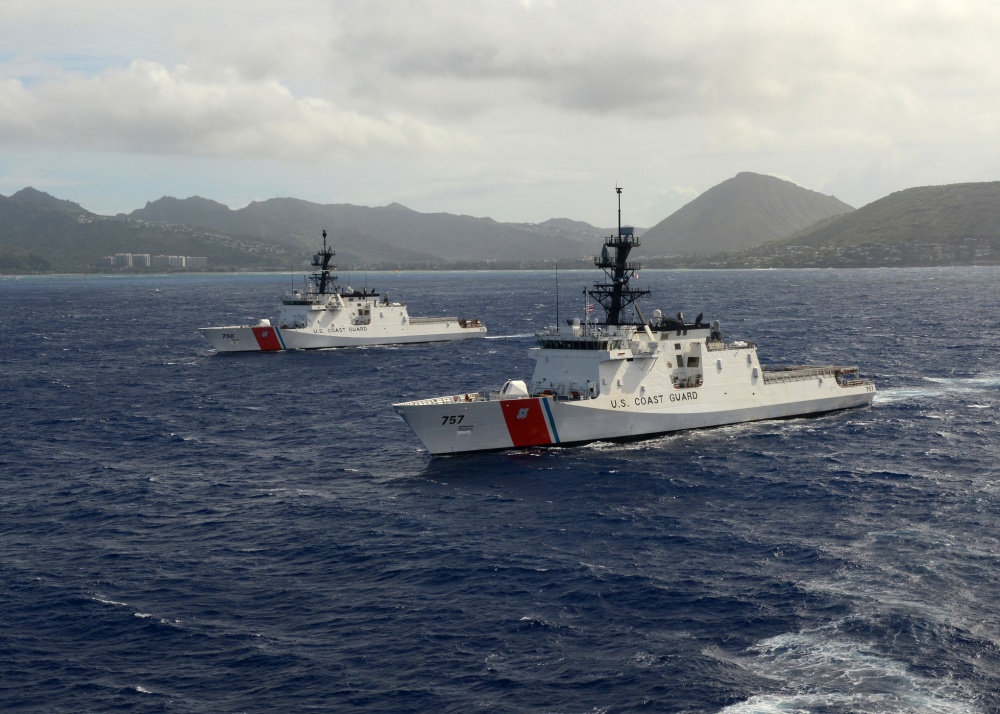
The crews of the Coast Guard Cutters Midgett (WMSL 757) and Kimball (WMSL 756) transit past Koko Head on Oahu, Hawaii, Aug. 16, 2019. The Kimball and Midgett are both homeported in Honolulu and two of the newest Coast Guard cutters to join the fleet. (U.S. Coast Guard photo by Petty Officer 3rd Class Matthew West/Released)

We are replacing twelve 378 foot WHECs with eleven Bertholf class, so:

  • Old Fleet, 12 x 178 = 2136
  • New Fleet, 11 x 128 = 1408

A reduction of 728.

Replacing the WMECs:

The legacy fleet of 29 WMECs included Alex Haley, Acushnet, fourteen 210s, and thirteen 270s. We have pretty good figures for the crew size of these older ships. For the 25 projected OPCs, we have only the figure for accommodations, 126. I have assumed the crew size will be the same as for the 270s, 100, but it might be more like 110.

OPC “Placemat”

Old Fleet total: 2524

  • 270s: 13 x 100 = 1300
  • 210s: 14 x 75 =1050
  • Alex Haley       99
  • Acushnet         75

New Fleet, 25 x 100 = 2500

For a reduction of 24. On the other hand, if the OPC crew is 110, we have an increase of 226.

Replacing the Island class WPBs:

The Coast Guard Cutter Naushon (WPB 1311) 110-foot Island-class patrol boat and crew conduct training in Kachemak Bay near Homer, Alaska, Feb. 16, 2018.(Picture source U.S. Defense Visual Information)

64 Webber class are replacing 49 Island class 110 foot WPBs. Actually we were down to 41 of the 110s before the FRC contract was awarded because of the abortive attempt to lengthen eight of the class by 13 feet. All eight were withdrawn from service in 2006.

The Coast Guard Cutter Donald Horsley conducts sea trials off the coast of Key West, Florida, on April 5. The Donald Horsley is the Coast Guard’s 17th fast response cutter and was commissioned in San Juan, Puerto Rico, on May 20, 2016. (U.S. Coast Guard photo by Eric D. Woodall)

This is where we see a significant increase. The crews of the 110s was nominally 16, though they may have carried more. For the crew of the Webber class WPCs I used 24, though the original crew was, I believe, supposed to have been 22.

  • Old Fleet: 49 x 16 =  784
  • New Fleet: 64 x 24 = 1,536

An increase of 752.

Perfection Achieve?:

So to add it all up:

Old Fleet

  • WHECs 2136
  • WMECs 2524
  • WPBs      784
  • Total     5444

New Fleet

  • NSCs 1408
  • OPCs 2500
  • FRCs  1536
  • Total   5444

Wow, how did that happen, so should be no problem right? Maybe not.

The Timeline: 

Since the this particular Legacy fleet existed, a number of things have happened to reduce the number of afloat billets.

Eight Island class WPBs were decommissioned after the attempt to lengthen them, a 128 billet decrease.

Acushnet was decommissioned, a 75 billet decrease.

378s have been decommissioned faster than NSCs have replaced them. Instead of twelve 378s we now have eight NSCs and two 378s, 24 billets less than the ultimate NSC fleet and 756 fewer than the legacy WHEC fleet.

Billet decreases due to replacement of 378s by NSCs is running ahead of billet increases as a result of replacing 110s with FRCs. About 73% of the NSCs have been commissioned compared to only about 60% of the FRCs.

So we have already seen all the saving we will see from the introduction of the NSCs but not all the increases we expect to see from the introduction of FRCs, I am estimating we will need about 300 additional billets to crew the yet to be completed FRCs.

So the fleet has already seen all the reductions in crew size and for the next few years, we should see an increase in the total number of billets. It appears we will have to add a bit over 500 additional billets to what we currently have.

This may have something to do with the decision to decommission some 87 foot Marine Protector class WPBs without replacement.

A question remains regarding support billets. Will these more complex ships require more support billets ashore?

More perspective. 

The legacy fleet composition used for comparison here represented the Coast Guard fleet during the period after Storis was decommissioned in 2007 and before Acushnet was decommissioned in 2011. If we look back to 2000  we will see that the Coast Guard had all 90 of these ships plus Storis and two more 210s, another 234 afloat billets.

“Closing the Gap at Home: The Future of Intel-Led Policing in the Coast Guard” –USNI Blog

A boarding team from the Coast Guard Cutter Mellon (WHEC 717) approach a fishing vessel on the high seas in January 2019 while patrolling in support of counter-Illegal, Unregulated and Unreported fishing and global security missions. Mellon’s crew is supporting international fisheries on the high seas and enforcement of the Western Central Pacific Fisheries Commission (WCPFC). (U.S. Coast Guard photo by Coast Guard Cutter Mellon)

The US Naval Institute blog has a post by Lieutenant Commander Jeff Garvey, USCG, with a whole raft of recommendations for how to improve Coast Guard law enforcement. It is mostly outside my wheelhouse, other than that I enjoyed a great relationship and enjoyed significant success working with PACAREA LE intelligence. They were a great team. Looks like he may know what he’s talking about.

Basing for Larger Patrol Cutters

W B Young asked,

“I was wondering if they are going to base these two WMSM in R.I., what base/homeport is losing ships to make up for this? What with 25 tentative WMSM replacing 28 current WMEC some homeport(s) were already going to be losing a currently based ship{s}”

Trying to answer this turned out to be a bit more than I wanted to put in just a comment. I am going to look at homeports for the larger patrol cutters, WHECs, WMECs, OPCs, and NSCs, breaking it down by district, as we move toward 36 large patrol cutters (11 NSCs and 25 OPCs).

Keep in mind these changes will not happen quickly. First OPC is not expected to be delivered until 2022 and then only one per year through 2028. Then only two per year, so we are looking at #25 arriving in 2037.

TRENDS:

There are some trends that seem to be playing out here:

  • Fisheries, Alien Migrant interdiction, and D7 drug interdiction are increasingly being done by Webber class WPCs.
  • Ships of a class are increasingly being based in groups of three or more for better support.
  • 210s are being moved South where they are closer to the Caribbean and Eastern Pacific drug interdiction areas and where the weather is less demanding.

LOOKING BACK: 

When I looked at homeports in 2015:

  • There were six large cutters in CGD1, three in Portsmouth, NH/Kittery, ME (two 270s and one 210) and three 270s in Boston.
  • There were nine in D5, six 270s and three 210s.
  • Nine in D7, two NSCs, two 270s, and five 210s.
  • D8, two 210s
  • A total of 26 in LANTAREA
  • In PACAREA, 14 total, three NSCs, seven 378s, one 282, and three 210s (That is really 11 “high endurance cutters” (NSCs, 378s, and Alex Hailey, rated a WMEC but really an HEC) and three 210s).

WHAT WE HAVE NOW

Currently we have 38 large patrol ships, already down two:

  • D1, five 270s
  • D5, Total of eight, six 270s and two 210s
  • D7, no change, Total of nine, two NSCs, two 270s, and five 210s
  • D8, Four 210s
  • LANTAREA total 26
  • PACAREA total twelve, six NSCs, two 378, one 282, three 210s

The LANT total has not changed, but D1 and D5 have each donated a 210 to D8.

PACAREA is down two ships. One from D11 and one from D13.

What we know about the future:

The last two 378s, both in PACAREA, will not last much longer.

Three more Bertholf class NSCs are going to be based in D7 at Charleston. As unlikely as it may seem, this is actually closer to the Eastern Pacific drug transit zone than San Diego.

The First two OPCs will go to San Pedro. The second pair will go to Kodiak. The third pair will go to D1 in Newport, RI.

What will happen to Alex Haley when the two OPCs arrive in Kodiak is not clear, but there is a good chance it has more life in it than many of the 210s. It is newer and more capable than any of them. In many ways it is close to a SLEPed 270. Hopefully it will be kept on.

Six 270s will undergo life extension program renovations. My presumptions are that,

  • These will probably last about a year, but hopefully less for later ship after we acquire some experience.
  • We will do only one at a time,
  • That the crew that brings it to be renovated will be reassigned, and
  • That a new crew will be assigned, much as if it were new construction.
  • After renovation it is likely that the ship will be assigned to a new homeport.

These renovations will need to start relatively soon. We need to complete the project by 2027, if we are going to get at least 10 years service out of all six before the 25th OPC is completed in 2037. (Wonder if perhaps we can install more powerful engines to get a bit more speed.)

The four OPCs going to PACAREA are really replacing four WHECs not WMECs. There used to be 10 WHECs on the West coast. When the two Webber class currently planned to be homeported in Astoria arrive, they may effectively start to replace the West Coast 210s in PACAREA.

PURE SPECULATION: 

This is what I think we will see, as all the WHECs and WMECs disappear and we are left with eleven NSCs and 25 OPCs.

We will certainly see homeport changes as the healthier ships are moved to ports vacated by those being decommissioned.

As their SLEPs are completed, 270s will replace 210s in D7 and/or D8. Those 210 will then be decommissioned or moved to replace other 210s that are decommissioned. Will be interesting to see if we simply decommission a 210 whenever an OPC is commissioned, or will we do a sequence for the first few ships, commission an OPC, but wait until a 270 completes SLEP before decommissioning a 210. It would be a way to maximize cutter days. The SLEP is going to cost us some ship years.

First District will end up with four OPCs. All probably in Newport, RI. Boston and Kittery will probably loose all their large patrol cutters.

Fifth District will end up with six OPCs. All homeported close together in Virginia, in one or two locations.

Seventh District will, we know, have five NSCs in Charleston, I suspect five OPCs for a total of 10 ships. Currently D7 has large patrol cutters based in five ports: Charleston, Mayport, Cape Canaveral, Key West, and St. Petersburg. Likely only two or three will continue to host this class of ship. Charleston is a certainty. My guess is that Mayport and Cape Canaveral will loose their patrol Cutters. Key West and possibly St. Petersburg (less likely) will have OPCs. Charleston could host OPCs as well, which would probably mean none in St Pete.

The Eight District will have four OPCs, probably all in Pensacola.

The number of large cutters in PACAREA will soon drop to 10 but will ultimately work back to 12, a total of six NSCs and six OPCs. Where do those last two OPCs go? Best guess–to San Pedro for a total of four, but it could be two to San Diego (still close to San Pedro) or one each to San Pedro and Kodiak.

Eleventh District will end up eight, four NSCs and four OPCs.

Thirteenth District will end up with no large patrol cutters, but will host three Polar Security Cutters. Could be wrong. Those last two PACAREA OPCs could end up in D13.

Fourteenth District will have two NSCs.

Seventeenth District will have two OPCs.

Readers with rationale why my suppositions are wrong, please weigh in.

The crew of USCGC Kimball (WMSL 756) arrive in Honolulu for the first time Dec. 22, 2018. Known as the Legend-class, NSCs are designed to be the flagships of the Coast Guard’s fleet, capable of executing the most challenging national security missions, including support to U.S. combatant commanders. (U.S. Coast Guard photo by Chief Petty Officer Sara Muir/Released)

Seapower’s July/August Coast Guard Issue.

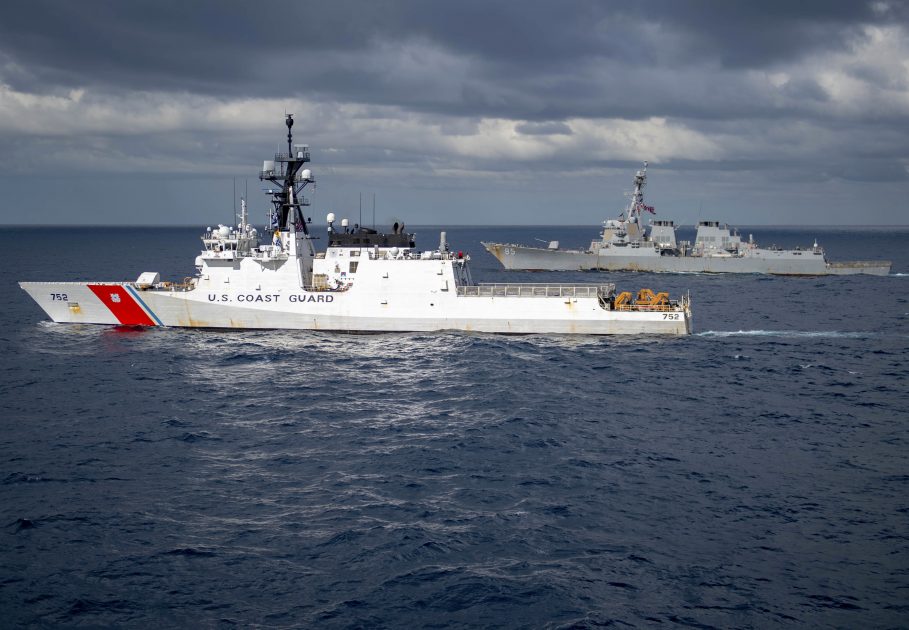
USCGC Stratton (WMSL-752), left, and the U.S. Navy Arleigh Burke-class guided-missile destroyer USS McCampbell (DDG-85) maneuver in formation during Talisman Sabre 2019 on July 11, 2019. US Navy Photo

The July/August issue of the Navy League’s magazine Seapower included a lot of Coast Guard content. I will not try to cover everything included, much of which has already been covered here, but I will mention a few things that stood out for me.

The Commandant’s Interview:

There was an interview with the Commandant, Admiral Schultz, that I found most interesting. There was a fair amount of information that was new to me.

Icebreakers:

Perhaps most significant was a comment regarding the Medium icebreaker.

“We also are looking to build probably a medium breaker, potentially what we’re going to call the Arctic security cutter — a little less capability in terms of icebreaking, but that capability would get us back to being an Atlantic and Pacific icebreaker Coast Guard.(emphasis applied–Chuck)

It may be that, if this ship is intended to transit the St Lawrence Seaway and work part time in the Great Lakes, like Canada’s proposed six “Program Icebreakers,” it would preclude the option of simply building six Polar Security Cutters rather than the three heavy and three medium icebreakers called for in the High Latitude Study. Alternately we might have four heavy Polar Security Cutters (PSC) in the Pacific and two Arctic Security Cutters (ASC) in the Atlantic.

The interview goes on to state, referring to its planned five year long progressive service life extension program, “…we could keep the 44-year-old Polar Star around here probably through the end of the decade if things go well.” (emphasis applied–Chuck)

The Western Pacific:

The Commandant noted that the Coast Guard had advisers in the Philippines, Vietnam, Fiji, and that an additional adviser would go to Malaysia and an attache to Australia to work with Australia and New Zealand. That there would also be an advisor assigned to Guam to work with the Commonwealth of Micronesia and the Federated States of Micronesia.

The Coast Guard is becoming more involved in countering Illegal, Unregulated, and Unreported (IUU) fishing, and will be providing leadership in international forums.

In reference to the forthcoming Tri-Service Maritime Strategy the Commandant said we could expect, “…to see the Coast Guard bring some unique capabilities to that conversation, particularly in the Indo-Pacific region.” 

Unmanned Systems:

Regarding land based systems the Commandant noted, “..we’ve completed prototype deployment of ScanEagle in Puerto Rico and Texas.” and “We teamed with U.S. Southern Command and CBP and employed one of those (MQ-9–Chuck) in an operation out of Panama that proved tremendously successful.”

He also mentions the possibility of using UAS of all sizes and mentioned the possibility of unmanned surface systems as well.

Cyber:

Sighting the FY2021 budget, Admiral Schultz said, “That is one of the biggest growth areas for humans in the Coast Guard here in the past budget cycle or two. There is somewhere north of 150 additional cyber warriors in the budget before the Congress right now.” 

“Insitu’s ScanEagle Performs ISR for Coast Guard”

There is a short one page report on the use of ScanEagle. It notes that ScanEagle is currently installed on six National Security Cutters and will be installed on all NSCs.

“A standard pack-out for a deployment of three ScanEagle UASs. The sensor systems include an electro-optical/infrared camera, a laser pointer, a communications relay, an automatic identification system (AIS), and visual detection and ranging (VIDAR)–a surface search capability.”

Interesting that it includes a laser pointer on the Coast Guard aircraft because that is usually used as a designator for laser homing weapons.

“The Era of the New Cutters”

This was a three page story, most of which is familiar to regular readers of this blog, but there was one nugget I had not seen before. “…the Coast Guard still will need to pursue a service-life extension program on six of the ships to ensure sustained fleet capability until the OPC program is finished.”

This almost certainly refers to the service life extension program (SLEP) for 270 foot WMECs. This is, I believe, the first time I have seen a number of ships mentioned, so not the whole class of 13. Notably it is only six so don’t expect a SLEP for 210s. They will soldier on in their current configuration until their long delayed retirement.

“Croatian Brodosplit Shipyard held cutting-steel ceremony of new coastal patrol boats for Croatia Coast Guard” –Navy Recognition

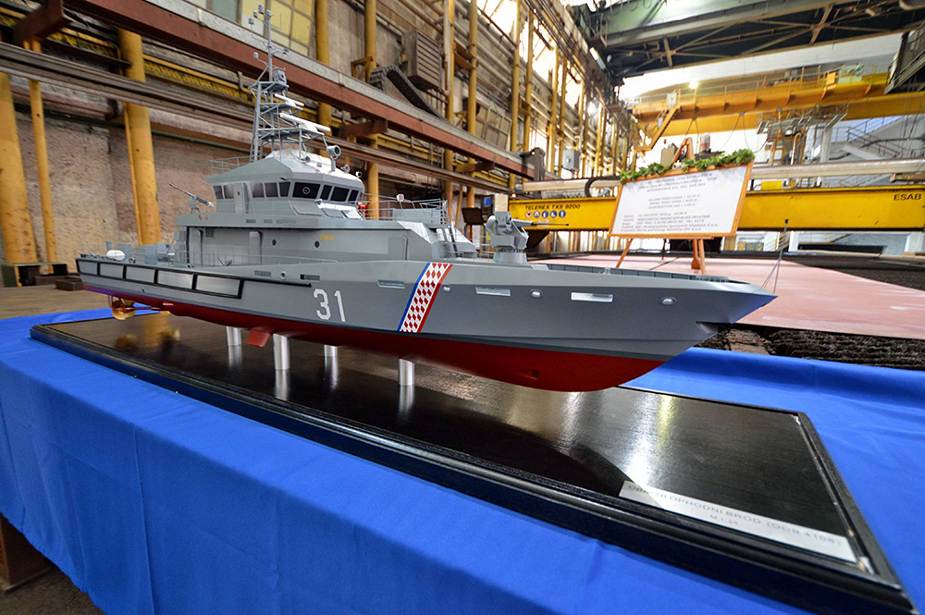
Scale model of the coastal patrol boat for the Croatian Coast Guard. (Picture source Brodosplit Shipyard)

Navy Recognition Reports that first steel has been cut for a new class of patrol boat for Croatian Coast Guard.

The Croatian-made patrol boat will have a length of 43,16 meters (142 feet) and a wide of 8 meters. She will be armed with one 30mm automatic cannon mounted at the front deck and two 12.7mm heavy machine gun, as well as four portable anti-aircraft missiles.

This makes it only slightly smaller than the 154 foot Webber class WPCs. Closer still to the Damen Stan 4207 patrol design (used by at least eleven nations), like the Canadian Coast Guard Hero class.

Two 2525 kW engines would provide 6772HP. That is well under the 11,600 HP of the Webber class, but it should still be good for 24 to 25 knots rather than the 15 knots the report seems to indicate, in apparent confusion with range specification (“…maximum speed of 15 knots with a maximum cruising range of 1,000 nautical miles.”)

Range is notably less than that of the Webber class (2,500 nmi), but Croatia has an EEZ of only 17,211 nautical miles square.

It is unusual in having a CBRN (Chemical, biological, radiological and nuclear) protection system).

Map: Adriatic Sea. Created by Norman Einstein, May 20, 2005.


Offshore Patrol Cutters to be Based in Newport, RI

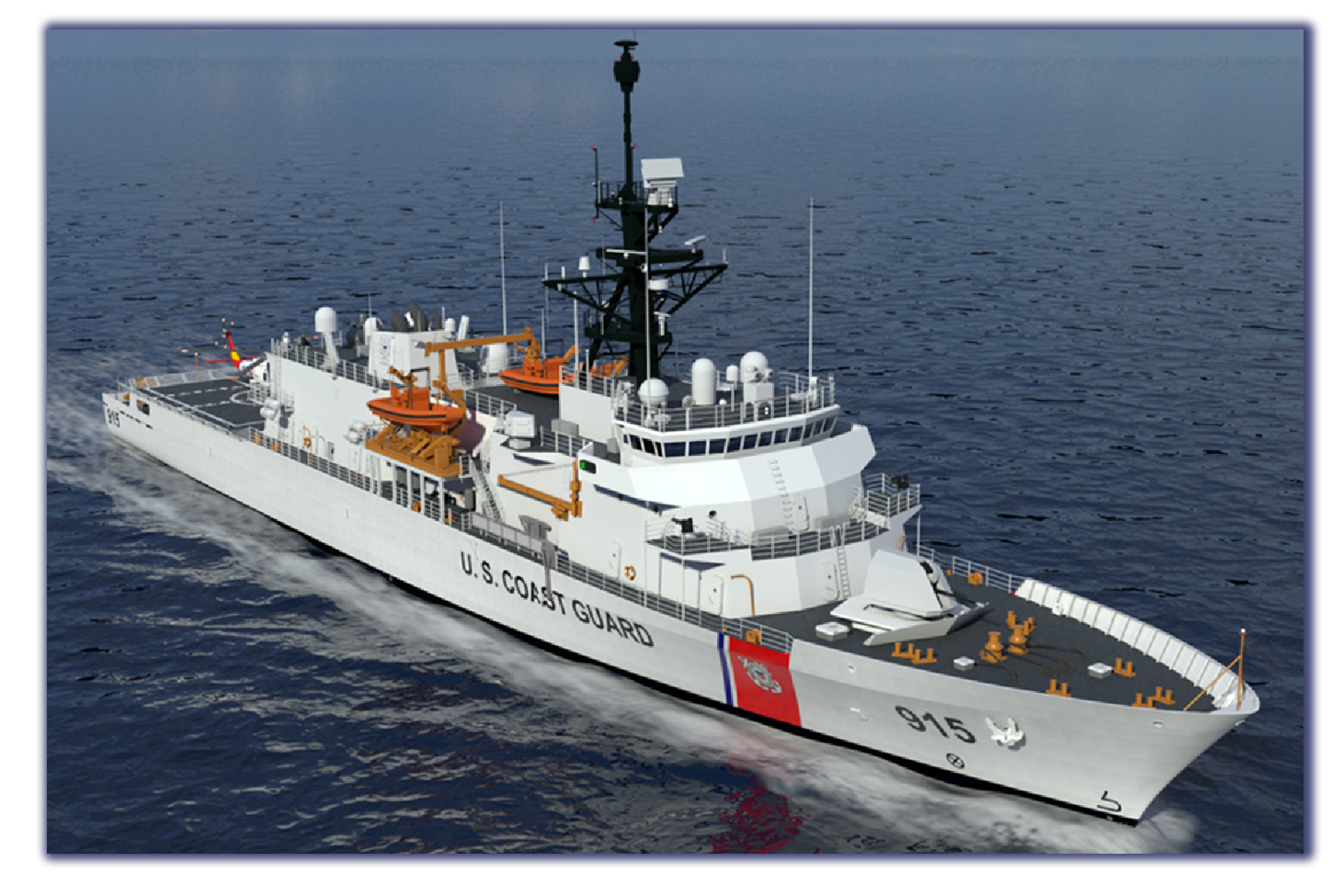
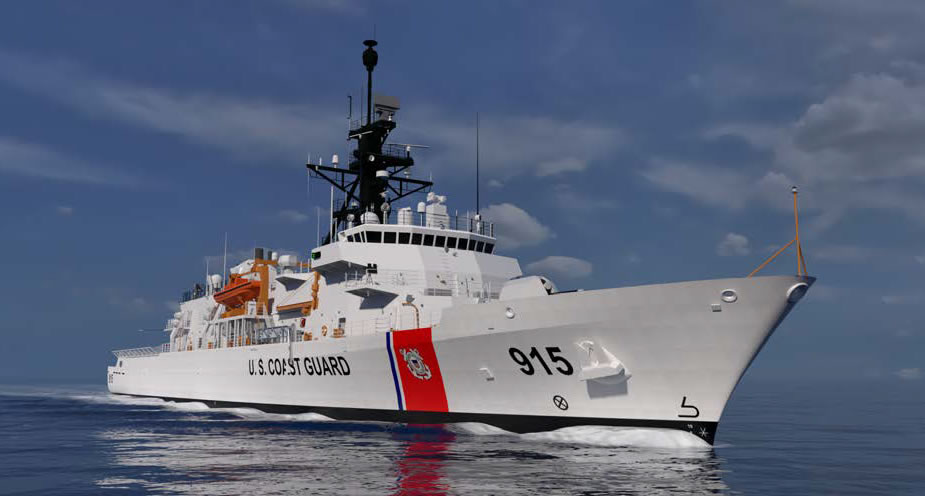
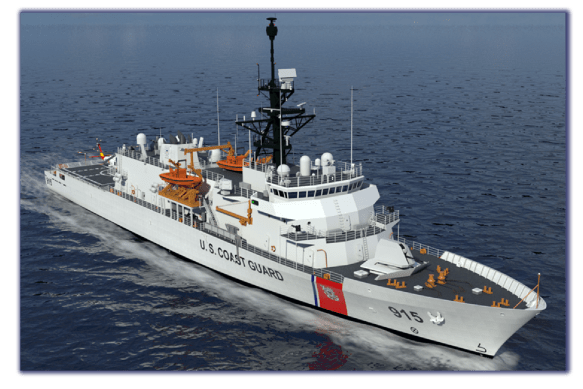
Artists rendering from Eastern Shipbuilding Group

Below is a Coast Guard Headquarters news release reproduced in its entirety, announcing two Off Shore Patrol Cutters (OPCs) will be homeported at Newport. That the first two OPCs would be based in San Pedro (Long Beach) and the second pair in Kodiak has already been announced, so presumably these are numbers five and six. These would be the first OPCs based on the East Coast, and also the first of the OPCs completed under the not yet awarded second construction contract. Delivery is expected in FY2026 and 2027.

Ultimately I would expect that most basing locations would ultimate support at least three ships. There seems to be a trend in this direction, and it makes sense for engineering and technical support. It also seems to follow a trend of the Coast Guard moving into moorings largely vacated at existing or former US Navy bases, e.g. Charleston, Pensacola, and Corpus Christi.

united states coast guard

 News Release  

U.S. Coast Guard Headquarters
Contact: Headquarters Public Affairs
Office: (202) 372-4630
mediarelations@uscg.mil
Headquarters online newsroom


U.S. Coast Guard announces Offshore Patrol Cutter homeport

WASHINGTON – The U.S. Coast Guard announced today that Naval Station Newport, R.I. will be home to future Offshore Patrol Cutters (OPCs).

“I am excited to announce the homeporting of two Offshore Patrol Cutters at Naval Station Newport, Rhode Island,” said Admiral Karl L. Schultz, Commandant of the U.S. Coast Guard. “NAVSTA Newport provides strategic operational reach and significant logistics support to our Service, helping secure our national interests in the Atlantic. I am grateful to the community and its leadership for their continued support of the U.S. Coast Guard and our families assigned to the region”. 

OPCs are the Coast Guard’s top acquisition priority and will provide the majority of the Coast Guard’s offshore presence, bridging the capabilities of the 418-foot National Security Cutters and the 154-foot Fast Response Cutters. OPCs will conduct missions including law enforcement, drug and migrant interdiction, search and rescue, homeland security, and defense operations. Each OPC will be capable of deploying independently or as part of a Task Group, and be capable of serving as a mobile Command and Control (C2) platform for surge operations such as hurricane, mass migration, or other contingency response operations.  

-USCG-

“General Atomics SeaGuardian UAV To Conduct Validation Flights For Japan Coast Guard” –Naval News

GA-ASI Concludes Successful Series of MQ-9 Demonstrations in Greece

Naval News reports that the Japanese Coast Guard will be testing the General Atomic SeaGuardian beginning in mid-September. There was another demonstration in Greece a few months ago.

“The purpose of the flights is to validate the wide-area maritime surveillance capabilities of RPAS for carrying out JCG’s missions, including search and rescue, disaster response, and maritime law enforcement. The flights are expected to run for approximately two months and will include support from the Japan Maritime Self Defense Force (JMSDF) at its Hachinohe base in Aomori Prefecture.”


The SeaGuardian system will feature a multi-mode maritime surface-search radar with Inverse Synthetic Aperture Radar (ISAR) imaging mode, an Automatic Identification System (AIS) receiver, and High-Definition – Full-Motion Video sensor equipped with optical and infrared cameras….The featured Raytheon SeaVue surface-search radar system provides automatic tracking of maritime targets and correlation of AIS transmitters with radar tracks.

Maybe we ought to ask if we could send an observer.