

Photo: Typhoon MLS-ER (Missile Launch System–Extended Range)
Just ran across a manufacturer’s web page that I thought might be interesting as an example of what can be accomplished in terms of arming smaller vessels. It is not the missiles so much as the launchers I found interesting.
These are two systems from Rafael. Rafael is the designer of the Typhoon gun mount we know as the Mk38 Mod2/3 being installed on the Webber Class WPCs and planned as the secondary weapon for the Offshore Patrol Cutter.
Typhoon MLS-ER
The first of these is the Typhoon MLS-ER (Missile Launch System–Extended Range) seen in the illustration above. The system includes the 8 km range Spike ER missile and reportedly can be installed on vessels as small as RHIBs. It is similar to Hellfire in capability, except that it has the potential advantage of providing for a man in the loop who can retarget or abort after launch.
You can see what appears to be a four round launcher mounted aft on the aft superstructure. The boat seen in the photograph is, I believe, a Super Dvora III. These boats are slightly longer than the Coast Guard 87 foot Marine Protector class WPBs, but are lighter displacement.The description of this boat says that they are armed with the Typhoon gun mount, Spike ER, and Hellfire. This makes me wonder if the missile launcher can launch Hellfire as well as Spike ER.
You can see the Spike ER, as well as the 25 mm gun in the Mk38, in operation in the video below.
Below is the Wikipedia description of the Spike-ER
Extended range or extra-long range version of the weapon. It was formerly also known as the NT-Dandy or NT-D. It has a minimum range of 400 m and a maximum range of 8,000 m (5.0 mi).[23] It has a larger diameter and is heavier than the other (older Spike missile–Chuck) systems, and is usually vehicle mounted. It is used by infantry, Light Combat Vehicle (LCVs), and helicopters. The Finnish Navy’s Coastal Jaegers also operate the version in the anti-ship role. The weight of the missile is 34 kg (74 lb 15 oz), the launchers are 30 kg (66 lb 2 oz) and 55 kg (121 lb 4 oz) respectively for the vehicle and air-launched versions. Penetration is around 1,000 mm (39 in) of RHA (Rolled Homogenous Armor–Chuck).
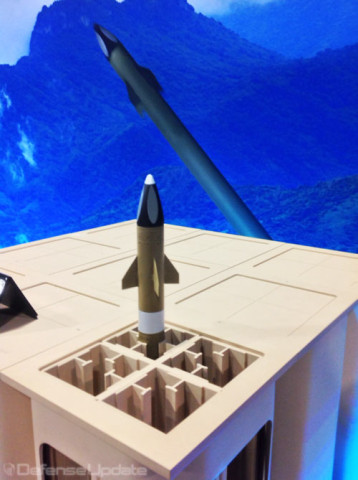
Typhoon MLS-NLOS (e.g. Non (greater than) Line of Sight)
The second system uses the Spike NLOS, a larger, longer ranged missile. We have seen this eight cell launcher before, on 62 meter Israeli designed patrol vessel built for Azerbaijan.

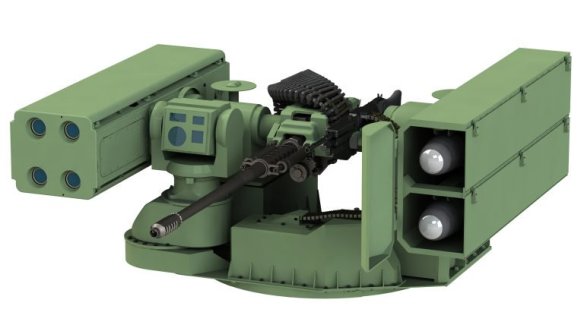
TYPHOON MLS NLOS has an eight cell Spike NLOS missile launcher and integrated Toplite stabilized observation and target acquisition system (same as on the Mk38 mod2). Photo: RAFAEL via defense-update.com
The Toplite is the same Electro-optic system mounted on our Mk38 mod2 gun mounts. The missile itself is about 50% larger than a Hellfire. The Wikipedia description is quoted below.
“Non Line Of Sight” is an ultra long-range version of the weapon, with a claimed maximum range of 25 km (16 mi). It is a significantly larger missile than other Spike variants, with an overall weight of around 70 kg (154 lb 5 oz). It can be launched from the ground or from helicopters. It was developed following lessons learned in the Yom Kippur War, which showed a need for a high-precision guided tactical ground-to-ground battlefield missile. Codenamed Tamuz (תמוז), the first variants entered service with the IDF in tandem with the Pereh missile carrier in 1981, though the existence of both was not revealed to the public until 2011. The Spike NLOS uses a fiber optic link similar to other Spike versions, but only out to 8 km, after which it employs a radio data link for command guidance.
In 2011 it also became known that in a highly unusual move, the British Army was hastily equipped with the missile, drawn directly from IDF inventory after being exposed to increasing insurgent attacks in Iraq and Afghanistan beginning in 2007. The UK initially acquired 600 missiles, which it designated EXACTOR-1 in British service, later procuring a more advanced variant designated EXACTOR-2. In a deal concluded on 6 September 2011, the South Korean government had agreed to purchase an unknown number of Spike NLOS missiles.
Rafael is working on expanding the missile’s versatility by enhancing the existing EO-IR/CCD seeker with semi-active laser (SAL) capability and different anti-armor, blast-penetration, and high-explosive fragmentation warheads to meet specific applications.
The Super Dvora III Class Patrol Boat:
While I started this post to talk about the missile systems, it seemed the Super Dvora III also has features worth discussing.
This boat is very similar in size to the Marine Protector Class WPBs. Dimensions are 90×18.6×3.6 feet for the Israeli and 87×19.4×5.6 feet for the WPB. The all aluminum construction of the Israeli boat has yielded much lighter displacement, ranging from 58 to 72 tons full load for the Israeli boat compared to 91 tons for the WPB. The lighter displacement would presumably result in both higher speed and lower fuel consumption. I am hoping the next WPB will be composite construction on the assumption that that would combine these advantages with corrosion resistance and lower maintenance.
The Israeli boat initially used an articulated surface drive but switched to a water jet. Both allowed these boats to operate in very shallow water. The Israeli boat is also much faster than the WPB (45 knots compared to 25 knots) for a relatively modest increase in power. (4,175 v 2,950 HP).
The Super Dvora Mk III’s weapons can be slaved to a mast-mounted, day/night, long range electro-optic systems. We will probably want such a system on our next WPB. It could aid in SAR, Law Enforcement, and navigation as well as weapons control.
The Israeli boat does not have a stern boat ramp and may not be as sea worthy as the WPB, but WPBs really are our “fast response cutters” so dash speed is a significant characteristic. I would expect the next WPB to be larger, faster, and better armed. If it could also operate in shallower water than our current WPBs that would also be desirable.

Photo: Israeli Shipyards’ Shaldag Patrol Boat with Spike ER launcher on superstructure aft.
Thanks to Lee for bringing these systems to my attention.





 Chuck Hill's CG Blog