
Chart of Paracel Islands. Image prepared by CIA
There has been much concern about China’s aggressive claims to nearly all of the South China Sea and how the rest of the world, particularly the Philippines, Vietnam, and the US will respond. The “Nine Dash Line” is an artifact of the mid-20th century, but claims on the islands go back to the 19th century.
In 1974 China and Vietnam came to blows over ownership of Paracel Islands, which are roughly equidistant from the Vietnamese coast and China’s Hainan Island.
The battle between the Navy’s of South Vietnam and the PRC is little known in the West, but it is apparently very important to the Chinese since the Peoples’ Liberation Army Navy (PLAN) has fought few battles in its relatively short history, and this is one they won, against what they portray as long odds.
I have long had an interest in the battle because two of the South Vietnamese vessels were former Coast Guard Cutters of the same class as my first ship out of the Academy, USCGC McCulloch (WHEC-386). I was transferred off shortly before she transited to join Coast Guard Squadron Three as part of Operation Market Time. With the end of the Ocean Station program and “Vietnamization,” seven of the class, as well as 26 WPBs, that were in country, were transferred to the Navy of South Vietnam. When Saigon fell, six of the seven former WHECs made it to the Philippines, later being inducted into the Philippine Navy. Surprisingly, another of the four Vietnamese ships in the battle had also served in the USCG.
I used three sources for this post,
Many of the photos come from a Chinese source.
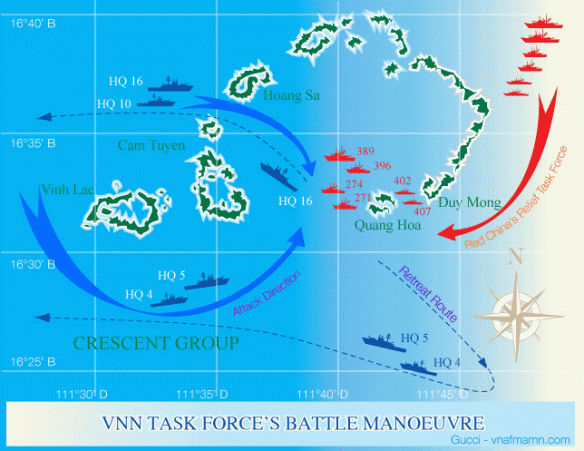
There was a lengthy standoff, but after the Chinese opened fire on a landing party reportedly under a flag of truce, killing three and wounding more, the Vietnamese Navy was given permission to open hostilities.
How the battle actually progressed is not really clear. There are apparently no track charts. The mechanics of the battle are missing so I will make some, hopefully informed, speculation about how it was actually fought.

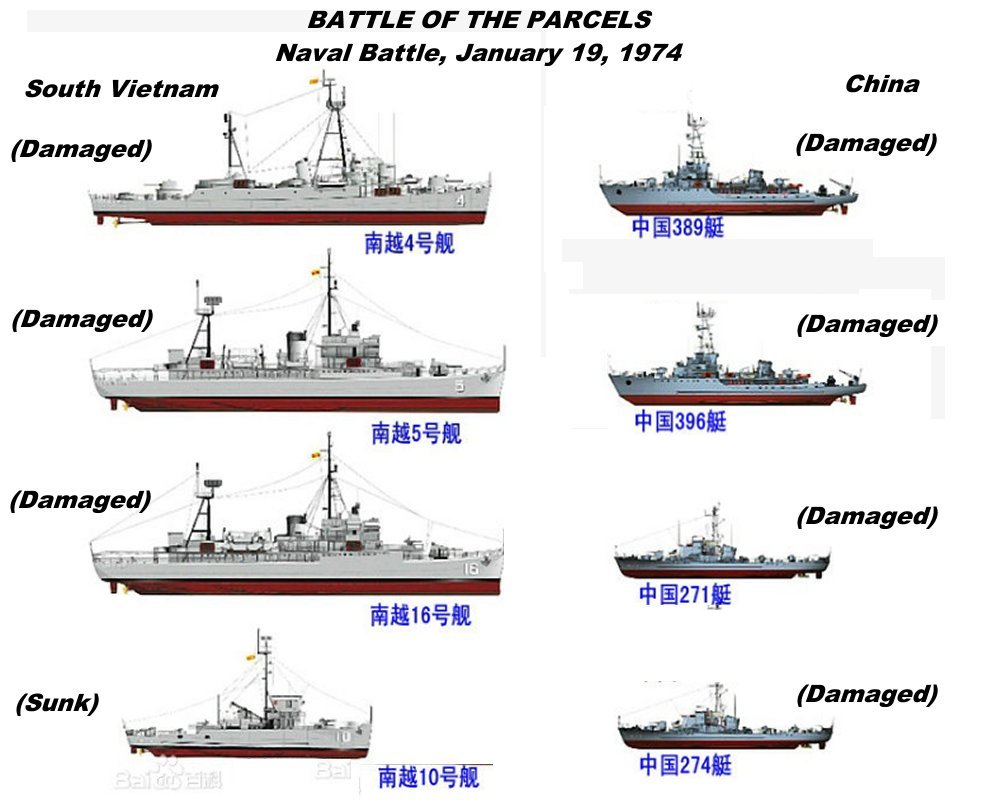
Participants in the Battle of the Paracels
The Participants:
There is conflicting information regarding the secondary weapons on the Vietnamese vessels and the types of vessels used by the Chinese, but the list below is what I interpret to be a reasonably accurate order of battle for the incident.
Vietnam
Two former Barnegat class small seaplane tenders,


- RVNS Trần Bình Trọng (HQ-05), the former USCGC Castle Rock (WAVP-383 later WHEC-383) and
- RVNS Lý Thường Kiệt (HQ-16), the former USCGC Chincoteague (WAVP-375 later WHEC-375) (The Vietnamese blog reports that this was the former USS/USCGC Bering Strait (AVP-34, WAVP-382/WHEC-382 but this is unlikely as she served as HQ-2)
By the time these two “311s” were transferred to Vietnam, most of their WWII armament, and all their ASW systems had been removed. As cutters they were armed with a single Mark 12 5″/38 caliber (127-mm) gun (55 pound projectile), four M2 Browning .50-caliber (12.7-millimeter) general-purpose machine guns, and perhaps two 81-mm mortars. The Vietnamese apparently added some weapons. A twin Bofors 40mm/56 gun mount is clearly visible on HQ-16 on the O-1 deck between the bridge and the 5″ mount. None of the pictures of HQ-05 I was able to find show a similar mount. Some sources say these vessels mounted four Bofors 40mm anti-aircraft gun mounts and four Mk. 4 single 20mm/70 Oerlikon anti-aircraft gun mounts, but I think this may have been their battery later while in Philippine service. These ships had a full load displacement of 2,800 tons, a length of 311 feet (95 meters), and a speed of 18 knots.

USS Forster (DER-334), the Vietnamese HQ-4
RVNS Trần Dư (HQ-04), the former USS Forster (DE-334) (WDE-434 while in Coast Guard service, 1951-1954). An Edsall class destroyer escort converted to a radar picket, armed with two rapid fire 3″/50 single mounts, two 20mm guns, and five .50 cal. machine guns. She had a full load displacement of 1,850 tons, a length of 306 feet (93.3 meters), and a speed of 20 knots, marginally faster than the 311s. This was perhaps the most capable of the Vietnamese combatants. It’s two 3″50s were in Mk34 mounts fore and aft, each with a rate of fire of 50 rounds per minute, two guns and the higher rate of fire, more than making up for their lighter (13 pounds) projectile. It also had the best fire control system, a Mk63.

HQ-10, an Admirable class minesweeper converted to a patrol vessel
RVNS Nhựt Tảo (HQ-10), the former USS Serene (AM-300) an Admirable class steel hulled minesweeper converted to a patrol craft, armed with a 3″/50 and two twin 40mm Bofors guns and six 20mm. She had a full load displacement of 853 tons, a length of 184.5 feet (56.3 m) and a nominal speed of 15 knots, but had had a casualty to one of her two main diesels engines before the battle, and was enroute to have it repaired when diverted to the scene of the battle. She was probably capable of only about 11 knots. This was by far the weakest of the Vietnamese ships. Her single 3″/50 was manually loaded and had no radar fire control.
China

T-396
Two Type 010 minesweepers, hull numbers 389 and 396, a variant of the Soviet T-43 steel hull minesweeper but used as patrol vessels. If I interpret the Chinese illustration above correctly, it appears that they were armed differently. #396 armed with a twin 37mm/67 guns, two twin 25mm guns and two twin 14.5mm/93 machineguns. #389 armed with an 85mm/52 dual purpose mount (20 pound projectile), a twin 37mm gun, and two twin 25mm guns. They had a full load displacement of 600 tons, were 197 feet (60 meters) in length, with a speed of 14 knots.

Two Project 122bis (NATO codename Kronshtadt class) submarine chasers hull numbers 271 and 274 armed with an 85mm gun, twin 37mm/67 guns, and three twin 14.5mm/93 machineguns. They also had ASW rocket launchers that might have been usable against surface ships at close range. About the size of the Webber class WPCs, they were 338 tons full load, 52.24 m (171.4 ft) loa, with a speed reported anywhere from 18 knots to 24.
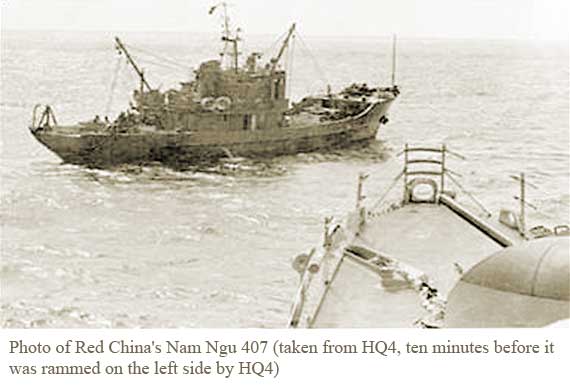
Two armored (presumably meaning armed) trawlers (presumably hull numbers 402 and 407). These did not participate in the battle.

Type 037, Hainan class subchaser #281

Type 037 Hainan class sub-chaser, two twin 57mm on the main deck fore and aft, two twin 25mm on the O-1 deck fore and aft. RBU1200s on the foc’sle.
Two additional small surface combatants 281 and 282 Type 037 Hainan Class sub-chasers, arrived too late to participate in the fight, but their impending arrival possibly influencing the decision to leave the field of battle. These 430 ton craft were 58.77 m (192 ft 10 in) long with a speed of over 30 knots. They were armed with four (2×2) 57mm guns and four (2×2) 25mm guns, four 5 tube RBU-1200 launchers.
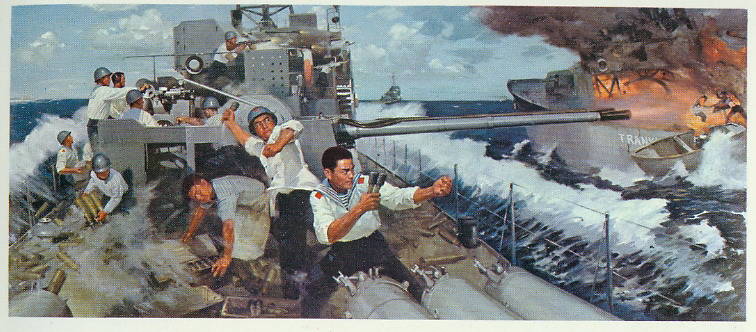
Chinese depiction of the fighting. I think there may have been some artistic license taken.

Chinese vessel damaged after the battle. Presumably T-389, which was intentionally grounded to prevent it sinking. Reportedly it was refloated.

HQ16 after the battle. Note the twin 40mm on the O-1 deck forward of the bridge.
QUESTIONS:
Why didn’t the Vietnamese use their range advantage?
It would appear that the Vietnamese had a range advantage with their two larger 5″ guns, but it was not possible to remain entirely outside the range of the Chinese guns. While the two 5″ had a nominal range of 18,200 yards (16,640 m), the Chinese 85mm guns had a range of 17,000 yards (15,565 m). Those ranges are not realistic, in addition to the fact it is almost impossible to achieve hits at max range against moving targets, we also have to consider the fire control system. I don’t have information on the Chinese firecontrol, but the Mk52 fire control on the two former Coast Guard cutters is very familiar and it has significant weaknesses as an anti-ship system.

Mk52 Gun Fire Control Director with Mk15 Gyro Sight and Mk26 radar
The Mk52 is a relative-rate fire control systems have been designed to engage air contacts at short or medium ranges. The gun target line is established by a crewman using handle bars, pointing the director at the target. Consequently it is responsive to fast moving targets, but lacks the precision required to fully exploit the maximum range of the 5″/38s. On destroyers and larger vessels, it was used only as a secondary fire control system for 5″ guns.
More about the range advantage later.
Why did the Vietnamese loose when they seemed to have the advantage?
The Vietnamese forces were at least equal in terms of their medium gun systems. They may have had a disadvantage in heavy machine guns, but that should have been offset by their much greater displacement. Four Vietnamese ships had a total full load displacement of 8,303 tons while the four Chinese ships that engaged them had a total full load displacement of 1,876 tons. It might be noted that all four the Vietnamese ships combined, were less well armed than a single Fletcher class destroyer as they were equipped at the end of WWII (five 5″/38s, fourteen 40mm, twelve 20mm, and five torpedo tubes).
Looking at the diagram above, you can see that the Vietnamese forces were split with two ships North of a reef labeled “Antelope” or “Bai da Ngam” and two ships South. If correct, this puts the two groups nine to ten miles apart, too far apart for mutual support, allowing the Chinese to deal with the groups consecutively. It may have been a conscious decision; it may have been that the Northern group opened fire first (which apparently they did at 10:24 AM), but for what ever reason, it appears they may have concentrated first on the Northern group which was the weaker of the two, with one former cutter (HQ-16) and the former minesweeper (HQ-10) slowed by an engine casualty. These two ships were the most heavily damaged in the fighting. The minesweeper was sunk and HQ-16 limped away listing with heavy damage.
The HQ-16 was reportedly hit by fire from the HQ-5, suggesting HQ-5 must have been far enough away that they could mistake their sister ship for a Chinese vessel. Since the battle only lasted 40 minutes it is unlike the Southern group ever closed sufficiently to support the Northern group. With the sinking of HQ-10 and the withdrawal of HQ-16 of the Northern group, the Southern group apparently decided they were outgunned and withdrew after exchanging.
What was the reported guided missile?
” Nhựt Tảo took a direct hit from a
ship-to-ship missile (China claims the weapon used was an RPG) on her bridge and went dead in the water.”
There are several references to guided missiles on the Chinese ships, and reports that the RVNS Nhựt Tảo (HQ-10), the former USS Serene (AM-300), was hit by a missile in spite of the fact that none of the Chinese ships were equipped with anti-ship guided missiles. I think it is possible the Chinese may have used their RBU-1200 anti-submarine rockets as an anti-ship weapon.

RBU-1200 rocket launchers, mounted on the bow of a small ASW vessel. The gun mount is a twin 25mm.
The RBU-1200 is an ASW rocket launcher with a range of 1200 meters (1310 yards). Projectile diameter is 250mm (9.8″) with a weight of 154 pounds (70 kg). The warhead weight was 75 pounds (34 kg). The typical launcher consisted of five tubes and most installations included multiple launchers, usually four, for a total salvo of up to 20 rockets. The rockets explode at a programmed depth or on contact. I believe I have seen that these weapons are sometimes used for shore bombardment, so presumably they would explode if they hit a ship.
The Chinese were reported to have said they had hit the ship with an RPG, a rocket propelled grenade. Rocket propelled projectiles like the RBU-1200 are some times referred to a grenades, so this may have been the type of “Rocket Propelled Grenade” they referred to.
“The smaller Chinese warships managed to maneuver into the blind spots of the main cannons on the Vietnamese warships.”
If they had attempted this, a counter might have been something like the “Thach Weave” which naval aviators in World War II when engaging faster more maneuverable Zero fighter aircraft. Wingmen alternately passing under the stern of the other aircraft to clear his “six.”
I suspect this only happened in the case of the HQ-10 and only after its one operating engine was disabled. When the crew manning its aft mounted 40mm guns were killed, which happened twice, it became essentially defenseless. This does lead to another observation.
The crews of automatic weapons on the Chinese ships were better protected than those on the Vietnamese ships.

Chinese (Soviet) 25mm
Looking at the installation of the 37, 25, and 14.5mm guns on the Chinese ships, it is apparent that their crews were better protected than those manning the 40, 20, and 12.7mm (.50 cal.) guns on the Vietnamese ships. If the Vietnamese guns were protected at all, it was only by shields protecting the crew from the direction the guns were pointed. Additionally the 3″/50s on HQ-10 and HQ-4 had no ballistic protection for the crews. By contrast the Chinese had wrap around protection that at least some extent protected their crews from effects of explosions that might occur to the side or in some cases behind the crew. The 85mm guns were shielded by what appears to be a complete enclosure, similar to those on the 5″/38s. The lack of protection endangers not only the gun crew, but also the ship they are trying to protect. I am still concerned about the lack of protection for Coast Guard gun crews manning .50 caliber machine guns and early model crew served 25mm Mk38s.

Chinese (Soviet) 37mm twin

Soviet era 14.5mm twin heavy machine gun. The Chinese also made a twin 14.5mm that looked much like the 25mm above, with the guns stacked vertically.
The Butcher’s Bill:

According to Wikipedia:
The South Vietnamese reported that the warship HQ-10 was sunk and the HQ-16 heavily damaged, while the HQ-5 and HQ-4 were both slightly damaged. 53 Vietnamese soldiers, including Captain Ngụy Văn Thà of HQ-10, were killed, and 16 were injured. On January 20, 1974, the Dutch tanker, Kopionella, found and rescued 23 survivors of the sunken HQ-10. On January 29, 1974, Vietnamese fishermen found 15 Vietnamese soldiers near Mũi Yến (Qui Nhơn) who had fought on Quang Hòa island and escaped in lifeboats.
After their successful amphibious assault on January 20, the Chinese held 48 prisoners, including an American advisor. They were later released in Hong Kong through the Red Cross.
The Chinese claimed that even though its ships had all been hit numerous times, none of them had been sunk. Warships #271 and #396 suffered speed-reducing damage to their engines, but both returned to port safely and were repaired. Warship #274 was damaged more extensively and had to stop at Yongxing Island for emergency repairs. It returned to Hainan under its own power the next day. Warship #389 was damaged the most by an engine room explosion. Its captain managed to run his ship aground and put out the fire with the help of the minesweepers. It was then towed back to base. China confirmed a total of 18 deaths among its forces.
The Vietnamese claimed greater damage to the Chinese forces including a sinking. Could the Chinese be lying? I doubt it, but it is certainly possible. We cannot assume either side would never attempt to shape the narrative for their own purposes. In any case it makes little difference in the long run.
When it ended:
After the battle, the Chinese doubled down on their commitment, bringing in additional reinforcements.
The Vietnamese made no further effort to reclaim the islands and left their remaining small garrisons to be captured by larger Chinese landing parties.
How it might have been done differently:
It appears the Vietnamese made two preliminary mistakes.
- Splitting their forces and
- Including HQ-10 in their force.
The error of splitting the force should be obvious. The HQ-10 was too weak to add much to the offensive capability of the force, and its reduced speed made her a liability. The Chinese were able to easily overtake and overwhelm her.
What should have been done with the other three ships (two 311s and the DER)? Operating as a unit, the Vietnamese would have had an advantage in medium range weapons (2×5″ plus 2×3″ rapid fire mounts vs 3x85mm) while at shorter range, the Chinese’ eight 37mm, eight 25mm, and sixteen 14.5mm might have tipped the balance the other way.
The Vietnamese would have had a speed advantage over at least two of the four Chinese vessels.
Rather than rushing to close the range, the Vietnamese should have tried to maintain a range to target within its effective range, less than 10,000 yard–optimally about 7,000 yards, but outside the effective range of the Chinese 37mm and smaller weapons–less than 5,000 yards. Optimally the Chinese would have wanted to be inside 2,000 yards.
For the Chinese to attempt to run would be suicidal, because Vietnamese could maintain a range, at least on the two slowest warships and the two trawlers, most favorable for them.
Assuming the Chinese attempted to close the range, the Vietnamese probably would not want to simply turn directly away, at least not for any length of time, because they would then only have one 3″/50 that could bear, while the Chinese could bring all three of their 85mm to bear. They could, however, by turning slightly away from the Chinese, going 18 knots, and keeping their enemy at about 120 or 240 degrees relative, slow their approach and allow virtually unlimited time to attrite the Chinese. The resulting track would approximate a circle with the Vietnamese on the outside and the Chinese on a shorter radius circle inside.
Hindsight is 20/20 and I benefitted from both better information about the opposing forces and much more time to think about it than the men who were actually there, so perhaps it would be unfair to be critical.






 Chuck Hill's CG Blog