“The Pentagon is buying the wrong ship, and it’s costing taxpayers billions”–David Axe

cyclone-crafts-1

Cyclone-class boats before the modernization program in formation. Courtesy of U.S. NAVY

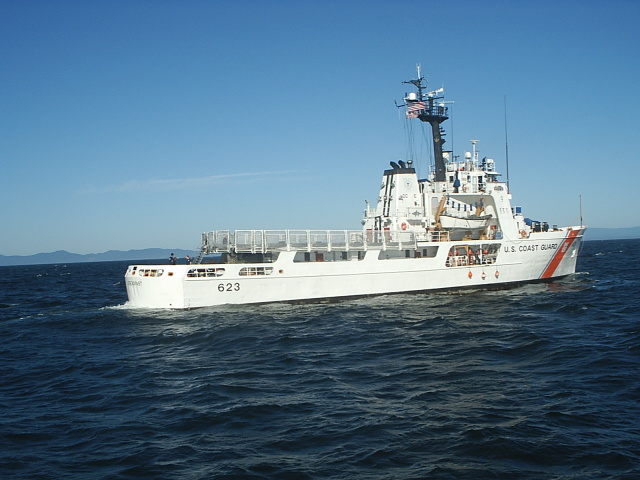
Influential defense columnist David Axe has written a piece picked up by Reuters that advocates that the Navy buy Webber class PCs instead of Littoral Combat Ships as replacements for the Cyclone class patrol craft currently homeported in Bahrain.

“It just so happens that Bollinger Shipyards, the same Louisiana shipyard that built the Cyclones, is building Sentinel-class boats for the Coast Guard that are roughly the same size as the Navy vessels, far more modern and reasonably priced at just $70 million a boat.

“If the Navy bought 10 fewer Littoral ships and acquired 10 new patrol boats for $70 million apiece instead, it would represent a net savings of more than $3 billion in ship construction costs while also boosting national security.

While I can’t totally agree with Mr. Axe, making the Webber class dual service would almost certainly provide some benefit to the Coast Guard in terms of training, future modernization, and long term sustainability.

RAF Retiring C-130Js, Perhaps an Opportunity

800px-USCG_C130_Hercules

The RAF is reportedly planning on premature retirement of its fleet of 24 C-130J transport aircraft, so that they will have a homogenous fleet of Airbus A400M transports.

The plan is the C-130J will be gradually withdrawn starting next year as the RAF ramps up operations of the first of 22 Airbus A400M airlifters, due to complete delivery by the end of 2018.

This might be an opportunity for the Coast Guard to replace the remaining H models that make up the majority of its C-130 fleet with the more capable J models, at much less than the cost of new aircraft.

“Substandard” or Whistleblower

Samsung

US Coast Guard photo

I don’t normally comment on CO reliefs. You can never know the full story looking in from the outside, and this is certainly the case here, but something is going on in the 13th district.

The Navy Times is reporting, Cdr. John Bitterman, commanding officer of the cutter Steadfast since July, “was fired for loss of confidence on Monday in the midst of an ongoing investigation…”

This seems to be a bit different, in that Cdr. Bitterman is claiming he is being fired not because of his performance, but because he reported the unsatisfactory condition of his ship, “… it was in such a state of disrepair — with moldy mattresses, lead contamination, bad decking —— that he asked his leadership for money to fix things up…His requests were denied…and the mix of the ship’s condition, the high operational tempo and the crew’s already rock-bottom morale led to his temporary relief.”

I have to wonder, is this going to be a trend? Steadfast is a 47 year old ship, and actually one of the newer 210s. Currently planned production of the Offshore Patrol Cutter suggest the last 210 will not be replaced until 2028 at which time it will be at least 59 years old.

Perhaps the Coast Guard will have to acknowledge, at some point, that they will have to retire ships without replacement.

Mini-Aegis Possible for Corvette (or Cutter) Sized Ships

NavyRecognition reports on the presentation of the Raytheon’s AN/SPY6(V) Air and Missile Defense Radar at the recently completed SEA-AIR-SPACE trade show.

This is the radar that has been selected to go on the Flight III version of the Burke class DDG. Most of the emphasis has been on larger installations, but the good news for the Coast Guard is that these systems are modular, based on two foot square elements than each constitute a separate radar, so that it can be scaled down as well as up. These fixed arrays would normally be arranged with four arrays positioned to each cover a 90 degree sector. Raytheon claims arrays consisting of nine elements arranged in a 3×3 square (6 ft x 6 ft) provides performance similar to the 12 foot octagonal AN/SPY-1D on existing Burke class DDGs. It appears the intention is that the Flight III ships will have roughly octagonal arrays consisting of 37 elements, 14 foot across. There is also an option for an even larger array of 69 elements in an octagonal 18 foot diameter array.

These radars are reportedly capable of performing virtually every type of radar function including air and surface search and firecontrol. Reportedly the radar will be “qualified” in 2017 and the initial operational capability will be attained in 2023, presumably with the first flight III DDG.

When might we consider using these?

The Bertholf was commissioned in 2008 so the class will start needing mid-life renovations some time after 2023.

The Offshore Patrol Cutter construction program is expected to be stretched out with funding over 15 years and deliveries will probably extend from FY2021 to FY2035. Over so long a period it would not be unreasonable to expect that there will be a “B class” with updated systems. By that time, these systems may be so common it may be reasonable to replace the planned radar suite with these fixed systems.

At the very least, at some point it might be advisable to convert at least one of each class to accept this or a similar system as a prototype for war emergency conversion. This might be something DOD would pay for.

Russia’s Oblique Icebreaker

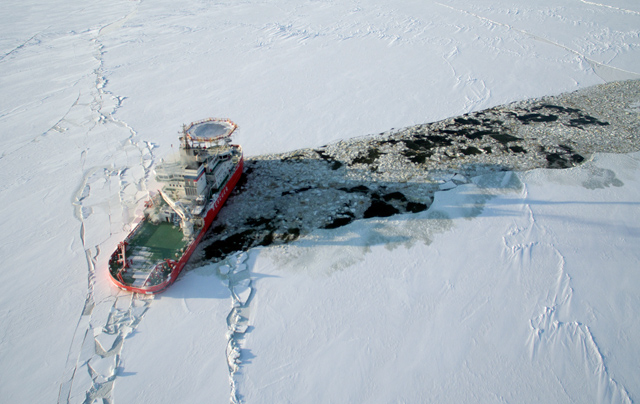
baltica_icebreaking

Photo: Acker Arctic, Russian Icebreaker Baltika

gCaptain reports successful completion of trials of Russia new concept icebreaker Baltika. The unique design allows the relatively small icebreaker, similar in size and power to USCGC Mackinaw, to open a channel wider than its own beam. The ship has a beam of 20.5 meters but has demonstrated the ability to open a 50 meter wide channel.

According to Project Manager Mika Hovilainen who was on board the vessel during the ice trials, “Baltika’s voyage to the Gulf of Ob proves the exceptional operational capability of the oblique icebreaker concept in very difficult ice conditions. The vessel could operate in ice conditions that exceeded the design criteria used as the basis of the vessel concept. Baltika could carry out the same operations as conventional icebreakers with just half of the propulsion power as well as perform maneuvers which are not possible for any other vessel currently in service.”