Maritime Counter-Insurgency/Stabilization

Gun crew on board USCGC Point Comfort (WPB-82317) firing 81mm mortar during bombardment of suspected Viet Cong staging area one mile behind An Thoi.(August 1965)

Good discussion of the maritime dimensions of “small wars” here.

Insurgencies, failed states, piracy, terrorism all look pretty much like law enforcement and require similar resources. It requires maritime “boots on the ground” in the form of patrolling vessels to do VBSS, including those that can operate in shallow water . The Navy has shown little interest in this type of warfare. Certainly their resources for these types of operations are limited.

When Operation Market time began in 1965, the Navy had 880 ships in the fleet including 287 cruisers, destroyers, and frigates, but that did not mean they did not see a need to bring in 26 Coast Guard 82 foot patrol boats and build 193 Swift boats. Currently the US Navy has about 273 deployable ships including about 100 cruisers, destroyers, frigates, and LCS, plus 13 PCs and the first of their 85 foot Mk VI boats plus a few smaller boats.

It is the nature of these conflicts, that the Navy will never be able to divert all its assets to address the threat. They will continue to worry about and employ assets to counter other threats.

This is an area where the DOD might want to consider funding Coast Guard forces to be available for contingencies to supplement the Navy’s resources. After all the Coast Guard is the country’s primary repository for knowledge about these types of missions. A decision might be based on a poll of the six Combatant Commander’s views of their requirements. It would not be necessary to be able to meet all these contingencies simultaneously, although two trouble spots is certainly a possibility, but choosing the most demanding could provide a good baseline.

USCGC_Owasco_(WHEC-39)_conducting_UNREP_Market_Time

Info Request–MH-68

I have received a request for information on past Coast Guard operations that I could not answer, but perhaps a reader could help:

I wonder if you can help me out. I’m just conducting some research into the embarked operation of the A109 (MH-68A in USCG speak) at sea. I am trying to find out if the USCG ever embarked the MH-68A for extended periods and, if they did, were the main rotor blades of the helicopter folded to allow it to be stowed in the ship’s hangar? Do you know if this was the case? Or did they remain on deck? Or completely remove the blades each time the aircraft was stowed?

I believe the Philippine Navy is operating this aircraft off their 378s now.

Just for fun, I added the video above. It does not show the aircraft being hangared, but it does show the boots used over the rotor tips to keep them from flapping in the wind, when the helo was secured on the flight deck. Beside it includes one of my favorite 378 COs.

Anyone know if the MH-68 was ever hangared on shipboard?


Towed Airborne Lift of Naval Systems (TALONS)

DARPA’s Towed Airborne Lift of Naval Systems (TALONS) effort seeks to develop a low-cost, fully automated parafoil system to extend small ships’ long-distance communications and improve their maritime domain awareness. DARPA developed TALONS as part of Tern, a joint program between DARPA and the U.S. Navy’s Office of Naval Research that seeks to enable forward-deployed small ships to serve as mobile launch and recovery sites for medium-altitude, long-endurance unmanned aerial systems.

Navy Recognition reports on two initiatives that are part of the TERN,  “a joint program between DARPA and the U.S. Navy’s Office of Naval Research that seeks to enable forward-deployed small ships to serve as mobile launch and recovery sites for medium-altitude, long-endurance unmanned aerial systems.”

We have talked about TERN before, it is intended to allow the LCS and similar sized ships to have persistent overhead surveillance by Unmanned Air Systems (UAS). The post talks about a launch and recovery system for fixed wing UAS, “SideArm,” but there is also this discussion of a towed system that looks like it might be applicable to units as small as WPBs and give them many of the advantages of a UAS with far less overhead.

DARPA’s TALONS effort seeks to develop a low-cost, fully automated parafoil system to extend small ships’ long-distance communications and improve their maritime domain awareness. Towed behind boats or ships, TALONS could carry ISR and communications payloads of up to 150 pounds between 500 and 1,500 feet in altitude—many times higher than current ships’ masts—and greatly extend the equipment’s range and effectiveness. Following successful ground-based tests, DARPA will conduct at-sea testing this year and potentially transition the technology to the U.S. Navy.

Why is this important? With a mast head height of say 36 feet the horizon distance is only about 7 nautical miles. Go to 500 feet and it is over 26 miles. Go to 1500 feet and it is over 45 miles. Effectively search widths could be multiplied several times over.

It doesn’t take much power to keep a parafoil up. In my neighborhood, there is a good sized man who flies a powered foot launched version out of our local open space. He has the engine and prop on his back, launches into the wind with just a short walk or run. Landings are frequently at walking speeds. That people (admittedly braver than I) are willing to entrust their lives to these things has to say something about their reliability.

(Historical note: During WWII, the Germans used an manned unpowered autogyro, the Focke-Achgelis FA-330, that was towed behind U-boats in an effort to extend their visible horizon.)

Innovative Gun Mount

Photo credit: MKIF. 57 mm Bofors Mk 3 gun in stealth turret at the bow of Swedish Visby class corvette Nyköping (K34) in Aura river in Turku during the Northern Coasts 2014 exercise public pre sail event.

Photo credit: MKFI. 57 mm Bofors Mk 3 gun in stealth turret at the bow of Swedish Visby class corvette Nyköping (K34) in Aura river in Turku during the Northern Coasts 2014 exercise public pre sail event.

NavyRecognition has an update on the Malaysian Gowind project. This light frigate is probably similar to what VT Halter might have come up with for the OPC, less the missiles and ASW equipment of course, but I would particularly like to take notice of the way the Bofors 57mm Mk3 mount which is otherwise essentially identical to our Mk110 mounts, is treated. It is similar to the installation in the photo above.

When the CG first fielded the 270s, we had problems with green water coming over the bow and impacting the gun. The Malaysian frigate has a fixed structure, with doors on top, where the gun barrel is recessed forward of the rotating gun shield that is intended to make the mount more stealthy, but it looks like it would also protect the mount from heavy seas as well. That might be reason enough for the CG to do something similar.

A Common Operating Picture?

Navy photo, experimental ship Stilleto

This sounds like it might be something the Coast Guard might be interested in.

PSS CDS receives critical data from multiple sensors and offers two-way sharing of information and commands across both classified and unclassified domains. Intersect™ Sentry is an automation and analysis tool that creates alerts from a variety of intelligence, sensor and reconnaissance data streams according to parameters defined by the user. Both systems have been successfully demonstrated in support of joint and coalition maritime operations.

Whatever that actually means, it sounds good, and it fits on something WPB sized.

New Info on China’s Navy and coast guards–ONI

File:Logo of the China Coast Guard.png

China Coast Guard Crest

The Office of Naval Intelligence (ONI) has issued incredibly detailed information on China’s Navy and para-military naval organizations in an unclassified form.

Perhaps most impressive is the PLA Navy Identification Guide which includes their coast guards. The sheer number of vessels in their coast guard type organizations is staggering.

The Diplomat offers their take on these new intelligence products. The author, “Andrew S. Erickson is an Associate Professor in the Strategic Research Department at the U.S. Naval War College and a core founding member of the department’s China Maritime Studies Institute (CMSI). He serves on the Naval War College Review’s Editorial Board.”

You can access all of these products here.


New Icebreaker–For the Great Lakes?

Launch of USCGC Mackinaw (WLBB-30) on April 2, 2005. Photo by Peter J. Markham.

Launch of USCGC Mackinaw (WLBB-30) on April 2, 2005. Photo by Peter J. Markham.

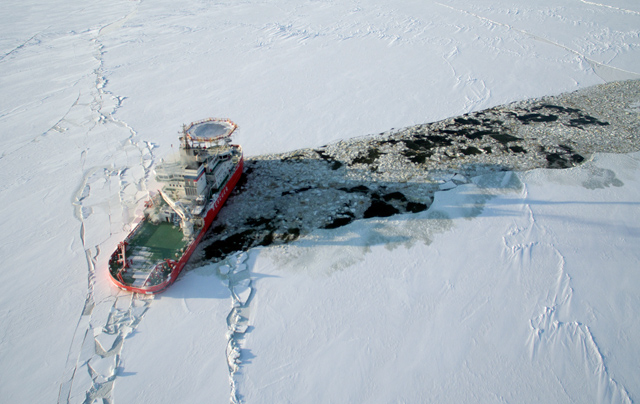
gCaptain is reporting that the severe conditions in the Great Lakes over the last two winters and the resulting loss of iron production, have prompted support for another Great Lakes icebreaker at least as large as Mackinaw.

“This is the second year in a row a brutal winter has slowed early season shipments of iron ore and other cargos on the Lakes. In April 2014, shipments of iron ore totaled just 2.7 million tons, a staggering 53.3 percent below the month’s long-term average.

“As a result, Rep. Candice Miller (R-MI) included a provision in the Coast Guard Authorization Act of 2015 (H.R. 1987) approved by the House Transportation and Infrastructure Committee that directs the U.S. Coast Guard to design and build a new, multi-mission icebreaker to enhance its capabilities on the Great Lakes.”

This could be an opportunity not only to build another icebreaker for the Great Lakes but also to design the three Medium Icebreakers the High Latitude Study has shown the Coast Guard needs.

A ship along the lines of Russia’s new oblique icebreaker would be particularly useful in the Great Lakes in that it would open a channel wider than the beam of the icebreaker itself.

baltica_icebreaking