Cutter Boat, AtoN, Medium
9

“Waters Deep” by Eileen Mahoney
“In Ocean waves no poppies blow
No crosses stand in ordered row
Their young hearts sleep beneath the wave
The spirited, the good, and the brave,
But stars a …constant vigil keep,
For them who lie beneath the deep,
‘Tis true you cannot kneel in prayer,
On a certain spot and think he’s there
But you can to the ocean go
See whitecaps marching row on row;
Know one for him will always ride,
In and out with every tide,
And when your span of life is passed
He’ll meet you at the ‘Captain’s Mast’
And they who mourn on distant shore,
For sailors who will come home no more,
Can dry their tears and pray for these
Who rest beneath the heaving seas,
For stars that shine and winds that blow
And whitecaps marching row on row
And they can never lonely be,
For when they lived They choose the sea.”
It is Memorial Day. If you are looking for a reminder of Coast Guard history, you might want to check out some of the links on the Heritage page.
The Naval Institute has posted a guide to museum ships.
They are not all Coast Guard, not even a majority, but there are a number of Coast Guard ships on the list.
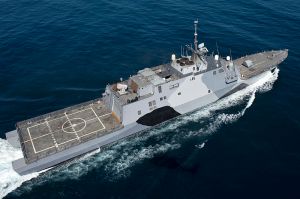
US Navy Photo. USS Freedom
Marinelink is reporting that LCS-1, USS Freedom, has completed “Rough Water Trials” (Seakeeping and Structural Loads Trials) off the coast of Oregon. A couple of thoughts.
Did we do these instrumented tests with either the National Security Cutter or a Webber class?
The Navy took quite a while before they got around to doing these and has already made a lot of decisions in the absence of test results.
May 29, the Commandant will be answering questions posted on his Facebook page. Coast Guard Compass has the details and some background.
The President spoke at the graduation ceremony for the Coast Guard Academy class of 2015. You can read the text of the speech here.

We got word today of an interesting development in the Senate from frequent contributor Tups.
“Today, U.S. Senators Maria Cantwell (D-WA) and Lisa Murkowski (R- AK) introduced the Icebreaker Recapitalization Act. The bill would authorize the U.S. Navy to construct up to 6 heavy icebreakers. The new icebreakers would be designed and operated by the Coast Guard. The Coast Guard is the sole service responsible for icebreaking missions.”
Here is the announcement of the bill.
The actual bill is here (pdf).
I note few things about how this bill and how it was written.
USNI is reporting the Navy is launching a new system that they hope will allow bottom up innovation including answers to specific command problems.
Looks interesting. It does require a Navy e-mail address to join.
Perhaps if it works the Coast Guard could use the same system.
Defense News reports that Pakistan is planning a new force to protect its ports and Exclusive Economic Zone. There are few details except that it should have 12,000 members. There is speculation that it will incorporate the existing Maritime Safety Agency which is a maritime agency under control of the Navy and their existing Coast Guard which is a shore-side agency under control of the Army.
When I first learned that the Navy had a 30 year shipbuilding plan, I thought it was silly, too many unknowns, too many variables. But I have changed my mind. The Coast Guard has made a serious tactical error in not paralleling the Navy planning process and creating a similar annual 30 year plan.
In the federal government budget process, the default allocation is that an agency will get the same proportion of the budget they got last year, in fact the same amount they got last year adjusted for inflation. The Coast Guard has not even been getting that. Increasing that proportion is always difficult.
When you concentrate on only one project at a time (it has been the National Security Cutter, now it is becoming the Offshore Patrol Cutter or OPC) without recognizing all the work that will be required in out years, it is too easy for Congress and the Administration to figure they can stretch out the project at hand without realizing it results in a growing backlog. Current Coast Guard public planning budget documents generally look only five years ahead, but most procurements take at least ten years to realize. The Navy considers ten years “near term” planning. The OPC project, as currently planned, will require funding at least through FY2030 and almost certainly some follow-up beyond that.
But FY2030 is not an end point. Keeping in mind that typically we need to start planning for replacement ten years before it is actually needed, the Coast Guard will not only need Polar Icebreakers, it will also need to begin several more replacement projects:
We need a plan to replace them all. We need to look at least 30 years into the future which would now mean FY2046. It would be the best argument for a realistic Coast Guard shipbuilding budget.
This is the Navy’s latest 30 year plan in tabular format.
 Chuck Hill's CG Blog