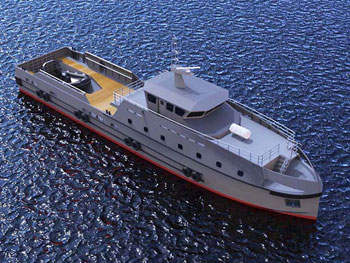
Inevitably the CG will want to replace its Marine Protector class WPBs. MarineLog reports construction of a class that look like something that might be considered. Yes, they are bigger than the existing WPBs, but at 35 meters (115′) vice 47 meters (154′), they are significantly smaller than the Webber class. Even so they can make 29 knots and have provision for an 8 meter RHIB.
Canadian Naval Review
One of our regular contributors, Lee Walher, has brought to my attention a publication I had not been familiar with, the Canadian Naval Review.
It seems to be a publication that addresses many issues that are common among coast guards and medium to small sized navies.
The publication is supported by subscription and sponsors. The full current edition is available only to subscribers, but in fact, it looks like virtually all the content is readily available. In addition, it appears that after a couple of months, full access is available to a pdf edition, via the Achieves and Index page.
This is the table of contents for the current edition.
Editorial: Always the Bridesmaid, Never the Bride, Ann Griffiths
The Case for a More Combat-Capable Arctic Offshore Patrol Ship, Rob Huebert
NOPEC: A Game Worth Playing?, Andrew Bergel
Interoperability and the Future of the Royal Canadian Navy, Andrew Touesnard
A Clash of Naval Strategies in the Asia-Pacific Region, Brian Wentzell
Most Capable Design or Most Qualified Team?, Janet Thorsteinson
Making Waves AOPS and the NSPS: Wishful Sinking?, Danford W. Middlemiss
Collaborative Naval Procurement: Lessons from the ANZAC Frigate Build, Jeffrey Collins
A View From the West: Reefs of Discontent in the South China Sea, Brett Witthoeft
Dollars and Sense: Can DND Afford New Submarines?, Dave Perry
Warship Developments: Flexible Examples from Offshore, Doug Thomas
Human Capital and the National Shipbuilding Procurement Strategy, Commander Ian Wood
Book Reviews
“Air Force looking at using Ospreys for search and rescue”–Air Force Times
USAF CV-22, DOD photo
The Air Force Times is reporting the Air Force is considering using the V-22 Osprey for SAR, at least Combat SAR. They see these platforms as having an advantage where speed is critical. They also recognize that in other circumstances, agility may be more important, so they are not considering wholesale replacement of helicopters with these relatively large aircraft. The planned purchase of 112 HH-60W next-generation Black Hawk helicopters is still expected to go ahead.
It may be worth noting the Marines are already using their MV-22 for combat SAR.
In the not to distant future, we may have aircraft that combine the agility of the H-60 with the speed of the V-22.
OBANGAME EXPRESS 2015: Two steps forward. One step back.–CIMSEC
Very interesting and balanced assessment of an exercise in the Gulf of Guinea from a German observer describing the successes and failures in attempting coordination between nations with long held suspicions and distrust.
Former USCG 378 figures prominently in an accompanying photo.
This is an important, but difficult area to work in. Fractured politically, the exercise included 23 nations. This was a US sponsored exercise, but it had substantial European participation.
Nice to see an honest exercise report, that is more than all sweetness and light.
CG funding, DHS not interested, Perhaps DOD would be
I’ve read reports of Congressional hearings lately that, combined with the continual erosion of Coast Guard AC&I funding have crystalized my view that the Coast Guard’s funding methods need some tweeking.
SOUTHCOM
First there is this story of SOUTHCOM (Marine Gen. John Kelly)’s testimony before the Senate Armed Services Committee in which he pleads for additional Coast Guard cutters to allow him to act on intelligence his organization already has.
“We got 158 metric tons of cocaine last year, without violence, before it ever even made it to Central America,” he said. “I do that with very, very few ships. I know that if sequestration’s happened, I would be down to maybe one, maybe two, Coast Guard cutters. That means, of the 158 tons that I would expect to get this year, I’d probably, if I’m lucky, get 20 tons. All the rest would just come into the United States along this incredible efficient network.”
He later explained, “Once it gets ashore in Central America and moves up through Mexico, we’re taking almost nothing off the market.”
General Kelly has taken to using unusually strong language including the words “defeat” and “existential theat.”
He also suggests that returning ISIS fighters might use the drug and people smuggling routes to enter the US from Latin America
NORTHCOM
Then there is this post from DefenseNews, reporting fireworks, as the Senate Armed Services Committee grilled Adm. William Gortney (NORTHCOM), Thomas Dee (Deputy Assistant Secretary of the Navy for Expeditionary Programs and Logistics) and Vice Adm. Charles Michel (Coast Guard’s Deputy Commandant for Operations) about the Armed Services’ ability to operate in the Arctic and particularly about procurement of another icebreaker.
NORTHCOM has new concerns about the Arctic. Not only have the Russians been building up military forces in the Arctic, they also have new weapons that might make a conventional cruise missile strike against the US feasible.
If we need to rebuild the DEW line to meet a new threat, we are going to need more icebreakers.
The Problem
The irony, of course, is that the Senate Armed Services Committee, as powerful as it may be, has essentially no direct influence on the Coast Guard’s budget, but perhaps it should.
The Coast Guard is after all an Armed Service of the United States at all times.
The Coast Guard has gotten some funding occasionally through the Navy, but not surprisingly this is an anomaly. Organizational dynamics being what they are, the Navy will always think money spent on the Coast Guard as a diversion and will want to either end it as quickly as possible, do the task with Navy assets, or have it funded from the Coast Guard budget. So getting anything like regular funding through the Navy is unlikely.
The DOD budget is not constructed the way you might think. All the money does not go to the services. A substantial part of the budget goes to the Department itself and a number of agencies of the Department outside control of the individual services. In the 2015 DOD budget request this amounted to 18.1 percent ($89.8 billion) – to fund the Defense-Wide account, which includes the Defense Health Program, intelligence agencies, Missile Defense Agency, Defense Advanced Research Projects Agency, and the many smaller DoD agencies. This is actually the fastest growing part of the DoD budget.
Perhaps there is a way DOD can transfer money to supplement the Coast Guard budget to answer the needs of Combatant Commanders (COCOMs) just as it funds independent agenies.
It is a Theme
FierceHomelandSecurity is reporting on testimony of VAdm. Charles Michel before the House Transportation subcommittee on Coast Guard and maritime transportation. As we have seen so many times recently, the Deputy commandant for Operations is pointing out that we simply do not have enough cutters to act upon all the intelligence we have for counter-drug operations. (If you look at the actual testimony, he also covers much more.)
It seems the Commandant and his staff have been repeating the same story at every opportunity.
I think they are doing the right thing. The Commandant makes a convincing case for why the country should want to do this. The other theme that accompanies it is the need for three heavy and three medium icebreakers, and the fact that the Coast Guard cannot afford to build them without a substantial budget increase.
It seems the Commandant and staff are doing their best to make a case for more money for shipbuilding. They are using the DHS Fleet Mix Study to point to the need for even more cutters than provided in the program of record and the “High Latitude Region Mission Analysis” to justify the Icebreakers.
I could point to additional shortfalls including the dearth of assets in the Western Pacific, but it looks like the Commandant has chosen his battle, and he is fighting it with determination.
The question now is, is anyone really interested in the Polar regions and our neighbors in Latin America and the problems created by the criminals that run the drug trade there.
Tunisian SAR boat
BairdMaritime reports SAFE boats, a US firm, has completed two 40 knot 20 meter (66 foot) patrol boats for the Tunisian Navy.
Something to Watch–off Yemen
Quoted from the German Navy Blog, Marine Forum, both entries dated 17 April.
-
Seven US Navy combat ships deployed off Yemen (Gulf of Aden; southern Red Sea): The entire IWO JIMA Amphibious Ready Group (IWO JIMA, NEW YORK, FORT McHENRY plus 2,200 embarked Marine), destroyers FORREST SHERMAN and WINSTON S CHURCHILL, (both belong to THEODORE ROOSEVELT CSG), minesweepers DEXTROUS and SENTRY, and dry cargo ship CHARLES DREW.
-
(Unconfirmed) reports that Iran is sending „seven to nine ships – some with arms“ toward Yemen. (rmks: if true, will be labelled „delivery of humanitarian aid“)
The US obviously does not want the Iranians to introduce more arms into the conflict. They or the Sunni Coalition may attempt to board the Iranian vessels if they enter Yemeni territorial waters. If this is done by US forces, there is a good chance Coasties will be in the boarding parties.
Counter-Drug help from Canada?

HMCS Saskatoon near Esquimalt, British Columbia and A CH-149 Cormorant helicopter that is practicing personnel transfers. Date March 2007 Photo by Rayzlens
The Canadians have been helping with Drug Interdiction Operations. They call it Operation Caribbe, but if I read between the lines correctly, their participation may be increasing.
Some changes are expected in the composition Canadian Navy, and in the way they operate. For the next few years, their fleet is going to be reduced by two supply vessels and two destroyers and their crew members are to be diverted to the twelve Kingston Class “Coastal Defense Vessels” that are normally manned only by reservists, and to more intense boarding training.
This should allow the Kingston class to be underway more, and I would expect they will want to work with Coast Guard LEDETs. They are already being employed in counter-drug ops. In March four were deployed for this purpose. Being relatively slow and having no helicopter deck, they may not be ideal for counter-drug operations, but they have proven useful.
These little ships are similar in size to 210s, shorter but beamier, and 30 years younger.
| Displacement: | 970 t (970.0 t) |
| Length: | 55.3 m (181.43 ft) |
| Beam: | 11.3 m (37.07 ft) |
| Draught: | 3.4 m (11.15 ft) |
| Propulsion: | 2 × Jeumont DC electric motors 4 × 600 VAC Wärtsilä SACM V12 diesel alternators 2 × Z drive azimuth thrusters |
| Speed: | 15 kn (27.78 km/h) |
| Range: | 5,000 nmi (9,260.00 km) |
| Complement: | 31 to 47 |
The Canadian Navy’s intent,
The Kingston-class ships are staffed entirely by the naval reserve. Under the new plan, the ships will be staffed 60 per cent by reserves and 40 per cent by the regular forces. That still doesn’t account for everyone, and the navy says sailors on land will focus on more advanced boarding-party and anti-terrorism training.
Hopefully the Coast Guard may be seeing even more of these little ships.
Navy MK VI Patrol Boat Update
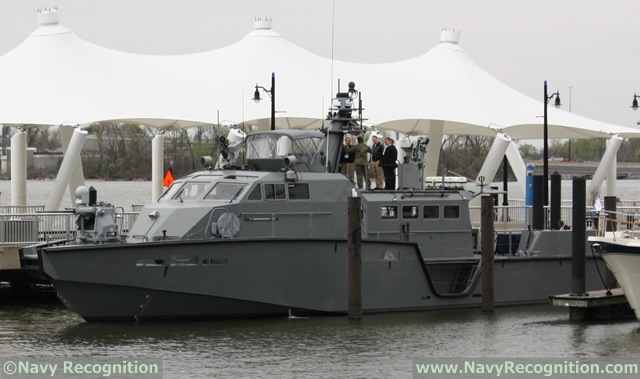
NavyRecognition has a report including pictures that provides additional information on the Navy’s new 85 foot Mk VI patrol boat.
We have talked about this boat before, and the earlier post still has some details that are not included in the NavyRecognition report.
Looking at the photos, you can see some resemblance to Coast Guard boats like the 47 footer (the step in the hull). The Mk38 mod2 looks a bit too close to the bow, but it certainly has a wide clear field of fire.