Timely Actions Needed to Address Risks in Using Rotational Crews–GAO

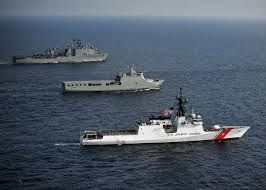
Waesche Carat 2012

The GAO has recently issued a report, “Coast Guard, Timely Actions Needed to Address Risks in Using Rotational Crews” (pdf) which discusses the “Crew Rotation Concept” (CRC) which has been part of the proposed National Security Cutter (NSC) program for at least a decade, but never tested. I believe there has also been discussion of using it on the Offshore Patrol Cutter as well.

This is perhaps the last, worst vestige of the Deep Water program.

First there is this explanation of the expectations of the plan from an Acquisitions Directorate web page that has since been taken down.

“Initially, the Coast Guard will employ four crews for three NSCs at a single homeport, rotating the cutters among the crews to limit crew PERSTEMPO to 185 days while maintaining each cutter’s operational tempo (OPTEMPO) at 230 days. The three-cutter, four-crew prototype will be evaluated in 2009 through an operational testing-and-evaluation process. Policy and procedures for CRC are based on the lessons learned by the Coast Guard and the U.S. Navy, as well as consideration of the recommendations made by auditors from the Government Accountability Office.”

Please forgive me for quoting myself but I feel the need to repeat some calculations from a post from 2010.

First assuming the projections are correct, we are replacing 12 ships which would provide 2,220 operating days with eight ships that will provide at best 1,840 so we are already two ships short.

Then you will also note that the presumption is that the ships will be operated in groups of three from the same home port, but there are only eight ships planned, meaning there will be a rump group of two somewhere. Will they be operated by three crews or by a single crew per ship?

What we hope to save here is acquisition cost, because the operating costs per op day cannot be lowered by this strategy and will actually be higher. I don’t know the projected life cycle costs for the National Security cutters, but in general, I’ve heard that the acquisition costs for similar systems is about 15% of the life cycle cost. Fuel and personnel costs are the real driver. Fuel costs should be the same per op day. Personnel costs will actually be higher, since each crew under the multi-crewing concept will only provide 172.5 op days instead of 185, so personnel costs will be 7.25% higher.

In addition, because the ship will only be in port 135 days a year instead of 180, there will be fewer opportunities for the crew to make repairs. These repairs, normally done by the crew, will have to be done by contractors at additional costs.

I would also note that the acquisition costs we hope to save actually decline as we add more ships. Four additional units are likely to cost far less on the average than the first 8. There is also the long term value of having four additional ships in hand if the country should need them in the future.

Frankly I don’t think we will see any significant savings from this manning approach and it may actually cost us in the long run.

If a truly convincing argument can be made for the concept, I would like to see it. And if the argument involves lower overhead because we get more “mission” op days compared to RefTra day, remember the reason we go, is to train the crews, not the ships, so every crew will needs to go.

As I noted above three into eight does not make for three ship groups. At that time, I thought it would be two ports with three ships and one with two, but in fact, apparently the intention is now two in Charleston, two in Honolulu, and four in Alameda, so it is three ships nowhere.

I am a little surprised the testing has not already started. After all we have had three ships in Alameda for three years now.

As far as I can tell, rotating multiple crews among multiple ships has never worked out. More here and here. We have certainly had the opportunity to test the concept on simpler platforms, but it has yet to be attempted in earnest. Frankly I think everyone knows this is not going to work, but they have just been pushing facing the embarrassing truth off into the future.

There may be viable alternatives to swapping out entire crews. In fact, apparently crews of existing NSCs have been augmented to allow them to provide 210 days away from Homeport. Actually nine augmented ships, U/W 210 days a year, would provide more availability (1890 days) than eight multi-crewed ships U/W 230 days a year (1840 days) but they would still not reach the level provided by twelve un-augmented ships (2220 days).

Unlike wine, bad news does not get better with age. It is time to bit the bullet. Try CRC or find an alternative. If it doesn’t work, well it was really someone else’s idea after all.

Guided 57mm Round Being Developed

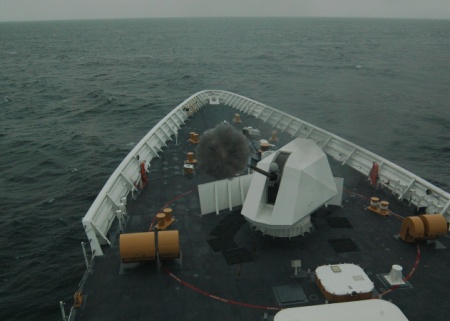
NSCfires57mm

Navy Recognition reports that BAE is developing a laser or image recognition guided round for the Mk110 57mm gun that equips the Bertholf Class, National Security Cutter (NSC) and is expected to equip the Offshore Patrol Cutter in addition to the two classes of Littoral Combat Ships.

It is referred to as “Ordnance for Rapid Kill of Attack Craft or ORKA (technical designation: MK295 MOD 1).” Which seems to indicate it is not an anti-aircraft round.

Guided rounds are already available for larger caliber weapons. Guess we will have to wait a while to see if it is actually any cheaper than a guide missile like Griffin or Hellfire. We already know the launcher is not cheaper.

NORTHCOM on the Arctic–Reason Enough to Buy Icebreakers

EagleSpeak has a report on a conversation with NORTHCOM and NORAD Commander, Admiral Bill Gortney, and it seems to suggest that the US military may need a serious icebreaker capability in about ten years.

Q: Sir in the past couple of months, U.S. officials expressed desire for some sort of new multipurpose sensor in the Canadian Arctic, not just for the ICBMs for maritime vessels, airplanes, that kind of thing. Haven’t really gotten much details on that. Can you give us kind of what you’re looking for there? And what timeline …

ADM. GORTNEY: Yeah, well the — the — the DEW (Distant Early Warning) line — the air defense radars that we maintain on northern Canada and then the Canada-U.S. border are, you know, in a few years — I’d say 10 years I think is the number — you know, they’re going to reach a point of obsolescence and we’re going to have to reinvest for that capability.

The question is what sort of technology do we want to use to reconstitute that capability? We don’t want to put in the same sorts of sensors because they’re not effective against the low-altitude, say, cruise missiles. They can’t see over the horizon.

So now the question is, what’s the technology that’s going to work up there? Is it an over-the-horizon radar system that would work, but it has challenges in the Arctic?

So that’s — those are the questions we’re asking the community about.

When the DEW line was being built several icebreakers would go north every Summer escorting ships carrying building supplies and equipment.

Apparently the DOD is studying the problem and should have a report out soon.

Q: The loss of sea ice in the Arctic, what — what security issues does that raise as we see that whole area changing up there?

ADM. GORTNEY: Well, that’s part of what we’re going to be reporting out, the necessary threats.

You know, the reality is, is that it is. The sea ice is melting. The Arctic shelf is getting smaller.

That said, it is still a very inhospitable place, you know. And today, if we wanted to go up there, you know, we don’t have the ability to reliably navigate, communicate and sustain ourselves up there.

And so that’s huge investments for the services to figure out how to do that, and when do we need to lay those investments in to be able to communicate, navigate and sustain?

And — and before we can communicate and navigate, we have to — we have to do the sustainment. We have to supply ourselves. You know, it’s three times as expensive and takes three times as long to put anything up there in the Arctic. I mean, it is a very, very harsh place.

We are seeing more intermodal traffic from ships that are going in there, but we’re not seeing — we’ve worked with the shipping industry and talked with the shipping — the major shipping companies, and they’re not really interested. You know, they need ships that can make them money 350 days out of the year. They can’t rely on a particular period of time; they need to move large numbers of containers and a large number of crude or liquid natural gas that happens to be out there.

But the reality is, there’s going to be more activity up there, and it’s actually more dangerous today than when we had a stable shelf.

So that’s what we’re — I’m looking forward to reporting that out here in the spring.

Explosive Expansion of China Coast Guard

Informationdissemination has a post on China’s shipbuilding program for cutters for their recently consolidated Coast Guard. The build rate is amazing.

…36 cutters of 1500 ton, 1000 ton and 600 ton class were built for various provincial flotilla of CMS. Much of the building and launching activities happened in 2013 and 2014.

…2 12,000 ton cutters…, 4 5000 ton cutters…, 4 4000 ton cutters…and 10 more 3000 ton cutters…

…all the newer large cutters for various arms of the consolidated Coast Guard are installed with naval gun.

Of the 2 smaller agencies that consolidated, HaiGuan (Chinese customs) had an order for 3 1500-ton class cutter with electric propulsion and 9 600 ton class cutters.

The new consolidated Coast guard agency have since started new programs. A year ago, they started projects for Type 818 patrol vessels (3000 ton class) and Type 718 cutters (2000 ton class), HP shipyard signed for 4 of the Type 818 and 5 of Type 718.

Reportedly the China Coast Guard already has 80 cutters of 1000 tons or more, twice the number in the USCG and it looks like it is still growing. Two of them will be the largest Offshore Patrol Vessels in the world.

The decision to arm all their larger cutter with Naval guns means they will have many more ships capable of performing Naval Surface Fire Support (NSFS). It also means the kind of shoving matches we have seen between China’s ships and those of other nations are potentially more dangerous.

“The Sea Based Logistics Response to the Haiti Earthquake”–Thinkdefence


The day following the Haitian Earthquake, Commandant, Adm. Thad Allen discusses the Coast Guard Response.

British Blog, Thinkdefence, has an interesting and very detailed examination of the response to the 2010 Earthquake in Haiti. There seems to be an omission of the 270s role as first US ships on scene, but it is really focused on the delivery of relief supplies. The blogger has a recognized fascination with containers that is almost a running gag, so don’t be surprised if there is a lot of talk about containers.

It is a great primer for disaster response planning.

USCG/DHS Mission Mismatch

I have been thinking about why the Coast Guard seems to be loosing the budget battle within the Department of Homeland Security (DHS). While funding for the Department has grown, the Coast Guard budget has in fact declined in real terms. I suspect it has a lot to do with perceptions of a miss-match between DHS missions and Coast Guard missions.

Congress attempted to address this perceived mismatch in the Homeland Security Act of 2002 by requiring an annual report of resources allocated to DHS missions and non-DHS missions, to ensure non-DHS missions are not ignored. I will refer to this “Annual Review of  the  United States Coast  Guard’s  Mission  Performance” (pdf) as the Performance Report.

It is an interesting report, but it does have significant weaknesses, largely stemming from the use of undifferentiated and undefined “resource hours” as a measure of effort. I reviewed a report back in 2010 and offered my criticism which have not changed here, here, and here.

Unfortunately, I think this report may be part of the problem, in that it defines several Coast Guard missions as “non-DHS,” and it gives the impression, erroneously I believe, that roughly half of the Coast Guard’s budget goes for things outside the DHS charter.

Of the eleven Coast Guard missions, six were regarded as Non-Homeland Security missions: SAR, AtoN, Living Marine Resources, Marine Environmental Protection, Marine Safety, and Ice Operations.

The five Homeland Security missions are Ports, waterways, and coastal security, Drug Interdiction, Undocumented Migrant Interdiction, Defense Readiness, and Other Law Enforcement (primarily Foreign Fisheries Enforcement).

But these distinctions are fallacious.

The Department views its own missions as:

  1. Preventing Terrorism and Enhancing Security
  2. Securing and managing our borders
  3. Enforcing and administering our Immigration laws
  4. Safeguarding and securing cyberspace
  5. Ensuring resilience to Disaster

NON-DHS MISSIONS: All these mission at least in some respects support DHS missions.

SAR: A robust SAR organization is clearly a necessary foundation for “Ensuring resilience to Disaster.” What were Katrina and Sandy but huge SAR cases? SAR command posts and communications are the skeletal structure upon which Disaster Response is based. After all, every SAR case is really a response to a disaster of some dimension. If the 3,000 plus people the CG saves every year had died in a single incident, it would have been a disaster on the order of 9/11.

AtoN: Most of the population lives near the coast or inland waterways. Most depend heavily on marine transportation and in many cases fishing. When there is a disaster, restoring safe navigation is a high priority both for bringing in assistance and for recovery.

Marine Environmental Protection (MEP):  The Deepwater Horizon was a disaster. MEP regulation attempts head off disasters and mitigate its effects, that is “Ensuring resilience to Disaster” plus offshore and portside energy infrastructure are potential terrorists targets.

Marine Safety: Marine Safety is designed to prevent marine disasters. A sunken cruise ship could be a disaster on the order of 9/11. Marine Safety standards tends to mitigate the effects of a terrorist attack on marine targets

Living Marine Resources: Destruction of valuable marine resources can actually be as disaster for the economy of some communities.

Ice Operations: Domestic icebreakers can prevent flooding. We recently had a case where a community in Alaska would have been left without fuel, if an icebreaker had not opened a path for delivery.

THE UNLISTED COAST GUARD MISSION:

Safeguarding and securing cyberspace: It is not one of the Coast Guard’s eleven statutory missions, but this is infact one of the Commandant’s key priorities. Still it is not addressed in the Coast Guard’s annual Performance Report.

THE NON-DHS DHS MISSIONS: Two missions listed as DHS missions in fact are of little interest to the department, and performance goals (which are themselves perhaps inadequate) in these two areas are not being met.

Defense Readiness: Apparently the Coast Guard is doing more for Defense Readiness now than it was before 9/11, but really little has been done in terms of adapting resources for wartime roles. Additionally, a potentially major Coast Guard contribution to defense readiness, the major cutters, are being replaced at such a slow rate, the fleet continues to age, making it less reliable.

Other Law Enforcement (primarily foreign fisheries): DHS probably has little interest in this. This mission also suffers from the aging of the cutter fleet, and additionally the very large US EEZ in the Western Pacific has been largely ignored.

Problems in DHS: I do think the Departments placement of priority on counter-terrorism over more general disaster response is misplaced,  and this is another source of problems.

CONCLUSION:

I will quote my closing paragraph from my 2010 post,

When it comes time to decide the Coast Guard budget, I would suggest Congress take a different approach. Consider return on investment. If you like the return you are getting from the Coast Guard now, invest more.  Don’t say, “Agency ‘X’ isn’t working, we need to put more money into that.” “The Coast Guard, is doing a good job with their current budget so we don’t need to give them any more.” I don’t quote scripture very often. I’m not religious, but there is some wisdom there. Check out the story of the “good and faithful servant” Mathew 25:14-30.