This is not the first time CIMSEC has talked about the attack, an earlier post “Indian Maritime Security After Mumbai,” July 2, 2012, by Mark Munson, talked about the difficulty of actually converting domain awareness into actionable information.
We have also talked about the attack, primarily here. (Note, apparently reports that the terrorists killed two Indian Coast Guard officers were untrue.)
Maritime Executive has a article regarding the necessity of an integrated Coast Guard. Don’t know that there is anything we haven’t talked about before, but always night to get another perspective.
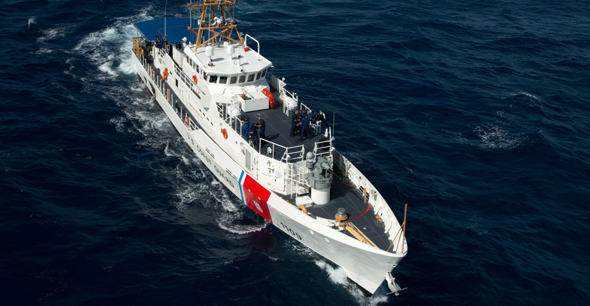
MarineLog is reporting the Coast Guard has exercised a $255.1M option for six more Webber Class WPCs plus spares with Bollinger bringing to 30 the total number ordered from this shipyard. Ten of these have been delivered.
Based on 15 interviews conducted by Paul Stillwell from August 2002 to August 2006. The volume contains 621 pages of interview transcript plus appendices and a comprehensive index. The transcript is copyright 2014 by the U.S. Naval Institute; the interviewee placed no restrictions on its use.
I’ve posted the video above before, but it is an excellent tribute to the spirit of those that responded so unselfishly to this attack.
Lockheed Martin animation of Hellfire employment from an LCS
It looks like the Navy is beginning to field some weapons that are appropriate for the Coast Guard’s mission of preventing maritime terrorist attacks while addressing concerns that using weapons in US ports may cause collateral damage.
I have always felt this mission had to devolve onto the smaller vessels, because the larger cutters don’t spend much underway time around US ports and when they are in port they usually cannot be gotten underway quickly. For this reason the WPCs need to be able to perform the mission.
The Longbow Hellfire is already present in the US inventory in large numbers and is being adopted for the LCS anti-surface module. The Brimstone is very similar in size, warhead, and range (about 8,000 yards), but has the advantage of a datalink that allows a “man-in-the-loop” which I think is desirable. Unfortunately, so far the USN is only looking at Brimstone as an air-launched weapon.
Test of Brimstone against two 40 foot maneuvering targets, discriminating between the targets and similar sized craft
Test of the Griffin. (Note limited damage)
A third system, SeaGriffin has a smaller footprint and warhead and has had a shorter range (only 43″ long, weighing 33 pounds, with a 13 pound warhead, surface to surface range of 5,500 meters), but it appears that the latest version may have a longer range, than either Hellfire or Brimstone, perhaps up to 18,000 yards (assuming they have, as reported, triple the previous range). The latest version of SeaGriffin does have a man-in-the-loop capability. Griffin is already being deployed on US Navy Cyclone class PCs. There are lots of photos showing the relatively small size of this system here.
I have never expected that extreme range was an important consideration for Coast Guard weapons, but for the anti-terrorism mission (or enforcing a blockade in wartime), we probably need the ability to engage from outside 4,000 yards (beyond the effective range of the 25mm Mk 38), because inside that range, there are a number of systems that might be added to a ship that could have a good probability of quickly disabling our vessels.
I still believe none of these weapons is capable of quickly and reliably stopping a medium sized ship or anything larger. For that I think we still need at least a light weight torpedo, but these weapons would significantly improve the chances against vessels of any size and particularly against small high speed maneuvering targets. Equipped with these, a Webber class cutter could be better able to fulfill this mission than a National Security Cutter with its 57mm guns.
Looks like Piracy may be making a comeback in the Caribbean. gCaptain reports that the crew of a LPG tanker has been assaulted, robbed, and the Captain shot in the vicinity of Trinidad.
gCaptain brings us news of a prototype ship to shore connector that the Marines are looking at, but to me the star was the over land, over water, icebreaking, craft the Canadian Coast Guard has developed.
The State Department has issued a document regarding US policy for the suppression of Piracy of the Horn of Africa (HOA) and in the Gulf of Guinea (GOG). It is a brief four page intro and two annexes, eight pages addressing the HOA and ten addressing the GOG.
“Provide persistent interdiction-capable presence at sea off the HOA. Consistent with other U.S. mission requirements, U.S. Navy and/or U.S. Coast Guard forces operating in the region provide persistent interdiction through presence, conduct maritime counter-piracy operations, and coordinate counter-piracy activities with other forces operating in the region to the extent practicable. When in range, these forces will prevent suspected pirate vessels from operating, respond to reports of pirate attacks with the objective of disrupting such attacks, and, in appropriate circumstances, terminate the act of piracy and any resultant hostage situation with intent to deliver any surviving pirates ashore for prosecution. These forces will also coordinate efforts among all multilateral coalitions such as Combined Maritime forces, NATO’s OPERATION OCEAN SHIELD, the European Union’s OPERATION ATALANTA, and independent naval forces.”

 Chuck Hill's CG Blog