
Versions of the following quotation are frequently mis-attributed to Petronius.
We trained hard … but it seemed that every time we were beginning to form up into teams we would be reorganized. I was to learn later in life that we tend to meet any new situation by reorganizing; and a wonderful method it can be for creating the illusion of progress while producing confusion, inefficiency, and demoralization.
In fact it is from the magazine article “Merrill’s Marauders” (Harper’s Magazine, 1957) that earned Ogburn (Charlton Ogburn) his book contract. In full, it reads thus:
We trained hard, but it seemed that every time we were beginning to form up into teams we would be reorganised. Presumably the plans for our employment were being changed. I was to learn later in life that, perhaps because we are so good at organising, we tend as a nation to meet any new situation by reorganising; and a wonderful method it can be for creating the illusion of progress while producing confusion, inefficiency and demoralization. http://en.wikipedia.org/wiki/Charlton_Ogburn
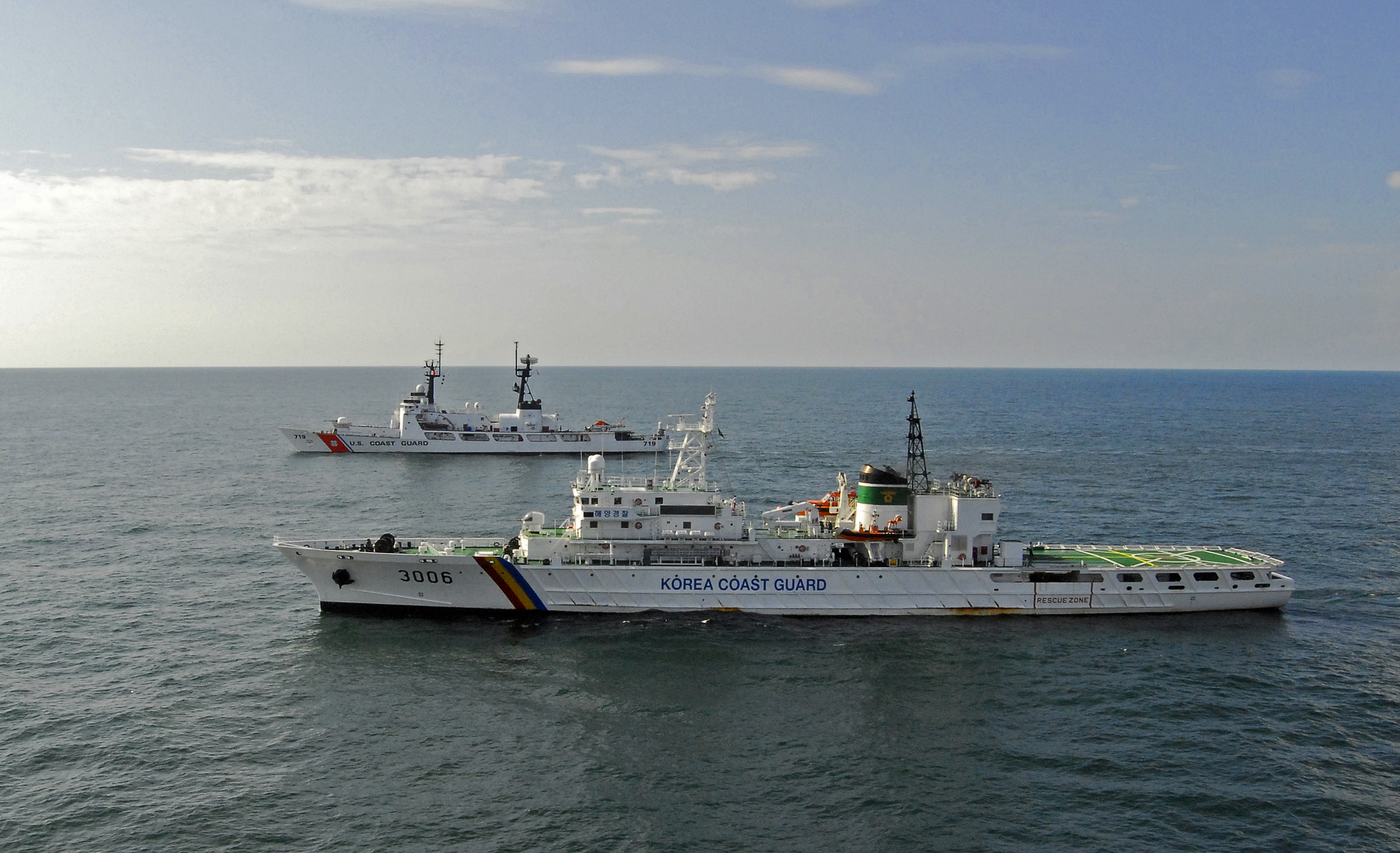
After the sinking of the ferry Sewol with the loss of over 300, South Korea’s President Park Geun-hye is vowing to dismember the South Korean Coast Guard.
South Korea’s EEZ is only about three percent that of the US’s but their Coast Guard is relatively large with about 4,500 personnel (according to my Combat Fleets of the World). Wikipedia indicates they have six fixed wing and 18 helicopters (not a lot, but proportionately more than the USCG). Most surprisingly, they have 33 ships of over 1000 tons with a total displacement greater than that of all USCG WMECs, WHECs, and WMSLs combined. They also have 39 WPCs of 250 to 500 tons. I don’t see any evidence that they have any responsibility for Aids to Navigation, Alien Migrant Interdiction (although that might be a subset of another mission} or ice operations, otherwise their mission set seems to parallel that of the USCG, but their priorities are shaped by the proximity of North Korea, China, and Japan.
The New York Times reports their President sees the problem as a cozy relationship between regulators and the regulated, something all regulatory organizations must guard against.
With that, she declared a war against what she called her country’s deeply entrenched culture of “kkiri kkiri,” or collusive ties between businesses and government regulators that she said had spawned lax regulatory enforcement and an easy acceptance of poor safety standards throughout the society.
The BBC reports,
Ms Park added that in its current form, the coastguard would be unable to prevent another large-scale disaster.
“The coastguard continued to get bigger in size but did not have enough personnel and budget allocated for maritime safety, and training for rescue was very much insufficient,” she said, according to Reuters.
Stars and Stripes has some very revealing statistics regarding the experience of South Korean Coast Guard Personnel.
Eleven out of the 13 coast guard chiefs named since 1996 have been land-based police officers, not coast guard officers; the top 14 current coast guard officers have no experience working as captains for 1,000-ton-class ships or bigger vessels; and about 25 percent of its top 67 officers have had less than one month of experience working on patrol ships, the coast guard said, confirming reports published by lawmakers.
It really appears that the problem is not the fact that they have a Coast Guard, but that it has been mismanaged and unprofessional. Clearly their Coast Guard is big enough, but it suffers from a leadership that does not understand the Marine environment and that will not be helped by the proposed reorganization. I am afraid the proposed reorganization will only provide the appearance of action while failing to address the very real problems.
They might benefit from more time spent with the US Coast Guard.



 Chuck Hill's CG Blog