Chinese Drift Net F/V Seized in the North Pacific

CCGD17 is reporting an unusual fisheries case.

This seizure was a result of an international effort. The F/V was spotted by a Canadian CP-140 (similar to a P-3) and boarded by a team from Morgenthau assisted by two Chinese agents, 625 miles East of Tokyo (Japan was also listed as a participant in the operation). After violations were discovered, the vessel was detained and custody subsequently transferred to a Chinese Coast Guard cutter.

I can’t help but be curious what will happen to the vessel, its owners and crew, when the Chinese government seems to condone and even encourage violation of international fisheries norms elsewhere.

Canadian SAR Aircraft, C-27J a Leading Contender

DehavillandCC-115Buffalo01
442 Transport and Rescue Squadron De Havilland Canada DHC-5 Buffalo (CC-115)

Canada’s military seems to be having a lot of trouble with their procurement, new naval helicopter, new patrol vessels, and new SAR aircraft All have taken much longer than expected.

DefenseIndustryDaily reviews the status of their program to replace their existing SAR aircraft which are now overworked DHC-5 (CC-115) Buffalo on the West Coast and CC-130E/H Hercules on the East Coast, in the works since 2008.

According to the report, the C-27 appears to be the most likely choice, other contenders include the HC-144’s big brother the EADS-CASA C295, the C-130J, the Bombardier DASH-8, the DHC-5NG Buffalo being resurrected by Viking Air Ltd., and the Bell V-22.

CG issues Draft RFP for Second Phase of FRC Procurement

page1-640px-USCG_Sentinel_class_cutter_poster_pdf

The Acquisition Directorate is reporting that they have issued a draft Request for Proposal (RFP) for a new contract to build Webber class WPCs.

It will provide for options of either four or six cutters per year for seven years. If all options were exercised the maximum number of cutters that could be built would total 42, but this probably will not be the case.

In February 2012, the Coast Guard exercised a $27.2M option to purchase the “Procurement and Data License Package” for the Webber class Fast Response Cutters, so the Coast Guard can allow other shipyards to bid to build follow-on ships of the same class.

25 September 2013, the Coast Guard exercised an option for six more cutters. This resulted in a total 24 Webber class built or under contract. I believe this was FY2013 money and we will see another contract to exercise the final option on the existing contract bringing the total to 30, which leads to a question. There is a statement in the RFP that I find difficult to understand, B.2.(b) “The total number of cutters obtained under this contract will be limited to twenty-six (26).” All along the program of record has been 58 of these vessels. The maximum number of vessels that can be funded under the phase one contract is 30 cutters so why limit this second contract to 26 when we have a stated requirement for 28 more? Does the Coast Guard plan on making a sole source buy of two ships in FY2015 and award this contract in FY2016?

Why preemptively limit the buy to less than the total of the options anyway. There might be a change of plans that would increase the Coast Guard requirement. The Navy might want to buy some using our existing contract, or the Coast Guard might want to make a Foreign Military Sale purchase on behalf of a friendly foreign government.

Despite being probably the best candidate we will ever see (a mature program with a proven product, approved by the Department for full rate production, that will continue for at least another five years), I saw no indication that a multi-year procurement was considered. I would hope that savvy ship builders would offer this as an additional option. It is still not too late for the Coast Guard to obtain Congressional permission to award a Multi-year Procurement for these ships. Or for Congress to direct this money saving procurement method.


Canadian Coast Guard’s New Shipboard Helicopter

Bell B429

Defense Industry Daily is reporting the Canadians have selected the Bell B429 as their new shipboard Coast Guard helicopter

“The request for proposals closes on May 27, but rivals AgustaWestland, Airbus Helicopters Canada and Sikorsky have all signalled they won’t be submitting bids, leaving Bell and its model 412 chopper (actually the B429–Chuck) as the only contender…. The companies declining to take part are doing so because their aircraft are heavier than the maximum of 4,989 kilograms (11,000 pounds), a safety limit established for the decks of coast guard ships in the 1970s.

Industry sources said at least one potential bidder expressed concern that the standard was outdated and asked the federal government for data on how the weight restriction was calculated. The intention was to prove the decks could handle higher ratings, but officials just came back and said the standard was the standard.”

The Bell B429 is a twin engine helicopter with the capability of allowing single pilot flight in IFR (instrument flight rules) conditions, designed for the medivac market. It is about 2000 pounds lighter than the MH-65 but is otherwise similar in performance. There are a number of door options including clamshell doors in the rear and an option for retractable wheeled landing gear.

Australia, Does it Need a Coast Guard?

In Australia most coast guard functions are handled by the Navy and Air Force. DefenceIQ has an interesting discussion of this alternate arrangement of responsibilities and its shortcomings.

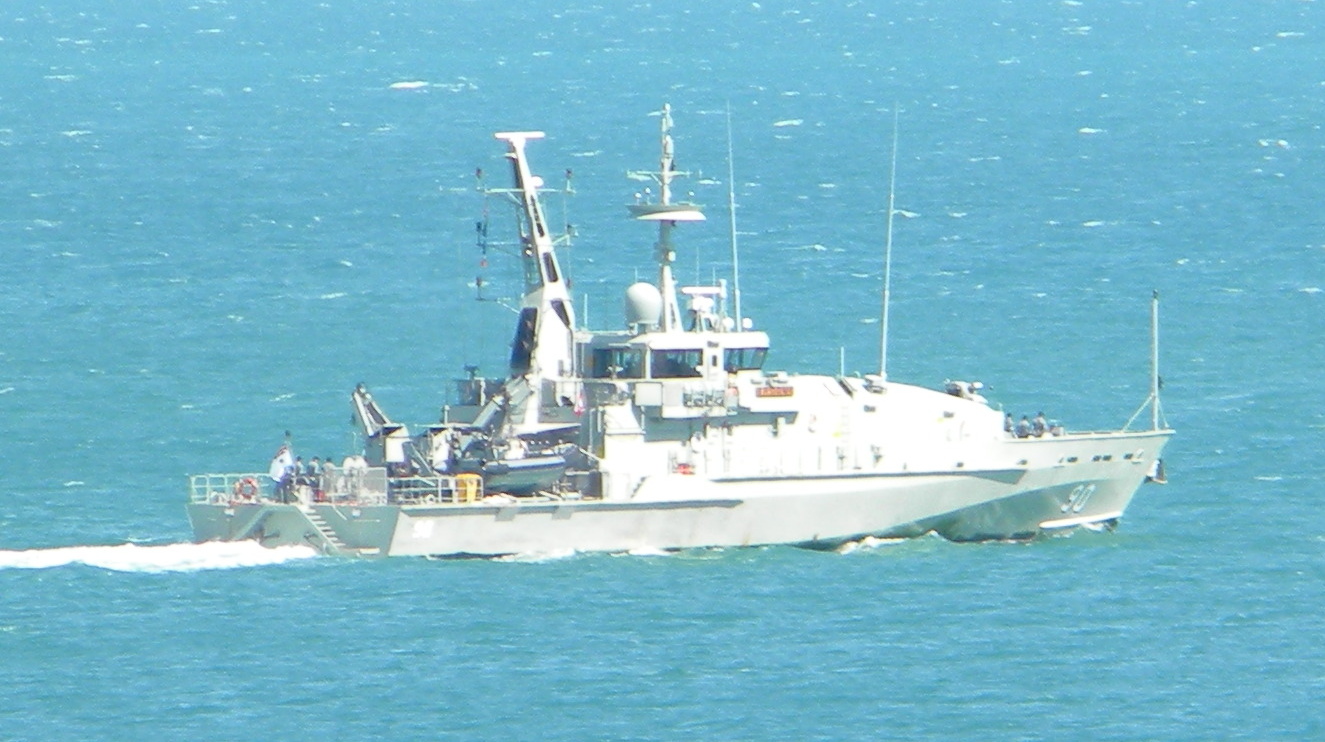
I also note the Australian Navy and their Customs service both operate similar patrol vessels, the Armidale class and the Cape class, and if anything the Customs’ Cape class are more capable.

Thanks to Lee for bringing this to my attention.

DefenseNews–Interview with Admiral Papp

DefenseNews has a short interview with outgoing Commandant, Admiral Papp. Generally nothing too surprising except perhaps the statement that he wrote fitness reports for all the CG flag officers every year and followed it up with counseling, certainly an onerous if extremely important task.

Overall an interesting and relatively short read.

I think I’m going to miss Admiral Papp.

Ireland’s New OPV, Samuel Beckett

Thought I had posted about this ship earlier, but could not find it, if I did. At any rate our friend at Think Defence has done a nice write up. This class (90 meters), may be the evolutionary immediate predecessor of Eastern’s OPC proposal, being a development of the New Zealand Protector class OPV (85 meters), which was in turn a development of the Irish Róisín Class (80 meters). The Samuel Beckett class is notable for their low cost, hybrid propulsion, and small crew size.

Russia Builds an OPC

NavyRecognition is reporting the launch of the first for a class of ships being built for the Maritime Border Guards of the Federal Security Service of the Russian Federation (FSB, successor of the KGB). The ship is similar in many respect to the projected Offshore Patrol Cutter.

Named “Ocean,” she is reportedly ice strengthened with a displacement of 2,700 tons, a speed of 20 knots, a range of 12,000 miles, and a 60 day endurance. She has a hangar and flight deck, at least two RHIBs, and a 76mm gun. Unlike previous classes used by the Maritime Boarder Guards this is not an adaptation of a Navy design.