More Chinese Misbehavior in the South China Sea

China imposes fishing curbs: New regulations imposed Jan. 1 limit all foreign vessels from fishing in a zone covering two-thirds of the South China Sea.

Credit for Chart: “China Orders Foreign Fishing Vessels Out of Most of the South China Sea,” The Washington Free Beacon

China is again pushing for a “new norm” that would make the South China Sea essentially Chinese sovereign territory. In clear violation of the United Nations Convention on Law of the Sea, the Province of Hainan has declared that, as of Jan. 1, all foreign vessels must get their permission to fish in approximately two thirds of the South China Sea including waters that are clearly within the Exclusive Economic Zones of the Philippines, Vietnam, Brunei, and Malaysia, an area reportedly five times the size of the state of Texas.

In addition to the report credited below the illustration, here is a Wall Street Journal Report and Reuters reports the diplomatic sparing between the US and China.

Their likely instrument in this push is the newly organized Chinese Coast Guard. Naval War College professor James R. Holmes, offers some thoughts on “The Return of China’s Small Stick Diplomacy in South China Sea.”

French to Build New Multipurpose Vessels

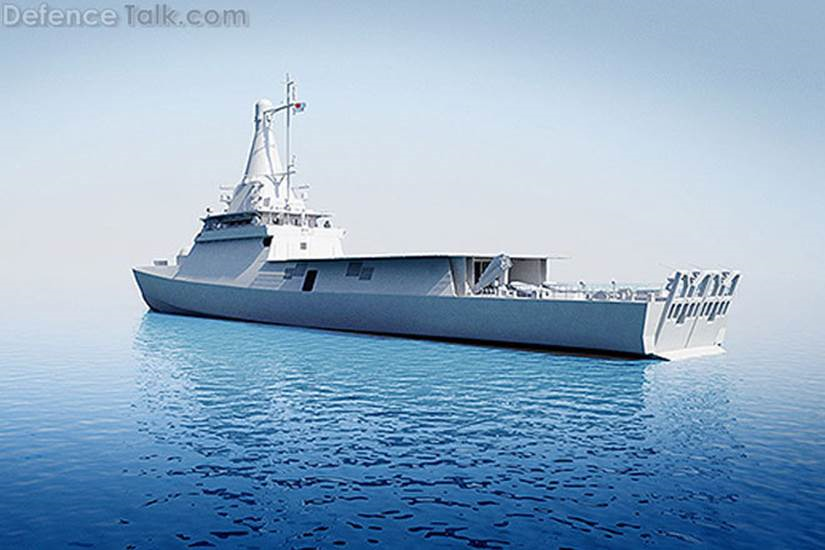
NavyRecognition has information on a new class of vessels the French Navy is building,

“…According to the French Procurement Agency (DGA), these vessels:
– have the ability to project 20 personnel (joint, police or gendarmerie) with two 4×4 vehicles along with their weapons and ammunition.
– will ensure the evacuation of citizens and have the ability to deploy and support divers and equipment (including drones) to conduct underwater interventions.
– Under the state action at sea, they will provide fisheries police missions, and contribute to the fight against illegal immigration, drug trafficking and piracy.”
– They will assist ships in distress and participate in safeguarding people and property, through their firefighting means and towing capacity of up to 30 tons

They are planning three with an option for a forth. The French have the second largest EEZ in the World, only slightly smaller than that of the US, and in many places it is based around small isolated islands.

These vessels, which appear to be based on Offshore Petroleum Industry Support ship designs, will likely replace existing fishery protection vessels that are themselves former trawlers and hydrographic survey ships. They will also likely be tasked with a variety of Coast Guard like missions including disaster response.

Tribute to the Aviators

File:Douglas Dolphin at the US National Museum of Naval Aviation.jpeg
Photo: U.S. Navy National Museum of Naval Aviation photo No. 2003.145.001 A Douglas Dolphin at the U.S. National Museum of Naval Aviation at Pensacola, Florida (USA). This aircraft was originally purchased in 1934 by William E. Boeing, founder of Boeing Airplane Company, for use as a transport. It was sold in 1941 and subsequently flew with the Civil Aviation Administration and Alaska Airlines before Dr. Colgate W. Darden, III, purchased it. Darden’s father, Colgate Whitehead Darden, Jr. former French Army and Lt. USMC, a U.S. congressman and Governor of the Commonwealth of Virginia, was Naval Aviator Number 871. Darden later donated the aircraft to the museum. It is painted as a U.S. Coast Guard RD-4.
This is over two years old, but I don’t remember seeing it. Some history worth knowing. “The Coast Guard’s Role in Naval Aviation

Recapitalization Plan in Eight Slides

FierceHomelandSecurity has a slideshow that summarizes the “Recapitalization Plan” in only eight slides.

If you have been following this web site, there won’t be much new here, but I did note a couple of things that might be significant (or maybe not).

In describing the Webber class Fast Response Cutters (FRC), their endurance is now described as seven days instead of the five that was the contract minimum. (Always figured they were probably good for more than that.)

In describing the Offshore Patrol Cutter (OPC) the speed is given as specifically 25 knots, not as a range from 22 to 25. I hope this is true, because it the increase from 22 to 25 makes the ships a lot more useful as potential naval vessels, if we ever need them to go to war.

The slides do seem a bit out of date in calling the helicopters HH-60 and HH65 instead of the current designations, MH–60 and M-H-65.

Christmas Poem

A seafarer’s Christmas poem by Robert Louis Stevenson, first published in the Scots Observer in 1888 —

“The sheets were frozen hard, and they cut the naked hand;
The decks were like a slide, where a seaman scarce could stand;

The wind was a nor’wester, blowing squally off the sea;
And cliffs and spouting breakers were the only things a-lee.

They heard the surf a-roaring before the break of day;
But ’twas only with the peep of light we saw how ill we lay.

We tumbled every hand on deck instanter, with a shout,
And we gave her the maintops’l, and stood by to go about.

All day we tacked and tacked between the South Head and the North;
All day we hauled the frozen sheets, and got no further forth;

All day as cold as charity, in bitter pain and dread,
For very life and nature we tacked from head to head.

We gave the South a wider berth, for there the tide-race roared;
But every tack we made we brought the North Head close aboard:

So’s we saw the cliffs and houses, and the breakers running high,
And the coastguard in his garden, with his glass against his eye.

The frost was on the village roofs as white as ocean foam;
The good red fires were burning bright in every ‘longshore home;

The windows sparkled clear, and the chimneys volleyed out;
And I vow we sniffed the victuals as the vessel went about.

The bells upon the church were rung with a mighty jovial cheer;
For it’s just that I should tell you how (of all days in the year)

This day of our adversity was blessed Christmas morn,
And the house above the coastguard’s was the house where I was born.

O well I saw the pleasant room, the pleasant faces there,
My mother’s silver spectacles, my father’s silver hair;

And well I saw the firelight, like a flight of homely elves,
Go dancing round the china-plates that stand upon the shelves.

And well I knew the talk they had, the talk that was of me,
Of the shadow on the household and the son that went to sea;

And O the wicked fool I seemed, in every kind of way,
To be here and hauling frozen ropes on blessed Christmas Day.

They lit the high sea-light, and the dark began to fall.
“All hands to loose topgallant sails,” I heard the captain call.

“By the Lord, she’ll never stand it,” our first mate, Jackson, cried. . . .
“It’s the one way or the other, Mr. Jackson,” he replied.

She staggered to her bearings, but the sails were new and good,
And the ship smelt up to windward just as though she understood.

As the winter’s day was ending, in the entry of the night,
We cleared the weary headland, and passed below the light.

And they heaved a mighty breath, every soul on board but me,
As they saw her nose again pointing handsome out to sea;

But all that I could think of, in the darkness and the cold,
Was just that I was leaving home and my folks were growing old.”

Thanks to Peter Lane and Historic Ship Geek

Line of Duty Fatality

This is a Coast Guard news release quoted in its entirety.

Coast Guard mourns passing of shipmate

Petty Officer Third Class Travis Obendorf died in a Seattle hospital Dec. 18 as a result of injuries he sustained during search and rescue operations near Amak Island, Alaska, Nov. 11, while serving aboard Coast Guard Cutter Waesche. Photo courtesy Coast Guard Cutter Waesche.
Petty Officer Third Class Travis Obendorf died in a Seattle hospital Dec. 18 as a
result of injuries he sustained during search and rescue operations near Amak
Island, Alaska, Nov. 11, while serving aboard Coast Guard Cutter Waesche.
Photo courtesy Coast Guard Cutter Waesche.

ALAMEDA – Petty Officer Third Class Travis Obendorf died in a Seattle hospital Dec. 18 as a result of injuries he sustained during search and rescue operations near Amak Island, Alaska, Nov. 11, while serving aboard Coast Guard Cutter Waesche.

Obendorf’s family was by his side when he passed away in Swedish Hospital following surgery.

“Our thoughts and prayers are with Petty Officer Obendorf’s family and his shipmates aboard Coast Guard Cutter Waesche during this difficult time,” said Vice Adm. Paul Zukunft, commander, U.S. Coast Guard Pacific Area.

At the time of his injury, Waesche personnel were conducting small boat operations to assist the disabled fishing vessel Alaska Mist with 22 mariners aboard. During the first transfer of passengers, Obendorf was injured while recovering the small boat. A Coast Guard helicopter crew transported him to Cold Bay for a commercial medevac to Anchorage and further medical care. Obendorf’s family arrived in Anchorage shortly thereafter.  He was then transferred to Swedish Hospital Dec. 6 for continued medical care.

“Petty Officer Obendorf’s selfless actions directly contributed to rescuing five mariners in distress.  His willingness to assist others, even amidst the dangerous environment of the Bering Sea, truly embodies the Coast Guard’s core values,” said Waesche’s commanding officer, Capt. John McKinley. “Travis will be sadly missed.”

The Coast Guard is investigating the incident.

For information about the Alaska Mist search and rescue case, please see http://www.uscgnews.com/go/doc/4007/1962946/.

A Quick Look at Guam.

File:Guam in Oceania (-mini map -rivers).svg

BreakingDefense has a post on the inadequacies of Guam’s infrastructure for support of additional Military presence. I’m referencing it here because, I think in the long run we are going to need to put more assets in Guam, to look after the huge Western Pacific EEZ. Ultimately I think it would be a good idea to base two or three Offshore Patrol Cutters there. Right now the Coast Guard has a 225 foot buoy tender and two 110s. The Navy supplies SAR helicopter assets in lieu of CG air assets.

To see how much of our EEZ is in the Western Pacific, look here, and keep in mind that Mercator projections are deceptive, making areas in the high lattitudes looks disproportionately large. The US has the Largest EEZ in the World and 85% of it is in PACAREA.

Late addition: Incidentally, it is about 3300 nautical miles from Guam to Hawaii, long way. The HC-130Js can fly that far unrefueled, if we had any in the Pacific, but the older “H” models at CGAS Barbers Point can’t. Even the “J”s would not have a lot of excess for doing searches flying between Oahu and Andersen AFB. It is almost 600 miles further from Kodiak. Maybe we ought to have some fixed wing there too.