MANPADS (Man Portable Air Defense Systems)–Will We See These?

A recent post concerning the unexpected presence of high tech Russian made SA-24, man portable anti-aircraft missiles in no-fly zone over Libya had an interesting side note, “Venezuela, for example, is buying thousands of SA-24s, and international watchdog groups worry that they will end up in the hands of narco-traffickers and insurgent groups.”

Actually I’m a bit surprised we haven’t seen more instances of terrorist or criminal organizations using high tech weapons. Perhaps criminals recognize that this could provoke unwanted additional attention.

(Video of the weapon in operation here)

Piracy, Indian Navy and Coast Guard Score Again

For the forth time this year, the Indian Navy and Coast Guard has taken down a pirate mother-ship. Responding to an attack in progress on the merchant ship MV Maersk Kensington, they not only foiled the attack, they went on to capture 16 pirates and free the 16 crewmen being held as hostages on the mother-ship, a previously pirated Iranian trawler. Eaglespeak has the details and pictures. The Indians seem to have an effective ROE.

Previous incidents were reported here, here, and here. Just an impression, but I suspect the Indians have figured out if you target the fuel drums on the mother ships, everyone will quickly abandon ship.

Towed Array Sonar–A Tool for Drug Interdiction

The use of “Self Propelled Semi-Submersibles” (SPSS), semi-submersibles that run with only a snorkel above water, and true submersibles by drug smuggling organizations represents a serious challenge to efforts to interdict drug trafficking. SPSS and snorkels are difficult radar and visual targets. They can be detected, but sweep widths are dramatically reduced. True submersibles are invisible to radar and only rarely visible from the air, when the water is clear and calm, and even then, only at relatively short distances.

Source: “Introduction to Naval Weapons Engineering

There is a way to detect these vessels at ranges greater than typical radar ranges against even normal surface contacts. Passive Acoustic Towed Arrays routinely make detections beyond the radar horizon. Direct path detection ranges vary a lot. They are typically inside the radar horizon, but there are common phenomenon that make detection at extended ranges possible. These include the deep sound channel, bottom bounce, surface ducting and convergence zone (all explained here. You can skip the math and go down to “Propagation Paths” that starts about a third of the way down). These conditions frequently allow detection at well over 60 miles. These conditions are also recognizable and predictable. Passive acoustic detection is not as unambiguous as radar, in that passive sonar does not provide range, but it does give other information radar does not, that can aid in classification. In the past, success with passive systems has been highly dependent on the skill of the operator, but reportedly newer systems like the Multi-Function Towed Array (MFTA), planned for the Littoral Combat Ship, provide computer assistance that makes them much more intuitive. Range can sometimes be inferred from knowledge about the water conditions, and it can also be deduced by target motion analysis. Whatever information can be gleaned from the passive contact can be used to cue a helicopter to search a specific area.

Because this sensor is passive, it permits searches without betraying own ship’s position. It is not too hard to believe that drug runners who can build submarines are sophisticated enough to use Electronic Support Measures (ESM) to detect and identify Law Enforcement units  based on their radar emissions. A towed array gives the commander the option of searching a large area while going passive electronically.

It would be reasonable to expect that the Navy would pay for these systems, just as they did sonar systems in the past, so that they could be available for military operations. The Offshore Patrol Cutters should incorporate provision for this system in their design. (Previous related posts here, here, and here.)

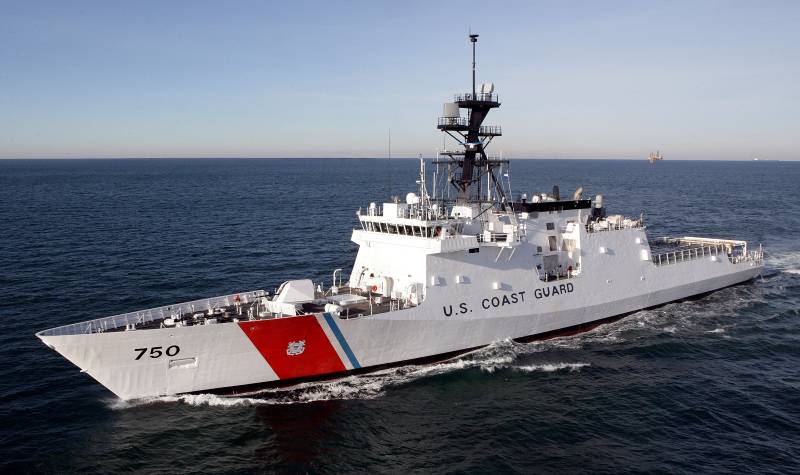
The Commandant Answers–the National Security Cutters: Multiple Crewing, Build Rates, OPC Compared

The Commandant has been good enough to answer three more of our questions, and we expect to hear more in the near future. Today we hear more about the National Security Cutter (NSC).

File:USCG National Security Cutter BERTHOLF (WMSL-750).jpeg
USCG National Security Cutter BERTHOLF (WMSL-750)

Will the Coast Guard implement the National Security Cutter multi-crewing plan referred to as the Crew Rotation Concept?  Has the concept been adequately tested?  If the plan is workable, would it be implemented on smaller vessels? Continue reading

Multiple crewing for Fast Response Cutters

If you are a regular reader of the posts here, you know that I have not been a fan of the “Crew Rotation Concept” that is supposed to make up for the fact that we are only building eight NSC to replace twelve Hamilton Class WHECs by home-porting three ships together and providing four crews. (Previous posts on this here and here.)

One of my criticism has been that if multiple crewing is such a good idea, we should be trying it on smaller, simpler ships first. This got me thinking about how it might work for the Fast Response Cutters (FRC), and I’ve come up with a bit different concept. It may offer some advantages and there may be good reasons to try it

WPC Kathleen_Moore

Continue reading

18 March 1945, CG manned DEs Sink U866

The Naval History and Heritage Command noted, “On 18 March 1945, USS Menges (DE 320), USS Mosely (DE 321), USS Pride (DE 323) and USS Lowe (DE 325) sank the German submarine U 866 south of Nova Scotia.”

These four Destroyer Escorts were among the 30 manned by the Coast Guard.

Here is the story of one of them:

DEPARTMENT OF THE NAVY — NAVAL HISTORICAL CENTER
805 KIDDER BREESE SE — WASHINGTON NAVY YARD
WASHINGTON DC 20374-5060

“Lowe

“Harry James Lowe, Jr., born 6 January 1922 In Paducah, Ky., entered naval service as a seaman apprentice 28 August 1940. He served in San Francisco from 6 December 1940 to 12 November 1942, when he was killed in action off the Solomon Islands when he refused to abandon his gun in the face of an onrushing Japanese torpedo plane. For his extraordinary heroism, Gunner’s Mate Third Class Lowe was posthumously awarded the Navy Cross. (The torpedo plane crashed into his gun mount-Chuck) Continue reading

Acquisition Directorate Newsletter, March 2011

The March 2011 issue of the Acquisition Directorate Newsletter, “Delivering the Goods” is available here. As usual there are two articles:

  • “Turning Inward: Addressing the Coast Guard’s Inland Fleet”
  • “Interagency Operations Centers Begin WatchKeeper Technology Demonstrations at Selected Ports”

And Master Chief Ayer answers the question, “Can you tell us more about the weapons system that will be installed on the new Sentinel-class patrol boats?”