Patrol Cutter Force Laydown, Atlantic vs Pacific

Republic of Korea Coast Guard vessel KCG Taepyongyang (KCG-3016), U.S. Coast Guard Cutter Waesche (WMSL-751) and Japan Coast Guard vessel JCGC Wakasa (PL-93) patrol in formation during a trilateral exercise in the East Sea, June 6, 2024. Coast Guardsmen from Japan, Republic of Korea and the United States used the trilateral exercise as an opportunity to rehearse cohesion between the nations when operating together. U.S. Coast Guard missions in the Indo-Pacific focus on issues directly supporting and advancing our regional partners’ efforts to protect fish stocks, ensure safety of life at sea, support environmental response, and provide disaster relief. (U.S. Marine Corps photo by Cpl. Elijah Murphy)

It occurred to me that having moved Harriet Lane to Hawaii and a report that a second 270 might be on as well, is the balance of distribution of cutters changing? Have we really beefed up our Pacific presence?

Looking back before the changes started in 2008 with the commissioning of Bertholf, the Coast Guard had 12 WHECs, 13 WMEC270s, 14 WMEC210s, Alex Haley, Acushnet (decommissioned 2011), and Storis (decommissioned 2007), 42 large patrol cutters (WMEC and larger). Of those, 10 WHECs, 3 WMEC210s, Alex Haley, Acushnet, an Storis were in the Pacific, 16 large patrol cutters or 38%,

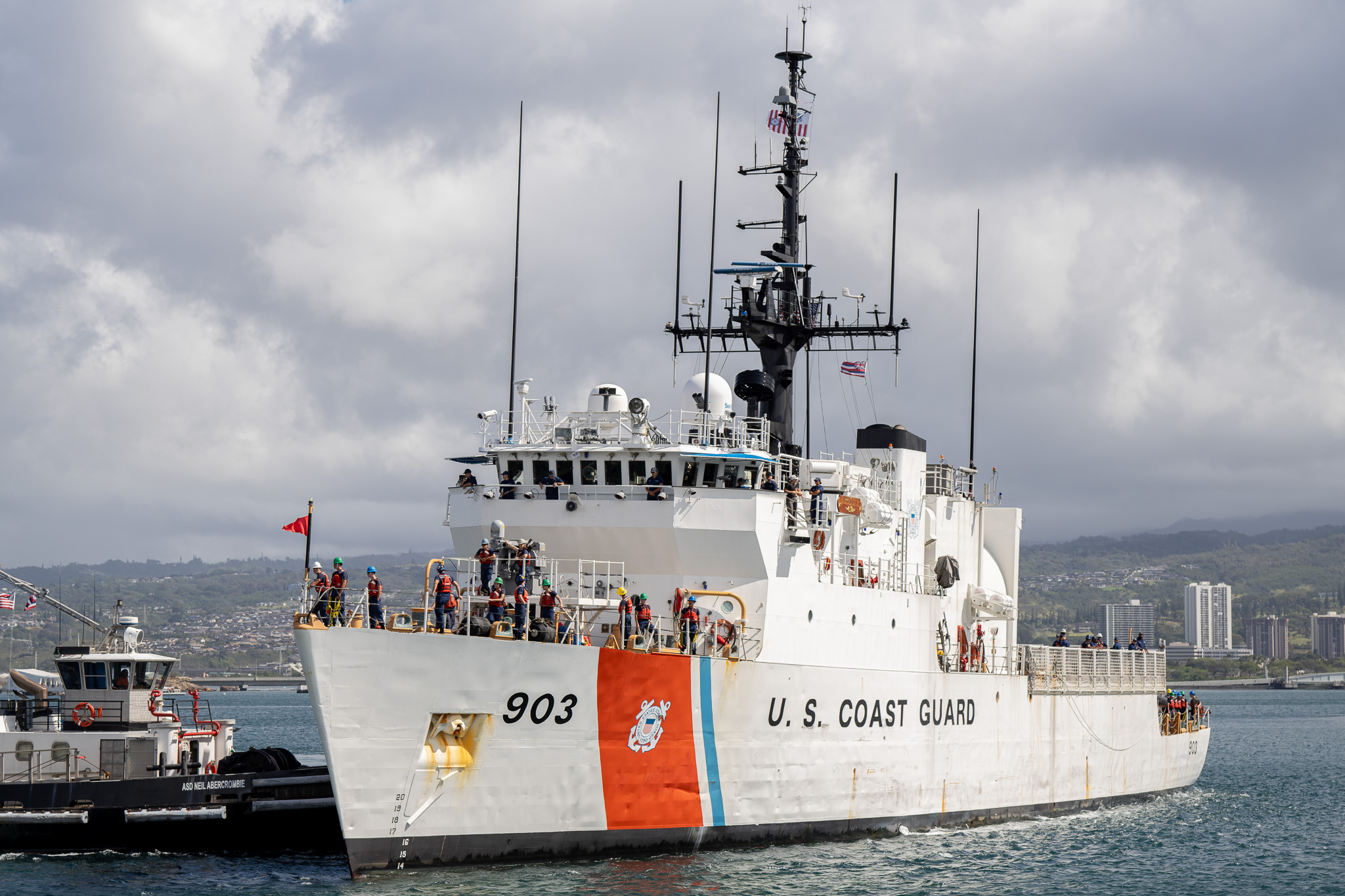
Currently there are 10 Bertholf class National Security Cutters, 13 WMEC270s, 9 active  WMEC210s, and Alex Haley for a total of 33 large patrol cutters. Of those, 6 NSCs, one WMEC270, and Alex Haley, a total of eight large patrol cutters are in the Pacific or 24%.

The first OPC and another WMEC270 are expected to go to the Pacific while NSC #11 will go to Atlantic Area. This will give us 35 large cutters with ten (29%) in the Pacific, if no additional 210s are decommissioned.

The four Eastern built OPCs are all expected to go to the Pacific, two in California and two in Alaska. They were expected to be finished first, but Austal may finish their first OPC before Eastern finishes all four.

How quickly the remaining 210s will be decommissioned (or placed in “in commission, special) remains a question. The current program of record plans to provide 36 large patrol cutters, 11 NSCs and 25 OPCs, but the original program of record would have provided 33 large patrol cutters. That is what we have now, so it is probably a floor we will try not to drop below. We can probably expect more 210s to be decommissioned on a one for one basis as the last NSC and new OPSs come online, especially since the new ships require more people than the 210s. All the 210s are now in the Atlantic so as the first OPCs are moved to the Pacific, we can expect a corresponding decrease in the number of Atlantic Area WMECs.

I think we will add a third WMEC 270 in the Hawaii. This would allow at least one to be deployed into the Western Pacific at all times. The current basing philosophy seems to recognize the advantages of basing at least three ships of a type together.

Looking ahead, assuming the fleet remains at a total of 33, by the end of 2028, certainly by 2030, the fleet will probably look like this, 11 NSCs, 13 WMEC270s, Alex Haley, and 8 OPCs or WMEC210s. (hopefully at least six 6 OPCs) with 6 NSCs, 3 WMEC270s, and 4 OPCs in the Pacific for a total of 13 or 39%, essentially the same relative distribution we had in 20 years ago but 6 fewer ships in the Atlantic and 3 fewer in the Pacific.

How the FRCs play into this. 

As we have noted in the past, FRCs have been doing some of the work 210s would have done in the past, particularly drug and migrant interdiction in the Caribbean. There are already more FRCs (57) than the 49 Island class WPBs they were built to replace, and we are on track to have at least 67 and probably more, so, numerically, to total fleet is about the same size now and will be growing. It has already grown in terms of tonnage and total billets afloat.

How does the distribution of FRCs look? I did a post on this in May.

The Coast Guard currently operates 55 FRCs throughout the United States and in support of U.S. Central Command. U.S. Coast Guard graphic. You might not recognize Puerto Rico (7) and Guam (3) which have been lumped together below Texas.

The Graphic above is a little out of date. two FRCs are now in Oregon. Disregarding PATFORSWA and WPC-1123, which was damaged by fire and probably will never be repaired, current totals, are 50 WPCs with 15 in the Pacific, 30%.

My projection of future homeports suggests ultimately Atlantic Area will receive three more FRCs and the Pacific Area nine more for a total of 62, with 24 (39%) in the Pacific. This is statistically identical to the distribution of large patrol cutters 20 years ago.

Is This Rational?

Broadly speaking, where we put our cutters and how they are distributed should be based on: (1) Where the people served are? and (2) Size of the areas being patrolled? But we also have to ask, (3) What is happening in those areas?

There are more people living on the Atlantic and Gulf coasts than on Pacific coasts. This does suggest that the Atlantic Area should have more assets, which is certainly the case. They have more pleasure boats, more sport fishermen. They may have more fishermen, but I feel sure they have fewer distant water fishermen. Many of these missions are near shore. This suggests more small cutters should be in the Atlantic.

On the other hand, the Pacific Area includes 84% of US EEZ and includes valuable commercial fishing, tuna in the Western Pacific and a wide variety of fishing of the Alaskan Coast. The distances are great. This suggests that more large cutters should be in the Pacific.

We are also trying to help our allies in the Pacific. Atlantic Area is also trying to grow capacity in Africa, but this is generally on a smaller scale and has historically been done by WMEC270s.

That Atlantic coast cutters are closer to the Eastern Pacific drug transit zones than Pacific coast cutters suggest more cutters in Atlantic Area. (This is why all of South America is considered part of the Atlantic Fleet’s operating area.)

The Alien Migrant interdiction problem in the Caribbean suggest the need for cutters in the Atlantic but these operations are relatively close to shore and have the advantage of nearby shore based fixed wing air coverage so the mission can generally be accomplished by smaller cutters. It is FRCs and WMECs that commonly do this mission now.

What we see is that, in terms of larger and smaller cutters, the Atlantic needs a large number of cutters but most can be smaller, while the Pacific needs proportionately more large cutters than the Atlantic and in fact probably more in absolute numbers, this is why in the past ten WHECs were assigned to Pacific Area while only two were assigned to the Atlantic.

The program of record really includes no medium sized patrol cutters, we will have only large cutters, 4,600 ton NSCs and 4,500 ton OPCs, and small patrol cutters, 353 ton FRCs. Contrary to what is said, we have no direct replacements for the WMECs since both NSCs and OPCs are definitely high endurance cutters.

We need a detailed fleet mix study that considers various alternatives to determine the best distribution of cutters and the most appropriate types for the mix of missions.

A new Fleet Mix Study has been completed, but it has not been made public, so we don’t know its recommendations or how complete the study of alternative was. The last Fleet Mix study, only considered NSCs, OPCs, and FRCs. At the time it was expected that OPCs would be much smaller than they turned out to be. I fear they may have similarly limited alternatives in the new study.

These decisions are complex. My feeling, informed by the results of the previous fleet mix study, is that building only 36 large cutters is not enough; that we need at least medium sized cutters (a modern MEC) in Guam and American Samoa; that we will not be able to build as many large patrol cutters as be need because OPCs have become too expensive and perhaps unnecessarily large for many missions.

We have contracts in place for up to 15 OPCs. That will give us 26 large cutters (NSCs and OPCs). It is not too late to contract for more than ten, perhaps as many as 20, truly medium sized cutters that would have smaller crews and perhaps more military potential, in this increasing hostile environment, than OPCs.
“Congress Looks to Continue Coast Guard’s Pacific Expansion” –Another WMEC Going to the Pacific?

U.S. Coast Guard Cutter Harriet Lane returns to home port after 79-day patrol, April 9, 2024. (U.S. Coast Guard photo by Senior Chief Petty Officer Charly Tautfest)

Military.com passed along a Honolulu Star-Advertiser report that another Medium Endurance Cutter is expected to join Harriet Lane in the 14th District in FY 2025. (I suspect, ultimately there will be a third.)

This along with additional improvements in Coast Guard funding and infrastructure are still at the draft legislation phase, so we can’t assume too much, but it at least points to the intention.

There are other items,

The current draft of the spending legislation also includes $3 million to increase the presence of regional Coast Guard advisers as well as $1.2 million for the Coast Guard’s Indo-Pacific Workforce Support Project, which includes funds to increase housing, medical and child care access and capacity in Hawaii and Guam to support the service’s Pacific operations. It also calls for the service to acquire a new pier at its Sand Island base, expand facilities and come up with a report on infrastructure at Coast Guard Air Station Barbers Point.

It does appear from the report that politics regarding unrelated issues are getting in the way, but we have learned to expect that the budget will not be passed before the FY starts. (FY2025 will begin October 1, 2024.)

The post also notes that Harriet Lane is now on her second Pacific deployment.

The report does provide some insight into the difficulties of keeping a 40 year old cutter on patrol. The post talks about the Offshore Patrol Cutters and mentions that they are delayed, but they do not really explain how very long it is going to be before the 270s will be replaced. Right now, we don’t expect the last 270 to be replaced until 2038–14 years away, and it may end up being longer.


“Houthi’s Blowfish: Guide To Explosive USV Threat In Red Sea” –Covert Shores / Ruminating on an Attack on a US Port

Covert Shore has an update on Houthi One Way Attack Uncrewed Surface Vessels (OWA-USV).

Comparisons are made to their Ukranian counterparts, but the Houthi systems are less sophisticated.

“Unlike the fully autonomous Ukrainian craft, Houthi USVs require a human pilot to navigate to the start line of the attack. After that the pilot transfers to another vessel. Consequently, these USVs retain a cockpit…The Houthis also rely on motherships, which tow the USVs on longer missions, pick up the pilots, and also provide command and control during the attack. This is a comparative weak point.”

If there is a terrorist attack on a US port using an OWA-USV, it is most likely to use this model. It will likely be improvised and could be anything from a personal watercraft to a yacht. It will probably look innocuous. Like the recent Houthi attack, it is like to have a crew of dummy figures to make it look populated.

Unlike the Houthi attacks on ships at sea, an attack on a port could be remotely controlled from shore.

These are effectively a poor man’s torpedo. As the post notes,

“USVs generally carry a larger warhead which detonates at or close up the waterline. They are also generally able to target weak points on a ship where this can have the biggest impact…”

In a port, the target may not be a ship. Other targets like a bridge, tunnel, or pipeline, may also be accessible.

New Airfield Options In the Western Pacific

A Marine Corps KC-130J Super Hercules aircraft with 1st Marine Air Wing, lands on a newly designated airstrip on the island of Peleliu, Republic of Palau, June 22. (Lance Cpl. Hannah Hollerud/Marine Corps)

We have heard a lot about operations of the Fast Response Cutters based in Guam and the arrival of a dedicated WMEC (Harriet Lane) for operations in Oceana, but really these surface units need eyes in the sky.

Barbers Point, HI, is the only Coast Guard Air Station in the Central and Western Pacific. The new C-130Js have got much longer legs, but it’s always good to have options.

I talked about some of the options for basing or at least temporary operations here. It looks like the US Military is adding some additional options.

The Air Force is reopening the World War II air base at Tinian. and improving facilities at YAP, Federated States of Micronesia. Defense News reports that the Marines have reopened an airstrip on Peleliu, Republic of Palau.

The Air Force has embarked on a program they call Agile Combat Employment concept that seeks smaller and dispersed overseas air bases.

Ultimately it seems the Coast Guard will need to base some fixed wing and perhaps helicopters West of Barbers Point, Hawaii.

We recently had a SAR case that highlighted the problem, a man overboard incident roughly 607 nautical miles south of Guam, reported 25 June.

“The U.S. Coast Guard, in a testament to international cooperation, also dispatched an HC-130 Hercules aircraft and crew from Air Station Barbers Point, Hawaii, to Guam, where they will stage. Due to the distance, the crew will observe mandatory rest and then proceed to the search area on the morning of June 27.”

In a SAR case, particularly a man overboard, prompt response is essential, but the tyranny of distance also effects our ability to maintain surveillance over vast areas of the US Exclusive Economic Zone and that of the Compact of Free Association nations that we are obligated to protect.

Perhaps the Air Force under the Agile Combat Employment concept could build the Coast Guard an air base in Western Pacific. It would be a win-win. The Coast Guard gets a base. The Air Force base will be maintained and have a cadre in residence to help in a contingency.

Turkish Twin 35mm CIWS on South Korean Built Philippine Corvette (corrected text)

Gökdeniz twin 35mm CIWS (Aselsan image)

Naval News reports,

“On June 25, 2024, Türkiye’s leading defense company Aselsan announced that the Philippine Navy’s newly launched corvette, BRP Miguel Malvar, is equipped with the Gökdeniz close-in weapon system (CIWS).”

This is the first of a class of two 3,200 ton light frigates or corvettes. It is notably larger than the two previous 2,600 ton Jose Rizal class frigates also built by Hyundai Heavy Industries in S. Korea for the Philippine Navy which have yet to receive a CIWS they are expected to mount. I presume they will receive this system as well. Hyundai has also been contracted to build six 94.4 meter Offshore Patrol Vessels. They are well armed for OPVs including a 76mm gun, short range AAW missiles, and two 30mm guns presumably in this mount.


USCG perspective: All three ship classes are considerably smaller than either the NSCs or the OPCs. The 94.4 meter OPV is about a third larger than the Bear Class 270s.

This will be the first CIWS in the Philippine Navy, but it also notable because of its potential effectiveness in other roles. It should be more effective than Phalanx against threats other than cruise missiles, it might even be better against them. This CIWS is equipped with the same 35mm guns that equip the German made Gepard Flakpanzer that has proven so effective against kamikaze drones in Ukraine. An air burst round is available for the gun as well as Armor Piercing/High Explosive/Incendiary and High Explosive Incendiary rounds. 

At effective ranges, 4000 yards or less, these would also be devastating against above water systems on any surface vessel.

At some point, I believe the Philippine Coast Guard will choose to arm their cutters. The largest of these could easily accommodate a 76mm but this twin 35mm might be a good alternative. It or smaller mounts using single 35mms would probably fit on many of their smaller cutters, simplifying ammunition logistics. The Bushmaster III chain gun can use the same ammunition.

Potential $198.1M Contract Award for Cutter-Based V-BAT UAS

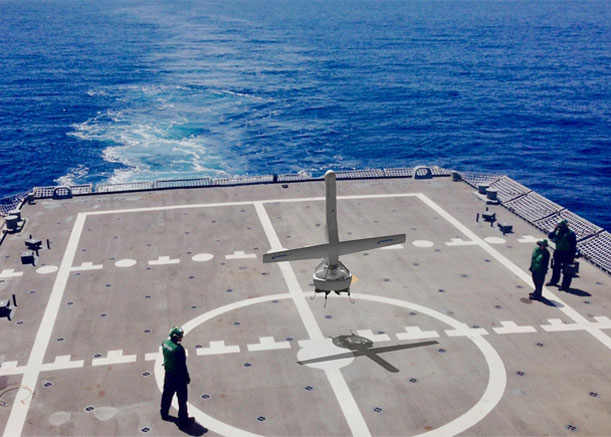
V-Bat from Martin UAV

Below is a news release. The total contract ceiling award amount is $198,106,876.21 over five years.

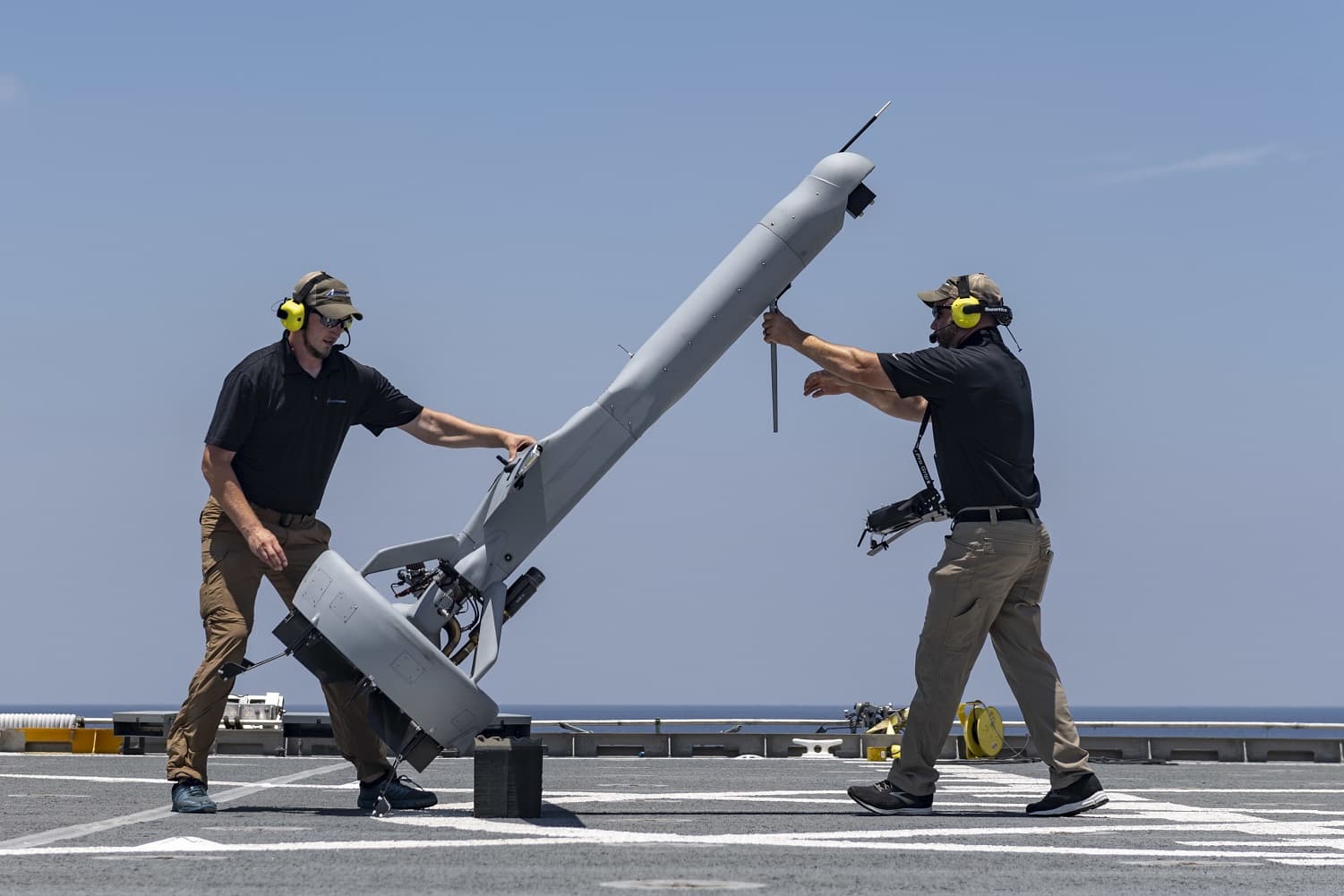
Compared to Scan Eagle, currently used on Coast Guard National Security Cutters, V-Bat system has a slightly smaller wing span than the ScanEagle (9′ vs 10’3″) and weighs about twice as much (88 lbs (40 kg) vs 44-48.5 lb. (22 kg)), heavier, but still easily handled. Payload can be as much as three times that of Scan Eagle. There is a skid under the nose to allows the V-BAT to be laid on the deck. Cruise speeds are similar. Dash speed is actually a little higher for the V-BAT (90 vs 80 knots).

There are a couple of things worth noting in this release that point toward a broadening of Coast Guard use of cutter based UAS.

While the contract is for “Contractor Owned Contractor Operated (COCO)” services, it includes service pilot and mission training which suggests that Coast Guard personnel will be learning to operate these systems and,

“Initially, the contract will be used to continue UAS capability on the national security cutter class; however, the contract can be used to support additional cutter classes in the future.”

USCGC Harriet Lane, after a change of homeport to Honolulu, completed her first Pacific patrol in April. As I noted, she apparently had no helicopter or UAS on board during a more than 70 day patrol, far from the nearest Coast Guard air station.

In 2020, V-BAT was successfully tested on Harriet Lane. V-BAT requires no catapult or recovery hardware. It should be possible to operate the system from any medium endurance cutter. Bear class 270 foot cutters, like Harriet Lane, could probably deploy with both a helicopter and more than one V-BAT.

V-BAT Vertical takeoff and landing UAV. Photo by Mass Communication Specialist 2nd Class Anderson W. Branch

Coast Guard awards contract to procure cutter-based unmanned aircraft system capability

The Coast Guard awarded a contract on June 26, 2024, to Shield AI Inc. of San Diego for unmanned aircraft system (UAS) capability that can be deployed from Coast Guard cutters. The indefinite-delivery, indefinite-quantity firm fixed-price contract runs through 2029 and is structured as five one-year ordering periods.

This contractor-owned, contractor-operated service will be used for intelligence, surveillance and reconnaissance in support of Coast Guard missions. Requirements for the cutter-based UAS capability – which the Coast Guard will term as maritime UAS or MUAS in the future – included fully automated flight operations, minimum endurance of 12 hours of flight time daily and the ability to provide services 24 hours a day, seven days a week. The payload will include electro-optical and infrared sensors and communications relays and be capable of providing surveillance, detection, classification and identification for all of the host cutter’s operational missions.

The contract has a total potential value of $198.1 million and includes installation and deinstallation of the UAS capability and pilot and mission training. Shield AI will deploy its V-BAT, which is a vertical take-off and landing UAS.

Initially, the contract will be used to continue UAS capability on the national security cutter class; however, the contract can be used to support additional cutter classes in the future.

For more information: Unmanned Aircraft Systems Program page

“Coast Guard Cutter Charles David Jr. holds Change of Command ceremony” –CWOs Commanding

Capt. Jason Ingram, Coast Guard Sector Key West commanding officer, presides over a change of command ceremony for USCGC Charles David Jr. (WPC 1107), in Key West, Florida, June 27, 2024. Chief Warrant Officer Adam Smith relieved Chief Warrant Officer Chad Barber as commanding officer ensuring continuity of leadership and operations aboard the cutter. (U.S. Coast Guard photo by Ens. Tabitha Martinez)

Below is a news release. I don’t normally pass along press releases regarding changes of command. They are well covered by Coast Guard News if you want to see them. I thought this was a bit unusual. USCGC Charles David, Jr. is a 154 foot patrol craft with a crew of 24. These are usually commanded by a Lieutenant or Lieutenant Command (O-3 or O-4). Command of one of these by a Chief Warrant Officer is an opportunity unique to the Coast Guard.USCGC Charles David (WPC-1107)

June 27, 2024

Coast Guard Cutter Charles David Jr. holds Change of Command ceremony

KEY WEST, Fla. — Chief Warrant Officer Adam R. Smith relieved Chief Warrant Officer Chad M. Barber as commanding officer of Coast Guard Cutter Charles David Jr., Thursday, during a change-of-command ceremony at Coast Guard Sector Key West.

Capt. Jason Ingram, Sector Key West commander, presided over the event.

Chief Warrant Officer Barber was the commanding officer of the cutter since July 2021, conducting 25 patrols and accumulating over 5,000 hours underway. He will transfer to the Coast Guard Cutter Alex Haley, home ported in Alaska. Chief Warrant Officer Smith takes command of the cutter after serving as the Officer in Charge of Station Provincetown, Massachusetts.

“Thank you to Chief Warrant Officer Barber’s family, his spouse Shannon, two sons Hayden and Logan, and his daughter Bryn, for their support while he served his community in the Florida Keys,” said Capt. Jason Ingram, commander, Sector Key West, .

Cutter Charles David Jr. is one of six Fast Response Cutters homeported in Key West and reports to Sector Key West. The cutter patrols over 55,000 square nautical miles of Sector Key West’s area of responsibility within the Florida Straits and the Gulf of Mexico, as well as regularly forward deploying to the Caribbean Sea and other areas in support of the Coast Guard’s national security, law enforcement, and lifesaving missions.

The change-of-command ceremony marks a transfer of total responsibility and authority from one individual to another. It is a time-honored tradition, conducted before the assembled crew, as well as honored guests and dignitaries to formally demonstrate the continuity of the authority within a command.

“New Trend: Transatlantic Narco Submarines” –Covert Shores

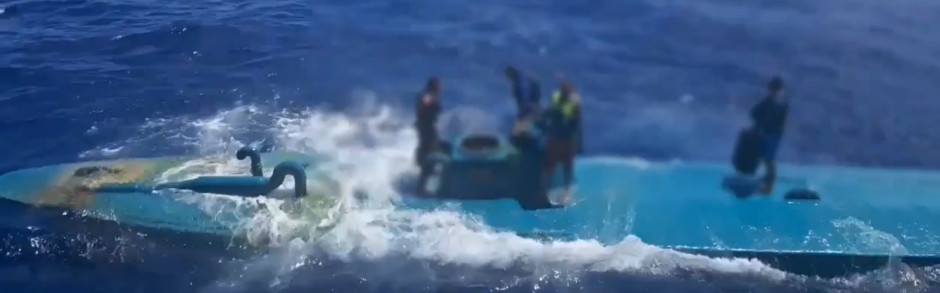
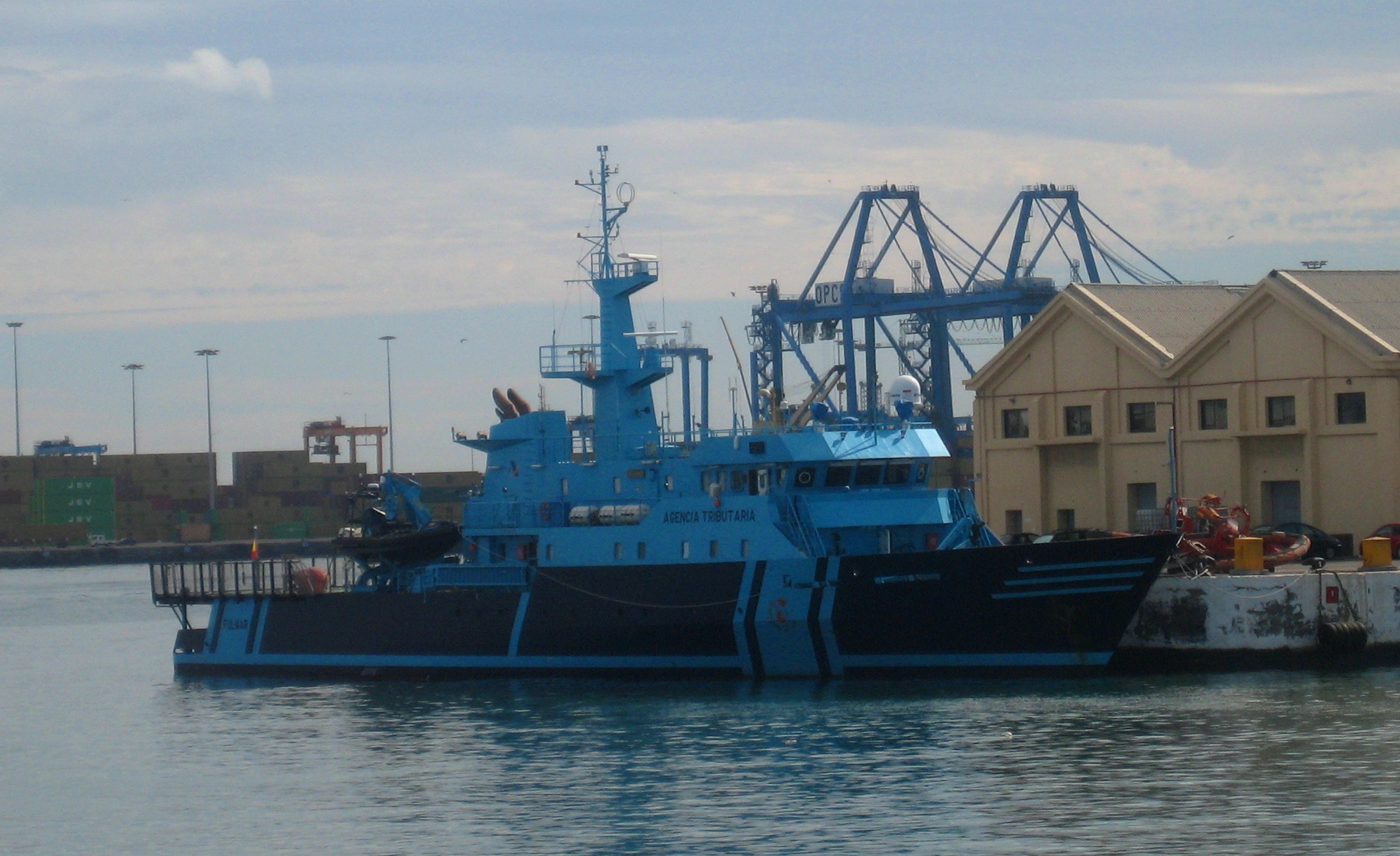
On June 26, 2024 Spanish police aboard SVA Fulmar interdicted a narco submarine 200 miles from the Canary Islands. The vessel was carrying 900kg of cocaine. The 4 crew scuttled the vessel before being rescued and arrested.–Covert Shores.

Covert Shores reports what appears to be a trend that self-propelled semi-submersibles are being used to transport cocaine directly from Latin America to Europe based on three interceptions beginning, one in March and two in June.

The use of internal diesel engines rather than outboards should not be surprising, considering they are much more fuel efficient that outboards, for the long distances involved.

Spanish Tax Agency vessel SVA Fulmar. 20 Nov. 2007. Photo credit: Outisnn via Wikipedia

“OVERCOMING THE DELIBERATE LEGAL AMBIGUITY ADOPTED BY CHINA’S COAST GUARD” –Baird Maritime

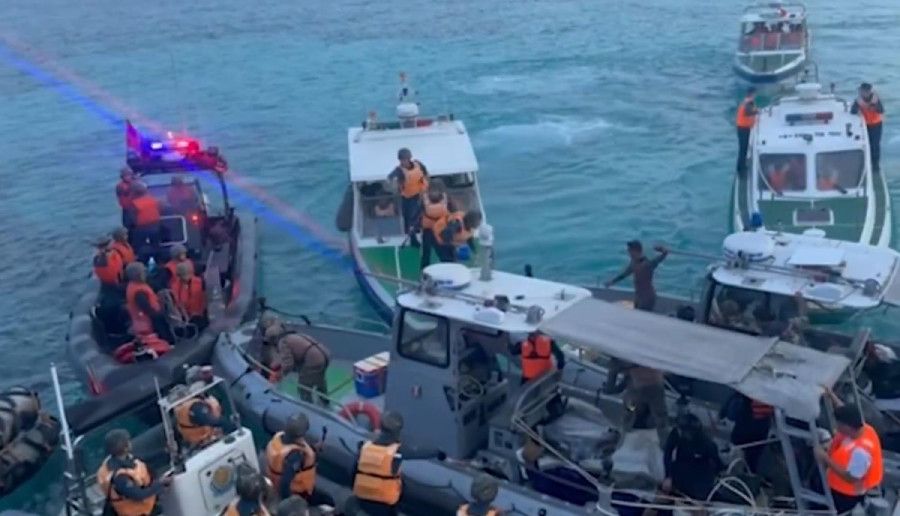
A still image taken from footage released by the Armed Forces of the Philippines showing China Coast Guard personnel confronting a resupply mission to Scarborough Shoal (Photo: Armed Forces of the Philippines)

Baird Maritime offers an opinion piece, “OVERCOMING THE DELIBERATE LEGAL AMBIGUITY ADOPTED BY CHINA’S COAST GUARD.” It is well done.

I will only say, that in the view of myself and, I believe, most of the rest of the world, there is no ambiguity here. What the China Coast Guard is doing in the EEZs of their neighbors is criminal. It began with the destruction of their neighbor’s natural resources as they build artificial islands destroying natural ecosystems. They claim resources that are not theirs. They drive away local fisherman depriving them of their livelihood. They protect a rapacious Chinese fishing fleet that has overfished their own waters and are now destroying vital natural resources in the waters of their neighbors. They have threatened deadly force to intimidate. They have attacked government vessels conducting peaceful routine operations and injured their crewmembers. Now they are threatening kidnapping.

This is state sponsored theft and piracy and an assault on the expected norms of international behavior. We need a forceful international response.

Metal Shark / Damen Foreign Military Sales Patrol Boat

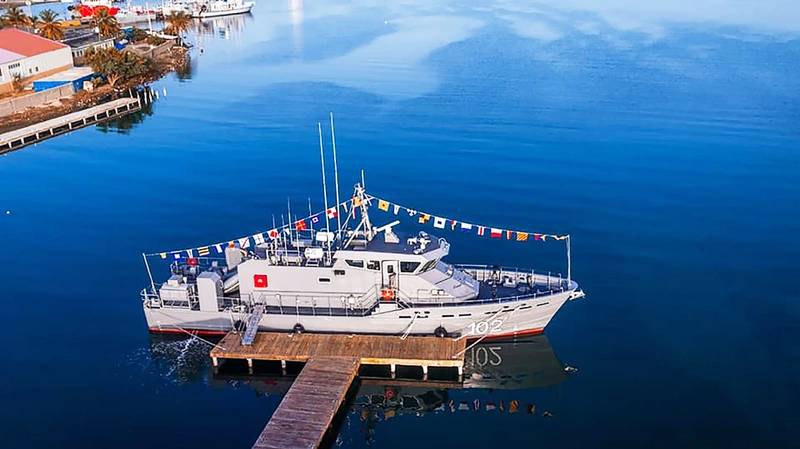
The NCPV Betelgeuse is docked during a ceremony at La Calderas naval base in Peravia, Dominican Republic, on August 6, 2020. The U.S. is delivering Near Coastal Patrol Vessel (NCPV)s to navies and coast guards in the U.S. Southern Command area of operations. The 85-foot NCPVs are built by Metal Shark at Franklin, La., for the Dominican Republic, El Salvador, Honduras, Costa Rica, Guatemala, and other United States partner nations. Photo courtesy Dominican Navy

Back in 2017 I passed along a report from NavyRecognition that Metal Shark had been awarded a contract

“…potentially worth upwards of $54 million, Metal Shark will build up to thirteen 85-foot Defiant-class welded aluminum cutters for the Dominican Republic, El Salvador, Honduras, Costa Rica, Guatemala, and other United States partner nations. Additionally, Metal Shark will supply electro-optical infrared sensors, diagnostic equipment, in-country reactivation, crew familiarization, and test support to NCPV (Near Coastal Patrol Vessel–Chuck) operators.

These are referred to as Defiant class patrol vessels.

Found a photo (above) of one in a Marine Link post, “Navy Combat Craft – Boats Evolve to Keep Pace with Threats.” The photo below is from Wikipedia.

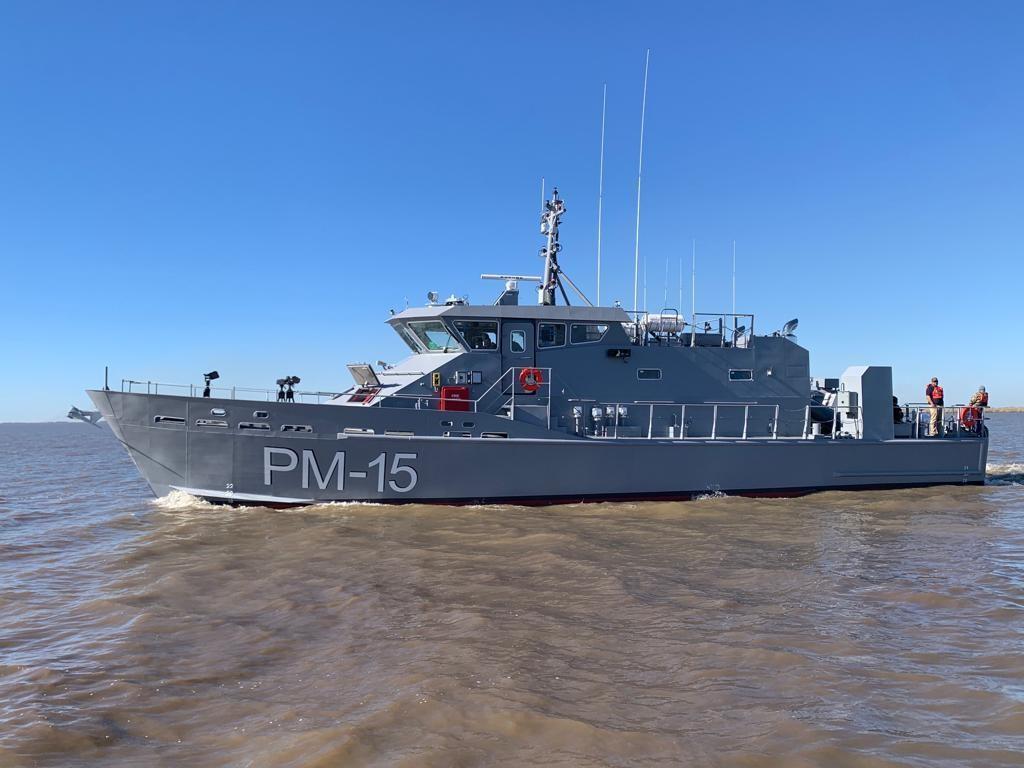
The PM-15, a Defiant class patrol vessel the USA gave to El Salvador, in 2021. US State Department photo.

It appears only five of the class were delivered, one each to the Dominican Republic, Honduras, Panama, El Salvador, and Costa Rica. No idea what happened to the contract for the remaining eight.

If it looks familiar, it is because it is an evolution of the Damen design that gave us the Marine Protector class 87 foot WPBs.