On Memorial Day

“Waters Deep” by Eileen Mahoney

“In Ocean waves no poppies blow
No crosses stand in ordered row
Their young hearts sleep beneath the wave
The spirited, the good, and the brave,
But stars a constant vigil keep,
For them who lie beneath the deep,
‘Tis true you cannot kneel in prayer,
On a certain spot and think he’s there
But you can to the ocean go
See whitecaps marching row on row;
Know one for him will always ride,
In and out with every tide,
And when your span of life is passed
He’ll meet you at the ‘Captain’s Mast’
And they who mourn on distant shore,
For sailors who will come home no more,
Can dry their tears and pray for these
Who rest beneath the heaving seas,
For stars that shine and winds that blow
And whitecaps marching row on row
And they can never lonely be,

For when they lived They choose the sea.”

“Brazil and the United States partner to combat illegal fishing as US Coast Guard Cutter arrives in Rio de Janeiro” –News Release

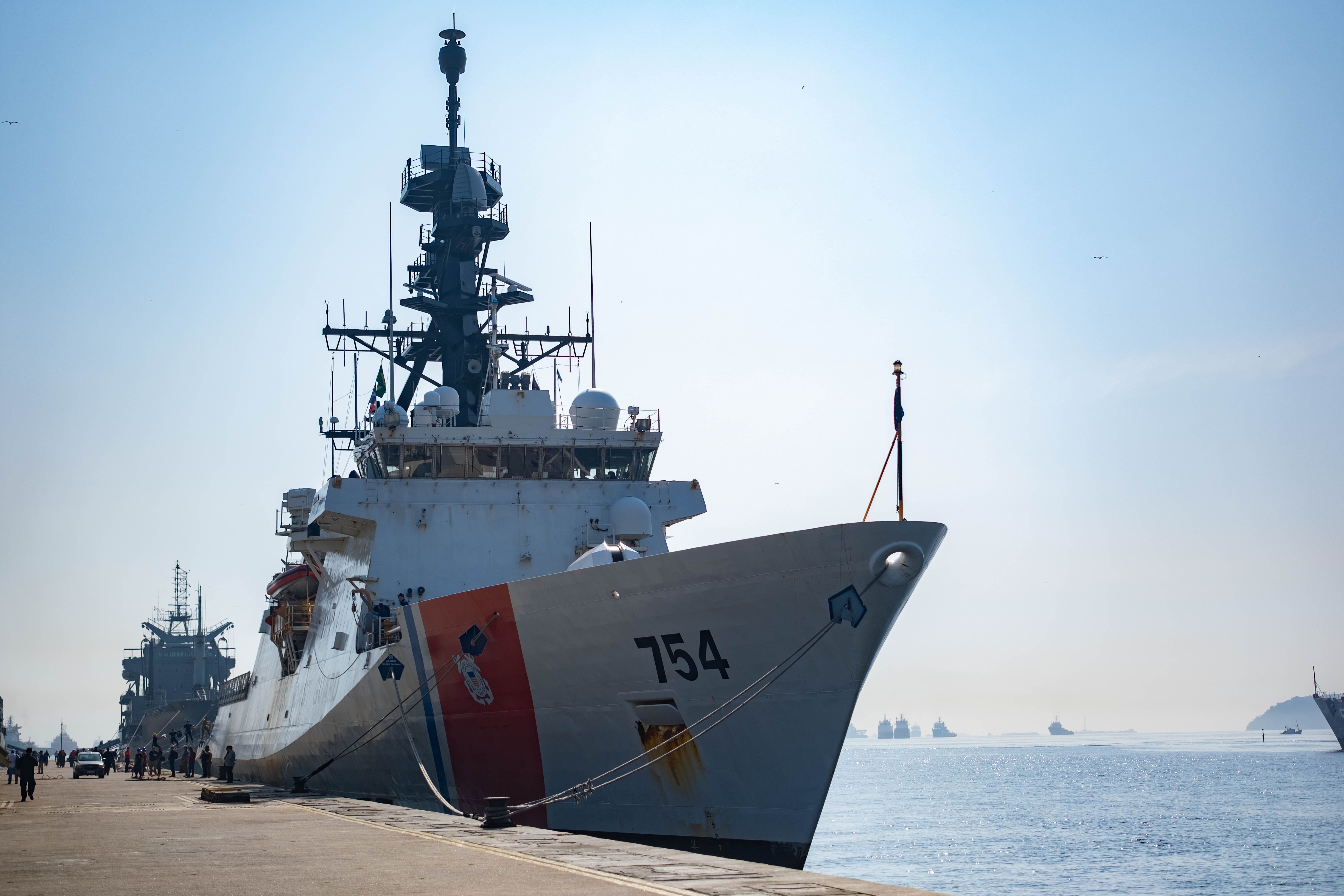
The U.S. Coast Guard Cutter James (WMSL 754) moors in Rio de Janeiro, Brazil, May 20, 2024. The James arrived in Rio de Janeiro for a scheduled port visit during Operation Southern Cross 2024. (U.S. Coast Guard photo by Petty Officer 3rd Class Logan Kaczmarek)

Below is a news release. This may seem a bit unusual, but it isn’t the first time a National Security Cutter has sailed the South Atlantic coast of Latin America. USCGC STONE was in Rio in March 2023. STONE also made a patrol of South Atlantic waters of Latin America in 2021 before she was even commissioned.

Cutters have also frequently participated in UNITAS exercises.


May 23, 2024

Brazil and the United States partner to combat illegal fishing as US Coast Guard Cutter arrives in Rio de Janeiro

RIO DE JANEIRO — U.S. Coast Guard Cutter James (WMSL 754) arrived in the port of Rio de Janeiro, Brazil for a scheduled visit, Monday.

This visit marks James’ third stop as the cutter continues its multi-mission deployment in the South Atlantic Ocean, exhibiting the U.S. Coast Guard’s partnership with Brazil and strengthening the interoperability of the two nations’ maritime forces to counter illicit maritime activity and promote maritime sovereignty throughout the region.

“Working with the Brazilian navy has been a successful demonstration of how our countries can work together,” said U.S. Coast Guard Capt. Donald Terkanian, James’ commanding officer. “James has had the opportunity to enhance relations between the U.S. and Brazil while also addressing the threats posed by illegal, unreported, and unregulated fishing, port security, and in facilitating safe and lawful maritime commerce and travel.”

James embarked Brazilian navy Lt. Cmdr. Fernando Schild in April of 2024. Brazil and the United States’ naval services both use unmanned aerial systems to provide increased maritime domain awareness across a variety of mission sets.  The embarked Brazilian officer is part of Brazil’s first ship-based unmanned aerial systems squadron, and the embarkation of this officer aboard James highlights the robust partnership between the two nations and their shared commitment to upholding the rules-based international order at sea.

In recent years, the United States and Brazil have partnered to share and exchange maritime tactics, techniques, and procedures. Since 2009, the U.S. Coast Guard has provided 34 mobile training team deployments and three resident training courses to Brazil in the areas of crisis management, mobile command systems, port security, maritime law enforcement, search and rescue, and disaster response. Both countries are dedicated to the responsible management of marine resources, demonstrating their shared commitment through the continued integration of their naval forces.

James, staffed by 150 men and women and is one of the largest and most technologically advanced ships in the Coast Guard’s fleet. The crew is dedicated to missions including combatting drug trafficking and monitoring for illegal, unreported, and unregulated fishing activities in the Atlantic. Their work not only supports U.S. interests but also contributes to regional stability and security.

James is the fifth Legend-class national security cutter in the Coast Guard fleet and is currently homeported in Charleston, South Carolina. The national security cutters can execute the most challenging national security missions, including support to U.S. combatant commanders.

James is under the command of U.S. Coast Guard Atlantic Area. Based in Portsmouth, Virginia, U.S. Coast Guard Atlantic Area oversees all Coast Guard operations east of the Rocky Mountains to the Arabian Gulf. In addition to surge operations, they also allocate ships to work with partner commands and deploy to the Caribbean and Eastern Pacific to combat transnational organized crime and illicit maritime activity.

For information on how to join the U.S. Coast Guard, visit GoCoastGuard.com to learn about active duty and reserve, officer and enlisted opportunities. Information on how to apply to the U.S. Coast Guard Academy can be found here.

“Combating Transnational Drug Flows,” A Conversation with the Deputy Director of Joint Interagency Task Force –South

The US Naval Institute brings us this video from the Center for Strategic and International Studies.

The accompanying article provides a brief overview, but I really recommend watching the entire interview. It is excellent. It even touches on Illegal, Unregulated, Unreported fishing.

There is an acknowledgement that resources made available for interdiction have declined even while seizures are up (as is the traffic in illegal drugs), but there is also good news in the successes of partner nations.

Again, there is no substitute for watching the interview.

RIMPAC–Coast Guard Participation?

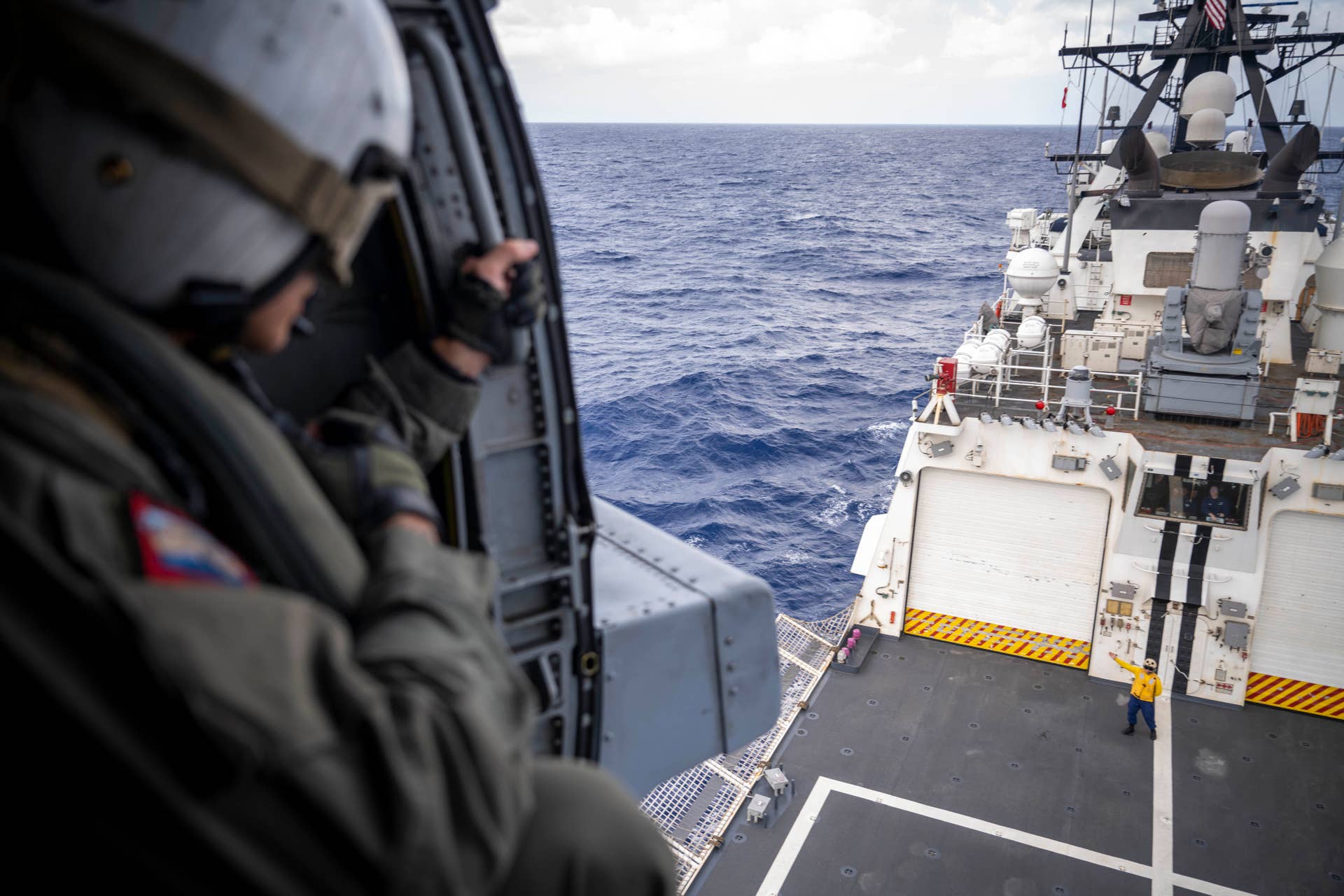
PACIFIC OCEAN (July 30, 2022) U.S. Navy Petty Officer 1st Class Humberto Alba, a naval aircrewman tactical-helicopter, attached to Helicopter Maritime Strike Squadron (HSM) 37, deployed on U.S. Coast Guard Legend-class cutter USCGC Midgett (WMSL 757), looks down at a USCGC crewmember after taking off during flight operations during Rim of the Pacific (RIMPAC) 2022. (U.S. Coast Guard photo by Petty Officer 3rd Class Taylor Bacon)

Below is a Third Fleet news release regarding the upcoming RIMPAC exercise. I am hoping we will see at least one story from each participating Coast Guard unit. There are likely to be several.

A National Security Cutter is almost certain to participate. I am particularly interested to see what the NSC will do. As I noted earlier, during the last two RIMPACs National Security Cutters did some interesting stuff. In 2020 Munro hosted a U.S. Navy Helicopter Sea Combat Squadron 21 MH-60S Helicopter. In 2022 Midget commanded a task force and hosted Navy MH-60R ASW helicopter.

Would be nice if they got to shoot their 57mm as part of the SINKEX. It’s not like they are going to prematurely sink the target. Maybe a dozen ALAMO rounds at 10,000 yards.

I would hope that, sometime in the future, we would conduct a Coast Guard SINKEX using one of our decommissioned ships. Would be good to get a practical demonstration of the effectiveness of our 57mm Mk110s.


May 21, 2024

U.S. Pacific Fleet Announces 29th RIMPAC Exercise

By Commander, U.S. Third Fleet Public Affairs

Approximately 29 nations, 40 surface ships, 3 submarines, 14 national land forces, over 150 aircraft and more than 25,000 personnel will participate in the biennial Rim of the Pacific (RIMPAC) exercise scheduled June 26 to Aug. 2, in and around the Hawaiian Islands.

RIMPAC 2024 is the 29th exercise in the series that began in 1971. As the world’s largest international maritime exercise, RIMPAC combines force capabilities in a dynamic maritime environment to demonstrate enduring interoperability across the full spectrum of military operations.

The theme of RIMPAC 2024 is “Partners: Integrated and Prepared.” To promote a free and open Indo-Pacific, Exercise RIMPAC is the premier joint and combined maritime exercise, utilizing and preserving a world class maritime training environment. With inclusivity at its core, RIMPAC fosters multi-national cooperation and trust, leverages interoperability, and achieves respective national objectives to strengthen integrated, prepared, coalition partners.

This year’s exercise includes forces from Australia, Belgium, Brazil, Brunei, Canada, Chile, Colombia, Denmark, Ecuador, France, Germany, India, Indonesia, Israel, Italy, Japan, Malaysia, Mexico, Netherlands, New Zealand, Peru, the Republic of Korea, the Republic of the Philippines, Singapore, Sri Lanka, Thailand, Tonga, the United Kingdom and the United States.

Hosted by Commander, U.S. Pacific Fleet, RIMPAC 2024 will be led by Commander, U.S. 3rd Fleet, who will serve as the Combined Task Force (CTF) commander. For the first time in RIMPAC history, a member of the Chilean Navy, Commodore Alberto Guerrero, will serve as deputy commander of the CTF. Rear Adm. Kazushi Yokota of the Japan Maritime Self-Defense Force will serve as vice commander. Other key leaders of the multinational force will include Commodore Kristjan Monaghan of Canada, who will command the maritime component, and Air Commodore Louise Desjardins of Australia, who will command the air component.

During RIMPAC, integrated and prepared partners train and operate together in order to strengthen our collective forces and promote a free and open Indo-Pacific. RIMPAC 2024 contributes to the increased interoperability, resiliency and agility needed by the Joint and Combined Force to deter and defeat aggression by major powers across all domains and levels of conflict.

Details of RIMPAC activities and imagery are available at http://www.cpf.navy.mil/rimpac and https://www.dvidshub.net/feature/RIMPAC2024. Media coverage of RIMPAC 2024 is authorized and encouraged, but in all cases will be coordinated through the Combined Joint Information Bureau (CJIB). Media interested in covering the exercise should fill out the following form:

https://docs.google.com/forms/d/e/1FAIpQLSdSTgxjVU15yNS-2OB_BKyzTxJQSjbVzecnbj5XU9vUke6QRQ/viewform?usp=sf_link

Any additional questions/queries should be sent to rimpac.media@gmail.com, or the C3F PA team (619-767-4383). Contact information for the RIMPAC CJIB will be made available prior to the beginning of the exercise.

“What The Navy’s Ship-Launched Missiles Actually Cost” –The War Zone

The War Zone has published a video (above) with transcript here. In addition to price, they provide a brief overview of capabilities of each system. I’ll cut to the chase and provide a “Reader’s Digest” version.

Sounds like a lot of money, but we don’t fire missiles every day. It is expensive just to keep a ship underway. As I discussed in my previous post, the cost of an operating day for a National Security Cutter is probably more than $250,000/day and I have seen much higher figures.

Just consider what courts award as compensation for wrongful death. You may not be able to put a cost on human life, but they do, and it looks like it’s well over $1M. Defending a ship and its crew is worth doing.

Back in 2020 I did a post based on a similar and perhaps more comprehensive look at the cost of missiles. That post also linked three previous posts that looked at how much it might cost to up-arm Coast Guard vessels here, here, and here.

If you compare the cost figures in the two reports, you might be surprised to find that the costs have not changed much in almost four years and in some cases have actually gone down.

There is another list of costs here, based on 2021 purchases.

It is worth noting that, upgrading cutters, should there be a decision to do so, looks like a real bargain compared to adding another ship to the Navy, arming, manning, and maintaining it. Of course, the Coast Guard would have to pay for the additional personnel to maintain and operate additional equipment, but the Navy does pay for the Coast Guard’s weapon systems.

USCGC Blackfin (WPB-87317) and USCGC Forrest Rednour (WPC-1129) in Costa Rica

Pulled this off the U. S. Coast Guard Pacific Southwest Facebook page after seeing a post by Bill James.

“The Costa Rican Coast Guard hosted crews from the @USCGC Forrest Rednour- WPC 1129 and Blackfin – WPB 87317 during a subject matter exchange in Golfito, Costa Rica May 15 and 16. The Coast Guard’s IUUF Center of Excellence facilitated a valuable exchange of best practices and raised the awareness of participating agencies concerning Illegal, Unreported and Unregulated fishing. The exchange was attended by Costa Rican Coast Guard (SNG), Fisheries and Aquaculture Institute (INCOPESCA), the National System of Conservation Areas (SINAC) on Regional Fisheries Management Organizations and the Inter-American Tropical Tunas Commission. These efforts greatly amplify diplomatic progress towards broader bilateral ties with Costa Rica to counter the challenges of IUUF and other forms of illicit maritime activity.”

Surprised they sent an 87 footer to Costa Rica. Could be because we will be transferring one or more to the Costa Rican Coast Guard? Costa Rica already has two former USCG Island class cutters.

BALTIMORE, MD, UNITED STATES, 02.13.2018, Costa Rican Coast Guard 1st Agent Davis Herrera stands watch over the newly acquired 110-foot patrol boat given to the Costa Rican Coast Guard by the U.S. Coast Guard at the Coast Guard Yard in Baltimore, Maryland, Feb. 13, 2018. Two of the former U.S. Coast Guard cutters are now Costa Rican Coast Guard Libertador class patrol boats. (U.S. Coast Guard photo by Petty Officer 3rd Class Ronald Hodges)

The USCG has had a long-term relationship with Costa Rica that goes back more than 50 years with a liaison officer having been stationed there. The relationship may go back as far as the founding of the Costa Rican Coast Guard in 1949.

While historically US Navy ships have not been welcomed in Costa Rica, Coast Guard cutters have been welcomed.

Blackfin is homeported in Santa Barbara and Forrest Readnour in San Pedro, CA.

This is from 1989, but good background. Looks like a lot has changed.

NSC and FRC Participate in Navy COMTUEX

USCGC Stone completes an Underway Replenishment.

The Navy League’s online magazine, Seapower, has a report on a recent Navy/Marine Composite Training Unit Exercise (COMPTUEX), “WASP ARG AND 24TH MEU COMPLETE JOINT FORCE’S MOST COMPLEX TRAINING,” that included an interesting note,

“U.S. Coast Guard Maritime Security Response Team (MSRT) East, USCGC Stone (WMSL 758), and USCGC Angela McShan (WPC 1135) participated in numerous events alongside the Navy and Marine Corps team to train and increase proficiency.”

I think this is a bit unusual, so it raised some questions in my mind. Training for doing LE boardings is normal and using a Coast Guard patrol craft to play an opposing force would not be that unusual, but the presence of USCGC Stone, a national security cutter (NSC), seems out of the ordinary. Is this just a one off or is there significance for Coast Guard Defense Readiness planning? Was this an experiment?

This particular COMTUEX was also otherwise unusual because an Amphibious Ready Group (ARG) does not normally have a destroyer attached.

So why would an NSC be involved? There are several possibilities, some mundane, some perhaps groundbreaking.

The post reports the training included, “events such as live-fire exercises, strait transits, maritime security exercises, amphibious landings, maritime interdiction, non-combatant evacuation operations, foreign humanitarian assistance, and counter-unmanned aerial systems (C-UAS) engagements.”

  • We know Stone did an Underway Replenishment.
  • There was an opportunity for formation steaming.
  • It may have been an opportunity to do some cross deck helicopter operations.
  • If Stone is to be included in the upcoming RIMPAC exercise (June and July), this would have been a good tune-up.

Now I will offer a couple of more imaginative, some will say imaginary, possibilities.

If an amphibious operation is conducted, Coast Guard units might provide SAR in case any of the landing craft are sunk. An NSC with Helicopter(s) would make a good SAR commander, while FRCs could follow the landing craft close into the beach, just as cutters did during the Normandy invasion.

Until recently, ARGs have generally operated without escort vessels. While operating off the hostile shore of a near peer adversary would probably require more than one AAW escort, there may have been a recognition that even during long transits from the West Coast, there may be a submarine threat.

The destroyer in this case, USS Cole (DDG 67), was a Burke class Flight I. When they were designed, they were expected to accompany aircraft carriers that had both fixed and rotary wing ASW aircraft in their air wing, so their design did not include helicopter hangars. The carrier based fixed wing aircraft are no longer active, and an ARG does not normally include ASW helicopters. Having seen National Security Cutters hosting Navy H-60s during the last two RIMPAC exercises, perhaps pairing an NSC with a Flight I Burke class DDG could provide a roost for ASW helicopters near the center of the formation while allowing the DDG greater flexibility in its positioning. The cutter could also function as plane guard, following the big deck amphib the way an escort is normally assigned to follow a carrier in case an aircraft goes into the water.

(During the Second Gulf War a WHEC assigned to a Carrier Strike Group functioned as plane guard and also provided a TACAN beacon because the one on the carrier was inoperative. All the other escorts had departed the scene to be in position to launch a Tomahawk missile strike.)

Changing of the Guard, WPC for WMEC

USCGC ALERT departing Astoria

Passing this along from the “Coast Guard Sea Duty Veterans” Facebook page. The post was by Bill James.


On Friday, 10 May, Cutter ALERT sailed beneath the Astoria-Megler bridge, crossed the Columbia River Bar, and proceeded south enroute to her new homeport of Cape Canaveral, Florida.
Simultaneously, the newly built CGC DAVID DUREN, one of the two 154’ USCG Sentinel Class cutters proceeded northward on its journey from Key West to its new homeport of Astoria, OR.
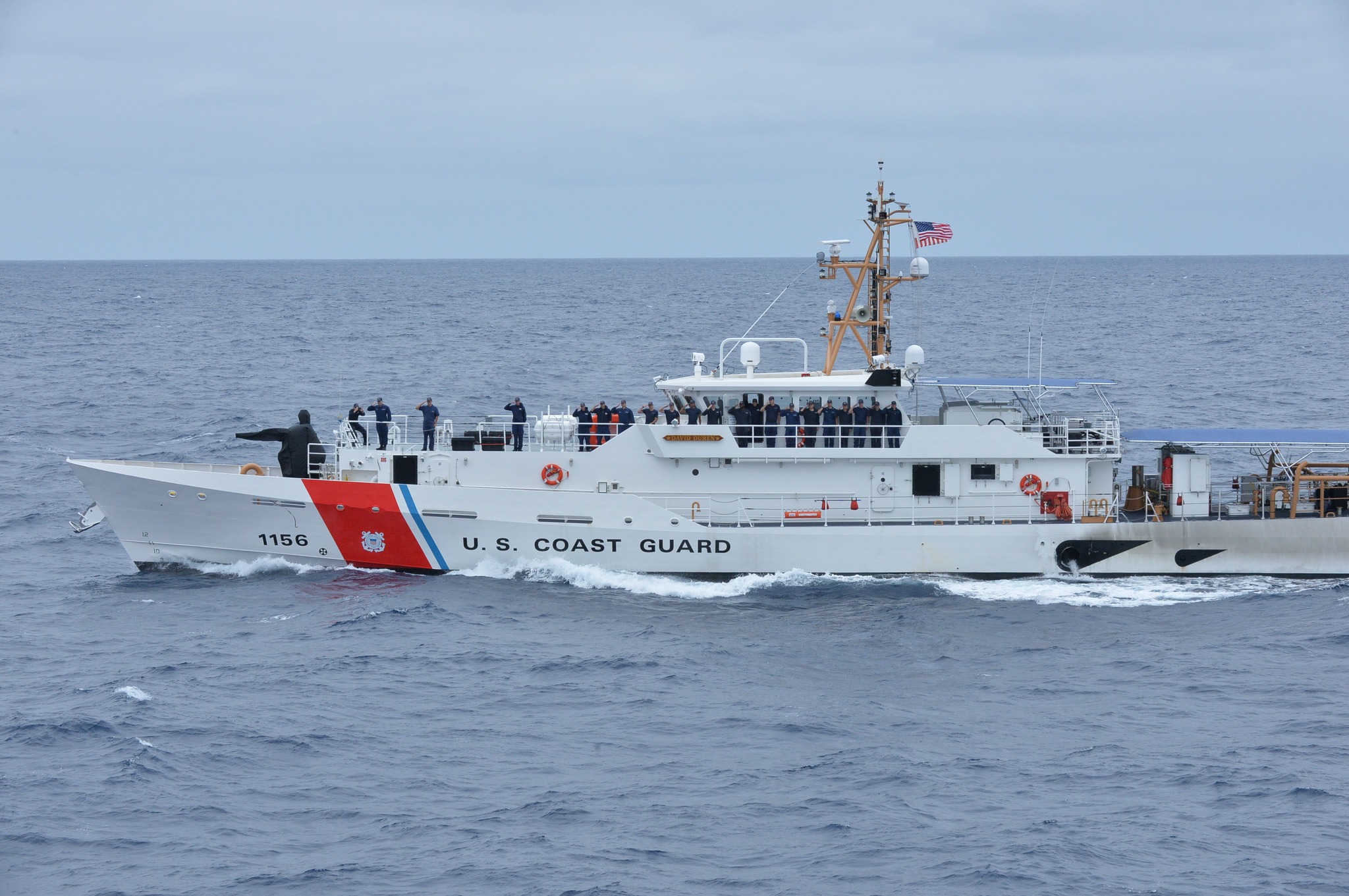
This Thursday, 16 May, the two cutters passed close abroad in the Eastern Pacific Ocean. DAVID DUREN rendered passing honors and ALERT returned the salute, thereby properly relieving ALERT’s 30-year watch to the first of two Sentinel Class Cutters to be stationed in Astoria.

USCGC DAVID DUREN (WPC-1156) Renders Passing Honors

Japan to Build Five Large Cutters for Philippine Coast Guard

Japanese built Philippine Coast Guard cutter BRP Melchora Aquino

The EurAsian Times reports that Japan and the Philippines have finalized their largest security agreement to date.

“The US $507 million project is funded by an Official Development Aid loan from the Japan International Cooperation Agency. Around $425 million will be utilized in constructing five 97-meter-long multi-mission response vessels (MRRV) and a five-year integrated logistics support package…The patrol vessels are expected to be delivered between 2027 and 2028.”

The Philippine CG already has two ships of this type. We talked about this class earlier. Final specs, if there are no changes, from NavyRecognition,

“The MRRV has a length of 96.6 meters (317 feet–Chuck), a maximum speed of not less than 24 knots, and has a complement of 67 crew members. She has a two 6600 kW (6.6MW) diesel engines.”

That is about 17,700 HP. By comparison, the OPCs, which are longer and twice as heavy. will have 19,520 HP.

It appears the Philippine Coast Guard still has not armed their cutters with anything larger than .50 caliber machine guns. This class does have water cannon. Their Japanese counterparts are armed with either 20mm Gatling guns or Bushmaster II 30mm chain guns in Remote Weapon Stations.

Meanwhile the Philippine Navy is also buying Offshore Patrol Vessels, six from S. Korea. They will be much more heavily armed.

“EASTERN SHIPBUILDING GROUP COMMENCES PHASE II OF MAJOR INFRASTRUCTURE IMPROVEMENTS” –News Release

Future USCGC Argus at launch Eastern Shipyard

Below is a news release from Eastern Shipbuilding Group. Hopefully these improvements will shorten construction times for the remaining Eastern built OPCs. It will almost certainly put Eastern in a better position to bid on the last group of OPCs which should be built at a rate of at least two completions per year.

If nothing else, any increase in US shipbuilding capabilities is good news.

Eastern has had their share of difficulties with the OPC program. Hopefully they will surprise us with increasing success on the three ships that follow the future USCGC Argus.


15 May, 2024

EASTERN SHIPBUILDING GROUP COMMENCES PHASE II OF MAJOR INFRASTRUCTURE IMPROVEMENTS

PANAMA CITY, FL – Eastern Shipbuilding Group, Inc (ESG) is proud to announce the commencement of phase two of a significant infrastructure improvement project at its Nelson Street government shipbuilding facility. This phase includes the construction of 1,000 linear feet of additional bulkhead and berthing space, installation of associated heavy weather mooring infrastructure, the extension of the launch facility by 120 feet to increase the total launch way length to over 500 feet, and the final dredging of vessel berthing spaces and the shipyard turning basin. These enhancements will significantly increase ESG’s capability to construct and deliver multiple ships per year, supporting future Department of Defense (DOD) shipbuilding goals.

“This infrastructure improvement project represents a major investment in our government shipbuilding capabilities,” said Joey D’Isernia, Chairman and CEO of ESG. “The increased capacity and shipyard enhancements will allow us to better support the Navy’s initiative to expand the shipbuilding industrial base in order to meet the demands of the national defense strategy.”

The addition of 1,000 linear feet of bulkhead will provide ESG with more berthing space to better support construction programs that require multiple vessel deliveries per year. The extension of the launch way by 120 feet will enable ESG’s Nelson Street government shipyard to accommodate larger vessels more than 500 feet, expanding its capacity to construct a variety of ships to meet the evolving needs of the U.S. Navy and other government agencies. The project is expected to be completed in the summer of 2025.

ESG is known for its expertise in designing and constructing a wide range of complex vessels, including U.S. Coast Guard Offshore Patrol Cutters, the newest U.S. Army Corps of Engineers Medium Class Hopper Dredge, fully automated multipurpose offshore support vessels, and the most technologically advanced modern factory trawlers. The expanded capacity resulting from this infrastructure improvement project will further strengthen ESG’s position as a leader in the shipbuilding industry.