“Italian oil producer Eni this week began drilling a new well in U.S. waters off the north coast of Alaska, becoming the first company to do so since 2015, federal regulators said on Wednesday.
“The oil and gas firm is working from an artificial island in the Beaufort Sea about three miles off Oliktok Point in the Arctic Ocean…The project could result in 20,000 barrels a day of oil production…”
–
This should add urgency to research into dealing with oil spills in the ice covered water. Perhaps also more justification for revitalizing the icebreaker fleet.
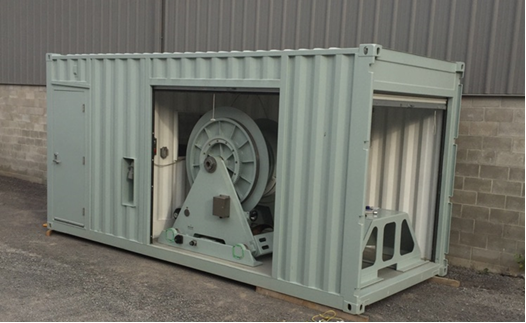
TRAPS containerized active/passive towed array from GeoSpectrum Technologies.
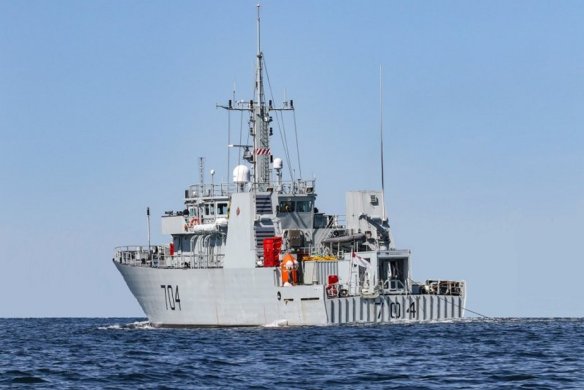
We talked about the possibility of using TRAPS earlier. I had an email discussion with a GeoSpectrum Technologies representative, Geoff Lebans. He tells me the Canadian Navy will test TRAPS from a Kingston class ship in March.
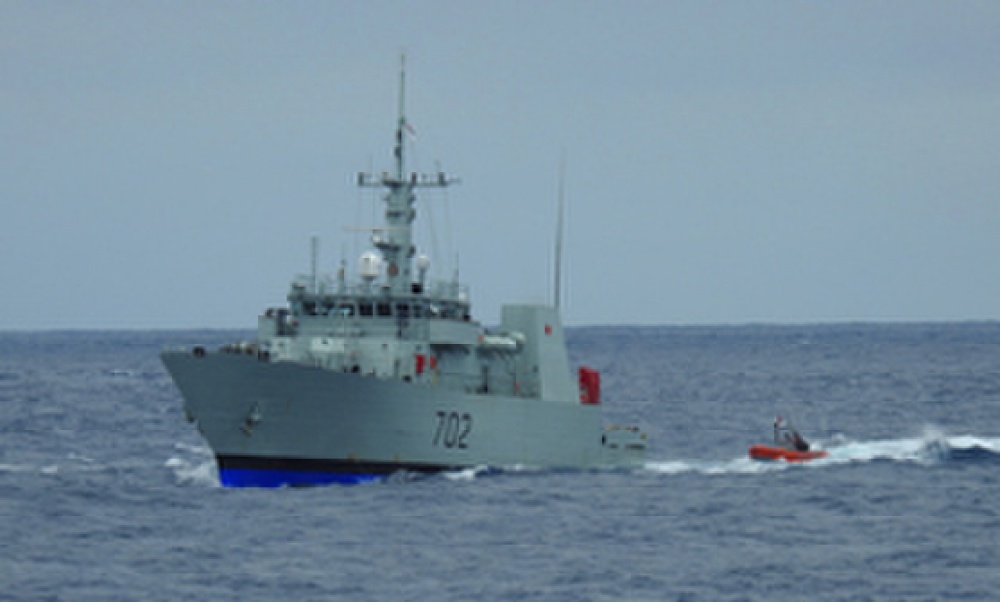
The Kingston class are a little smaller and slower than the 210 foot WMECs, but they have regularly assisted the Coast Guard in drug interdiction.
Would love to see how effective this system might be in detecting semi-submersibles.
The Coast Guard has expressed an interest in having unmanned systems providing networked sensors and GeoSpectrum makes a much smaller towed acoustic directional sensor that they believe would work with the Liquid Robotics™ Wave Glider™ and other small autonomous vehicles. Frankly, I could see the drug cartels putting a bounty on recovery of unmanned surface vessels and their sensors. Still the Navy might also be interested in this sort of network for ASW and they could probably fund the program out of loose change they might find in the sofa. Forth Fleet would probably more than happy to test it in the Eastern Pacific and cutters could probably deploy them.
TRAPS, towed reel-able Active Passive Sonar, deployed from HMCS Shawinigan, a 970 ton Kingston-class coastal defense vessel (photo added 7/03/2020)
Hopefully the Canadians will send their TARPS equipped ship down to the Eastern Pacific transit zones. If they do not, it might make a good Coast Guard R&D project to mount one on the back of a WMEC and use it to help define competitive contract requirements.
An acoustic system like this should be good for detection of something like a semi-submersible out to at least the first convergence zone, well beyond the visual and radar horizon. Mounted in a container they could be placed on WMECs bound for the Eastern Pacific and then transferred to the OPCs as they replace the MECs.
HMCS Nanaimo, a Royal Canadian Navy maritime coastal defense vessel operating in support of Operation Martillo
The Naval War College has updated and expanded its Law of Naval Operations Handbook. Below is their press release quoted in full including a link to download the handbook. Thanks to Bryant’s Maritime Consulting Blog for bringing this to my attention.
Story Number: NNS171221-08Release Date: 12/21/2017 10:54:00 AM By Daniel S. Marciniak
NEWPORT, R.I. (NNS) — The U.S. Naval War College Stockton Center for the Study of International Law has announced the release of an updated and revised version of “The Commander’s Handbook on the Law of Naval Operations,” Dec. 20.
Last updated in 2007, the handbook is one of the preeminent legal resources addressing international law and naval operations, and is a joint-service effort coordinated among the U.S. Navy, Marine Corps and Coast Guard.
The revision updates and expands upon various topics regarding the law of the sea and law of war. In particular, the handbook:
– Updates the history of U.S. Senate consideration of the U.N. Convention on the Law of the Sea, to include its 2012 hearings;
– Emphasizes that islands, rocks and low-tide elevations are naturally formed and that engineering, construction and land reclamation cannot convert their legal status;
– Provides more detail on U.S. sovereign immunity policy for Military Sealift Command chartered vessels and for responding to foreign requests for health inspections and medical information;
– Removes language indicating that all U.S. Navy and Coast Guard vessels under command of a noncommissioned officer are auxiliary vessels;
– Emphasizes that only warships may exercise belligerent rights during international armed conflicts;
– Adds a description of U.S.-Chinese bilateral and multilateral agreements promoting air and maritime safety;
– Updates the international law applicable to vessels seeking a place of refuge;
– Updates the description of vessels assimilated to vessels without nationality;
– Provides detailed descriptions of the five types of international straits;
– States the U.S. position on the legal status of the Northwest Passage and Northern Sea Route;
– Updates the list of international duties in outer space;
– Updates the law regarding the right of safe harbor;
– Adds “honor” as a law of war principle;
– Adds information about weapons reviews in the Department of the Navy;
– Updates the law regarding unprivileged enemy belligerents;
– Includes information about the U.S. position on the use of landmines;
– Expands on the discussion of the International Criminal Court;
– Updates the law of targeting.
The handbook will serve as the benchmark for the law of naval warfare and maritime security and be a vital resource for commanders, practitioners and academics.
MarineLink brings word that at least one company is looking at using drones to pass the messenger between a towing vessel and the vessel to be assisted.
With KOTUG’s drone solution, the messenger line would be delivered to a predetermined location with object recognition software. Instead of picking up the heaving line of the assisted ship, the messenger line of the tug will be brought to the assisted ship in a more controlled manner. This will allow the tug to safely sail beside the assisted ship instead of in front of the assisted ship.
I normally try to stay on topic, but in view of the season, thought I would pass this along. 10,000 Japanese singing Beethoven’s Ode to Joy in German. This began in World War One when Germans being held in a Japanese POW camp sang it. It has become an annual tradition.
Looking at a new device caused me to consider how we might improve an old one, the Alidade.
SOFRESUD Intuitive Pointing Device (IPD)
NavyRecognition reports an innovation in target designation that might have some additional uses.
Performances are the following:
• Portable and mobile with full angular coverage
• Accurate and quick designation
• Day or night capability with digital zoom
• Data, audio and video recording and transmission
• All weapon and combat management systems compatible
• Optional on picatinny rails: counter-UAV & blinding non-lethal accessories
It is not really a firecontrol system, it’s an “Intuitive Pointing Device” (IPD). They refer to it as predesignation. It is really just a very sophisticated way to quickly and accurately input visual bearing and elevation, laser range, and image to a combat management system or remote weapons control station. This is seen as needed particularly for fast and/or stealthy targets and low-level surface or ground-based targets that can be seen but are difficult for radar to pick out of the clutter. Sounds particularly useful in the swarm attack scenarios the Navy has been so concerned about.
In its full configuration, the new IPD integrates many sensors to ensure all conditions capability:
– Extreme low light camera
– Uncooled IR camera
– Eye-safe laser rangefinder
– Fiber optic gyrometers
– Ambient microphone
– Display
Photo: “SOFRESUD’s IPD has a “slew to cue” capability when coupled with the remote weapon stations (such as a Nexter Narhwal or MSI Defence Seahawk) (or the Mk38 mod2/3–Chuck) vis the combat management. IPD operators can there steer and point the RWS to the exact location of the target. Optional equipment can be attached to the IDP thanks to picatinny rails: Sights, laser pointers, dazzlers…”
A Better Alidade:
I got to thinking about alternative uses for this device, including visual navigation, setting buoys, or just checking contacts for bearing drift. That, in turn, got me to think about our customary visual bearing determination device, the alidade. I don’t think they have changed since WWII.
Photo: 090113-N-9758L-040 PEARL HARBOR, Hawaii (Jan. 13, 2009) Quartermaster 3rd Class Mark Minick, assigned to the Pearl Harbor-based guided-missile cruiser USS Chosin (CG 65), looks through the telescopic alidade as the ship departs Naval Station Pearl Harbor during the Commander, Naval Surface Group Middle Pacific (MIDPAC) Surface Combatant Group Sail. (Original Navy description)
Our alidades have no low light level or IR capability or any way to measure distance. They have no electronic connection to pass either bearings or a picture of what is being looked at.
Wouldn’t it help the shipping officer in combat if he could get both an electronically transmitted visual bearing and a visual of a contact that would allow him to see the target bearing?
Visual navigation could be both quicker and more reliable if bearings could be quickly and reliably be passed electronically with the navigator able to confirm that the bearing taker is looking at the point the navigator intends.
The OOD or other bearing takers could benefit from a low light level or IR capability.
And off course the ability to point at air targets might be useful.
Ergonomics:
While the ergonomics of our alidades are very comfortable, there are potential problems with the IPD. Because it looks a lot like a gun, using it may lead to misunderstandings. There must be a protected place to put it down when not in use, but it is not illustrated. It’s probably too heavy to be used over long periods without some form of support.
If it were redesigned to rest safely on the gyro repeater and be used for bearing taking from there, it might solve some of these potential problems. Still to point to air targets you would want to be able to lift it off the stand, here a collapsible wire stock might be helpful.
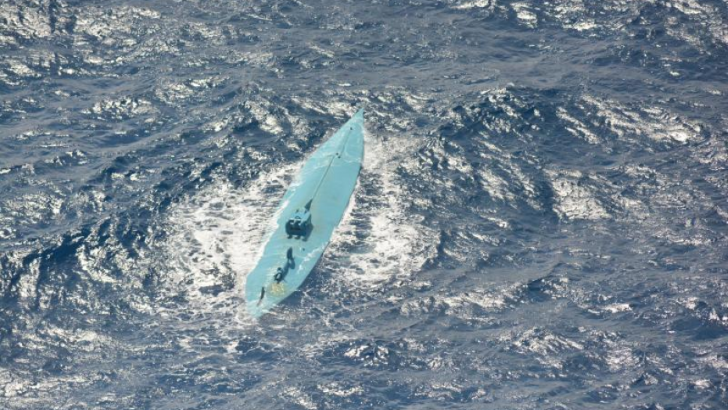
A U.S. Coast Guard cutter intercepted a self-propelled semi-submersible vessel engaged in smuggling more than 3,800 pounds of cocaine, federal officials said Sunday.
According to the U.S. Customs and Border Protection (CBP), on November 13, CBP and Marine Operations (AMO) arrested the crew during operations in international waters (I don’t think this could be true–Chuck), and all three suspects will face charges in the U.S.
“The drug cartels are relentless and extremely innovative,” National Air Security Operations Center – Corpus Christi Director Allen Durham said.
“Interdicting self-propelled semi-submersible vessels requires expertise and the right aircraft. Air and Marine Operations will continue to beat the cartels at their own game to protect our borders.”
The multi-day operation from surveillance to interception, according to CBP, involved several interagency partners including the U.S. Coast Guard and the U.S. Navy.
AMO operates maritime patrol aircraft from Corpus Christi, Texas, and Jacksonville, Florida, to conduct long-range aerial patrols and surveillance missions along the U.S. borders and in drug transit zones in Central and South America, according to CBP.
“”The drug cartels are relentless and extremely innovative,” the Corpus Christi director for the National Air Security Operations Center said earlier this month. “Interdicting self-propelled semi-submersible vessels requires expertise and the right aircraft.”
“Texas is mobilising its drug agents and prosecutors to specifically target drug submarine builders and operators, ABC America reports.”
These both appear to stem from a press release that originated in Texas from Customs and Border Protection, presumably the National Air Security Operations Center – Corpus Christi Director Allen Durham. Apparently the semi-submersible was detected by a CBP P-3.
As far as I can tell, the interdiction, which apparently occurred on November 13, actually happened off Panama.
If and when we ever get self propelled semi-submersibles going directly into the US, it will be a significant event with its possible implications for terrorism, but I don’t think we have any public knowledge of that happening yet.
The Navy Times reports Senate approval of appointment of four Pentagon Assistant Secretaries, including a retired Coast Guard Commander, Tom Harker, who will serve as Comptroller of the Navy.
“Thomas Harker of Virginia to be an Assistant Secretary of the Navy, Financial Management and Comptroller. Mr. Harker currently serves as Associate Deputy Assistant Secretary of Financial Policy for the Department of Veterans Affairs. Mr. Harker served in a mixture of operational and financial management tours before retiring from active duty as a Coast Guard commander in 2012. Since retiring from active duty, he spent two years in public accounting before returning to the Coast Guard as a civilian. His final assignment on active duty before retirement was in the Executive Office of the President’s Office of Management and Budget. Mr. Harker is a recipient of the Coast Guard Meritorious Service Medal, Commendation Medal, and Achievement Medal; the American society of military comptrollers distinguished award for business management; and the association of government accountants achievement of the year award. Mr. Harker is a graduate of the University of California and received his masters of business administration from the University of Miami.”
“His USCG career has included time as comptroller for the Integrated Support Command, business manager of the Buoy Tender Replacement Project and deputy chief for the Office of Financial Transformation and Compliance.”





 Chuck Hill's CG Blog