“Coast Guard releases a request for proposal for long range interceptor III cutter boats” –CG-9

Long Range Interceptor, Length: 35 feet
Maximum Speed: 40 knots
Range: 240 nautical miles
MEDITERRANEAN SEA (April 23, 2021) Crew prepare to depart from the U.S. Coast Guard Legend-class national security cutter Hamilton (WMSL 753)… (U.S. Coast Guard courtesy photo)

The Acquistions Directorate (CG-9) has issued a Request for Proposal (RFP) for a new, third generation of Long Range Interceptors. This is an 11 meter (35 foot) boat, unique to the National Security Cutters. For convinence, I have reproduced the CG-9 announcement below.

If you want to look more closely at the specs, go here and select Attachment 1. A couple of interesting items you will find among the specs are references to removable ballistic protection panels (p.66) and “OVER-THE-HORIZON SATELLITE BLUE FORCE TRACKING (SBFT) SYSTEM” (p.97).


Coast Guard releases a request for proposal for long range interceptor III cutter boats

The Coast Guard released a request for proposal (RFP) today to acquire the third generation of long range interceptor boats (LRI III). The Coast Guard plans to acquire up to 17 LRI IIIs. The RFP is available here.

The acquisition is being conducted as a total small business set-aside under Federal Acquisition Regulation Subpart 19.5.

Proposals are due by Nov. 1.

The LRI cutter boat platform is designed to augment Coast Guard national security cutter mission effectiveness by providing over-the-horizon capability in search and rescue, drug and migrant interdiction, living marine resources, defense readiness, and ports, waterway and coastal security missions.

For more information: Boat Acquisition Program page.

“U.S. Coast Guard Cutter James’ commanding officer temporarily relieved” –LANTAREA

Hate to see this sort of thing. Just passing it along. No comment.

News Release

U.S. Coast Guard Atlantic Area

U.S. Coast Guard Cutter James’ commanding officer temporarily relieved

PORTSMOUTH, Va. — The commanding officer of USCGC James (WMSL 754), Capt. Marc Brandt, was temporarily relieved of duties Friday, Aug. 26, 2022.

Vice Adm. Kevin Lunday, commander of Coast Guard Atlantic Area, effected the relief due to a loss of confidence in Brandt’s ability to command the cutter. The circumstances leading to a loss of confidence involved a mishap aboard the cutter. No personnel were injured.

Lunday appointed Capt. John Driscoll to assume temporary command of the cutter pending the results of an investigation into the mishap. 

Brandt has been temporarily assigned to Coast Guard Atlantic Area.

James is a Legend-class national security cutter (NSC) homeported in Charleston, South Carolina, with a crew of 148 officers and enlisted personnel. NSCs are the Coast Guard’s most technologically-advanced cutters in the fleet.

“U.S. Coast Guard arrives for planned port visit in Cairns, Australia” –Adventures in Paradise with the Webber Class

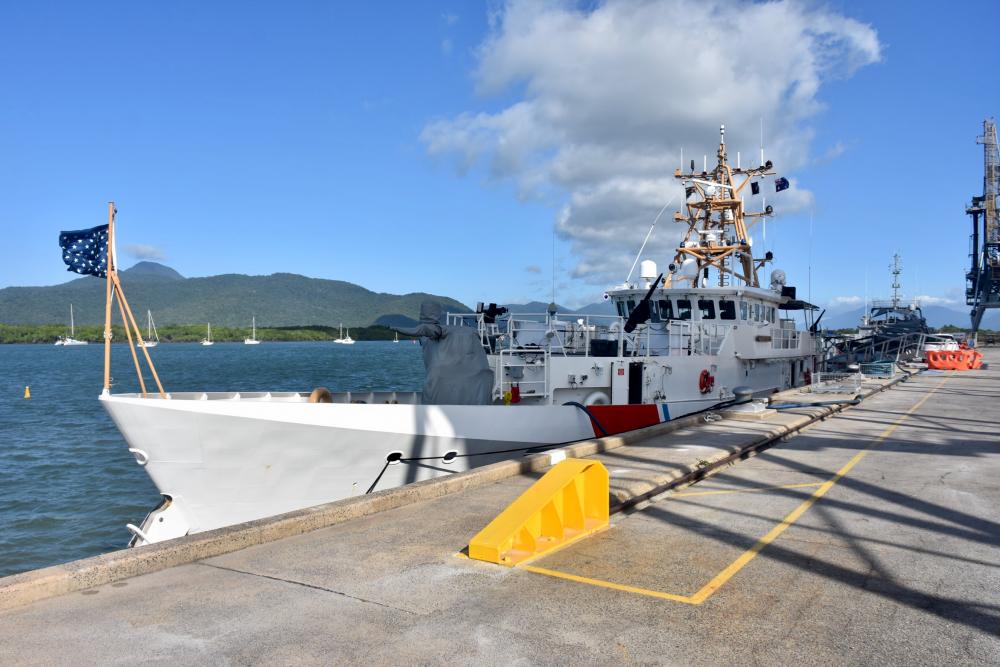
The Sentinel-class fast response cutter USCGC Oliver Henry (WPC 1140) arrive in Cairns for engagements with Australian Defence and Home Affairs partners and local representatives, Aug. 31, 2022. The U.S. Coast Guard is conducting a routine deployment in Oceania as part of Operation Blue Pacific, working alongside Allies, building maritime domain awareness, and sharing best practices with partner nation navies and coast guards. Op Blue Pacific is an overarching multi-mission U.S. Coast Guard endeavor promoting security, safety, sovereignty, and economic prosperity in Oceania while strengthening relationships with our regional partners. (U.S. Coast Guard photo courtesy USCGC Oliver Henry)

The six Hawaii and Guam based Webber class Fast Response Cutters do seem to get around. USCGC Oliver Henry made it to North Eastern Australia, mooring at Her Majesty’s Australian Station Cairns, which is home to some Australian Navy patrol, hydrographic, and survey vessels. Cairns looks like a delightful little city (population in June 2019 was 153,951). Not bad after no one tossed out the welcome mat in the Solomon Islands. The crew is going to have a lot of sea stories.

Cairns is a bit over 1800 nautical miles South of Oliver Henry’s homeport in Guam.

News Release

U.S. Coast Guard Forces Micronesia / Sector Guam

U.S. Coast Guard arrives for planned port visit in Cairns, Australia

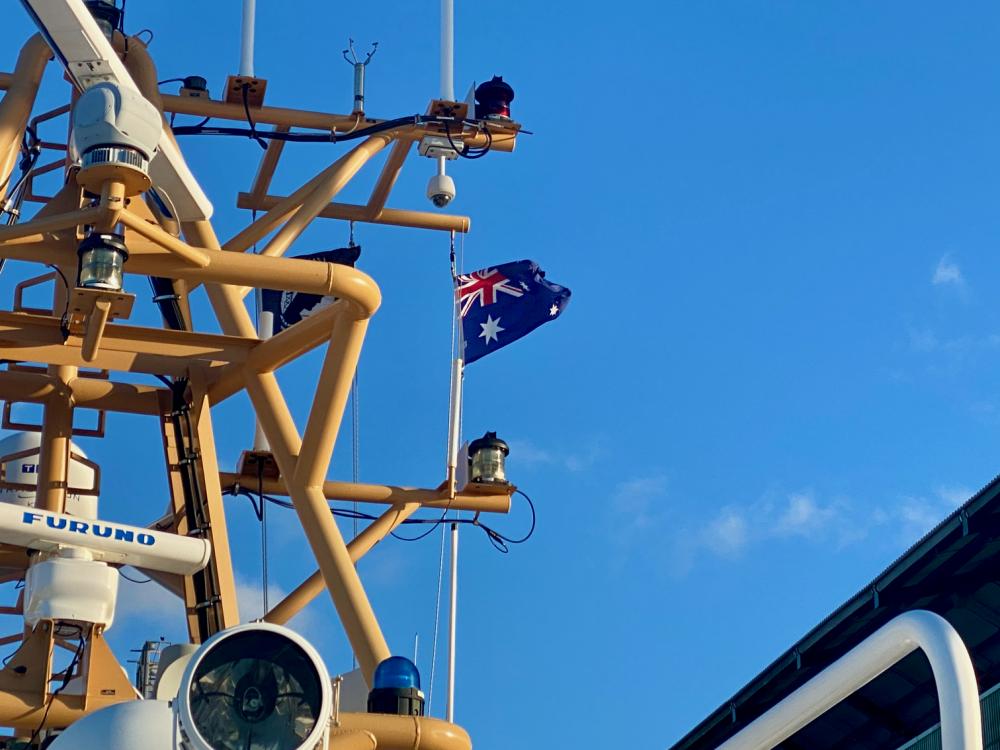
The Oliver Henry is the first U.S. Coast Guard fast response cutter ever to fly the Australian ensign.  The Sentinel-class fast response cutter USCGC Oliver Henry (WPC 1140) command stand for a photo with Cmdr. Alfonso Santos, commander of HMAS Cairns, and Capt. Toby Reid, U.S. Coast Guard representative to the defense attache office of the U.S. Embassy in Australia,
USCGC Oliver Henry meets with Cairns regional Council and mayor The Sentinel-class fast response cutter USCGC Oliver Henry (WPC 1140) arrive in Cairns for engagements with Australian Defence and Home Affairs partners and local representatives, Aug. 31, 2022

Editor’s Note: Click on the images above to view or download more.

CAIRNS, Australia — The Sentinel-class fast response cutter USCGC Oliver Henry (WPC 1140) crew arrived in Cairns for engagements with Australian Defence and Home Affairs partners and local representatives, Aug. 31.

“A cutter arrival to Australia is another first, not only for U.S. Coast Guard Forces Micronesia but also our fast response cutter fleet and is a reminder of our Service’s commitment to our partners and our enduring presence in the region,” said Capt. Nick Simmons, commander U.S. Coast Guard Forces Micronesia/Sector Guam. “The ship driver in me was envious when Lt. Hofschneider reported ‘OH transiting southbound along Inner Great Barrier Reef Passage enroute to Cairns. No issues or concerns.’ Not the kind of thing many Coast Guard members have ever written or said.”

Before arrival in port, Oliver Henry’s crew operated at sea with aerial support from the Australian Border Forces in the Torres Strait. While in port, the two nations will continue to build on the relationship forged at sea. Upon arrival, the crew was greeted by representatives from the Royal Australian Navy HMAS Cairns and the U.S. embassy. They were also guests of the Cairns Regional Council.

“It is an honor for Oliver Henry and her crew to visit and host our Australian friends,” said Lt. Freddy Hofschneider, the Oliver Henry commanding officer. “The U.S. and Australia have been standing side-by-side for more than 100 years. This is more than a partnership, it is mateship. The U.S. Coast Guard looks forward to more opportunities where we can work with the Australian Border Force, Royal Australian Navy, and other Australian partners to advance the rule of law at sea.”

During their stop in Cairns, members of Oliver Henry anticipate engagements with local officials and the community while also experiencing local culture.

The U.S. Coast Guard is conducting a routine deployment in Oceania as part of Operation Blue Pacific, working alongside Allies, building maritime domain awareness, and sharing best practices with partner nation navies and coast guards. Op Blue Pacific is an overarching multi-mission U.S. Coast Guard endeavor promoting security, safety, sovereignty, and economic prosperity in Oceania while strengthening relationships with our regional partners.

The Oliver Henry is the 40th Sentinel-class fast response cutter. The ship was commissioned along with its sister ships, Myrtle Hazard and Frederick Hatch, in Guam in July 2021. In the time since, the crew has participated in several search and rescue cases, completed a counternarcotics patrol off Guam with the Japan Coast Guard, and conducted sovereignty and fisheries patrols in the Forces Micronesia/Sector Guam area of responsibility.

For more U.S. Coast Guard Forces Micronesia/Sector Guam news, visit us on DVIDS or subscribe! You can also visit us on Facebook at @USCGForcesMicronesia.

For more U.S. Coast Guard Forces Micronesia/Sector Guam news, visit us on DVIDS or subscribe! You can also visit us on Facebook at @USCGSectorGuam.

“Coast Guard FRC Seizes Illegal Narcotics in Gulf of Oman” –Seapower/Same Job, Different Hemisphere

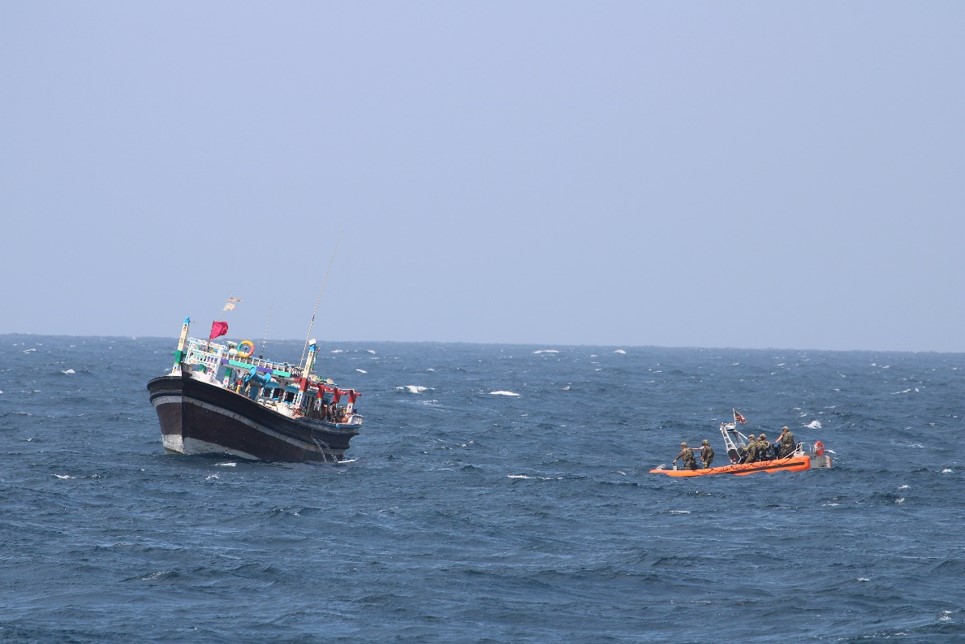
Personnel from U.S. Coast Guard fast response cutter USCGC Glen Harris (WPC 1144) interdict a fishing vessel smuggling illegal narcotics in the Gulf of Oman, Aug. 30, 2022. U.S. COAST GUARD

The Navy League’s on-line magazine, Seapower, reports,

A U.S. Coast Guard fast response cutter interdicted a fishing vessel smuggling illegal drugs worth an estimated U.S. street value of $20 million while patrolling the Gulf of Oman, Aug. 30, NAVCENT Public Affairs said Aug. 31.

USCGC Glen Harris (WPC 1144) seized 2,980 kilograms of hashish and 320 kilograms of amphetamine tablets during operations in support of Combined Task Force (CTF) 150.

This is USCGC Glen Harris’ third drug bust since joining Patrol Forces SW Asia in January.

“Coast Guard, other agencies to remove 2 abandoned vessels from Columbia River in Portland, Ore.” –One of Them Is a Former US Coast Guard Cutter

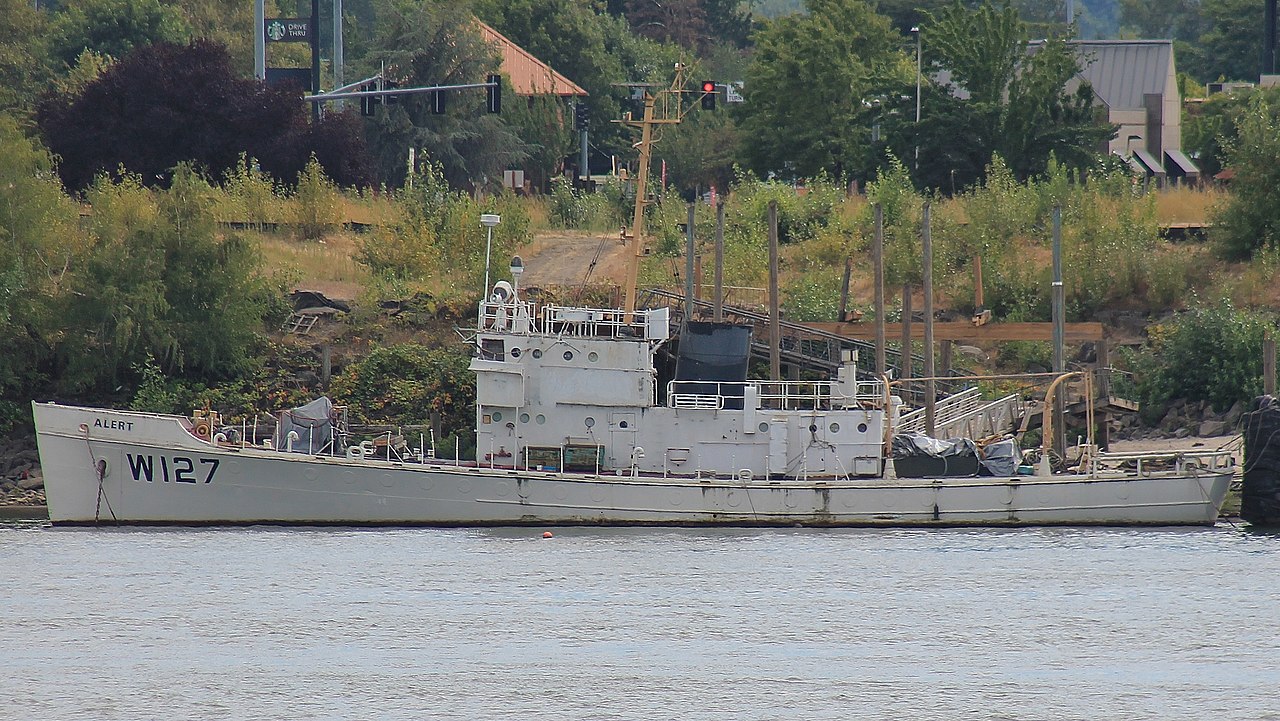
The Active-class cutter USCGC Alert (WMEC-127) moored on the Columbia River, by Hayden Island in Portland, Oregon. Seen on 14 August 2019. Photo from Wikipedia by godsfriendchuck.

Just saw this news release and realized they were talking about the former USCGC Alert (WMEC-127). We talked about this ship and its unfortunate post Coast Guard history earlier including a lot of information in the comments.

Since this was what passed for a WMEC when I entered the academy in 1965, you can see why I sometimes see the Webber class FRCs as MECs. The FRCs have more freeboard.

News Release

U.S. Coast Guard 13th District PA Detachment Astoria

Coast Guard, other agencies to remove 2 abandoned vessels from Columbia River in Portland, Ore.

PORTLAND, Ore. – The Coast Guard and other agencies have approved a plan Wednesday to remove two abandoned vessels from the Columbia River in Portland.

The vessels Alert, a 125-foot vessel, and Sakarissa, a 100-foot vessel, are currently sunk off Hayden Island. They are adjacent to the Interstate 5 Bridge and a mile upriver from the Burlington Northern Santa Fe (BNSF) railroad bridge.

Due to hull deterioration and oil saturation of the vessels’ interiors, they have been discharging a sheen into the waterway. They also pose a collision hazard for vessels operating outside the navigation channel.

“Even though the Coast Guard oversaw the removal of thousands of gallons of diesel and oily water from these vessels in 2020, they still pose a risk,” said L.t. Lisa Siebert, the Incident Management Division Supervisor at Coast Guard Sector Columbia River – Detachment Portland. “We have worked closely with our State and local partners to develop an integrated plan to remove these vessels and protect the public and the environment.”

This project will be funded in two phases. During the first phase, the Coast Guard plans to use the Oil Spill Liability Trust Fund (OSLTF) to raise the vessels and transport them to a facility in order to safely pump any remaining oil waste product from the vessels. During the second phase, the Oregon Department of State Lands, with funding support from Metro, is scheduled to assume custody of the vessels for final disposal.

The Coast Guard was granted authorization to access the OSLTF for $1 million for its phase of the project. There is currently a ceiling amount of $500,000 for each vessel. This amount is determined for the response based on anticipated obligations. Since this is just an estimate, this ceiling is subject to change during the response.

The Coast Guard plans to begin operations in early September, starting with dive assessments to determine the safest way to raise and transport the two vessels. The Coast Guard plans to conduct operations to raise the vessels throughout the month of September. 

“These plans are preliminary and we will continuously assess our plan and make adjustments if needed,” Siebert said. “Throughout this response, the safety of the public and responders will remain our top priority.”

During project activities, the immediate vicinity of the area will be closed to public access.

“I’m incredibly happy our partnerships and hard work resulted in a much-needed plan to remove these vessels,” Siebert said. “This project is truly a team effort and we can’t do it alone.”

Involved in developing the plan were the Coast Guard, Oregon Department of State Lands, Metro, Oregon Department of Environmental Quality, and the National Oceanic and Atmospheric Administration.

For the most up-to-date information about this project, follow us on Twitter at @USCGPacificNW.