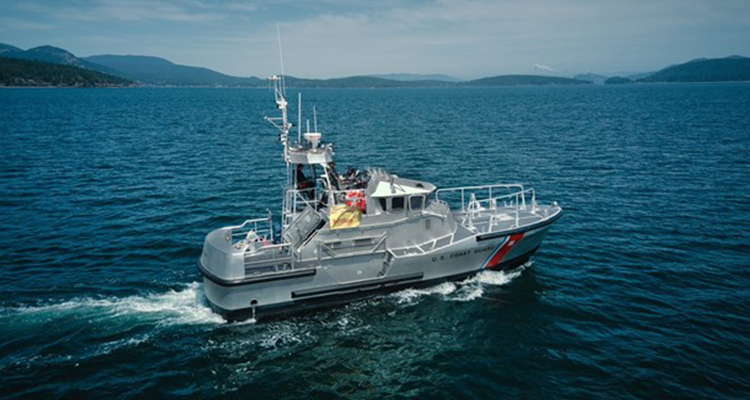
“First 47-foot motor lifeboats delivered following design modification to service life extension program” –CG-9

U.S. Coast Guard photo.

Below the line is the latest Acquisitions Directorate report on the 47 foot MLB life extension program. Previous reports containing additional information are:


First 47-foot motor lifeboats delivered following design modification to service life extension program

The Coast Guard’s In-Service Vessel Sustainment (ISVS) Program in partnership with the Boat Acquisition Program completed service life extension program (SLEP) work on a ninth and 10th 47-foot motor lifeboat (MLB) in June.

The SLEP work package for these two MLBs incorporated design modifications to address operational test and evaluation (OT&E) findings. The extra time and resource investment to develop and refine solutions from the OT&E findings for these two boats should reduce future MLB SLEP durations.

Based on the OT&E findings, the additional work completed on these MLBs encompassed a reconfiguration of the open and enclosed bridge areas, revised console configuration on the open bridge and revised exterior lighting. Further repairs under the SLEP included engine control system modifications to improve speed and responsiveness in hazardous surf conditions as well as extensive hull plating replacement.

For efficiency, the SLEP work is being conducted in two locations, one on each coast, and each facility worked on one of the MLBs incorporating the OT&E production modifications.

On the West Coast, the work was completed in Bellingham, Washington, on June 14, 2023. This MLB was the first post-SLEP boat delivered to Station Umpqua River along the Central Oregon coast.

On the East Coast, the work was completed in the newly opened facility in Portland, Connecticut, on June 9, 2023. This boat is the second post-SLEP MLB delivered to Station Barnegat Light, New Jersey.

SLEP work extends an asset’s service life by replacing obsolete, unsupportable or maintenance-intensive equipment with standardized configuration. The 47-foot MLB SLEP was initiated to extend the useful life of the MLB fleet by 20 years through 2047. The SLEP timeline remains on schedule to place up to 107 MLBs back to full operational capability prior to 2030.

For more information: In-Service Vessel Sustainment Program and Boat Acquisition Program pages

“Alaska’s top Coast Guard official warns of rising medevac cases as he leaves command” –Anchorage Daily News

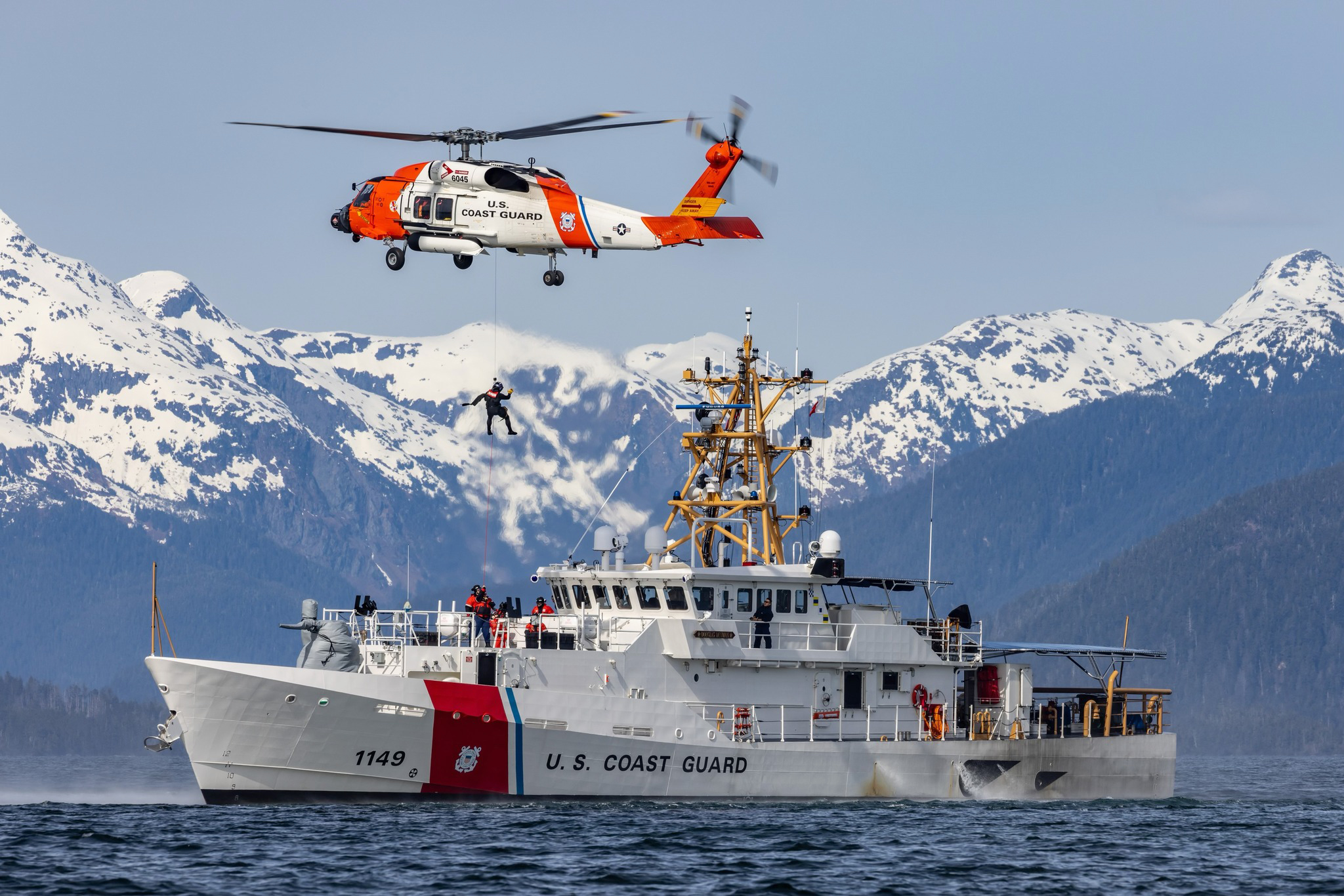
Crews assigned to Coast Guard Air Station Sitka, the Coast Guard cutter Douglas Denman, Sitka Mountain Rescue and the Sitka Fire Department participate in the first day of a weeklong search and rescue exercise in Sitka, Alaska, May 9, 2023.

The Anchorage Daily News reports,

“… as Rear Adm. Megan Dean takes command, Moore said, his service is facing new challenges in the state, and one of the biggest is a growing — and possibly unprecedented — demand for emergency medevac flights.”

It’s a surprisingly detailed report on a change in workload and the reasons behind it.

Thanks to Paul for bringing this to my attention.

CAPT Joseph L. Crowe Jr., USCG, a Tribute

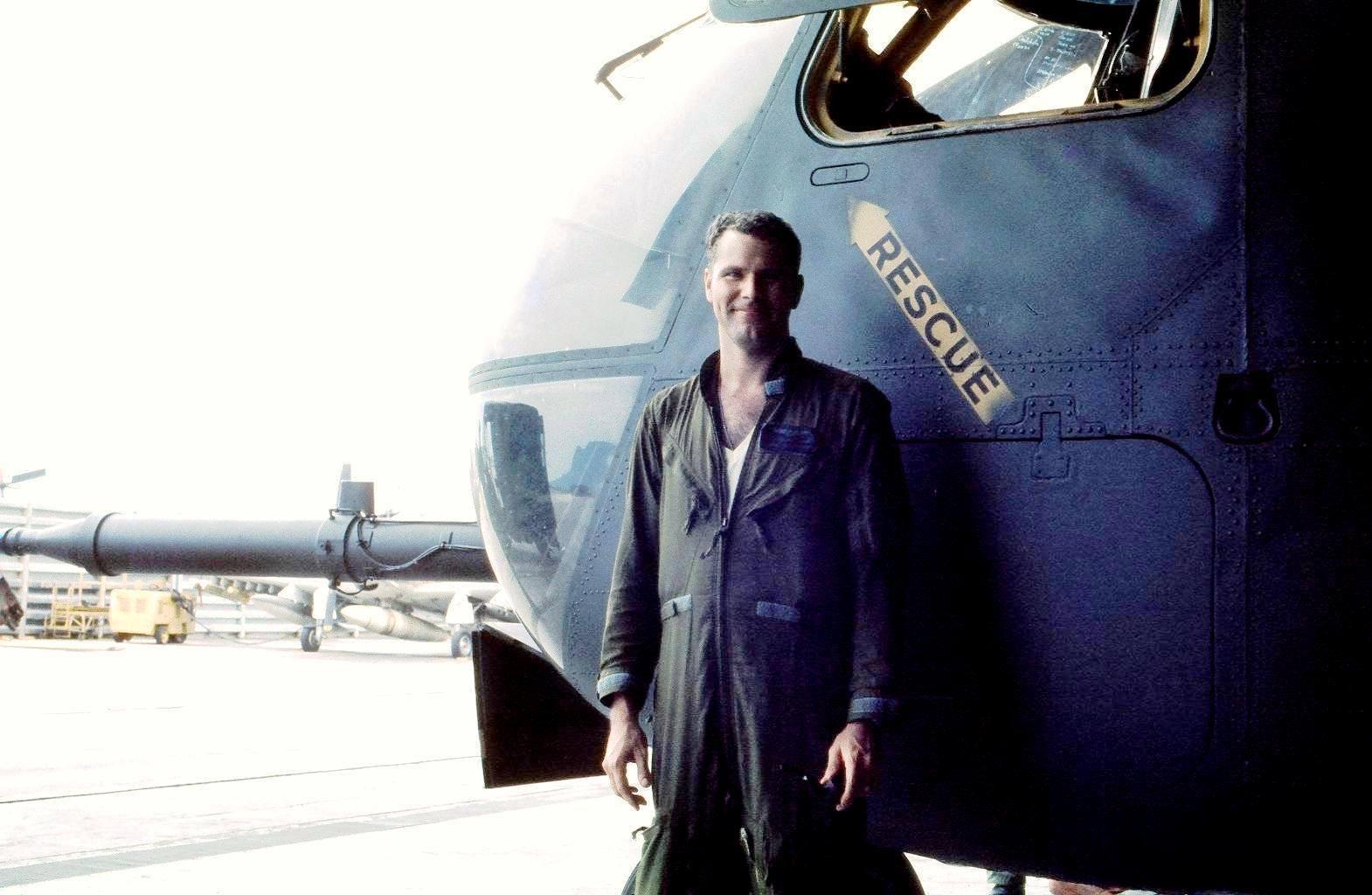
Joseph “Jay” Crowe

The tribute below was written by Captain Sean M. Cross, United States Coast Guard (Retired), son of a former shipmate who had a somewhat successful CG career, Vice Admiral Terry M. Cross, US Coast Guard (ret.).

Capt. Sean Cross has a regular presence on Facebook, regularly marking “Today in Coast Guard Aviation History.”

The following information about Captain Crowe is from “Special Forces Roll of Honour”:

Crowe​, Joseph Lawrence,Jr, Lieutenant Commander, 37 Aerospace Rescue and Recovery Squadron (3 A.R.R. Group) (US Coast Guard attached)​, Distinguished Flying Cross with oak leaf cluster, Cambodia 1971 and South Vietnam 1972.
Born 10.6.1940 Greensburg,Pennsylvania.
Son of Joseph Lawrence and Sara Jane (nee Griffith) Crowe.
Graduated USCG Academy,New London,Connecticut 6.6.1962.
Helicopter pilot.
CGAS, Cape Cod, Massachusetts 1975 (Lt Commander), awarded 2nd oak leaf cluster to DFC 1975 for sea rescue 145 miles south of Cape Cod.
Retired as Captain. 
Married Anne B. O’Mahony.
Died 22.2.2003 Port Angeles,Washington
Massachusetts National Cemetery, Bourne, Barnstable County, Massachusetts Section 28 Site 481

Cadet Joseph “Jay” Crowe, CGA class of 1962.

For more information on Coast Guard aviators’ role in the Vietnam War I recommend, The Coast Guard Flies in Vietnam 

For more Coast Guard history, check out my Heritage page.


 During his 30-year career with the Coast Guard, CAPT Crowe was recognized as a respected leader, a skilled aviator and a decorated hero during and after the Vietnam War.

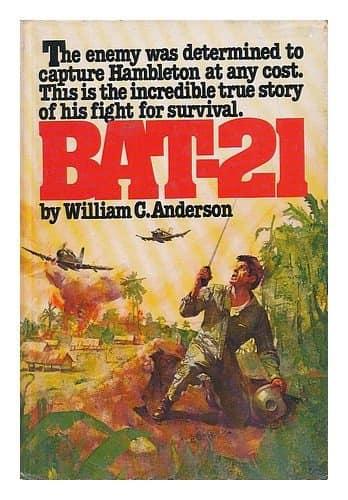
Between 1968 and 1972, ten Coast Guard helicopter pilots were assigned to the 37th Aerospace Rescue and Recovery Squadron at Da Nang, South Vietnam as part of a service exchange program.  LCDR Crowe and his fellow Coast Guard aviators flew hundreds of rescue missions over enemy-infested jungles recovering downed American airmen. Their actions kept many pilots out of North Vietnamese prison camps.  During his tour in Vietnam, LCDR Crowe earned two Distinguished Flying Crosses and nine Air Medals.  One of LCDR Crowe’s combat search and rescue missions was immortalized in William C. Anderson’s famous book BAT-21 (also a very good movie–Chuck):

“Coast Guard Lieutenant Commander Jay Crowe, with additional aircraft cover, broke through the clouds and began a rapid descent towards the area where Lieutenant Colonel Hambleton waited. He was met by an immediate curtain of enemy fire, hurled against him with an intensity that defied belief. Enemy rounds literally shredded “Jolly Green 65”, and it was only the courage and flying skill of the Coast Guard pilot that enabled the chopper to stay airborne long enough to return to base.”

Finally, toward the end of his Vietnam tour, LCDR Crowe was moved into rescue planning because he excelled at it.  Following the 1972 Easter Offensive, LCDR Crowe planned the complex “Quang Tri Citadel” evacuation that saved 132 American advisors and South Vietnamese soldiers caught in the onslaught and surrounded by four North Vietnam Army divisions that were pounding the Citadel with artillery, mortars, and rockets for several weeks. The potential for disaster was as great as the potential for success – losses greater than 25% were expected.  Using elements from the Air Force, Army, Marine Corps and the Navy, all 132 people were evacuated without one bit of battle damage to any of the five HH-53C helicopters.

During his first tour at Air Station Cape Cod, LCDR Crowe earned notoriety as the 1976 recipient of the American Helicopter Society’s (AHS) Frederick L. Feinberg Award as the helicopter pilot who accomplished the most outstanding achievement that year.  LCDR Crowe rescued seven men stranded on the bow section of the stricken tanker Spartan Lady about 145 miles south of Martha’s Vineyard.  Thirty-five men were pulled from the tanker, which had broken in half in hurricane force winds, by four Coast Guard helicopters.  LCDR Crowe arrived on-scene after several attempts by other helicopter crews had failed to rescue the seven men.  According to eyewitness reports, it appeared the men were virtually unreachable.  Weather conditions included hurricane force winds, blowing snow, high seas and limited visibility.  For 45 minutes, LCDR Crowe and his crew improvised rescue methods to a very limited hoisting area until they were finally able to pull each man aboard.  In addition to the AHS award, LCDR Crowe was decorated with his third Distinguished Flying Cross.

Tanker MV Spartan Lady about 145 miles south of Martha’s Vineyard.

CAPT Crowe served two tours at Air Station Cape Cod.  His tour as Commanding Officer (1986 to 1988) was highlighted by marked increases in the unit’s operational and personnel support capabilities – capabilities that still benefit Air Station Cape Cod today.  Under CAPT Crowe’s leadership the unit extended its normal operating area to Canada, the Caribbean and the Bahamas, supporting a record 857 aircraft deployment days.  In addition, the unit also implemented its Rescue Swimmer program well ahead of schedule and led efforts in the advancement of night LE activities and secure communications gear. CAPT Crowe oversaw several quality of life and support improvements including the construction of a new hangar (Building 3172) that brought fixed-wing maintenance operations back from a loaned hangar and the opening of the Kaehler Memorial Clinic – which significantly increased the level of patient care available to Cape Cod military personnel.

CAPT Crowe is a Coast Guard hero.  The word “hero” is often overused, but CAPT Crowe earned the title several times over.  In times of war and peace, he demonstrated uncommon valor in the face of great personal risk.  CAPT Crowe made enduring contributions to the Coast Guard and our Nation.

CAPT Crowe passed away at age 62, in his home in Port Angeles, WA on 22 February 2003 from complications relating to lung-cancer that doctors linked his cancer to service in Vietnam.

“Navy makes sure helicopters cannot land on new Offshore Patrol Vessels” –The Australian

Australia Considering Modular C-Dome For Arafura OPVs
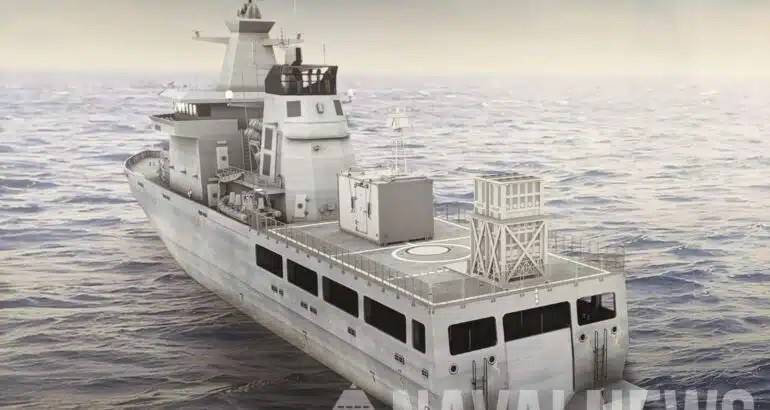
Illustration of Arafura-class OPV fitted with C-DOME

The Australian reports,

“Normally when a navy acquires a new ship, they want it to be as capable as possible. Not so the Royal Australian Navy, which has down-designed the Arafura class Offshore Patrol Vessels (OPVs) so that they can no longer support the weight of a helicopter on the large rear deck.”

The article goes on to criticize this and other decisions regarding the ship, but there may be method to this madness.

I would assume the Australian Navy is putting some thought into these decisions and it may be related to my observations in a post only two days ago, “When is a Flight Deck Not a Flight Deck?”

The intention may be to save topside weight so that an additional load or loads, heavier than an 11 ton helicopter, can be placed high on the ship.

A helicopter deck must be very strong everywhere, because it may be required to take high dynamic loads concentrated on just a few square inches, that may occur unpredictably, almost anywhere on the deck. By contrast even a large load like SURTASS-E, that spreads the load over a much larger area, requires less deck strength.

SURTASS-E. (U.S Department of Defense)

It may be that the Australian Navy has decided to use the “flight deck” as a mission load area where they anticipate placing heavy loads. The weight savings from weakening the flight deck may also permit additional topside weight for other systems, like weapons, if it is not required for loads on the flight deck.

“U.S., Philippine, Japan Coast Guards conduct trilateral engagements in the Philippines” –DVIDS

(From left) Japan Coast Guard Vessel Akitsushima (PLH 32), U.S. Coast Guard Cutter Stratton (WMSL 752), Philippine Coast Guard vessels BRP Gabriela Silang (OPV 8301) and BRP Melchora Aquino (MRRV-9702) conduct a trilateral engagement in the South China Sea June 5, 2023. Stratton deployed to the Western Pacific to conduct engagements with regional allies and partner nations, reinforcing a rules-based order in the maritime domain. (U.S. Navy photo by Chief Petty Officer Brett Cote)

Passing along the Coast Guard Pacific Area release below, distributed by the Defense Video Information Distribution Service (DVIDS). An earlier post, “Philippine Coast Guard Will Hold First-Ever Trilateral Exercise with U.S., Japan” –USNI, provided information on the participating ships.


Story by Chief Petty Officer Matthew Masaschi,

06.09.2023

MANILA, Philippines — The U.S. Coast Guard Cutter Stratton (WMSL 752) and crew departed the Philippines Thursday following the first trilateral engagements between the U.S., Philippine, and Japan Coast Guards.

Stratton’s crew conducted professional exchanges and joint operations in port and at sea with the Japan Coast Guard Vessel Akitsushima (PLH 32) and the Philippine Coast Guard during Stratton’s months-long Indo-Pacific deployment.

Stratton, the Akitsushima and Philippine Coast Guard vessels Gabriela Silang, and Melchora Aquino spent three days at sea off the coast of Bataan, Philippines, executing simulated search-and-rescue scenarios, maritime law enforcement boardings, passing exercises, and formation maneuvering drills. Additionally, they conducted communications and signaling drills, crew professional exchanges and joint boat and air operations following their Manila port visit.

While in Manila, members from the three services conducted combined damage control training, executed cooperative mission planning and table-top exercises ahead of at-sea combined operations. They conducted crew exchanges and toured partner vessels, participated in a women-in-law-enforcement discussion panel, played in a basketball tournament, volunteered at a beach cleanup, visited a children’s hospital and gathered for social receptions.

“It was an honor for Stratton to come together with our Philippine and Japan Coast Guard allies to learn from each other, work together to address common challenges and enhance our interoperability for joint maritime operations,” said U.S. Coast Guard Capt. Brian Krautler, Stratton’s commanding officer. “The experiences gained from our multi-mission trilateral operations underway, our professional exchanges in port and the relationships forged over the last week have been invaluable enablers for the U.S. Coast Guard and our allies to secure a continued free and open Indo-Pacific.”

The multi-day trilateral engagement was named “Kaagapay,” a Filipino word meaning “standing side by side.”

The relationship between the United States Coast Guard and Philippine Coast Guard was built over many years of partnership between the two services. The relationship flourished through the Philippine cadet exchange program at the U.S. Coast Guard Academy, U.S. Coast Guard mobile training team deployments to the Philippines, Philippine Coast Guard Officer enrollment in the U.S. Coast Guard’s Maritime Law Enforcement Academy, engagements by U.S. Coast Guard Cutter Midgett and U.S. Coast Guard Cutter Munro in Manila in recent years and Stratton’s subsequent participation in the first trilateral USCG, PCG, and JCG training operation. The U.S. and Philippine Coast Guard’s partnership has solidified the commitment of both services to upholding a rules-based order in the maritime domain.

The engagement was another SAPPHIRE touchpoint between the U.S. and Japan Coast Guards. In 2022, Operation SAPPHIRE was established through a memorandum of cooperation between the U.S. and Japan Coast Guards as a perpetual operation to strengthen relationships, increase bilateral engagements, and focus on maintaining a free and open Indo-Pacific.

Operating under the tactical control of Commander, U.S. 7th Fleet, Stratton’s crew will engage in professional and subject matter expert exchanges with partners and allies throughout the Indo-Pacific during their months-long patrol to the region.

The U.S. Coast Guard maintains steadfast partnerships and strives for persistent presence in the Indo-Pacific region. Stratton’s current Indo-Pacific patrol is the cutter’s second patrol in the region and one of seven national security cutter deployments to the Indo-Pacific since 2019.

The Coast Guard provides expertise in all aspects of maritime governance, within the mission sets of: search and rescue; illegal, unreported, and unregulated fishing; maritime environmental response; maritime security; maritime domain awareness; maritime aviation operations; and humanitarian assistance and disaster relief.

Commissioned in 2012, Stratton is one of four Coast Guard legend-class national security cutters homeported in Alameda, California. National security cutters are 418-feet long, 54-feet wide, and have a 4,600 long-ton displacement. They have a top speed in excess of 28 knots, a range of 12,000 nautical miles, endurance of up to 90 days and can hold a crew of up to 170.

National security cutters feature advanced command and control capabilities, aviation support facilities, stern cutter boat launch and increased endurance for long-range patrols to disrupt threats to national security further offshore.

U.S. Coast Guard Pacific Area is responsible for U. S. Coast Guard operations spanning across six of the seven continents, 71 countries and more than 74 million square miles of ocean. It reaches from the shores of the West Coast of the United States to the Indo-Pacific, Eastern Pacific, Arctic and Antarctic regions. Pacific Area strives to integrate capabilities with partners to ensure collaboration and unity of effort throughout the Pacific.

When is a Flight Deck Not a Flight Deck?

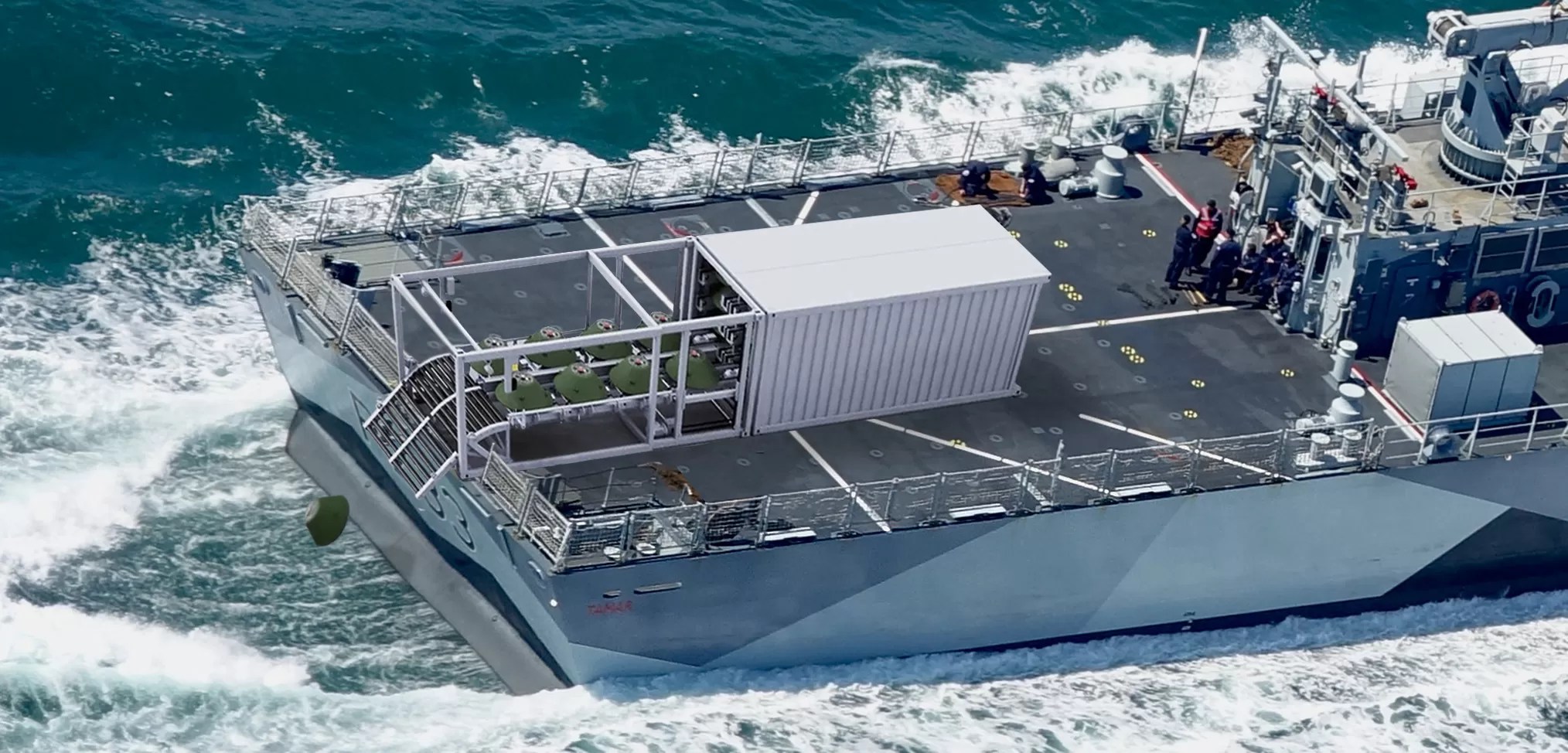
Containerized minelaying system on a River Batch 2 Offshore Patrol Vessel

It has been said that aircraft carriers are the ultimate modular warships because their primary weapons (aircraft) are interchangeable.

A flight deck on an Offshore Patrol Vessel (OPV) certainly offers a degree of aviation options. General purpose, cargo, ASW, and ASuW helicopters and a range of Unmanned Air Systems, but it appears our allies, the UK and particularly Australia may be looking at other ways to use this large open space.

Royal Navy:

Navy Lookout had a post that talked about restoring a naval mining capability in the Royal Navy. There was no specific reference to using flight decks or to Offshore Patrol Vessels.

The RN does not need dedicated minelaying vessels. The SSNs have a theoretical minelaying capability but XLUUVs are a much lower risk and stealthier solution for covert and sensitive missions. Where stealth is less important, containerised minelaying solutions are being developed that can be secured to the deck and dispense mines over the stern. (emphasis applied–Chuck)

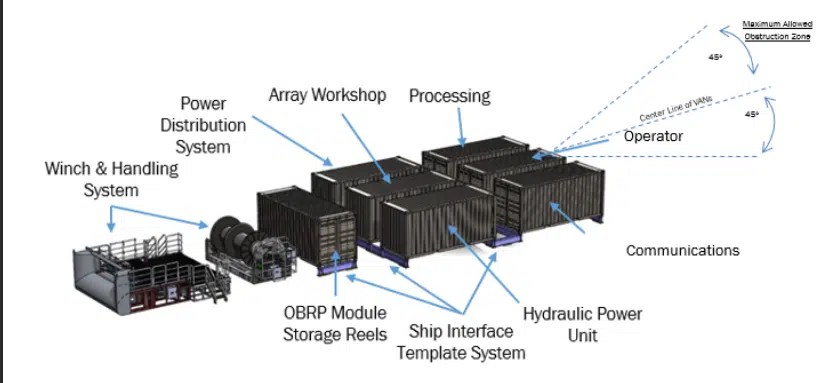
But the photo, above, definitely got my attention. There we see an SH Defence “CUBE” containerized mine laying system developed by RWM Italia S.p,A. (Rheinmetall). on the flight deck of a River Batch 2 Offshore Patrol Vessel (HMS TAMAR).

Australian Navy:

Australia is planning to produce up to 14 flight deck equipped Arafura class OPVs including two intended specifically for Mine Counter Measures (MCM). These ships were always intended to accept containerized mission loads. It appears they are now planning what these ships will do in wartime.

Missile Launcher:

We already saw “Australia Considering Modular C-Dome For Arafura OPVs” –Naval News

Australia Considering Modular C-Dome For Arafura OPVs
Illustration of Arafura-class OPV fitted with C-DOME

Mine Layer:

As noted in the Navy Lookout, Australia is planning to buy and produce large numbers of mines. Naval News reports,

“Australia is set to accelerate the procurement of sea mines as part of Project SEA 2000…The decision to rapidly procure the capability, reportedly from a European supplier, will deliver a ‘significant’ deterrent effect according to Defence…it’s understood that the government has budgeted approximately $500 million to 1 billion Australian dollars for the acquisition…the weapons being brought are smart mines, able to disseminate between civilian vessels and a variety of military targets, allowing a strategic anchorage to be denied to hostile forces, all the while preserving access for aligned vessels(emphasis applied–Chuck)

This all points to large numbers of mines being used in defensive fields. Such minefields will almost certainly be laid by surface vessels. Australia does have some civilian crewed support ships that might be used for mine laying, but as the Arafura class comes online, they will be the most likely surface minelayers.

SURTASS-E:

SURTASS-E. (U.S Department of Defense)

Then there is these reports from Naval News and The Drive that Australia is getting SURTASS-E systems.

SURTASS-E is expected to provide long range detection and cuing for tactical weapons, against both diesel- and nuclear-powered submarines. Again, the Arafura class seems a likely host, because the system is intended for military crew manning and, unlike the civilian manned National Support Squadron ships, these ships are armed and have communication systems that include tactical data link.

Now About the Coast Guard:

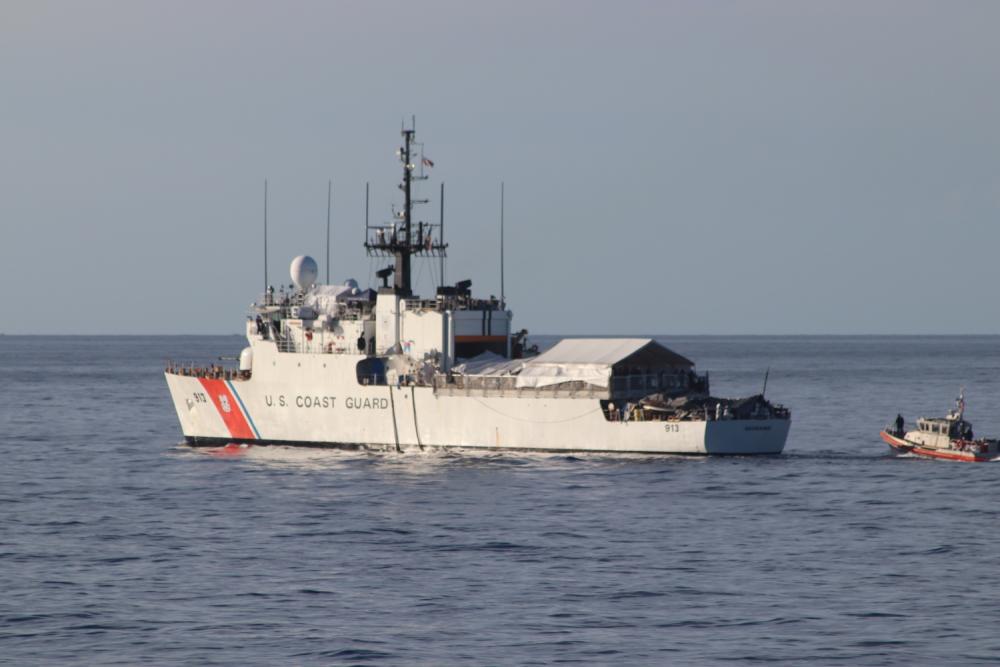
Using a flight deck for non-aviation purposes is not a foreign idea to the Coast Guard. They do it all the time to provide a holding area for migrants. 

USCGC Mohawk’s (WMEC 913) crew patrols the South Florida Straits during Operation Vigilant Sentry, Jan. 5, 2023. Mohawk’s crew patrolled the Florida Straits and Caribbean Sea in support of Homeland Security Task Force—Southeast and Operation Vigilant Sentry in the Coast Guard Seventh District’s area of operations for a 46-day patrol. (U.S. Coast Guard photo by USCGC Legare (WMEC 912)

“ASEAN Coast Guard Forum strengthens cooperation to combat maritime threats” –Indo-Pacific Defense Forum

Coast guard leaders and personnel from member states of the Association of Southeast Asian Nations participate in the June 2023 ASEAN Coast Guard Forum in Jakarta, Indonesia. IMAGE CREDIT: Indonesian Maritime Security Agency

Indo-Pacific Defense Forum reports on the second annual ASEAN Coast Guard Forum.

“Representatives of the coast guards of Brunei, Indonesia, Malaysia, the Philippines, Singapore and Thailand attended the meeting…The inaugural ACF was held in Bali, Indonesia, in November 2022. The next ACF will be held in the Philippines in 2024, with Thailand serving as host in 2025.”

Good to see growing regional international cooperation between coast guard agencies. Similar organizations include the North Pacific Coast Guard Agencies Forum initiated by the Japan Coast Guard in 2000 and the Arctic Coast Guard Forum established in 2015.

Coast Guard in Oceania in the News

The USCGC Oliver Henry (WPC 1140) crew arrives in Manus, Papua New Guinea, on Aug. 14, 2022, from Guam as part of a patrol headed south to assist partner nations in upholding and asserting their sovereignty while protecting U.S. national interests. The U.S. Coast Guard is participating with partners to support the Pacific Islands Forum Fisheries Agency-led Operation Island Chief and the larger Operation Blue Pacific through patrols in the Western Pacific in August and September 2022. (U.S. Coast Guard photo by SW3 Victor Villanueva, NMCB-FOUR)

A couple of recent articles about the US relations with Palau and Papua New Guinea.

Map of the exclusive economic zones in the Pacific.

There has long been interest in a US base on Manus, Papua New Guinea, but this is politically sensitive. Basing cutters there that protect an important economic resource and occasionally rescue the locals when they get in trouble, would probably be most welcome.

On the map above, Manus and Guam do not look that far apart, but Manus is 1,737.88 km (938 nautical miles) SSE of Guam. That is about the distance from Miami to New York City. 

Cutters based in Manus would be closer to parts Freely Associated States (FAS) of Palau and Federated States of Micronesia than cutters based in Guam and much closer to most non-FAS Micronesian nations. It might also be a good place to site a fixed wing forward operating base (CGAS Honolulu DET).

I am beginning to think we will see two new bases in the Western Pacific, one in American Samoa and one in Manus.

If we do end up with additional Webber class based outside Hawaii and Guam, we might need a squadron support organization similar to, and perhaps even larger than, PATFORSWA, to support all FRCs based in the Pacific South and West of Hawaii, e.g. a PATFORSWPAC.

“New Naval Vessels For Denmark” –Naval News

OMT MPV-80 technical specifications

Naval News reportthat the Danes are embarking on a naval program. The details of what kind of ships and how many are not clear but,

Naval News understands that some of the future vessels will be OMT’s MPV-80. These will feature a great deal of modularity via “The Cube” system by local company SH Defence.

The MPV-80 looks a lot like an Offshore Patrol Vessel, but with a difference.

The Danes have a long and apparently successful history of incorporating modularity in their ship designs. They invented the StanFlex system almost 40 years ago. (Not to mention, they have been making LEGOs since 1949.) It appears this design will go much further, “Container capacity: 30 –23 of which are ‘Cube’ ready.” The post explains “The Cube” system by local company SH Defence but more here.

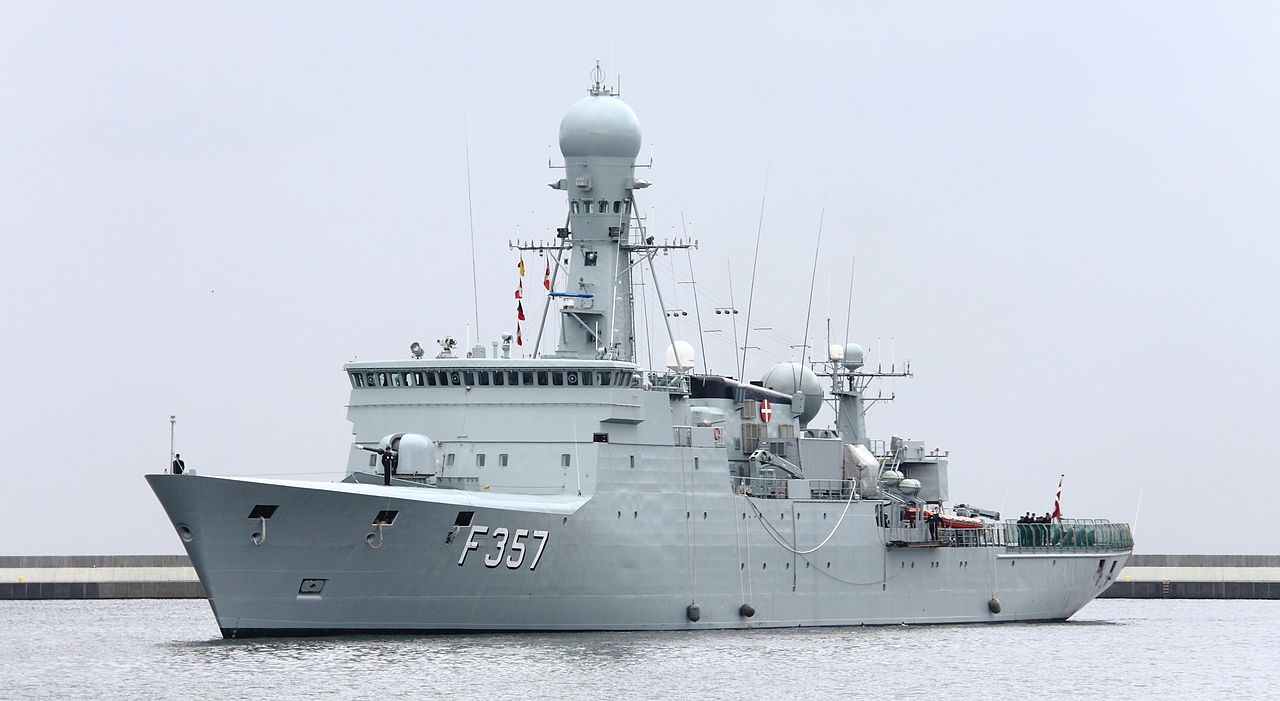
It does appear the four ice-strengthened Thetis class patrol frigates, already over 30 old, are in need of replacement.

Thetis-class ocean patrol vessel belonging to the Royal Danish Navy. Source: konflikty.pl, Author: Łukasz Golowanow