“U.S. Coast Guard Cutter Stratton visits Yokosuka” –News Release

An earlier Western Pacific Deployment. U.S. Coast Guard Cutter Stratton (WMSL 752) participates in a exercise with the Australian maritime surveillance aircraft in the South Pacific Ocean, Feb. 23, 2022. The Stratton is currently underway conducting exercises and operations with partner nations in the South Pacific region. (U.S. Coast Guard photo by U.S. Marine Corps Sgt. Sarah Stegall)

Passing along this news release. You might want to check out the original. They have more photos. The officer seen in two of the photos in fatigues is Air Force three star Lt. General Ricky Rupp, Commander of United States Forces Japan and Fifth Air Force.

May 10, 2023

U.S. Coast Guard Cutter Stratton visits Yokosuka

Editor’s Note: To view more U.S. Coast Guard Indo-Pacific imagery, click here.

YOKOSUKA, Japan – U.S. Coast Guard Cutter Stratton (WMSL 752) departed Yokosuka, May 3, following a scheduled port visit while deployed to the Indo-Pacific.

Stratton is deployed in the Indo-Pacific to engage with ally and partner nations and to promote a free and open Indo-Pacific.

“Deploying U.S. Coast Guard assets to the Indo-Pacific promotes security, safety, sovereignty, and economic prosperity in the region while strengthening relationships between the U.S. and partner nations,” said Capt. Brian Krautler, Stratton’s commanding officer. “The crew was excited to experience the wonderful culture and hospitality of Japan.”

Yokosuka is Stratton’s third port visit since departing its homeport of Alameda, California.

The Stratton crew is conducting exercises in the region to share best practices and expertise in search-and-rescue and law enforcement. U.S. Coast Guard and U.S. Navy forward-deployed forces remain ready to respond to crises globally as a combined maritime force.

Stratton is a 418-foot national security cutter capable of extended, worldwide deployment in support of homeland security and defense missions. National security cutters routinely conduct operations throughout the Pacific, where their unmatched combination of range, speed, and ability to operate in extreme weather provides the mission flexibility necessary for the greater U.S. Coast Guard to serve as a unique strategic contributor in the region.

The namesake of the Stratton is Capt. Dorothy Stratton, who led the service’s all-female reserve force during World War II. She was the first female commissioned officer in the Coast Guard and commanded more than 10,000 personnel. The ship’s motto is “We can’t afford not to.”

Stratton is operating as part of Commander, Task Force (CTF) 71, U.S. 7th Fleet’s principal surface force. CTF 71 is responsible for the readiness, tactical and administrative responsibilities for forward-deployed Arleigh Burke-class guided-missile destroyers as well as any surface unit conducting independent operations in the region.

U.S. 7th Fleet is the U.S. Navy’s largest forward-deployed numbered fleet, and routinely interacts and operates with allies and partners in preserving a free and open Indo-Pacific region.

U.S. Coast Guard Pacific Area is responsible for U. S. Coast Guard operations spanning across six of the seven continents, 71 countries and more than 74 million square miles of ocean. It reaches from the shores of the West Coast of the United States to the Indo-Pacific, Eastern Pacific, Arctic and Antarctic. Pacific Area strives to integrate capabilities with partners to ensure collaboration and unity of effort throughout the Pacific.
“New Danish 64m Patrol Vessel Nordsøen optimised, built and delivered with Hull Vane®” –News Release

Below is a news release from the makers of Hull Vane. I, of course, have no direct knowledge of how well this works or what unmentioned disadvantages there may be, but it does look like this is no longer theory. There have been years of experience with these by sophisticated end users. I have been tracking this for a while (see below) and have hoped the US Coast Guard would investigate its application. The cost saving appears substantial. If it has been looked into, and found disadvantageous, please let me know.


Danish 64m Patrol Vessel Nordsøen optimised, built and delivered with Hull Vane®

May 9, 2023 


Quiet, efficient, comfortable

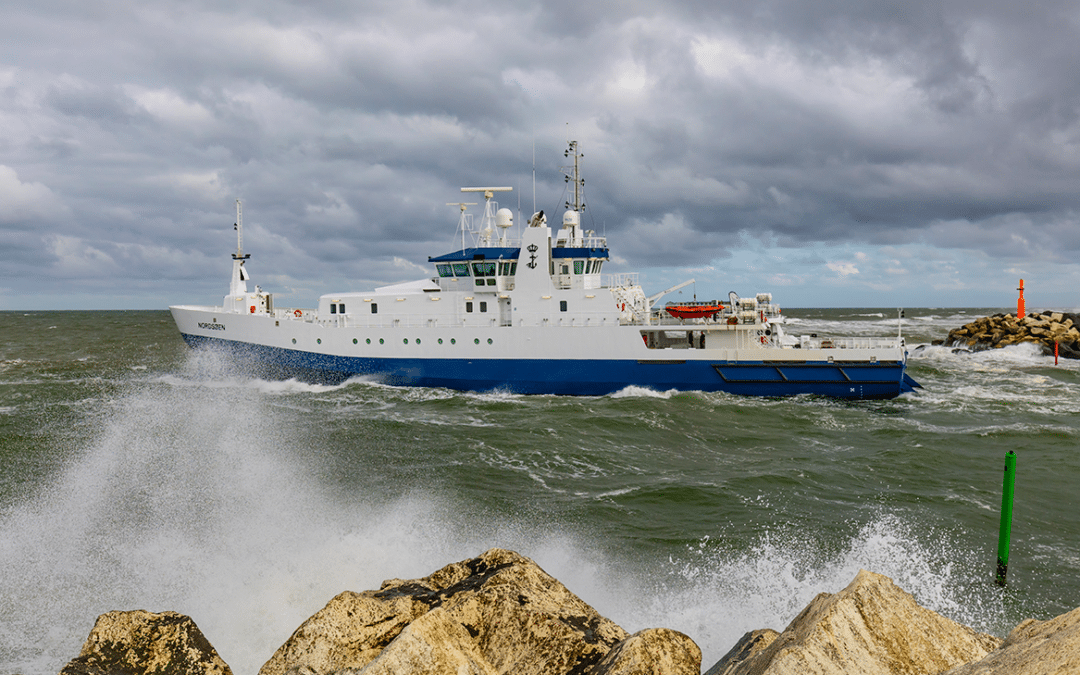
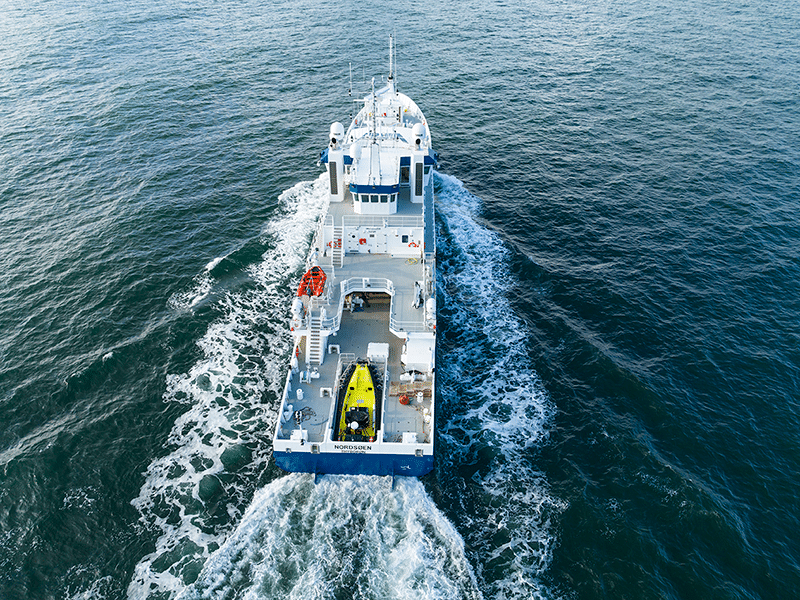
Last summer was a hectic time at Hvide Sande Shipyard, based on Denmark’s West Coast. July and August were filled with sea trials, finishing touches and commissioning of systems of the newbuild Nordsøen. Hvide Sande Shipyard won the public tender to build the vessel in late 2020. On August 24, 2022, the ship was named and handed over to her owner. It is the first Offshore Patrol Vessel which combines azimuthing propulsion pods with a Hull Vane® behind the transom.

Regardless of the speed, Nordsøen sails almost wakeless, thanks to the Hull Vane®  (Photo credit: Thorbjørn Sund)

12 to 17% less CO2 emissions
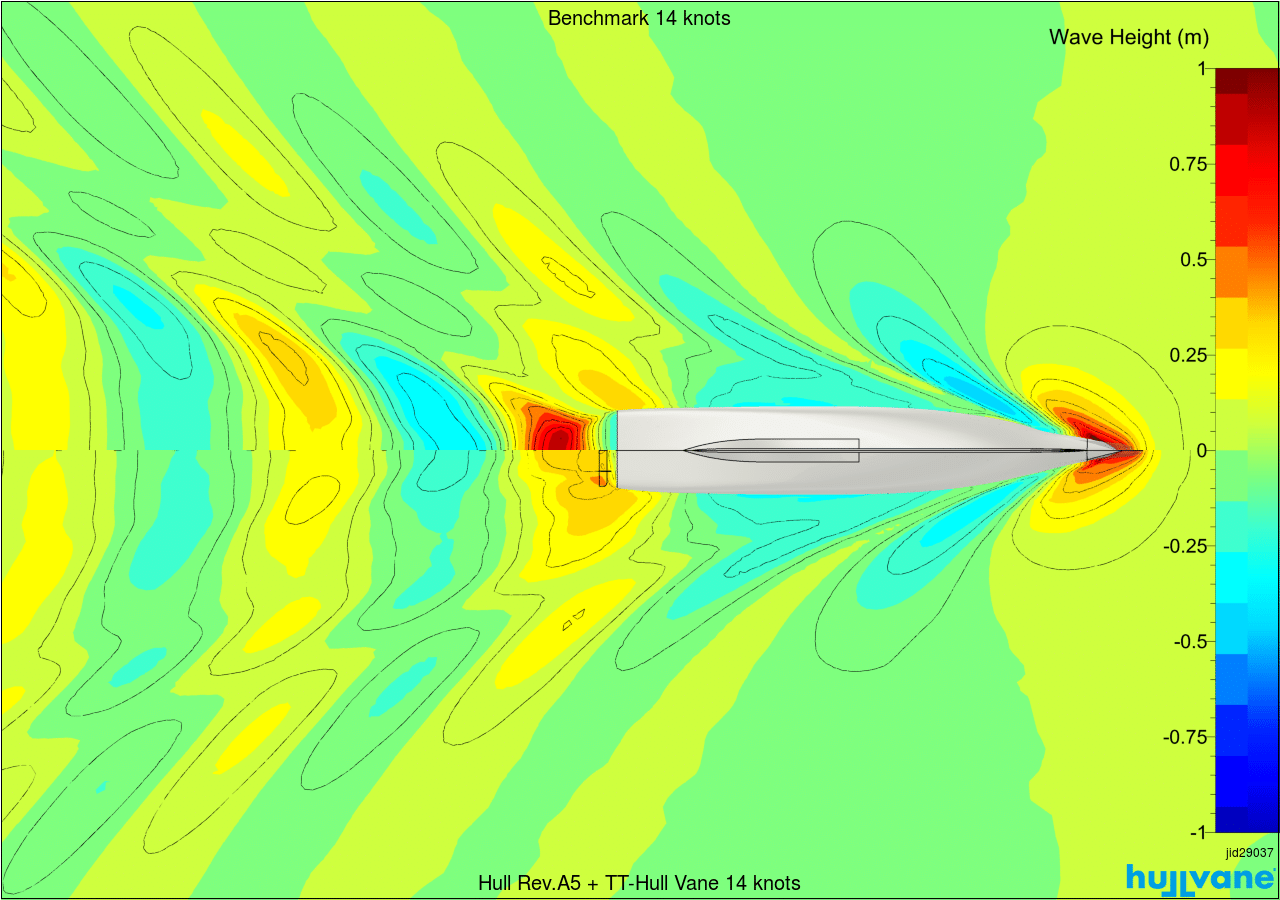
Given that the public tender awarded a lot of points on low lifecycle costs and energy efficiency, Hvide Sande Shipyards contacted Hull Vane BV during the concept design stage. Due to her length, displacement and speed range (10-18 knots), it was quickly determined that Hull Vane® would provide great benefits, which was later confirmed with CFD computations with and without Hull Vane®. The resistance reduction from the Hull Vane® amounts to 12% at 10 knots, 17% at 14 knots and 14% at 18 knots.

Wave profile without (top halve) and with Hull Vane® (bottom halve) at 14 knots.
Diesel Electric pod drives
Bruno Bouckaert, sales director of Hull Vane BV: “The project was atypical, in the sense that from the first conversation about Hull Vane® up to its installation, everything was done through online meetings, as we were in full Covid lockdown-times. That said, the project couldn’t have run smoother. There are some interesting firsts for Hull Vane®: Nordsøen is the first ship where Hull Vane® is installed on a ship with azimuthing propulsion drives. The combination works perfectly, and in fact, because of the Hull Vane®, the pods have to do less steering corrections in bow- or stern-quartering seas, which also improves their efficiency and reduces the noise level.
Another first is the stern ramp system. On Nordsøen, the stern ramp is equipped with a slide-out system. All we had to do is make sure that the Hull Vane® was out of the path of this system. We see a benefit of such systems as it allows patrol vessels and naval ships with a stern ramp to be designed with an optimal hull shape, without a lot of transom immersion. Offshore Patrol Vessels sail a lot of time at moderate speeds (5-15 knots), and then it’s really beneficial to have not too much transom immersed”.

Quietly efficient
So what’s the verdict after the sea trials and several months of usage? All expectations have been met, and the vessel is said to be exceptionally quiet and efficient. The ship has never sailed without Hull Vane®, but it’s obvious that Nordsøen makes very few waves, a clear sign of her efficiency.

According to the operational profile published in the tender documents, the Hull Vane® on Nordsøen saves 317.000 liter of marine diesel fuel per year. That’s enough to drive all the way around the earth every other day with a normal diesel car. The CO2 emissions are reduced by 1.090 tons per year, at an off-the-charts low CO2 abatement cost of – 212 €/ton CO2 abated. The reduced resistance from the Hull Vane® allowed the shipyard to purchase smaller azimuthing pods and diesel-generator plant, a cost saving which exceeded the Hull Vane® cost and therefore reduced the total build cost. It may sound against the laws of quantum mechanics, but the Hull Vane® on Nordsøen actually has a negative payback period. The investment in the Hull Vane® was recovered before the ship even sailed her first nautical mile.

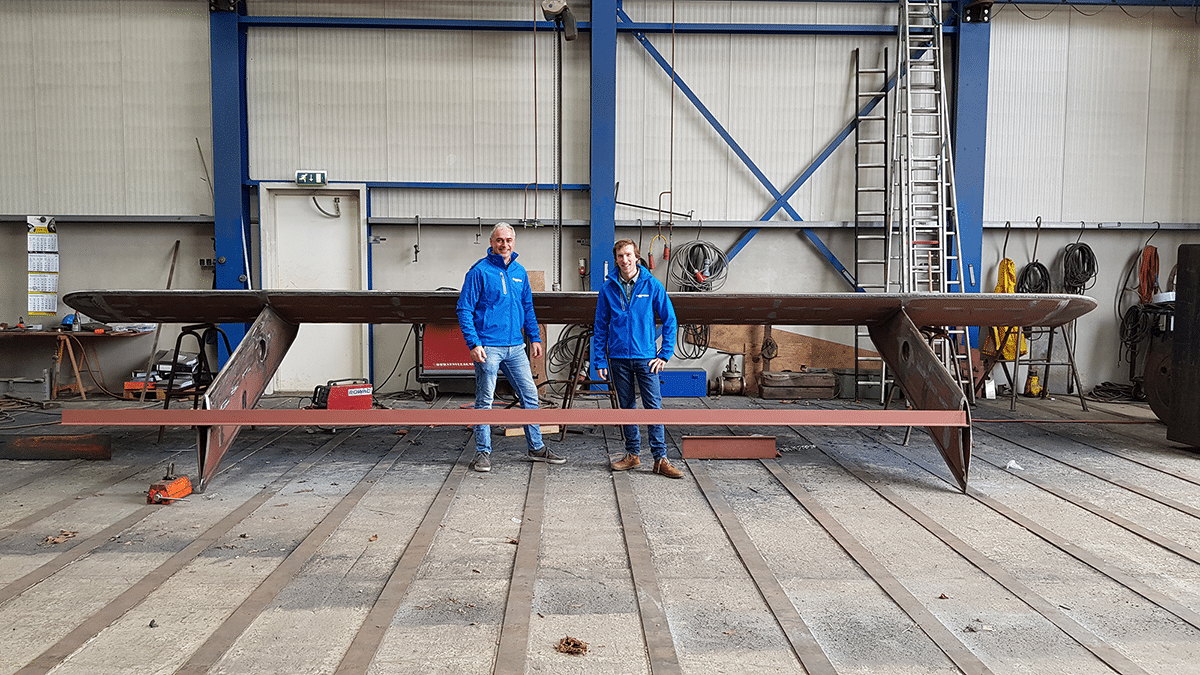
Hull Vane team on site visit during construction
Hull Vanes have now been installed on many patrol vessels operating in the Netherlands, France, Belgium, Denmark and Nigeria. On all these vessels, the reduction in fuel consumption from the Hull Vane® exceeds 10%. It’s a proven and very cost-effective solution for governments wishing to reduce the use of energy and CO2 emissions of their fleet, at a negative cost due to the energy savings. Whatever the fuel of the future will be, Hull Vane® makes the future energy transition easier and more affordable.

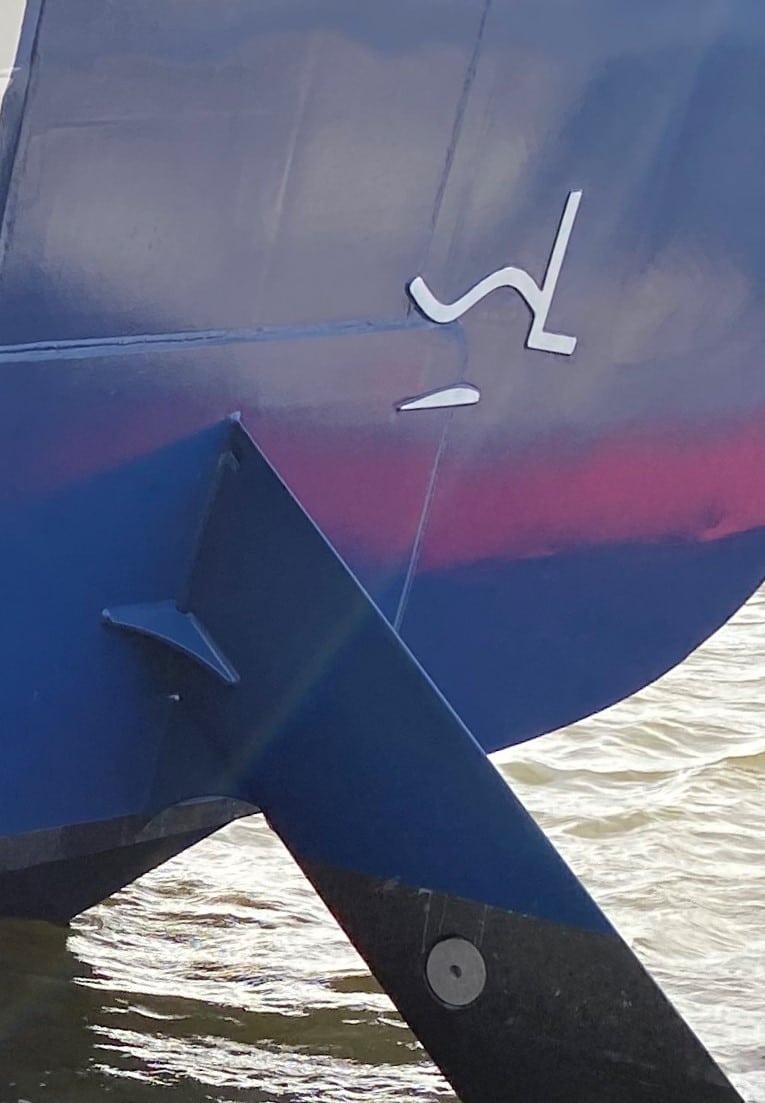
Hull Vane® marking on the transom

House Appropriations Committee FY2024 Budget Hearings

Note the video above does not actually start until about minute 17.

Above is a video of the Commandant’s testimony before the House Committee on Appropriations that occurred about two weeks ago. It may be worth noting that those present were not the full committee. The full committee includes 71 members, currently 34 Republican and 27 Democrat.

The Coast Guard enjoys bi-partisan support in Congress, and it was evident in this committee hearing.

Concerns identified included:

  • IUU fishing
  • Border security/drugs/immigrants
  • Recruiting problems
  • Chinese investments/influence in Mexico’s transportation systems
  • The effects of offshore wind farms

There was discussion about the Unfunded Priority list, including:

  • Funding of four additional Fast Response Cutters,
  • Improvements at the Coast Guard Yard that would allow a larger floating dry dock capable of servicing the Offshore Patrol Cutters (1:21:00),
  • and various infrastructure improvements. Charleston, Seattle, and Alaska in particular were mentioned.

There was a lot of concern about the influx of non-prescription fentanyl. This is a problem the Coast Guard has not had much of a role in countering, but there was hope that the Coast Guard might be able to work with the Mexican Navy on ways to track the distribution of precursor chemicals which are imported into Mexico legally.

There was discussion of the lack of progress on the Polar Security Cutters and questions about the waterways commerce cutters.

The Commandant was consistent with her previous statements that the Work Force is her highest priority. Increased recruiting capacity, additional recruiters and recruiting offices, has been funded.

Some comments that surprised me:

  • Indo-Pacific support cutter, Harriet Lane, to arrive in Honolulu before the end of the year, will operate out of there for a couple of years before going on to her final homeport. (49:00)
  • Maritime illegal immigration attempts peaked earlier in the year and are now decreasing.
  • A Maritime Domain Awareness data fusion center has been started. The CG is getting Saildrone USVs to assist in data collection. Scan Eagle was mentioned but there was no specific discussion about land based UAS.
  • Purchase of a commercially available icebreaker was included in the FY2023 budget but was delayed until FY2024. The CG is apparently now ready to proceed with that.

The Commandant also confirmed that the Coast Guard was ready to proceed with procurement of a Great Lakes icebreaker with capabilities similar to Mackinaw (1:10:00).

There is a report on the hearings by “Workboat” here. Thanks to Paul for making me aware of this article, that then led me to find the video above. 

“Australia Considering Modular C-Dome For Arafura OPVs” –Naval News

Australia Considering Modular C-Dome For Arafura OPVs
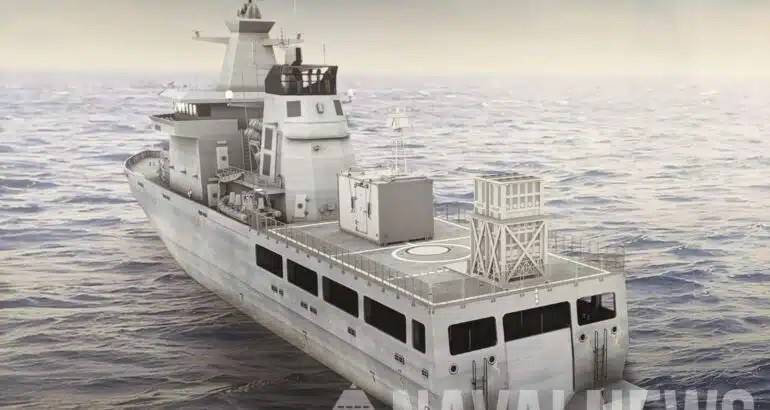
Illustration of Arafura-class OPV fitted with C-DOME

Naval News reports,

“The Royal Australian Navy (RAN) is in talks to procure a containerised variant of Rafael’s C-Dome in an effort to increase the firepower of its future Offshore Patrol Vessels (OPV).”

Arafura class OPVs:

The Arafura-class is based on the Lürssen-designed Darussalam-class, operated by the Royal Brunei Navy. This is expected to be a class of 14, 12 off shore patrol vessels and two dedicated to mine counter-measures. They are expected to displace 1640 tons, be 80 meters (262 ft) long and 13 meters  (43 ft) of beam with a draft of four meters (13 ft) with a speed of 22 knots.

C-DOME Missile System:

C-Dome is the naval version of the Israeli Iron Dome missile system which was developed with considerable US support. There has been considerable US interest in the Iron Dome system (here, here, and here). Systems are coproduced by Rafael and Raytheon. Complete systems are built in the US.

The new Israeli Sa’ar 6 corvettes are expected to have forty vertical launch cells for C-Dome in addition to 40 Barrak 8.

From Wikipedia specifications for the Iron Dome interceptor:

  • Weight: 90 kg (200 lb)
  • Length: 3 m (9.8 ft)
  • Diameter: 160 mm (6.3 in)
  • Proximity fuse

By comparison, the Evolved Sea Sparrow Missile weighs 620 pounds, is 12 feet in length, and has a diameter of 10 inches. It can be quad packed in the Mk41 vertical launch cells.

The RIM-116, Rolling Airframe Missile (RAM), weighs 162 pounds, is 9’2″ long, and has a diameter of 5″ so smaller than the Israeli system, but it has yet to be deployed in a vertical launcher so it apparently needs two launch systems to provide 360 degree coverage.

“U.S. Looks To Transfer 4 Patrol Boats To The Philippines” –Naval News

Ukrainian Navy Island-class patrol boats, formerly of the U.S. Coast Guard, conduct maritime security operations in the Black Sea off the coast of Odesa, Ukraine. UKRAINIAN NAVY

Naval News reports,

“On Monday, the U.S. announced its intention to transfer four patrol boats to the Philippine Navy. The transfer intends to support the Armed Forces of the Philippines’ modernization plan, specifically the Philippine Navy’s maritime capabilities.”

Note these are to go to the Philippine Navy, not their Coast Guard.

They will be getting two 110 foot (33.5 m) Island class and two 87 foot (26.5 m) Marine Protector class patrol boats.

This may just be the first such transfer. There are still quite a few Island class that may be available for transfer. The Coast Guard 2023 “Asset” poster indicates there were nine Island class cutters still in service when the poster was created. There are probably others that have been decommissioned but have not yet been transferred or otherwise disposed of.

The Marine Protector class now 14 to 25 years old. There is no direct replacement planned for this class but several have been decommissioned as their role has been taken by the 45 foot Response Boat, Medium and the 154 foot Webber WPCs. 

Since these boats are going into the Philippine Navy rather than the Philippine Coast Guard, there is a possibility they may be armed with something larger than .50 cal. (12.7mm) machine guns. The Island class, in US Coast Guard service, were armed with crew served manual early models of the 25mm Mk38 gun mount. It is not clear if the boats will be transferred with their guns in place. When the 378 foot WHECs were transferred to the Philippine Navy, their 25mm Mk38 gun mounts were removed before transfer. The Philippine Navy has 25mm Mk38s of several marks including the remote weapon stations. They also have 20, 30, and 40mm guns that might equip the cutters.

These cutters will have a significant speed advantage over most China Coast Guard and maritime militia vessels. Maximum speeds are 25 knots for the 87 footers and 29 knots for the 110 foot cutters. The Island class also has sufficient range (2,900 nmi (5,400 km) to go anywhere in the South China Sea.

US Sends a “Warning” to China Against Targeting the Philippine Coast Guard

CRASH AVERTED This photo taken on April 23, 2023 shows BRP Malapascua (right) maneuvering as a Chinese coast guard ship cuts its path at Second Thomas Shoal in the Spratly Islands. AFP PHOTO

A Reuters report, “U.S. issues guidelines on defending Philippines from South China Sea attack” indicates the US would consider an attack on the Philippine Coast Guard grounds for invoking the Mutual Defense Treaty between the US and the Philippines.

There was more to it than that, but certainly the recent confrontations between the Philippine CG and China CG and maritime militia must have prompted this clarification.

Perhaps less obvious, is that, apparently, it would also activate the treaty if a US Coast Guard vessel were attacked in the South China Sea.

“The guidelines said the bilateral treaty commitments would be invoked if either is attacked specifically in the South China Sea and also if coast guard vessels were the target.”

“Confronting All Ten Modalities of Maritime Terrorism” –Real Clear Defense

Taj Mahal Palace hotel, Mumbai Terrorist Attack,

Real Clear Defense has a post explaining ten modalities of maritime terrorism including some examples you may not be aware of. They are:

  1. An Attack on the Water from the Water
  2. An Attack on the Water from the Land
  3. An Attack on the Land from the Water
  4. A Precursor Attack in the Maritime Domain
  5. A Maritime Activity Related to Terrorist Financing
  6. Money Laundering of Terrorist Funds Through Maritime Activity
  7. Maritime Activity Related to Terrorist Logistics, Intelligence and Sustainment
  8. Cyberattacks by Terrorists Targeted at Maritime Activity
  9. Indirect Attacks on the Maritime Domain
  10. Hybrid Aggression

You may find the explanations interesting. The author summarizes,

“These ten modalities of maritime terrorism are not necessarily exhaustive, but they do provide a somewhat parsimonious taxonomy to assist security professionals in identifying and countering terrorist activity in the maritime domain. As a practical reality, most states have limited maritime law enforcement capacity, and the same agency is often tasked with countering everything from fishing without a license to oil spills to drug trafficking to piracy. Understanding how terrorists may be engaging in the maritime space can help sensitize analysts and operators to terrorist activity that may otherwise be obscured. At the same time, that understanding can help inform policy makers how to create a national-level approach that limits opportunities for terrorists to engage in any of the ten modalities. A state’s national security may be significantly impaired by any one of these terrorist activities, so every state should proactively strive to make itself as inhospitable as possible to all ten modalities of maritime terrorism.”

“The National Coast Guard Museum” –Real Clear Defense

NEW YORK, New York (Sept. 11)–A Coast Guard rescue team from Sandy Hook, NJ, races to the scene of the World Trade Center terrorist attack. USCG photo by PA2 Tom Sperduto

Real Clear Defense reminds us why we need a National Coast Guard Museum and ask for additional help in building it.

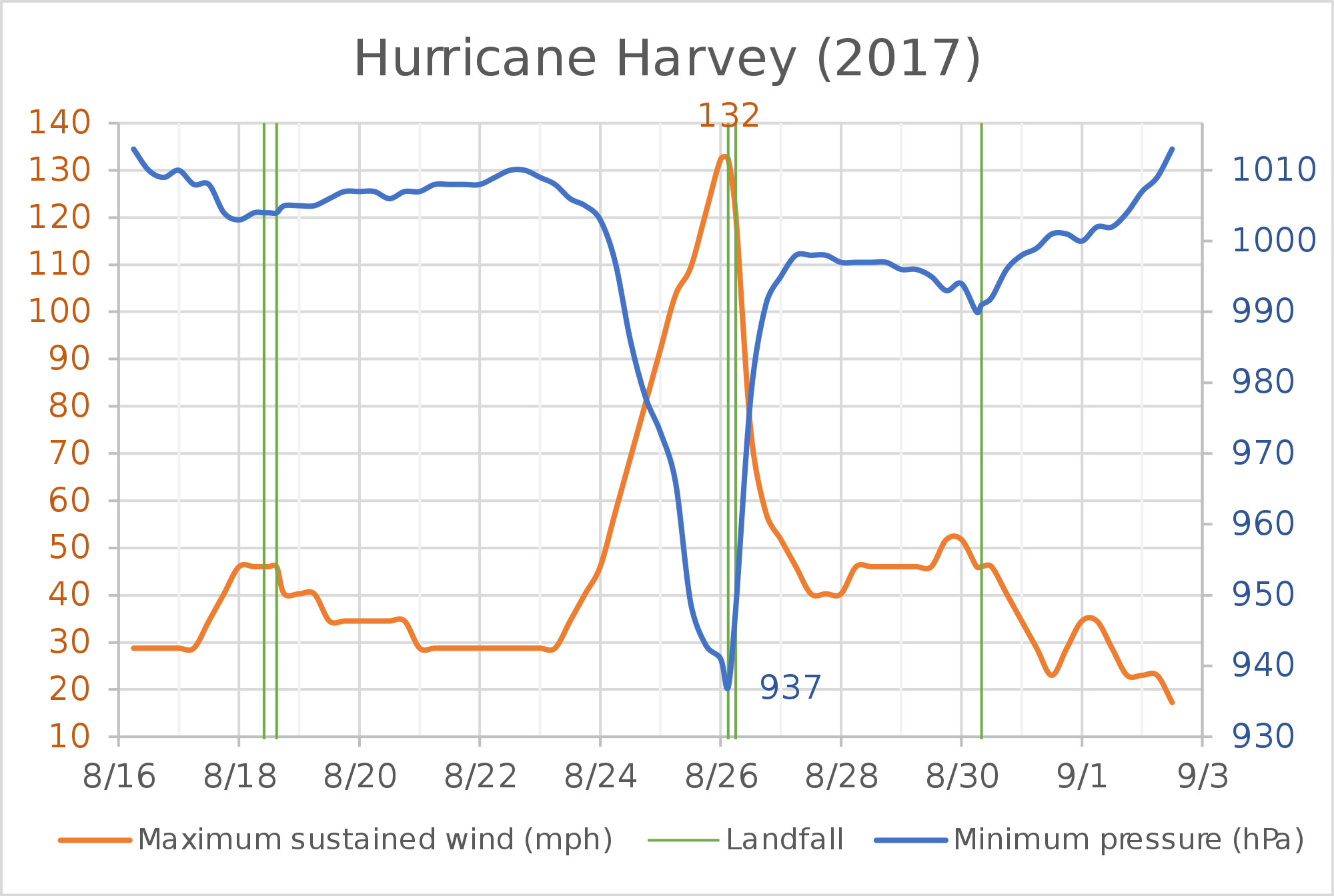
  • Maximum sustained wind speed and minimum pressure of Hurricane Harvey (2017), Data source: NATIONAL HURRICANE CENTER, TROPICAL CYCLONE REPORT, HURRICANE HARVEY, NOAA

How Much Time Should a Cutter be Expected to be at Sea?

USCGC MUNRO

How much time should we reasonably expect a cutter to be at sea? It is a reasonable question, since, generally, time spent in port is not mission time.

How do we compare with similar services?

The Coast Guard standard for large cutters has been 185 days away from homeport annually, but that includes times in port or being repaired if it is done “away from homeport.”

We get a pretty regular readout on US Navy ships from the US Naval Institute’s Fleet and Marine Tracker that indicates US Navy ships are underway about a quarter of the time, but this includes both combatants (USS) which tend to be more complex and maintenance intensive than large cutters and auxiliaries (USNS) that are much simpler than combatants. While the USNI does not provide a specific breakdown the USNS ships clearly spend much more time underway than the combatants. That is not necessarily bad since a combatant’s primary mission is to prepare for war and that can happen inport as well as underway, but the Navy constantly complains that their combatants are overworked while on average, cutters do spend much more time underway annually than Navy combatants.

The Royal Navy OPVs rotate crews and appear to spend very long periods deployed and apparently a high number of days per year underway.

SeaWaves recently reported on the “thirtieth anniversary of its armament and its first colors ceremony” of the French Frigate La Fayette. (It was commissioned in 1996) Classed as a frigate, this class, of 25 knot, diesel powered ships was built without any ASW capability, and was in many ways comparable to Hamilton class WHECs. They also performed many of the same functions.

“… La Fayette has taken part in all the operational missions of the Navy, distinguishing herself in particular in the fight against piracy in the Indian Ocean and the fight against drug trafficking.”

The SeaWaves report provides a data point on how much time this particular ship spent underway.

“In 30 years, the La Fayette has thus carried out 3,107 days at sea and the equivalent of 21 round-the-world trips, carried out 33 operational deployments on all the seas of the world, visited 55 countries in 266 stopovers or even contributed to the seizure of more than 10 tons of drugs.”

That is 103.6 days/year underway. Even if we only count the 27 years since her commission and include the underway time prior to commissioning that would be 115 days per year. Sounds like cutters probably compare favorably.

How much time do large cutters spend underway? Congress has asked this question and I don’t think it was ever answered. It is certainly a statistic we should know. The Coast Guard has nothing to be ashamed of and much to be proud of.

“GAPPED BILLET SQUALL ON THE HORIZON: THE USCG OFFICER CORPS COULD BE IN TROUBLE” –CIMSEC

CIMSEC has an interesting article by a serving officer, Lt. Joseph O’Connell.

He starts off talking about gapped billets in the Coast Guard in general, 200 in 2021, but then concentrates on gapped afloat billets, 11 in 2021.

” This shortage grows more acute when considering the critical billets O3 and O4 officers fill aboard Coast Guard cutters: Operations Officers, Engineer Officers, Executive Officers, and Commanding Officers, depending on the cutter class.”

I am sure his observations are accurate, as far as they go, but I think he may have missed an important aspect of the Coast Guard’s assignment policies that has resulted in many officers, with sea going ambitions, making the choice to leave the service at the O-3/4 level. If we don’t do something differently, the problem is going to get worse.

As the Coast Guard continues to bring new hulls online while operating legacy assets the demand for afloat officers will far outstrip the limited and dwindling supply, with projections anticipating a 25% increase in cutter billets from current levels.

A change in personnel assignment policy could make a big difference.

I am long out of the service, so it is best if you check to see if my assumptions are correct.

Assumptions:

  • The ambition of most seagoing officers is ultimately to have a command afloat.
  • Being a department head or XO is not an end in itself. It should be seen as a step toward command.
  • Assignment officers are more likely to select an officer to command if they have had a previous successful command tour.
  • If an O-3 sees that it is extremely unlikely he will ever get a command, he is unlikely to seek a department head or XO job and may very well leave the service.

Effects:

Coast Guard personnel policies have created a situation where if you have not gotten a command as an E-3, it is unlikely you ever will.

The service is procuring 65 Webber class WPCs. At least 51 have already been commissioned. While a few are commanded by warrants or O-4s, generally they are commanded by O-3s. These and the few other O-3 afloat command billets create a large pool of potential future COs to choose from.

Those that have been or expect to be O-3 COs are unlikely to seek billets as department heads or XOs.

Those who miss the opportunity to command at the O-3 level, will see little chance they will be an afloat CO in the future.

Proposal:

Make command of a Webber class an O-4 billet.

Require that those selected to command Webber class WPCs will have completed a successful department head or XO afloat tour.

Rationale:

While some may feel command of a patrol craft requires only a junior officer, consider that these little ships, unlike WPBs, are doing all the same missions as an MEC (except the aviation component) with a smaller crew and fewer senior personnel to advise and support the CO. These ships generally operate independently, unlike Navy patrol craft which generally operate in groups under a squadron commander. We are seeing some of them embark on voyages of thousands of miles, operating outside US waters.

This policy would provide an incentive for officers to seek department head or XO tours as O-3s.

The Officers chosen to be COs at the O-4 level will be more experienced and more mature.

The service will have had more time to evaluate the officers prior to assignment including direct observation by a CO afloat, who should make a recommendation for or against a future command afloat.

Ultimately some officers will determine that they really have no chance of getting a CO afloat tour, but it will happen later in their career, when they may have found other rewarding work and they are less likely to leave the service.