The Long Blue Line blog series has been publishing Coast Guard history essays for over 15 years. To access hundreds of these service stories, visit the Coast Guard Historian’s Office’s Long Blue Line online archives, located here: THE LONG BLUE LINE (uscg.mil)
It was low tide in Charleston Harbor at 1:55 a.m. on Dec. 29, 1997 when 13-year-old Daniel Cornett’s anguished voice slashed the quietude of Coast Guard Group Charleston’s Watch Center:
“May … Mayday, U.S. Coast Guard, come in,” on Channel 16 (the distress channel) on VHF-FM marine radio.
The Sailing Vessel Morning Dew had just crashed into Charleston’s North Jetty. Daniel, his brother and cousin were jolted from a sound sleep. Daniel’s father, 49-year-old Michael Cornett, who had been steering the boat under engine power for the last eight hours, was ejected from the vessel, according to government reports.
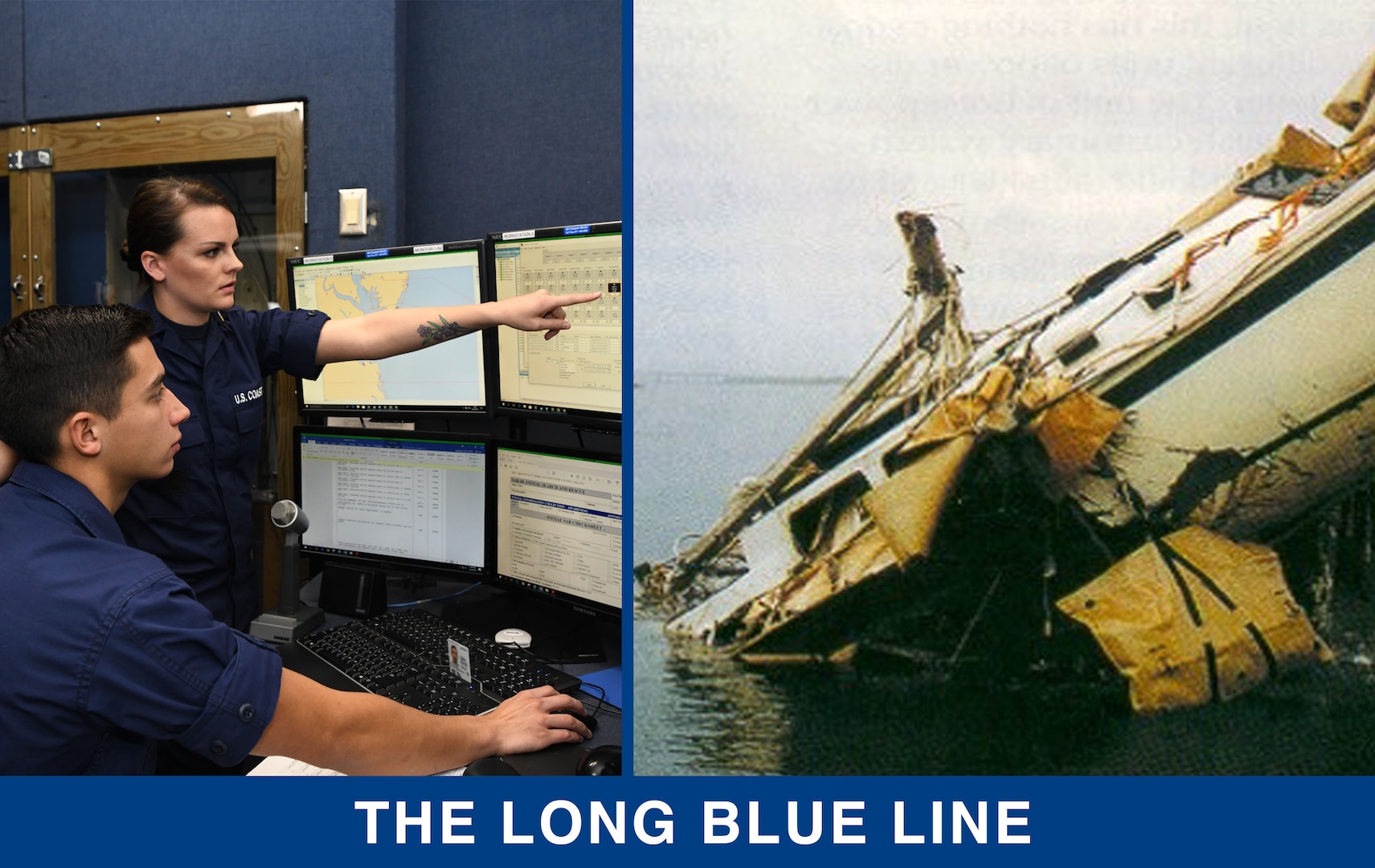
At Coast Guard Group Charleston (later Sector Charleston), the regional maritime rescue headquarters, this particular four-second mayday radio call by the youngest Cornett family member was heard and automatically recorded by Stancil technology, a device designed to preserve critical radio messages. Unfortunately, the Coast Guard’s sole radio watchstander, a twenty-three-year-old petty officer, was 17-feet away from the radio console refilling his coffee mug as an otherwise quiet late-night shift drew on.
In his later testimony with the National Transportation Safety Board (NTSB), the petty officer said he heard only the tail end of the heavily garbled distress message, “U.S. Coast Guard, come in.” The radio watchstander had completed telecommunications school just a few months prior and only recently been qualified to stand watches without supervision. Despite what the NTSB would later call an extraordinary training program, he was unprepared for the circumstances that were about to unfold.
Following standard radiotelephone protocol, the watchstander responded fourteen seconds later: “Vessel calling Coast Guard, this is Coast Guard Group Charleston, over.” He then repeated his call using multiple radio transmission towers in different locations along the South Carolina shore. He also invited conversation on VHF-FM channel 16. But there would be no two-way interactive radio calls from the 34-foot sailboat Morning Dew on this fateful night.
Despite the odd time of night and prevailing weather conditions, the group’s radio watchstander quickly returned to the normal humdrum of off-season and late-night routine. This included monitoring as many as ten different frequencies that, during busy times, sometimes blared from an equal number of speakers mounted throughout the communications center. In the summer, radio watchstanders were constantly managing their time and involved in various conversations, often near simultaneously.
Four minutes later, at 2:21 a.m., the crackle of an unintelligible burst of static was recorded on Group Charleston’s Stancil recorder. The watchstander, believing the earlier call and this one might be from the same source, again tried the radio without success. “Vessel calling Coast Guard, this is Coast Guard Group Charleston, over.” There was no response, and no log entries were made of the calls.
Given the state of the Coast Guard’s National Distress System network of VHF-FM near-shore system in late 1997, the Morning Dew’s only chance at this point in the distress would have been if the watchstander had been looking directly at the Direction-Finding equipment at the exact moment when the first distress call and the second follow-up static burst were heard. Even so, rewinding the tape and determining the word Mayday had been used would have only elevated awareness and mandated a call to his supervisor, the group duty officer (GDO) who was seeking authorized rest. Not hearing the initial word Mayday and theorizing a mariner was just testing his radio or the call had “skipped” from many miles away, and not following procedure to rewind the tape to conduct further investigation, the watchstander returned to other duties.
The radio watchstander would soon become involved with the Morning Dew again when he took a call from the local harbor pilot’s organization about four hours later, relaying a report from an inbound vessel of shouts being heard from the vicinity of Charleston Channel Buoy #22. He quickly relayed the information to his 17-year experienced GDO, who asked a pilot boat to investigate on behalf of the Coast Guard. Tragically, no additional assets were dispatched, and the GDO suspended further efforts before sunrise.
Around 11 a.m., tourists visiting from Atlanta would find bodies from the sailing vessel Morning Dew as two of the teenage boys washed ashore on a nearby beach. The Coast Guard then responded in full force, only to find a third body. Weeks later, the body of Morning Dew’s operator would wash ashore on a nearby island.
Within weeks, amid the growing hue and cry of the grieving family members, a major 18-month-long search and rescue analysis would be undertaken and begin to address difficult shortcomings in human behavior, procedures, and technology. Key gaps were the failings of the VHF-FM National Distress System (NDS) radio system, the backbone of the Coast Guard’s near-shore (20 miles) rescue communications system. Coast Guard Commandant James Loy would later go on to publicly speak about the Morning Dew case at a search and rescue conference entitled The Value of a Life. He would later say that, “there are two capstone issues that must be addressed by our service. There are issues of leadership and communications systems.”
The original NDS in use for the Morning Dew case was built in the 1970’s, and was designed to provide Very High Frequency–Frequency Modulated (VHF-FM) radio coverage of 95,000 miles of coastline and connect mariners in distress to each other, point-to-point, and Coast Guard rescue services. After 25 years, the NDS’s problems were well known and documented in a Mission Needs Statement that, “formally acknowledged that a materiel solution is required to address the capability gaps.”
At the time of the Morning Dew case, there were as many as 68 known coverage areas where service was either poor quality or non-existent. The NDS was also supported by an antiquated tape-recording system that was both manually intensive and cumbersome. Additionally, the direction-finding system at the time had no recording capability. This meant that if a watchstander was not looking at the direction indicating compass rose at the time of the distress call and a different call came in, only the new call’s direction would be displayed.
According to Coast Guard sources, the Morning Dew case, “validated the need for a new VHF-FM system for the Coast Guard.”
The Morning Dew case was a collection of human and technological errors. Despite the original early morning call not having enough information to launch a rescue, the relatively junior Telecommunications Specialist failed to rewind the audio tape, make required log entries, or notify his supervisor. He also could not note the bearing of the call because he was recharging his coffee cup. Even if he had done all of that, the quality of the recording and in the insufficiency of locating information still might not have made a difference at that moment.
It would have, however, put rescuers on alert that they were dealing with an unresolved Mayday call, perhaps altering their response to the later cries heard from the Charleston channel area. The Coast Guard would eventually develop a new procedure in 2005 called, “range ring analysis” based on signal strength that could have provided a rough estimate of the caller’s position and a start point for a searchable area. But the Morning Dew case was in 1997.
Significant procedural changes would later be made. Among them, adding new watchstanders, always providing for at least three personnel on watch, on average. Additionally, experienced, permanent civilian search and rescue personnel would be provided in every sector for continuity and training purposes. Today’s watch centers still, however, feature a single communications operational specialist in a booth, but there are always more senior people around to discuss issues if there is any doubts about what to do.
The single most significant technological change the Coast Guard would make is the replacement of the NDS with the Rescue 21 (R21) near shore communication system. The system, an advanced command, control, and direction-finding communications system, was created to better locate mariners in distress and save lives and property at sea and on navigable rivers.
By harnessing state-of-the-market technology, Rescue 21 enables the Coast Guard to execute its search and rescue missions with greater agility and efficiency. Rescue 21 helps identify the location of callers in distress via towers which generate lines of bearing to the source of VHF radio transmissions reducing search time. It extends coverage to a minimum of 20 nautical miles from the coastline, improves information sharing and coordination with the Department of Homeland Security and other federal, state, and local first responders, and can also help watchstanders recognize potential hoax calls by identifying discrepancies between what a caller is reporting in distress and the actual transmission site, thus conserving, and reducing risk to valuable response resources.
Relative to its predecessor systems, R21 can provide reliable and redundant capabilities to determine where some calls originate, rapid retrieval and position fixing, and ruling out the need for searches for obvious hoax callers. It also facilitates near shore distress cases in areas where the Coast Guard performs 90% of its rescues.
According to the Coast Guard’s Joe Ayd from the Office of C5I Capabilities, today’s Rescue 21 system implements, “the Coast Guard’s ability to receive VHF-DSC [Digital Selective Calling], which allows a vessel like the Morning Dew to simply press a button on their radio to [digitally] transmit a distress call and provide a position [if connected to the boat’s GPS] to the Coast Guard command center.” VHF-FM DSC took coastal rescue communications from a point-to-point system (distressed mariner – Coast Guard) to a virtual paging system where any boat receiving the DSC distress call is duty bound to digitally relay it to a Coast Guard shore rescue facility on behalf of the troubled mariner.
Ayd added that, “R21 made significant improvements to the ability of the watchstander to not only retrieve the audio of a call, but to also conduct some basic cleanup of the call to better understand what is being said through all the noise or garble.”
This means that an already busy Coast Guard watchstanders can economize on the effort to scan the recording within the confines of an already busy environment with the best chance of understanding the content of the call.
It took an 18-month exhaustive search and rescue system investigation, a 20/20 television expose and a $19.5 million-dollar civil judgment and more than two decades to complete R21 along U.S. coastlines and in Alaska’s remote and rugged areas. “The final tower in the Rescue 21 system was accepted in October 2017, completing a design and installation process spanning more than 20 years.”
The Coast Guard has made significant progress with the R21 VHF-FM system since the 1997 Morning Dew case. However, the venerable service faces new challenges and opportunities to improve near shore rescue communications. For example, over the last two years (Fiscal years 22 and 23), the Coast Guard has annually responded to between 15,000 and 16,000 calls for assistance with just over half being received by phone. During that same time, only between 1,200 and 1,500 rescues were initiated each year with radio notifications. Over the last decade, the number of rescue calls initiated by radio has declined while phone and other smart technology notifications have increased.
Captain Webster writes about contemporary Coast Guard rescues. Readers may contact him and access or order his published works, including Lost in Charleston’s Waves, detailing the Morning Dew tragedy, at https://www.wrussellwebster.com






 Chuck Hill's CG Blog