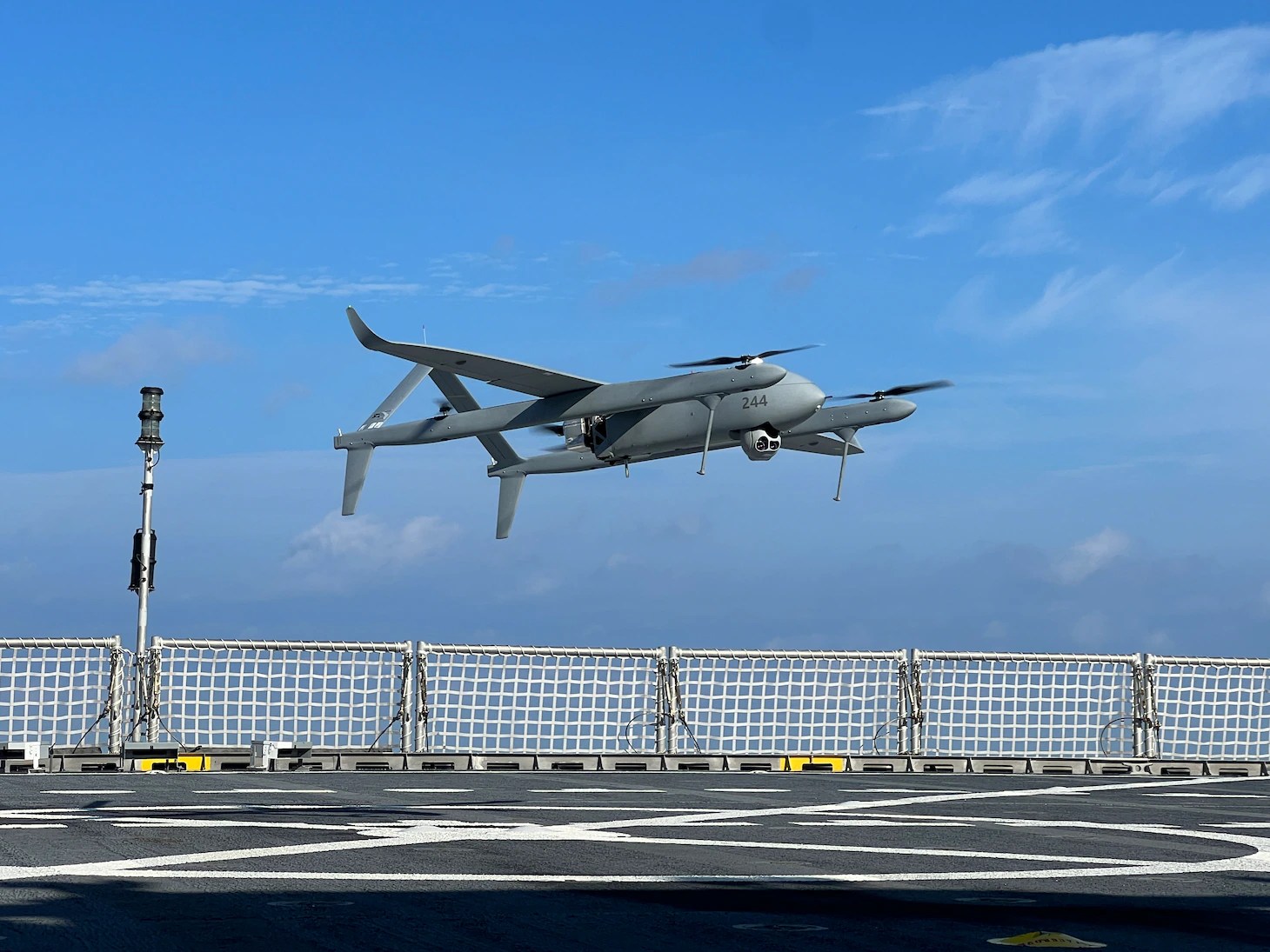
“Hybrid Fleet Campaign Event Evaluates Technology For Future Operations” –4th Fleet

U.S. Naval Forces Southern Command/U.S. 4th Fleet demonstrated unmanned air and surface capabilities from expeditionary fast transport USNS Burlington (T-EPF 10) during the command’s Hybrid Fleet Campaign Event (HFCE) in Key West Oct. 4-13, 2023.

Below is a news release from 4th Fleet. Notably, 4th Fleet is approaching the problem of operationalizing unmanned systems in a different way from that of 5th Fleet.

“A key detail in SECNAV and CNO’s vision was that 4th Fleet would not stand up a separate task force like U.S. 5th Fleet did in Bahrain in 2021, but would develop the hybrid fleet from inside the staff already in place.”


 Oct. 20, 2023

Hybrid Fleet Campaign Event Evaluates Technology For Future Operations

By USNAVSOUTH/4TH FLEET PUBLIC AFFAIRS

U.S. Naval Forces Southern Command/U.S. 4th Fleet demonstrated unmanned air and surface capabilities from expeditionary fast transport USNS Burlington (T-EPF 10) during the command’s Hybrid Fleet Campaign Event (HFCE) in Key West Oct. 4-13, 2023.

This is the most recent event in U.S. 4th Fleet’s campaign to operationalize cutting edge technologies. After successful rollout of the Campaign at UNITAS in July 2023 and the beginning of operation WINDWARD STACK in September, the Science and Technology event in Key West this past week focused on the evaluation of unmanned systems in advanced kill chains, contested littoral operations, survivability, and sustainment at sea.  It served as both a proving ground for emerging technologies and an opportunity for senior leaders to see for themselves the capabilities of systems that could support the hybrid fleet.

“One of the best ways to change our force is to rapidly operationalize new technologies, new systems, and new tactics, techniques, and procedures,” said Adm. Lisa Franchetti, Vice Chief of Naval Operations. “Whether you’re talking about artificial intelligence, cyber, unmanned platforms, directed energy, or hypersonic missiles, we are on the cusp of technological breakthroughs that are going to define future conflict.”

“This week’s technology evaluation event will push boundaries and risk failure in order to allow us to evaluate unmanned technology and then move to operationalize that technology to inform the hybrid fleet,” Rear Adm. Jim Aiken, Commander U.S. Naval Forces Southern Command (USNAVSOUTH) & U.S. 4th Fleet, said in advance of the event. “We have many events scheduled and in some of those events we will win, and in some of them we will learn. In both cases, the Hybrid Fleet will be informed, and the Navy will continue to push forward at the speed of technology.”

The campaign to inform the hybrid fleet calls for the combination of manned and unmanned systems to allow U.S. 4th Fleet to execute its larger missions of defending the southern approaches to the United States, countering malign activity in the region with our partners, and supporting the detection and monitoring of illicit trafficking in the region.

“Broad partnership across DoD and industry partners has allowed 4th Fleet to mature operational capabilities rapidly fostering innovation and providing informed recommendations to the parties involved in creating the Disruptive Capabilities Office,” said Dr. Chris Heagney, the Naval Air Systems Command Fleet/Force Advisor to USNAVSOUTH/4th Fleet.

In April 2023 at the Navy League of the United States’ annual Sea Air Space Symposium, Secretary of the Navy (SECNAV) Honorable Carlos Del Toro and then Chief of Naval Operations Adm. Michael Gilday announced that USNAVSOUTH/4th Fleet would operationalize hybrid fleet operations. A key detail in SECNAV and CNO’s vision was that 4th Fleet would not stand up a separate task force like U.S. 5th Fleet did in Bahrain in 2021, but would develop the hybrid fleet from inside the staff already in place.

“This technology evaluation event is a continuation of the campaign we began in April,” said Cmdr. David Edwards, USNAVSOUTH/4th Fleet’s technology and innovation director. “We evaluate these technologies in focused events like this, then operationalized the technology quickly to fulfill operational requirements in the U.S. Southern Command Area of Responsibility (AOR). While we operate these systems to fulfil the 4th Fleet mission, the evaluation continues over months and years, not just hours and days. Those operational evaluations inform future acquisitions to ensure the Navy is ready to fight and win with these technologies.

HFCE was 4th Fleet’s largest technology event yet with 305 participants including VCNO and Master Chief Petty Officer of the Navy James Honea and 26 other U.S. government distinguished visitors, 10 foreign partners, 18 industry partners, and 47 Department of Defense Commands participating.

U.S. Naval Forces Southern Command/U.S. 4th Fleet supports U.S. Southern Command’s joint and combined military operations by employing maritime forces in cooperative maritime security operations to maintain access, enhance interoperability, and build enduring partnerships in order to enhance regional security and promote peace, stability, and prosperity in the Caribbean, Central and South American region.

“Combined Maritime Forces, U.S. Coast Guard Make $21 Million Drug Seizure in the Gulf of Oman” –NAVCENT

GULF OF OMAN (Nov. 14, 2023) Illegal narcotics seized from a stateless vessel are stacked on the deck of the U.S. Coast Guard Sentinel-class fast response cutter USCGC Emlen Tunnell (WPC 1145) in the Gulf of Oman, Nov. 14. Emlen Tunnell was operating under Combined Task Force 150, one of five task forces under Combined Maritime Forces, the largest multinational naval partnership in the world. CTF 150 focuses on maritime security operations in the Gulf of Oman, Arabian Sea and Indian Ocean. (Photo by U.S. Coast Guard courtesy photo)

Below is a NAVCENT news release.


Combined Maritime Forces, U.S. Coast Guard Make $21 Million Drug Seizure in the Gulf of Oman

By U.S. Naval Forces Central Command Public Affairs | November 20, 2023

MANAMA, Bahrain —

A U.S. Coast Guard cutter crew seized about $21 million worth of illegal drugs from a stateless vessel while operating in the international waters of the Gulf of Oman, Nov. 14.

Coast Guardsmen from the Sentinel-class fast response cutter USCGC Emlen Tunnell (WPC 1145), working under the command of Combined Maritime Forces’ Combined Task Force (CTF) 150, seized 2,000 kilograms of hashish and 384 kilograms of methamphetamine from the vessel during an interdiction operation.

“This new seizure shows once again the operational effectiveness of Combined Maritime Forces assets and nations,” said French navy Capt. Yannick Bossu, CTF 150 commander. “It illustrates that nations from all around the world are committed to regional maritime security in the Indian Ocean alongside their regional partners.”

This event marks the fifth time in recent months the French-led CTF 150 has interdicted illicit narcotics at sea. In those previous operations, CTF ships seized more than 4,522 kilograms of methamphetamine, heroin, and hashish from stateless vessels during interdiction operations, with a street value of more than $94 million.

CTF 150 is one of five task forces under Combined Maritime Forces, the largest multinational naval partnership in the world. CTF 150 focuses on maritime security operations in the Gulf of Oman, Arabian Sea and Indian Ocean.

Since 2021, Combined Maritime Forces has seized more than $1 billion in illegal drugs while patrolling waters across the Middle East.

The 38-nation naval partnership upholds the international rules-based order by promoting security and stability across 3.2 million square miles of water encompassing some of the world’s most important shipping lanes.

“C4F’s Hybrid Fleet Completes Target Detection Test” –4th Fleet

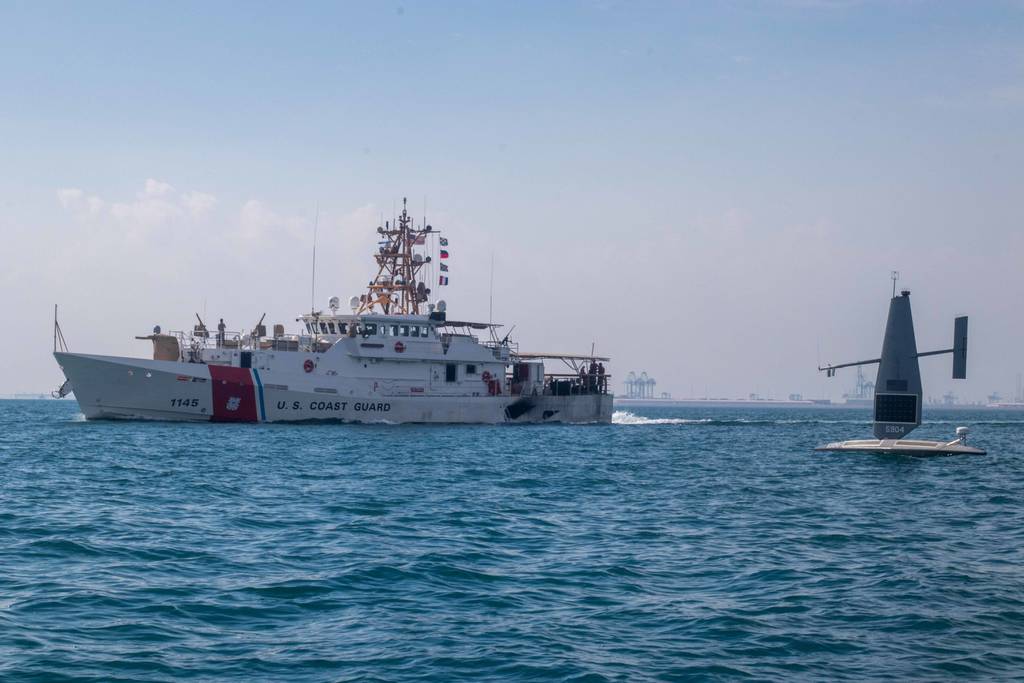
A Saildrone Explorer unmanned surface vessel operates alongside U.S. Coast Guard fast response cutter USCGC Emlen Tunnell (WPC 1145) in the Arabian Gulf, Nov. 29, during Digital Horizon 2022. (Sgt. Brandon Murphy/US Army)

Below is a 4th Fleet News Release. This development will have obvious impact on Coast Guard drug and alien migrant interdiction efforts. This is a result of extending experimentation with unmanned systems to 4th Fleet in much the same way it was done in 5th fleet.


 Oct. 17, 2023

C4F’s Hybrid Fleet Completes Target Detection Test

By USNAVSOUTH/4TH FLEET PUBLIC AFFAIRS

Joint Interagency Task Force South (JIATF-South) and Saildrone successfully completed an evaluation of the unmanned surface vessel Saildrone Voyager’s radar and electronic sensors against surface targets in the vicinity of Key West September 29, 2023.

Part of U.S. 4th Fleet’s campaign to inform the hybrid fleet, the evaluation looked at how many Saildrones the fleet would need to cover a given area of water and optimize the probability that the Saildrones would detect suspected drug runners at sea.

“This successful detection test is the completion of one small step in our campaign to inform the hybrid fleet,” said Capt. David Fowler, U.S. 4th Fleet’s Maritime Operations Center Director. “This is the type of testing and development that we can conduct even as we move toward continuous hybrid operations in the Caribbean.”

Right now continuous operations are underway with Operation Windward Stack. The U.S. 4th Fleet operation deploys long-dwell Saildrone unmanned surface vessels (USVs) to the Windward Passage in the Caribbean order to operationalize the combination of unmanned and manned systems in normal day-to-day operations.

In the coming months, other long-dwell USVs, interceptor USVs, long range UAVs, and VTOL UAVs will join the Saildrones in Operation Windward Stack. These systems will combine with traditional naval surface vessels to expand maritime domain awareness (MDA) and define combinations of unmanned and manned forces that work best for specific operations.

U.S. Naval Forces Southern Command/U.S. 4th Fleet supports U.S. Southern Command’s joint and combined military operations by employing maritime forces in cooperative maritime security operations to maintain access, enhance interoperability, and build enduring partnerships in order to enhance regional security and promote peace, stability and prosperity in the Caribbean, Central and South American region.
Learn more about USNAVSOUTH/4th Fleet at https://www.fourthfleet.navy.mil, https://www.facebook.com/NAVSOUS4THFLT and @NAVSOUS4THFLT.

“France’s DGA Orders 7 New OPV For The French Navy” –Naval News

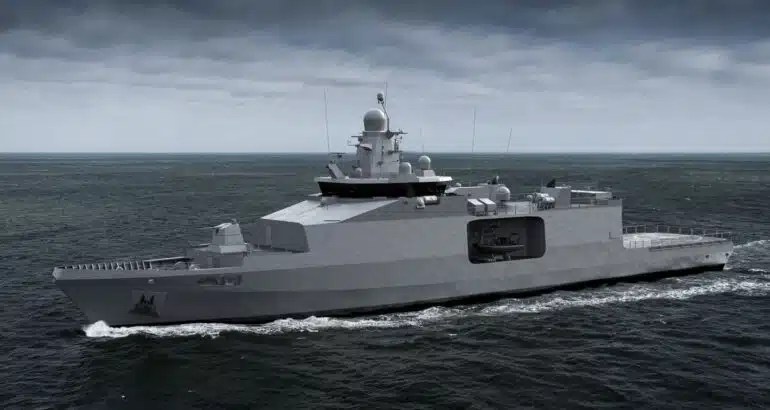
Artist impression of the Patrouilleur Hauturier OPV underway. Naval Group image.

Naval News reports,

The French defense procurement agency (DGA) ordered on 17 November 2023 seven new offshore patrol vessels (OPV) as part of the “Patrouilleurs Hauturiers” program for the French Navy (Marine Nationale).

These “second rank” ships will have missions similar to USCG cutters. We heard about the requirement for these ships and the vessels they would replace three years ago. At that time ten ships were expected. Since then, the requirement was reduced to six and now seven. France has been building several different classes of large patrol vessels (here, here, and here).

This new class of Patrouilleurs Hauturiers (offshore patrol vessels) are expected to displace 2400 tons full load, have a range of 6,000 miles, and have accommodations for up to 84 personnel (passengers and crew). They are expected to mount the new 40mm gun.

“Coast Guard Yard removes two 27-ton engines as part of medium endurance cutter service life extension program” –CG-9

Coast Guard Cutter Spencer approaches the pier at Coast Guard Yard in Baltimore. Service life extension program work on the medium endurance cutter will last 15 months. U.S. Coast Guard photo.

Below is a news release from the Acquisitions Directorate (CG-9). Included is a statement that USCGC Campbell will be the next WMEC to undergo SLEP. Check out the video linked below.


Workers at Coast Guard Yard in Baltimore remove a 27-ton main diesel engine from Coast Guard Cutter Spencer. U.S. Coast Guard photo by Lt. Charles Lortz, In-Service Vessel Sustainment Project Residence Office Baltimore.

On Nov. 8, personnel at Coast Guard Yard in Baltimore achieved a milestone in the 270-foot medium endurance cutter service life extension program (SLEP) by safely removing the two main diesel engines from Coast Guard Cutter Spencer. The engines each weigh 54,000 pounds – or 27 tons – and this is the first lift of this weight that has been conducted at Coast Guard Yard in more than a decade. This also is the first time Yard personnel have removed an engine from a 270-foot medium endurance cutter.

To gain the necessary access, workers removed the extendable aircraft hangar and cut through two decks. View a time-lapse video of the process here.

While Coast Guard Cutters Seneca and Harriet Lane served as prototypes for the electrical and structural work and installation of a new gun weapons system, Spencer is the first Coast Guard Famous-class medium endurance cutter to receive all major SLEP work items, including replacement of the main diesel engines. The SLEP work will sustain the cutters’ capabilities, enabling them to meet mission needs until they are replaced by offshore patrol cutters. This program is part of the In-Service Vessel Sustainment (ISVS) Program, the Coast Guard’s strategic class-by-class evaluation of its vessels to determine what major maintenance and upgrades are necessary for each class of cutters to reach or extend their service lives.

Spencer has been in service since June 1986, and the original engines provided nearly 90,000 hours of operational service prior to their removal.

As the next phase in the SLEP, two new ALCO 251 engines will be installed. The engines removed from the Spencer will be remanufactured by Fairbanks Morse Defense and installed on the next medium endurance cutter to go through the SLEP, Coast Guard Cutter Campbell.

Coast Guard Yard is the service’s sole shipbuilding and major repair facility and part of the Coast Guard’s core industrial base and fleet support operations.

For more information:In-Service Vessel Sustainment Program page

Second Indian Navy Anti-Piracy Patrol in the Atlantic –Sea Waves

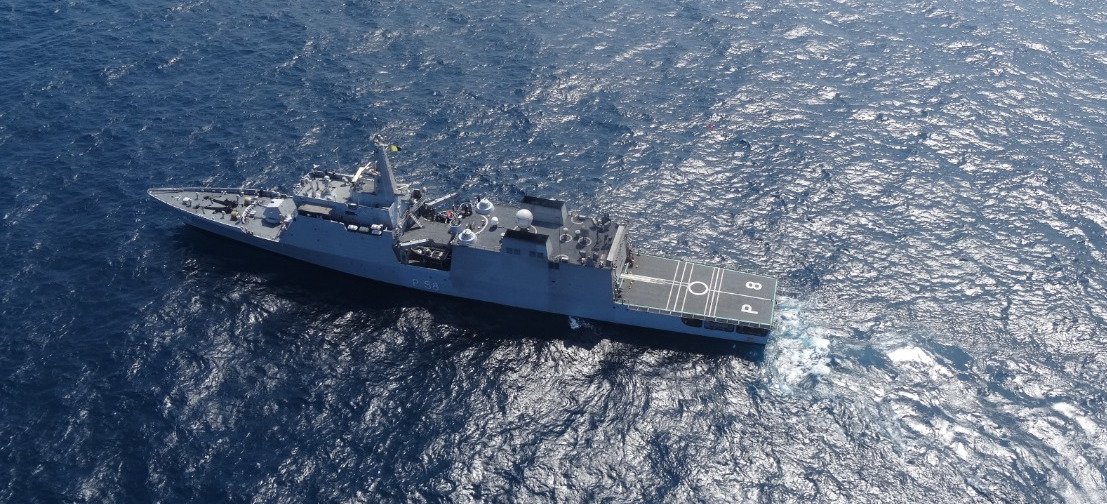
INS Sumedha (P58) en-route to Bangladesh 9 March 2021. Photo credit: Indian Ministry of External Affairs.

Sea Waves reports.

INS Sumedha is on an Extended Range Operational Deployment and is currently operating in the Atlantic Ocean along the West Coast of Africa. During this period, INS Sumedha operated in the Gulf of Guinea (GoG) undertaking a 31 days anti-piracy patrol. This is the second such patrol being undertaken by the Indian Navy in this crucial maritime region. The maiden GoG Anti piracy patrol was undertaken by INS Tarkash in Sep – Oct 22.

This is a new effort by the Indian Navy. US Coast Guard WMECs have been doing similar capacity building in the same area. We might be able to coordinate our efforts.

“Singapore orders four offshore patrol vessels from Fassmer” –Naval Today

Photo credit: German Federal Police

Naval Today reports,

Singapore’s Ministry of Defence (MINDEF) has signed a contract with German company Fassmer to acquire four new offshore patrol vessels (OPVs)…The ships are based on an OPV design operated by the German Bundespolizei (Federal Police). Furthermore, they are designed with high maneuverability to operate in Singapore’s congested waters.

In a comment, a reader, Katoult, who I see provided the photo above, pointed me to an even better article on the topic at Naval News, thanks.

I have a lot of respect for Singapore’s decision makers. They are very tech savvy and, like the US, cannot depend on cheap labor in large numbers. I am a bit surprised they did not use a version of their Littoral Missions Vessel design for this mission. This is the fourth nation to choose a Fassmer OPV design. It does appear to be a bit more seaworthy and incorporates a hangar that the Littoral Missions Vessel does not include. I think we will see unmanned systems operating from these ships.

“Philippines, U.S. Launch Joint Patrols Near Taiwan” –gCaptain

gCaptain reports,

The Philippine military said three navy vessels, two FA-50 light combat aircraft and an A-29B Super Tucano light attack plane would participate, while the United States would send a littoral combat ship and a P8-A Poseidon maritime patrol and reconnaissance aircraft.

Perhaps significantly, unlike the photo above, on both sides, the units are not coast guard.


USS Dewey (DDG-105), bottom, steams in formation with the Philippine Navy offshore patrol vessel BRP Gregorio del Pilar (PS 15) while conducting a bilateral sail in the South China Sea, Oct. 21, 2023. US Navy Photo

The USNI has additional information here https://news.usni.org/2023/11/21/u-s-philippines-begin-three-days-of-joint-patrols-in-the-south-china-sea.

“Coast Guard completes two-week operation in Pacific region” –D14

Below is a D14 news release. Another step in the formation of an international fisheries enforcement alliance.


Nov. 20, 2023

Coast Guard completes two-week operation in Pacific region

U.S. Coast Guard District 14

HONOLULU – The U.S. Coast Guard has concluded Operation Kuru Kuru, an annually held comprehensive two-week operation in the Pacific region, highlighting the Coast Guard’s commitment to supporting international partners in the region.

Operation Kuru Kuru, executed from 22 Oct. to 3 Nov. 2023, is a collaborative effort with the Regional Fisheries Surveillance Centre, aimed at countering Illegal, Unreported, and Unregulated (IUU) fishing across the region.

The operation encompasses a wide array of objectives, including enhancing cooperative surveillance engagement between participating nations, conducting boarding activities at sea to combat IUU fishing, and utilizing remote sensing information to drive intelligence-led operations. This operation covers a combined area of 15 participating Pacific Island Country exclusive economic zones and the adjacent high seas pockets, approximating 8.2 million square miles, an area more than twice the size of the continental United States.

“The U.S. Coast Guard’s presence and contributions to Operation Kuru Kuru underscore our commitment to regional security and disaster response,” said Cmdr. Andrew Williams, enforcement branch chief for U.S. Coast Guard District 14. “We are honored to stand alongside our international partners as we work together to address challenges that impact the Pacific region.”

While engaged in the region, the Coast Guard offers a host of mission capabilities, including proactively supporting search and rescue operations, humanitarian  aid, and air and vessel surveillance to counter illegal, unreported and unregulated fishing across the region.

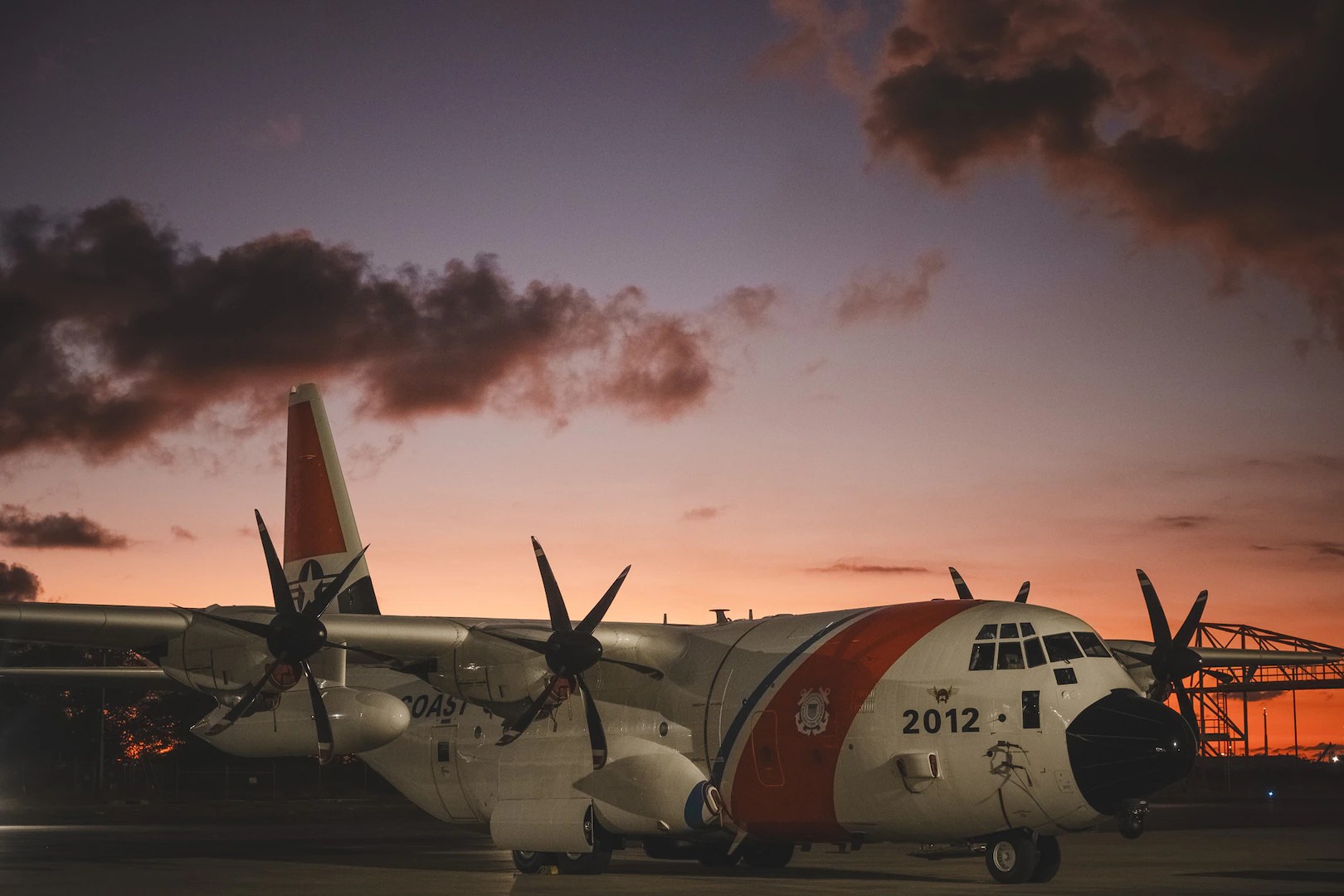
During this operation, a Coast Guard C-130 based out of Coast Guard District 14’s Air Station Barbers Point, responded to a request from the Maritime Rescue Coordination Centre Fiji to perform search and rescue operations in and around the Nonouti Island, Gilbert Islands, Kiribati. The C-130 was then rerouted following Tropical Cyclone Lola’s impact on Vanuatu to conduct post-storm assessments throughout the South Pacific island chain surrounding Vanuatu. These assessments were integral in gauging the extent of damage caused by the cyclone and facilitating the coordination of relief efforts.

Despite the operational challenges posed by Tropical Cyclone Lola, the C-130 was able to conduct aerial surveillance fishery patrols within the EEZs of Fiji, Tonga, American Samoa, and Vanuatu, providing several crucial observation reports to partner nations.

“Operation Kuru Kuru highlights the Coast Guard’s partnership with Pacific Island nations and how these collaborative efforts are vital in our mission to combat Illegal, Unreported and Unregulated fishing.” said Rear Adm. Michael Day, commander of U.S. Coast Guard District 14. “Together, we can protect our oceans, preserve marine resources, and ensure sustainable fisheries for future generations while addressing additional challenges that impact the Pacific region.”

Through operations like Operation Kuru Kuru, the Coast Guard remains dedicated to serving and safeguarding the international community, addressing IUU fishing, and responding to humanitarian crises. It reinforces the importance of multilateral cooperation and regional security to protect the resources and well-being of Pacific nations.

The Coast Guard is responsible for ensuring the safety, security, and environmental protection of the Pacific region. Its core missions encompass search and rescue, law enforcement, fisheries protection, and humanitarian assistance across a vast and diverse area of operations.