
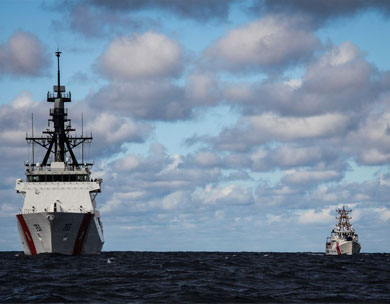
The Coast Guard started its recapitalization voyage almost three decades ago with the “Deepwater” Project. After false starts and course corrections, it seemed we finally got on course, but for too long we have relied on dead reckoning. It has been a long time since we have taken a fix to see if we are still on course. Meanwhile the world has changed. The fleet designed many years ago may not really be the fleet we want in the future.
To make our procurement case before Congress and the Department, we need a rigorous analysis of our requirements.
The Congressional Research Service issued an updated version of its “Coast Guard Cutter Procurement: Background and Issues for Congress” on August 7. As always one of the questions was what is the proper number and mix off assets, specifically, “the planned procurement quantities for NSCs, OPCs, and FRCs.”
The Coast Guard’s Program of Record (POR, 8 NSCs, 25 OPCs, and 58 FRCs, 91 total) has not changes since 2004. In that period the Navy has updated their requirements eight times.
As in previous reports, the Congressional Research Service author refers to the Fleet Mix Study. The Fleet Mix Study, which was apparently begun in 2007, seemed to indicate that while the Program of Record Fleet would be an improvement over the legacy fleet, it would not provide sufficient assets to meet all statutory requirements.
The last analysis of requirements, the “refined objective mix” of 2011, apparently based on a review of the initial study results, which were deemed unrealistically demanding, showed that the POR would provide only 61% of the vessels required to fulfill the Coast Guard’s statutory missions (9 NSCs, 49 OPCs, and 91 FRCs, 149 total).
But it has been a long time since the one and only “Fleet Mix Study” was done, and many of its assumptions were incorrect. The initial fleet mix analysis was to have been followed by follow-on FMA phases that would assess capabilities needed for coastal and inland missions as well as emerging missions, such as Arctic operations and those of the Deployable Operations Group (DOG). These were apparently never completed, but we did at least get the High Latitude Study that documented a need for three heavy and three medium icebreakers.
We need a new Fleet Mix Study, and according to the CRS report, we have been directed by Congress to do a new analysis.
Asset Acquisition Report.—The Commandant is directed to provide to the Committee, not later than one year after the date of enactment of this Act, a report that examines the number and type of Coast Guard assets required to meet the Service’s current and foreseeable needs in accordance with its statutory missions. The report shall include, but not be limited to, an assessment of the required number and types of cutters and aircraft for current and planned asset acquisitions. The report shall also specifically address regional mission requirements in the Western Hemisphere, including the Polar regions; support provided to Combatant Commanders; and trends in illicit activity and illegal migration. (Pages 39-40)
Additionally the Congress has repeatedly directed development of a 20 year ship building plan. So far we have failed to deliver while the Navy provides a 30 year plan every year.
How was the Fleet Mix Study Wrong:
“The OPC and NSC will operate 230 days away from homeport (DAFHP). No specific crewing method is assumed (i.e., crew rotation concept [CRC]).
They may not have explicitly assumed the Crew Rotation Concept, but 230 days away from homeport certainly reflects an underlying assumption that the NSCs and OPCs would be operated at a higher tempo than could be sustained with only one crew per ship.
“Additional acquisition/next generation platforms have the same capabilities and cost as the FMA Baseline Fleet mix cutters and aircraft.”
These new, larger, more sophisticated assets cost more to maintain than the vessels they replace. According to the Master Chief Petty Officer of the Coast Guard, “our new ships costs almost twice as much to maintain as our old ships, but our money to maintain them has been relatively flat.” The OPCs and the FRCs require more people to man them than the ships they replace, adding to their operating cost. It appears the Coast Guard is going to need a substantial growth in its budget just to operate its assets in the Program of Record (POR).
What did not happen:
The Crew Rotation Concept was rejected as a “cost saving” measure, cutting the theoretical availability of NSC and OPC mission days.
The plan included 36 HC-144s, but when 14 C-27s became available, the HC-144 program was truncated so now we have only 32 Medium Range Search Aircraft instead of 36.
Shipboard Unmanned Air Systems (UAS), of lesser capability, in the form of ScanEagle, are only now being deployed on NSCs.
No Coast Guard land based UAS has been deployed.
The networking that was envisioned has proven problematic.
What has Changed:
The original “Deep Water” program was developed after the collapse of the Soviet Union but before “9/11.” It was modified to at least theoretically address the terrorist threat, and the result was the 2004 Program of Record we still live with. At that time the US had no near peer naval competitors. The US Navy was unchallenged at sea, so there was no need for the Coast Guard to shoulder any significant war time role.
The Navy has all but abandoned any attempts to assist in drug interdiction.
The Coast Guard has begun to assume significant roles in the Western Pacific in the US EEZ and in support of the Federated States of Micronesia.
The Coast Guard is also supporting efforts by COCOMs in Africa and Asia to build additional coast guard like capabilities.
The replacement assets, particularly for the WMECs, are coming on line too slowly, and we are likely to see a drop in capability as these already difficult to maintain assets continue to age over the next 15 years current plans require to replace them.
Congress has departed from the Program of Record and funded eleven National Security Cutters instead of eight.
The Webber class seem to be exceeding our expectations and have proven more capable that I believe was originally envisioned.
Ship Debt:
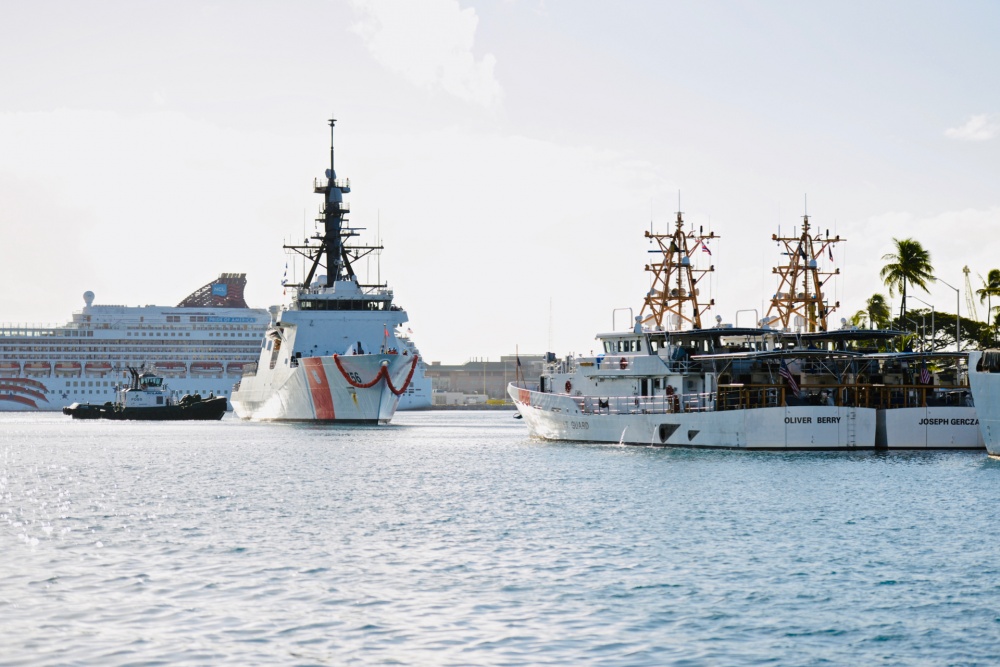
The Fleet Mix Analysis was not linked to time of fulfillment except to say that it was looking at requirements for the year 2025. A reasonable service life for naval vessels is typically 30 years. Our youngest 210 is now 50 years old and the oldest 55. Two of the 210 were already passed off to Sri Lanka and Colombia. The youngest 270 is 29 years old and the oldest, 36 years old. We really should have started the OPC program 24 years ago. The plan to build the OPC provides the first coming on line in 2021, one in 2022, one in 2023, and two per year with the last to be delivered in 2034. That is 25 ships to replace 29 that were in the legacy fleet, one of which, Acushnet, was decommissioned in 2011. The remaining overaged ships are already having difficulty meeting their scheduled commitments. This situation will only get worse over the next decade. We really need to introduce the time element into our analysis. Some things just cannot wait.
The Bottom Line:
- We need a new fleet mix study.
- It needs to include the WPB replacement.
- It needs to consider more than just the ship types as we are currently building as they are currently configured. We need to ask if equipment changes could make them more effective and reduce the total platform requirement. Specifically I think better armed WPCs and WPBs could eliminate a need for additional OPCs to fulfill the Ports, Waterways, and Coastal Security role.
- The objective the Coast Guard has set for itself in Drug interdiction is I believe about 10%. That really serves no purpose, but to impose something less than an income tax penalty on drug shippers. It needs to be much higher.
- The mix should also consider an alternative to meet the apparent need for more medium sized cutters using a notional alternative about half the size of the OPC, such as Cutter X.
- We need to consider the Coast Guard’s role in the national fleet and what capabilities need to be incorporated to fulfill those roles in a potential conflict with China or in worst case, a combination of China and Russia.
Conclusion:
Each commandant should prepare a new fleet mix to provide a best estimate of the Coast Guard’s future needs for his successor. Since a typical term is four years, the Commandant could take two years to frame a new fleet mix study. This would still allow about a year for completion and a year for evaluation and refinement of the results before passing it along to his successor.
In the period since the development of the program of record in 2004 we have had five Commandants, but only one, not completely comprehensive, look at our resource requirements. It is well past time for another.





 Chuck Hill's CG Blog