Huge New Marine Reserve, Pacific Remote Islands Marine National Monument

Pacifci Marine Reserve
Photo Credit: Marine Conservatory Institute, Click to enlarge.

We knew this was coming. gCaptain reports implementation and gives more detail.

“The proclamation expands the existing Pacific Remote Islands Marine National Monument to six times its current size, resulting in 490,000 square miles (about 390,000 square nautical miles) of protected environment around tropical islands and atolls in the south-central Pacific Ocean. At that size, it is now the largest protected area on the planet, land or sea. The protected area encompasses the seven islands and reefs of Wake, Johnston, Baker, Howland, Kingman, Jarvis and Palmyra, as well as the ocean around them.”

If I read this right, the area encompassed in larger than the entire US Atlantic Coast EEZ (considering Gulf of Mexico separate) and the difficulty policing it is exacerbated by the fact that it is in several pieces separated by hundreds of miles. As I noted earlier, this sure looks like justification for at least one more cutter in Hawaii, and possibly other additional ships and air assets there or in Guam. A ninth NSC added to the FY2016 budget appears well justified.

Document Alert, Western Hemisphere Stategy

Coast Guard Compass has reported the release of the “Coast Guard Western Hemisphere Strategy.” I have only made a very cursory scan. At this point I will only note that one thing I frequently see in strategies (including this one) is an apparent presumption that a “multi-layer” strategy is always better, when actually a comprehensive, well executed single layer may be better than a porous multi-layered approach which dilutes our effort. The illegal importers of drugs prove on an almost daily basis that our current multi-layered efforts are far less than 100% effective. By extension we cannot expect them to be effective in intercepting potentially more disastrous security threats.

Bad News, but No One Hurt

gCaptain reports, “The U.S. Coast Guard Cutter Key Largo collided with the 42-foot commercial fishing vessel Sea Shepherd (not that Sea Shepherd–Chuck) earlier today (Sept 23, 2014–Chuck), sinking the vessel approximately nine nautical miles east northeast of Vieques, Puerto Rico according to a USCG report.”

Presumably we will hear more about this.

The Arctic and Pirates of the Pacific

Two news releases that I thought might be of interest. They seem to show where the Coast Guard might be moving in the future. I’m not quoting the full text just giving the basics.

First relative to the Arctic:

“Officials at the U.S. Coast Guard Academy established the Center for Arctic Study and Policy (CASP) in a ceremony Sept. 19, attended by Vice Adm. Peter Neffenger, Vice Commandant of the U.S. Coast Guard.

“The establishment of the Center is part of the Coast Guard’s strategic objectives for the Arctic which include improving awareness, modernizing governance, and broadening partnerships in the region.”

And relative to both Piracy and additional interest in the Pacific:

“The U.S. will become the 20th nation to join the Regional Cooperation Agreement on Combating Piracy and Armed Robbery against Ships in Asia (ReCAAP) on Tuesday.

“Established in 2006, ReCAAP’s mission is to enhance regional cooperation through information sharing, capacity building and cooperative arrangements in combating piracy and armed robbery against ships in the region. It is the first government‐to‐government agreement to promote this type of enhanced collaboration for fighting piracy and armed robbery against ships in Asia.

“Coast Guard Rear Adm. Paul Thomas, the assistant commandant for prevention policy, will represent the U.S. as a governor on the ReCAAP council.”

PATFORSWA Lessons Learned, Expeditionary WPCs

We have had some discussion recently about how lessons of expeditionary deployment of patrol craft are lost and must be relearned. I’m opening this post in hopes it will be a temporary repository for discussion of what went well and what needed improvement. There are a number of possible topics that come to mind.

Augmentation
Command Relationships
Communications
Equipment
Logistics
Medical
Orientation
Personnel policies
Rules of Engagement
Spares
Training
Weapons

For starters I will quote Craig Allen Jr.’s comments on an earlier post:

“…the Coast Guard not capturing it’s lessons-learned from Vietnam–I agree! There is very little to document that extraordinary expeditionary USCG operation. I fear the same hard-won knowledge from 12+ years of USCG OCO mission in the AG will also fade into obscurity unless there is an effort made to preserve it. The skillsets for MIP/MIO/SFA and operating in semi-permissive environments should not have to be reinvented every time they’re required.

“There are some organizational obstacles to internalizing the PATFORSWA lessons-learned though. One is that the mission is tied to OCO funding, which the USCG does not know whether it will get or not. (Every year the rumor is that the new P4 crew will be the ones to turn out the lights and lock up when the mission stands down.) Investing the effort/$ into making long-term organizational improvements in training, equipment, tactics, etc. when the future of the mission is so uncertain can be a tough sell. Second obstacle is the one-year tour length. Makes it difficult to gain the experience/knowledge required to internalize lessons-learned. By the time a P4 team adjusts to the battle rhythm and can start to see where improvements can be made, its already time to start preparing for handoff to their reliefs. Does the CG have 12 years of recent OCO experience or 1 year of experience repeated 12 times?

“Right now there are a few hundred PATFORSWA vets with recent first-hand knowledge of an important niche mission for the CG (and some at LANTAREA who have managed the program and know how its evolved over time.) So… are there lessons worth capturing to better prepare the CG to fulfill similar missions in the future? Have they been adequately discussed and recorded? If not, how do we ensure that they are?

“One hopes that, ten years from now, we’re not trying to figure out how to do these kinds of missions all over again. My suggestion that the USCG and USN establish an expeditionary PC training facility was one idea for how we might keep the skills sharp in anticipation of their likely demand in the future.”

Whaling Conundrum

gCaptain reports that the Japanese will resume whaling in spite of rulings against it by the International Court of Justice and the International Whaling Commission.

Mostly, whaling has been done in the waters off Antarctica, although there has been some Arctic Whaling, where the US currently makes no specific territorial claim, but has reserved the right to make claims at a later date. Leaving the policing of these waters by others may be seen as weakening any future US claim and strengthening the hand of Nations that actually police these waters.

Will the US in the person of the Coast Guard attempt to stop Japanese whaling in either the Arctic or the Antarctic?

Video Screens as Communications Devices

CIMSEC has an interesting post that talks about using video devices for a number of unconventional purposes in the naval environment, “Camouflage: You Ain’t Screen Nothin’ Yet.”

The post includes several innovative ideas that might stimulates thinking, but one relatively simple idea caught my eye, that of using video displays (think jumbo-tron) to communicate with another vessel possibly using multiple languages or graphics. Might be useful in boarding situations involving non-English speakers to supplement the methods currently used.

Singapore Builds “Cutter X”

SingaporeLittoralMissionVesselPortBow

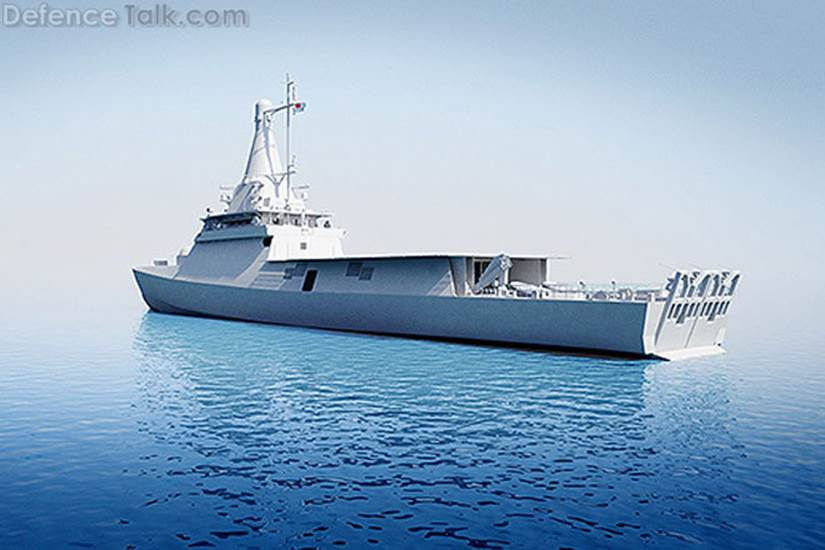
Singapore is building a new class of patrol vessels that look very much like my proposal for “Cutter X”, trading some Webber class and some larger ships for an intermediate design, costing about half what an OPC would cost, basically putting the equipment and crew (with some augmentation) of a Webber Class into a larger more seaworthy hull, to allow them to be used for extended operation in environments that do not require the ice strengthened hull and ability to launch and recover helicopters and boats in sea state five provided by the OPC.

Singapore is building eight of the ships under the project name “Littoral Missions Vessel” to replace eleven smaller, 500 ton, Fearless class patrol vessels that are approaching 20 years old. These ships are reportedly 80 meters in length (262.5 feet), displace 1200 tons (probably a light displacement), have a beam of 12 meters (39.4 feet), a range of 5,000 nautical miles at 15 knots, and a speed of 27 knots, all with a crew of only 30, though they do include additional accommodations for 30 more. (more here)

SingaporeLittoralMissionVesselPortQuarter

It appears these ships will use the same engines as the Webber Class. It is not clear how many of these engines they are using. Two would give them almost 12,000 HP which would almost certainly be good for at least 24 knots, but it might require three or four engines to make 27 knots.  (reports now indicate the class has two engines totallin about 12,000 HP)

In some respects these ships are more capable than the proposed cutter, in that they will have a 76mm gun and firecontrol system, in addition to smaller remotely operated weapons. It also appears to have space reserved for a small AAW missile system. On the other hand, while the flight deck can handle an H-60, the ship, unlike the French L’Adroit which was my model for “cutter X”, has no helicopter hangar, although it might be possible to add one using the same solution employed on L’Adroit (putting it under the bridge).

Soon, I expect to do an update of the “Cutter X” proposal, based on where we are now in the cutter recapitalization program.