Defense Media Network has a fairly comprehensive overview of what the Coast Guard has been doing in the Arctic.
Thanks to Lee for the link.

Defense Media Network has a fairly comprehensive overview of what the Coast Guard has been doing in the Arctic.
Thanks to Lee for the link.
German Navy blog “Marine Forum” reports (21 January) that the
China Ship-building Industry Corporation has been contracted with developing and building a 10,000-ton and another 4,000-ton surveillance ship.
(rmks: for paramilitary China Coast Guard or China Marine Surveillance)
Meanwhile, in a move designed to bolster their claims in the South China Sea, they also report,
With Vietnam: China will expand paramilitary infrastructure at Sansha City (Paracel Archipelago) in the South China Sea … permanently base a 5,000-ts patrol ship (rmks: prob. China Marine Surveillance – CMS) and begin regular patrols.
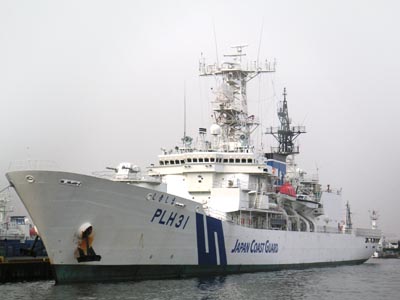
Don’t expect China’s new 10,000 ton cutter to look like a US Coast Guard Cutter. The Chinese seem to measure their Coast Guard primarily in comparison to the Japanese Coast Guard which has until now operated the largest cutters in the world, two 9,350 full load, Shikishima class high endurance helicopter carrying cutters. Like their Japanese counterparts, they are likely to be built to merchant standards, will be only lightly armed, but will have excellent aviation facilities. The additional tonnage is likely to give them an advantage if they get in a “shoving match” with opposing coast guards, and they are likely to have a secondary military transport role. With a relatively large number of boats, they could probably land a fair number of personnel in a relatively short time. By way of comparison the National Security Cutters are 4,500 tons full load.

US Coast Guard Illustration
As names were announced for the first fourteen Webber class Fast Response Cutters, the official USCG blog, “Coast Guard Compass” gave a short description of the service of the enlisted heroes these ships were named for. (You can find links to these fourteen posts here.)
Now ten more names have been selected and Coast Guard Compass is again posting descriptions of their service. The first five are:
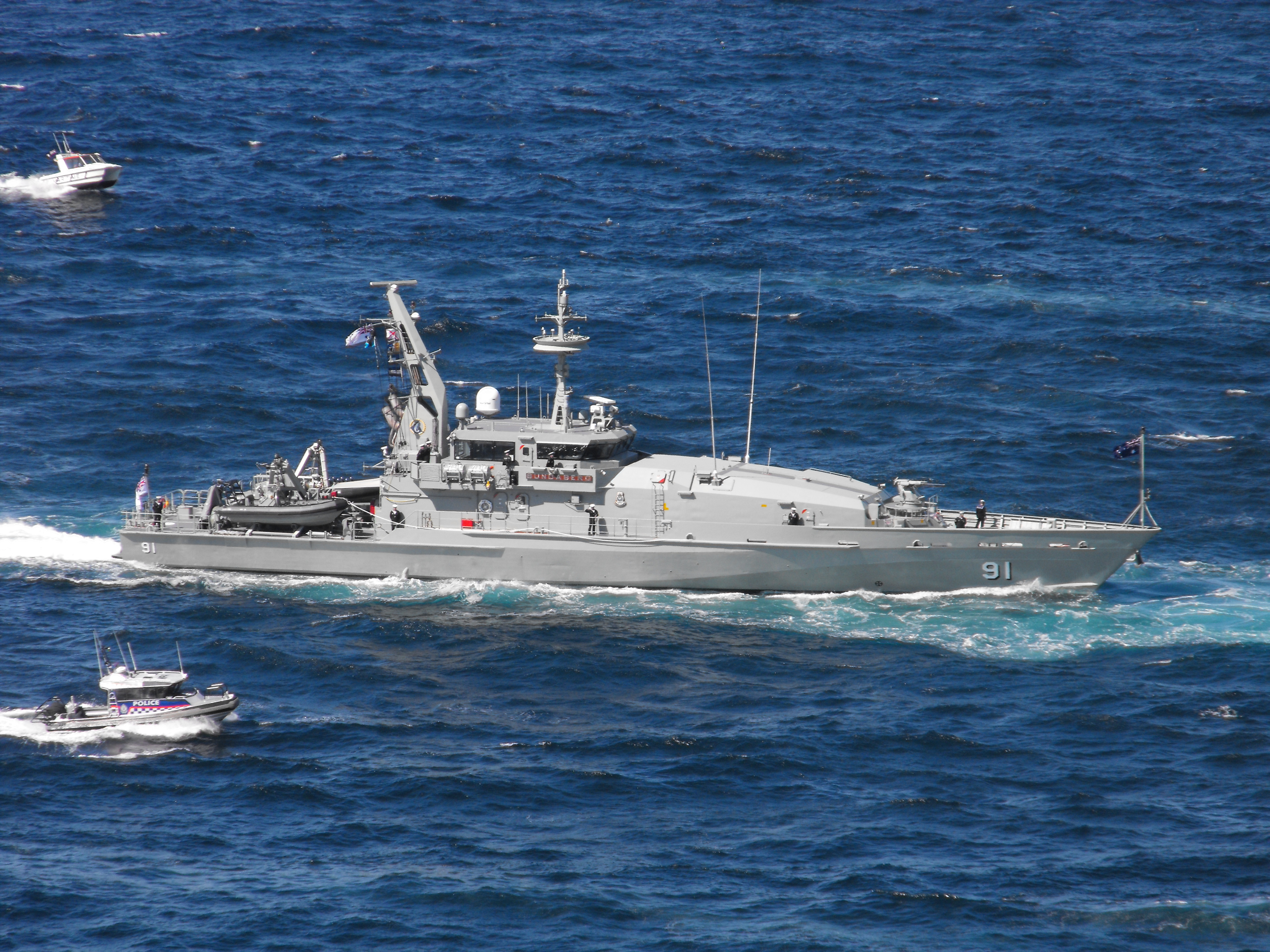 One of the less glamorous and certainly less rewarding missions the Coast Guard does is alien migrant interdiction operations (AMIO). It seems to come in waves but it never goes away completely.
Other countries have similar operations. We’ve talked about the problems the Italians have been having.
The Australians are having similar problems but their geography works against them. Plus they are trying to address this problem with vessels that simply may not be up to the job, at least not they way they are doing it.
Their workhorse for this mission are ten Armidale Class patrol boats, based in Darwin. These vessels are longer than the Fast Response Cutters, but because of their aluminum hulls, they are actually much lighter displacement. Their range and crew size are similar. They are slightly slower at 25 knots.
The problem is that the emigrants are not trying to come directly to continental Australia, they are trying to get to Australian territory in the form of islands close to Indonesia but distant from mainland Australia, The Cocos Islands or Christmas Island.
The Cocos Islands are less than 600 miles from Indonesia but over 2,000 miles from the boats’ base in Darwin.
Christmas Island is less than 200 miles from Indonesia, but over 1500 miles from Darwin.
These relatively small patrol craft have to transit about 1,500 miles before they can even start to work. The Australian Navy has recently gotten into a bit of hot water over entering Indonesian waters as they try to enforce their immigration laws.
I was interviewed on a pod-cast for Center for International Maritime Security (CIMSEC) talking about Corvettes and Offshore Patrol Vessels, and the series of posts that I managed for them. You can hear the pod-cast here: Sea Control 18 – Naval Corvettes
You can find the original posts in the series here:
http://cimsec.org/corvette-next/
http://cimsec.org/corvettes-persian-gulf-strategic-survey-paul-pryce/
http://cimsec.org/corvette-exists-przemyslaw-krajewski/
http://cimsec.org/opv-missions-wartime/
http://cimsec.org/philippine-navy-frigate-program-opv-name/
http://cimsec.org/corvettes-support-global-seapower/
http://cimsec.org/cheaper-corvettes-coop-stuft-like/
http://cimsec.org/case-pickets/
http://cimsec.org/offshore-patrol-cutters-opc-lcs/
http://cimsec.org/look-corvettes-air-defense/
http://cimsec.org/seafighters-will-never-operate-logistics-free-world-2/
Fire Aviation is reporting an interesting wrinkle in the story of the transfer of Coast Guard C-130s to the Forrest Service,
“We were surprised to hear from Mrs. Jones (a Public Affairs Specialist for the Forest Service at the National Interagency Fire Center-Chuck) …that a joint U.S. Coast Guard and U.S. Forest Service program office will provide logistics, operations, training, maintenance, and support for the C-130H aircraft. The Coast Guard has been managing a fleet of C-130s since 1959, using them for long range search and rescue, drug interdiction, illegal migrant patrols, homeland security, and logistics. They have 24 older C-130Hs which are being upgraded with new center wing boxes and cockpit equipment with new multi-function displays. In 2008 they began replacing some of the C-130Hs with new C-130Js; they have six now with three more on order. All these numbers were valid before the Coast Guard agreed to send seven C-130Hs to the USFS if the Coast Guard could get the 14 almost new C-27J aircraft from the military that had been earmarked for the Forest Service.”
Second Line of Defense has an editorial “Enhancing the Integration of the USCG with the USMC and the USN: Synergy and Mission Effectiveness as Key 21st Century Efforts,” advocating a more “naval” Coast Guard. In particular, it supports the building of more large ships that might be used as adjuncts to the Navy/Marine Corps Amphibious Ready Group/Marine Expiditionary Unit (ARG-MEU) teams.
It also raises the question, can the MV-22 Osprey land and take off from our ships so that they might act as “lily pads.”
FierceHomelandSecurity is reporting that while it appears the Coast Guard’s budget is down, it will represent a significant increase over the administration’s request.
“The Coast Guard will get a topline of $10.2 billion, a decrease of $211 million compared to the previous year enacted amount, but $463 million more than called for in White House budget proposal. For acquisition, construction and improvements, the service is set to get $1.376 billion, and to use funds to procure a seventh National Security Cutter and contract for long lead time materials for the eighth (and final) NSC. The omnibus will also fund the production of six Fast Response Cutters–Coast Guard officials have warned that an annual production rate of less than four FRCs would cause the cost of the FRC recapitalization program to rise and put in doubt the service’s ability to buy all 58 planned total FRCs.”
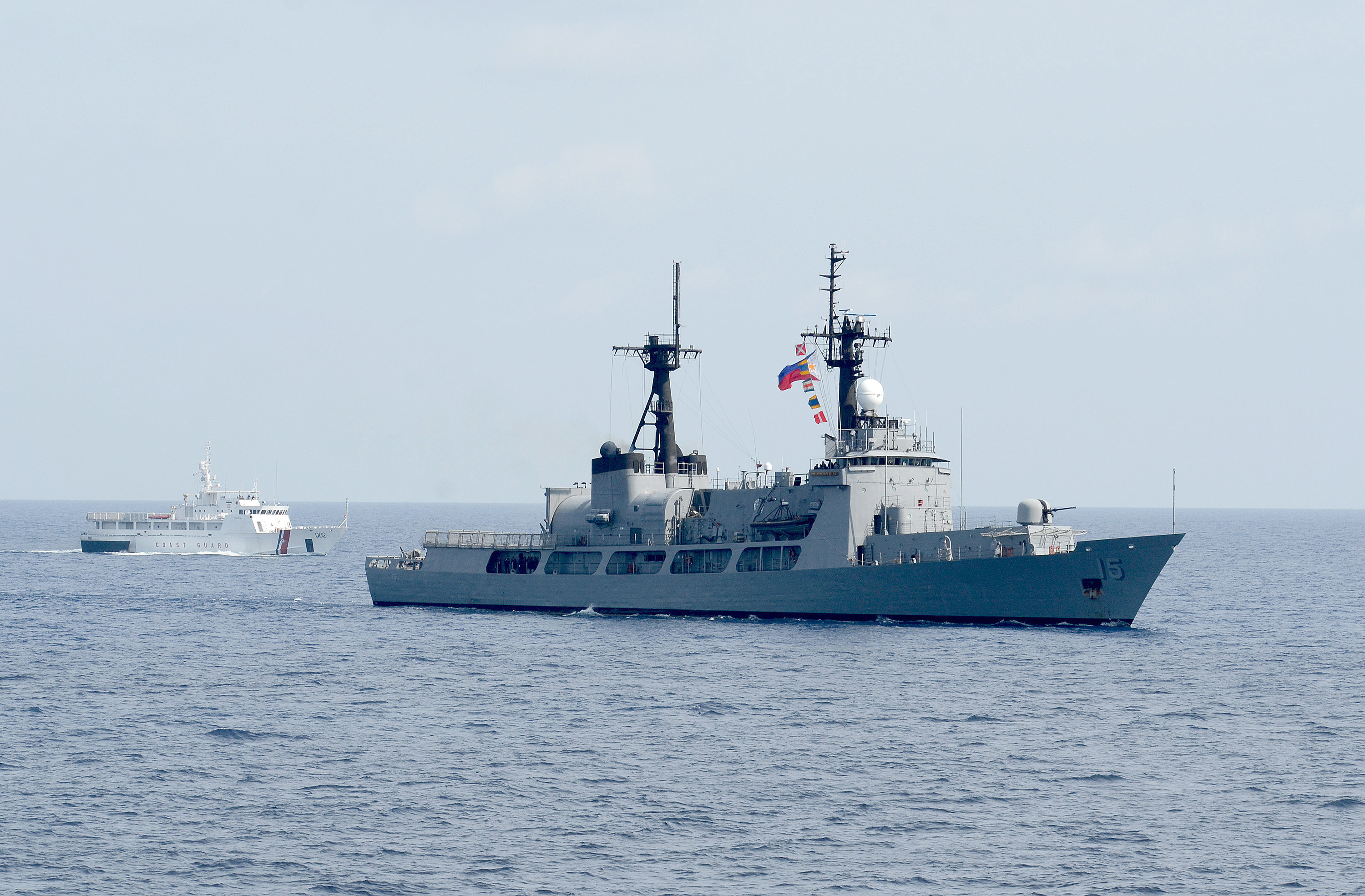
Photo Credit: United States Navy with the ID 130629-N-YU572-530, by Mass Communication Specialist 1st Class Jay C. Pugh, PHILIPPINE SEA (June 29, 2013) The Philippine Coast Guard vessel Edsa (SARV 002), left, and the Philippine Navy frigate Gregorio Del Pilar (PF 15) steam in formation during Cooperation Afloat Readiness and Training (CARAT) Philippines 2013.
Global Post is reporting the Philippines is looking for two more “frigates” from the U. S. It is not clear they are referring to Hamilton Class Cutters, but it seems likely. Referring to the two WHECs they already have, the article states,
“The Philippines has already acquired two refurbished American frigates in the past two years, and they now lead patrols in the South China Sea.”
The request might conceivably refer to retiring Perry Class navy frigates, but that would introduce an additional set of systems to the Philippine Navy and the gas turbine powered FFG-7s are not as economical to operate as the normally diesel powered Hamiltons with their combined diesel or gas turbine (CODOG) power plant. The redundancy offered by the cutters’ four engine, two shaft power plant may also be seen as an advantage over the FFG-7’s two engine, single shaft propulsion.
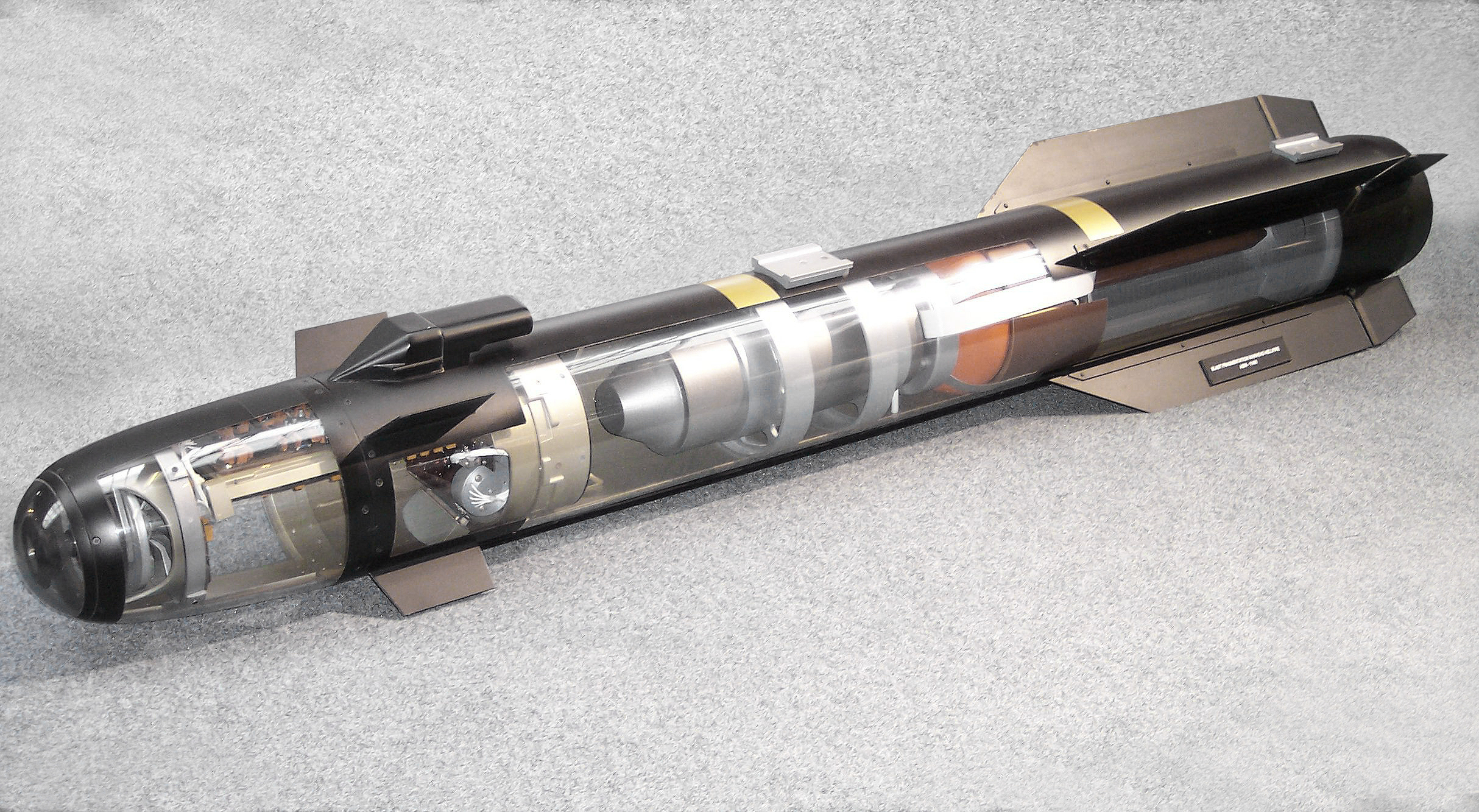
Photo credit: Wikipedia, Stahlkocher, Lockheed Martin Longbow Hellfire.
The US Navy is looking at weapons to arm the Littoral Combat Ships (LCS) for operations against swarming small craft. These weapons will be relatively small and low cost, so they are potentially applicable to Coast Guard vessels as small WPBs. The first system selected was the Griffin, but while it may be improved, it currently has only a very short range.
Earlier, we talked about one of the contenders, the Brimstone, also called the Sea Spear. Another contender has surfaced, including both a missile and a firecontrol system that is already in the US inventory, the LONGBOW system employing the fire-and-forget LONGBOW HELLFIRE AGM-114L missiles. This missile is similar in size to the Brimstone, and like the Brimstone has a millimeter wave guidance, fire and forget capability.
Unlike the Brimstone, there is no claim of a man-in-the-loop capability, which would appear to be a desirable feature, particularly for the Coast Guard, where the target may be surrounded by innocent vessels that we would want to avoid targeting. On the other hand the vertical launch capability does appear to offer some packaging advantages. Lockheed claims “…Nearly 400 radars and more than 14,000 missiles have been contracted for the U.S. Army and international customers” so it is already an established product line with advantages in economy of scale. These systems are currently mounted on Attack Helicopters, so we can be assured that the weight and space requirements are not too demanding for installation on even relatively small craft.
NavyRecognition reports that the Army, Navy, and Lockheed Martin has demonstrated that these missiles can be vertically launched from a 65 foot Navy boat simulating a section of an LCS. The Navy may also want to fit this, or whatever system is ultimately chosen, to their new patrol boat.
Specifications for the AGM-114L Longbow Hellfire from Wikipedia:
Here is Lockeed Martin’s description:
The LONGBOW system is built by a Joint Venture of Lockheed Martin and Northrop Grumman. U.S. Army testing shows integrated capabilities enhance the Apache lethality fourfold and survivability sevenfold. The mission equipment package is in production for the U.S. and several international customers. The Apache LONGBOW system is a proven force multiplier that has been battle-proven in Operation Enduring Freedom and Operation Iraqi Freedom. The LONGBOW Weapon System has been in full-rate production since 1996, with First Unit Equipped in 1998. Nearly 400 radars and more than 14,000 missiles have been contracted for the U.S. Army and international customers. For the Apache Block III upgrade, a new Radar Electronics Unit (REU) will replace two line-replaceable units. The REU will provide growth capabilities to the LONGBOW FCR and will reduce maintenance cost.
LONGBOW FCR
The LONGBOW FCR has a very low probability of intercept. It rapidly and automatically searches, detects, locates, classifies, and prioritizes multiple moving and stationary targets on land, water and in the air in all weather and battlefield conditions from standoff ranges. Target coordinates are automatically available to other sensors and weapons for target confirmation, rapid engagement, and reduced fratricide. Target data is digitally available through the data modem for real-time transfer to other platforms and command posts. The self-contained Radar Frequency Interferometer provides rapid and accurate identification and azimuth to enemy air defense units. High system reliability and two-level maintenance maximize operational availability and reduce support costs.LONGBOW HELLFIRE Missile
The LONGBOW system employs fire-and-forget LONGBOW HELLFIRE AGM-114L missiles that can be launched from defilade, increasing battlefield survivability. The LONGBOW HELLFIRE missile locks on targets before or after launch and has been used in Operation Enduring Freedom and Operation Iraqi Freedom.The M299 Smart Launcher has a fully digital interface to the Apache helicopter and fires all types of HELLFIRE missile.
 Chuck Hill's CG Blog
