“USACE cancels solicitation for Nome’s port expansion project, future uncertain” –KNOM.org

USCGC Alex Haley moored in Nome, AK.

KNOM.org reports,

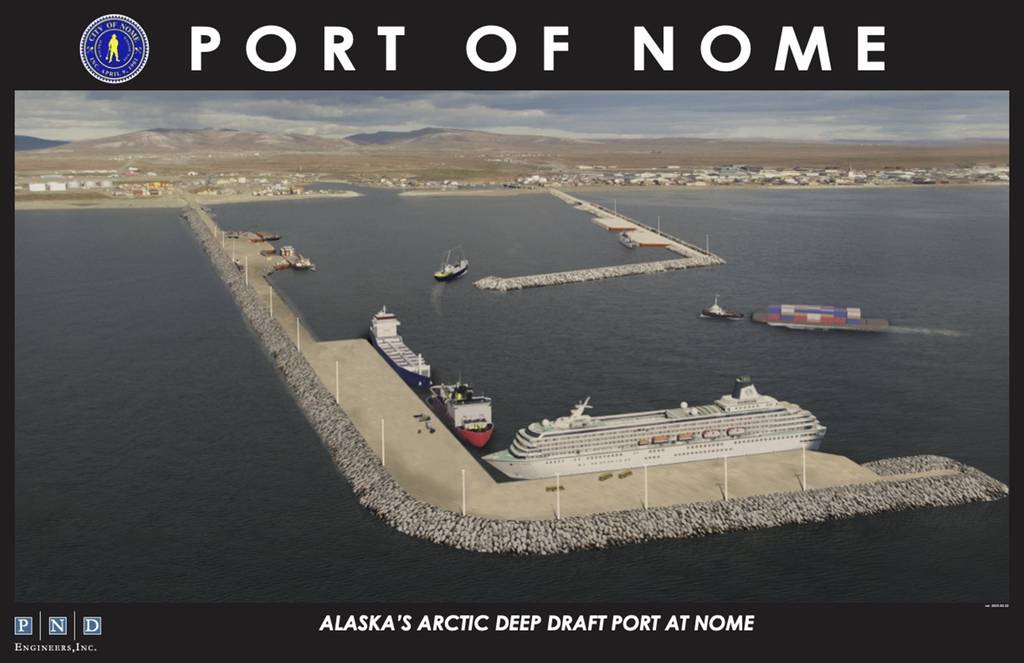
The U.S. Army Corps of Engineers (USACE) says plans to build the country’s first deep draft port in the Arctic are too expensive.

USACE canceled its port expansion contract solicitation on Wednesday, October 16. It cited two key factors: the proposed pricing exceeded both the cost limits set by U.S. law and the available funding for the project.

Plans were to dreg to 40 feet. Sounds like they may need to be another Congressional action before work can proceed.

Rendering provided by the City of Nome shows how the Port of Nome, Alaska, would have appeared following an expansion project that would have cost more than $600 million.  (PND Engineers Inc./City of Nome via AP)

“Enhancing Domain Awareness in the Arctic” –Third Fleet

A U.S. Navy P-8A Poseidon takes off at Joint Base Elmendorf-Richardson, Alaska, Sept. 14, 2024. The P-8 Poseidon aircrew assigned to Patrol Squadron (VP) 9 and a U.S. 3rd Fleet Naval and Amphibious Liaison Element (NALE) supported joint and bi-national forces from Alaskan North American Aerospace Defense Command Region and Alaskan Command during Operation POLAR VORTEX by providing maritime domain awareness in conjunction with the 611th Air Operations Center air component to provide domain awareness during operations and exercises in remote regions of Alaska and the Arctic. (U.S. Air Force photo by Senior Airman Quatasia Carter)

Below is a 3rd Fleet press release. Notably missing is any mention of the Coast Guard, that might be understandable, but I have also seen no Coast Guard news release about participation in Operation POLAR VORTEX. If you are doing Maritime Domain Awareness anywhere around Alaska, you would think the Coast Guard would be involved.


Oct. 28, 2024

Enhancing Domain Awareness in the Arctic

By Tech. Sgt. Donald Hudson

During Operation POLAR VORTEX, a Naval and Amphibious Liaison Element (NALE) led by U.S. 3rd Fleet and supported by U.S. Fleet Forces was embedded into the bi-national Alaskan North American Aerospace Defense Command (NORAD) Region at Joint Base Elmendorf-Richardson, Alaska.

The NALE is primarily a function of the Navy Reserve, with Reserve personnel filling roughly 98 percent of NALE billets, given the operational tempo of this unique work. NALE Sailors train in mobilization to billet (MOB to-billet) positions and generally deploy on 90 to 270-day orders, responding both to planned operations and emergent crises, including training exercises, freedom of navigation operations, and humanitarian assistance and disaster relief. MOB-to-billet is the activation (other than for training) of SELRES Sailors to serve in the authorized and funded manpower billet at the command to which they are permanently assigned.

NALE units are attached to U.S. Fleet Forces Command, U.S. Pacific Fleet, U.S. Naval Forces Europe and Africa, and most numbered fleets.

While in Alaska, the NALE worked alongside U.S. Air Force and Royal Canadian Air Force (RCAF) members in the 611th Air Operations Center (AOC) to increase domain awareness in the Arctic region during Operation POLAR VORTEX by instantly linking maritime and air domain awareness.

“The situational awareness the NALE has provided is the most maritime awareness the AOC has had in the 14 years I’ve been here,” said Alaska Air National Guard Col. Jeff Smith, deputy commander, 611th AOC. “It’s been great to see the coordinated efforts between air and maritime domains.”

By co-locating, the NALE and 611th AOC were able to coordinate information instantly to the Joint Force Air Component Commander (JFACC) and provide a detailed real-time operating picture from the surface to air across some of the most remote operating areas in Alaska.

The NALE worked to seamlessly integrate their expertise of maritime domain awareness and employ a Navy P-8 Poseidon alongside joint and bi-national air assets. The cooperation increased tactical performance of joint forces validating command and control and tactical execution of mission objectives between various aircraft including exercising simulated air-to-surface strikes.

“The NALE has been essential to air operations,” said RCAF Brig. Gen. David Moar, deputy commander, Alaskan NORAD Region. “They were key in synchronizing air operations with naval air assets and providing information to enable the JFACC to coordinate and support the maritime component.”

3rd Fleet operations in U.S. Northern Command’s (USNORTHCOM) area of responsibility throughout the Gulf of Alaska aligned with Commander, U.S. Pacific Fleet objectives to demonstrate resolve and credible deterrence in defense of the homeland in the area. The operations also supported USNORTHCOM and NORAD’s mission of homeland defense, aerospace warning and control, and preserving a stable Arctic region in cooperation with U.S. Allies and partners.

“The NALE is an essential part of integrating the Maritime Operations Center (MOC) and AOC to provide multi-domain awareness to both Component Commanders,” said U.S. Navy Capt. Chris “Turtle” Turl, NALE director. “By coordinating information between each Commander’s guidance, the NALE facilitates the planning and execution of the mission to effectively meet the commander’s intent.”

NALE Sailors regularly engage in training exercises, freedom of navigation operations, and humanitarian assistance and disaster relief to enable better integration between joint air assets. The NALE provide the necessary face to-face contact among planner, commanders and staff to ensure mutual understanding, unity of effort and reduce friction between components.

Operating across the vast distances and remote areas in the Arctic comes with many operational hurdles to overcome such as harsh weather and sea conditions causing increased risk to aircrews should an incident occur. Enhancing communication between joint forces is essential to meet the mission while overcoming obstacles and lowering operational risks.

Through joint and bi-national teamwork the NALE and 611th AOC were able to maximize domain awareness and more effectively employ air assets saving time, and costs while reducing risk and increasing efficient use of tactical air assets and manpower.

“Coast Guard to send 3 more cutters to Guam, has no plans to escort Philippine ships” –Stars and Stripes

A U.S. Coast Guard boat crew and boarding team from U.S. Coast Guard Cutter Oliver Berry (WPC 1124) approaches a foreign fishing vessel to conduct a joint boarding inspection with members of the Western and Central Pacific Fisheries Commission on the high seas in Oceania, Sept. 22, 2024. U.S. Coast Guard Cutter Oliver Berry’s crew recently completed a 45-day patrol in Oceania in support of Operation Blue Pacific, promoting security, safety, sovereignty, and economic prosperity in the region.

Stars and Stripes reports,

The Coast Guard will double its Guam fleet to six cutters but doesn’t plan to accompany the Philippine coast guard as it struggles to maintain territorial claims in the South China Sea, the service’s Pacific-area commander said Friday.

This is based on a video news conference by Pacific Area Commander Vice Adm. Andrew Tiongson speaking from Japan.

“The Coast Guard will not escort Philippine resupply missions to the BRP Sierra Madre, a grounded warship garrisoned by Filipino troops at the Second Thomas Shoal in the South China Sea, according to Tiongson.”

The Philippines has not asked for escorts, Tiongson said. “We do advise, and we do assist,” he said. “We provide what we would do in this situation.”

He also said, “It’s possible we may get another Indo-Pacific support cutter,” using the description applied to USCGC Harriet Lane, recently arrived in the Pacific Area to support operations in the Western Pacific.

There is more in the article.

“U.S. Coast Guard encounters joint Chinese Coast Guard, Russian Border Guard patrol in Bering Sea” –Coast Guard News

Russian Okean class Patrol Ship. This is the larger of the two Russian ships. “An HC-130J Super Hercules airplane crew from Coast Guard Air Station Kodiak observes two Russian Border Guard ships and two Chinese Coast Guard ships approximately 440 miles southwest of St. Lawrence Island Sept. 28, 2024. This marked the northernmost location where Chinese Coast Guard vessels have been observed by the U.S. Coast Guard. (U.S. Coast Guard courtesy photo)”

Below is a CG news release, presumably from District 17 (Alaska).

An earlier post reported joint Russian/Chinese Coast Guard exercises and the formation of this four-ship combined task force.

They are in the Bering Sea. Will be interesting to see if they go up into the Arctic. It is a period of near minimal ice.

There is an interesting contrast between the two Russian ships and the two Chinese ships. In spite of the fact that this is happening in Russia’s back yard, the Chinese ships clearly outclass the Russian ships, being newer, larger, and faster.

China Coast Guard type 818 cutter like the two deployed with the Russian Coast Guard

Why four ships hanging together when the US Coast Guard does Alaska Patrols in the Bering with only one ship? The Chinese tend to operate in groups. We haven’t seen this with the Russian Coast Guard, but I really haven’t seen much from them anyway.

Could the Chinese be teaching the Russians how to do gray zone operations, or is it just that totalitarian regimes need someone to do the work and someone to watch them?

On the other hand, the China Coast Guard has lots of ships but relatively few aircraft, and they operate primarily in two heavily trafficked, contested areas, the South and East China Seas.

News Week also has a good report on this.


Oct. 1, 2024

JUNEAU, Alaska – The U.S. Coast Guard located four vessels from the Russian Border Guard and Chinese Coast Guard conducting a joint patrol in the Bering Sea, Saturday.

While patrolling the maritime boundary between the United States and Russia on routine patrol in the Bering Sea, a HC-130J Super Hercules airplane crew from Coast Guard Air Station Kodiak observed two Russian Border Guard ships and two Chinese Coast Guard ships approximately 440 miles southwest of St. Lawrence Island.

The vessels were transiting in formation in a northeast direction, remaining approximately five miles inside the Russian Exclusive Economic Zone. This marked the northernmost location where Chinese Coast Guard vessels have been observed by the U.S. Coast Guard.

 “This recent activity demonstrates the increased interest in the Arctic by our strategic competitors,” said Rear Adm. Megan Dean, commander of the 17th Coast Guard District. “The demand for Coast Guard services across the region continues to grow, requiring continuous investment in our capabilities to meet our strategic competitors’ presence and fulfill our statutory missions across an expanding operational area.”

The HC-130 aircrew operated under Operation Frontier Sentinel, an operation designed to meet presence with presence when strategic competitors operate in and around U.S. waters. The Coast Guard’s presence strengthens the international rules-based order and promotes the conduct of operations in a manner that follows international law and norms.

Fisheries Enforcement from a Littoral Combat Ship

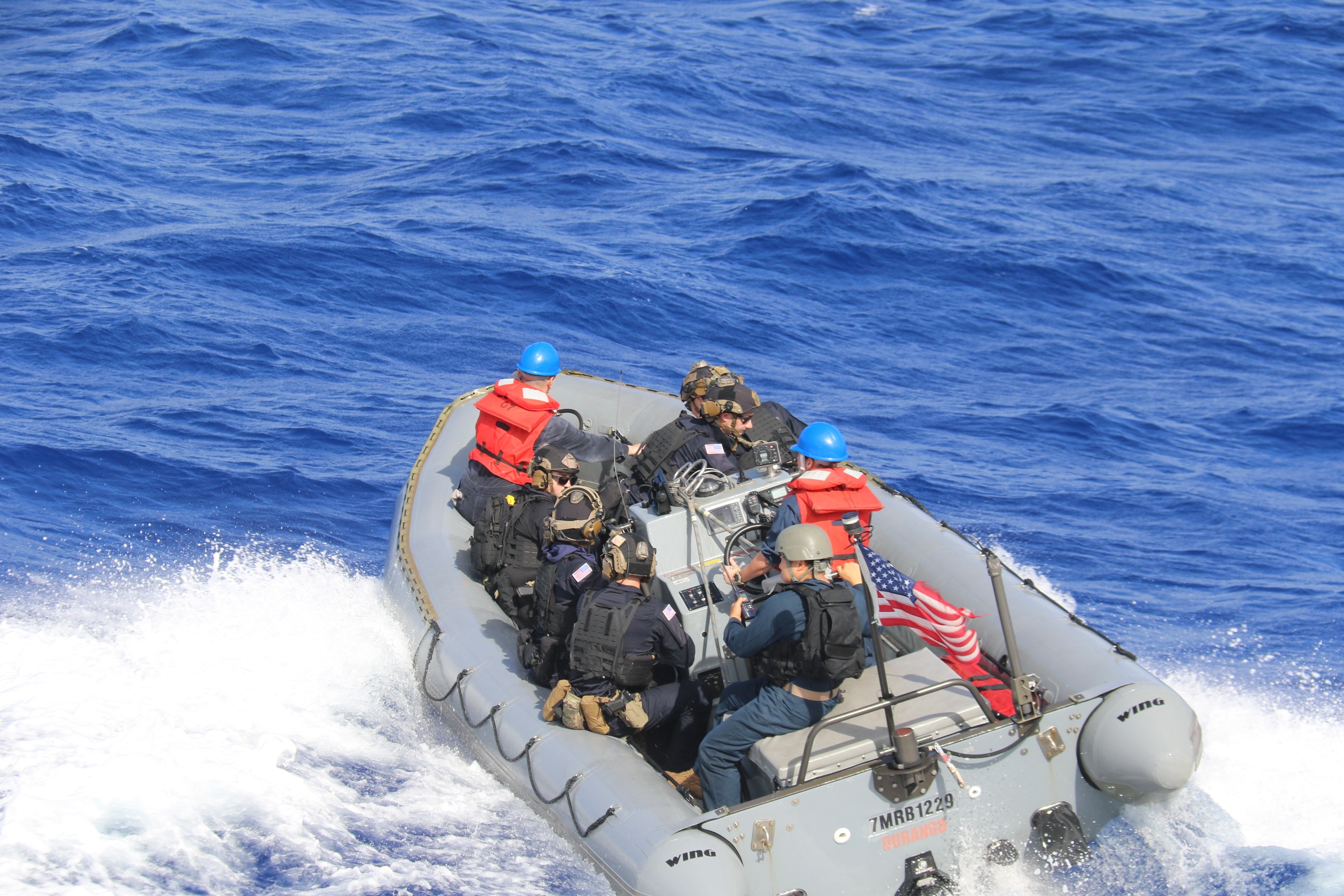
PACIFIC OCEAN – Sailors from USS Omaha (LCS 12), along with five U.S. Coast Guard law enforcement members, transit in a rigid-hull inflatable boat to a foreign flagged fishing vessel in support of the Oceania Maritime Security Initiative (OMSI) in the Pacific Ocean, Sept. 12. Omaha, assigned to U.S. 3rd Fleet, is operating in support of OMSI in the Indo-Pacific region. A U.S. Coast Guard law enforcement detachment from the Pacific Tactical Law Enforcement Team embarked aboard Omaha is supporting maritime fishery law enforcement operations for U.S. and Pacific Island nations in Oceania. OMSI is a Secretary of Defense program that leverages Department of Defense assets to increase U.S. Coast Guard maritime security and maritime domain awareness support in Oceania through operations in remote U.S. Exclusive Economic Zones and bilateral maritime law enforcement agreements with Pacific Island nations. (U.S. Navy photo by Hospital Corpsman First Class Weiju Lai)

Below is a news release from 3rd Fleet. TACLET taking the opportunity to use a Navy unit’s transit time to do some fisheries enforcement. Photo below for reference.

PACIFIC OCEAN (Aug. 8, 2021) The Independence variant littoral combat ship USS Omaha (LCS 12) simulates a refueling-at-sea with the aircraft carrier USS Abraham Lincoln (CVN 72). (U.S. Navy photo by Mass Communication Specialist 3rd Class Javier Reyes)


Sept. 20, 2024

USS Omaha participates in Oceania Maritime Security Initiative

By Commander, Littoral Combat Ship Squadron 1

The Independence-variant littoral combat ship USS Omaha (LCS 12), with an embarked detachment from Helicopter Maritime Strike Squadron (HSM) 35 and a law enforcement detachment from U.S. Coast Guard Tactical Law Enforcement Team Pacific, began operations in support of Oceania Maritime Security Initiative (OMSI) Sept. 8.

A Secretary of Defense program, OMSI is aimed at diminishing transnational illegal activity on the high seas in the Pacific Island nations of Oceania’s Exclusive Economic Zones (EEZ), as well as increasing interoperability with partner nations.

Omaha’s range and capabilities allow the embarked U.S. Coast Guard law enforcement detachment the ability to access the remote U.S. and Pacific Island nations’ EEZs.

“We embrace the opportunity to work closely with the U.S. Coast Guard as we help enforce economic policies among some of our closest partners in the Western and Central Pacific,” said U.S. Navy Cmdr. Kevin Smith, commanding officer of Omaha. “It is rewarding to work with these island nations to patrol their waters, maintaining a free and open region.”

The objective of OMSI is to reduce and eliminate illegal, unregulated and unreported fishing, combat transnational crimes in EEZs of the Western and Central Pacific region and enhance regional security.

“The partnership between the U.S. Navy and U.S. Coast Guard plays an integral role in the OMSI mission,” said Coast Guard Chief Maritime Enforcement Specialist Kyle Smouse. “Deploying U.S. Coast Guard law enforcement detachments aboard U.S. Navy vessels allows the Coast Guard to have a greater presence and impact in enforcing Western and Central Pacific Fisheries Commission (WCPFC) regulations. These areas of operation would be difficult to reach without the support of the U.S. Navy.”

The WCPFC international fisheries agreement focuses on the long-term conservation and sustainable use of fish stocks in the Western and Central Pacific Ocean. The WCPFC seeks to address problems in the management of the high seas fisheries in the Western and Central Pacific Ocean, where there is unregulated fishing and vessel re-flagging to evade controls.

Omaha, homeported in San Diego and assigned to U.S. 3rd Fleet, is on a scheduled deployment in the Pacific Ocean. Littoral combat ships are fast, optimally manned, mission-tailored surface combatants that operate in near-shore and open-ocean environments, winning against 21st-century coastal threats.

“U.S. Coast Guard encounters Russian naval vessels near Point Hope, Alaska” — CG News

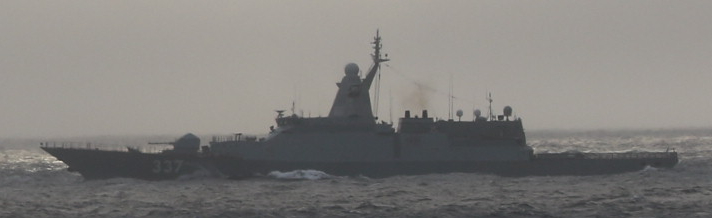
“The crew of U.S. Coast Guard Cutter Stratton (WMSL 752) encountered and shadowed four Russian Federation Navy (RFN) vessels 57 miles northwest of Point Hope, Alaska, Sept. 15, 2024. The Russian Surface Action Group consisted of a Severodvinsk-class submarine, a Dolgorukiy-class submarine, a Steregushchiy– class Frigate, and a Seliva-class tug. Stratton patrolled under Operation Frontier Sentinel, a Coast Guard operation designed to meet presence with presence when strategic competitors operate in and around U.S. waters. (U.S. Coast Guard courtesy photo)”

Below is a news release from Coast Guard news.

Point Hope, Alaska is well North of the Bering Strait and the Arctic Circle, bordering the Chukchi Sea, 312 miles SW of Utqiagvik (formerly Pt. Barrow) and almost a thousand miles North of Dutch Harbor. None of my Alaska Patrols ever got that far North.

Russian Yasen class SSGN

The Severodvinsk or Yasen class submarine is a nuclear submarine equipped with eight missile silos for up to 32 cruise missiles and ten torpedo tubes.

Russian Borei class SSBN

The Dolgorukiy or Borei class submarine is a SSBN with 16 silos for ballistic missiles.

The surface combatant seems to have been miss identified. It is Gremyashchiy (337) lead ship of her class of 2,500 ton Project 20385 corvettes (NATO considers them frigates).

Note, USCGC Stratton is not an ice strengthened vessel.

This may have been a transfer of the SSGN and SSBN to the Russian Pacific Fleet.

The post story seems to indicate Stratton stumbled across this group. Shouldn’t we have known they were there?


Sept. 16, 2024

JUNEAU, Alaska — The U.S. Coast Guard located four Russian Federation Navy (RFN) vessels Sunday, 57 miles northwest of Point Hope, Alaska.

While on a routine patrol in the Chukchi Sea, the crew of U.S. Coast Guard Cutter Stratton (WMSL 752) observed the RFN vessels transiting southeast along the Russian side of the Maritime Boundary Line (MBL).

The crew of the Stratton witnessed the RFN vessels cross the MBL into the U.S. Arctic and moved to observe the vessels. The Russian vessels were assessed to be avoiding sea ice on the Russian side of the MBL and operated in accordance with international rules and customs as they transited approximately 30 miles into the U.S. Exclusive Economic Zone.

“We are actively patrolling our maritime border in the Bering Sea, Bering Strait, and Chukchi Sea, with our largest and most capable cutters and aircraft, to protect U.S. sovereign interests, U.S. fish stocks, and to promote international maritime norms,” said Rear Adm. Megan Dean, Commander of Coast Guard District Seventeen. “Coast Guard Cutter Stratton ensured there were no disruptions to U.S. interests.”

The Russian Surface Action Group consisted of a Severodvinsk-class submarine, Dolgorukiy-class submarine, Steregushchiy– class Frigate, and Seliva-class tug.

The Stratton is patrolling under Operation Frontier Sentinel, an operation designed to meet presence with presence when strategic competitors operate in and around U.S. waters. The Coast Guard’s presence strengthens the international rules-based order and promotes the conduct of operations in a manner that follows international law and norms.

Coast Guard Cutter Stratton is a 418-foot legend class national security cutter homeported in Alameda, Calif.

“Runaway costs and design delays: Are Coast Guard’s new icebreakers worth it?” –The Sandboxx

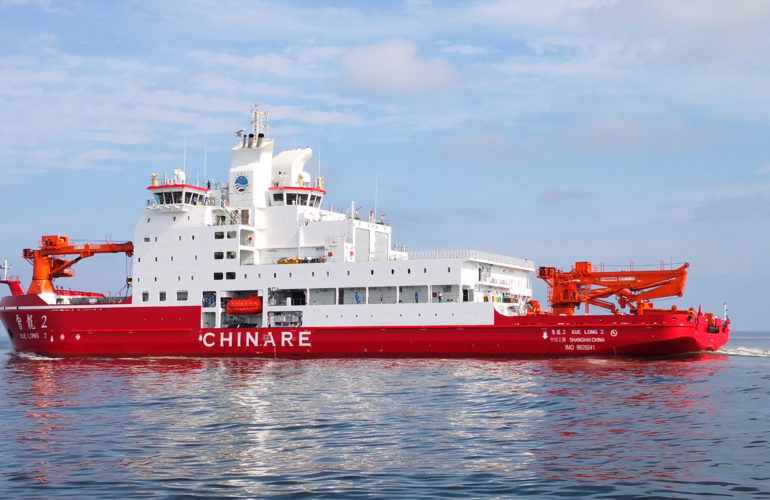
Xue Long 2 on sea trials. Photo by PRIC.

The Sandboxx has a brief look at the problems the US has had in fielding replacement icebreakers.

What I think they leave out of the article is that while the Chinese seem to be planning heavy icebreakers including possibly nuclear-powered ones, the Chinese icebreakers built so far are nowhere near as powerful as Polar Star or the Polar Security Cutter. Mostly they have been ice capable research ships. Their only Chinese built medium ice breaker, Xue long-2, is smaller and a third less powerful than Healy. The three Chinese icebreakers currently in the Arctic include the much smaller 5,600-ton, 8,600 HP (6.4KW) Polar Class 6 Ji Di, smaller than the old Wind class icebreakers.

Aerial view of China’s icebreaker Ji Di berthing at the pier of Qingdao Olympic Sailing Center on July 3 in Qingdao, Shandong Province of China.
© Sun Qimeng/VCG via AP, “China and Russia to Expand Scientific Cooperation in Arctic: Report” –Newsweek

By some counts the US, and most notably Canada, have more icebreakers than China. All of China’s icebreaker construction is not directed at the Arctic. They also have interests in Antarctica (which I find more troubling), and they have ports that ice over requiring domestic icebreaking.

The Sandboxx also describes the 8,500 ton Project 23550 ice class patrol vessels as Russia’s “… first “combat icebreaker,” a small, agile, and armed-to-the-teeth escort ship with launchers installed for anti-ship and cruise missiles.” That is hyperbole. It has provision for placing two containers on the stern. Those containers could contain cruise missiles, but any ship that can mount containers in a position where the space above the container is unobstructed could have a similar capability. Other than being armed with containers, they are armed very much like a Coast Guard cutter. They have a single medium caliber gun, either 76mm or 100mm. They have no surface-to-air missile system other than perhaps man portable air defense systems (MANPADS) and no CIWS of any kind. Furthermore, they are not Russia’s first armed icebreaker. Russia has had armed icebreakers since at least WWII, including the Project 23550’s predecessors, the Ivan Susanin class, eight ships completed 1973 to 1982, four of which are still in service. I went aboard one of them in San Francisco, when they came to help celebrate the 200th anniversary of the beginning of the US Coast Guard.

It would not be too difficult for the US to build counterparts to the Project 23550s for the US Coast Guard or Navy, especially after the recent ICE Pact agreement with Canada and Finland. Ships don’t have to be as capable as the Polar Security Cutters to be useful. The Chinese are proving that.

Polar Star is Home–Finally

Polar Star at Mare Island Dry Dock LLC undergoing the fourth phase of its five-year Service Life Extension Project. U.S. Coast Guard photo by Cmdr. Jeremy Courtade.

Below are two news releases, first one from Coast Guard News, the second from the Acquisitions Directorate (CG-9).

The Coast Guard has been working very hard to make sure that Polar Star can meet her annual commitment to open a path for resupply of the Antarctic Base at McMurdo, but it has to have been hard on the crew. They just completed the fourth phase of a five-part Service Life Extension Program (SLEP), but unlike the single phase SLEPs and MMAs we are seeing with the buoy tenders and medium endurance cutters at the Coast Guard Yard, here the crew stays aboard. After 138 days on the resupply mission, instead of returning to Seattle, their homeport, they went to Vallejo, California, where they spent about 140 days. Altogether, 285 days away from homeport, and over a one-year period, more days in Vallejo than in homeport.

Polar Star has only one more of these to go, but it looks like the Crew of USCGC Healy is going to go through the same 5-year SLEP cycle, where they will spend more time in Vallejo than in their homeport. This is just wrong. There are only two yards on the West Coast that can accommodate ships of this size. The Navy, with its huge presence, is a strong competitor for the use of the one in Seattle. By contrast the Bay Area has virtually no Navy presence. It is likely the Icebreakers will have to use the yard in Vallejo for almost all their drydocking. Maybe it is time to change their homeport to somewhere in the San Francisco Bay Area, maybe even Vallejo.

Improvements are planned for Base Seattle, largely on the assumption that the Polar Security Cutters (PSC) will be based there, but they can expect to run into the same problem. Given the greater size of the PSCs and the long-term probability the Navy presence in Seattle will remain large and may well increase, the problem is not going away. The dry dock in Vallejo was built to accommodate battleships. It is big enough.


U.S. Coast Guard Cutter Polar Star (WAGB 10) (left) sits moored next to U.S. Coast Guard Cutter Healy (WAGB 20) at Coast Guard Base Seattle, Aug. 25, 2024. The Polar Star and Healy are routinely deployed to Arctic and Antarctic locations to support science research or help resupply remote stations. (U.S. Coast Guard photo by Lt. Chris Butters)

Aug. 28, 2024

Coast Guard heavy icebreaker returns to Seattle following Antarctic deployment, months-long Service Life Extension Project in California

SEATTLE — The U.S. Coast Guard Cutter Polar Star (WAGB 10) and crew returned to Seattle, Sunday, after 285 days away from the cutter’s home port.

Following a 138-day deployment to Antarctica supporting Operation Deep Freeze 2024, the Polar Star reported directly to Mare Island Dry Dock (MIDD) LLC. in Vallejo, California, to commence the fourth phase of a five-year Service Life Extension Project (SLEP).

The work completed at MIDD is part of the in-service vessel sustainment program with the goal of recapitalizing targeted systems, including propulsion, communication, and machinery control systems, as well as effecting significant maintenance to extend the cutter’s service life.

Polar Star’s SLEP work is completed in phases to coordinate operational commitments such as the cutter’s annual Antarctic deployment. Phase four began on April 1, 2024, targeting three systems:

  • Boiler support systems were recapitalized, including the electrical control station that operates them.
  • The heating, ventilation and air conditioning (HVAC) system was refurbished through the overhaul of ventilation trunks, fans and heaters that supply the cutter’s berthing areas.
  • The flooding alarm system was redesigned, providing the ability to monitor machinery spaces for flooding from bow to stern.

Additional work not typically completed every dry dock included removing and installing the starboard propulsion shaft, servicing and inspecting both anchor windlasses, inspecting and repairing anchor chains and ground tackle, cleaning and inspecting all main propulsion motors and generators, installation of an isolation valve to prevent seawater intrusion into the sanitary system, and overhauling the fuel oil purifier.

Phase four of Polar Star’s SLEP took place over approximately 140 days and represented a total investment of $16.8 million. By replacing outdated and maintenance-intensive equipment, the Coast Guard will mitigate lost mission days caused by system failures and unplanned repairs. The contracted SLEP work items and recurring maintenance is taking place within a five-year, annually phased production schedule running from 2021 through 2025.

The Coast Guard is investing in a new fleet of polar security cutters (PSC) that will sustain the service’s capabilities to meet mission needs in both the Arctic and Antarctic regions. The SLEP allows Polar Star to continue providing access to the Polar regions until the PSCs are operational and assume the high latitude missions. Polar security cutters will enable the U.S. to maintain defense readiness in the Polar regions; enforce treaties and other laws needed to safeguard both industry and the environment; provide ports, waterways and coastal security; and provide logistical support – including vessel escort – to facilitate the movement of goods and personnel necessary to support scientific research, commerce, national security activities and maritime safety.

“Completing a dry dock availability is a positive milestone, and despite challenges due to being away from home port, our crew’s energy and resilience inspires me every day,” said Capt. Jeff Rasnake, Polar Star’s commanding officer. “The amount of time and effort put into Polar Star and its mission is truly remarkable. The dedication and teamwork displayed across all stakeholders exemplifies the Coast Guard’s flexibility and commitment to ensuring the continued success of Operation Deep Freeze as well as strengthened partnerships among nations invested in the Antarctic latitudes. I look forward to observing how this crew will continue to grow as a team and to discovering what we can accomplish together.”

Along with the rigorous maintenance schedule, Polar Star held a change of command ceremony on July 8, 2024, in Vallejo, where Rasnake relieved Capt. Keith Ropella as the cutter’s commanding officer. Rasnake served as the deputy director for financial management procurement services modernization and previously served as Polar Star’s executive officer. Ropella transferred to the office of cutter forces where he will oversee the management of the operational requirements for the cutter fleet and develop solutions for emerging challenges facing the afloat community.

Polar Star is the Coast Guard’s only active heavy polar icebreaker and is the United States’ only asset capable of providing year-round access to both polar regions.

Commissioned in 1976, the cutter is 399 feet, weighing 13,500 tons with a 34-foot draft. Despite reaching nearly 50 years of age, Polar Star remains the world’s most powerful non-nuclear icebreaker with the ability to produce up to 75,000 horsepower. Polar Star’s SLEP is important to the survival of the Antarctic mission and crucial to the well-being and success of Polar Star and crew during these long missions.


Coast Guard completes fourth phase of service life extension work on Polar Star

Coast Guard Cutter Polar Star completed the fourth phase of its five-year Service Life Extension Project (SLEP) at the Mare Island Dry Dock LLC in Vallejo, California. The cutter departed the San Francisco Bay Area on August 22, for its homeport in Seattle.

The SLEP, a key initiative within the Coast Guard’s In-Service Vessel Sustainment (ISVS) Program, aims to extend the service life of the Polar Star by modernizing targeted systems, including propulsion, communication, and machinery control systems. Concurrent with the SLEP work, crews conducted significant maintenance efforts to ensure the cutter remains capable of operating within some of the most extreme environmental conditions on earth.

SLEP work on the Polar Star is conducted in phases to align with the cutter’s operational commitments, such as the cutter’s annual Antarctic deployment. Phase four began on April 1, 2024, focusing on the following systems:

  • Heating, ventilation and air conditioning systems were refurbished with ventilation trunks, fans and heaters to improve air circulation and maintain comfortable living environment for the ship’s crew during extended deployments.
  • Boiler support systems were recapitalized, including the electrical control station that operates them to generate reliable heating and steam supply to the water maker.
  • The flooding alarm system was redesigned to enable the crew’s ability to monitor the ship’s machinery spaces for flooding from bow to stern.

Additional work completed during this phase, beyond routine dry dock maintenance, was critical to ensuring the Polar Star’s operational readiness. This included significant overhauls and inspections of key propulsion and anchoring systems that are essential for the cutter’s operational performance.

Kenneth King, Program Manager for the ISVS Program, commented on the milestone, saying, “I am tremendously proud of the joint In-Service Vessel Sustainment Program, the Long Range Enforcer Product Line team and their significant efforts in completing Phase 4. Our dedicated professionals continue to exemplify our service’s core values to ensure Polar Star meets its multifaced missions in the polar regions until the arrival of the Polar Security Cutter Fleet.”

For more information:In-Service Vessel Sustainment Program page and Polar Security Cutter Program page.

Change is Coming, “Coast Guard delivers first MH-60T to new Air Station Ventura” –News Release

The first MH-60T medium range recovery helicopter to operate out of new Air Station Ventura lands on the station’s ramp on June 8, 2024. U.S. Coast Guard photo.

Below is information from the Acquisitions Directorate (CG-9) website. The first new Coast Guard Air Station in 25 years, and a money saving approach that will organically produce 36 aircraft and transition eight air stations from MH-65 to MH-60T operations.

The new airstation replaces a Coast Guard Airstation San Francisco detachment that operated two H-65s out of a leased hangar at Point Mugu.


The Coast Guard on June 8 delivered an MH-60T medium range recovery helicopter to the service’s first new air station in 25 years, Air Station Ventura, located at Naval Base Ventura County in Point Mugu, California. CGNR 6055 is the first of three MH-60T Jayhawk helicopters that will be delivered to the air station; all will be derived from Navy hull conversions completed by the Aviation Logistics Center (ALC) in Elizabeth City, North Carolina.

This is the third delivery under the MH-60T Acquisition/Sustainment Program, which started as a service life extension program (SLEP) for the Coast Guard’s fleet of 45 Jayhawks. The program has since expanded to include increments for fleet growth as the service transitions to an all-MH-60T fleet.

Converted Navy hulls are one of the two hull sources being used in the program, along with newly manufactured hulls from the original equipment manufacturer, Sikorsky Aircraft Corp. Low-flight-hour Navy HH-60H and SH-60F Seahawk hulls are structurally converted into the MH-60T configuration. The program also includes replacement of critical dynamic components, such as main rotor blades, and new electrical wire harnesses. All aircraft production – the assembly and installation of dynamic components on the hulls – is completed at ALC.

The deliveries to Air Station Ventura are the first under Increment 2, the first fleet growth phase of the program, which will organically produce 36 aircraft and transition eight air stations from MH-65 to MH-60T operations. Converted Navy hulls will form the majority of the aircraft to be produced under Increment 2, according to Reid Adams, program manager for the MH-60T Acquisition/Sustainment Program. He noted that Navy conversion hulls are cost effective, saving the Coast Guard at least $5 million per aircraft compared to purchasing new hulls. ALC also has developed efficiencies that have shaved months off the Navy conversion process; each conversion can now be completed in under one year.

“We were able to utilize completed Navy hull conversions that were already in storage to facilitate the Ventura stand-up; this allowed the program to save one year on the ability to stand up Ventura,” Adams said.

Crew members inspect the folding rotors on CGNR 6055 at Air Station Ventura. U.S. Coast Guard photo.


The MH-60T delivered to Air Station Ventura includes main and tail rotor fold-capability, enabling the helicopter to be deployed and hangared aboard the national security cutter, as well as future offshore patrol cutters and polar security cutters. This is the first Jayhawk with this feature since the 1990s, when the smaller MH-65s were deployed. With the move to an all-MH-60T fleet, this capability is essential for aircraft that will be used to support cutter operations.

This is the third Navy conversion hull delivered to the fleet under the MH-60T Acquisition/Sustainment Program; the first went to Aviation Training Center Mobile in 2021 and the second to Air Station Clearwater in 2022, both in support of SLEP activities on the legacy fleet of 45 MH-60Ts and now incorporated as Increment 1 of the expanded acquisition/sustainment program. Thirteen additional Navy hulls are in various stages of work from structural conversion to completed and in storage.

Each conversion of Navy HH-60H and SH-60F Seahawk hulls takes over 1,500 separate maintenance cards for mechanics to follow. U.S. Coast Guard photo.


“The next 13 hulls will be used to fulfill the SLEP or fleet growth demands, as required; with the new hulls now in the mix, the program anticipates the majority of the converted Navy hulls to be utilized for fleet growth purposes,” Adams said. Three new hulls have been delivered of the 45 currently on order with Sikorsky.

Ventura marks the Coast Guard’s first permanent air station in the region since 2016. Prior to breaking ground for Air Station Ventura in 2021, the service conducted aviation operations from a forward-operating base at Naval Base Ventura County supported by Coast Guard Air Station San Francisco.

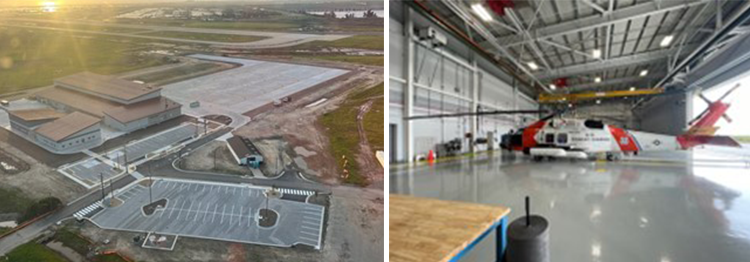
Air Station Ventura features a $70 million state-of-the-art 43,000-square-foot hangar and a 12,000-square-foot administration and berthing facility. At full capacity it will house three MH-60T Jayhawk helicopters and approximately 100 personnel, significantly enhancing the Coast Guard’s capabilities in the region.

The new Coast Guard Air Station Ventura and its MH-60T hangar is located at Naval Base Ventura County in Point Mugu, California. U.S. Coast Guard photos.


For more information: MH-60T Acquisition/Sustainment Program page.

“Coast Guard Cutter Kimball returns home following Bering Sea deployment” –CG News

U.S. Coast Guard Cutter Kimball (WMSL 756) conducts a passing exercise with the Royal Canadian Navy ship HMCS Regina while Kimball patrols the Bering Sea, July 18, 2024. During Kimball’s 122-day patrol, the crew also interacted with strategic partners in Victoria, Canada, strengthening relationships by focusing on shared interests in the Bering Sea and the expanding Artic region. U.S. Coast Guard photo by Ensign James Bongard.

Below is a Coast Guard News release. It wasn’t like the ALPATs I remember. For one thing it was four months long. There was the interaction with the Canadian Navy, shadowing Chinese warships, engagement and community outreach during a port visit in Nome, but this caught my attention.

Kimball’s crew was instrumental in conducting a proof of concept fueling at sea with the Coast Guard Cutter Bailey Barco (WPC-1122), a fast response cutter (FRC) homeported in Ketchikan, Alaska. This successful evolution extended the endurance of the Bailey Barco and resulted in Bailey Barco’s crew conducting over 10 vessel boardings in Bristol Bay, Alaska, an area not routinely accessed by FRCs due to logistical constraints.

Pacific Area has been pushing the envelope on employing the Fast Response Cutters, doing things never expected. A second set of eyes on patrol.


Aug. 7, 2024

Coast Guard Cutter Kimball returns home following Bering Sea deployment

HONOLULU — The crew of the Coast Guard Cutter Kimball (WMSL 756) returned to their home port at Base Honolulu, Thursday, after completing a 122-day patrol in the Northern Pacific, Bering Sea, and American Arctic.

Kimball’s crew patrolled in support of Operation Alaskan Groundfish Enforcer, Alaskan Sentinel and Bering Shield, promoting maritime governance by enforcing domestic fishery regulations while countering illicit maritime activity from foreign fleets along the maritime boundary line.

Kimball’s crew detected four Chinese surface combatants operating in vicinity of the Amchitka and Amukta Passage within the U.S. exclusive economic zone in early July. Under Operation Frontier Sentinel, Kimball monitored the Chinese vessels, meeting presence with presence to ensure there were no disruptions to U.S. interests in the maritime environment around Alaska.

Kimball’s crew interacted with strategic partners in Victoria, Canada, strengthening relationships by focusing on shared interests in the Bering Sea and the expanding Artic region. Kimball’s command cadre met with senior leadership from the Royal Canadian Navy at the Canadian Maritime Forces Pacific and Joint Task Force Pacific headquarters, participating in geopolitical analysis briefs and roundtable discussions on enhancing joint maritime domain awareness in the Arctic. The visit included tours of the HMCS Ottawa, HMCS Corner Brook and culminated later in the patrol with a passing exercise with HMCS Regina, promoting interoperability with the Royal Canadian Navy and simultaneously advancing the Tri-Service Maritime Strategy through U.S. sea-service engagements.

Showcasing law enforcement expertise, Kimball’s crew ensured fishing vessels in the Bering Sea were within compliance of all federal fishery conservation laws and safety requirements through the completion of twenty living marine resources boardings. Kimball’s boarding team identified one vessel operating in violation of U.S. fisheries regulations, resulting in a $4,500 violation from National Oceanic and Atmospheric Administration’s (NOAA) office of law enforcement.

Kimball’s crew protected U.S. economic interests monitoring foreign fishing vessels along the maritime boundary line, preventing U.S. economic exclusion zone incursions. Kimball’s law enforcement teams conducted a joint boarding with Customs and Border Protection and NOAA of a foreign flagged reefer vessel to inspect fish bait being imported into the United States strengthening federal partnerships in the region.

While operating in the Bering Sea, the crew demonstrated the multi-mission agility of the national security cutter’s advanced command-and-control capabilities by coordinating Alaskan based Coast Guard air and surface assets, forming dynamic force packages that dramatically enhanced the nation’s offshore search and rescue (SAR) abilities. Kimball operated with a forward deployed MH-60 Jayhawk helicopter and aircrew in Cold Bay, Alaska, and the District Seventeen command center to execute complex SAR exercises for improving, coordination, response times, and range of rotary Coast Guard assets to assist mariners in distress.

Additionally, Kimball’s crew was instrumental in conducting a proof of concept fueling at sea with the Coast Guard Cutter Bailey Barco (WPC-1122), a fast response cutter (FRC) homeported in Ketchikan, Alaska. This successful evolution extended the endurance of the Bailey Barco and resulted in Bailey Barco’s crew conducting over 10 vessel boardings in Bristol Bay, Alaska, an area not routinely accessed by FRCs due to logistical constraints.

During port visits in Alaska, Kimball’s crew engaged with local communities. In Nome, crewmembers engaged with the tribal leadership and conducted two community outreach events, including public training and engagements for “Kids Don’t Float,” a statewide initiative to prevent youth drowning incidents. Kimball crewmembers demonstrated the importance of proper life jacket use and cold immersion survival. While in Dutch Harbor, crewmembers volunteered for community events including staging tents and site facilities for summer cultural camps.

“This crew excelled at operating in one of the harshest maritime environments, rising to the challenge of meeting presence with presence when encountering strategic competitors, ensuring the safety and security of U.S. fishermen, engaging with local communities, and providing overarching SAR coverage throughout the Bering Sea” said Capt. Robert Kinsey, Kimball’s commanding officer. “The Coast Guard is a key domestic and international Arctic security leader, shaping the region to promote rule of law and prevent foreign malign influence. I couldn’t be more proud of the crew’s professionalism, dedication, and ability to work together with our partners, foreign and federal, to deliver mission excellence for the American people.”

Commissioned in 2019, Kimball is one of ten commissioned Coast Guard legend-class national security cutters and one of two homeported in Honolulu. National security cutters are 418-feet long, 54-feet wide, and have a 4,600 long-ton displacement. They have a top speed more than 28 knots, a range of 12,000 nautical miles, and can hold a crew of up to 170. National security cutters routinely conduct operations throughout the Pacific and Atlantic, where their combination of range, speed, and ability to operate in extreme weather provides the mission flexibility necessary to conduct vital strategic missions.

The namesake of U.S. Coast Guard Cutter Kimball is Sumner Increase Kimball, who was organizer of the United States Life-Saving Service and the General Superintendent of the Life-Saving Service from 1878–1915. The ship’s motto is “Wield the Paddles Together: Work Together.”