“Hawaii-based ‘Indo-Pacific Support Cutter,’ focused on Oceania, is on its first Pacific deployment”- Stars and Stripes

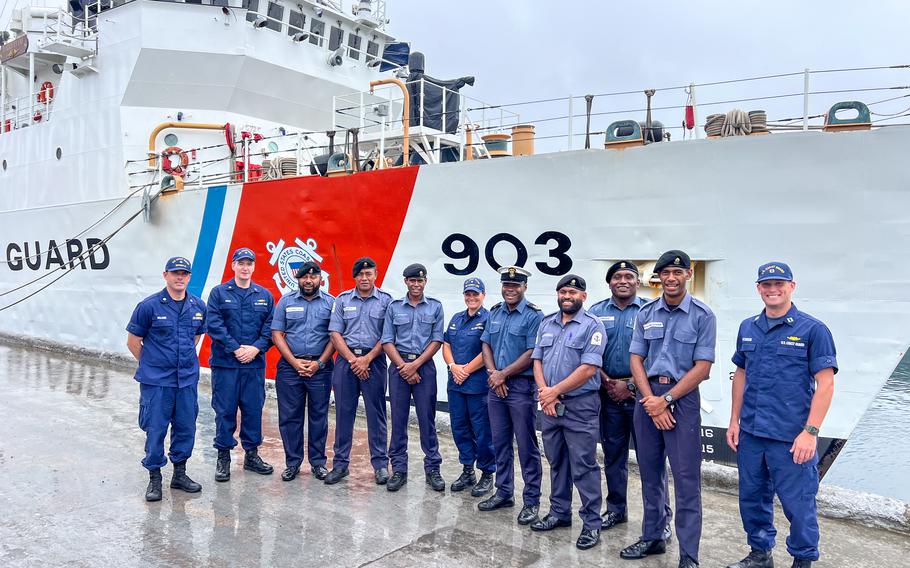
U.S. Coast Guard and Fiji Navy personnel stand in front of the U.S. Coast Guard Cutter Harriet Lane while moored in Suva, Fiji, Feb. 19, 2024. (Charly Tautfest/U.S. Coast Guard)

Stars and Stripes has a nice long article about USCGC Harriet Lane’s first Pacific deployment.

It also suggests we may have been pushing the Guam and Hawaii based Fast Response Cutters (FRS) beyond their limits for long term operation.

“But the small vessels are also limited in both how far and how long they can operate. While they can island hop, they struggle with sustained operations on the high seas, and a high operation tempo has strained the vessels. Some are in need of serious maintenance soon.” (emphasis applied–Chuck)

There is also no mention of the fact that frequently a buoy tender that is larger than Harriet Lane accompanies the FRCs on these expeditionary patrols.

While the article talks about getting new medium sized ships in the Pacific. “…Lane is a “stop gap“ until the service can send a newer, better medium-size ship to the Pacific,” the new Offshore Patrol Cutters (OPC) (more than twice as large as Harriet Lane) will not directly replace the 40 year old cutter in Hawaii. The OPCs are to be based in Long Beach and Kodiak. so rather, it will be that the OPCs relieve the two Hawaii based National Security Cutter of any need to do Alaska Patrols and frees them to do patrols in the Western Pacific.

(Forgive me for being nit picking, but the “Over the Horizon boats” are not “inflatable” even if we do call them RHIBs. For the uninitiated “inflatable” conjures up an entirely different picture.)

“U.S. Coast Guard Cutter Polar Star completes Operation Deep Freeze 2024 mission, departs Antarctica” –News Release

Below is a Pacific Area news release. I followed the link in the editor’s note and there are some great photos and interesting stories, including the fact that while in McMurdo Sound, divers went under the ice to repair a leaking shaft seal.  

ANTARCTICA, 02.03.2024,Photo by Petty Officer 2nd Class Ryan Graves
U.S. Coast Guard Lt. Cmdr. Don Rudnickas, the Coast Guard Cutter Polar Star (WAGB 10) operations officer, salutes Cmdr. Jayna McCarron, Polar Star’s executive officer, prior to a medal ceremony for Polar Star’s crew on the Ross Ice Shelf, Antarctica, Feb. 3, 2024. The U.S. military’s support of U.S. Antarctic research began in 1955. U.S. Indo-Pacific Command continues to lead the Joint Task Force-Support Forces Antarctica team in providing logistic support for the United States Antarctic Program. (U.S. Coast Guard photo by Petty Officer 2nd Class Ryan Graves)

Feb. 23, 2024

U.S. Coast Guard Cutter Polar Star completes Operation Deep Freeze 2024 mission, departs Antarctica

Editor’s Note: For more imagery of Operation Deep Freeze, click here. 

SOUTHERN OCEAN — The U.S. Coast Guard Cutter Polar Star (WAGB 10) and crew departed McMurdo Station, Antarctica, Feb. 12, after operating for 51 days below the Antarctic Circle in support of Operation Deep Freeze 2024.

The Polar Star and crew broke a 38-mile channel through fast ice to create a navigable route for vessels to reach McMurdo Station and escorted a cargo vessel and oil tanker through the ice to and from the station.

“This year, the fast ice in McMurdo Sound was exceptionally thick due to the winds and temperature at the end of last season” said Lt. Cmdr. Don Rudnickas, operations officer. “It challenged our ship and our crew in almost every way, but we met those challenges to achieve our ultimate concern – the resupply of McMurdo Station by sea.”

Before departing the Antarctic Region, the cutter also visited the Bay of Whales, where members from all three of the Coast Guard Regional Dive Lockers dove 90 miles south of the previously documented record for southernmost scuba dive. The crew also went ashore adjacent to the Ross Ice Shelf in the Bay of Whales where they conducted their Antarctica Service Medal ceremony and were able to walk up to the ice shelf.

“Operation Deep Freeze demands more than just breaking ice; it requires navigating the complexities of keeping a 48-year-old cutter operational while subjecting her to the most extreme conditions possible,” said Capt. Keith Ropella, commanding officer. “We rely on the crew’s technical expertise, teamwork, and their commitment to overcoming the relentless obstacles posed by time and nature. It’s also the collaboration of a Joint Task Force, comprised of servicemembers from the U.S. Air Force, Army, and Navy, that play a crucial role in mission success.”

Operation Deep Freeze is the annual logistical support mission provided by the Department of Defense to the National Science Foundation (NSF) managed by the U.S. Antarctic Program (USAP). This includes coordination of strategic inter-theater airlift, tactical intra-theater airlift and airdrop, aeromedical evacuation support, search and rescue response, sealift, seaport access, bulk fuel supply, port cargo handling, and transportation requirements supporting the NSF. This is a unique mission demonstrating U.S. commitment to the Antarctic Treaty and to research programs conducted for the betterment of all humanity. The Polar Star and crew contribute to this yearly effort through icebreaking to clear the channel for supply vessels.

The Polar Star is the United States’ only asset capable of providing access to both Polar Regions. It is a 399-foot heavy polar icebreaker commissioned in 1976, weighing 13,500 tons and is 84-feet wide with a 34-foot draft. The six diesel and three gas turbine engines produce up to 75,000 horsepower.

“Pacific Security Depends on Funding the New COFA Agreements with 3 Pacific Island Nations” –Japan Forward

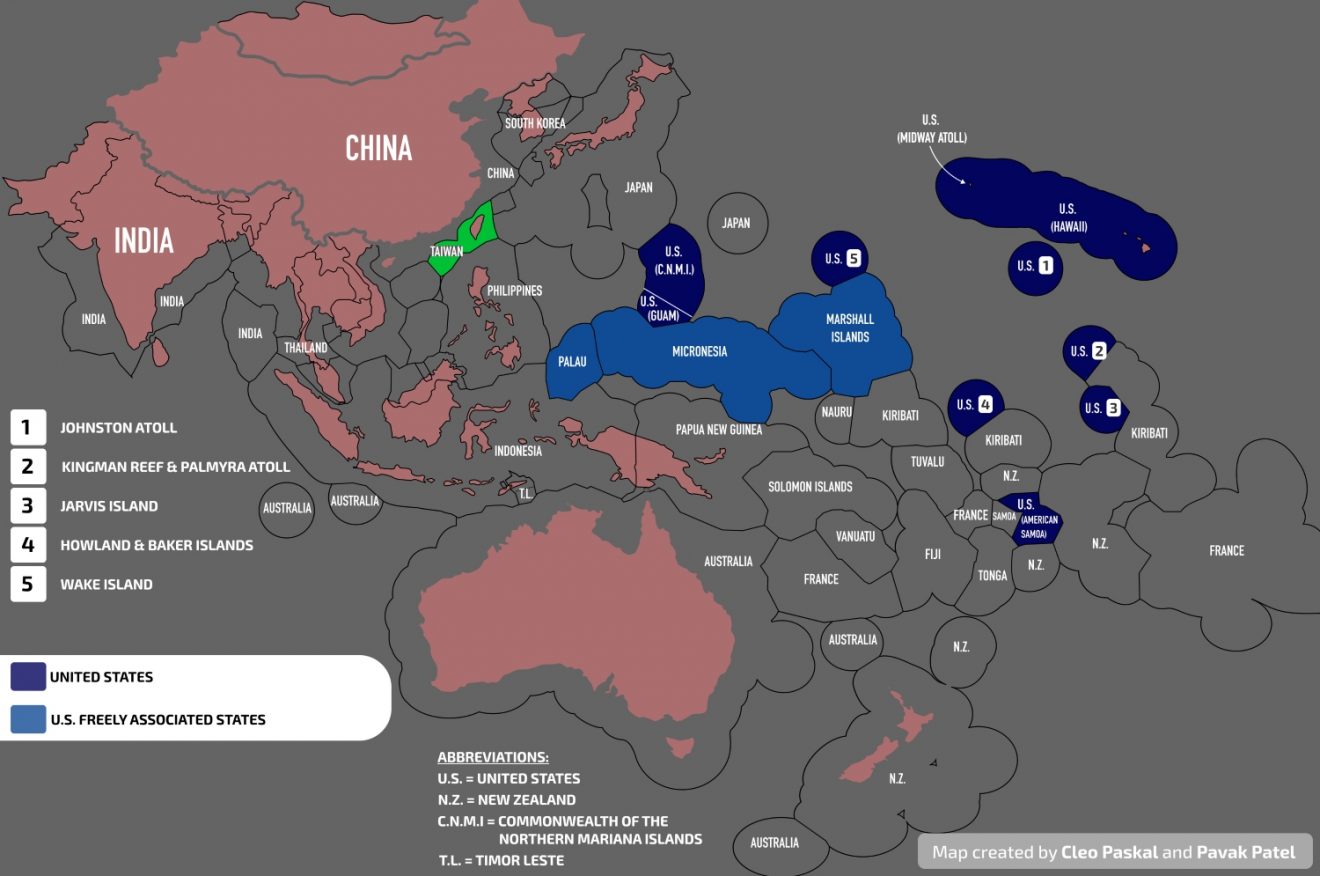
Map of EEZs in the Central Pacific showing significance of Palau, Micronesia and the Marshall Islands. (© Cleo Pascal.)

Japan Forward reports,

American control of the Central Pacific depends on three treaties with three nations: Palau, the Federated States of Micronesia, and the Republic of Marshall Islands. They are known as Compacts of Free Association (COFA). These nations and their huge maritime territory comprise most of an “east-west corridor” from Hawaii to the western edge of the Pacific. That corridor is essential for American control and military operations in the region.

And it looks like we may be blowing it due to lack of attention and a penny-wise pound-foolish legislature.

Please read the linked article above and do what you can to convey a sense of urgency in approving these treaties.

I don’t think these three small Pacific Island nations want to depend on China but if we lose our current close relationship, we may never get it back.

Related:

Thanks to Lee for bringing this to my attention.

“China Protests as U.S. Carrier Goes on Patrol With Philippine Navy” –Maritime Executive

BRP Ramon Alcaraz (former USCGC Dallas) equipped with new Sea Giraffe multi-mode radar in Cebu.

Maritime Executive reports,

“This week, the Carl Vinson Carrier Strike Group will carry out a two-day joint patrol with Philippine forces…The carrier USS Carl Vinson leads the exercise, accompanied by cruiser USS Princeton and destroyers USS Sterett and USS Kidd. The Philippine contributions include the former U.S. Coast Guard cutters USCGC Hamilton and USCGC Dallas, which were transferred to the Philippine Navy and renamed.

USS Dewey (DDG-105), bottom, steams in formation with the Philippine Navy offshore patrol vessel BRP Gregorio del Pilar (PS 15, the former USCGC Hamilton) while conducting a bilateral sail in the South China Sea, Oct. 21, 2023. US Navy Photo

The following information is from Wikipedia, concerning their ongoing modernization.

The Philippine Navy plans to modernize the entire ship of the class, with an initial program to upgrade the ship’s sensors, and another program to improve its weapon systems.

Several systems were acquired through US Foreign Military Sales (FMS) and Foreign Military Financing (FMF), which includes the BAE Systems Mk. 38 Mod. 2 machine gun system, the SAAB AN/SPS-77 Sea Giraffe AMB 3D air/surface search radar, and the FLIR Systems SeaFLIR 230 Electro-Optical/Infra-Red Camera.[20]

Meanwhile, the Philippine Navy will launch a program to acquire, install and integrate several other sensors into the ship, as part of the Horizon 2 phase of the Revised AFP Modernization Program. Among those to be acquired are new Combat Management System (CMS), Hull Mounted Sonar (HMS), and a Radar Electronic Support Measures (R-ESM).

Future upgrades are planned to install defensive and offensive missile systems, as well as torpedo weapon system, although funding is still being secured and might only be included in the next phase of the Navy’s modernization program.

In 2020 October 14, Navy chief Giovanni Carlo Bacordo revealed the completion of the 3D modeling program for the entire ship class’ cabling systems to be used for their electronic upgrades (CMS + 4 sensors).

“Indian Navy Commandos Retake Ship In Arabian Sea” gCaptain/Reuters

The Indian Navy approaches the M/V Lila Norfolk in the Indian Ocean, January 5, 2024. Photo courtesy Indian Navy

gCaptain reports,

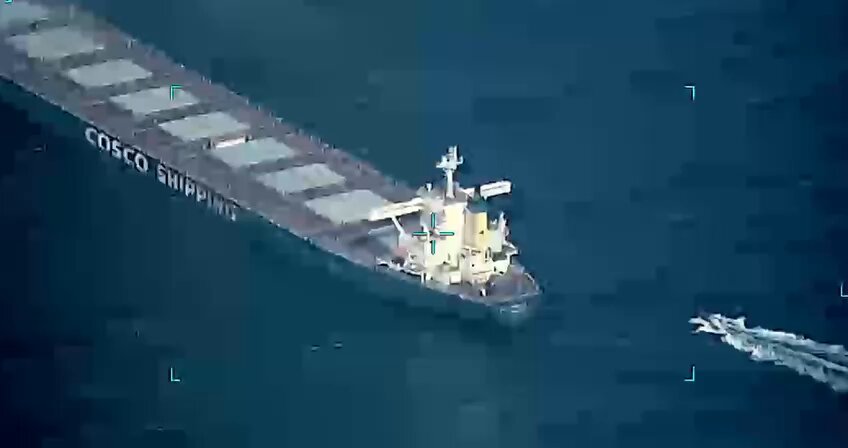
“An Indian Navy warship intercepted the MV Lila Norfolk on Friday afternoon, less than a day after the navy received news that it had been hijacked off Somalia’s coast in the North Arabian Sea.”

The crew of 21 had taken shelter in a citadel. By the time the Indian Navy destroyer, INS Chennai, had arrived, the pirates had fled.

The MV Lila Norfolk “was kept under continuous surveillance using MPA (Maritime Patrol Aircraft–Chuck), Predator MQ9B & integral helos.

Notably, the Indian Navy is one of several users of the MQ-9B Sea Guardian Medium Altitude Long Endurance UAS including the Japan Coast Guard, the UK, Taiwan, and Greece. The US Coast Guard after years of observation of Customs and Border Protection’s use of earlier model MQ-9 Predators, the USCG has yet to procure or even experiment with a shore based long endurance UAS.

“Australian Border Force crackdown nets 30 foreign fishers, destroys three boats off Kimberley coast” –ABC.net.AU

Map showing the Kimberley Marine Park. The shaded area is a National Park Zone (‘no take’ zone).

ABC.net.au reports the Australian Border Force has seized 30 Indonesian fishers and destroyed three boats in a crackdown against illegal fishing in the 74,469 km2 (28,753 sq mi) Kimberley Marine Park, established in 2018, off Northwestern Australia. The combined catch of the three fishing vessels was over a ton of trepang (sea cucumber).

Australian sea cucumber sells for about $350 (presumably Australian $) per kilogram.(ABC Midwest & Wheatbelt: Chris Lewis)

In addition to the loss of marine catch, there is fear that the fishermen, who frequently come ashore, may bring with them livestock diseases common in Indonesia but not present in Australia.

An illegal fishing vessel is destroyed at sea.(Supplied: Australian Border Force)

Australia has been seeing a resurgence of illegal fishing in their EEZ including Marine Parks, and there have been calls for more vigorous enforcement.

“Head of Royal Canadian Navy Outlines Ottawa’s Pacific Strategy” –USNI

This is starting to get a little old, but I am trying to catch up.

US Naval Institute reports on a Center for Strategic and International Studies (CSIS) interview with Vice Adm. Angus Topshee, Commander, Royal Canadian Navy, Chief of the Naval Staff, that discusses their Navy’s increased emphasis on the Pacific.

I have included the video of the interview above.

Three AOPSs at pier before the commissioning ceremony for HMCS Margaret Brooke (AOPV-431). Canadian Navy photo

He discusses operating with the Coast Guard for drug interdiction, icebreaking, and fisheries beginning about time 9:00. The new Arctic Offshore Patrol Ships are expected to play important roles in these activities.

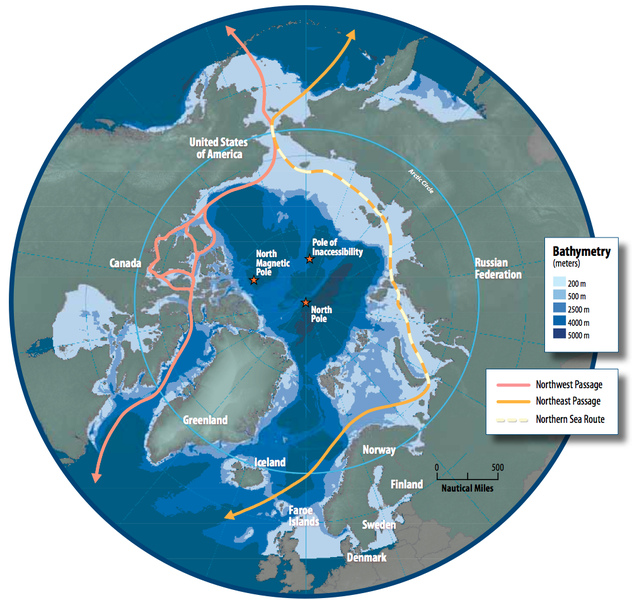
Map of the Arctic region showing shipping routes Northeast Passage, Northern Sea Route, and Northwest Passage, and bathymetry, Arctic Council, by Susie Harder

He explains why he does not see the NW Passage (which includes Alaskan waters) as a future international trade route (12:30).

He anticipates an end to the moratorium on fishing in the Arctic (14:30).

Discusses response to “Gray Zone” threats to undersea infrastructure (15:30).

Discussed war in Ukraine (19:00). Re sinking of Moskva, “Cruise missiles should not sink ships” (20:30). Drones (21:00). AI (24:50).

Where will they concentrate their efforts–Indo-Pacific (27:00). AOPS will be used for Fisheries in the Western Pacific.

Artic is an expeditionary theater, you have to bring everything with you, because there are no port facilities (29:00). Looking to create dual use facilities.

Recruiting (31:30). National Shipbuilding program (35:30), Technology sharing.

“U.S. Coast Guard Cutter Harriet Lane arrives at new homeport in Pearl Harbor” –News Release

USCGC Harriet Lane arrives Pearl Harbor. USCG Photo.

Below is a news release from CG News (more photos there). As part of the prototype SLEP, her 76mm Mk75 gun and Mk92 fire control system have been removed. The AN/SLQ-32 has been retained. It appears there are now additional communications antenna in place of the fire control system, and a 25mm Mk38 gun weapon system is mounted on a bandstand in place of the 76mm.


Dec. 13, 2023

U.S. Coast Guard Cutter Harriet Lane arrives at new homeport in Pearl Harbor

HONOLULU – U.S. Coast Guard Cutter Harriet Lane (WMEC 903) and crew arrived at its new homeport at Joint Base Pearl Harbor-Hickam, Wednesday, after transiting more than 8,000 nautical miles over 36-days from Portsmouth, Virginia.

The Harriet Lane is U.S. Coast Guard Pacific Area’s newest Indo-Pacific support cutter and spent more than 15 months in a Service Life Extension Program (SLEP) in Baltimore, Maryland, to prepare for the transition in missions and operations. Following reconstitution of the crew in July and returning to Portsmouth in August, the crew went through an extensive dockside period, ensuring the cutter was ready for the transit from the Atlantic Ocean to the Pacific Ocean.

“Re-homeporting U.S. Coast Guard Cutter Harriet Lane is indicative of the Coast Guard’s commitment to the Indo-Pacific – the most dynamic region in the world,” said Rear Admiral Brendan McPherson, deputy commander, U.S. Coast Guard Pacific Area. “Harriet Lane will work by, with, and through allies and partners within the Indo-Pacific region to promote capacity building and model good maritime governance.”

“The crew and I look forward to building partnerships in Oceania to enhance our capabilities, strengthen maritime governance and security while promoting individual sovereignty,” said Cmdr. Nicole Tesoniero, commanding officer of the Harriet Lane. “We plan to build upon many decades of enduring support, operating in concert with the needs of our partners.”

Harriet Lane and crew departed Coast Guard Base Portsmouth, November 2023, and during the transit, the crew conducted trainings for upcoming operations along with professional development for crewmembers. Harriet Lane transited through the Panama Canal, and had port calls in Golfito, Costa Rica and San Diego.

Harriet Lane, commissioned in 1984, is a 270-foot medium endurance cutter now homeported in Honolulu to support Coast Guard missions in the Pacific region. The service’s medium endurance cutter fleet supports a variety of Coast Guard missions including search and rescue, law enforcement, maritime defense, and protection of the marine environment.

“US Coast Guard Seeks Bigger Role to Search, Board Vessels in Pacific” –gCaptain

PERU, 10.07.2023, Courtesy Photo, USCG District 11
A Coast Guard boarding team member catches a view looking aft across the deck of a squid jigger vessel during a boarding inspection, with Coast Guard Cutter Alder in the background, during Operation Southern Shield 2023, October 2023. The Coast Guard recently completed the first high-seas boardings and inspections off the coast of Peru under a newly adopted multi-lateral agreement to monitor fishing and transshipment operations within the South Pacific Regional Fisheries Management Organization (SPRFMO) Convention Area. (U.S. Coast Guard photo)

gCaptain gives us a sort of status report on the Coast Guard’s emerging role in Western Pacific international fisheries enforcement.

“The Philippines opens a new monitoring base on a remote island in the disputed South China Sea” –AP

Thitu Island, where the Philippine Coast Guard recently opened a monitoring station. AP photo/Aaron Favila

AP reports,

“THITU ISLAND, South China Sea (AP) — The Philippines inaugurated a new coast guard monitoring base Friday on an island occupied by Filipino forces in the disputed South China Sea and plans to expand joint patrols with the United States and Australia to counter China’s “pure bullying” in the strategic waterway, a Philippine security official said.”

The AP story includes 17 additional photos.

Thitu is the second largest of the naturally occurring island in Spratly Islands and has a civilian population of about 200.

Spratly Islands military settlements. Source: Cartothèque Spiridon Manoliu, via Wikipedia.

Thitu lies about 500 kilometers (310 mi) west of Puerto Princesa on the larger Island of Palawan so it is outside the larger contiguous Philippine EEZ.

Ownership of the Spratly Islands is disputed, not only between the Philippines and China, but also by Taiwan, Vietnam, Malasia, and Brunei.

Thanks to David S. for bringing this to my attention.