“Russian and Chinese naval exercises: Reading between the lines” –The Watch

A Coast Guard Cutter Kimball crewmember observing a Russian Destroyer in the Bering Sea, September 19, 2022. Coast Guard Photo

The Watch provides an opinion piece by ADAM LAJEUNESSE, PHD, an associate professor in the public policy and governance program, at St. Francis Xavier University in Canada.

He discusses why the Russians and Chinese decided to extend their exercise into waters near Alaska, and what the US response should be to such demonstrations.

Managing the response is therefore a balancing act. These activities cannot be ignored or even downplayed, but emphasis should be put on short-circuiting adversary messaging. Beijing is anxious to paint U.S. FONOPs as shams. While the U.S. government has been disciplined in its messaging as it was during a similar voyage in 2021, more emphasis should be placed on the PRC’s right to be there. Though it may seem counterintuitive, there is a benefit to overtly recognizing Chinese ships’ right to be in the region. While that may be politically tricky, it should be possible to warn of the dangers posed by the PRC’s navy generally, while also emphasizing its right to be anywhere on the high seas.

Russia’s attempt to portray itself as a great power equal, capable of threatening the U.S. homeland can, likewise, be turned back upon itself. The reality is that Moscow’s weakness has forced it to increasingly rely on the PRC for economic and political support. Its naval partnership should be addressed more explicitly for what it is, the gradual replacing of Russian power in the North Pacific and, potentially, the Arctic by the PRC.

His evaluation is a perfect explanation of why having such exercises monitored by Coast Guard cutters, as had been done in 2021 and 2022, was a perfect response. (In fact, Chinese warships transited US territorial waters in 2015.)

Why the change in 2023?

To some extent at least, I think the Navy response, specifically sending DDGs to shadow the group, was because they were stung by unfair criticism, that we looked weak because there had been no obvious US Navy presence previously.

If NORTHCOM wanted to take out the Chinese/Russian surface action group (SAG), air assets could have done the job. That the US Navy SAG never exceeded four units, if anything does make us look weak.

Perhaps a USAF B-1 fly-over on a day when no live fire exercises were scheduled might have been an appropriate response. (B-1s with LRASM are a particularly deadly anti-ship combination.)

If there had been hostilities, putting a numerically inferior US Navy SAG close to a potentially hostile SAG, might have just resulted in a friendly fire incident, if the Air Force confused US units with Chinese or Russian units.

Also, we should never miss an opportunity to remind the Russians, they have reason to fear China more than the US. The Russian ships in the SAG were all either older or smaller than their Chinese counterparts, and I am sure the Chinese made it abundantly clear to the Russians, that they had outgrown any Russian tutoring.

“U.S. Coast Guard Cutter Kimball returns home following 85-day Bering Sea patrol” –CG News

Below is a news release from Coast Guard News. Looks like Kimball had an unusual Alaska Patrol, responding to the wildfire on Maui, to terminating an unsafe voyage, to shadowing a Russian naval exercise.


 Nov. 2, 2023

U.S. Coast Guard Cutter Kimball returns home following 85-day Bering Sea patrol

HONOLULU — The U.S. Coast Guard Cutter Kimball (WMSL 756) returned home to Honolulu, Wednesday, after an 85-day multi-mission patrol covering 14,000 nautical miles spanning from the Hawaiian Islands to north of the Arctic Circle.

The crew provided search-and-rescue coverage and conducted living marine resources (LMR) and counter Illegal Unreported and Unregulated (IUU) Fishing operations during the patrol following their actions responding to the Maui wildfires.

Kimball departed August 8 for the Aleutian Island chain and later that evening, the cutter received a report of people in the water attempting to escape a raging wildfire on Maui. The cutter shifted to the tactical control of Sector Honolulu and altered course to support the mass search and rescue efforts. Arriving on scene within hours, Kimball assumed the role of On Scene Commander of Coast Guard Station Maui, Coast Guard Cutter Joseph Gerczak (WPC 1126), and Air Station Barbers Point MH-65s, who collectively searched 790 square nautical miles, saved 17 lives, and assisted approximately 40 survivors ashore. During Kimball’s three days on scene, their crew launched two cutter small boats for over 25 combined hours and deployed the cutter’s UAS drone for over 8 hours of flight time, conducting search and rescue and damage assessment support.

After being relieved by Juniper, Kimball’s crew transited north to support the Coast Guard’s 17th District by providing search-and-rescue coverage and conducting LMR and counter IUU-Fishing patrols spanning the Northern Pacific Ocean, Bering Sea, and the American Arctic.

Operating under Operation Alaskan Groundfish Enforcer, Kimball ensured compliance with all federal fisheries conservation laws and safety requirements by completing 10 LMR boardings on fishing vessels in the Bering Sea. Kimball issued eight citations and one termination for gross violation of U.S. and international regulations. This resulted in the Kimball escorting the fishing vessel back to the nearest port and ensured they corrected their discrepancies.

As the sole U.S. military asset in the Bering Sea, Kimball diverted to provide presence alongside the U.S. domestic fishing fleet in the remote region of the U.S. Arctic upon receiving intelligence of a Russian military exercise within the U.S. Exclusive Economic Zone (EEZ). Kimball’s presence ensured the safety of 23 mariners while they worked within the U.S. EEZ near Russian warships as part of Operation Frontier Sentinel.

“I couldn’t be prouder of Kimball’s crew,” said Capt. Bob Kinsey, Kimball’s commanding officer. “They were able to showcase the true value that the national security cutter brings to such a dynamic area of responsibility. The crew’s diversity of skill harnessed our Coast Guard authorities and capabilities to provide tangible lifesaving results, from responding to the tragic fires in Maui to providing an influential presence in the Chukchi Sea and American Arctic to preserving the livelihoods of our Bering Sea fishermen through the enforcement of federal safety and living marine resources laws.”

To ensure crew preparation and proficiency, Kimball conducted numerous flight operations with MH-65 Dolphin and HH-60 Jayhawk helicopters and aircrews from U.S. Coast Guard Air Station Kodiak, resulting in the qualification of eight pilots and recertification of Kimball’s crew.

While in Dutch Harbor, Alaska, Kimball’s crew engaged with the local community by participating in sports at the community center, conducted cutter tours, and volunteered for community events. Notably, Kimball assisted the Museum of the Aleutians in relocating fragile gray whale fossils for a new exhibit. Kimball also met with the mayor of Dutch Harbor to discuss how the Coast Guard and the town can continue strengthening their relationship.

Commissioned in 2019, Kimball is the Coast Guard’s seventh national security cutter. National security cutters are the largest and most technologically sophisticated cutters in the Coast Guard’s white-hull fleet. National security cutters can operate in the most demanding open ocean environments, including the Bering Sea’s hazardous fisheries and the Southern Pacific’s vast approaches, where much of the American narcotics trafficking occurs. With robust command, control, communication, computers, intelligence, surveillance and reconnaissance equipment, stern boat launch and aviation facilities, as well as long-endurance station keeping, National security cutters are an afloat operational-level headquarters for complex law enforcement and national security missions involving multiple Coast Guard and partner agency participation.

-USCG-

“US Coast Guard cutter provides presence during Russian military exercise in Bering Sea ” –D17

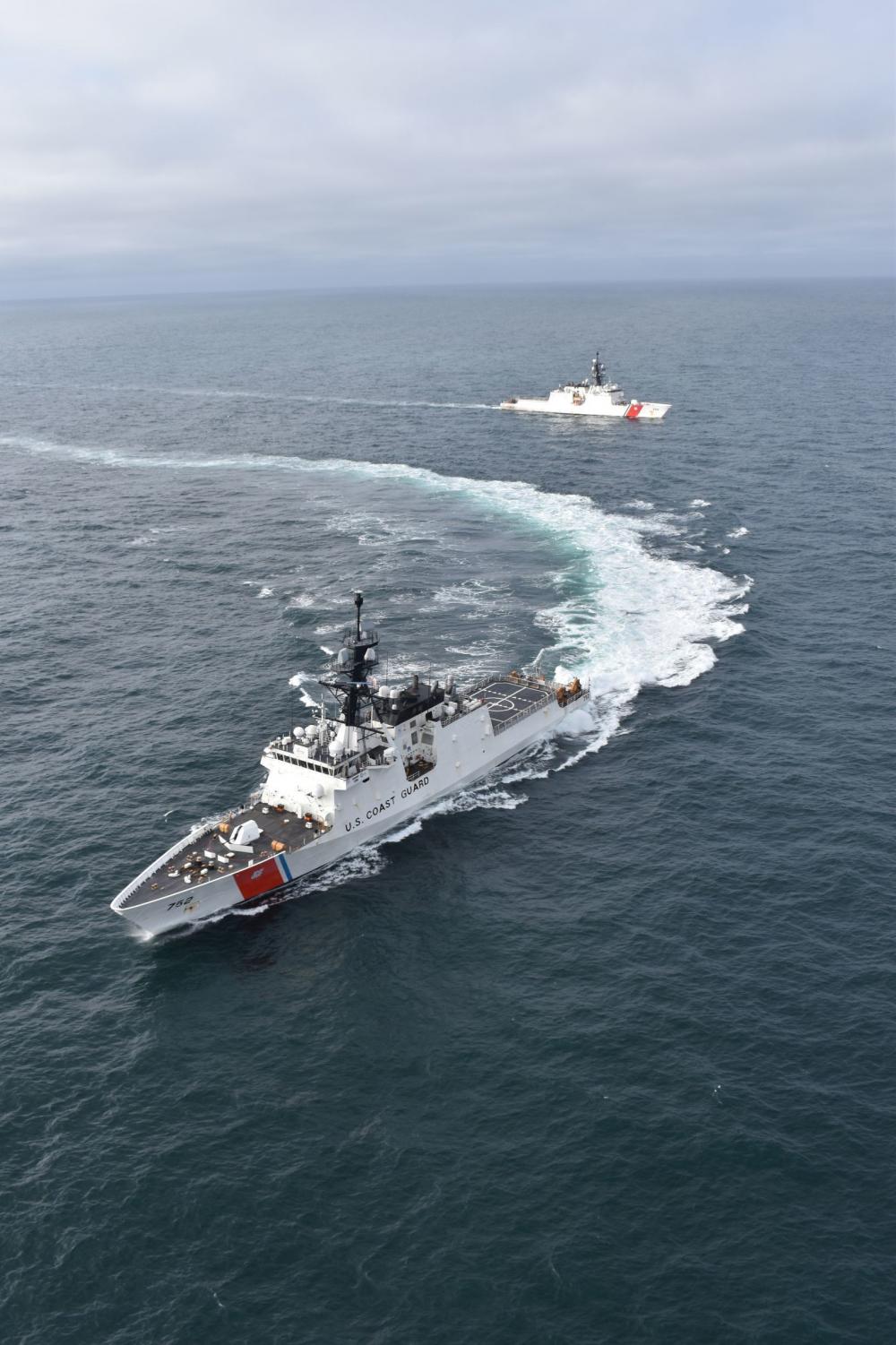
U.S. Coast Guard Cutters Stratton (WMSL 752) and Kimball (WMSL 756) steam in formation while patrolling the U.S.-Russian Maritime Boundary Line (MBL), in the Bering Sea, Sept. 26, 2022. This marked the first time two national security cutters jointly patrolled the MBL above the Arctic Circle. (U.S. Coast Guard courtesy photo).

Below is a District 17 (Alaska) News Release

Sept. 18, 2023

US Coast Guard cutter provides presence during Russian military exercise in Bering Sea

D17 Public Affairs

JUNEAU, Alaska – The crew of Coast Guard Cutter Kimball (WMSL 756), in coordination with U.S. Northern Command, provided U.S. presence during a Russian military exercise in the Bering Sea, Friday.

The Kimball patrolled in the vicinity of U.S. fishing vessels conducting their work in international waters within the U.S. exclusive economic zone (EEZ) during ongoing Russian military operations, which included the launch of a missile, approximately 300 miles southwest of St. Lawrence Island.

“Though military operations and exercises in international waters are lawful,” said Rear Adm. Megan Dean, Seventeenth Coast Guard District commander, “we will continue to ensure there are no disruptions to U.S. interests or commerce in the maritime environment around Alaska.”

On Sept. 10, an urgent warning of navigational dangers advisory message, known as a HYDROPAC, was released through the National Geospatial Agency regarding Russian military operations in the Bering Sea. The area of the HYDROPAC includes a portion of the U.S. EEZ southwest of St. Lawrence Island along the U.S./Russia Maritime Boundary Line and remains in effect through Sept. 24.

The Coast Guard notified vessels and the commercial fishing industry operating in the vicinity of the HYDROPAC, and made notifications to federal, state and tribal governments about the exercise. The Coast Guard continues to provide notifications throughout the maritime and fishing industry by all available means.

The Kimball, a 418-foot legend-class national security cutter homeported in Honolulu, Hawaii, is currently operating under the Seventeenth District’s Operation Frontier Sentinel.

Operation Frontier Sentinel is a Seventeenth Coast Guard District operation designed to meet presence with presence and ensure there are no disruptions to U.S. interests in the Alaskan maritime environment. The Coast Guard routinely patrols international waters under the service’s statutory authorities to ensure maritime safety and security of the U.S. maritime industry, to protect U.S. sovereign rights and to promote international rules-based order. Coast Guard presence ensures due regard for all lawful uses of the seas.

“Army Long Range Missile Launcher Spotted on Navy Littoral Combat Ship” –USNI

An Army MK 70 missile launcher on the flight deck of Littoral Combat Ship USS Savannah (LCS-28) in San Diego, Calif. Photo obtained by USNI News

The USNI News Service reports,

A portable missile launcher capable of firing a combination of long-range anti-ship and anti-air weapons was spotted this week undergoing testing aboard a Littoral Combat Ship in San Diego, Calif., according to photos provided to USNI News.

Based on a series of photos reviewed by USNI News, the launcher is a Lockheed Martin MK 70 containerized vertical launching system that is capable of firing both a Raytheon Standard Missile 6 and a Tomahawk Land Attack Missile. It was spotted on the flight deck of Independence-class LCS USS Savannah (LCS-28), which was pier-side in San Diego, according to a USNI News review of the images.

If you can operate Army missile launchers from an LCS you can also operate them from a Coast Guard cutter.

This could be particularly useful in Alaska where there are no Navy ships and limited road infrastructure. Launchers could be flown to meet cutters already in Alaskan waters long before Navy ships could reach the area.

“NPS Research on Coast Guard Icebreaker to Enhance Arctic Readiness” –Marine Link

During a seven-week Arctic transit aboard the U.S. Coast Guard icebreaker USCGC Healy (WAGB 20), Dr. Nita Shattuck from the Naval Postgraduate School (NPS) will study the impact of the extreme environment on crew performance and potential mitigations. Additional research includes assessment of an Amos01 3D printer installed by David Dausen from NPS’ Consortium for Advanced Manufacturing Research and Education (CAMRE), and specially instrumented to measure the impact of adverse Arctic sea conditions.

Marine Link reports the Naval Post Graduate School is doing some interesting studies on the working environment experienced by USCGC Healy’s crew.

To study the effects of these conditions on a ship’s crew at sea, Shattuck and her team will collect physiological data from the Healy’s crew members. Using innovative wearable technology, they will continuously monitor physiological processes such as sleep, heart rate, heart rate variability, respiration, oxygen saturation, and skin temperature. Study participants indicate that the rings are an improvement over wrist-worn wearables. The team will also use other sensors to monitor ambient light, noise levels, motion, and vibration aboard the ship.

The report also mentions that Healy will be going to Tromsø, Norway. How they get there will be interesting. Will they go the Northwest Passage through the Canadian EEZ or the Northern Sea Route through Russia’s EEZ?

“USNI News Fleet and Marine Tracker: Aug. 21, 2023”

USCGC Munro (WMSL-755) escorts USNS Fisher (T-AKR-301) in the East China Sea on Aug. 12, 2023. US Navy Photo

Looking at the latest US Naval Institute “Fleet and Marine Tracker,” I am a bit surprised to see there are still 3 Navy ships operating under 4th Fleet, presumably doing drug interdiction. This is an uptick.

Again, they report on atypical Coast Guard operations:

  • Legend-class National Security Cutter USCGC Munro (WMSL-755) departed South Korea last week and is in the Korea Strait. (As I mentioned earlier, there is a possibility, cutters may encounter the new North Korean corvettes.)
  • Coast Guard Cutter USCGC Healy (WAGB-20) continues its work in the Beaufort Sea. Healy is on a five-month deployment in partnership with ONR and the National Science Foundation.
  • Coast Guard Cutter USCGC Forward (WMEC-911) is currently supporting Operation Nanook. Operation Nanook is an annual Canadian-led exercise that fosters international cooperation and shared responsibility in the Arctic and the northern Atlantic Regions. The cutter recently made a port call in Nuuk, Greenland.

You can use Control F “USCGC” if you want to quickly find the Coast Guard cutters mentioned in the USNI posts.

PATFORSWA is mentioned again.

The link in the Healy entry, “U.S., Canadian Icebreakers Conduct Operation, Rendezvous en Route to Arctic Ocean” is interesting, plus there is more in the USNI post including an “adorable” polar bear photo.

“Russia and China Sent Large Naval Patrol Near Alaska” –Wall Street Journal

The Wall Street Journal reports,

“Eleven Russian and Chinese ships steamed close to the Aleutian Islands, according to U.S. officials. The ships, which never entered U.S. territorial waters and have since left, were shadowed by four U.S. destroyers and P-8 Poseidon aircraft.”

The Russians and Chinese have been doing these joint deployments into the Bering Sea for at least a few years, and normally it has been the Coast Guard that followed them. This time the Navy sent a capable force, in addition to P-8 Maritime Patrol Aircraft they sent USS John S. McCain (DDG-56), the USS Benfold (DDG-65), the USS John Finn (DDG-113) and the USS Chung-Hoon (DDG-93).

Previous reports: 

Coast Guard Cutter Kimball encounters Russia and People’s Republic of China military naval presence in Bering Sea” –D17, Sept. 2022

“Chinese Warships Sailing Near Alaska’s Aleutian Islands Shadowed By U.S. Coast Guard” –Small Wars Journal, Sept. 2021

Chinese Navy Operating Off Alaska, Sept. 2015

http://www.state.gov/e/oes/ocns/opa/arc/uschair/258202.htm . This map of the Arctic was created by State Department geographers as part of the U.S. Chairmanship of the Arctic Council.

Why are they there?:

Russia is easy to understand. This is very close to their territory and their Pacific Fleet base in Petropavlovsk, but why the Chinese?

Russia is China’s top crude oil source, and much of that oil comes from Russia’s Arctic. In any conflict China’s energy sources are likely to be a target and the Bering Strait is the choke point on the most direct route from the Russian Arctic to Chia.

I would note that China’s excursions into the Bering Sea all seem to be toward the end of summer, which is about as nice as it gets in the Aleutians.

“First US deep water port for the Arctic to host military, cruise ships” –Navy Times

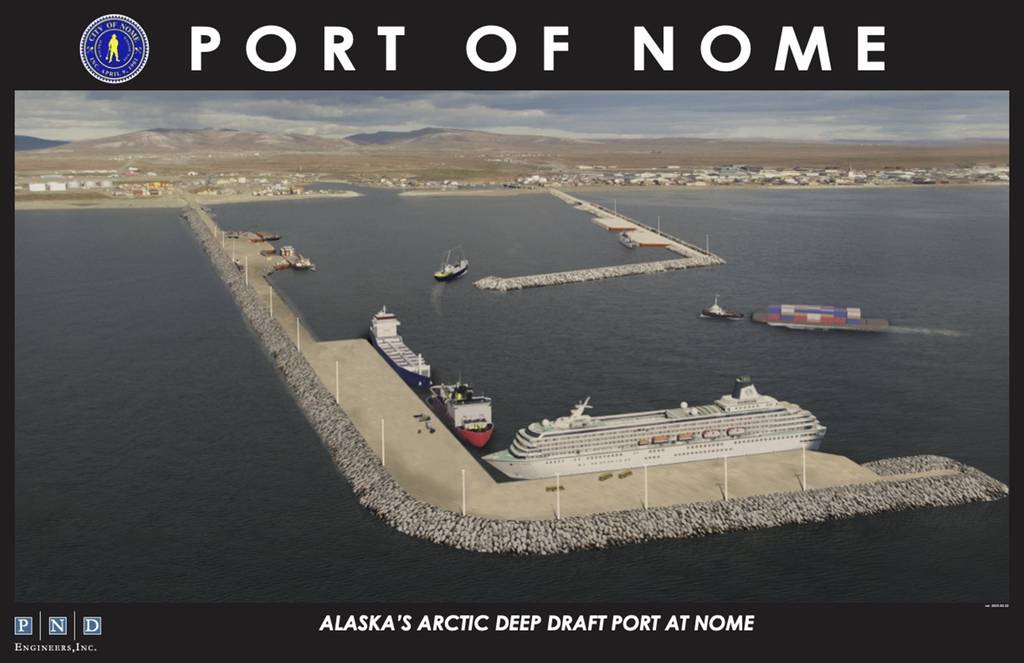
This rendering provided by the City of Nome shows how the Port of Nome, Alaska, will appear following an expansion project that will cost more than $600 million. Shipping lanes that were once clogged with ice for much of the year along Alaska’s western and northern coasts have relented thanks to global warming, and the nation’s first deep water Arctic port should be operational in Nome by the end of the decade. (PND Engineers Inc./City of Nome via AP)

Navy Times reports,

Workers will dredge a new basin 40 feet (12.2 meters) deep, allowing large cruises ships, cargo vessels, and every U.S. military ship except aircraft carriers to dock, Port Director Joy Baker said.

Nome in red. Adapted from Wikipedia’s AK borough maps by en:User:Seth Ilys.

We have been talking about a deepwater port in the area for some time,

Alaska and the Bering Strait

Nome isn’t actually in the Arctic, despite the fact that the US government defines the Arctic to include the Bering Sea. The Arctic Circle runs just a little North of Nome, essentially at the Bering Strait. The Bering Strait connects the Pacific with the Arctic Ocean and is about 44 nautical miles (82 kilometers) wide at its narrowest point. Whoever controls the Bering Strait can regulate traffic between the Pacific and the Arctic Oceans. Having a nearby deepwater port would certainly help, if it were desirable to regulate that traffic. Nome is within 160 nautical miles of the Russian side of the Strait.

Traffic through the Strait has increased and the possibility of a cruise ship disaster in the Arctic is probably a District 17 nightmare, but I think the probability is low that large numbers of CG units will be based at Nome. As noted earlier, I don’t think we will see either large patrol cutters (unless it is the Alex Haley) or FRCs based there but moving one of the Juniper class seagoing buoy tenders there, with its light icebreaking capability might make sense. A medium icebreaker might be a possibility, but that is a very long shot.

As I have noted before, the US Navy’s Pacific Fleet surface ships have not really shown much interest in operating in the Arctic. Their “Arctic” exercises have been in the Gulf of Alaska or little, if at all, North of the Aleutians.

We might see Air Force and Marines in the area in time of War. Airpower and/or shore based anti-ship missiles could control surface traffic through the Strait. Those forces would have to be supplied, which would mean logistics shipping to what we now know will be the deepwater port at Nome. The shipping would presumably require naval protection, air and/or surface.


“Alaska’s top Coast Guard official warns of rising medevac cases as he leaves command” –Anchorage Daily News

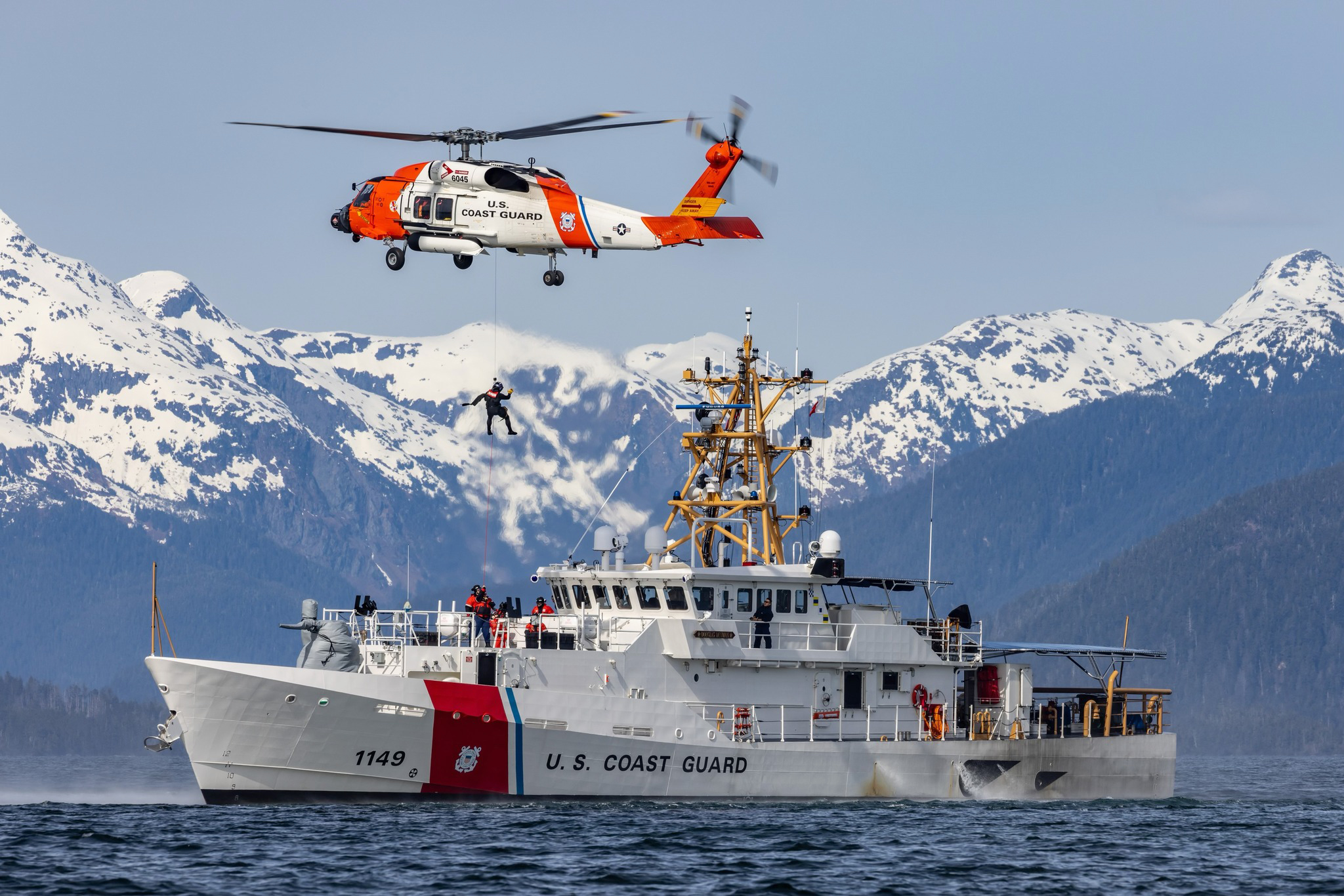
Crews assigned to Coast Guard Air Station Sitka, the Coast Guard cutter Douglas Denman, Sitka Mountain Rescue and the Sitka Fire Department participate in the first day of a weeklong search and rescue exercise in Sitka, Alaska, May 9, 2023.

The Anchorage Daily News reports,

“… as Rear Adm. Megan Dean takes command, Moore said, his service is facing new challenges in the state, and one of the biggest is a growing — and possibly unprecedented — demand for emergency medevac flights.”

It’s a surprisingly detailed report on a change in workload and the reasons behind it.

Thanks to Paul for bringing this to my attention.

New Units for Alaska, the Haley, and Nome

Northeast Russia and Alaska. Photo: Shutterstock

One of our readers sent me an article from the Alaska Beacon about the need for additional housing for the military that includes some insight into the Coast Guard’s future in Alaska.

The information about the Coast Guard is toward the end of the article. This seems to be confirmation that the two FRCs in Ketchikan will be joined by four more, two in Kodiak and one each in Sitka and Seward, and that their additional supporting infrastructure is being provided.

We already knew the third and fourth OPCs, Ingham (917) and Rush (918), will be going to Kodiak.

What About USCGC Alex Haley?:

The crew of the USCGC Alex Haley (WMEC 39) transfers custody of the detained fishing vessel Run Da to a People’s Republic of China Coast Guard patrol vessel in the Sea of Japan, June 21, 2018. The Alex Haley and PRC Coast Guard crews detained the Run Da suspected of illegal high seas drift net fishing. U.S. Coast Guard photo. Petty Officer 1st Class William Colclough

The Alex Haley is currently homeported in Kodiak. When I saw that two OPCs were to be homeported in Kodiak, my first assumption was that they would replace the Haley as well as USCGC Douglas Munro also based there, but perhaps that assumption was unwarranted.

Alex Haley is nominally a medium endurance cutter, but with a 10,000 nautical mile range and a 3,484 tons full load displacement, she is more of a high endurance cutter with the crew of a 270 foot WMEC.

She is an old ship, having been originally commissioned in 1971, but still younger than any of the 210 and considerably more capable. She is well suited to the Alaskan environment, so I don’t see her being moved outside the 17th District (Alaska). She is simple, meaning she is relatively easy to maintain, but with twin shafts and four engines, she also has redundancy.

She was extensively renovated, and her engines replaced before she was recommissioned into the Coast Guard in 1999, more than eight years after the last 270 was commissioned.

The second OPC to be based in Kodiak probably will not arrive before 2028. The last 210 will probably not be decommissioned until about 2033.

If the intention is to ultimately have three OPCs in Kodiak, as I believe may be the case, there is a good possibility that the Haley could hang on until that ship arrives.

What about Nome?:

USCGC Alex Haley moored in Nome, AK.

There is also mention of the planned port expansion in Nome with a suggestion that the Coast Guard may have units there.

One tight spot may be Nome, where there are plans to expand the city port into a deepwater, Arctic-service port which Moore called a “fantastic opportunity” for Coast Guard operations.

I don’t think we will see either large patrol cutters (unless it is the Alex Haley) or FRCs based there, but moving one of the Juniper class seagoing buoy tenders there, with its light icebreaking capability might make sense. I suppose a medium icebreaker might be a possibility, but that is a very long shot.

There will probably be a seasonal air detachment stationed in Nome.

Thanks to Paul for bringing this to my attention.