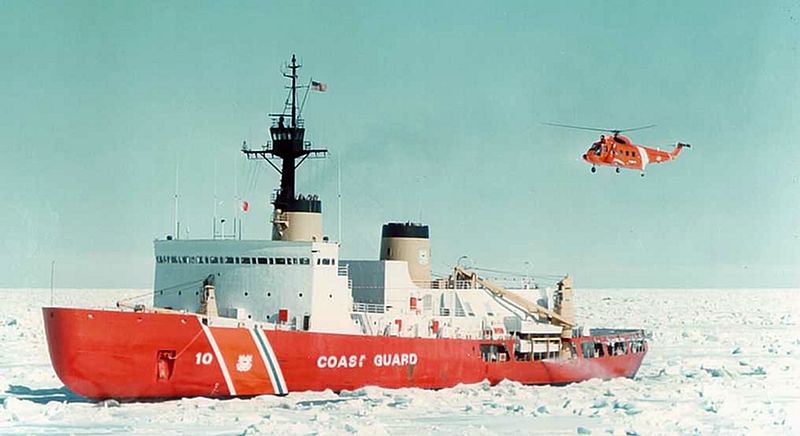
USCGC Polar Star will be 47 years old by the time we see a replacement. USCGC photo.
The Navy has issued a Request for Proposal with options for up to three heavy polar icebreakers. Its not a block buy, but it is a bit of a surprise. I have copied and pasted the brief summary below. (Thanks to Tups for bringing this to my attention.)
Solicitation Number:
N00024-18-R-2210
Notice Type:
Presolicitation
Synopsis:
Added: Feb 14, 2018 2:17 pm
The Naval Sea Systems Command plans to issue an unrestricted solicitation for the procurement of the Detail Design and Construction (DD&C) of up to three (3) Heavy Polar Icebreakers (HPIB) under a Fixed Price Incentive Firm (FPIF) Contract. This contract will award Advance Procurement and Detail Design, and include option line items to procure three (3) Heavy Polar Icebreakers. The contract will also include options for Provisioned Items orders to outfit the ships and purchase spares, repair parts, and other special equipment; Engineering and Industrial Services in support of Government systems installation and post-delivery activities; Special Studies for Government-directed engineering tasks; and Crew Familiarization. The HPIB will be procured utilizing full and open competition in accordance with the Federal Acquisition Regulation (FAR) Part 15, Contracting by Negotiation. Award is anticipated to be made to a single Offeror who offers the Best Value to the Government as determined by the tradeoff process as defined in Sections L and M of the Solicitation. The solicitation is anticipated to be posted within 30 days, this synopsis is provided as an advance notice.
This synopsis and any updates and/or changes for this planned procurement, the posting of the RFP, and any future Amendments to the RFP, will appear at the Federal Business Opportunities (FBO) website located at http://www.fbo.gov. Inquires/questions concerning this announcement may be e-mailed to the Naval Sea Systems Command, Shipbuilding Contracts Division representatives listed below.
The points of contact for this posting are Ms. Melissa Donnelly, Contract Specialist, e-mail Melissa.Donnelly@navy.mil AND Mr. James Platner, Contracting Officer, e mail, James.Platner@navy.mil. Please send inquiries via e-mail to both points of contact. No telephone inquiries will be accepted and requests for solicitation packages will not be honored, as a solicitation is not prepared at this time. This notice does not constitute an Invitation for Bid or Request for Proposal and is not to be construed as a commitment by the Government.
The contracting agency is: Naval Sea Systems Command, 1333 Isaac Hull Ave SE, Washington Navy Yard, DC. 20379-2020
Contracting Office Address:
SEA 02
1333 Isaac Hull Avenue SE
Washington Navy Yard, District of Columbia 20376
United States
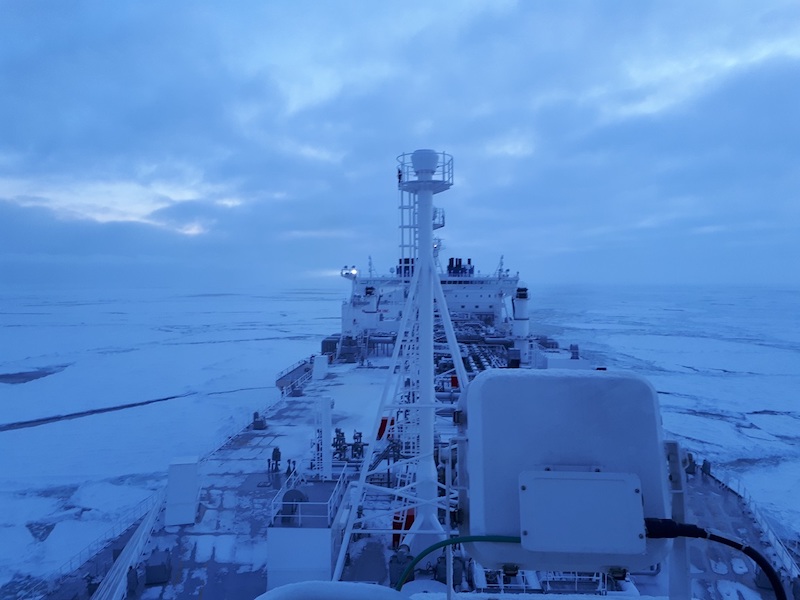
LNG transport vessel Eduard Toll transiting the Northern Sea route without icebreaker escort, December/January 2017/18
gCaptain provides proof we can expect to see merchant vessel transits of the Arctic Ocean even in Winter time.
“At times during the trip, the unescorted Eduard Toll broke ice 1.8 meters thick at speeds of five knots astern, arriving at Sabetta ahead of schedule sometime in early January. “
The Eduard Toll is one of a class of six being built in S. Korea for a Russian/Chinese joint venture.
Chinese icebreaking research vessel Xue Long (Snow Dragon), Photo by Bahnfrend
Reuters has an interesting short article about China’s interest in the Arctic. Initially this will probably be primarily concerned with shipment of Russian LNG, but it appears we can expect other activities as well, including fishing. Certainly we should expect more traffic through the Bering Strait, bringing with it the possibility of SAR and Marine Environment Protection incidents.
“The white paper said China also eyes development of oil, gas, mineral resources and other non-fossil energies, fishing and tourism in the region. It said it would do so “jointly with Arctic States, while respecting traditions and cultures of the Arctic residents including the indigenous peoples and conserving natural environment”. “
Above is a video of a symposium conducted by the Center for Strategic and International Studies, November 29, 2017, with Rear Admiral Michael F. McAlister, Commander, 17th Coast Guard District, as the speaker. He talked about:
The Arctic as he sees it now and his concerns for the future.
Working relationship with counterparts in Russia, China, Canada, and other Artic nations.
Some of the topics were a traffic management scheme jointly proposed with Russia for the area around the Bering Strait.
Prospect of increased Illegal, Unregulated, and Unreported Fishing in the Arctic.
Differences in pollution response regulations and planning compared to how it is done in the lower 48.
Improved communications among Arctic Coast Guard Forum nations.
Extending Maritime Domain Awareness to include groups outside the Coast Guard such as environmental groups and native villages.
As an aside he also mentioned a program I was not aware of, that the Coast Guard seconds officers to think-tanks like CSIS.
Dan Sullivan, Sub-Committee chair (R, Alaska)(Lt.Col., US Marine Corps Reserve)
Gary Peters, ranking member (D, Michigan)(LCdr. US Navy Reserve, Supply Corps)
Bill Nelson, ranking member of the Commerce Committee (D, Florida)(Capt. US Army Reserve)(NASA Scuttle payload specialist)
Roger Wicker, Chairman of the Seapower sub-committee (R, Mississippi)(Lt.Col. ret. USAF reserve)
Richard Blumenthal (D, Connecticut) (USMC Reserve 1970 to 1976 discharges as Sargent)
Brian Schatz (D, Hawaii)
Ed Markey (D, Mass.) (Spec4, US Army Reserve, 1968-73)
Jim Inhofe (R, Oklahoma) (Spec4, US Army, 1956-1958)
Maria Cantwell (D, Washington)
You can also check out the original post from the Senate Committee on Commerce, Science, and Transportation. (Same video is available there, but the meeting does not actually start on that version of the video until minute 36.) There you can also find the written statements of the other three witness who constituted the second panel. The Commandant was the sole witness on the first panel.
This was something of a love fest for the Coast Guard with repeated praise for the people and actions of the Coast Guard.
This hearing was reputedly about how the Coast Guard had been impacted by the unusually severe Hurricane season. There is not a lot new here but there were some interesting remarks.
Polar Icebreaker Contracts
The intention is to Contract for the first Icebreaker and then employ block buy for the next two (28m). To me this seems to negate most of the advantage of a block buy. I don’t believe we will or should buy one and then wait until we have tried it out before contracting for the next two. That would necessitate a delay of at least five years during which we would still have the nightmare scenario of our only heavy icebreaker having no rescue if it should break down in the ice–certainly not an impossibility even with a new ship. If we are going to contract for the remaining two before testing the first, we might as well block buy all three.
First of class is always the most expensive. If the shipyard gets a block buy they know that initial improvements in productivity can be amortized over the entire block buy quantity. In some cases, in order to win the whole project, the shipyard will cut the price of the first ship substantially knowing they will make a profit over the entire project.
If we buy one and then block buy the second and third, we have paid for improvements to the winning yard with the first contract and minimized the chances for a competitive bid for numbers two and three.
Legislation has capped DOD participation in icebreaker procurement, so the bulk of icebreaker procurement costs will come out of the Coast Guard budget.
Authorization
There was a lot of discussion about the need to have the Coast Guard Authorization Bill signed into law, still not approved. You can see it here.
Other topics
There was a discussion of the high cost of the Coast Guard response to the recent series of Hurricanes.
Representative Sullivan spent a lot of time, discussing and advocating for an eleven mile road from King Cove (population estimate–989) to Cold Bay, Alaska (population estimate–122) which has an all-weather airport with two runways, one 10,180 feet and one 6285 feet in length. The Coast Guard connection is that the road would minimize or eliminate the necessity for the Coast Guard to Medivac emergencies from King Cove by helicopter, which is frequently hazardous. It is a Federal issue, because the road would run through a Federal reserve. The Commandant fully supported the desirability of completing the proposed single lane gravel road as a means of minimizing the requirement for helicopter medivac.
Video Breakdown
28m Domestic icebreakers–Design work on new domestic icebreakers is expected to start in 2030. That sounds a bit late to me. Mackinaw was commissioned in 2006 so if that is what he is really talking about, that makes sense, but the 140 foot icebreaking tugs are a different story. The first for of these will be 51 years old in 2030. More than half of them have already completed in-service which was expected to add 15 years to their service life. Morro Bay, at least, is expected to reach the end of her service life in 2030, and considering how long it takes us to build a ship we really need to start the process not later than 2025.
45m Western Pacific Fisheries Protection–They have not seen much risk of Illegal, Unregulated, or Unreported fishing.
51m Inland River Tenders
56m We may need to replace the 52 ft MLBs with something larger than the 47 foot MLB sometime in the future, but their end of life is not yet apparent
58m Coast Guard Museum in New London
60m Sexual Assault in the CG
1h02m Puerto Rico/Virgin Islands continuing commitment and its effects on drug seizures and alien migrant interdiction.
1h05m Vessel homeporting
1h08 CG center of expertise, particularly in regard to clean up spills in ice and fresh water
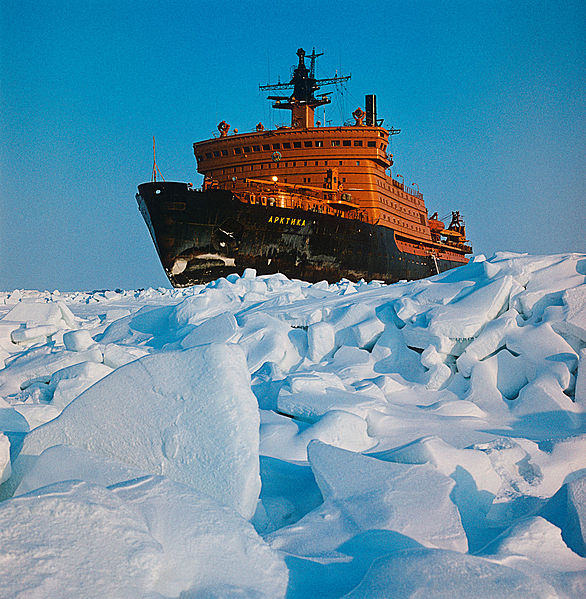
The nuclear-powered icebreaker Arktika in the Kara Sea. RIA Novosti archive, image #186141
We have had the “Bomber Gap”, the “Missile Gap”, and the “Cruiser Gap.” None of which were ever real, but they were effective in putting more money into a program.
Now we have the “Icebreaker Gap” which is real, but largely irrelevant. Hopefully it will get money for the Coast Guard.
It is certainly true that the Russians have far more Icebreakers than the US, but shouldn’t it enough that we really need these ships, regardless of what the Russians may be doing?
I hate to see fear replacing logic, but perhaps the ends justify the means. Is there a military dimension to the Russia/US icebreaker fleet comparison? Certainly neither country is going to invade the other over the poles. We are not likely to see fleets of icebreakers shooting at each other, the Russians already have plenty of missile carrying aircraft and submarines in the Arctic. But we may need to place sensors, bases, or other assets in high latitudes even when others don’t like it. That may be impossible without icebreakers. The US has fewer icebreakers than any other type of critically important vessel. We have far more carriers, SSBNs, destroyers, amphibious warfare ships, underway replenishment ships. The loss of any one of them would not mean the end of a capability. The loss of even one of our icebreakers could.
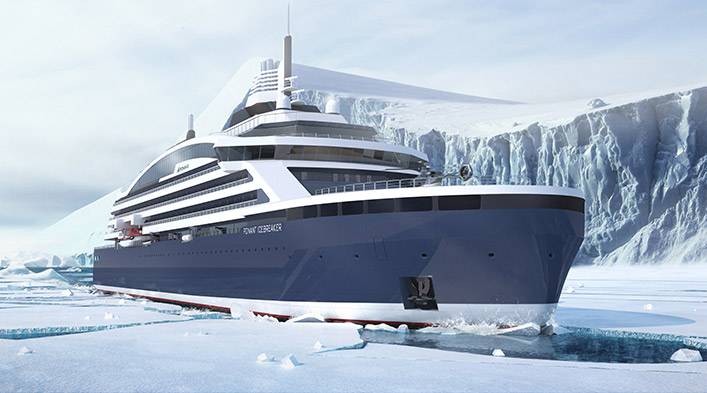
Marine Link reports award of a $320M contract for construction of a 30,000 gross ton 150 meter Polar Class 2 expedition vessel to be powered by a hybrid LNG/electric power plant. “The vessel can accommodate 270 passengers in 135 staterooms, in addition to a crew of 180 persons.”
It is expected to host two helicopters and 16 Zodiac dinghies.
They think they can take it to the geographic North Pole.
gCaptain reports on a ten nation accord to protect fisheries in the central Arctic Ocean.
“For the next 16 years, commercial fishing will be prohibited in the central Arctic, a Mediterranean-sized patch of icy ocean more than 200 nautical miles from any nation’s coastline. This will give scientists time to study whether fishing might safely be allowed there. The goal is to avoid the overfishing that has depleted fish populations in other parts of the world — pollock in the Bering Strait, for instance, or krill in the Antarctic Ocean.”
Posted by LT Amy Midgett, Friday, December 1, 2017
Director of Marine Transportation Systems Mr. Mike Emerson presented a Keynote Address on Arctic Waterways Management at the 11th Annual Arctic Shipping Summit in London, England on November 30, 2017.
The two day conference brought together experts and stakeholders to discuss some of the issues associated with Arctic operations, such as limited infrastructure and the harsh environment, and how regulations and technical advancements will impact commercial waterways management.
In his remarks, Emerson gave an overview of highlights from the U.S. Chairmanship of the Arctic Council from 2015-2017, and identified some emergent areas that warrant attention during chairmanships of the Scandinavian countries. He also discussed the Arctic Coast Guard Forum, which continues to demonstrate collaborative value, as evidenced by the success of the multi-national ARCTIC GUARDIAN Search and Rescue Exercise that was conducted off the coast of Iceland in September. Looking forward, Emerson said he anticipates increasing interest from countries outside the Arctic Circle to participate more fully in the Arctic Coast Guard Forum, as well as Arctic Council decision-making.
As Arctic ice recedes, a direct sea route from Europe to Asia is opening up along the coast of Russia, and Emerson said he expects the Northwest Passage across North America to follow suit.
“With more navigable waters, we can expect more shipping activities, and greater demands for waterways management,” Emerson said in his remarks. “The U.S. Coast Guard therefore, is engaging peer agencies across both borders in developing joint proposals for ship routes and areas-to-be-avoided in waterways that we share with Russia and Canada. These efforts, and a fresh focus on charting, polar codes, and acquisition of ice-capable assets are immediate priorities for ensuring marine safety and security.”
Emerson concluded his remarks by forecasting the need for government and industry leadership in infrastructure investments to support increased Arctic shipping, along with resource development, fisheries, and tourism. Finally, he emphasized the need to reconcile waterways management with indigenous communities – an area the Coast Guard is actively addressing.
Conference attendees also heard from representatives from the IMO, Canadian Coast Guard, Transport Canada, the Norwegian Ice Service, and many other private shipping and environmental organizations. Other topics covered included Arctic regulations, safe navigation and communications, effective infrastructure, and crew hiring and training.
Federal News Radio has an interview with the Commandant. There is a short written summary here or you can listen to it on their page or above. Some interesting developments with regard to drug interdiction in the Eastern Pacific. Sea story about actual employment of a sea based Unmanned Air System.
Interestingly he again refers to Russia arming Icebreakers so I think perhaps we may see some movement to arm or at least make provision for arming our new icebreakers.


 Chuck Hill's CG Blog