“USNI News Fleet and Marine Tracker: Aug. 14, 2023” –USNI

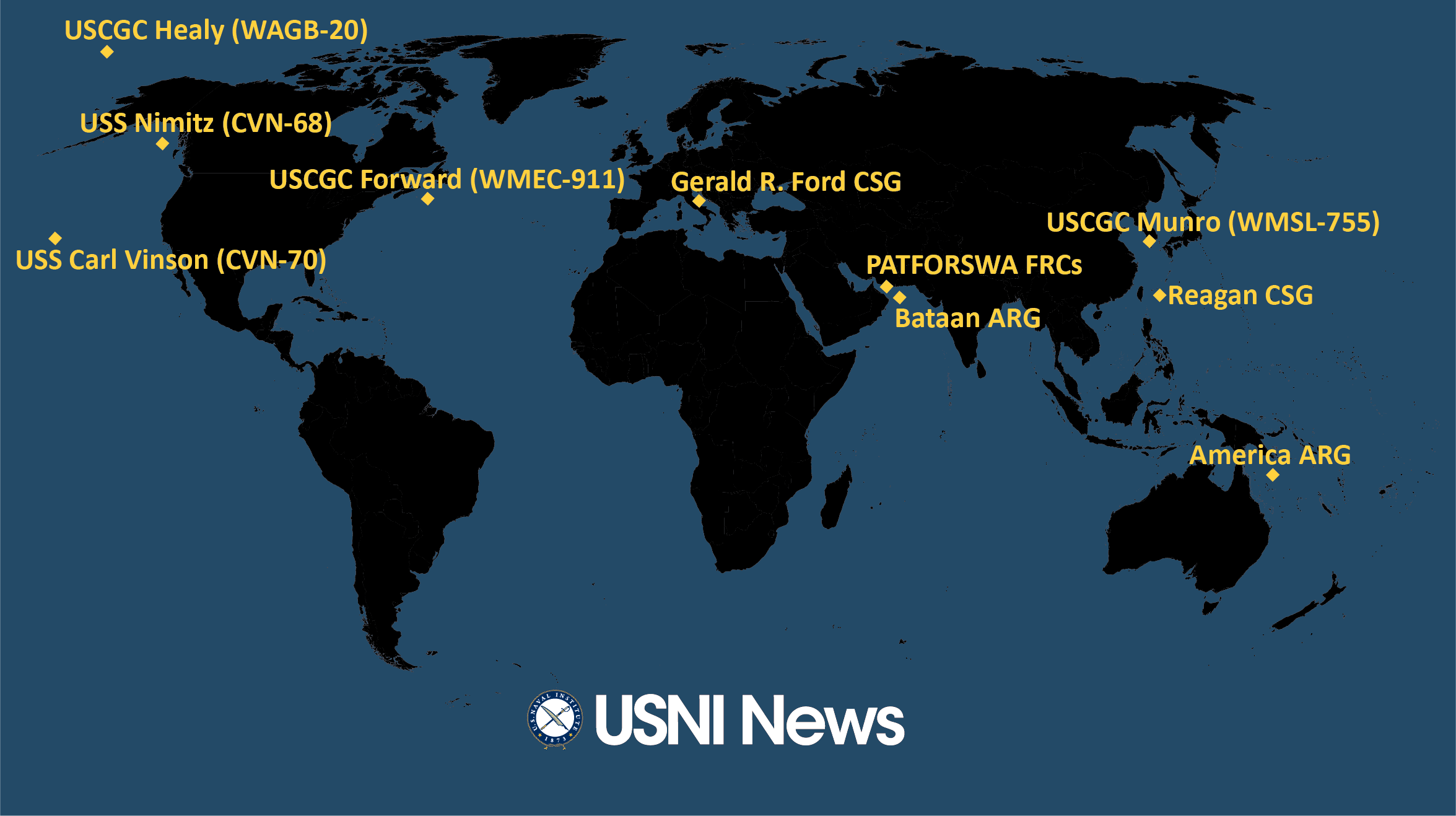
The US Naval Institute News Service “Fleet Marine Tracker” continues to report atypical Coast Guard activities. It continued to report on USCGC Healy’s Arctic deployment and mentioned PATFORSWA as they have since they have since they began including Coast Guard units in May.

This week, they included some activity I have not seen reported elsewhere.

“Legend-class National Security Cutter USCGC Munro (WMSL-755) departed Fleet Activities Yokosuka (CFAY) and is now in South Korea.”

“Coast Guard Cutter Forward (WMEC-911) is currently supporting Operation Nanook. Operation Nanook is an annual Canadian-led exercise that fosters international cooperation and shared responsibility in the Arctic and the northern Atlantic Regions.”

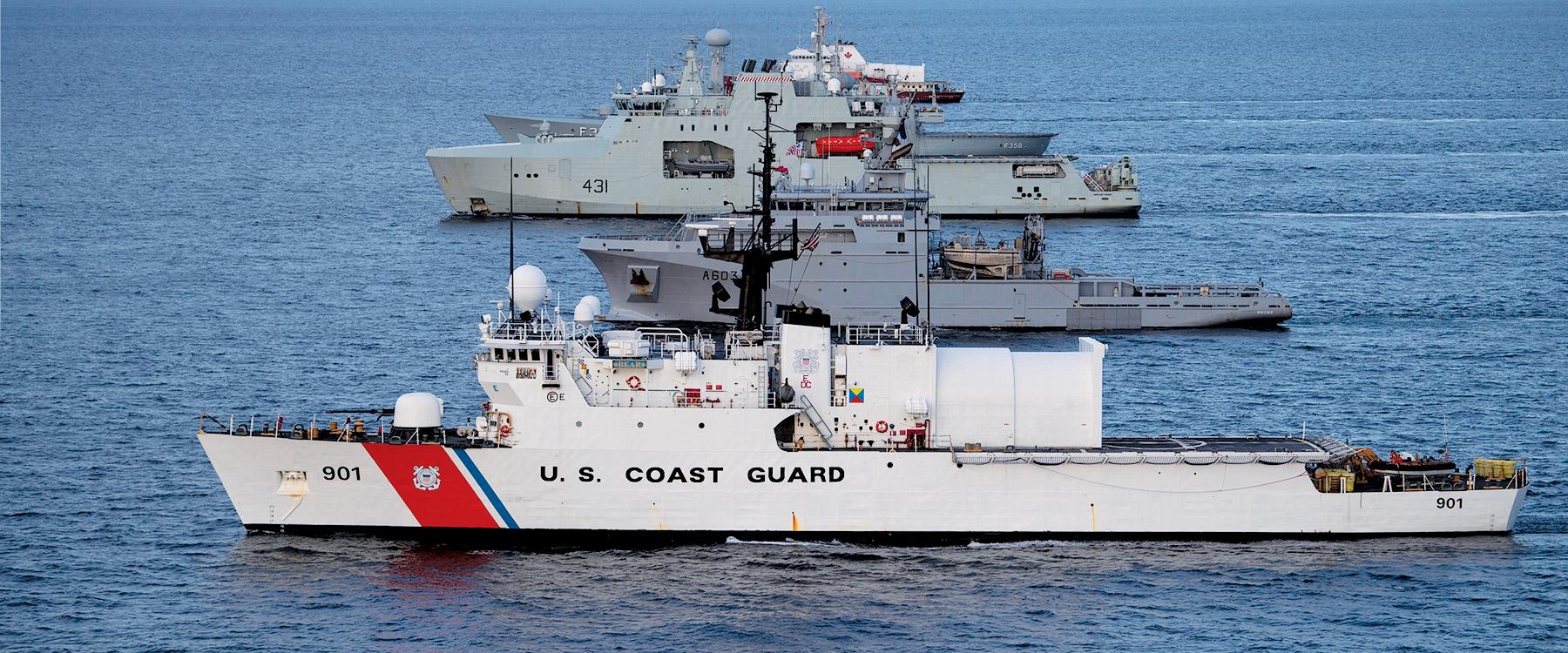
The USCGC Bear (WMEC-901) and allied ships from Canada, Norway, France, and Denmark steam in formation in the North Atlantic Ocean during last year’s Operation Nanook in August 2022. 

“Russia and China Sent Large Naval Patrol Near Alaska” –Wall Street Journal

The Wall Street Journal reports,

“Eleven Russian and Chinese ships steamed close to the Aleutian Islands, according to U.S. officials. The ships, which never entered U.S. territorial waters and have since left, were shadowed by four U.S. destroyers and P-8 Poseidon aircraft.”

The Russians and Chinese have been doing these joint deployments into the Bering Sea for at least a few years, and normally it has been the Coast Guard that followed them. This time the Navy sent a capable force, in addition to P-8 Maritime Patrol Aircraft they sent USS John S. McCain (DDG-56), the USS Benfold (DDG-65), the USS John Finn (DDG-113) and the USS Chung-Hoon (DDG-93).

Previous reports: 

Coast Guard Cutter Kimball encounters Russia and People’s Republic of China military naval presence in Bering Sea” –D17, Sept. 2022

“Chinese Warships Sailing Near Alaska’s Aleutian Islands Shadowed By U.S. Coast Guard” –Small Wars Journal, Sept. 2021

Chinese Navy Operating Off Alaska, Sept. 2015

http://www.state.gov/e/oes/ocns/opa/arc/uschair/258202.htm . This map of the Arctic was created by State Department geographers as part of the U.S. Chairmanship of the Arctic Council.

Why are they there?:

Russia is easy to understand. This is very close to their territory and their Pacific Fleet base in Petropavlovsk, but why the Chinese?

Russia is China’s top crude oil source, and much of that oil comes from Russia’s Arctic. In any conflict China’s energy sources are likely to be a target and the Bering Strait is the choke point on the most direct route from the Russian Arctic to Chia.

I would note that China’s excursions into the Bering Sea all seem to be toward the end of summer, which is about as nice as it gets in the Aleutians.

“Coast Guard Cutter Bertholf returns home after 120-day Bering Sea patrol” –Coast Guard News

Aerial view of Kotzebue, Alaska, U.S. U.S. Army Corps of Engineers, photographer not specified or unknown

Below is a US Coast Guard News report. This was a “Bering Sea Patrol” or what we used to call an Alaska Patrol or ALPAT, but it actually went further North than the Bering Sea.

Northwest Arctic Borough Alaska incorporated and unincorporated areas Kotzebue highlighted. From Wikipedia by Rcsprinter123

When we used to do ALPATs, we spent a lot of time around Dutch Harbor and out toward Adak. We might have gone as far North as the Bering Strait but didn’t spend much time there. Going North of the Berring Strait, which is on the Arctic Circle, was very rare, and we made no port calls at Nome (just south of the Strait) or at any location North of the Strait.
In this case, Bertholf made a port call at Kotzebue (population about 3,100) which is not really in the Bering Sea, it is in the Chuckchi Sea, North of the Bering. Note Bertholf had to anchor out in the Sound. There was no place for them to moor. You can see virtually all of the town in the photo above. It is above the Arctic Circle. It is a tiny town, but it has become important for the Coast Guard as the location for a seasonally deployed Helicopter detachment. (I have not seen any report of a detachment being deployed to Kotzebue this year.)
Despite a lot of talk about the increasing importance of the Arctic, so far, US Navy Pacific Fleet surface ships operating North of the Aleutians, are very rare. They may have operated in the vicinity of Dutch Harbor during an exercise, but I think it is fair to say we are more likely to see Russian and Chinese warships. We did in 2021 and 2022.

Aug. 3, 2023

Coast Guard Cutter Bertholf returns home after 120-day Bering Sea patrol

ALAMEDA, Calif. – The Coast Guard Cutter Bertholf (WMSL 750) and crew returned to homeport, Thursday, to Coast Guard Island after a 120-day Bering Sea patrol in support of United States national security, U.S. fishing fleet safety and prosperity, and the protection of U.S. living marine resources.

While patrolling the Bering Sea, Bertholf’s crew members conducted 15 boardings of commercial fishing vessels, ensuring compliance with federal fisheries laws, and preserving the highly valuable U.S. living marine resources. These boardings also ensure that the U.S. fishing fleet have sufficient safety equipment to survive in the event of an at-sea emergency.

In a demonstration of the strong trusted partnership between Japan and the United States, Bertholf conducted major at-sea and shore side engagements with the Japan Maritime Self Defense Force (JMSDF) training ships Kashima and Hatakaze. During the at-sea engagement, Bertholf, Kashima and Hatakaze executed multiple formations, and during a farewell pass, the JMSDF personnel displayed a highly impressive drumline performance on their flight deck.

Afterward, the three ships moored up together in Dutch Harbor, Alaska, and continued to build relationships and shape partnerships. These engagements included reciprocal ship tours, a baseball game, a fun run up local mountain Ballyhoo, and a Dutch Harbor beach bonfire.

The next day, the Japanese and U.S. crews came together with the Unalaska community and officials from the Qawalangin Tribe during the 81st anniversary of the World War II Battle of Dutch Harbor ceremony to commemorate the lives lost, the community impacts, and to recognize the healing and partnership that has been built in the decades that followed. Rear Adm. Konno, JMSDF Training Squadron Commander, Rear Adm. Moore, commander of U.S. Coast Guard Seventeenth District, and Mayor Tutiakoff presided over the ceremony and exchanged official gifts.

Additionally, Bertholf crew guarded the boundary line between the U.S. and Russian Exclusive Economic Zone (EEZ), ensuring that the fish in U.S. waters were protected from illegal, unreported and unregulated fishing from foreign nations.

Later in the patrol, Bertholf and crew anchored in Kotzebue Sound and engaged in several events with the community members of Kotzebue, Alaska, including a color run and a softball game. In addition, Bertholf’s law enforcement operators engaged with local fishermen and fish processors to establish positive relationships and ensure awareness of boater safety regulations and salmon skiff exemptions in the region.

“Our accomplishments during this patrol would not have been possible without the amazing crew that we have aboard,” said Capt. Billy Mees, Bertholf commanding officer. The entirety of the crew and their families have my utmost respect for the sacrifices they make for their country.”

The Bertholf returned home on the eve of the 15th anniversary of its commissioning date; August 4th, 2008, which also coincides with the Coast Guard’s 233rd birthday. Since then, Bertholf has truly lived up to the storied past of her namesake, Commodore Ellsworth P. Bertholf, the first Commandant of the U.S. Coast Guard, and its motto, Legends Begin Here.

“Coast Guard icebreaker departs for months-long Arctic deployment” –Coast Guard News

Passing this along from Coast Guard News.

July 12, 2023

Coast Guard icebreaker departs for months-long Arctic deployment

SEATTLE — The Coast Guard Cutter Healy (WAGB 20) departed Seattle, Tuesday, for a months-long Arctic deployment.

The crew aboard Healy, a 420-foot icebreaker, will provide U.S. surface presence in the Arctic, conduct high latitude science and research missions, engage in exercises and professional exchanges with foreign partners, and conduct other operations as directed throughout the deployment.

Healy’s deployment supports the Coast Guard’s Arctic Strategy while providing critical training opportunities for Polar sailors and future operations in the Arctic.

“We’re excited to begin our Arctic deployment to the high latitudes,” said Capt. Michele Schallip, Healy’s commanding officer. “Our deployment will support scientific exploration to increase understanding of the changing Arctic environment and associated impacts. We’ll also have opportunities to deepen the Coast Guard’s cooperation with our allies, and partner nations through engagements and joint exercises to promote regional stability, security and strengthen our collaborative partnerships.”

Schallip assumed command of the Healy in June, having previously served as the cutter’s executive officer.

The Healy deploys annually to the Arctic to support multiple science missions and Operation Arctic Shield, the service’s annual operation to execute U.S. Coast Guard missions, enhance maritime domain awareness, strengthen partnerships, and build preparedness, prevention, and response capabilities across the Arctic domain.

Commissioned in 2000, Healy is one of two active polar icebreakers in the Coast Guard’s fleet. The Seattle-based Coast Guard Cutter Polar Star (WAGB 10) is a Polar icebreaker commissioned in 1976.

The Coast Guard is recapitalizing its Polar icebreaker fleet to ensure continued access to both Polar regions and support the country’s economic, commercial, maritime, and national security needs.

“First US deep water port for the Arctic to host military, cruise ships” –Navy Times

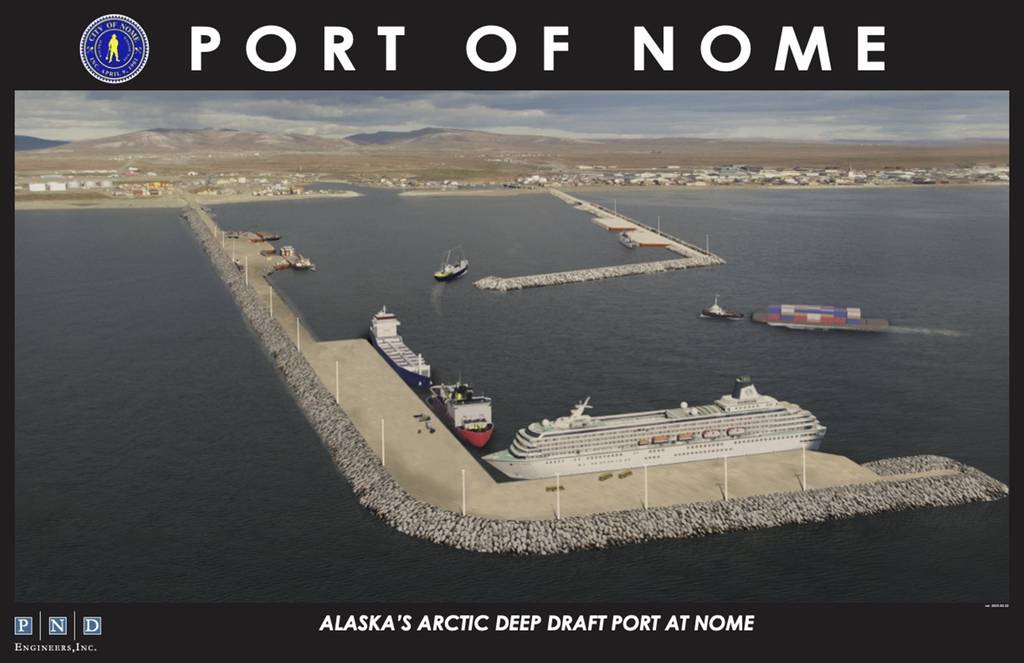
This rendering provided by the City of Nome shows how the Port of Nome, Alaska, will appear following an expansion project that will cost more than $600 million. Shipping lanes that were once clogged with ice for much of the year along Alaska’s western and northern coasts have relented thanks to global warming, and the nation’s first deep water Arctic port should be operational in Nome by the end of the decade. (PND Engineers Inc./City of Nome via AP)

Navy Times reports,

Workers will dredge a new basin 40 feet (12.2 meters) deep, allowing large cruises ships, cargo vessels, and every U.S. military ship except aircraft carriers to dock, Port Director Joy Baker said.

Nome in red. Adapted from Wikipedia’s AK borough maps by en:User:Seth Ilys.

We have been talking about a deepwater port in the area for some time,

Alaska and the Bering Strait

Nome isn’t actually in the Arctic, despite the fact that the US government defines the Arctic to include the Bering Sea. The Arctic Circle runs just a little North of Nome, essentially at the Bering Strait. The Bering Strait connects the Pacific with the Arctic Ocean and is about 44 nautical miles (82 kilometers) wide at its narrowest point. Whoever controls the Bering Strait can regulate traffic between the Pacific and the Arctic Oceans. Having a nearby deepwater port would certainly help, if it were desirable to regulate that traffic. Nome is within 160 nautical miles of the Russian side of the Strait.

Traffic through the Strait has increased and the possibility of a cruise ship disaster in the Arctic is probably a District 17 nightmare, but I think the probability is low that large numbers of CG units will be based at Nome. As noted earlier, I don’t think we will see either large patrol cutters (unless it is the Alex Haley) or FRCs based there but moving one of the Juniper class seagoing buoy tenders there, with its light icebreaking capability might make sense. A medium icebreaker might be a possibility, but that is a very long shot.

As I have noted before, the US Navy’s Pacific Fleet surface ships have not really shown much interest in operating in the Arctic. Their “Arctic” exercises have been in the Gulf of Alaska or little, if at all, North of the Aleutians.

We might see Air Force and Marines in the area in time of War. Airpower and/or shore based anti-ship missiles could control surface traffic through the Strait. Those forces would have to be supplied, which would mean logistics shipping to what we now know will be the deepwater port at Nome. The shipping would presumably require naval protection, air and/or surface.


Canada’s Multi-Purpose Vessels

Canadian CG MPV. Credit Aker Arctic.

Canada has a project to replace a large part of the Canadian Coast Guard fleet with up to 16 Multi-purpose Ships at an estimated cost of $14.2 billion (Canadian), with the first ship to be delivered in 2029.

There has not been a lot of reporting about this class, but frequent contributor Walter pointed me to two sources, Seaspan Shipyards and designer Aker Arctic. It appears they have very concrete ideas about what the class will look like.

Canadian CG MPV. Credit Aker Arctic.

MISSIONS:

According to Aker Arctic,

The MPVs will also perform cargo missions, bringing supplies to northern communities, carry out search & rescue and patrol missions, in addition to icebreaking. Most of their time will be spent on the St Lawrence River, the Great Lakes, and along the Canadian East Coast. Additionally, they will have a summer Arctic mission leaving from Victoria in British Columbia and travelling north around Alaska to the Canadian Arctic.

Due to the wide variety of tasks, the long-distance mission to the western Arctic, and the fact that some of the waterways have a limited depth, the vessel needed to be compact with a shallow draught, narrow beam, high endurance, and with a large cargo capacity.

CHARACTERISTICS:

  • Displacement: about 8,500 tons
  • Length, overall: 99.9 meters (328′)
  • Beam: 20.3 meters (66.7′)
  • Draft: 6.2 meters (20’4″)
  • Propulsion: diesel-electric; two azimuthing propulsion units

As is the case with all Canadian Coast Guard cutters, they have no fixed armament. It does look like it could host a medium sized helicopter and containerized systems, including perhaps below the hangar deck.

RANGE:

To me the most surprising characteristic of the ship is its range, 12,000 nautical miles. This was apparently driven by a summer Arctic mission from Victoria in British Columbia, north around Alaska to the Canadian Arctic.

ICE CLASS: 

These ships will be Canadian Ice Class 4, meaning they will have the capability to maintain a speed of 3 knots through ice 4 feet thick. The Canadian Coast Guard will consider these heavy icebreakers. We don’t have any figures on horsepower, but they probably will have less than 20,000 HP which, in the USCG system, would classify them as light icebreakers.

Compared to the US Coast Guard’s “heavy” Great Lakes icebreaker, Mackinaw (3,500 tons and 73m), these will be more powerful and more than twice as large. These might be a good design for the planned second USCG Great Lakes icebreaker.

IMPLICATIONS FOR THE USCG:

Aside from possible use of the design for Great Lakes icebreaker, these might be pretty close to what the USCG needs for their planned medium icebreakers. Certainly, consultation with Canadian counterparts will sharpen the focus of the US design effort. We might also have reasons to limit beam and draft.

Exercises–RIMARCTIC? and Unmanned in UNITAS in July

National Defense has a short post, “JUST IN: Gilday Calls for Massive International Exercise in Arctic.” It talks about doing an exercise comparable to RIMPAC in the Arctic. Chief of Naval Operations, Adm. Michael Gilday is almost certainly talking about an exercise on the Atlantic side of the Arctic, in the Norwegian Sea, above the Greenland-Iceland-UK gap. If the Exercise were held as far North as the Barents Sea, the Russians would probably get very excited.

The Arctic Circle runs just North of Iceland and North of the upper end of the Baltic Sea. Credit: CIA

The Coast Guard would almost certainly participate. The Canadians already host an Arctic Exercise, Nanook, but it is very small scale. It takes place west of Greenland and the US Navy has not generally participated.

(I have serious doubts that this RIMARCTIC is ever going to happen, at least not as something on the scale of RIMPAC. Everyone wants to go to Hawaii.)

The USCGC Bear (WMEC-901) and allied ships from Canada, Norway, France, and Denmark steam in formation in the North Atlantic Ocean during Operation Nanook in August 2022. 

The post also talks about China’s massive investment in Oceanography and there is an interesting footnote. We have heard 4th Fleet would be start experimenting with Unmanned systems soon, paralleling what has been done in 5th Fleet with Task Force 59. Apparently, it will begin with UNITAS.

The Navy plans to introduce unmanned vessels to their South American partners as a part of the UNITAS naval exercise in July. Uncrewed surface and subsurface boats can monitor sea lanes and search for nefarious activities such as drug smuggling and illegal fishing, he said.

These “potentially unmanned [capabilities] give us, along with allies and partners —which is really key here — the ability to keep an unblinking eye on that kind of activity and collect data,” he said.

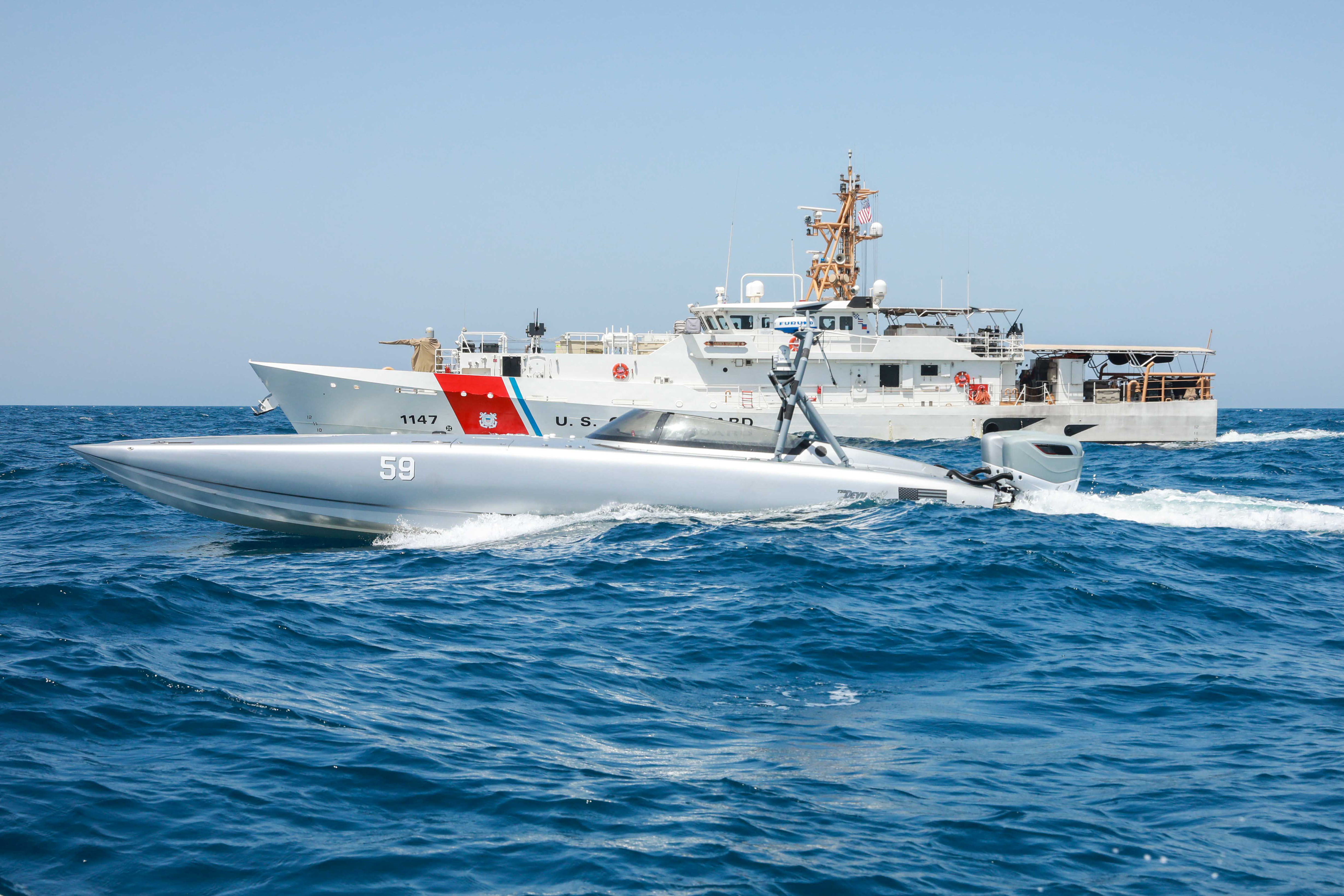
The Coast Guard fast response cutter Clarence Sutphin Jr. sails alongside an unmanned surface vessel in the Persian Gulf during exercise Eagle Resolve 23, June 1, 2023. Eagle Resolve is a combined joint all-domain exercise that improves interoperability with the U.S. military and partner nations, including Saudi Arabia.

China Coast Guard in the Russian Arctic?

Chinese Coast Guard officials observed the April 25 anti-terror exercise conducted by FSB Coast Guard in the Kola Bay north of Murmansk. Photo: Murmanski Vestnik

The Barents Observer has an interesting article, “Russia’s Coast Guard cooperation with China is a big step, Arctic security expert says,” that seems to portend a China Coast Guard presence in the Arctic, perhaps shepherding their fishing vessels.

“The Russia-China memorandum signed in Murmansk opens for joint efforts to combat terrorism, illegal migration, fighting smuggling of drugs and weapons, as well as stopping illegal fishing. The deal was signed by top leaders with FSB Border Guards and the Chinese Coast Guard.”

It may be noteworthy that this meeting was not in Asia, in one of Russia’s Pacific ports. It was in Europe, in Murmansk, on the Kola Peninsula, home of the Russian Arctic Fleet.

This agreement may turn out to be a first step toward joint China and Russia exploitation of Russia’s, as yet unrecognized, extensive continental shelf claims in the Arctic extending all the way to the North Pole and beyond into areas also claimed by Canada and Denmark (from Greenland).

“Frozen Frontiers, China’s Great Power Ambitions in the Polar Regions” –CSIS

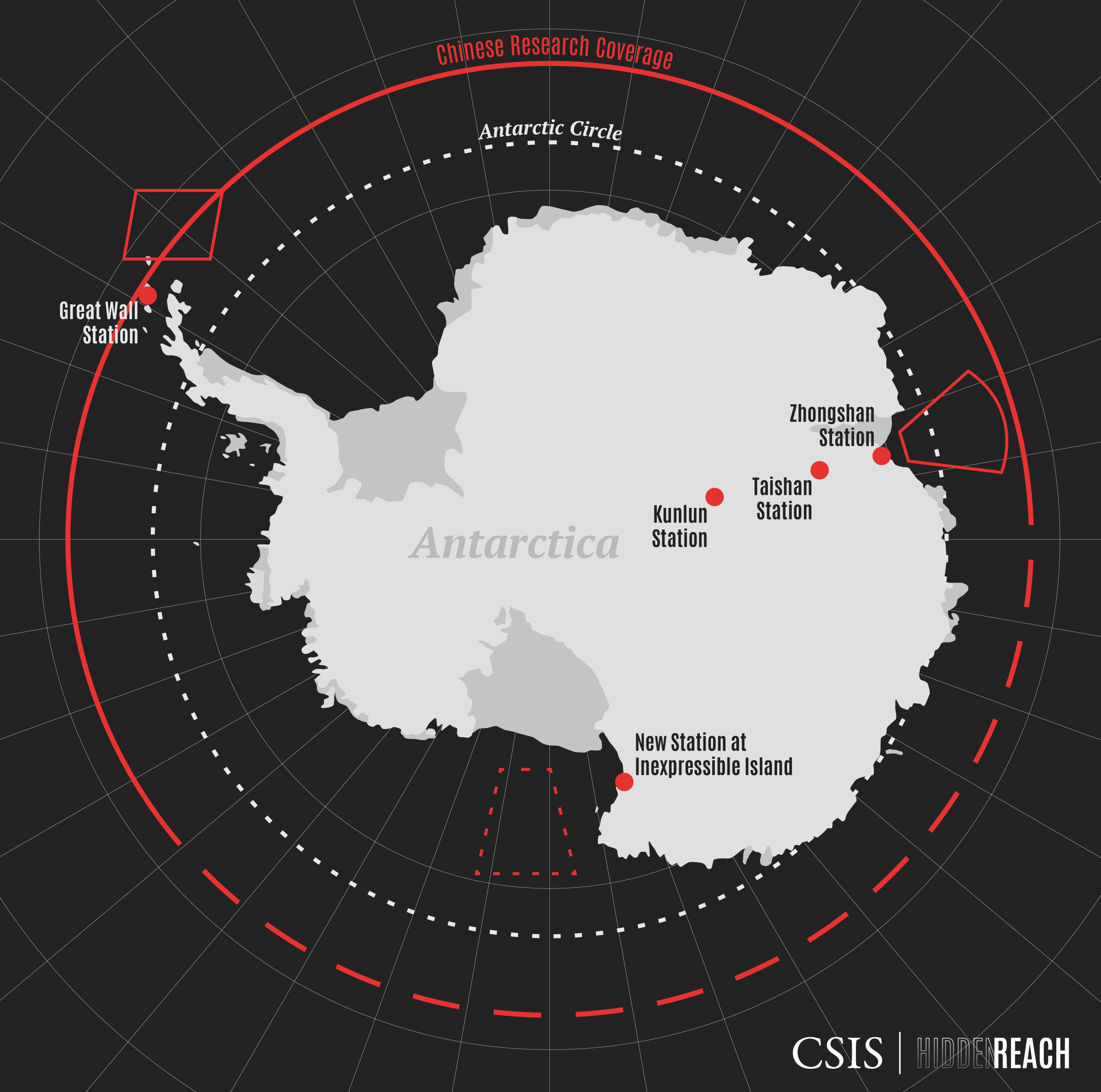
Adapted from a 2021 Chinese environmental evaluation report submitted to the Secretariat of the Antarctic Treaty. Source CSIS

The Center for Strategic and International Studies (CSIS) has an excellent overview of Chinese interests in the polar regions.

Chinese activities in the Arctic have gotten a lot of coverage, but their activities in Antarctic have been underreported and are, I believe, of much greater concern long term. Their coverage of China’s efforts in Antarctic is at the end of post. It is less extensive than that of China’s Arctic activities, but is perhaps the best I have seen.

China’s activities in the Arctic are just a part of their progress toward making Russia a client state. The relationship is not one of equals, it is very unbalanced, akin to Fascist Italy’s relationship to Nazi Germany. Ultimately Russia will be a victim of China’s determination to recover any territory that was once part of China. There is a lot of Asian Russia that China thinks should be theirs.

China is pouring assets into Antarctic, including potentially dual use facilities. They are setting themselves up to claim parts of the continent once the current treaty expires. This is probably going to put them in conflict with the US and some of our allies.

“Preserving Alaska’s living marine resources” –D17

USCGC Bertolf class National Security Cutter off Unimak Island, Aleutians, Alaska

Below is a summary of District 17’s Living Marine Resources conservation and management efforts. There is also information about the Magnuson-Stevens Fishery Conservation and Management Act (MSFCMA), 1976, that resulted in the expulsion of foreign fishing vessels from a 200 mile Exclusive Economic Zone even before the United Nations Convention on Law of the Sea and about the North Pacific Regional Fisheries Training Center (NPRFTC) (one of five such centers) that “teaches the enforcement of Conservation and Management Measures on behalf of four international fisheries commissions and 62 signatory nations across North and South America, Asia, Oceania, Europe, and Africa, covering over 80 percent of the Pacific Ocean​.”


April 20, 2023

Preserving Alaska’s living marine resources

ANCHORAGE, Alaska — Alaska supports some of the most abundant and diverse marine ecosystems in the world. With more than 46,000 miles of shoreline – more than all of the lower 48 U.S. states combined – the ocean is an integral part of Alaska’s ecosystems, economy, history and culture. According to National Marine Fisheries Service’s (NMFS) Fisheries of the United States 2020 report, U.S. commercial fisheries landed 8.4 billion pounds of seafood valued at 4.7 billion dollars, 199-million saltwater recreational fishing trips were taken, and recreational anglers caught one billion fish with 65 percent released alive. According to the 2019 report, commercial and recreational saltwater fishing supported 1.8 million. Alaska produces more than half the fish caught in waters off the U.S. coast, provides jobs and a stable food supply for the nation, and supports a traditional way of life for Alaska Natives and local fishing communities. Protection of the state’s 5.7-billion-dollar domestic fishery has never been more crucial.  

The living marine resources (LMR) mission is one of two missions focused on protecting fisheries in and outside U.S. waters. The Coast Guard is responsible for enforcing LMR regulations on domestic, commercial, recreational, and charter fishing vessels. Tasked with enforcing applicable fisheries laws in partnership with the NMFS, the Coast Guard’s goal is to provide the at-sea law enforcement presence necessary to reach national goals for LMR conservation and management. Vessel boardings are a critical component to accomplishing this mission providing an opportunity for teams to inspect a vessel’s catch, gear, and other items to ensure regulatory compliance as well as safety.

“The 17th Coast Guard District’s LMR mission is to promote a level playing field in Alaska’s extremely valuable commercial fisheries, protect resources, and ensure safety of life at sea,” said Lt. Cmdr. Jedediah Raskie, D17’s domestic fisheries enforcement chief. “The LMR enforcement mission is a complex operation requiring in-depth planning, multilateral partnerships and inter-agency collaboration. A continued at-sea presence is crucial, and this is only accomplished through dedication and teamwork with our enforcement partners.”

Those partners include:

Coast Guard – Coast Guard Cutters from Alaska, Washington, Hawaii, and California, Sector Anchorage, Sector Juneau, North Pacific Regional Fisheries Training Center, Maritime Safety and Security Teams (MSSTs)

State – Alaska State Troopers, Alaska Department of Fish and Game (ADF&G), local law enforcement

Other Federal – NOAA’s Office of Law Enforcement (OLE), Department of State, U. S. Drug Enforcement Administration, Customs and Border Protection (CBP)

Collectively in 2022, D17 patrolled 10,723 NMs, conducted 654 federal LMR enforcement boardings (11 on foreign-flagged vessels), detecting 30 violations on 26 vessels, and seizing catch on three fishing vessels. The top five fisheries violations include logbook discrepancies, no Individual Fishing Quota (IFQ) permit onboard, expired or no federal fisheries permit (FFP) onboard, sea-bird avoidance gear not onboard or improperly constructed, and improperly marked buoys on fishing gear.

“Right now, our teams are heavily involved with enforcement surrounding the opening of Pacific halibut and sablefish season,” said Lt. Cmdr. Jedediah Raskie. “The Pacific halibut and sablefish Individual Fishing Quota (IFQ) program is the largest catch share program in the U.S. and comprises 90 percent of D17’s total fisheries boardings.”

With the IFQ program, each fisherman has a catch quota that can be used during the open season from March to November. The North Pacific Fishery Management Council developed this program to address issues associated with the race-for-fish that had resulted from the open-access and effort control management of the halibut and sablefish fisheries. Top IFQ violations include: not having an official logbook onboard, no IFQ permit and/or FFP onboard, illegally retaining and/or mutilating halibut, and failure to retain and/or log retaining Pacific cod and rockfish.

Background

The Magnuson-Stevens Fishery Conservation and Management Act (MSFCMA) is the primary law governing mariner fisheries management in U.S. federal waters. The act’s keys objectives are to prevent overfishing, rebuild overfished stocks, increase long-term social and economic benefits, and ensure a safe and sustainable supply of seafood. Prior to the MSFCMA, waters beyond 12 NM were international waters and fished by fleets from other countries.

This 1976 law created eight regional fishery management councils responsible for the fisheries that require conservation and management in their region. The councils are charged with conserving and managing fishery resources from 3 to 200 miles off the coast while the State of Alaska manages fisheries that occur within 3 NM from shore. To learn more, visit  About the MSA — U.S. Regional Fishery Management Councils (fisherycouncils.org)).

The North Pacific Fishery Management Council (NPFMC) is one of the regional councils established to oversee fisheries in the 200-mile Exclusive Economic Zone (EEZ). With a jurisdiction of approximately 1,025,000 NM, the council manages more than 140 species within 47 stocks and stock complexes, primarily groundfish in the Gulf of Alaska, Bering Sea, and Aleutian Islands, targeting cod, pollock, flatfish, mackerel, sablefish, and rockfish species harvested by trawl, longline, jig, and pot gear. The council also makes allocation decisions for halibut in concert with the International Pacific Halibut Commission that biologically manages the resource for U.S.-Canada waters. Other large Alaska fisheries for salmon, crab, and scallops are managed jointly with the State of Alaska. More at North Pacific Fishery Management Council – Managing Our Nation’s Fisheries Off The Coast Of Alaska (menlosecurity.com).

To better enforce the fishery council’s management plans, the Coast Guard determined that region specific training was necessary to ensure boarding officers received adequate instruction in enforcing the increasingly complex laws that govern our nation’s living marine resources. The Coast Guard’s five fisheries training centers are dedicated to providing training in LMR and protected marine species law enforcement to eliminate natural resource degradation associated with recreational boating, recreational fishing, commercial fishing, and illegal incursions by foreign fishing vessels into our EEZ.

The North Pacific Regional Fisheries Training Center (NPRFTC) in Kodiak trains students operating across the vast and harsh environments of the Seventeenth Coast Guard District, to include the Arctic Ocean, Bering Sea, Aleutian Islands archipelago, Gulf of Alaska, and the Inside Passage, an area that encompasses 3,853,500 SQ NM of sea and more than 47,300 miles of coastline. NPRFTC also teaches the enforcement of Conservation and Management Measures on behalf of four international fisheries commissions and 62 signatory nations across North and South America, Asia, Oceania, Europe, and Africa, covering over 80 percent of the Pacific Ocean​. NPRFTC personnel provide instruction to surface and aviation law enforcement crews, command personnel and supporting staff, and deployable specialized forces units. Upon completion of the training, boarding officers are then charged with carrying out the LMR by performing at-sea boardings to ensure compliance.

The nation’s waterways and their ecosystems are vital to the country’s economy and health. The Coast Guard’s LMR mission is to assist in preventing the decline of marine proteced species populations, promote the recovery of marine protective species and their habitats, partner with other agencies and organizations to enhance stewardship of marine ecosystems and ensure internal compliance with appropriate legislation, regulations, and management practices.