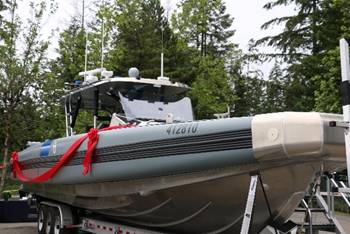
CBP Coastal Interceptor Vessel, First of 52

NewCoastalInterceptorVesselPhotoCBP-59862

New Coastal Interceptor Vessel Photo CBP

MarineLink reports Customs and Border Protection’s (CBP) Air and Marine Operations (AMO) has acquired the first of a planned 52 Coastal Interceptor Vessels (CIV), that look a lot like Coast Guard Response Boat, Small.

“AMO marine interdiction agents will operate the CIV in offshore coastal waters to combat maritime smuggling and protect U.S. ports from acts of terrorism.”

This sounds a lot like duplication of Coast Guard Missions. But then they do not do the other Coast Guard missions.

GAO Report on Operational Test and Evaluation of the National Security Cutter

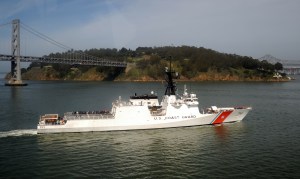
USCGC_Waesche_by_Yerba_Buena_Island

GAO has published a report on the National Security Cutters, GAO-16-148, contending, “Enhanced Oversight Needed to Ensure Problems Discovered during Testing and Operations Are Addressed.” Note, it goes beyond problems discovered during tests and evaluation, to include other problems encountered during operation.

Results are interesting. In many ways it sounds discouraging, with ten major deficiencies found during testing, but on the basis of my very limited experience with this sort of thing, I suspect it is at least no worse than average. After all, the cutter was rated as operationally effective and suitable. The Littoral Combat Ship program is very much a contemporary program, and it is also still undergoing testing.

During testing there were problems with the gantry on the stern, the single point davit, the gun, air search radar, and the Nulka decoy system. I did find it a bit troubling that essentially, all the weapon systems seemed to be having problems.

Probably more troubling are the problems encountered during operations, “…the NSC’s engines and generators have experienced persistent problems, the reasons for which are not yet known. As a result of these and other equipment casualties, the NSC has been operating in a degraded condition in some mission areas, even while having spent fewer days away from home port than planned.” Problems with the main engines include an inability to maintain full power while operating in warm water due to over heating and incidents of cracked cylinder heads at a higher than normal rate, page 31-35.  Generator bearings are overheating and failing at an unacceptable rate, page 35/36. The generator problems have resulted in ships operating with no functional back-up generator.

You can find a list of “Initial Operational Test and Evaluation Major Deficiencies and Coast Guard plans to resolve them” in Table 5, page 23/24.

Table 6, page 28 identifies “Retrofits and Design Changes for the National Security Cutter Class with Costs over $1 Million as of June 2015” totaling $202.1M. This is of course an incomplete list, in that additional changes are expected. Changes are also expected for the ammunition hoists, and the stern and side doors.

Replacement of the Gantry Crane (page 29): The crane, intended to move boats around the stern, was not designed for a salt water environment. I’m sorry, whose idea was this? How was this ever acceptable. If the shipyard picked the crane, I think they owe us at least the cost of replacement. A replacement has apparently been successfully prototyped.

Single Point Davit, page 30: The davit doesn’t work in high sea states, and it is not compatible with the Over the Horizon Boat IV so the ships end up with three different type boats. A replacement for this has also been prototyped.

Appendix II provides a “Summary of the Key Performance Parameters of the National Security Cutter,” page 42/43.

“As we found in 2015, during 2013 and 2014 the NSC fleet spent fewer days away from home port than the Coast Guard’s interim goal of 210 days. In addition, the NSCs operated in a degraded condition in one or more mission areas during a majority of their time spent in operations from 2010 to 2014 due to major equipment casualties.”

But the ships have a degree of redundancy and a depth of capability that allowed them to carry on.

“Although the NSC was often operating with major casualties during the period we examined, during the period from September 2013 through September 2015 the NSC was not mission capable as a result of maintenance needs only about 2 percent of the time, indicating that the casualties experienced during those years did not prevent the NSC from maintaining at least partial mission capability.”

Despite the lack of maturity of these assets, in terms of routing out systemic problems, that 2% figure is far better than the legacy fleet.

There was also a somewhat surprising note that the NSCs have space, weight, and power for a mine detection system.

We have Bryant’s Maritime Consulting to thank for the link to this document. 

Stern Launch System Innovation

In order to diversify their product portfolio, and with this keep ahead of the competition, the company of Global Davit decided to collaborate with the Dutch company TBV Marine Systems, part of High-tech Solutions & Design B.V. This company is in the process of developing, manufacturing and implementing of stern Launch and Recovery Systems (L.A.R.S.) which can launch and recover the bigger Fast Rescue Crafts (FRCs). This system can be used in higher Sea States, so in waves up to 2.25 meters.

Photo: “The stern Launch and Recovery Systems (L.A.R.S.) can launch and recover the bigger Fast Rescue Crafts (FRCs). This system can be used in higher Sea States, so in waves up to 2.25 meters.”

Navy Recognition reports a innovation in stern launch system that has resulted from the cooperative effort of German company Global Davit GmbH and Dutch company TBV Marine Systems.

Trimaran Patrol Boat

Our friend at NavyRecognition offers this video of the CMN Ocean Eagle 43 prototype built for the Navy of Mozambique, in sea trials in what are reported to be State 5 seas.

There is no displacement listed, but, except in beam, this vessel is notably smaller than the Webber class WPCs (143 ft vs 154 for the Webber class). It has a smaller crew (7) and accommodations (15), but otherwise appears to have similar capabilities with a speed of 30 knots, a range of 3000 miles at 20 knots, and a 7 meter RHIB in a ramp at the stern.

They also advertise a proposed mine hunter version that is more limited in speed and dispenses with the small UAS flight deck in favor of unmanned underwater vehicles for mine hunting and destruction. Assuming the same hull is used, the dimensions for both are 43.6 meter in length, 15.7 meter beam, and two meter draft.

When it comes time to replace the 87 footers, perhaps we should consider something similar, though dealing with the much greater beam might be a bit of a challenge in some places.

Low Noise Patrol Boat

Bairdmaritime reports the Norway has received some new patrol boats (interceptors) that I find remarkable both for their speed (up to 50 knots) and for their quiet operating environments.

“We are proud to have achieved noise levels well below specification. 61 decibels in the wheelhouse and 71 in the transport room at a cruising speed of 40 knots is unique in a fast patrol boat of this size…”

They also have ” a comprehensive heating system to cope with severe Nordic winter conditions (including de-icing of deck areas).”

Things to think about when the Coast Guard ultimately starts to replace its 87 footers.

Long Range Interceptor In Action

I would not normally talk about a routine law enforcement action, but this video has some interesting aspects.

Stratton recently intercepted a second semi-submersible, that had been spotted by a Navy patrol aircraft, arresting its four crewmembers and recovering 12,000 pounds of its 16,000 pound cargo of Cocaine, before the semi-submersible sank under tow.

What I wanted to point out in the video was:

First, the instrumentation on the 35 foot Long Range Interceptor ship’s boat (time 1:12). (Correction–I made and error here, this is actually the instrumentation on a 26 foot “Over-the-Horizon (OTH) IV” of which the Coast Guard has procured 101.) It looks a lot like the “glass cockpit” of a modern light plane. Long Range Interceptors are only deployed by the Bertholf class National Security Cutters. (The OTH-IV is operated from the NSCs, WHECs, WMECs, and WPCs. Anyone know if they are also operated from WAGBs and WLBs?)

Second, was the way the boat was recovered in the stern ramp of Stratton (2:25 to 3:00). Note there is no one in the bow to attach the line that will pull the boat up onto the ramp. In 2013 we had a fatality on the Waesche because the automatic capture mechanism was not working properly and Petty Officer Travis Obendorf was on the bow of the boat. You can access the accident report here.

CG 36500, Bernie Webber’s Boat, Lives On

The Finest Hours

The Boston Globe has a nice post about the now 69 year old, 36 foot, wooden hull, motor surfboat Bernie Webber and his pick-up crew used to rescue 32 crew members trapped on the stern of an oil tanker, SS Pendleton, that had broken in half in a storm, and the people who restored and care for it.

The story of this rescue was told in a book and is being made into a movie.

I have it on good authority that the organization that maintains the boat could use some support.